Shared tools, an OS and autonomy that make cars, trucks, drones and warships intelligent.
The tools that started in cars now drive much of the new work in defense; the next test is whether Seoul becomes a place where both are built, not only sold.
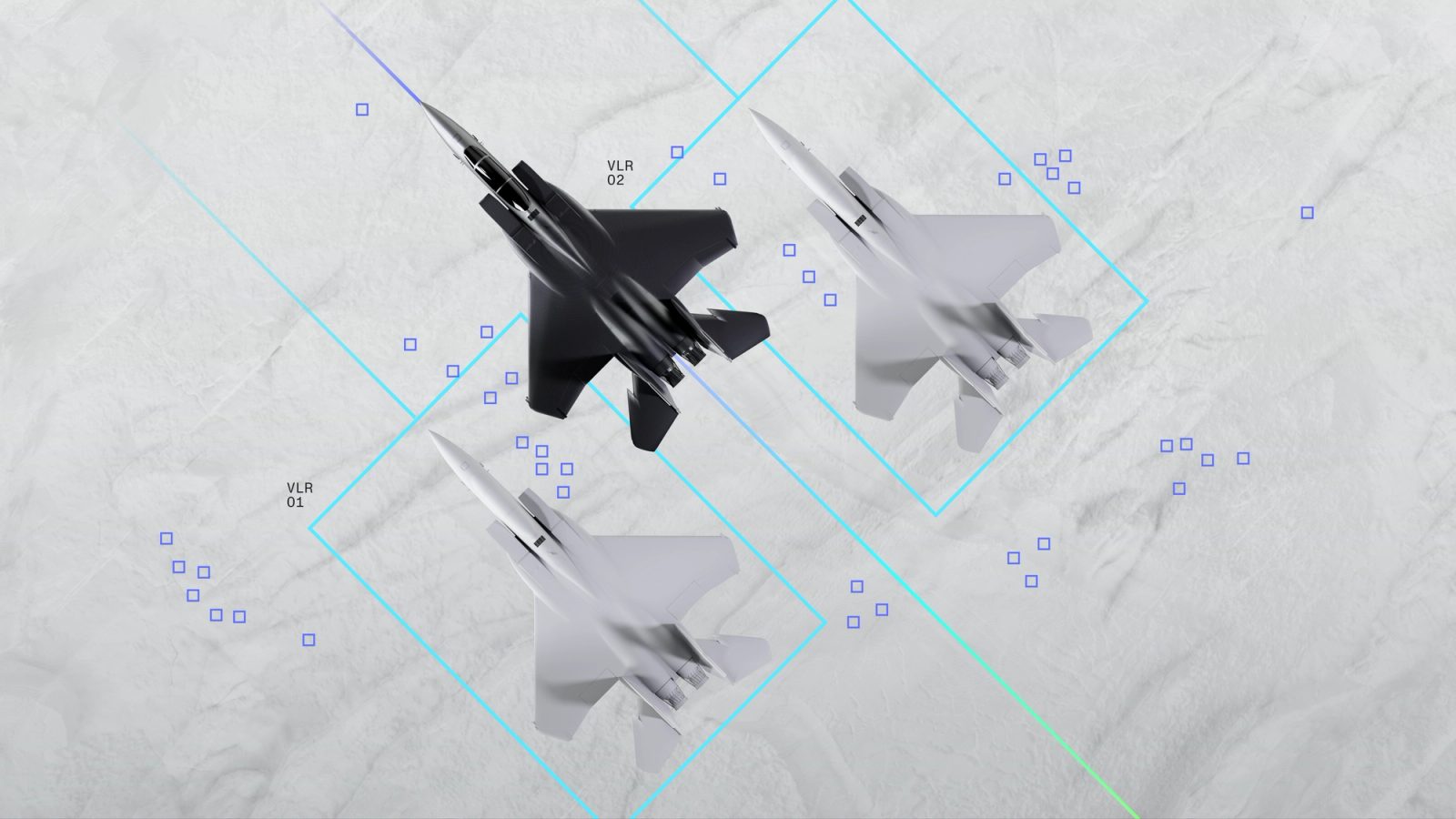
Official defense page image for Axion, the data platform for software-defined warfare.
Axion
Build, test and certify autonomous systems in one shared digital environment, then collect field data to train them further.
Programs replace slow, costly live test events with continuous simulation and reuse what each test learns.
Scientific Systems
Virtual test runs in place of costly field trials
Up to 20 virtual test runs for the effort of one physical trial; vessel setups that took a day now run in minutes.
Axion generates labeled synthetic sensor data for target recognition and replays existing flight and vessel paths in simulation.
What changed? +
Coordinating a field trial took 6 to 12 months and cost millions of dollars per event, often for dozens of usable logs; each trial needed two weeks of preparation.
Company-published case study with Scientific Systems engineers quoted; it covers maritime perception and target recognition work.
U.S. Army
An infantry squad vehicle made autonomous in 10 days
Autonomous in 10 days; two weeks of missions with the 101st Airborne at the Joint Readiness Training Center, with live software updates.
Engineers fitted sensors, a pedal-pushing robot and the company's off-road autonomy and Vehicle OS, with a Humvee as mobile command post.
What changed? +
Army leaders asked the company to bring commercial technology to a bare-bones Infantry Squad Vehicle with no windshield, body panels or roof.
Company blog account of one vehicle made autonomous in 10 days and one two week training exercise in 2025.
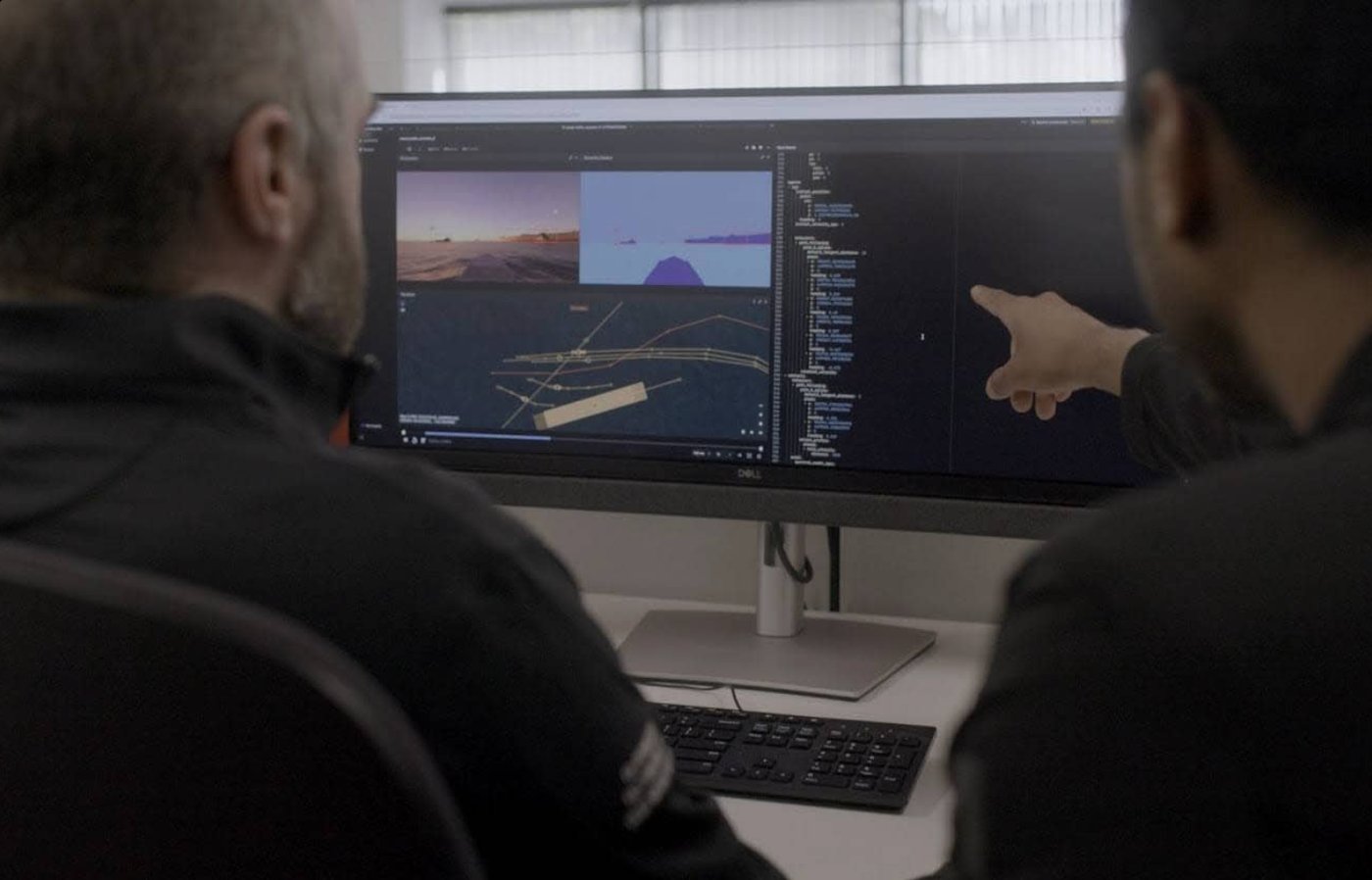
Official image from the Scientific Systems case study: engineers working in Axion.
02 / HOW IT BECOMES REAL
One drone mission, from simulation to the field and back
Illustrative scene: a defense program wants drones from several vendors to search an area together, and must prove they work as a team before a live exercise.
01
Turn the mission into tests
Engineers sit with the customer to draw out operational requirements and turn them into scenarios and pass criteria. The Seoul defense postings ask for the first part of this with Korean defense customers: drawing out requirements and turning them into product specifications.
02
Fly the team in a digital proving ground
A vendor-neutral simulation runs hundreds to thousands of agents in one battlespace, with synthetic sensor data that comes with ground-truth labels. Problems surface before any hardware ships.
03
Move from software to real hardware
The same tests run software-in-the-loop, then with real hardware in the loop, then with a few live platforms beside virtual ones. Each level checks that the autonomy runs on the machine it is meant for.
04
Use the live exercise to confirm, not discover
At the range, a team that finds an issue can fix it and fly again within an hour instead of weeks. In the Army ISV project, engineers embedded with soldiers and pushed live software updates during a two week exercise.
05
Bring field data back into training
A data engine collects sensor and mission data from fielded systems, curates it and retrains models, which are then updated over the air. Each run adds scenarios to the shared library for the next test.
Follow the work, step by step+
A bet against a single winner
Applied Intuition starts from an argument about how the car industry is built. Its founding deck, as Andreessen Horowitz described it in July 2026, had a slide called Ideas We Believe To Be True. One of them held that any single autonomous vehicle maker would stay a single-digit share of the global car market, because cars are made and sold by many manufacturers. In 2017 most money went the other way, into full-stack robotaxi programs that each hired engineers, built a fleet and rebuilt roughly the same development tools. If no one company took the market, the rest of the industry would need intelligence too, and most manufacturers could not rebuild every layer of software themselves. An independent supplier would have to provide the common infrastructure. That is the company Qasar Younis and Peter Ludwig set out to build.
What’s different about Applied Intuition versus other companies in our ecosystem is we don’t succeed if our customers don't succeed.
Qasar Younis · Co-founder and CEO · Isuzu partnership announcement · 2024-08-26
The second belief explains the shape of the business today: autonomy is one engineering problem whether the machine drives, flies or sails. The company sells three layers, tools and infrastructure, an operating system and autonomy, to automakers, truck makers, mining, construction and farm equipment makers, and to the U.S. military and its allies. It calls this dual-use. Why now has two answers. In cars, the vehicle became software-defined, and in 2026 Stellantis, Honda and Nissan announced work on the company's Vehicle OS. In defense, the company's own pages argue that the Department of War is fielding autonomous systems faster than it can test, integrate and sustain them, and in May 2026 the Pentagon's Chief Digital and AI Office chose Applied Intuition to build the platform under Autonomy Factory, a shared pipeline for every service.
One mission, followed through the toolchain
Take an illustrative program that wants drones from several vendors to search an area as a team. Today that is usually proven by putting real vehicles on a range, at a cost the company puts at hundreds of thousands of dollars per vehicle, a few times a year, and often the live event is the first time the vendors' systems talk to each other. In a digital proving ground the same mission first runs in a vendor-neutral simulation with hundreds to thousands of agents. Axion generates synthetic sensor data with ground-truth labels, so perception can be trained and tested before a flight. The same tests then run software-in-the-loop, with real hardware in the loop, and with a few live platforms flying beside virtual ones. When the team reaches the range, the company says a problem can be found, fixed and flown again within an hour instead of weeks. Afterwards a data engine brings field data back, retrains models and updates them over the air.
People's judgement stays in three places. Someone has to turn an operator's need into scenarios and pass criteria; the Seoul defense postings ask engineers for the step before it, drawing out Korean defense customers' operational requirements and turning them into product specifications. Someone has to decide where simulation fidelity matters and close the gap between simulated and real flight, a task the drone autonomy posting spells out. And a person supervises the machines in the field; in the 2026 AeroVironment deal, a team of drones works under the supervision of a single operator. The commercial loop is the same idea with cars: Toyota's Woven Planet group used the tools to run tens of thousands of scenarios at once in the cloud.
What a buyer is really paying for
Dual-use here is code reuse, not a slogan. The Scientific Systems case says many of the simulation features used for its maritime work were first built for on-road autonomy programs. The defense business therefore inherits years of automotive engineering, and a buyer is paying for fewer test events and faster fixes more than for any single feature.
Two Seoul roles build parts of this loop: defense tooling, and multi-agent drone autonomy tools that must hold up on real airframes. The Lead Customer Engineer and the new-grad FDE take the same toolchain into customers' programs. All four are on site in Seoul, and the two defense roles collaborate daily with US teams.
Understand the products and their customers+
Four products on three layers
Applied Intuition's catalogue reads as three layers, each sold to commercial and defense customers, sometimes under different names. The tools layer is Tools for Vehicle Intelligence for commercial customers and Axion for defense. The commercial toolchain grew from the first simulators, Simian, Spectral and Orbis, into products for drive data, maps and validation, and now covers petabyte-scale data ingestion, a closed-loop flywheel that turns sensor logs into labeled training segments, neural simulation and an SDK that runs on cloud, on premises or in air-gapped networks. Axion, launched in May 2025, gives defense engineers and operators one environment to build, test and deploy, plus a data engine for fielded systems. The U.S. Navy's first large-scale data engine, the Data Edge Collection Kit, is part of that work, and in May 2026 Axion became the base of the Department of War's Autonomy Factory.
The autonomy layer is the Self-Driving System for commercial vehicles and Acuity for defense. SDS for Trucking drives Isuzu's heavy trucks in Japan, and SDS for Automotive, launched in 2025, reached Japan in June 2026 using production cameras and radar without HD maps or lidar. Acuity runs onboard ground, air and maritime vehicles and coordinates several of them over mesh networks in jammed or denied environments. It builds on EpiSci, a defense autonomy company bought in February 2025 whose software was used in the U.S. Air Force's first successful dogfight between an AI-piloted jet and a human pilot, and it has been deployed on the X-62A VISTA jet.
The middle layer is Vehicle OS, an operating system and code-first toolchain that runs across a vehicle's computers. The company says it can reduce integration effort by up to five times. TRATON is building TRATON ONE OS on it for all new vehicles across Scania, MAN, International and Volkswagen Truck & Bus, with rollout targeted for 2028; Stellantis expanded its work into the STLA Brain platform in May 2026; Honda and Nissan followed in October; and in April HII signed an MOU with the company on Warship OS. Above all three layers sits Dana, launched in July 2026, which lets AI agents drive the toolchain.
Named customers, and what each case measures
The company publishes named cases on both sides. Scientific Systems, which builds collaborative autonomy for the U.S. military, used to spend 6 to 12 months and millions of dollars arranging a field trial that often yielded dozens of usable logs. With Axion it now runs up to 20 virtual tests for the effort of one physical trial, and vessel setups that took a day run in minutes. For the U.S. Army, engineers turned a bare-bones Infantry Squad Vehicle autonomous in 10 days, then spent two weeks with soldiers of the 101st Airborne at the Joint Readiness Training Center, pushing software updates live. Isuzu's trucks ran two seven-day demonstrations for the Japanese government in 2025, each covering 1,800 km of autonomous driving with 92 terminal maneuvers. In Korea, the Police Science Institute of the Korean National Police University used Simian and Basis to turn the Road Traffic Act into test scenarios.
Live testing simply can’t keep pace with the modern battlefield. Digital-first development and integration are essential to scaling unmanned systems.
Peter Ludwig · Co-founder and CTO · Axion and Acuity launch · 2025-05-20
How to read these cases
Named cases as Applied Intuition publishes them, read 22 October 2026
Customer
Product
Reported result
Basis
Scientific Systems
Axion
Up to 20 virtual runs per physical trial's effort
Company case, customer engineers quoted
U.S. Army
Off-road autonomy, Vehicle OS
ISV autonomous in 10 days; two week exercise
Company blog, 2025
Isuzu Motors
SDS for Trucking
Two seven-day government demos, 1,800 km each
Company releases, Isuzu quoted
Toyota (Woven Planet)
Simulation tools
Tens of thousands of scenarios in parallel
Company case, undated
Korean Police Science Institute
Simian, Basis
Road Traffic Act turned into scenarios
Company post, 2023
Every result here is published by Applied Intuition, and the measures differ: test effort for Scientific Systems, days to autonomy for the Army, kilometers driven for Isuzu. The defense results describe demonstrations and exercises. In an interview, ask how a program moves from a demonstration to a production contract, and which measure the company tracks across customers.
03 / THE EVIDENCE
The story, in numbers.
DATED OBSERVATIONS
Annual recurring revenue, Sacra estimates
USD · USD
Estimates by the research firm Sacra, not company-reported figures. ARR is separate from funding and valuation. These are dated disclosures, not a continuous growth record.
Figures, dates & basis +
Annual recurring revenue, Sacra estimates
Date
Value
Basis
2023
$207M
Estimate published in July 2025.
2024
$415M
Estimate published in July 2025, about double 2023.
2025
$830M
Estimate in Sacra's April 2026 update.
Sacra
DATED OBSERVATIONS
Valuation at each announced round
USD · USD
Valuations the company announced with its Series D, E and F rounds; a valuation is a price set in a financing, not revenue. These are dated disclosures, not a continuous growth record.
Figures, dates & basis +
Valuation at each announced round
Date
Value
Basis
2021-11-11
$3.6B
$175M round co-led by Elad Gil, Addition and Coatue.
2024-03-12
$6B
$250M round led by Lux, Elad Gil and Porsche.
2025-06-17
$15B
$600M fundraise and tender offer.
Applied Intuition
Series F at $15B
A $600 million fundraise and tender offer co-led by BlackRock-managed funds and Kleiner Perkins.
Autonomy Factory
The CDAO selected the company to build the platform under Autonomy Factory, a shared autonomy pipeline for the Department of War.
Honda and Nissan
Two Japanese automakers announced Vehicle OS work on the same day.
Read the growth story+
Who pays, and for what
Applied Intuition sells software, not machines, and two kinds of customer pay for it. Commercial machine makers license the toolchain and sign multi-year platform programs for Vehicle OS and the Self-Driving System. These are long engagements: TRATON's operating system was announced after more than a year of co-development and targets trucks in 2028. Sacra, a research firm, estimated in 2025 that automakers buy three to five year subscriptions averaging about $740,000. Governments buy through commercial acquisition paths, such as the Defense Innovation Unit's Commercial Solutions Opening used for the Army's Robotic Combat Vehicle work, multi-award purchase agreements and production contracts. Revenue grows when a customer adds the next layer, as Nissan did from simulation in 2020 to Vehicle OS in 2026, and when a new machine type reuses infrastructure that already exists.
Autonomy is where artificial intelligence meets the warfighter.
Qasar Younis · Co-founder and CEO · Axion and Acuity launch · 2025-05-20
The dated numbers, and what each measures
Three kinds of number appear, and they should not be mixed. Funding and valuation come from the company's own announcements: a $40M Series B in 2019, $125M Series C in 2020, $175M Series D at a $3.6B valuation in November 2021, $250M Series E at $6B in March 2024, a secondary sale of over $300 million in July 2024 in which investors bought shares from employees and early investors, and a $600 million Series F fundraise and tender offer at $15B in June 2025. The company's own words are about growth: in March 2024 it said it had kept triple-digit growth year over year, profitably. Sacra, a research firm, estimates annual recurring revenue at $207M for 2023, $415M for 2024 and $830M for 2025. In October 2026 The Information reported investment offers that would value the company at $30 billion or more; that is a reported offer, not a completed round.
Applied Intuition's dated numbers and what each one measures
Date
Number
What it measures
Source
2021-11-11
$175M Series D at $3.6B
Funding and round valuation
Company release
2024-03-12
$250M Series E at $6B
Funding and round valuation
Company release
2024-07-25
Over $300M secondary
Shares sold by employees and early investors
Company release
2025-01-14
Up to $171.1M over three years
CDAO contract ceiling
Company release
2025-06-17
$600M Series F and tender offer at $15B
Funding, tender and round valuation
Company release
2025
$830M ARR
Research estimate of recurring revenue
Sacra
2026-10-13
Offers at $30B or more
Reported offers, not a closed round
The Information
Who else wants the same work
On the commercial side Sacra lists automotive simulation incumbents such as dSPACE, IPG Automotive, Siemens, Ansys and Vector, the GPU and cloud companies, and the vertically integrated stacks of Tesla and Waymo. Automakers' own software teams are a rival as well; Honda's announcement stresses that it keeps control of its vehicle architecture while it buys help. In defense The Information reported in October 2026 that Applied Intuition competes with Anduril and Saronic as it moves into autonomous military vehicles. The company's answer is to stay hardware-agnostic. It says most companies approach drones vertically, building an aircraft and coupling the autonomy to it, while it partners with machine makers such as AeroVironment, HII and Callen-Lenz.
Three risks
Three risks follow from the sources. First, defense contract numbers are ceilings: $49 million for the Robotic Combat Vehicle prototyping phase, a $249 million agreement shared with other vendors, and up to $171.1 million over three years from the CDAO, so actual spending depends on budgets and program decisions. Second, customers can build or leave. Honda and Isuzu are both building in-house capability alongside the company, and TechCrunch updated its 2025 funding story to note that the autonomous vehicle company Gatik says it no longer works with Applied Intuition. Third, the defense field is crowded with companies that sell whole systems, and the model depends on hardware makers choosing third-party autonomy.
Two habits help in an interview. Name each number by its kind: $15B is the Series F valuation, $830M is Sacra's estimate of 2025 ARR, and $171.1M is a contract ceiling. Then ask how a defense program moves from a ceiling to funded work, and which commercial programs the Seoul team supports.
04 / THE PEOPLE
Someone saw it first.
Co-founder and CEO
Qasar Younis
Automotive engineer at General Motors and Bosch, founder of a company acquired by Google, then COO of Y Combinator. He graduated from Kettering University in 2004 and grew up around Detroit as the child of immigrants.
The choice behind the company +
Bet the company on selling shared tools to the whole industry rather than building one self-driving car, then took the same tools into defense.
Co-founder and CTO
Peter Ludwig
Spent five years at Google leading work on Google Maps and Android Automotive and holds computer science degrees from the University of Michigan. A 2021 interview says he worked part time on vehicle software from high school, influenced by his father, an ADAS researcher.
The choice behind the company +
Argued for digital-first development in defense: Axion and Acuity were built so programs test in simulation before they test in the field.
“What’s different about Applied Intuition versus other companies in our ecosystem is we don’t succeed if our customers don't succeed.”
Qasar Younis is the co-founder and CEO. He grew up around Detroit as the child of immigrants, graduated in engineering from Kettering University in 2004 and worked as an automotive engineer at General Motors and Bosch. He then founded a technology company that Google acquired and became chief operating officer of Y Combinator. Peter Ludwig is the co-founder and CTO. He spent five years at Google leading work on Google Maps and Android Automotive and holds computer science degrees from the University of Michigan. A 2021 Korean newspaper profile says the two met on the Google Maps team, and that Ludwig had worked part time on vehicle software since high school, following his father, an ADAS researcher. They started the company in 2017 in a house in the Sunnyvale suburbs.
Find where the tectonic plates are shifting and stand on the fault line. That is where the most profound opportunities are.
Qasar Younis · Co-founder and CEO · Kettering University commencement address · 2026-06-26
Decisions that explain the company
Three decisions explain the company's shape. The first was to sell to everyone. a16z writes that the large Level 4 programs at first did not want an outside tooling supplier and said no, so the company sold to smaller Bay Area autonomy teams such as Voyage, then won a global automaker's formal request for development tooling around 2018 to 2019 against more than two dozen bidders. The second was defense, which the company entered roughly 18 months after founding by hiring people from inside the field. That led to the Army's Robotic Combat Vehicle toolchain award in 2022, a CDAO production contract in January 2025, the EpiSci acquisition in February 2025 and the Axion and Acuity launch in May 2025. The third was to climb from simulators to data infrastructure, then to Vehicle OS and autonomy, and in 2026 to Dana. a16z adds that the company has largely kept the close to $1 billion of primary capital it raised while revenue nearly doubled for several years in a row.
Beyond the founders, three leaders matter for a Seoul hire. Varun Mittal, one of the first employees, became the company's first President in August 2025 after shipping vehicle software at Aptiv and Bosch. Jason Brown speaks for the defense business as General Manager in the 2025 and 2026 defense releases, including the AeroVironment and Callen-Lenz agreements. In Seoul, Juyong Oh lists himself as Site Lead & Head of Sales, Korea. Mittal's rule of thumb, from the conversation announcing his promotion, fits the company's habit of shipping first: if the product does not ship today, the long-term strategy debate will not matter.
How the company says it works and hires
The company publishes ten values. Move fast, move safe says speed and safety are not a trade-off and that deliverables should be measured in days, not weeks. Never disappoint the customer asks every decision to start from understanding the other side. High output matters warns against work theater, and Follow-up is half the work says that what is not written down and followed up might as well not have happened. Postings describe an in-office company, five days a week. On hiring, a July 2026 engineering post explains the new format: a 45 minute coding screen with no AI, then an onsite with a 45 minute system design question and two hours to build a working prototype with any AI model, demoed to a panel of engineers. In a 2024 post the company also said its offices outside Silicon Valley are not remote satellites without a say in decisions.
For a Seoul engineer, the people who shape the work are the US product engineering teams you ship with every day, the Korean customers whose requirements you translate, and the Seoul site lead. Expect the AI-assisted onsite: practise designing a system aloud, then building a small working version quickly and explaining each choice.
05 / THE NEXT CHAPTER
Build defense autonomy tools in Seoul, and carry them to customers
On-site engineering as the Korea-based extension of US product teams, technical deep dives with Korean defense customers, delivery for a major enterprise customer across simulation, validation and autonomy, and new-grad deployment work.
Team shape read from public LinkedIn profiles at human speed on 22 October 2026; the org chart above is the current reading. Counts are people found, not official headcount, and grouping does not establish reporting lines.
Why Korea? Why now?+
The company's own explanations are from 2021. Its Korea representative said Applied came to work with Korean headquarters in Korean time and in Korean, and named defense as an area where unmanned systems leave much room to collaborate. Qasar Younis said the company opened offices in Germany, Japan and Korea because each major car-producing country has its own mobility culture, and pointed to Korea's strength in chips, devices, displays and appliances. In 2026 a Sunnyvale-based Korea market posting adds that the Korean government and industry are investing heavily in physical AI. Signet reads the current Seoul hiring as the defense half of that plan arriving.
Korea entry
The company entered Korea in November 2020, according to a 2021 interview with its Korea representative at the time.
Supernal, part of Hyundai Motor Group
Simulation collaboration for autonomous advanced air mobility at the U.S.-based Supernal.
LG Electronics
LG's Advanced Robotics Lab used synthetic datasets to train stereo vision for autonomous mobile robots.
Korean Police Science Institute
The institute used Simian and Basis to test autonomous driving against the Road Traffic Act.
LG Innotek strategic partnership
LG Innotek sensors go on the company's test fleet, and LG Innotek plans its own autonomous test vehicles in Korea.
CEOs meet in Seoul
Qasar Younis met LG Innotek's CEO at its Magok headquarters to discuss robots and drones.
Understand the Korea opportunity+
Why Korea, in the company's words
Korea was Applied Intuition's fourth country, after the US, Germany and Japan, and the company entered in November 2020. Its Korea representative at the time explained the move in an April 2021 interview: the company had been working with Korean-founded startups and large Korean companies from Silicon Valley, and came to Korea to work with their headquarters in Korean time and in Korean. He listed electronics, semiconductors, displays, batteries, shipbuilding, heavy industry, construction and defense as Korean industries with global strength, and said that because unmanned systems are essential in defense too, there was much room to collaborate there. A month earlier Qasar Younis told the same newspaper that the company had opened offices in Germany, Japan and Korea because each major car-producing country has its own mobility culture, and that Korea's strength in chips, devices, displays and appliances would shape how its car ecosystem develops.
It is right that the process of absorbing a disruptive new technology should be gradual. [English rendering of the Korean original]
정진 · Korea representative in 2021 · Money Today interview · 2021-04-28
The public Korea record since then is a list of named partners rather than one large account. Supernal, the Hyundai Motor Group air mobility company in the U.S., announced a simulation collaboration in February 2022. LG Electronics' Advanced Robotics Lab used synthetic datasets to train robot cameras in 2023, and the Police Science Institute at the Korean National Police University used Simian and Basis to test autonomous driving against the Road Traffic Act. On 30 March 2026 Applied Intuition and LG Innotek announced a strategic partnership: LG Innotek's cameras, lidar and radar go onto the company's global test fleet and into its simulation as virtual sensors, and LG Innotek plans to run its own autonomous test vehicles in Korea. On 29 April Qasar Younis met LG Innotek's CEO at its Magok headquarters to discuss robots and drones. The Seoul postings add that the Gangnam team has strategic relationships with major Korean automotive OEM customers.
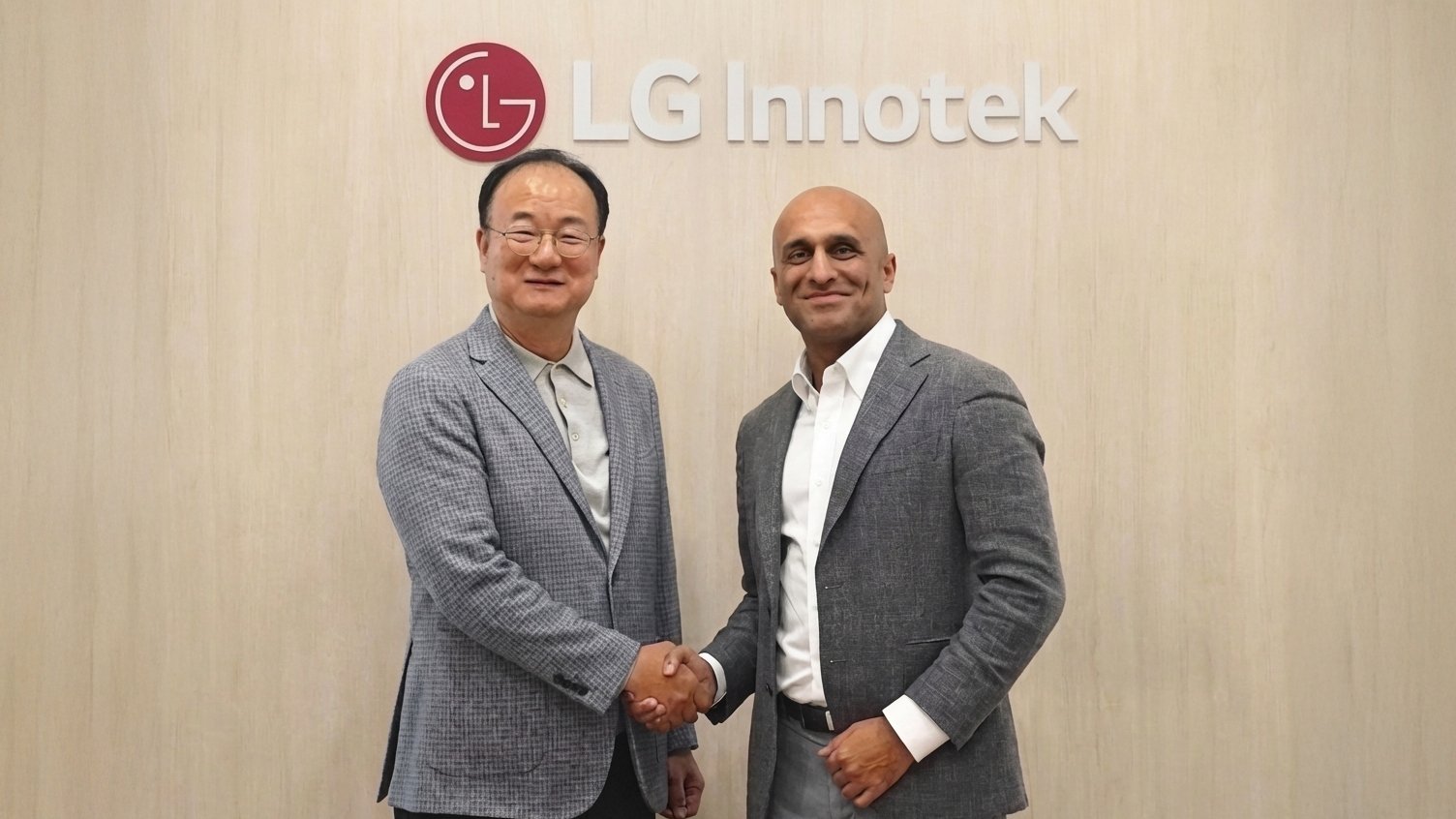
Hyuksoo Moon of LG Innotek and Qasar Younis, from the March 30, 2026 partnership release.
The team on the ground
On 22 October 2026 LinkedIn's South Korea filter showed 18 people who list Applied Intuition, sorted by LinkedIn as 15 in engineering and 3 in business development. By headline, the largest group is engineering, followed by application engineering, business development and one engineering manager for defense. The site is led by Juyong Oh, who lists himself as Site Lead & Head of Sales, Korea. Two Seoul postings put the site at more than 10 employees from companies such as LG, Ansys and Unity. The same job board also carries two Sunnyvale-based roles for the Korea market, a technical business development lead and a solution engineer who work with Korea-based account managers. The business development posting, from August 2026, calls the role the bridge between headquarters and the Seoul office at a moment when the Korean government and industry are investing heavily in physical AI.
What the four Seoul roles are for
Read together, the four open Seoul roles describe two jobs. The first is building defense products in Korea. Software Engineer - Defense Tooling, open since May 2025, builds the simulation and AI tooling behind autonomous defense systems, mentors junior engineers and runs technical deep dives with Korean defense customers. Software Engineer - Multi-Agent UAV Autonomy (Defense), posted in September 2026, builds tools for multi-agent mission planning, coordination and training, then builds reference drone autonomy on them and flies it on real airframes to find what breaks. Both describe Seoul as the Korea-based extension of the global product teams. The second job is carrying the toolchain into customers' programs. Customer Engineering - Lead Customer Engineer runs one major enterprise customer's simulation, validation and autonomy workstreams and its executive relationships, in Korean and English. Forward Deployed Engineer - New Grad (2027) works directly with customers to deploy and integrate products in their real-world environments, across commercial and defense work.
For the worry that Seoul only executes: the defense postings place Seoul engineers on shared roadmaps with US teams and ask them to turn Korean customers' needs into product specifications, and a 2024 company post says its offices are not satellites without a say. In the interview, ask which Korean programs the Seoul team supports today.
Three things will show how deep Korea goes: whether a Korean defense customer or prime contractor is named publicly, whether LG Innotek's Korean test vehicles and the robot and drone work turn into joint products, and whether a Korean automaker announces Vehicle OS or SDS work by name.
KOREA OPEN ROLES
4 open roles in Korea
Current Signet catalog · 2026-10-23
FOR YOU
Use the mock application to show work where you turned a customer's need into tested software.
Solutions Engineer
Customer Engineering - Lead Customer Engineer
Seoul (On-site)
Posting checked
The work
Lead a major enterprise customer's simulation, validation and autonomy programs as its main point of contact.
Who fits
Typically 7+ years integrating complex systems with enterprise customers; professional Korean and English.
Keep in mind
Executive reporting, incident response and escalations; ADAS/AD background is a plus.
The CDAO selected Applied Intuition to build the platform under Autonomy Factory, built on the Axion toolchain and data engine, so program offices, developers and operators share one environment to develop, validate and certify autonomous systems.
Drone teams on AV's Mayhem 10
AeroVironment agreed to integrate Applied Intuition's Acuity ISR/Strike software into its Mayhem 10 launched effects system, so teams of drones can find, track and engage targets under the supervision of a single operator.
Honda and Nissan pick Vehicle OS
Honda announced a partnership to speed its in-house software-defined vehicle platform with Vehicle OS, and Nissan extended a relationship that began with simulation in 2020 into Vehicle OS and AI-native development tools.
More context on what comes next+
Defense moves to the center
Read against the thesis, 2026 has two threads. The first is that the defense toolchain became shared infrastructure. In March the company delivered the U.S. Navy's first large-scale data engine, in April it signed an agreement with the shipbuilder HII on Warship OS, and in May the CDAO selected it to build the platform under Autonomy Factory for the whole Department of War. In July it introduced Drone Stack for ISR and strike missions on any aircraft, and AeroVironment agreed to put Acuity ISR/Strike on its Mayhem 10 launched effects so that a single operator supervises a team of drones. In September the company described a digital proving ground run with the Pentagon's research and engineering office to test air, surface and undersea vehicles from different vendors on one mission.
The Autonomy Factory is the connective tissue between AI and the physical world of defense.
Qasar Younis · Co-founder and CEO · Department of War Autonomy Factory announcement · 2026-05-14
Cars, agents and a reported price
The second thread is the commercial base. Stellantis expanded into STLA Brain in May, the Self-Driving System reached Japan in June, and on 6 October Honda and Nissan announced Vehicle OS work on the same day. In July the company launched Dana, an agentic platform that lets AI agents run its tools, and said it had rebuilt much of its autonomy tools platform on Dana in six months. On 13 October The Information reported offers that would value the company at $30 billion or more, against the $15 billion Series F of June 2025. That is a reported offer, not a closed round.
For an engineer in Seoul, this pace is both the pitch and the workload. Each new program, from Autonomy Factory to Mayhem 10, is a set of customer requirements that someone has to turn into tested features, and Korean customers will ask how those programs apply to their own systems.
What to watch next
Whether the reported offers become an announced round, and at what valuation and size.
Whether Autonomy Factory and the AeroVironment integration move from selection and demonstration to funded production work.
Whether the Seoul defense team names Korean programs or partners, and whether the LG Innotek work spreads to drones and robots.
A LITTLE MORE CONTEXT
Understanding Applied Intuition.
What does Applied Intuition do?
Applied Intuition builds the software that other companies use to make their machines intelligent: tools to simulate, test and validate autonomy, an operating system for vehicles, and autonomy stacks. It sells the same layers to automakers, truck makers, mining and farm equipment makers, and to the U.S. military and its allies. Its mission, on the company page, is to build physical AI that creates a safer, more prosperous world.
What is the opportunity in Korea?
On-site engineering as the Korea-based extension of US product teams, technical deep dives with Korean defense customers, delivery for a major enterprise customer across simulation, validation and autonomy, and new-grad deployment work.
Are these confirmed job openings?
Employer postings were checked on 2026-10-22. Availability can change. Mock applications request a review from Signet.
How can I explore the company in more depth?
Follow the company from its vision through products, evidence and people to the Korea team and current roles. Use the table of contents to move within the page, and expand the sections for more context.