Three tools that hold the record of work
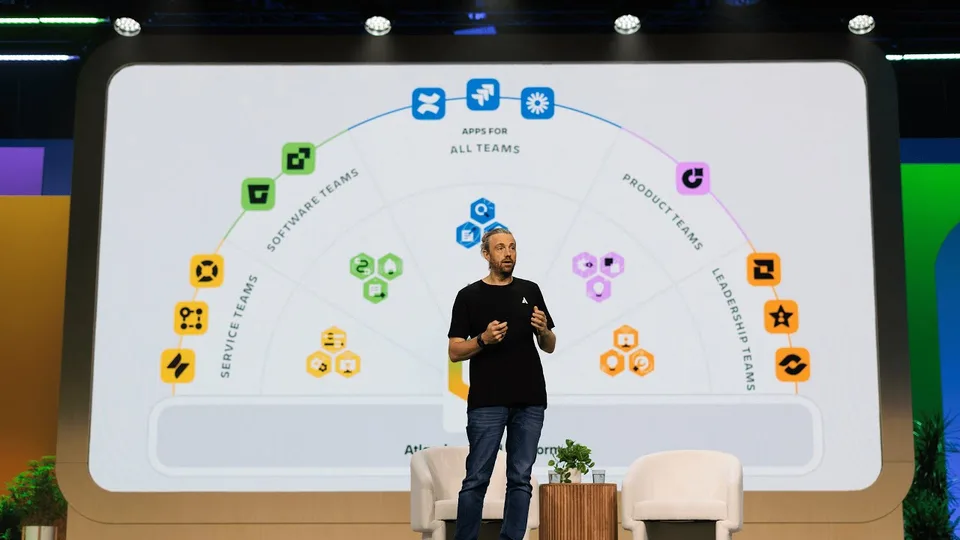
Jira is where teams plan and track work. Marketing, HR, operations, product and engineering teams create work items, assign owners and follow progress on shared boards, and Atlassian now describes Jira as the place where people hand work to AI agents and approve what comes back. Buyers range from one team to a whole enterprise; the product page says 350,000+ companies use Atlassian and 85% of the Fortune 500 use its products.
Confluence is the written side of the same work: requirements, plans, meeting notes and decisions. Atlassian pitches it as the place where every doc, thread, meeting and decision becomes trusted context for a team and its AI agents. Rovo search answers questions across connected knowledge, the Rovo MCP server lets tools such as Claude, ChatGPT or a developer's IDE read it, and status markers flag stale pages so that what a team writes today stays usable tomorrow.
Jira Service Management is a service desk. Employees raise requests through a help center to IT, HR, facilities and other service teams, and each request is tracked with its status, channel and response time. It now sits inside the Service Collection, which the CEO said in April 2026 had passed $1 billion in ARR. An investor research site reported in July 2026 that roughly 60% of its instances serve non-IT work such as HR, legal and facilities.
Selling the whole: Rovo, collections and engineers on site
Rovo is the AI layer over all three: search, chat and agents across Atlassian and other business apps, with admin controls over what the AI can access, the point Atlassian stresses to large buyers. Increasingly the products are sold as bundles. The Teamwork Collection, which a Korean partner describes as Jira, Confluence, Rovo and Loom together, passed 1 million seats and 1,000 customers less than six months after launch, and the CFO said in August 2026 that Teamwork customers have 4 to 5x more paid seats per instance than customers of Jira or Confluence alone. For the largest accounts Atlassian also runs Forward Deployed Engineering, senior engineers who embed with a customer to put AI agents into production; the program page counts 80+ agents built, 100+ enterprise customers and about 12 weeks to measurable value.
What customers report, and what it covers
The model enterprise story is Mercedes-Benz. Its IT and research teams adopted Jira and Confluence on their own, until legacy infrastructure and silos held back work on the software-defined vehicle. Within about two years it consolidated thousands of projects and users onto Atlassian Cloud Enterprise, connecting 50,000+ colleagues across 260+ locations. The case reports examples of 10x faster software delivery and 80% of platform team capacity shifted from maintenance to service and innovation.
The Korean case closest to the open roles is Interpark, founded in 1995 as Korea's first internet shopping service. It had run Jira and Confluence since 2019 on server licences, with costly upgrades, and the discontinuation of server licences raised the question of migration. With Platinum Solution Partner Dmove it spent three months on analysis and preparation and 1.5 months on the move to Jira and Confluence Cloud Premium for 1,600 users, using Atlassian Guard to centralise user administration. The case reports user permissions 30% more organized.
A second Korean scene shows the renewal side. The education publisher Miraen widened its Atlassian use from development to planning and publishing with partner Open Source Consulting. More people were eligible than it held licences for, while regular users fitted a licence tier of about 100, and it now keeps Jira licence use at about 70 to 80%. The partner said recent Atlassian Cloud price increases make sizing licences to real use more important.
Across these cases the pattern repeats: a partner runs the migration or the rollout, and the reported results come from the vendor, the partner or the customer. For an account manager or a CSM in Korea, the work is turning that pattern into renewals: showing adoption where licences are paid for, and finding the next team to bring on.