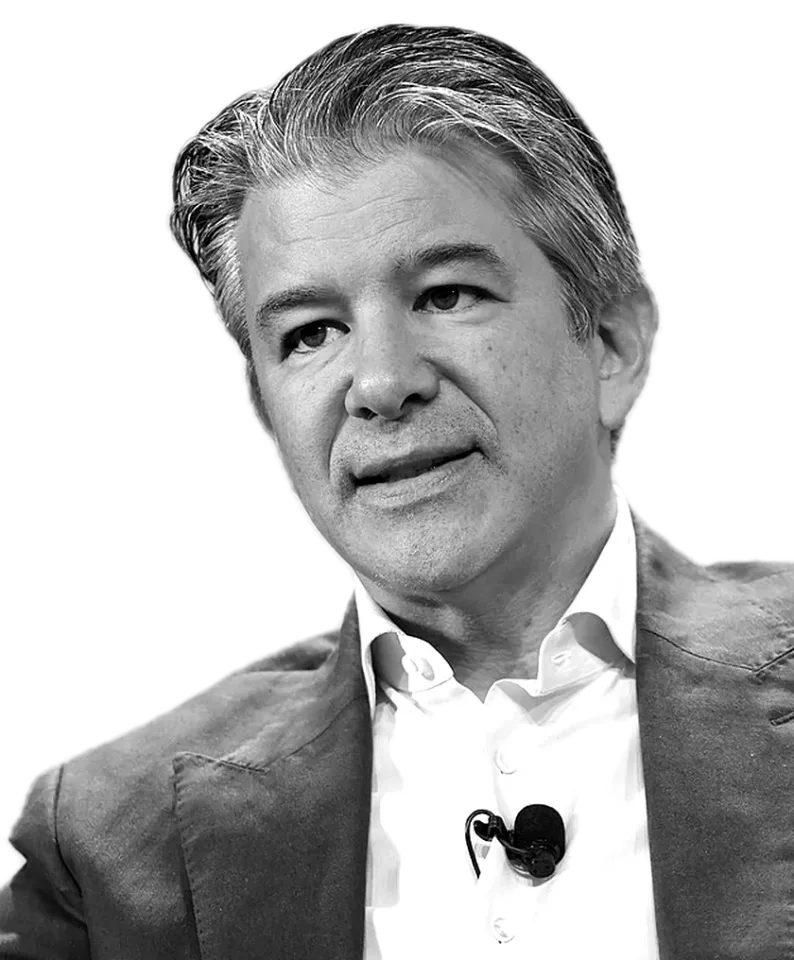
Travis Kalanick, founder and CEO of Atoms
Atoms / THE WORLD THEY ARE BUILDING

Build specialized machines and infrastructure that make physical work more productive.

Machines perform useful, measurable work in food, mining and transport.

See it taking shape ↓
01 / THE PRODUCTS

The products behind the promise.

Pronto haulage at an industrial site
Official Pronto field image; a portfolio operation.
Pronto AHS

Retrofit vehicles and operate autonomous haul routes.

Existing equipment becomes part of an autonomous operating system.

Heidelberg Materials

Run a mixed fleet at Lake Bridgeport

More than two million tons of limestone hauled in less than eight months.

Pronto AHS coordinated Caterpillar and Komatsu haul trucks.

What changed? +

Quarry autonomy had to fit trucks from different manufacturers.

Pronto-published Lake Bridgeport operating result, January 2026; material hauled at that site, separate from Atoms revenue.

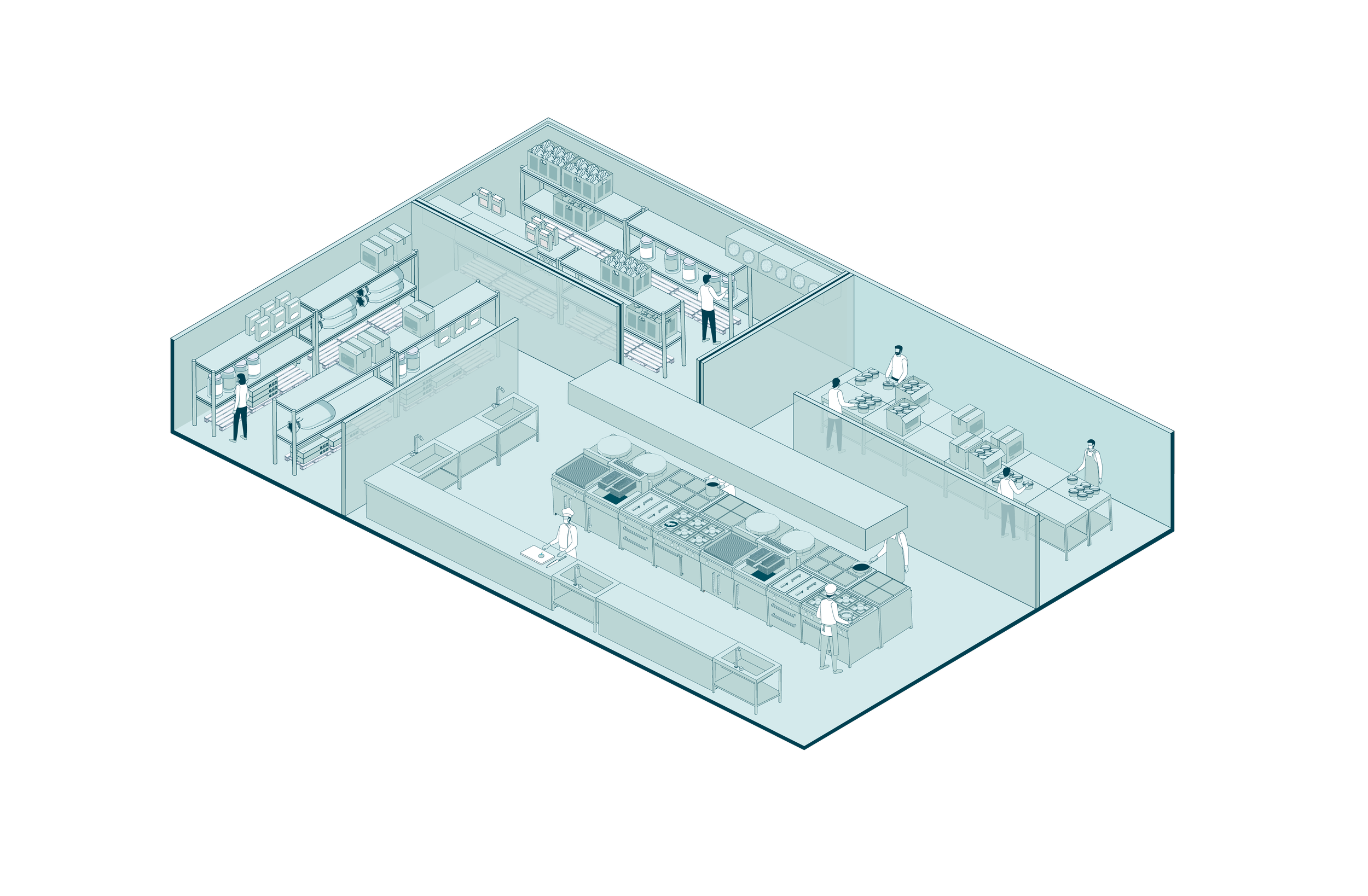
ProFood food-production facility illustration
Official facility illustration, separate from a software interface.
02 / HOW IT BECOMES REAL

Follow an order through the kitchen

Illustrative restaurant flow read from portfolio documentation.

  1. 01

    Choose a production location.

    Choose a production location.

  2. 02

    Consolidate channel orders.

    Consolidate channel orders.

  3. 03

    Route work to the kitchen.

    Route work to the kitchen.

  4. 04

    Check preparation and handoff.

    Check preparation and handoff.

  5. 05

    Review sales and order issues.

    Review sales and order issues.

Follow the work, step by step

A meal and a truck are physical workflows

A restaurant can accept an order online while the kitchen behind it is still struggling to prepare, package and hand off the meal. A quarry can own expensive trucks while the productive route still depends on manual coordination. Atoms groups those physical operations into a common business question: how can machines and software improve the work that makes, stores and moves things? Its portfolio spans food, mining and transport, with existing businesses at different stages. Signet reads the choice as a bet on tightly defined industrial tasks, where the buyer can compare useful output with the cost of operating the system. That is a more concrete starting point than the appearance of a robot. An autonomous hauler has a route to complete, and a kitchen has meals to produce. The relevant result is whether the customer's operation becomes safer, more dependable or more productive. Each of those results needs its own evidence from the actual site, rather than a demonstration borrowed from another environment.

Follow an order through the kitchen

An illustrative restaurant workflow shows how several portfolio tools connect without becoming one interchangeable product. The operator first chooses a production location that fits demand, utilities and delivery access. CloudKitchens supplies a private, ready-built kitchen inside a shared facility; its location-opening service describes selecting a market, adding cooking equipment and completing onboarding. Otter then brings orders from delivery applications and direct channels into a common queue. Menu management synchronizes item availability, while the kitchen display routes tickets to the appropriate stations. An employee still checks whether the food is ready and whether the handoff matches the order. Analytics gives the operator a way to review sales, cancellations and menu performance afterward. Signet would follow one exception through the chain: an unavailable item should change the menu, the ticket and the customer-facing promise consistently. The value comes from those connected operational choices, not from a collection of dashboards. The example is a reading of the product workflow, rather than a report about one named restaurant's achieved savings.

A deployment has to keep working

The mining workflow exposes the same demand for a functioning system in a harsher setting. Pronto describes retrofitting an existing haul vehicle, teaching a route through a manual drive and dispatching the vehicle through an operator interface. Safeguards cover the site's operating rules and interactions with manually driven equipment. Its Lake Bridgeport report describes a commercial mixed fleet rather than a laboratory demonstration. Signet would ask how the operating team handles changing loading points, maintenance and a failed release, because physical work continues while the software changes. This is also a useful lens for the Seoul Technical Program Manager opening. The posting asks for requirements, schedules, dependencies, quality assurance and release coordination across product and engineering. The local job is therefore legible as the work of carrying an agreed change to a reliable release. It does not authorize an assumption that the Seoul hire owns a particular mine or robotic kitchen. An applicant can explain how they made a technical dependency visible and resolved it before it became a delivery failure.

Understand the products and their customers

Software coordinates the restaurant

Otter is the restaurant software layer within Atoms' food portfolio. The point of sale accepts and processes orders, the order manager consolidates channels, and the kitchen display sends work to cooking stations. These components solve related but different problems. An operator can keep an existing point of sale and connect supported integrations, or evaluate Otter's own terminal and payment arrangement. Direct online ordering gives a restaurant a branded ordering route, and loyalty tracks rewards and return visits. The menu tool handles location-specific items and availability; analytics brings channel and location data together for review. The buyer is a restaurant operator who has to decide whether the integration removes enough daily friction to justify replacing or connecting current tools. Signet would test the order path with modifiers, an unavailable item, a cancellation and a handoff, because the difficult cases reveal whether the shared queue is dependable. Product availability and pricing must retain their market scope. The public US product pages describe a portfolio offer, rather than a promise that every feature or payment arrangement is available to a Seoul customer.

Facilities are part of the product

CloudKitchens offers a private commercial kitchen with shared facility infrastructure, built for delivery, takeout and production. It separates the tenant's cooking work from infrastructure and front-of-house operations managed by the provider. A delivery-only kitchen can let an existing restaurant move courier activity away from its dining room, while a producer can use ready-built space with storage and utility connections. ProFood extends the physical infrastructure into build-to-suit production and cold-chain facilities. Its services include tenant-driven acquisition, permitting, power coordination, construction delivery and property management. These are real-estate and operating services, not software interfaces. Picnic addresses another food movement problem by combining office lunch orders into one delivery, with team ordering, catering and employer subsidies as separate use cases. Lab37 appears in the group portfolio as automated kitchen systems. Signet reads the portfolio as several ways to make food production and delivery easier to operate. It would still evaluate each arrangement by the tenant's actual workflow, contract and equipment needs rather than treating all food businesses as one fully integrated commercial bundle.

Retrofit the equipment a mine already owns

Pronto supplies an autonomous haulage system for mines and quarries. The system combines vehicle actuation, sensing, route behavior and an operator interface, with editions chosen for different site needs. Its product material describes camera and positioning technology, site-specific safeguards and emergency-stop interactions with manually operated equipment. Later announcements describe additional sensor combinations for more demanding mining environments, so the original vision-based configuration should not be generalized to every edition. Heidelberg Materials is a named customer case: the Lake Bridgeport quarry used Caterpillar and Komatsu trucks together and reported more than two million tons of limestone moved in less than eight months. The result is material hauled at a particular operation, rather than Atoms' revenue or a universal cost-saving rate. April's announcement planned two additional North American sites; July's Hitachi announcement was a memorandum of understanding. Signet would distinguish an operating deployment, a planned rollout and a partner agreement. That distinction helps a candidate discuss product delivery without turning a roadmap into a completed installation.

03 / THE EVIDENCE

The story, in numbers.

DATED OBSERVATIONS

Otter restaurants, product scope

restaurants
100K+

Single minimum adoption snapshot for Otter, separate from Atoms parent customers or revenue.

Figures, dates & basis +
Otter restaurants, product scope
DateValueBasis
2026-10-10100K+More than 100,000 restaurants on the current product page.

Atoms / portfolio company

Pronto acquisition completed

Pronto acquisition completed

Hitachi automation MOU

Hitachi automation MOU

New equity investment

New equity investment

Read the growth story

The group earns through different contracts

The food portfolio has several commercial mechanisms. Otter's public US pricing sells a monthly point-of-sale bundle per location, with payment transaction fees and hardware-lease conditions. Broader bundles add order aggregation, online ordering, loyalty and website capabilities. CloudKitchens provides kitchen space and managed facility infrastructure, while ProFood owns and leases food-production and cold-chain facilities. Pronto supplies autonomous haulage technology and deployment support to industrial operators. Signet would map these as software and payment arrangements, property contracts and industrial automation relationships, rather than combine them into one recurring-software metric. A customer can expand through more restaurant locations, a larger facility or another deployed fleet; the cost and time required to serve those expansions differ. More software seats do not describe the cost of power upgrades or vehicle installation. For a candidate, the useful question is which operating unit owns the promise being delivered. Requirements and release plans should connect to that unit's customer economics and service responsibilities, because a feature has value only when the buyer can use it in the contracted operation.

Capital and customer activity answer different questions

The July 22, 2026 founder announcement describes a $1.7 billion equity investment led by a16z and a consolidated Atoms equity structure. That is capital supplied to the business, separate from sales earned from customers and separate from company valuation. The company letter also identifies debt partners, which should retain their own financing category. Product-level adoption offers a different kind of evidence. Otter currently says more than 100,000 restaurants use its tools, while ProFood describes more than 500 sites in its property operation. These thresholds describe different portfolio businesses, so they are not a consolidated parent customer count. The growth chart in this profile therefore keeps a single Otter restaurant snapshot with an explicit product scope. It does not create earlier years or an implied trajectory from the fundraising event. Signet would read capital as resources for expansion and product adoption as evidence of reach, then look for operating results in particular deployments. Neither category alone resolves whether the entire group converts its physical infrastructure and software into profitable contracts.

Three operating risks need separate tests

The first risk is safe field operation. Pronto's solution explicitly addresses site safeguards, object detection and coordination with manually driven equipment. Signet would treat an error in that environment as an operating risk requiring controlled deployment and escalation. The second is facility and capital execution. ProFood's offering depends on acquisitions, permits, utilities, construction and a tenant's equipment requirements; the right software release cannot substitute for a site that is ready to operate. The third is integration and service continuity in restaurant workflows. Otter connects external ordering channels, point-of-sale systems and payments, and its refund product addresses disputes and information gaps. An unreliable order path can create immediate work for staff and affect a customer's meal. These risks follow directly from the products being offered, rather than imply that a specific failure has occurred. Alternatives also differ by product: a restaurant may retain a current POS and separate delivery tablets, a producer may develop its own premises, and a mine can use manual haulage or another automation arrangement. Signet would compare the delivered workflow with that actual alternative.

04 / THE PEOPLE

Someone saw it first.

Travis Kalanick, founder and CEO of Atoms
Founder and CEO, Atoms

Travis Kalanick

Former Uber CEO; the company connects its history to City Storage Systems and CloudKitchens.

The choice behind the company +

Unifies food, mining and transport under the Atoms physical-automation direction.

“Pronto has already proven that with millions of tons hauled autonomously in commercial operations.”

Travis Kalanick · Pronto acquisition announcement · 2026-04-06
The decisions behind the company

The founder keeps the physical-world thread

Travis Kalanick is Atoms' founder and CEO. His current vision letter connects the company to the work he pursued after Uber through City Storage Systems and CloudKitchens. The important decision for this profile is the extension from food infrastructure into mining and transport, supported by a common view of physical automation. The July investment announcement puts the various businesses into one equity structure. Signet reads that structure as a way to coordinate capital and technical talent across different operating businesses, while keeping each product's actual customer and deployment scope clear. Kalanick's April statement on Pronto focuses on machines that perform useful industrial work. His argument can guide product selection, but an argument is not itself evidence of profitability. A candidate should be able to move from the founder's ambition to a specific constraint: what task repeats, what a customer pays to complete it and what makes a deployment reliable. That is how a broad industrial thesis becomes an engineering or operating decision instead of remaining a founder narrative.

Mining has an experienced operating leader

Anthony Levandowski is named as Pronto's CEO on the current company page and as head of Atoms Mining and Transport in the April expansion release. The difference between those titles reflects the portfolio and parent-company scopes rather than two inferred reporting lines. Pronto's team page also lists Catherine Culkin as CTO and Christian Kurasek as CFO. Their work belongs to the autonomous-haulage business, while the Seoul posting sits in the employer board's PM Brick & Mortar department. Ben Horowitz joined the Atoms board with the July investment and describes specialized industrial robots as the investment's focus. These people matter for understanding the company's direction, but the posting names collaboration with product managers and software engineers rather than a personal reporting relationship to any of them. Signet would prepare a stakeholder map around decisions, responsibilities and dependencies. It is useful to know who defines the portfolio direction, who leads a product operation and who must agree to a release. Combining those responsibilities into one presumed manager would obscure how the work actually gets done.

The culture has to cross disciplines

Atoms' careers page describes builders who work across AI, hardware, software, operations and manufacturing. Its published principles emphasize understanding an operation, predicting what happens next and controlling outcomes, alongside the idea that robots should have productive jobs. Signet would interpret those principles through a release decision rather than treat them as a personality checklist. A program manager may have to challenge an optimistic schedule when a dependency or quality issue changes what can safely ship. The Seoul requirements ask for software-development-lifecycle knowledge, cross-functional execution and issue resolution; a software engineering background is preferred. This leaves room for a technically fluent program manager whose strongest evidence is delivery rather than writing the product code. The role includes communication to technical and nontechnical audiences, which is substantive work when they see the same risk differently. An interview example can show the disputed assumption, the evidence gathered and the change to the plan. That is closer to the stated cross-disciplinary environment than simply claiming enthusiasm for AI or repeating a culture slogan.

05 / THE NEXT CHAPTER

Seoul has a technical delivery opening

Seoul technical delivery across product management and software engineering.

Technical program management
  • Technical Program Manager
Collaboration
  • Product managers
  • Software engineers

Team view uses the current employer posting; grouping describes advertised work and collaboration.

Why Korea? Why now?+

The current employer board locates a technical program-management function in Seoul.

Understand the Korea opportunity

Seoul has a technical delivery opening

The current Atoms employer board lists one Korea opening, Technical Program Manager, in Seoul. The department is PM Brick & Mortar within product management. The posting describes ownership of the process from requirements and development through testing and release, with schedules, scope and budgets held together. Signet reads the Korea hiring as a need for technical delivery coordination in an organization that combines software with operating businesses. This is a narrower and more useful claim than assuming the local team represents every part of the food, mining and transport portfolio. The public board establishes the hiring location and function. The organizational view therefore groups the advertised work and its named collaboration partners. A candidate can use the role to assess the work they would actually take on: converting requirements, tracking dependencies, resolving issues and making a release decision legible. That assessment should come from the current employer description rather than a historical job title or a portfolio's broad industry story.

Manage the boundary between product and engineering

The Technical Program Manager works with product managers and software engineers to translate product requirements into technical specifications and keep expectations aligned. The responsibilities include surfacing risks and dependencies across teams, supporting quality assurance, escalating technical issues and overseeing code reviews or release validation where applicable. That last qualification matters: it does not make every release task equivalent to being the code author. The employer requests three to five years in technical program management, technical project management or a similar role, along with software-development-lifecycle knowledge and cross-functional execution. A software engineering background, SaaS-platform experience and familiarity with tools such as Jira, Confluence and Git are preferred. Signet would prepare an example in which the candidate distinguished a blocking technical dependency from a scheduling inconvenience. It should explain what they learned from the engineering team, how they changed the plan and what they communicated to stakeholders. The interview evidence becomes stronger when it preserves the requirement's actual strength instead of turning a preferred qualification into a mandatory gate.

Make the working condition part of the decision

The posting explicitly requires five days per week at the Seoul office. That condition is central to deciding whether the job fits, alongside the delivery responsibilities. Signet's suggested first quarter begins by mapping active programs, release gates and dependency owners, then establishing a shared view of scope and escalation. A later step is to carry a concrete change through testing and release with assumptions and decisions recorded. Those are preparation ideas derived from the advertised work, not employer promises or a guaranteed onboarding plan. A useful application packet can include an anonymized requirements-to-release timeline, a risk register and an example of communication to a technical and a nontechnical audience. Confidential artifacts should retain only the decision structure and public-safe evidence. The role favors someone who is comfortable entering technical discussions and coordinating execution without claiming authority the posting does not assign. The portfolio context makes operational judgment relevant, but the application should still answer this particular Seoul role: how did you turn an agreed product requirement into dependable delivery across several contributors?

Korea openings

No current Korea openings were found. The company story is still available.

See overseas openings →
07 / NOW & NEXT

The next scene is taking shape.

Pronto acquisition completed

Pronto acquisition completed

Hitachi automation MOU

Hitachi automation MOU

New equity investment

New equity investment

More context on what comes next

The portfolio now includes completed mining ownership

Pronto's April 6, 2026 announcement says Atoms completed its acquisition and made the business the technology engine of Atoms Mining. That completed transaction is different from the April 30 plan to deploy at two more Heidelberg Materials sites during the rest of the year. Signet would connect the two through execution: a larger parent can supply resources, while the team still has to adapt autonomous haulage to each site's equipment and operating conditions. The Lake Bridgeport result provides an operating reference, not automatic proof that every subsequent site is complete. The next useful evidence is how another deployment reaches stable operation with the customer's existing fleet.

An open-fleet partnership remains a partnership

The July 15 Hitachi Construction Machinery announcement is a memorandum of understanding aimed at open mine automation. It combines equipment and mining expertise with Pronto's ability to retrofit different manufacturers' trucks. Signet reads this as a potential route to distribution and deployment, with the announcement's agreement stage retained. A partner's installed base can create opportunities, but the customer still needs a site assessment, safeguards and an operating plan. What to watch is whether the agreement produces specific customer deployments and how those deployments support equipment choice. This avoids turning the announced relationship into recognized revenue or a universally released product package.

New capital has to become delivered work

July's $1.7 billion equity investment and Ben Horowitz's board appointment bring the group and its industrial thesis into a shared financing structure. The current portfolio still spans facilities, restaurant software, autonomous haulage and emerging transport work. Signet would watch three connected outcomes: dependable field operation, practical integration across food workflows and disciplined conversion of capital into customer-ready systems. These are different operating tests and should keep their own metrics. The Seoul Technical Program Manager opening contributes a smaller, concrete part of the story by coordinating requirements, dependencies, testing and releases. An applicant can connect the new direction to that work without claiming a future transport product has already launched.

Their future. Your next chapter.

Find your part ↑

An independent profile by Signet. No affiliation or investment recommendation. Introductions happen only with your consent.
Research reviewed 2026-10-10

A LITTLE MORE CONTEXT

Understanding Atoms.

What does Atoms do?

A restaurant can accept an order online while the kitchen behind it is still struggling to prepare, package and hand off the meal. A quarry can own expensive trucks while the productive route still depends on manual coordination. Atoms groups those physical operations into a common business question: how can machines and software improve the work that makes, stores and moves things? Its portfolio spans food, mining and transport, with existing businesses at different stages. Signet reads the choice as a bet on tightly defined industrial tasks, where the buyer can compare useful output with the cost of operating the system. That is a more concrete starting point than the appearance of a robot. An autonomous hauler has a route to complete, and a kitchen has meals to produce. The relevant result is whether the customer's operation becomes safer, more dependable or more productive. Each of those results needs its own evidence from the actual site, rather than a demonstration borrowed from another environment.

What is the opportunity in Korea?

Seoul technical delivery across product management and software engineering.

Are these confirmed job openings?

Employer postings were checked on 2026-10-10. Availability can change. Mock applications request a review from Signet.

How can I explore the company in more depth?

Follow the company from its vision through products, evidence and people to the Korea team and current roles. Use the table of contents to move within the page, and expand the sections for more context.

Back to the collection ↗