Photograph of Melanie Perkins.
Canva / THE WORLD THEY ARE BUILDING

Everyone can make something that moves people.

Reusable assets, local language and review help teams adapt a shared design system.

See it taking shape ↓
01 / THE PRODUCTS

The products behind the promise.

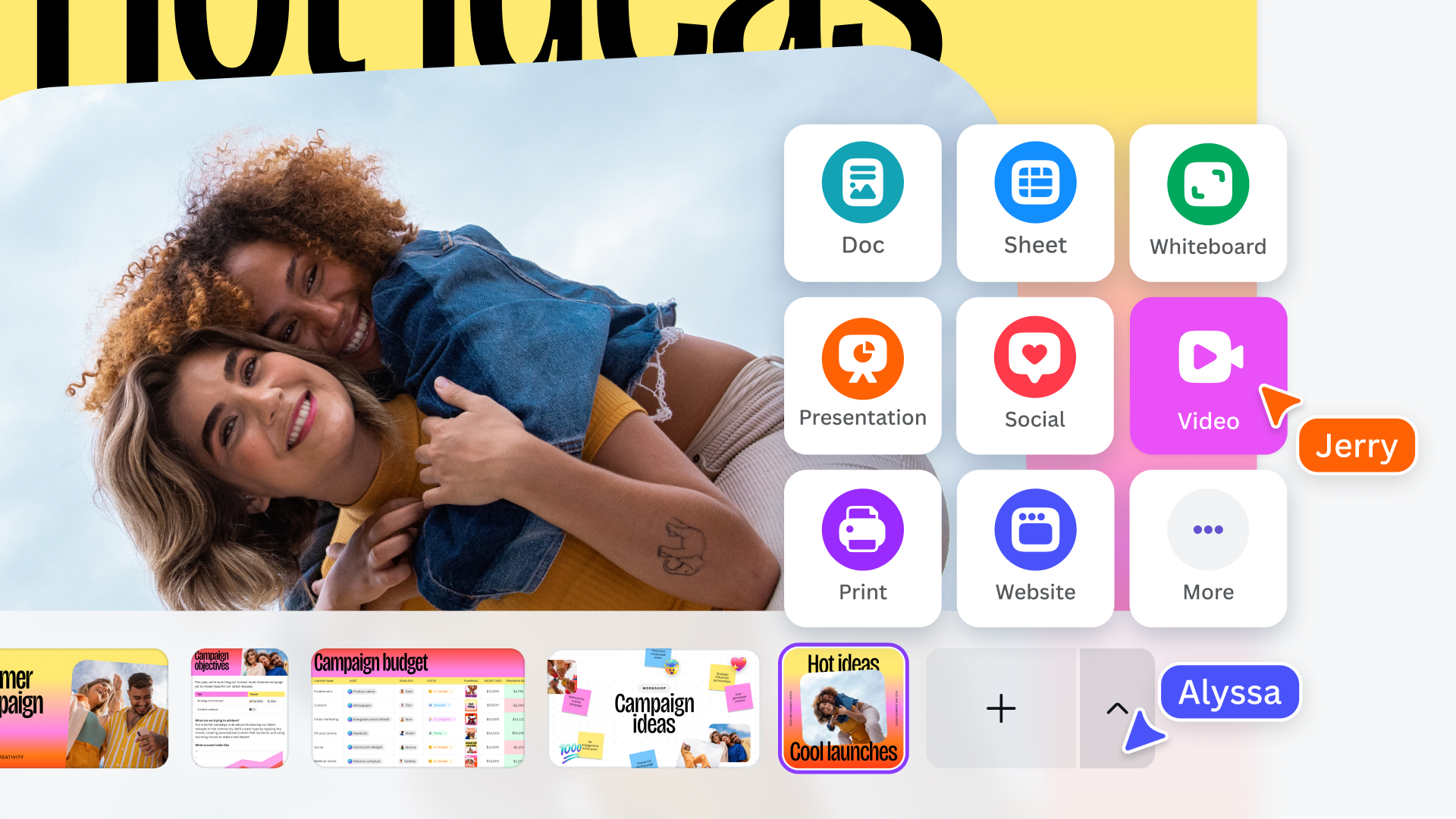
Visual Suite editor: documents, sheets, presentations and other formats in one design.
Visual Suite

Create across presentations, docs, whiteboards and Sheets.

Carry a project across formats without recreating its context.

Docusign

Give sales teams reusable branded materials

The vendor case reports battle-card production falling to 1.5 days, $300K in design-hour savings and 50% higher sales engagement.

Self-service templates and shared rebrand materials let teams create and update content themselves.

What changed? +

Battle cards depended on the design team and took seven days to produce.

Vendor-published Docusign outcomes for the described sales-material and brand workflow; sales engagement is kept as its own measure.

Visual Suite editor: documents, sheets, presentations and other formats in one design.
02 / HOW IT BECOMES REAL

From a new campaign brief to locally useful assets

This illustrative distributed marketing workflow combines Canva’s published tools with the Korean Design Lead’s actual remit. It is not a claim that a named Korean customer uses this exact sequence.

  1. 01

    Define the audience and visual system

    The team agrees the campaign objective, brand kit and reusable templates. A local lead reviews whether the concept fits Korean language and design habits.

  2. 02

    Turn one idea into multiple formats

    Visual Suite places documents, presentations and other formats together. Canva AI can help draft or refine designs, while people choose and edit the output.

  3. 03

    Personalize content within approved rules

    Templates let sales or regional teams change the relevant text and content. Collaboration and approval controls keep work connected to the brand owners.

  4. 04

    Review quality, discovery and performance

    The Korean lead audits templates and elements, finds discoverability gaps and briefs creators on improvements. Marketing and growth feedback informs the next content cycle.

Follow the work, step by step

An idea needs a usable design

Canva begins with the work a person wants to communicate. In her first-person account, Melanie Perkins describes teaching design programs while at university in Perth and finding their learning curve difficult. She first tested an online, collaborative approach with school yearbooks through Fusion Books, before pursuing a broader design platform. That sequence explains the company’s bet better than a list of tools: make creation understandable enough that people with a real communication need can produce and publish something themselves. The product launched in 2013. A user may start with an invitation, a class activity or a business presentation, while a professional designer sets the visual rules for many people to use. Signet reads this as a question of who controls which part of the design. Simplicity has to cover the first attempt as well as the later work of editing, collaboration and publication.

Keep the output editable

The 2026 AI launch changes the starting point to a conversation. Canva describes its Design Model as understanding layout, hierarchy, branding and layers. In the launch workflow, a user gives a goal or brief and receives individual editable objects, then asks for a change or takes over manually. The important distinction for a candidate is between producing an image and producing work that another person can adapt. A locked picture and a layered design support different responsibilities. Canva’s claim is that conversation, tools and editing can remain in one environment. The launch was introduced as a research preview, and its stated capabilities are a product description rather than a guarantee for every brief. Signet’s example is a small business campaign: a creator sets the message, examines the proposed layout and changes the language before sharing the final assets with colleagues.

A library carries local judgement

The Korean language launch connects this AI direction with content work. Canva says the assistant added sixteen languages beyond English, including Korean, and incorporated templates and design assets while learning cultural preferences. The Korea Design Lead’s current posting asks for creative direction, content curation, local creator briefs and AI adoption in production. The Language Manager looks after style, terminology and product experience; the SEO specialist helps people discover useful content through Naver and the website. Those are distinct ways to influence the same journey from intent to editable work. Local relevance is therefore more specific than translating a menu. A Korean headline has to fit its visual setting, a template has to match its occasion, and search content has to lead to something a person can use. These responsibilities are visible in the employer’s own descriptions of the work.

Follow the decision through publication

For someone joining the Korea team, a useful portfolio follows the decisions between a brief and published work. The Design Lead posting includes audits of templates and elements, analysis of content performance, collaboration with marketing and community teams, and negotiation of competing priorities. The two marketing postings describe hands-on production, feedback rounds and delivery against the content calendar. A candidate can show who needed the content, how a cultural or brand decision changed it, and what evidence informed the next version. Signet’s reading is that the difficult work sits between repeatable systems and individual judgement. AI and templates can accelerate an initial output; the local team still decides whether that output communicates the intended idea. An application becomes more useful when the example includes both the creative artifact and the process that made it dependable for other people.

Understand the products and their customers

Create across formats

Visual Suite puts documents, presentations, whiteboards, spreadsheets and other design formats into the same creative environment. The practical value is the relationship between formats: a team can organize an idea, explain it in a presentation and turn it into material for a different channel. The official editor image shows a format picker over a design rather than a collection of disconnected product logos. For a Korean creator, the useful question is which part of the project can be reused and which part requires local adaptation. An internal presentation and a social campaign may share brand assets but need different language, hierarchy and layout. The current Design Lead posting explicitly covers templates and elements across social, presentations, websites and print. Its brief is to keep creative quality and cultural fit as the output expands across these surfaces.

Let teams use the brand

Canva Enterprise adds organization, brand and access controls to the creative workflow. The buyer is a larger organization that wants many teams to create while keeping a shared visual system. Docusign’s published story makes the operating change concrete. Its Creative team supported requests from employees across the business and used Brand Kit, Brand Templates and Brand Controls to spread a new identity. The case reports battle-card production falling from seven days to one and a half days. This is a vendor-published result for Docusign’s described sales-material workflow, so the number stays attached to that customer and task. The product story is the redistribution of work: designers build and maintain the system, while sales or other teams edit approved material. A Korean portfolio can demonstrate its own handoff, measured period and result.

Conversation meets editing

Canva AI and Code extend what a creator can produce from an initial request. The AI 2.0 launch describes conversational design, editable objects and memory, alongside workflows for research, connected information, spreadsheets and interactive experiences. The important test is whether the output can be examined and changed by the person responsible for it. Canva Code 2.0’s launch description includes HTML importing and interactive experiences, while the assistant’s connection to the editor lets a user refine a generated design. A candidate should match an example to the stated workflow rather than describe AI as a universal quality improvement. The Korea hiring asks for hands-on use of AI in production and language-quality evaluation. That combination makes review part of the product’s value: a person may accelerate drafting while still checking tone, detail, visual coherence and the needs of the audience.

Professional craft and reusable systems

The current ProSuite announcement joins Affinity, Cavalry, Flourish and Leonardo into a connected professional tool set. Canva describes a path from detailed design or animation to wider team use; the announced Cavalry-to-Canva editable handoff is coming soon. This is useful product context for a designer who works outside the main editor as well as within it. Separately, FedEx’s vendor-published case describes more than five hundred branded templates and use across fourteen hundred teams in forty-five countries. Its detailed story reports a seventy-seven percent decrease in brand-review submission requests within three months of rollout. The case’s overview also uses review-time wording, so this page keeps the precise submission-request measure when discussing that result. The broader point is how a professional team turns craft into material that others can adapt, while preserving a clear owner for the brand system.

03 / THE EVIDENCE

The story, in numbers.

DATED OBSERVATIONS

Reported and estimated ARR

USD · B
Reported and estimated ARR2023-12-28: About $1.7B; 2024: $2.8B; 2025: $4BAbout $1.7BDec 2023$2.8B2024 year-end$4B2025 year-end

ARR uses founder reporting and labeled Sacra estimates. It is kept separate from Reuters’ August 2025 annualized-revenue disclosure and recognized annual revenue. These are dated disclosures, not a continuous growth record.

Figures, dates & basis +
Reported and estimated ARR
DateValueBasis
2023-12-28About $1.7BFounder-reported ARR.
2024$2.8BSacra estimate of year-end ARR.
2025$4BSacra estimate of year-end ARR, separate from the official recap’s $3.5B revenue figure.

TechCrunch · Sacra

DATED OBSERVATIONS

Secondary transaction valuations

USD · B
Secondary transaction valuations2024: $32B; 2025-08-20: $42B$32BOct 2024$42BAug 2025

Values attributed to private secondary transactions, not company revenue or new financing proceeds. These are dated disclosures, not a continuous growth record.

Figures, dates & basis +
Secondary transaction valuations
DateValueBasis
2024$32BSacra reports the October 2024 secondary transaction valuation.
2025-08-20$42BReuters relays the company’s announced employee-tender valuation.

Sacra · Reuters via TradingView

Seed funding

Canva announced $3M to build the collaborative design platform.

Visual Suite 2.0

Sheets, AI and Code broadened creation across data and interactive content.

Employee tender

Reuters reported a $42B employee-tender valuation alongside annualized revenue; a secondary sale is not operating revenue.

Read the growth story

Free use can become a paid workflow

Canva makes money through subscriptions that add content, creative capabilities and organization controls to free creation. The company describes Pro for individuals and creators, Business for smaller teams, and Enterprise for larger organizations. At the Business launch in October 2025, the stated US list price was twenty dollars per person per month with no minimum seat requirement. This is a dated US launch price, while an actual buyer should use the current local checkout or enterprise agreement. Free access for eligible education users is a separate distribution and mission program. The business question is why a person or team pays as the work becomes more regular. Brand assets, collaboration, AI capacity and controls can become useful as more people depend on a shared workflow. The Korea openings influence that path through useful content, Korean-language quality, search discovery and marketing production.

Keep each financial measure attached to its date

The growth chart retains dated ARR milestones from founder reporting and separately labeled research estimates. Around one point seven billion dollars in December 2023 came from Adams’s interview. Sacra estimates two point eight billion at the end of 2024 and four billion at the end of 2025. A February 2026 report also attributes the latter year-end ARR figure to Obrecht. The August 2025 employee tender used a forty-two-billion-dollar valuation and accompanied a separate annualized revenue announcement. That valuation describes a transaction in existing shares rather than revenue from customers or new money received by Canva. The company’s 2025 recap uses its own revenue wording, while the ARR chart uses a recurring annualized measure. A candidate can follow the scale of subscription use without adding these values together or converting the tender value into the size of the operating business.

A team purchase changes the work

Enterprise adoption adds a different requirement to an easy individual editor. A brand team needs more people to produce content while keeping approved assets, identity and access consistent. Docusign’s case describes self-service sales material; FedEx’s describes a large template system used across countries. These cases support the product mechanism rather than proving every buyer will achieve the same result. Canva’s enterprise anniversary also describes resellers, agencies and consultancies supporting onboarding and organizational use. Those channels can bring a company into a larger procurement and implementation process. Signet reads the competitive question as the task a buyer wants to coordinate: specialized design craft, collaborative business material, marketing production or an integrated team workflow. Professional tools, AI assistants and office suites can overlap with parts of that work. The useful comparison identifies the actual user, output and approval responsibility instead of treating every creative application as interchangeable.

Three things determine useful growth

The three risks on this page follow that operating model. First, local content and language must remain useful as creation scales; otherwise discovery can bring a person to material that does not fit their task. Second, AI use has an operating cost, and the company’s reported decision to pace a rollout makes the relationship between usage and sustainable delivery worth examining. Third, professional and organizational requirements become more demanding as the product reaches additional teams. Signet labels these as its reading of the product, current job responsibilities and dated reporting. For a Korea candidate, the practical response is evidence of a decision that improved quality, discovery or reuse. A content audit, a more effective editorial calendar or a handoff that let another team adapt a design can explain how the person contributed. The argument is strongest when the measure and period stay attached to the actual project.

04 / THE PEOPLE

Someone saw it first.

Photograph of Melanie Perkins.
Co-founder & CEO

Melanie Perkins

Perkins and Cliff Obrecht tested online collaborative design through the school-yearbook business Fusion Books before Canva.

The choice behind the company +

Her retrospective describes using a narrow yearbook problem to learn how customers buy and use design software before pursuing a broad design platform.

Photograph of Cameron Adams.
Co-founder and chief product officer

Cameron Adams

The 2013 announcement identifies Adams as a former Google lead designer who joined as co-founder and Head of Product.

The choice behind the company +

That founding combination joined a tested customer problem with product-design expertise. This is an interpretation of the founding record, not a quotation.

“I wanted to make design software simple, online and collaborative.”

Melanie Perkins · First-person Canva retrospective · 2018-01-14
The decisions behind the company

A narrow problem taught the business

Melanie Perkins’s 2018 first-person account starts with teaching design tools and testing a simpler collaborative approach in school yearbooks. With Cliff Obrecht, she worked through the practical requirements of a paying customer before taking the idea wider. Her advice to start with a niche and then expand links the origin to the later platform: a broad mission can be pursued through a task whose user and result are specific. The March 2013 seed announcement identifies Perkins, Obrecht and Cameron Adams as the founding team and records three million dollars raised for the collaborative design platform. The official company account dates Canva’s product launch to 2013. These are separate pieces of the founding record, with the older account useful for understanding decisions rather than measuring the current business. A candidate can read how the team tested a problem before explaining the mission in larger terms.

Three founders explain different decisions

Perkins is the co-founder and CEO, Obrecht the co-founder and COO, and Adams the co-founder and chief product officer in the current public leadership material. Their published remarks reveal different views of the same company. Perkins describes the original simplicity problem. Adams’s 2024 enterprise interview explains a shift from empowering an individual to supporting an organization, with fragmentation brought into one platform. Obrecht’s 2026 interview places AI conversations and the final editing workflow together, explaining how Canva can work with larger AI assistants. The statements have different dates and contexts; they are a record of direction rather than a single slogan invented for this page. For the Korean team, that direction becomes choices about content, language, discovery and campaigns. A candidate can connect the part of the system they know to the particular decision a founder was explaining.

Principles connect ambition and use

Canva’s published values include making complex things simple, empowering others, pursuing excellence, being a good human, setting ambitious goals and being a force for good. The website describes pragmatic solutions and consideration for the user alongside communication and constructive feedback. The Two-Step Plan links building a valuable company with doing good, and the company’s own giving update records a new cash-transfer commitment through GiveDirectly. That plan is useful context for free education and nonprofit access, while each program still has its own eligibility and scope. Signet’s reading is that the principles create a practical tension for creative work: ambitious scale has to coexist with clear instructions, local language and quality control. A candidate can explain a case where simplifying a system helped another person do their work, and show the tradeoff they made to preserve quality.

Prepare for the actual hiring process

The public hiring page describes four consistent components while allowing variation by role and specialty: an initial screen, a first interview with a potential coach or colleague, a take-home challenge and a final interview. The final stage includes presenting the challenge findings and behavioral questions aligned with the company’s skills framework. This is a general process description, so a candidate should use the recruiter’s instructions for the exact role. The Korea Design Lead posting gives more concrete preparation material: creative leadership, a portfolio with local cultural relevance, cross-functional collaboration and management of freelancers or creators. The Language Manager and SEO postings instead emphasize linguistic judgement or search content and measurable outcomes. A strong application can select evidence for that seat rather than treating all five openings as the same career opportunity. The founder direction supplies context; the individual posting supplies the work to demonstrate.

05 / THE NEXT CHAPTER

Make Korean content worth choosing

The postings name country content strategy, marketing, SEO, community, product and localization collaborators. Dated Korea materials describe education and partners separately from customer use.

Named in September 2026 Korean reporting

김대현

Country Manager, Canva Korea

Brand marketing
  • Korea Brand Marketing Lead
Community
  • Korea Community Lead
Market growth
  • Korea digital presence and brand strategy

Public-profile observation on October 7 and dated Korea press provide this functional view. Categories describe observed work rather than reporting lines or official staff totals.

Why Korea? Why now?+

Dated local content, language support, education and partnerships connect the company’s creation workflow with Korean use.

Local content investment

Korean reporting describes creators and an education content program.

First local brand campaign reported

Two campaign films connect Canva with Korean daily and working life.

Imweb cooperation announced

Joint education connects visual planning with website creation.

Understand the Korea opportunity

Localization is the work across the journey

The Korea story is built from dated local content, language support, education and partnerships. Korean reporting in October 2024 describes local creators producing templates and an education creator program. The first local brand campaign followed in May 2025, and Canva AI added Korean later that year. Those developments connect the original easy-creation proposition with material and language that a Korean user recognizes. In a written Korean interview, the company’s global Pro Design marketer describes localization across product, content, marketing and partnerships. That person is a global marketer rather than the Korea country manager. Signet reads the local hiring as separate responsibilities along the same user journey. Content makes a useful starting point, language makes the product understandable, SEO makes it discoverable, and marketing brings the message into campaigns and communities. Each part has to work with the others for the experience to feel local.

Education and partners provide distinct channels

The June 2026 local event report says Canva for Education was provided through the Ministry of Education platform to about two point nine million teachers and students in eleven regions. This is education access rather than paid subscriptions. A July teacher-program report describes training participation, while the Everytime partnership supports university students’ content creation. In September, Imweb and Canva announced joint education and content cooperation, beginning with a webinar that connects visual planning in Canva Whiteboard to website widgets built in Imweb. These are different types of local evidence: education provision, a youth community partnership and a business-creation partner. Newneek’s executive also described use across planning, visual storytelling and sales material at the May event. The named examples establish what local communication and production can involve, with each source’s own scope kept visible instead of turning all names into measured enterprise deployments.

The observed team has functional responsibilities

Korean press names Kim Dae-hyun as Canva Korea’s country manager, including the September 2026 Imweb announcement. The public-profile observation on October 7 found current Korea brand marketing, community and market-growth titles. Localization and content responsibilities are supported separately by the current employer postings. This page uses company-matched current titles as functional groups and leaves ordinary people unnamed. The observation is a reading of public profiles, and the figure does not establish a reporting hierarchy or employee total. The employer postings add the collaborators a new hire would work with: Country Content Strategy Lead, Country Manager, Brand Marketing Lead, Korea SEO Lead, product, design, engineering, marketing, localization, creators and outside partners. The combination explains a working structure more usefully than making a precise headcount from profile categories. A candidate can choose a collaboration case that reflects the interfaces described in the exact posting.

Compare five seats by their exact work

The five current Korea postings are all located in Seoul. Design Lead is a twenty-four-month fixed-term employee seat; its qualifications include a relevant degree, creative leadership, a culturally relevant portfolio and experience with freelancers or creators. Korean Language Manager is a twelve-month contract focused on Korean writing, professional English and linguistic quality; several experience items are introduced as ideal rather than given a fixed minimum year count. SEO Content Specialist is permanent, full-time work with five or more years in SEO, content or digital marketing, native or near-native Korean and business English. Marketing Graphic Designer and Marketing Campaign Specialist are distinct official postings whose bodies both describe a twelve-month Marketing Creative Producer assignment. They emphasize a portfolio and bilingual production; around five years is a typical background rather than a hard minimum. The original texts remain separate, with every seat keeping its own mock application.


KOREA OPEN ROLES

7 open roles in Korea

Current Signet catalog · 2026-10-19

FOR YOU

Read each seat’s contract and conditions before the mock application.

Marketing · Content

AI Quality Evaluator - Korean (12-month contract)

Seoul

Posting checked

The work
Evaluates the quality of AI-generated images and designs for the Korean locale and applies labels.
Who fits
Is a native Korean speaker with strong written and spoken English.
Keep in mind
Read the role details for the full responsibilities and requirements.
Design · Creative

Design Lead, South Korea (24-month contract)

Seoul, South Korea

Posting checked

The work
Lead local creative direction, content curation, audits and creator briefs.
Who fits
Seoul-focused full-time fixed-term employee position, 24 months; same statutory benefits as permanent employees performing the same or similar work under Korean law.
Keep in mind
Seoul focus; 24-month fixed-term employee contract and statutory benefits.
Marketing · Content

Korean Language Manager (12-month contract)

Seoul, South Korea

Posting checked

The work
Shape Korean product language, style, terminology and localization quality.
Who fits
12-month contract in Seoul. The candidate profile stresses strong Korean writing and linguistic judgement, cultural and user-experience understanding, initiative and influencing cross-functional partners.
Keep in mind
12-month contract; language-lead, SaaS and LQA experience are preferred.
See all 7 roles
Marketing · Content

Marketing Campaign Specialist (South Korea)

Seoul, South Korea

Posting checked

The work
Produce campaign assets, video and copy with the Brand Marketing Lead.
Who fits
Full-time in Seoul; the official description separately states a 12-month contract.
Keep in mind
Body names Creative Producer, 12-month term; separate official posting.
Design · Creative

Marketing Creative Producer (12-month contract)

Seoul · Hybrid

Posting checked

The work
Produces social, banner, and short-form video assets for brand campaigns.
Who fits
A solid, proven portfolio in marketing or creative production spanning both graphic design and motion work.
Keep in mind
Read the role details for the full responsibilities and requirements.
Design · Creative

Marketing Graphic Designer (12-month contract)

Seoul, South Korea

Posting checked

The work
Produce campaign assets, video and copy with the Brand Marketing Lead.
Who fits
Full-time role in Seoul with a 12-month contract stated in the official description.
Keep in mind
12-month contract; about 5 years is typical, with track record emphasized.
Marketing · Content

SEO Content Specialist - Korea

Seoul, South Korea

Posting checked

The work
Own Naver content and publish useful Korean search and website material.
Who fits
5+ years in SEO, Content Marketing and/or Digital Marketing; native or near-native Korean and business-level English; SEO content or content marketing portfolio.
Keep in mind
Permanent, full-time 40 hours weekly; owned-channel experience preferred.
07 / NOW & NEXT

The next scene is taking shape.

AI 2.0 research preview

Canva introduced AI 2.0 with a design model, tools and editable objects.

Korea teacher programme

Korean coverage described ongoing teacher training, with more than 4,000 participants reported since May.

Imweb joint education agreement

Canva and Imweb announced joint education and content linking visual planning with website creation.

More context on what comes next

A conversation is another place to begin

The recent product direction extends the same idea of editable creation into AI conversations. AI 2.0 was introduced in April as a research preview built around a design model, tools and editable objects. The current Google announcement brings Canva into Gemini and AI Mode in Search, where a person can start from a search or prompt and move to editing. The Muse connector is explicitly available to users in the United States and Canada in the opened announcement. This page keeps that geography attached to the feature. Signet reads these connections as additional starting points for a design, with human review and final editing still part of the workflow. A Korea candidate can consider how local language and content quality remain useful when the entry point changes from a template search to an assistant conversation.

Craft connects to team use

ProSuite’s current announcement connects Affinity, Cavalry, Flourish and Leonardo. The stated direction is detailed professional work that can move into broader team use in Canva. Some handoff features are described as coming soon, so release status remains part of the story. This adds context for the Korea Design Lead and marketing production hires, who work with visual quality, multiple formats and AI-assisted production. The applicant’s useful example is a project where a professional decision became a repeatable asset for another person, with a clear explanation of what could be edited and what needed to stay consistent. That evidence can connect specialist craft with the platform’s broader audience without treating a product announcement as a completed customer outcome.

Watch the local content reach useful work

The September Imweb agreement links visual planning with a live website-building workflow through joint education and content. The education and university partnerships provide different local channels, while the five current jobs build the content, language, search and campaign work around them. Over the next year, Signet would watch how local templates and language quality fit the newer AI entry points, how professional assets move into usable team material, and how the Korea team measures discovery and production. These are questions drawn from the sources rather than promises about a hire’s first year. An application can start with one documented project, attach the actual period and result, and show how the candidate made the work understandable and reusable for the people who needed it.

Their future. Your next chapter.

Find your part ↑

An independent profile by Signet. No affiliation or investment recommendation. Introductions happen only with your consent.
Research reviewed 2026-10-08

A LITTLE MORE CONTEXT

Understanding Canva.

What does Canva do?

A sales team needs material for its next meeting while designers are preparing a brand campaign. Canva gives people in other disciplines templates and tools within a shared brand system.

What is the opportunity in Korea?

The postings name country content strategy, marketing, SEO, community, product and localization collaborators. Dated Korea materials describe education and partners separately from customer use.

Are these confirmed job openings?

Employer postings were checked on 2026-10-08. Availability can change. Mock applications request a review from Signet.

How can I explore the company in more depth?

Follow the company from its vision through products, evidence and people to the Korea team and current roles. Use the table of contents to move within the page, and expand the sections for more context.

Back to the collection ↗