One map, sold three ways
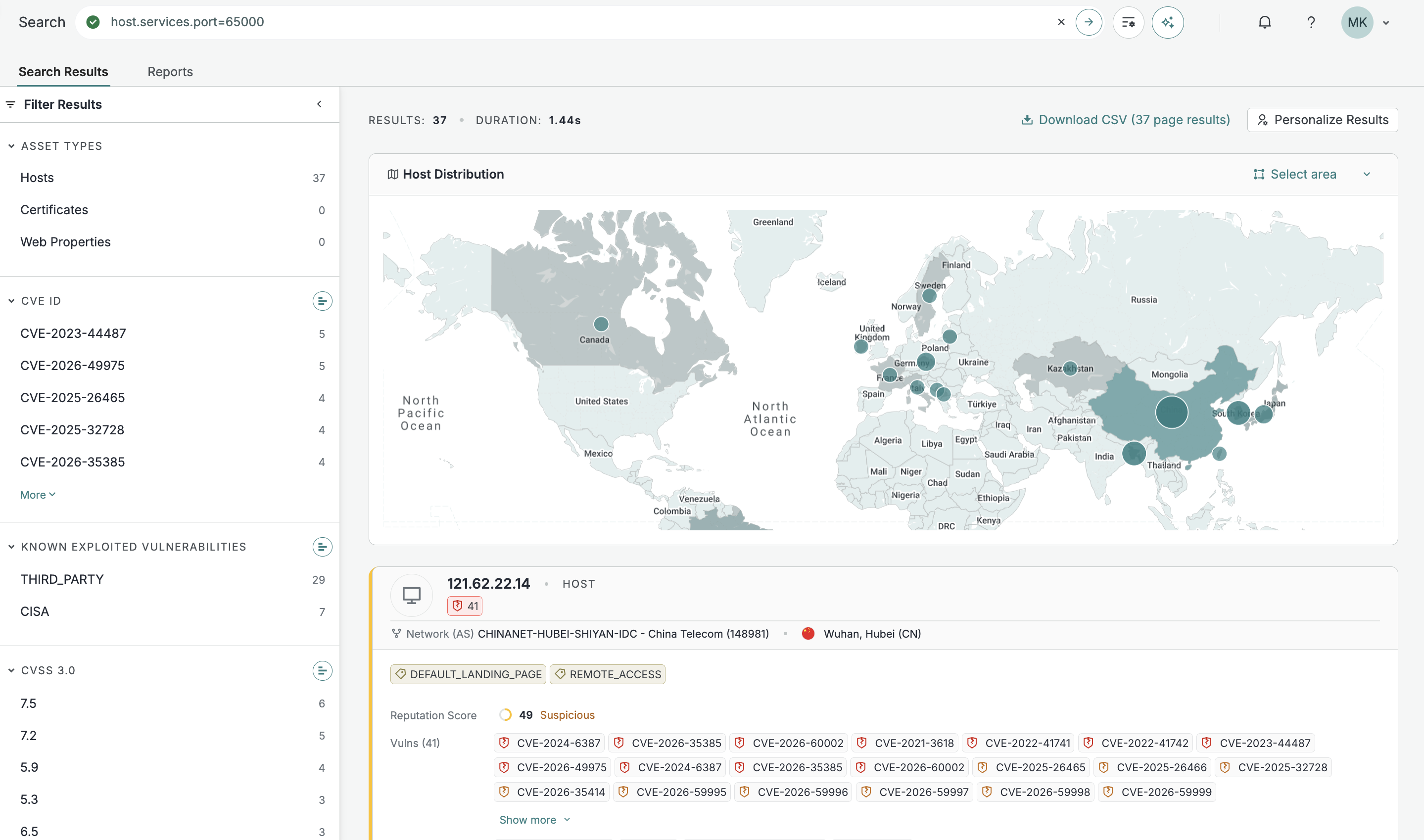
Censys sells one data asset, the Internet Map, through three products. The Censys Platform is the search and investigation tool. Analysts look up hosts, services, certificates and domains, follow the relationships between them and look back through their history. The pricing page lists three paid tiers: Core, for analysts who triage alerts; Adversary Investigation, for threat hunting and threat intelligence teams that track attacker infrastructure; and Security Operations, for enterprises that use Censys data across triage, incident response, threat intelligence and detection engineering. A free account gives basic visibility into standard ports and services.
Underneath sits the scan engine. Censys says it probes more than 200 protocols across all 65K ports from several vantage points, and pairs exhaustive scans with models that predict where services are likely to be. The research team, named Censys ARC in March 2026, writes the annual State of the Internet report from the same data and, in the founder's words, strengthens "the insights embedded in our platform." For a seller, that research is part of the product: it is a reason a security buyer trusts the map.
Attack Surface Management turns the map toward one organization. It discovers and monitors the company's internet-facing assets, including cloud environments and unmanaged services, and flags risks to fix. Workspaces split the attack surface by owner. The supplier’s Swiss Life testimonial describes workspaces as a way to connect each newly found risk with the person responsible for fixing it. The buyer here is an exposure management or vulnerability team rather than a threat hunter.
The Enrichment API brings the map into the tools a security team already runs. It is one lightweight endpoint: an IP address goes in, a fixed JSON profile comes out. Censys built it for high-volume automated lookups in SIEM, SOAR and AI SOC pipelines and integrates with SIEM, SOAR and threat intelligence platforms. In July 2026 it introduced Unlimited Enrichment, a host lookup that does not draw down credits, and named consumption-metered tools such as VirusTotal as the habit it wants to break: in its argument, teams that pay per lookup enrich late, and only a fraction of alerts.
A telecom with two million addresses
The best documented named customer is NOS, a Portuguese telecom operator that manages about 2 million IP addresses and critical infrastructure. Before Censys, its cloud, IoT and 5G footprint was growing and existing tools produced noisy alerts. NOS evaluated several vendors, including Palo Alto Xpanse and Shodan, and chose Censys ASM and Search. On onboarding, Censys pulled together data across NOS's three major cloud providers and revealed previously unknown assets connected to its attack surface, along with assets running outside security controls such as firewalls. Its head of cybersecurity describes broader visibility into attacker infrastructure. A team lead says Censys let them narrow down the vulnerable OpenSSH services before the CVE was released.
Other named uses show how wide the buyer base runs. At-Bay, a cyber insurer that aims to make underwriting decisions in under two minutes, uses Censys data to automate insurance processes, and its CTO says it chose Censys over other tools because of its reliability. Citizen Lab at the University of Toronto used Censys data, which Censys gives free to researchers and non-profits, to trace infrastructure of the spyware vendor Candiru. In March 2026 Censys said organizations representing over 50% of the Fortune 500 use it, and in October 2025 it counted 40+ national intelligence and defense agencies.
Read the evidence the way a buyer will
The customer stories are published by Censys and largely describe how customers use the product. Its NOS document also prints a claim of 65% more attack surface on average than competitors. That is the supplier’s general comparison, while the NOS-specific evidence concerns cloud aggregation and previously unknown assets. The company’s summary of a commissioned Forrester study reports a 70% reduction in false positives and 30% asset-discovery and assessment efficiency improvement for a composite organization modeled from customer interviews, assessed over three years. Treat those as scoped sponsored evidence. Signet’s reading: a Korean proof of value should agree on its own asset set, baseline and success criteria, then compare the results with the customer’s existing process.