Scott Wu of Cognition
Cognition / THE WORLD THEY ARE BUILDING

Software that helps build software.

The opportunity is a team that can run many bounded engineering tasks in parallel. Its usefulness depends on accepted changes and dependable tests, rather than the volume of code an agent generates.

See it taking shape ↓
01 / THE PRODUCTS

The products behind the promise.

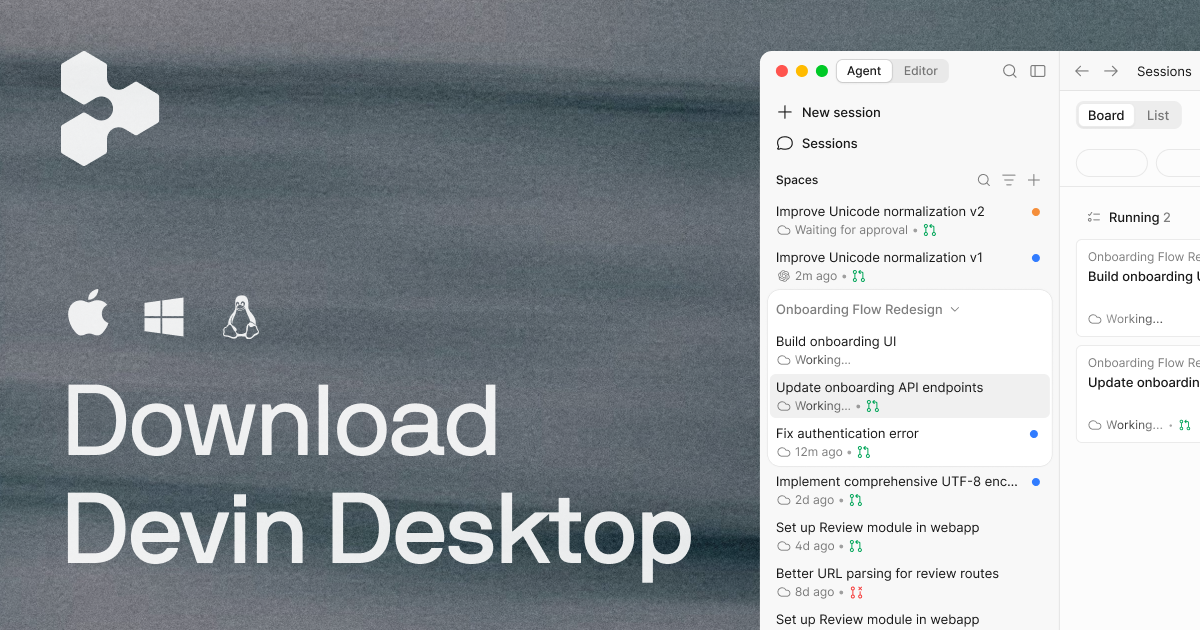
Devin Desktop: agent sessions and task board in the official product image.
Devin

Delegate implementation and steer the plan.

Move bounded backlog work toward a reviewable result.

Nubank

Refactor a large ETL monolith

Vendor case reports 8-12x engineering-hour efficiency and over 20x cost savings on delegated migration scope.

The team used previous migration examples to tune Devin, delegated subtasks and reviewed changes before merging.

What changed? +

Moving roughly 100,000 data classes out of a monolith demanded repetitive engineering work.

These are task-level case-study comparisons, not a bank-wide productivity or headcount result.

Itaú Unibanco

A bank opens Devin to all its technology staff

75% of teams use Devin. A migration of 59 services from .NET to Java ran 6x faster at 5x lower cost, and about 70% of scanner-flagged vulnerabilities were resolved automatically.

Within five months a waitlist of nearly 1,000 developers formed, and nine months later the bank and Cognition extended Devin to everyone working with technology at the bank.

What changed? +

Brazil's largest bank, with more than 17,000 people in technology, first tried a standard A/B test of teams with and without Devin, an approach the case study says assumed Devin was a tool for discrete tasks.

Vendor-written case study, read on 2026-10-07; figures are reported by Cognition for specific migrations and teams, not as bank-wide productivity.

Devin Desktop window with a list of agent sessions and a board of running sessions
Official Devin Desktop image: a developer's list of agent sessions, some working and one waiting for approval, beside a board of running sessions.
02 / HOW IT BECOMES REAL

From a migration ticket to a reviewed pull request

An illustrative bank engineering team starts with a repetitive refactor. This journey follows Devin’s documented planning, repository and review tools, rather than claiming every task runs unattended.

  1. 01

    Define one repeatable transformation

    An engineer supplies the source repository, examples and acceptance criteria. A narrow unit of work makes both delegation and checking manageable.

  2. 02

    Explore the code before editing

    Devin Search locates relevant code and returns references. Interactive Planning gives the engineer a plan to adjust before execution.

  3. 03

    Run bounded tasks in cloud environments

    Parallel Devin sessions each have an IDE and tools to edit and test. The engineer can step in when the agent needs direction.

  4. 04

    Approve the change before merging

    The reviewer examines the diff and fixes edge cases. Nubank’s documented migration retained human approval while scaling repetitive work.

Follow the work, step by step

More software is needed than people can write

Cognition starts from a shortage. In its September 2026 funding announcement it writes that software shapes nearly every part of modern life, and that "the world’s demand for software far exceeds our capacity to build it." Its answer is to change what an engineer spends the day doing. The company says it started in January 2024 believing that "engineers should operate more like architects and delegate execution to swarms of agents." Its first product, Devin, was introduced in March 2024 as an agent with a shell, a code editor and a browser inside a sandboxed computer, able to plan an engineering task, carry it out and work with the people who assigned it.

Within our lifetime, engineers will go from bricklayers to architects, focusing on the creativity of designing systems rather than the manual labor of putting them together.

Scott Wu · Co-founder and CEO, Cognition · Internal note to the Cognition team, published on the company blog · 2025-07-14

What sets Cognition apart is who does the typing. An independent research report from February 2026 puts the difference plainly: Cognition targets fully autonomous agents that plan, execute and validate multi-step tasks, rather than tools that assist a developer inside an existing workflow. A person hands over a bounded task and reviews the result, and many such tasks can run at once. Wu has described the product's form simply: "the form factor is just a software engineer." He is just as plain about the price of that choice: in September 2025 he said Devin "does take a decent amount of effort to onboard," much like a new engineer.

Why now: stronger models, a second product, deep funding

Three changes turned the bet into a business in 2025 and 2026. The models got better at long tasks: in July 2026 the company wrote that Devin had matured from a junior engineer to a mid-to-senior level, launching and managing other Devins and testing its own work. Wu, speaking in May 2026, put it more cautiously, "somewhere between a junior and a mid-level engineer." The product widened: in July 2025 Cognition agreed to buy Windsurf, an AI code editor with $82M of ARR and more than 350 enterprise customers, which brought a tool developers use on their own machines and a sales organisation. And the money arrived: over $400M at a $10.2B post-money valuation in September 2025, over $1B at $26B in May 2026 and over $2B at $48B in September 2026.

A migration ticket, followed step by step

Follow an illustrative bank team with years of old code to move. An engineer picks one repeatable change and gives Devin the repository, past examples and the tests that define done. Devin reads before it writes: its search tool finds the relevant code with references, and the engineer can edit Devin's plan before anything runs. Several Devin sessions then work in parallel, each in its own virtual machine, created for the task and removed when the work is finished. The engineer steps in when a session needs direction, and nothing merges until a person has reviewed the pull request.

The review step is part of the design. Wu frames it with the checks teams already use for people: "we have processes for these things because humans make mistakes too," which is why software teams have pull requests, review and continuous integration. He has also said the company strongly recommends that customers keep Devin away from production databases. Nubank's published migration followed this pattern: engineers reviewed Devin's changes, made minor adjustments and merged them, instead of making every change by hand.

Cognition runs on its own product. In May 2026 it said 89% of the code its engineers commit is committed by Devin, and the rest by local agents in Devin Desktop. In September 2026 it described Devin Automations that start work from events in Slack, GitHub or Linear without anyone opening a chat, and Wu has described Devins "running on loops" that look for things in the products that do not seem right and fix them. The direction is from a tool a person drives toward a teammate that picks up work on its own.

The strongest evidence so far is adoption rather than independent measurement. An independent account published in January 2025 counted 3 successes in 20 tasks on an early version of Devin. Results since then come from case studies Cognition publishes with its customers. Adoption is easier to check: Citi, Goldman Sachs, Santander, Mercedes-Benz and the US Army and Navy are named customers, and the company says its run-rate passed $1B in September 2026.

For a Korea hire, this chapter is the pitch you would carry. Korean engineering heads will ask whether an agent can be trusted inside their code. The company's own answer is review, tests and limited access, plus real onboarding effort at the start. The two Seoul roles exist to do that onboarding well, one by selling it and one by making it work.

Understand the products and their customers

One agent, two places to work with it

Cognition sells one idea, delegated engineering, in two working modes. Devin is the cloud agent: it runs in its own environment, takes a task from a chat, a ticket or an event, and returns a pull request for a person to review. Devin Desktop is the editor on a developer's own machine, where local agents work next to the person; it is the product line that came with Windsurf, whose brand Cognition says it has merged with its own. Cognition's own model, SWE-1.6, had become the most used model in Devin Desktop by May 2026, which the company credits to its cost and its speed of up to 950 tokens a second.

Around the agent sit tools that help people and agents understand a codebase. Devin Search answers questions about code and cites the files it used, and DeepWiki writes architecture documentation for a repository with an Ask Devin box for follow-up questions. In April 2026 Cognition began charging for Ask Devin, DeepWiki and Devin Review, which had been free. Its September 2026 funding post added narrower agents: Auto-Triage takes a first pass at incident investigation, Security Swarm finds and triages vulnerabilities, and Automations start work from events in other systems.

Where the code runs, and whose model writes it

Enterprise buyers first ask where their code goes. Cognition's documentation splits Devin in two. The brain, a stateless service that powers Devin's intelligence, always runs in Cognition's cloud. The Devbox, where code executes and connects to the customer's systems, can run in a single-tenant environment that Cognition hosts for one customer and links to the customer's network through AWS PrivateLink or an IPSec tunnel, and an Enterprise Assured tier adds customer managed encryption keys. Under a multi-year agreement with AWS announced in September 2026, customers can buy Devin on AWS Marketplace and choose the AWS region where their dedicated Devin runs, which the company says helps teams meet local data residency requirements.

The second question is the model. Cognition calls itself an agent lab: it works with all the foundation model labs and combines their models with its own. Wu said in 2025 that the company does fine-tuning and reinforcement learning on models but does not pre-train base models. In July 2026 it wrote that SWE-1.7 started from an open-source model and that many of the strongest open-source models come from AI labs in mainland China. It tested SWE-1.7 on its own trustworthiness suite, which includes 145 politically sensitive questions, and reported results as good as or better than models from US frontier labs.

Who has bought it, and what was measured

Nubank gives the clearest before and after. Moving about 100,000 data class implementations out of a monolith had been planned as 18 months of work for more than 1,000 engineers. Nubank collected migrations its engineers had done by hand, used some to fine-tune Devin and the rest as a test set, then delegated the work. The case study reports 8 to 12x efficiency, defined as the hours a migration task normally takes against the hours spent prompting and reviewing Devin, and over 20x cost savings on the delegated scope.

Itaú shows adoption spreading inside a bank. Brazil's largest bank, with more than 17,000 people in technology, first tried a standard A/B test of teams with and without Devin, an approach the case study says assumed Devin was a tool for discrete tasks. Within five months a waitlist of nearly 1,000 developers formed. Nine months later the bank opened Devin to everyone working with technology, and 75% of its teams use it, by the case study's count, which also reports about 70% of scanner-flagged vulnerabilities resolved automatically.

We’re going to start augmenting our workforce with Devin, which is going to be like our new employee.

Marco Argenti · Chief Information Officer, Goldman Sachs · Television interview, as reported in the press · 2025-07-11

Two more cases show the range of buyers. Mercedes-Benz ran a four-week pilot in which, by Cognition's account, Devin analysed more than 200,000 lines of COBOL and cut an estimated eight months of modernisation work to eight days; the carmaker then deployed Devin, Windsurf and Devin for Terminal across engineering teams from the United States to Europe and Asia. WPP Enterprise Solutions, a services unit with more than 12,000 experts, uses Devin on client projects, and Cognition engineers work hands-on with its engineers to scope each new use case. On one e-commerce rebuild its case study reports 110% of the contracted scope delivered in 25% less time.

Every result above is measured by the customer or by Cognition and published by Cognition. Each describes one task or one project, rather than a company's overall productivity. In an interview, keep a claim and its definition together: eight days against an estimate of eight months compares a forecast with an outcome.

The Deployed Engineer posting describes this exact work: product demos, pilots, picking the right use cases and training customers to roll Devin out to thousands of engineers. The Nubank and Itaú cases are the fastest way to learn the playbook before a first conversation.


03 / THE EVIDENCE

The story, in numbers.

DATED OBSERVATIONS

Devin ARR before the Windsurf acquisition

USD · M
Devin ARR before the Windsurf acquisition2024: $1M; 2025: $73M$1MSep 2024$73MJun 2025

This series covers Devin alone before Windsurf was acquired. It is separate from Cognition’s later combined annualized revenue run rate. These are dated disclosures, not a continuous growth record.

Figures, dates & basis +
Devin ARR before the Windsurf acquisition
DateValueBasis
2024$1MDevin ARR; before the Windsurf acquisition.
2025$73MDevin ARR; before the Windsurf acquisition.

Cognition

DATED OBSERVATIONS

Funding-round valuation

USD · B
Funding-round valuation2025-09-08: $10.2B; 2026-05-27: $26B; 2026-09-08: $48B$10.2BSep 2025$26BMay 2026$48BSep 2026

Valuation is separate from the dollars raised and from revenue. These are dated disclosures, not a continuous growth record.

Figures, dates & basis +
Funding-round valuation
DateValueBasis
2025-09-08$10.2BPost-money valuation of the financing round.
2026-05-27$26BValuation announced with Series D.
2026-09-08$48BValuation announced with Series E.

Cognition

Devin introduced

Cognition demonstrated an agent using developer tools to execute tasks.

Devin 2.0

Parallel IDE sessions, planning and codebase search broadened collaboration.

Series E

Raised over $2B at a reported $48B valuation. This is financing evidence, separate from revenue.

Read the growth story

Who pays, and how the bill grows

Cognition earns money in three layers. Individual developers subscribe: Pro costs $20 a month and Max $200 a month, each with a usage allowance that refreshes daily and weekly, and work beyond the allowance is charged at API prices. Teams pay $80 a month plus $40 a month per full developer seat. Enterprises sign contracts priced by quote and billed in ACUs, Agent Compute Units, with dedicated deployment, single sign-on, central admin controls and account management. An independent analyst describes the resulting revenue as a mix of per-seat and usage-based Devin subscriptions and multi-seat enterprise deployments of the Windsurf editor.

The design means revenue follows usage. When a customer hands Devin more tasks, it pays for more compute, so in Signet's reading growth depends as much on expansion inside existing accounts as on new ones. In May 2026 the company said enterprise usage had grown more than 10x since the start of the year, and a press report relayed a company figure of 50% month-over-month growth in enterprise usage over six months. Partners widen the doors: Infosys, Cognizant and LTM deploy Devin across their clients, and since September 2026 Devin is sold on AWS Marketplace.

The dated numbers, and what each one measures

The headline number is run-rate revenue, a pace rather than a year of booked sales. The company reported $492M on 27 May 2026, almost $900M on 8 September and $1B in annualized revenue run rate on 25 September, 17 days later. Press coverage notes that run-rate is usually one month's revenue multiplied by 12. Earlier figures measure something narrower: Devin alone had ARR of $1M in September 2024 and $73M in June 2025, before the merger, and Windsurf had $82M of ARR when the deal was signed. These numbers cover different scopes and should not be read as one line.

Dated numbers and what each one measures
WhenNumberWhat it measuresBasis
2024-09$1MDevin ARR, Devin alone, before WindsurfCompany
2025-06$73MDevin ARR, Devin alone, before WindsurfCompany
2025-07-14$82MWindsurf ARR at signing of the acquisitionCompany
2025-09-08$10.2BPost-money valuation; over $400M raisedCompany
2026-05-27$492MRun-rate revenueCompany
2026-05-27$26BPost-money valuation ($25B pre-money); over $1B raisedCompany; pre-money figure press-reported
2026-09-08Almost $900MRun-rate revenueCompany
2026-09-08$48BValuation; over $2B raisedCompany
2026-09-25$1BAnnualized revenue run rateCompany
2026$800MPossible cash burn for the year, from a leased Nvidia clusterPress-reported
End of 2026$4B to $5BExpected annualized revenuePress-reported forecast

Valuation is a separate measure: $10.2B post-money in September 2025, $26B post-money in May 2026 and $48B in September 2026. By one press calculation, Cognition now commands a higher multiple of revenue than its rival Cursor did in the spring. Costs are where the picture is least settled. The company said in September 2025 that its total net burn across its history was under $20M. A year later, press reports said a leased Nvidia server cluster costing hundreds of millions of dollars a year could push 2026 cash burn to $800M, and that annualized revenue could reach $4B to $5B by the end of 2026. Both are press reports rather than company figures.

Rivals on two fronts, and three risks

Cognition competes on two fronts. Among independent tools, Cursor is the most direct rival in one analyst's view; in April 2026 Cursor was in talks to raise at a $50B valuation with annualized revenue above $2B, then agreed to sell to SpaceX for $60B, largely because it was short of compute, according to investors cited in the press. Among the model makers, Anthropic's Claude Code, OpenAI's Codex and Google's Jules are coding agents of their own, and large technology companies are expanding GitHub Copilot and Amazon Q. Cognition uses models from OpenAI and Anthropic and also trains its own, which press coverage reads as a path to lower costs and breakeven. It remains one of the largest independent AI coding startups not absorbed by a model maker.

Three risks follow from this. Compute is expensive and some suppliers are also rivals, so costs depend on how much of the work Cognition's own models can carry. The evidence for results comes mostly from the vendor, which leaves room for a customer to expect more than a pilot delivers. And regulated buyers will look hard at where the brain runs and where the models come from.

Two habits help in an interview. Say run-rate revenue, not ARR or annual revenue, when you cite $1B, and ask how Cognition measures it; Korean press calls the same figure ARR. And keep company figures apart from press reports: the $800M burn and the $4B to $5B forecast came from the press, not from Cognition.

04 / THE PEOPLE

Someone saw it first.

Photograph of Scott Wu.
Co-founder & CEO

Scott Wu

Wu authored Devin’s March 2024 launch announcement for the applied AI lab.

The choice behind the company +

The initial product equipped the agent with a shell, editor and browser so it could carry out a task and collaborate with engineers.

“Within our lifetime, engineers will go from bricklayers to architects, focusing on the creativity of designing systems rather than the manual labor of putting them together.”

Scott Wu · Internal note to the Cognition team, published on the company blog · 2025-07-14
The decisions behind the company

Competitive programmers who chose to build a product

Scott Wu is Cognition's co-founder and chief executive. He has said he started coding when he was nine. The company says its founding team, which includes competitive programmers, holds 10 IOI gold medals, and that 21 of its first 35 team members had founded a company before. At the March 2024 launch, Korean tech press listed Steven Hao as chief technology officer and Walden Yan as chief product officer alongside Wu. Yan's writing shows how the team thinks about reliability. In a June 2025 essay on agents sharing full context, which he calls context engineering, he wrote that it "is effectively the #1 job of engineers building AI agents."

If I ask what Cognition’s one goal is, I would say it’s to make it much easier for everyone around the world to build software.

Scott Wu · Co-founder and CEO, Cognition · Printed Q&A interview · 2026-05

That goal explains a choice about what kind of company to be. Wu has said a company that exists to bring AI coding to people around the world has a core DNA "pretty different" from one focused on advancing research itself. Cognition post-trains models but does not pre-train them, and it describes itself as an independent agent lab that combines models from several providers with its own rather than tying customers to one. In July 2026 it called itself the Switzerland of AI and put model evaluation in the open with Arena Mode and a public leaderboard.

Three decisions that shaped the company

Buy distribution. In July 2025 Cognition agreed to acquire Windsurf. A year later Wu and Jeff Wang, who led Windsurf at the time of the deal, explained the logic in one sentence: "Cognition had built one of the best engineering orgs in Silicon Valley and was looking for a GTM org; Windsurf had built one of the best GTM orgs and was looking for engineering." GTM, go-to-market, means the people who sell. The two companies shared under 5% of their enterprise customers, and combined enterprise ARR rose more than 30% in the seven weeks after the deal. The company then grew from 44 to 350 people in a year.

Stay independent. In August 2026 Wu disputed a report that SpaceX had tried to buy the company, writing that Cognition "is not for sale," and about three weeks later it raised over $2B at $48B. Go where the customer is. "We show up" is one of four principles on the company's About page, and in the year to September 2026 Cognition opened offices in Washington, D.C., Tokyo, Singapore, London, São Paulo and Madrid, in addition to its San Francisco, New York and Austin hubs.

How it says it works, and what that asks of people

Cognition publishes four principles. The team is the company: it bets on "kind, low-ego individuals" who invest in and challenge each other. We show up: it works alongside customers "in real systems, under real constraints." Go for it all: it takes on hard problems without letting constraints limit its ambition. The inflection point is here: decisions made now will define the next era of software engineering.

The pace behind those words has been reported in the press. After the Windsurf deal in 2025, Cognition laid off 30 Windsurf employees and offered the roughly 200 who remained a buyout worth nine months of salary. Those who stayed were reportedly expected to work more than 80 hours a week and six days in the office, and Wu wrote in an internal email that "We don’t believe in work-life balance." Korean tech press repeated this in September 2025. Wu's own public framing is that the culture is a choice each person makes, and he said only a small fraction took the buyout.

Opt in to the intensity and the new culture and yeah, we’re going to be going after some very ambitious goals.

Scott Wu · Co-founder and CEO, Cognition · Podcast interview (Cheeky Pint), published transcript · 2025-08-27

Two leaders outside headquarters matter most for a Korea hire. Richard Spence, Vice President and General Manager for APAC, is based in Singapore and, in the company's April 2026 words, responsible for regional strategy, customer engagement and market expansion across Southeast Asia and key markets including South Korea. Takumi Masai became Japan President and General Manager in April 2026, after more than 30 years in Japanese enterprise technology, with senior roles at IBM, Pivotal, Microsoft and Workday and, most recently, as President of Datadog Japan. His job is the nearest public model of what the Korea Country Leader would do.

On the fear that headquarters decides and Seoul executes, the evidence points both ways. Japan got a local president with three decades in the market and a dedicated local team. The Korea Country Leader posting gives the role country-level profit and loss, hiring and sales execution, and asks it to feed localisation needs back to Product and Engineering. How much pricing and product authority sits in Seoul is a question for the first conversation.

05 / THE NEXT CHAPTER

Build the Korean business around shipped software

Own country P&L, enterprise and government partnerships, local hiring and onboarding with the global product team.

Regional market-expansion remit includes South Korea

Richard Spence

APAC Vice President and General Manager

Sales hiring
  • Country Leader - South Korea
Customer technical hiring
  • Deployed Engineer - South Korea

Team view built from Cognition's April 2026 announcements for Japan and Singapore and from its Seoul job postings read on 2026-10-07. It names the regional leader the company placed over South Korea; it is not a headcount and does not establish reporting lines.

Why Korea? Why now?+

Cognition's own reason for coming to Asia is demand. In April 2026 it wrote that enterprises across Southeast Asia, Australia, India and South Korea are accelerating efforts to modernize how software is built and deployed, and it made its Singapore-based APAC leader responsible for market expansion in South Korea. Its way of selling needs people on the ground, since it says it works side by side with customers wherever they are, and Japan showed the pattern: a local president, a local team, a partner into banks and named customers at launch. The Korea Country Leader posting names the buyers it wants, South Korean enterprises and government agencies. Signet's reading is that Korea is a chosen market at the start of its build, staffed in the same order Cognition used in Japan.

Korean press first covers Devin

Korean tech press reported Devin's launch under the headline "RIP, SW 엔지니어", relaying the company's benchmark result.

Japan launch, the first step into Asia

Cognition launched in Japan with Takumi Masai as Japan President and General Manager and a dedicated local team, calling it its first step into Asia.

Singapore headquarters takes on South Korea

Cognition opened its APAC headquarters in Singapore and made Richard Spence, Vice President and General Manager for APAC, responsible for market expansion in key markets including South Korea.

Korean press lists Korea among the targets

Reporting the $48B round, Korean tech press listed South Korea among the markets in Cognition's Asia-Pacific expansion.

Understand the Korea opportunity

Korea arrives in Cognition's second step into Asia

Cognition entered Asia in April 2026 in two moves. On 9 April it launched in Japan, "our first step into Asia," with Takumi Masai as Japan President and General Manager and a dedicated local team to work with Japanese enterprises and partners. On 30 April it opened its Asia-Pacific headquarters in Singapore. That post is where South Korea first appears in the company's own words: the APAC leader, Richard Spence, is responsible for market expansion across Southeast Asia and key markets including Australia, India and South Korea. The reason given is demand. Cognition wrote that enterprises in those markets "are accelerating efforts to modernize how software is built and deployed."

Read against the rest of the company's story, Korea fits a pattern. Its named customers are large organisations, from Citi and Santander to the US Army, and it says every company, from banks to automakers to governments, has more to build than time to build it. It says it works side by side with customers wherever they are, which is why it opens offices rather than selling only from San Francisco. And the Korea Country Leader posting names the buyers it wants, South Korean enterprises and government agencies, and asks for deep relationships in both sectors. Signet's reading: Korea is a chosen market at the start of its build.

Two open seats in Seoul, in the order Japan used

On 2026-10-07 Cognition's own job board lists two roles in South Korea, both on site in Seoul: a Deployed Engineer for South Korea, posted on 25 June 2026, and a Country Leader for South Korea, posted on 6 September 2026. The Country Leader posting calls the role "our first senior hire in market" and asks for someone who can "build the full South Korea business from scratch." In Asia, the company's September 2026 office list names Tokyo and Singapore, and the customers it has named in the region are in Japan and Singapore.

Japan shows the order Cognition used. Its first Tokyo postings went up in February 2026, a Partner Deployed Engineer for APAC and a Deployed Engineer for Japan. The President was announced on 9 April, an account director role followed in May, and in June a Head of Partnerships "reporting into the GM and President" was posted, with support and recruiting roles over the summer. Korea has followed the same order so far: an engineer first, and the country head 73 days later. Japan's launch also came with named customers, DeNA and, through the partner ULS Consulting, Mizuho Securities, and an event in Tokyo. Signet's reading: if Korea follows Japan, the first year includes a local partner, early reference customers and a launch event.

What the Korea hiring asks for, read across both roles

Read together, the two postings describe a country launch split between a builder and an engineer. The Country Leader owns country-level profit and loss, hiring, sales execution and operations; leads partnerships with enterprises and government agencies; closes deals directly and through partners; and builds a local team across sales, customer success, engineering, support and operations. It asks for 10+ years of leadership in South Korea and fluency in Korean and English. The Deployed Engineer leads the technical side of each sale, with demos, pilots and the choice of which tasks to delegate to Devin, then designs the training that lets a customer roll Devin out to thousands of engineers.

The first Korean buyers will ask questions the company has already started to answer. On data, a dedicated Devin can run in a customer-chosen AWS region, while the brain stays in Cognition's cloud. On models, Cognition has published how it tests models built from open-source bases, including bases from Chinese labs. On language, Devin's documentation is published in English and six other languages, Japanese among them, and the Country Leader is asked to feed localisation needs back to Product and Engineering. In Signet's reading, turning those answers into a security review that a Korean bank or public agency accepts is part of the first year's work.

Korean readers met Devin in March 2024 under a headline that read "RIP, SW 엔지니어". In September 2025 Korean tech press described Cognition as known for its work intensity, and in September 2026 it reported the $48B round and listed South Korea among the company's Asia-Pacific targets. The Country Leader is asked to represent Cognition in South Korea's business and technology community, so part of the job is answering that first headline with Wu's own position.

We’ve never thought about it as replacing humans. I know it’s like a scenario, folks have said these things. It has never been our view.

Scott Wu · Co-founder and CEO, Cognition · Interview with a technology news site · 2026-05-29

The two current Seoul postings ask people to launch a business and lead customer deployments. Cognition assigned South Korea to its Singapore-based APAC leader’s market-expansion remit in April 2026. The Country Leader role owns hiring and country profit and loss, while the Deployed Engineer scopes pilots and customer training. For a candidate, the risk is the breadth of an early market build: sales, adoption and hiring advance together. If that matches work you want to own, the mock application can help you test the fit. Ask how the local role and regional team will divide decisions during the first customer pilots.

KOREA OPEN ROLES

2 open roles in Korea

Current Signet catalog · 2026-10-19

FOR YOU

Choose between building the country business and delivering technical adoption.

GTM · Sales · BD

Country Leader - South Korea

South Korea (On-site)

Posting checked

The work
Launch Korea, own country profit and loss, hire and close deals.
Who fits
At least 10 years of leadership experience in South Korea, ideally in fast-growing software or AI companies.
Keep in mind
First senior Korea hire, accountable for local P&L, hiring and direct and partner sales.
Solutions Engineer

Deployed Engineer - South Korea

South Korea (On-site)

Posting checked

The work
Lead demos, pilots and training that turns Devin into customer usage.
Who fits
A degree in a STEM field.
Keep in mind
Customer-facing; build requested features and work through changing scope.
07 / NOW & NEXT

The next scene is taking shape.

Planning becomes part of the interface

Devin 2.0 added an agent-native IDE and repository knowledge tools.

Enterprise usage expands

Cognition reported over 10x enterprise usage growth since year start.

Fresh capital for broader execution

Series E raised over $2B alongside the near-$900M revenue run-rate disclosure.

More context on what comes next

Four months that doubled the run-rate

Read against the bet, the last year has three threads. The first is money. Run-rate revenue went from $492M in May 2026 to almost $900M in September, when Cognition raised over $2B at a $48B valuation in a round led by Andreessen Horowitz and Accel, and to $1B on 25 September, 17 days later. The cost side moved too: press reports put possible 2026 cash burn at $800M, driven by a leased Nvidia server cluster. In August, Wu had disputed a report that SpaceX tried to buy the company, writing that it "is not for sale."

Reach: Asia, partners and AWS

The second thread is reach. Japan launched on 9 April 2026 and Singapore became the Asia-Pacific headquarters on 30 April. Mercedes-Benz announced a rollout across engineering teams in the United States, Europe and Asia in April, LTM took Devin into a security practice serving over 260 clients in July, and in September a multi-year AWS agreement put Devin on AWS Marketplace with a choice of region. The two Seoul postings belong to this thread. The AWS arrangement also adds per-session virtual machines and audit-log APIs that feed the customer’s existing monitoring tools. That makes regional deployment controls and an inspectable work trail part of the enterprise buying conversation.

Own models, and what to watch next

The third thread is models. SWE-1.6 became the most used model in Devin Desktop by May, the company published how it tests open-source-derived models in July, and it introduced SWE-2 on 10 September, post-trained from a 2.8T-parameter open-source model. Press coverage reads this as the route to relying less on OpenAI and Anthropic and getting closer to breakeven. Three things are worth watching over the next year.

  • Whether run-rate growth stays ahead of compute costs as more customers delegate more work.
  • The first named Korean customer or systems integrator partner, as Japan had DeNA and ULS Consulting at its launch.
  • Whether Cognition stays independent while rivals consolidate, as Cursor did by agreeing to sell to SpaceX.

Their future. Your next chapter.

Find your part ↑

An independent profile by Signet. No affiliation or investment recommendation. Introductions happen only with your consent.
Research reviewed 2026-10-07

A LITTLE MORE CONTEXT

Understanding Cognition.

What does Cognition do?

A bank can spend months moving old code while new products wait. Cognition gives engineers a way to delegate implementation to Devin and spend their own attention on architecture, priorities and review.

What is the opportunity in Korea?

Own country P&L, enterprise and government partnerships, local hiring and onboarding with the global product team.

Are these confirmed job openings?

Employer postings were checked on 2026-10-07. Availability can change. Mock applications request a review from Signet.

How can I explore the company in more depth?

Follow the company from its vision through products, evidence and people to the Korea team and current roles. Use the table of contents to move within the page, and expand the sections for more context.

Back to the collection ↗