What changed? +
Keep recent information accessible after failure or attack.
Vendor-published healthcare case; planned and observed outcomes distinguished.

Signet connects protected history to dependable operations and governed AI.
See it taking shape ↓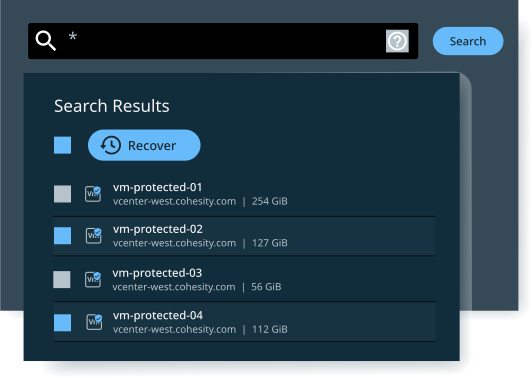
IT teams can apply backup policies across supported environments and search for a file, virtual machine or historical version to restore.
Keep recent information accessible after failure or attack.
Vendor-published healthcare case; planned and observed outcomes distinguished.

Illustrative virtualized application recovery from the official scope.
Map the essential application and dependencies.
Apply retention and access controls to copies.
Investigate threats and test an isolated restore.
Validate the recovery sequence with owners.
Cohesity sells technology that helps organizations protect data, recover it after disruption and use protected information for analysis. Its Data Cloud connects backup and recovery with security controls and AI-oriented access. The buyer may run databases in its own facilities, business applications in a public cloud and collaboration tools as SaaS. Those environments create different dependencies when an incident interrupts operations. Signet reads the company through the question of whether people can resume an essential service with trusted data. Keeping a backup is one part of that outcome; locating a suitable recovery point, checking it and restoring dependent applications are additional decisions. Cohesity's September research makes that distinction explicit by comparing system restoration with continued business operations. For a Korean applicant, a useful introduction starts with one service that must remain usable, such as an internal collaboration system or a business database. Explain its owner, the data it relies on, the acceptable interruption and the evidence needed before returning the recovered environment to use. That connects the product category to a task an enterprise actually has to complete.
Consider an enterprise preparing to recover a virtualized application after a cyber incident. This is an illustrative workflow assembled from published capabilities rather than a claim about a particular Korean customer. The team first identifies the application's data and dependencies and defines a protection policy. It keeps protected copies with the relevant access and retention controls, then investigates threats and chooses a recovery point. An isolated recovery environment provides a place to inspect and test the restored workload before reconnecting it. RecoveryAgent helps teams build and test blueprints that organize the sequence and handoffs. The business owner still needs to confirm that the application performs its required function. Signet would assess an implementation through those choices: how the recovery group was defined, who approved a sensitive action and what test established readiness. The product demonstration can show search and recovery controls, but the customer's exercise establishes whether the selected configuration fits its environment. A candidate can describe the difference between a successful backup job and a test of the recovery process that demonstrated service continuity under the agreed conditions.
Bethany Children's Health Center in Oklahoma supplies a named example of why recoverability matters. It treats children with complex medical needs and needs clinicians to regain access to recent information after a failure or attack. The vendor-published case describes immutable copies kept on premises and in FortKnox, with joint approval required for sensitive changes. A common interface helps the IT team oversee backup and restore activity across those locations. The story also describes plans for Gaia to help staff search documents and produce reports, so those prospective benefits should retain their stated stage. Signet sees a practical distinction between protecting a data copy and using that copy to support a clinical organization. The former needs permissions, retention and dependable recovery; the latter also needs a question, appropriate access and an answer that staff can trace. An applicant can use the case to explain what evidence they would ask for in a comparable project. The result would be a concrete discussion of operating requirements and tested outcomes, with the hospital's own expectations kept separate from guaranteed performance for every customer.
DataProtect covers enterprise backup and recovery across on-premises systems, clouds and SaaS workloads. Its published features include immutable snapshots, centralized management, global search and recovery of virtual machines, files and application objects. The buyer is usually an organization with several environments and a need to apply protection consistently. Administrators can use the search interface to locate an item or a suitable historical version, then choose the relevant recovery action. Certified deployment platforms and management options affect how that environment is operated. Signet would compare a proposal with separate backup tools or an alternative enterprise platform using the actual supported workload and deployment requirements. It would ask the team to validate permissions, restore behavior and the handling of failures in a customer exercise. The marketing page publishes large speed and cost comparisons, but the preparation here focuses on a testable scenario instead of assuming those figures apply to a new buyer. A candidate with support or implementation experience can show how they diagnosed the current setup, selected the appropriate policy and demonstrated the resulting recovery path to the customer.
NetBackup is part of Cohesity after the completed combination with Veritas' enterprise data protection business. The current product page presents paths to keep, extend or transform an existing environment, and identifies version 11.2 as the latest release. Its workloads include databases, virtualized applications and Kubernetes, with controls for threat scanning and recovery orchestration. The Data Cloud for NetBackup solution describes an architecture in which media services run on the platform and DirectIO supplies a path into SpanFS. That description specifies supported versions, giving a technical buyer a concrete compatibility check. Signet would read this as a way to improve a customer's environment while recognizing its established policies and operational habits. A sales or support discussion needs to know the current application, infrastructure and desired transition, then test the proposed integration. Alternatives include continuing the current deployment or adopting another enterprise backup product. The strongest candidate example shows a migration or extension whose dependencies, rollback plan and verification were understandable to both engineers and the business owner. A shared brand does not by itself establish that every feature is interchangeable across DataProtect and NetBackup.
Gaia makes protected enterprise information searchable for AI use while preserving access permissions and historical context. The current page describes SaaS, hybrid self-managed and air-gapped self-managed deployment options, with different interfaces and compute responsibilities. Its retrieval flow indexes protected material, applies access controls, retrieves relevant context and returns answers with citations. The on-premises discussion connects that design to validated infrastructure and NVIDIA software. Signet would begin with a buyer's data location, existing permissions and the question an employee or agent needs to answer. A regulated organization may prefer a deployment that keeps the data within its own infrastructure, while a connected deployment can integrate with supported AI tools. Those are architectural choices rather than evidence that a particular customer's compliance review has been completed. The page still identifies Gaia Catalog as coming soon and marks Glean integration as forthcoming; those stages belong in the evaluation. Compared with a separate search index or a new data pipeline, the proposed benefit is useful access to existing protected history. An applicant can explain retrieval quality, permissions, answer traceability and deployment responsibility with a concrete test.
Company-disclosed combined pro forma figures for fiscal years ending July; not legacy organic growth or a current2026total. These are dated disclosures, not a continuous growth record.
| Date | Value | Basis |
|---|---|---|
| 2023-07-31 | $1.3B | Combined pro forma FY2023ARR at announcement. |
| 2024-07-31 | $1.5B | Combined pro forma adjusted FY2024ARR at completion. |
Cohesity
Veritas enterprise data protection business joined Cohesity.
Cohesity offers software subscriptions, cloud services and partner-managed deployment routes for data protection and related capabilities. An enterprise pays for the agreed product and service scope rather than the monetary value of the information stored in its backups. The scope-of-license document defines entitlements and prerequisites, while the certified-platform page identifies supported infrastructure. Signet reads expansion through a buyer's additional workloads, security requirements and need to operate the service across more environments. Partners can contribute implementation, infrastructure and managed operations, making the delivery model relevant to the commercial plan. A candidate discussing growth should therefore state what the customer bought, who provided each part and how the customer verified the value. Protected data volume measures scale, and a customer count measures adoption; neither is an annual revenue amount. Likewise, the size of a market described in a press release measures an opportunity, rather than sales already earned. The distinction allows a commercial or technical applicant to connect a concrete customer project to a revenue mechanism without inventing a price, margin or contract value that the source does not provide.
The chart uses two company-disclosed annual recurring revenue figures for the combined businesses on a pro forma basis. The February 2024 announcement gave 1.3 billion dollars for the fiscal year ending July 2023, and the December 2024 completion release gave 1.5 billion dollars for the fiscal year ending July 2024. The latter release also described pro forma adjusted annual revenue above 1.7 billion dollars and an adjusted cash EBITDA margin of twenty-eight percent. ARR, annual revenue and that margin are distinct measures with distinct definitions. The chart is not a record of legacy Cohesity's organic growth and it should not imply an independently audited series or a current 2026 total. The transaction valued the combined company above seven billion dollars at completion, another separate historical measure. Signet uses the figures to show the commercial scale brought together by the transaction while keeping the dates and scope visible. A candidate can apply the same discipline to a customer example by stating whether a metric describes recurring commitments, recognized sales, activity or an expected future outcome.
Signet groups the operating watchpoints into three areas. First, portfolio integration has to respect existing customer investments while creating useful connections between products. The published deployment paths and version requirements provide evidence to examine rather than a reason to assume all environments can change at once. Second, recoverability depends on a customer's configuration and practice: permissions, trusted recovery points, application dependencies and clear decisions during an incident. The September research describes gaps in those conditions, with global survey results kept distinct from Korean-only conclusions. Third, expansion into AI access and agent recovery must preserve the scope and maturity of each capability. Gaia Catalog remains forthcoming, and the September agent announcement targets broad availability at the end of 2026 while offering access to select customers now. A candidate can explain how they managed one of these risks through a limited pilot, a compatibility check or a recovery exercise with the business owner. This is Signet's interpretation of what to follow, grounded in the company materials. It keeps adoption and implementation evidence alongside the scale figures so growth is assessed through what customers can actually use.

Founded Cohesity in2013after distributed-systems work.
Consolidate data across infrastructure.

Leads company direction.
Deliver a combined portfolio while supporting investments.

Leads product strategy.
Connect detection to practical recovery.

Leads worldwide field organization.
Deliver through sales, services and partners.
“No new console. No workflow changes. Just the power of Cohesity, wherever their AI already lives.”
Sanjay Poonen · Maestro announcement · 2026-06-16
Mohit Aron founded Cohesity in 2013 after work on distributed systems, including the Google File System and the co-founding of Nutanix. The current leadership page identifies him as Founder Emeritus, a different position from the earlier founder and chief executive role. Signet reads that history as a useful way to understand the company's interest in consolidating data across infrastructure. It is an editorial interpretation of the stated background rather than a claim that a biography predicts customer results. A backup environment has to retain information, find it and deliver it when other parts of the organization are under pressure. Architecture therefore matters through the operational behavior it enables, such as scaling capacity and locating historical versions. A candidate can prepare a distributed-system example where they made a tradeoff between performance, reliability and manageability and then verified the result. The relevant connection is the reasoning behind the design and the customer's ability to operate it. An impressive prior employer alone does not substitute for evidence of how a particular product works in an actual deployment.
Sanjay Poonen is CEO and President, while Vasu Murthy is Chief Product Officer and Kit Beall is Chief Revenue Officer. Their current responsibilities connect company direction, product strategy and the worldwide field organization. The field scope includes sales, presales, professional services, channels and alliances, giving a Korean applicant context for collaboration beyond one local team. Poonen's combination announcement committed to continuing support for products from both businesses. The contemporary NetBackup materials show that investment through specific deployment paths and release features. Signet would examine the leadership direction through these operating commitments: how customers can retain an established product, how teams explain an extension and how they deliver a supported change. Murthy's discussion of agent recovery adds another test, distinguishing detection of an unwanted action from the ability to recover afterward. These statements help explain priorities without replacing a product validation. For a candidate, the useful preparation is a project involving several teams where the scope, responsibilities and acceptance criteria remained clear as the technology changed. That example makes a large combined portfolio easier to reason about through a real decision.
The current employer material states integrity and respect as working values and describes continuous learning and collaborative colleagues. The Korean technical-support advertisements connect that cultural language to concrete tasks: record the investigation, explain the issue and develop knowledge articles that other engineers can reuse. Signet interprets integrity here as being precise about what the team observed and what remains a hypothesis. Respect can appear in the way an engineer communicates during a customer's disruption and shares context with the next team. Those are preparation suggestions based on the employer's expectations, not a promised assessment rubric for an interview. The partner leadership role adds coaching, performance management and collaboration with sales engineering and renewals, so its evidence should include how the candidate helped others deliver a plan. A useful example includes a difficult decision, the information available at the time and what changed after the result was checked. This makes the values visible through behavior. It also encourages an applicant to discuss a limit honestly, rather than present every forecast or product claim as an outcome already achieved.
Both support advertisements describe investigation, troubleshooting, timely resolution and reusable knowledge articles, with collaboration across engineering and account management. They list three to twelve years of experience in storage, networking and virtualization environments, Linux administration and diagnostic tools, and remote file protocols such as NFS and SMB. The senior advertisement additionally states Korean fluency and business English; that explicit language requirement should not be silently copied into the second advertisement, whose visible requirement list does not include it. Both mention using AI tools to improve work. Signet would suggest preparing an incident where the candidate separated an observed symptom from a likely cause, chose the next diagnostic step and explained the result to the customer. Include what went into the case record and what another engineer could reuse afterward. This is preparation advice rather than an employer-promised first ninety-day plan. The examples should keep the environment, personal contribution and outcome clear. A large technical vocabulary is useful when it explains a diagnosis; the stronger evidence is a chain of decisions that led to a checked resolution and better shared knowledge.
The live board supplies functions, not a reporting chart.
Support local customer environments and develop partner routes.
The live official board lists three Korea-based openings on October 10: Senior Technical Support Engineer, Technical Support Engineer and Director of Enterprise Partner Sales. The first two belong to the support organization and are full-time Seoul roles; the third owns partner sales activity and the Korea channel plan. This is a hiring snapshot rather than a count of all employees or proof of a particular reporting line. The company also publishes a Seoul office at the thirty-fifth floor of 300 Olympic-ro in Songpa-gu. The employer material describes two or three office days a week for employees within a reasonable commute, and the support advertisements prefer candidates near the designated location or committed to relocation with work authorization. Signet reads the local presence through maintaining customer operations and developing routes to market. A support example and a partner leadership example should therefore make different contributions visible. The former can show diagnosis and customer communication; the latter can show a team plan, partner development and accountable execution. A title alone is less informative than the original responsibilities and requirements.
Both support advertisements describe investigation, troubleshooting, timely resolution and reusable knowledge articles, with collaboration across engineering and account management. They list three to twelve years of experience in storage, networking and virtualization environments, Linux administration and diagnostic tools, and remote file protocols such as NFS and SMB. The senior advertisement additionally states Korean fluency and business English; that explicit language requirement should not be silently copied into the second advertisement, whose visible requirement list does not include it. Both mention using AI tools to improve work. Signet would suggest preparing an incident where the candidate separated an observed symptom from a likely cause, chose the next diagnostic step and explained the result to the customer. Include what went into the case record and what another engineer could reuse afterward. This is preparation advice rather than an employer-promised first ninety-day plan. The examples should keep the environment, personal contribution and outcome clear. A large technical vocabulary is useful when it explains a diagnosis; the stronger evidence is a chain of decisions that led to a checked resolution and better shared knowledge.
The partner director advertisement calls for leadership of alliance, cloud, managed-service, reseller and distribution relationships, with hiring, coaching and performance management. It seeks major Korean SI account-management experience, knowledge of the Korean market, a customer and partner network, sales-data analysis and English and Korean communication. Its responsibility list assigns Korea, while the introductory paragraph unexpectedly refers to key partners in Japan. The original wording is preserved and that inconsistent territory reference is recorded for review, so the applicant can resolve it with the hiring team rather than have the article silently change the job. Signet would prepare a partner plan with the target segment, each partner's contribution, the team's execution and the measured result. Local event plans supply another signal of market activity: the official tour page schedules November sessions in Busan, Gwangju, Daejeon and Seoul. Those are future dates as of this research and should be described as scheduled. Together, the hiring and event evidence support a discussion of customer and partner work in Korea without inventing a local executive, headcount or named paid customer.
Current Signet catalog · 2026-10-19
Explain a recovery decision with clear owners, evidence and outcomes.
The June 16 announcement introduced Maestro as a path to expose Data Cloud actions, signals and Gaia through Model Context Protocol. It connects company direction to enterprise teams' chosen AI workflows, with platform permissions, authentication and auditing still governing access. The availability section explicitly says Copilot, RecoveryAgent and Gaia MCP support were available, while the Maestro MCP interface and additional agents were expected later in the year. Signet therefore treats the announcement as a staged product direction and follows which specific capabilities a customer can use under its subscription. A demonstration needs a defined action and permission boundary, with an understandable result in the existing operating workflow.
On September 16 Cohesity introduced Agent Resilience for the infrastructure behind AI agents. The release supports Amazon Bedrock AgentCore and Bedrock Agents, with Microsoft and Google platforms on the roadmap. It says select customers can use the capability now and targets general availability for the end of 2026. Protection of agent memory and configuration supplies the initial scope, while the wider autonomous cyber-resilience model remains a vision with further automation planned. The same release describes an available policy-based way for Enterprise Edition and DSPM customers to protect newly discovered sensitive data. Signet would watch recovery exercises, supported resources and the controls on a restore, keeping the present release separate from the broader planned model.
September's commissioned Vanson Bourne research surveyed 3,200 IT and security decision-makers at organizations with at least 1,000 employees across twelve countries, including South Korea. Seventy-eight percent prioritized restoring systems, while twenty-two percent had documented and tested how critical operations would continue. These are aggregate survey findings with their sample and methodology, not a Korean market rate or a measured performance outcome for Cohesity customers. Signet connects the report to the next practical evidence: a recovery plan with dependencies, decision owners and a recovery exercise of the essential business function. That gives support and partner teams a concrete conversation about the customer's readiness. Combined with the staged AI releases, it explains what to follow after a launch: an environment the customer has configured, tested and can trust during disruption.
Cohesity sells technology that helps organizations protect data, recover it after disruption and use protected information for analysis. Its Data Cloud connects backup and recovery with security controls and AI-oriented access. The buyer may run databases in its own facilities, business applications in a public cloud and collaboration tools as SaaS. Those environments create different dependencies when an incident interrupts operations. Signet reads the company through the question of whether people can resume an essential service with trusted data. Keeping a backup is one part of that outcome; locating a suitable recovery point, checking it and restoring dependent applications are additional decisions. Cohesity's September research makes that distinction explicit by comparing system restoration with continued business operations. For a Korean applicant, a useful introduction starts with one service that must remain usable, such as an internal collaboration system or a business database. Explain its owner, the data it relies on, the acceptable interruption and the evidence needed before returning the recovered environment to use. That connects the product category to a task an enterprise actually has to complete.
Both support advertisements describe investigation, troubleshooting, timely resolution and reusable knowledge articles, with collaboration across engineering and account management. They list three to twelve years of experience in storage, networking and virtualization environments, Linux administration and diagnostic tools, and remote file protocols such as NFS and SMB. The senior advertisement additionally states Korean fluency and business English; that explicit language requirement should not be silently copied into the second advertisement, whose visible requirement list does not include it. Both mention using AI tools to improve work. Signet would suggest preparing an incident where the candidate separated an observed symptom from a likely cause, chose the next diagnostic step and explained the result to the customer. Include what went into the case record and what another engineer could reuse afterward. This is preparation advice rather than an employer-promised first ninety-day plan. The examples should keep the environment, personal contribution and outcome clear. A large technical vocabulary is useful when it explains a diagnosis; the stronger evidence is a chain of decisions that led to a checked resolution and better shared knowledge.
Employer postings were checked on 2026-10-10. Availability can change. Mock applications request a review from Signet.
Follow the company from its vision through products, evidence and people to the Korea team and current roles. Use the table of contents to move within the page, and expand the sections for more context.