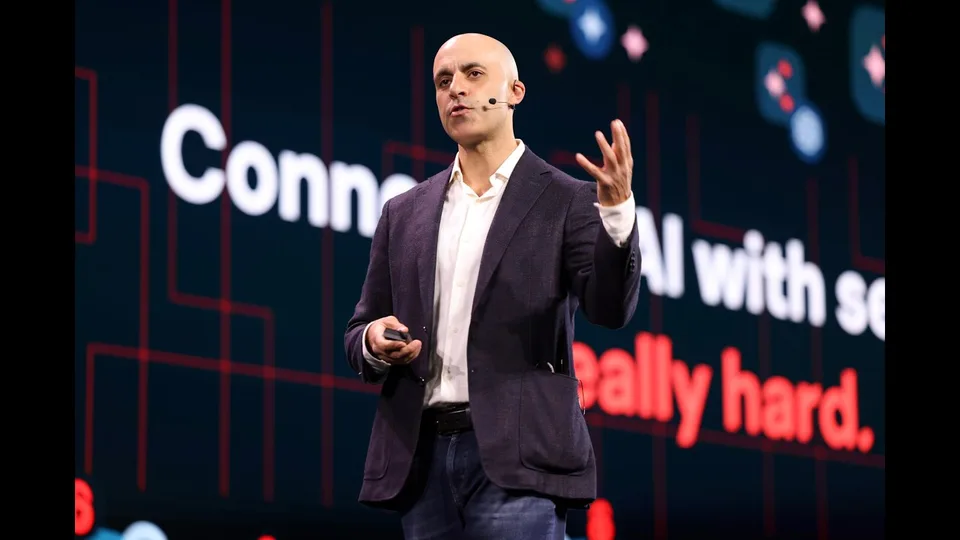
Databricks co-founder and CEO Ali Ghodsi speaking at Data + AI Summit 2026
Databricks / THE WORLD THEY ARE BUILDING

Turn data into a system teams can build on.

The opportunity is to close the gap between a data platform and operational action. As more applications depend on the same context, dependable delivery and governance become part of the product’s value.

See it taking shape ↓
01 / THE PRODUCTS

The products behind the promise.

Lakeflow Pipelines editor: code, pipeline graph and Genie assistance.
Lakeflow

Ingest and transform streaming and batch operational data.

Provide current context for analytics and models.

Rolls-Royce Civil Aerospace

Monitor engines with live data

The customer story describes real-time engine monitoring and shared analytical access.

The published case describes streaming datasets processed in the lakehouse and shared analytics across teams.

What changed? +

Jet-engine availability requires continuous insight from flights and environmental conditions.

The official customer case describes an Azure deployment and the selected engine-monitoring workflow.

Lakeflow Pipelines editor: code, pipeline graph and Genie assistance.
02 / HOW IT BECOMES REAL

From machine telemetry to a maintenance application

An illustrative energy operator combines sensor readings with work orders. The journey follows Databricks’ published predictive-maintenance architecture, not a fabricated customer rollout.

  1. 01

    Combine live signals with asset history

    Lakeflow prepares streaming and batch inputs alongside maintenance records. Context makes an alert more useful than an isolated sensor value.

  2. 02

    Track who can use data and models

    Unity Catalog manages permissions and lineage. Teams can see the source and ownership behind the data used in an operational model.

  3. 03

    Check the model before acting on its score

    MLflow evaluates, traces and monitors the model. The operating team needs to know how an alert behaves before it becomes a work instruction.

  4. 04

    Put the result in the team’s application

    Databricks Apps exposes the workflow while Lakebase holds low-latency operational state such as acknowledgments. People can act without a separate spreadsheet export.

Follow the work, step by step

Start with the company’s data

Databricks began in 2013 with a team rooted in academic research and open source. Its commercial bet is that a company should be able to use the same governed data foundation for engineering, analytics and AI. That question has become more practical as employees ask an AI assistant to explain a business result or act on it. An answer has to respect the meaning of a table, the user’s access rights and the way the business measures success. The platform brings those responsibilities into the same working environment rather than treating each new application as a separate data project.

Consider a manufacturing team investigating a machine that keeps stopping. The published platform materials describe collecting operational and enterprise data, preparing it for analysis and making it available under common governance. In an illustrative workflow, an engineer checks which measurements represent the machine, corrects the pipeline and agrees an access policy before another team uses the result. A useful model comes after those decisions. This is the part of the proposition that a candidate can examine: who defines the data, who is allowed to use it and whether the final output helps someone make a real operational decision.

An agent needs business context

The 2026 product direction extends that foundation to the work of business teams. Genie One connects governed data with information from workplace applications, and Genie Ontology is described as a live context layer. The useful distinction is between finding a fragment of text and understanding which business record can support an answer. A sales team asking about an account needs the right customer and transaction definitions. A finance team needs the right period and measure. Signet’s reading is that Databricks is competing over that connection between enterprise information and a dependable action, with governance carried into the agent’s work.

Lakebase adds an operational Postgres database to this story. Lakeflow prepares and moves data; Unity Catalog governs it; Genie helps people ask questions and work with the answers. Those roles are connected, but they are distinct products and responsibilities. The company’s releases also place model choice and AI cost control alongside context. A production application therefore has several tests to pass: the data has to arrive reliably, the answer has to use the right context, the user has to have permission and the workload has to fit the customer’s budget. That is a more demanding task than a convincing first demonstration.

The final test happens at the customer

The Korea postings make that work visible. AI FDEs build and productionize generative AI applications. Forward Deployed Engineers own architecture and implementation across data engineering, AI and applications. The technical programme role coordinates a portfolio of engagements, customer objectives and technical dependencies. These are different routes into the same adoption problem. The commercial platform becomes valuable when the customer can keep using what the team built. A candidate should therefore bring an example with a clear starting condition, technical decisions, people involved and a result that survived the first launch. That follows the published remit of delivery, not a promise of a particular career path.

Read the ten Korea roles as a set. Technical sales managers build and coach teams; architects help customers choose workable designs; the industry GTM leader connects manufacturing and automotive needs with regional sales; sales development management creates and improves the pipeline. Delivery engineers then turn the agreed use case into working systems. Signet’s interpretation is that the handoffs matter as much as individual product expertise. The candidate’s question is concrete: where in that chain has your experience changed a customer’s decision or removed a delivery obstacle? The job-family selector separates those responsibilities so you can start with the work closest to your own.

Understand the products and their customers

Prepare it, then govern it

Lakeflow addresses the engineering work before an analyst or an application can rely on the data. Its documentation shows a development environment with code and a pipeline graph, making the relationships between inputs and transformations visible. For a candidate, that screen is a clue about the job rather than a claim of effortless automation. A pipeline still needs a source owner, a transformation that matches the business meaning and a way to deal with failures. The platform packages the environment in which those tasks happen. The customer outcome to examine is a dependable flow of usable data, with someone accountable when it changes.

Unity Catalog handles a different part of the problem: discovering data and enforcing permissions around its use. The access-request interface shows that obtaining a table is a governed action. This matters when engineers, analysts and agents share a platform. Connecting more teams increases the value of the data, while also increasing the need to know what each person can see and do. A solutions architect should be able to connect that control to the customer’s requirements. A security specialist should be able to explain the policy and validate the result. The product is useful through those decisions, not simply through the presence of a catalogue.

Ask a question, build an application

Genie’s documented response interface combines a question with a query result, a table and a chart. The later Genie One announcement broadens the work to business applications and reusable agents. Those are related stages of the product story: an employee first needs an answer grounded in the organisation’s data, then a repeatable way to act on it. The company describes permissions and governance as part of that process. A useful evaluation asks whether the answer uses the correct business definitions and whether a colleague can reproduce the result. Signet would look for an example of adoption, not only an attractive response in a prepared demonstration.

Lakebase supplies operational Postgres for applications and agents. Its project-creation screen is a useful reminder that the platform now reaches beyond analytical reports into the records an application reads and writes. The engineer has to think about an application’s state, database configuration and deployment, as well as the data used to generate an answer. Databricks connects that product direction to its AI strategy in its financing releases. For a customer-facing builder, the question is which part of the customer’s architecture belongs in this operational database and how it should connect to existing systems. The answer depends on the workload and the customer’s constraints.

A Korean customer makes the case tangible

The KRAFTON customer story gives a concrete version of the shared-platform argument. Its game development teams had been working across different data systems. The story describes consolidating data access and use through Databricks and reports 20PB of data from more than 40 services. Those figures describe the selected customer case at the time of publication. They are not a platform-wide performance promise. What matters for a candidate is the change in work: people across game teams can use a common data foundation while access remains controlled. The engineering and governance tasks are inseparable in that account of adoption.

The manufacturing material and the Rolls-Royce case add another setting: operational measurements become a basis for analysing equipment and improving decisions. A data platform has to fit the customer’s workflow, not only store its information. That is why the Korea hiring spans architects, specialists, engineering managers and FDEs. Each role owns a different test of the product’s usefulness. You might explain an architecture before purchase, build a reliable application after purchase or coordinate the delivery programme that connects both. Start with the product that your experience helps a customer use, then follow the job detail to see the exact qualifications and working conditions.

03 / THE EVIDENCE

The story, in numbers.

DATED OBSERVATIONS

Reported annual revenue

USD · B

Reported private-company fiscal-year revenue is kept separate from dated company run-rate disclosures.

Figures, dates & basis +
Reported annual revenue
DateValueBasis
2024-01-31$1.6B+Databricks disclosed over $1.6B of revenue for the fiscal year ending January 31, 2024. The value is a disclosed lower bound.
2025-01-31$2.6BARK cites reported revenue for the fiscal year ending January 2025, separately from a mid-2025 run-rate forecast.

Databricks · ARK Invest

DATED OBSERVATIONS

Funding-round valuation

USD · B
Funding-round valuation2026-02-09: $134B; 2026-08-13: $190B$134BFeb 2026$190BAug 2026

Transaction valuations; financing amounts and debt capacity are not revenue. These are dated disclosures, not a continuous growth record.

Figures, dates & basis +
Funding-round valuation
DateValueBasis
2026-02-09$134BValuation in the Series L financing announcement.
2026-08-13$190BClosed strategic round valuation; replaces the July $188B term-sheet stage.

Databricks · Databricks via Sixth Street

Company founded

The Spark research ecosystem became an enterprise software company.

$5.4B run-rate

The company reported scale and further Lakebase and Genie investment.

Funding closes

$5B funding closed at a $190B valuation; this supersedes the July $188B term-sheet stage.

Read the growth story

Keep the measurement with the number

Databricks reported a revenue run-rate above $7B in August 2026, following a figure above $5.4B in February. The measurement matters as much as the increase. A run-rate extends a current revenue pace over a year; it should be read separately from revenue recognised over a completed fiscal year. The chart keeps those measures in different series. That lets a candidate read commercial momentum without confusing it with an annual financial statement. The dated company releases are useful milestones, while the work behind them remains customer workloads that keep consuming the platform. Look at the period and the basis before comparing any headline number.

The August financing closed at a $190B valuation, whereas the July announcement concerned a signed term sheet at $188B. Those are successive transaction stages. The financing amount, valuation and operating run-rate answer different questions and should stay separate. Investment can support product development; valuation records the agreed terms of a transaction; consumption reflects the customer work being paid for. A person joining the company should be able to explain which number supports their understanding of the business. Signet reads the releases as evidence of resources and product direction, while using customer stories and job descriptions to understand the work that turns those resources into adoption.

The customer pays for work running

The pricing materials describe usage units, including DBUs for processing and DSUs for storage, with contractual arrangements around the service. This makes consumption inside an account a practical commercial question. A customer may begin with one workflow and add more as teams find useful applications. The field engineering manager postings explicitly connect team effectiveness, platform use and consumption targets. A candidate should understand that connection without assuming every technical project becomes expansion. The project has to solve a customer problem well enough to be used. Good discovery and architecture make that outcome more plausible; reliable delivery and enablement help the customer keep operating it.

Professional services adds an implementation responsibility alongside the software. The FDE page describes support for migrations, data and AI projects and broader adoption. The engineer posting states that FDEs are billable and responsible for completing projects to specification. That combination explains why delivery quality has a place in the business model. The customer needs a working system and a way for its own people to use it; Databricks needs adoption to connect with continued use. A programme manager coordinates the dependencies between engagements. An architect helps resolve design choices. Different roles participate in the same commercial outcome through different kinds of accountability.

Evaluate the workload and its controls

Data platforms compete for the customer’s analytics, engineering and AI work. Snowflake is a relevant comparison for enterprise data workloads; the buyer also has cloud services and its existing architecture to consider. A useful comparison starts with the customer’s task, data location, permissions, integration requirements and budget. It should not turn different companies’ revenue measures into a direct technical ranking. Signet’s reading is that Databricks’ combination of operational data, analytics and agents creates both an opportunity and a delivery obligation. The product has to fit a real workflow, and the candidate has to understand why the customer would adopt that combination.

Three practical risks follow from the published proposition. Workload cost needs attention because the service is usage-based. Data and permission design need attention because an agent’s answer depends on governed business context. Implementation needs attention because a pilot has to become a system the customer operates. These are Signet’s reading of the pricing, product and delivery materials. They give a candidate useful things to examine: how a team monitors cost, how it validates an answer and how it takes responsibility after launch. A strong example of handling one of those tensions can explain your fit more clearly than a general enthusiasm for AI.

04 / THE PEOPLE

Someone saw it first.

Photograph of Ali Ghodsi.
Co-founder & CEO

Ali Ghodsi

Ghodsi joined the Berkeley research ecosystem as a visiting scholar and helped create the Spark-related venture.

The choice behind the company +

The founders turned research software into a managed enterprise platform, later broadening into data and AI applications.

“Enterprises don't just want AI that talks.”

Ali Ghodsi · Company announcement · 2026-08-13
The decisions behind the company

Research became a company

Databricks’ origins matter because they explain the platform’s preference for an open data foundation. The company dates its founding to 2013 and links it to the creators of Apache Spark and other open-source projects. Its story then moves from a research community to enterprise software that customers use in their own operations. The relevant question for a candidate is how that technical inheritance is translated into a commercial service. Engineering has to serve an actual workload; sales has to explain why the customer should change; delivery has to make that change work. The company’s shape joins those responsibilities rather than treating the origin story as a substitute for them.

Ali Ghodsi is the co-founder and CEO in the company’s current releases. The 2026 summit announcement also names Matei Zaharia, Arsalan Tavakoli-Shiraji and Reynold Xin as co-founders on the main stage. Naming those people is useful when it explains a product or field responsibility, rather than filling a page with biographies. Tavakoli’s Korean partnership statement connects field engineering with the local market. Ghodsi’s financing statements connect investment with Lakebase and Genie. Those are decisions a candidate can follow through the products and the work advertised in Korea. They tie the leadership story to what the company is asking people to build and sell.

The investment follows a product decision

The February 2026 release describes two product directions for the next stage: operational databases for agents and conversational access to data for employees. In June, Genie One brought a broader business-workflow proposition. In August, the company again placed Lakebase, Genie and AI cost controls at the centre of its investment case. Read that sequence as a leadership choice about which enterprise problems deserve engineering effort. The commercial ambition depends on employees and developers using the platform for more kinds of work. A candidate’s contribution needs to connect with one of those uses, whether through technical implementation, customer architecture or a sales organisation that understands the use case.

The founder’s short line, “Enterprises don't just want AI that talks.”, captures one part of that choice. The surrounding release is about agents that remember context, answer accurately and execute work within a budget. It is a statement of product intent. It should be tested against a customer’s actual deployment. Signet’s reading is that this creates room for technically strong people who can translate a business problem into an operational result. It also creates a high bar for claims made in a demonstration. The candidate should be ready to explain both what the system did and how the team established that the result was dependable.

Principles have a place in the interview

The careers page publishes six culture principles. Customer focus, decisions grounded in data and a bias for action are especially relevant to the customer-facing postings, because those jobs combine technical judgement with delivery and commercial goals. The hiring page says role-specific competencies and culture principles are assessed in a structured process. A presentation is part of some go-to-market and executive hiring. Those statements describe the company’s general process; the recruiter sets the process for a specific opening. For preparation, a detailed example is more useful than repeating a value. Show a decision, its evidence, the people who disagreed and the action you took.

Korea leadership should be read with dates attached. 강형준 was appointed country manager in 2024 and appears as the Korea leader in 2026 coverage. Earlier announcements of other local appointments describe the team at that time. The page therefore focuses on the current, supported leader and the job responsibilities being hired, with the team view presented on its stated basis. For someone joining, that separation helps connect leadership with the work without turning a historical announcement into today’s entire reporting structure. Ask how your particular seat collaborates with field engineering, services and sales, then use the employer posting to anchor the answer.

05 / THE NEXT CHAPTER

Make complex Korean programmes deliver

The roles connect customer demand with architecture, reliable implementation, team development and continued platform use.

LOCAL & REGIONAL LEADERSHIP

강형준

Country Manager, Korea

Sales
  • Enterprise Account Executive
  • Sales Director
  • Senior SDR Manager
Engineering
  • Forward Deployed Engineer
  • Solutions Architect
  • AI/ML Specialist
Information Technology
  • Delivery Solutions Architect
Operations
  • Senior Engagement Manager in FDE
Business Development
  • Head of Partnerships, Korea
  • Business Development Representative

The public-profile reading supplies the current work shape; dated company and press sources confirm the named Korea leader. Profile filters describe observations and do not establish reporting lines.

Why Korea? Why now?+

Korean customer cases and the KT partnership show data and AI work across games, manufacturing and regulated industries. The ten current roles span commercial development, architecture, management and delivery.

Korea growth reported

The company reported growth in its Korea business for the completed fiscal year.

KT partnership

KT and Databricks announced collaboration in data and AI work and skills.

Understand the Korea opportunity

Customers already have complex work

The Korean opportunity is grounded in named customers and partnerships. KRAFTON’s story describes a common data foundation across game teams. The KT collaboration connects Databricks with data and AI work for regulated industries and the public sector through KT’s cloud offering. These sources show distinct routes to adoption: a customer can operate its own data platform, and a partner can help bring the platform to other organisations. The partnership statement identifies areas of collaboration and skills development. Read those as the scope announced at the time, with the customer case giving a concrete example of actual use. They are useful context for why delivery and technical sales appear together in hiring.

Korea country manager 강형준 appears in dated press coverage of the business. The hiring gives a second view of the organisation: it asks for a mix of builders, architects, technical leaders, programme delivery and commercial management. The APJ industry role includes Seoul among several regional locations, while the other current postings identify Seoul. A role’s location list and language requirements belong to that posting; they should not become a claim that every job has the same arrangement. The team view on this page carries its own basis, and the job cards preserve employer titles and conditions so an applicant can compare the work accurately.

Ten jobs, several responsibilities

The AI Engineer, FDE and Forward Deployed Engineer postings ask for people who can build working customer systems. The first centres on generative AI deployment; the second covers architecture and implementation across data, AI and applications. Field Technical Program/Project Manager has a different responsibility: coordinating a portfolio of complex programmes, milestones and dependencies. Solutions Architect and the specialist architecture seats help customers validate a design and use the platform. The industry GTM role connects manufacturing and automotive demand to the regional business. Sales development management leads the Seoul business-development team and its pipeline. Each opening has its own detail sheet and mock application, with the three-line reading drawn from its own wording.

Management seats make the team-building responsibility explicit. The specialist solutions architect manager coaches a team that supplies depth in complex sales engagements. The senior field engineering manager builds and leads pre-sales architects for the Korean market. The sales development manager recruits and develops BDRs, analyses performance and works with sales and marketing. These are different teams with different goals. A candidate should choose a case that matches the seat: improving an architecture team’s contribution, scaling technical pre-sales or helping a development team produce qualified opportunities. Numbers and team sizes in your own example should be yours, while the employer’s requirements stay attached to the specific posting.

Prepare the decision you can explain

Several postings specify native Korean and a particular level of English; the exact strength differs by job. The programme posting requires PMP and a Databricks Associate certification within six months of hire. Technical and management requirements also differ, and preferences should stay distinct from requirements. Preparing well starts with reading that distinction. Then reconstruct one relevant project: the customer’s goal, the architecture or operating choice, the people involved, the constraint you faced and the result. That is the material you can take into a mock application. It lets you test whether your experience speaks to the role before moving into the employer’s own process.

Signet’s first-quarter reading is a preparation framework, not an employer schedule. Begin by learning the customer context and the platform responsibilities relevant to your seat. Next, agree a specific use case and the tests that show it works. Then connect the pilot or sales motion with the customer’s operating team and the colleagues who will carry it forward. For a builder, that means production and evaluation. For an architect, it means a design the customer can use. For a manager, it means improving the team’s decisions and handoffs. The common thread is accountable customer adoption, with your actual responsibilities determined by the posting and the hiring discussion.

KOREA OPEN ROLES

10 open roles in Korea

Current Signet catalog · 2026-10-19

FOR YOU

Pick a role and test your explanation in a mock application.

Engineering · AI

AI Engineer - FDE (Forward Deployed Engineer)

Seoul, South Korea

Posting checked

The work
Build and deploy customer GenAI applications.
Who fits
7+ years building GenAI applications and production deployment expertise.
Keep in mind
Own production GenAI rollouts; travel once every 4 to 8 weeks to see customers as needed.
GTM · Sales · BD

APJ Manufacturing & Automotive Industry GTM Leader

Seoul, South Korea; Singapore; Tokyo, Japan

Posting checked

The work
Lead manufacturing and automotive GTM across APJ.
Who fits
10+ years of manufacturing leadership, including 5+ years in technology GTM, strategy or BD.
Keep in mind
Regional work covering Japan, Korea and India; regular APJ travel.
Solutions Engineer

Field Engineering Manager, Specialist Solutions Architects

Seoul, South Korea

Posting checked

The work
Hire and coach specialist architects for complex customer engagements.
Who fits
5+ years managing technical teams and 5+ years building data solutions.
Keep in mind
Hire and grow the team, own regional consumption targets and report to the Director, Field Engineering.
See all 10 roles
Customer Success

Field Technical Program/Project Manager

Seoul, South Korea

Posting checked

The work
Lead complex delivery programmes and coordinate technical dependencies.
Who fits
5 to 8 years managing complex technical programmes.
Keep in mind
Korea hybrid; PMP and a Databricks Associate certification within six months.
Engineering · AI

Forward Deployed Engineer

Seoul, South Korea

Posting checked

The work
Own architecture and build customer data, AI and application systems.
Who fits
7+ years in data engineering, analytics or software engineering; cloud and Spark experience.
Keep in mind
Billable customer delivery, reporting to Korea's FDE Director; travel to customers 20% of the time.
Solutions Engineer

Solutions Architect

Seoul, South Korea

Posting checked

The work
Guide customer architecture and platform adoption with account executives.
Who fits
Coding, cloud and complex proof-of-concept experience.
Keep in mind
Seoul hybrid; build reference architectures and demo apps and lead workshops.
Solutions Engineer

Specialist Solutions Architect - Data Warehousing

Seoul, South Korea

Posting checked

The work
Guide warehouse evaluation, tuning and production migration.
Who fits
5+ years in technical warehouse roles, plus customer-facing and production programming experience.
Keep in mind
Guide performance evaluations and production migrations; Databricks certification is a nice-to-have.
Solutions Engineer

Specialist Solutions Architect - Security

Seoul, South Korea

Posting checked

The work
Design security architectures and support customer platform security reviews.
Who fits
5+ years with external clients and 3+ years designing cloud infrastructure.
Keep in mind
Guide security reviews and cloud identity/network design; Databricks certification is a nice-to-have.
Solutions Engineer

Sr. Manager, Field Engineering

Seoul, South Korea

Posting checked

The work
Build and lead Korean pre-sales solutions architects.
Who fits
Pre-sales management building and developing Big Data, Cloud or SaaS teams.
Keep in mind
Report to Korea's Field Engineering Director; own hiring, team growth and presales efficiency.
GTM · Sales · BD

Sr. Manager, Sales Development

Seoul, South Korea

Posting checked

The work
Recruit and coach the Seoul BDR team and improve pipeline generation.
Who fits
2 to 3 years minimum as a sales development manager and quota-carrying sales experience.
Keep in mind
Report to the Sales Development Director; own team pipeline targets, hiring and coaching.
07 / NOW & NEXT

The next scene is taking shape.

Revenue run-rate exceeds $5.4B

Databricks reported $5.4B+ and over 65% year-over-year growth.

Strategic round term sheet

Databricks announced a signed funding term sheet at $188B valuation.

Funding closed at $190B

The company closed $5B financing and reported $7B+ revenue run-rate.

More context on what comes next

Two operating milestones

February and August 2026 provide two company-reported run-rate milestones. Read the later figure with its date and measure, and keep it separate from completed fiscal-year revenue. The movement gives context for the scale of customer use. It does not tell an applicant which Korean workload produced it. That question belongs to customer cases, local sales and the implementation work described in the current postings.

September’s Row Zero acquisition adds a newer product direction to that investment story. The company announced a planned spreadsheet experience inside Genie, connected with live data, permissions and auditability. Preserve the timing: the acquisition is completed, while native integration is described as the next product step. Signet reads this as a way to meet finance and operations teams in the tools they already use, with the context and controls carried into their models and actions.

A broader task for Genie

The June Genie One launch moved the story from a query assistant toward business workflows and reusable agents. The company connects that direction with a live context layer and governed data. For someone considering the company, the next question is practical: which employee tasks can use that context reliably, and how does a customer validate the answer before it becomes an action?

Lakebase adds the operational database side of that same direction. A customer application needs somewhere to keep and change its records as well as a way to understand them. Together, the products increase the kinds of work the platform addresses. They also make architecture, permissions, integration and cost more visible in the candidate’s work. A useful preparation example connects those conditions with one actual customer outcome.

Watch the path from sale to use

The Korea roles are a current view of how the company expects that work to happen. Hiring spans sales development, an industry GTM remit, technical architects, engineering managers, programme coordination and builders. Read them together to understand the handoffs, then choose the seat whose responsibility matches your experience. The company page keeps all ten roles equal so the hiring story remains broader than one selected vacancy.

For a candidate, the next step is to test the connection between the company’s product direction and your own work. Pick a role, read the employer original and prepare a concrete account of a decision you made. A mock application lets you practise that explanation inside Signet. New employer announcements and the live role list can change the picture, so this reading retains the dates and conditions behind each claim.

Their future. Your next chapter.

Find your part ↑

An independent profile by Signet. No affiliation or investment recommendation. Introductions happen only with your consent.
Research reviewed 2026-10-08

A LITTLE MORE CONTEXT

Understanding Databricks.

What does Databricks do?

A useful sensor alert connects a measurement with its history and a decision the maintenance team can act on. Databricks brings operational data, analytics and AI onto a governed foundation and connects it to applications people use.

What is the opportunity in Korea?

The roles connect customer demand with architecture, reliable implementation, team development and continued platform use.

Are these confirmed job openings?

Employer postings were checked on 2026-10-08. Availability can change. Mock applications request a review from Signet.

How can I explore the company in more depth?

Follow the company from its vision through products, evidence and people to the Korea team and current roles. Use the table of contents to move within the page, and expand the sections for more context.

Back to the collection ↗