Official photograph of Olivier Pomel
Datadog / THE WORLD THEY ARE BUILDING

See the problem before the customer does.

The MCP Server gives AI agents governed access to live operational evidence. The opportunity is faster investigation with the same observability context engineers use, while teams still need to validate actions and outcomes.

See it taking shape ↓
01 / THE PRODUCTS

The products behind the promise.

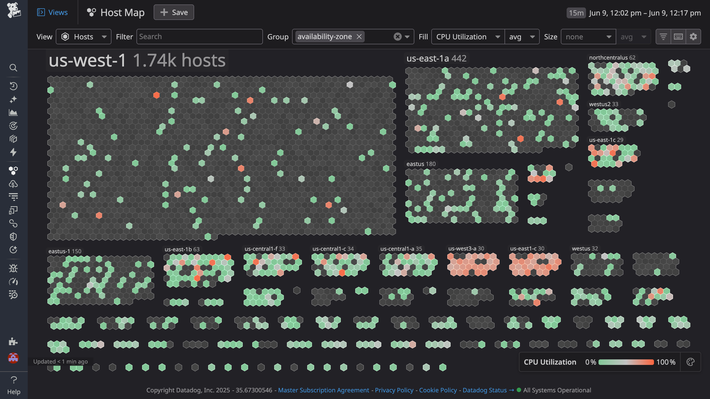
Datadog Host Map grouped by availability zone and colored by CPU use
Official Infrastructure Monitoring product screenshot of Host Map. The displayed hosts and metrics are demo content.
Infrastructure Monitoring

Inspect metrics across cloud infrastructure, hosts and containers.

Operations teams can find the infrastructure context of an incident.

GS Retail

Give operations and franchises a shared service view

GS Retail reports earlier detection, faster root-cause investigation and fewer support tickets in its customer case.

The case describes shared infrastructure, APM, logs and network visibility, alongside Real User Monitoring for franchise-user experiences.

What changed? +

During a cloud migration, GS Retail needed to monitor more than 100 previously on-premises workloads and services used by franchise owners.

Datadog-published Korean customer case, including the 2023 migration context.

Samsung

Connect telemetry to regional incident investigation

The case reports identifying a regional issue within one minute in the described workflow.

Its case connects Datadog telemetry and MCP with an AIOps workflow using Amazon Bedrock.

What changed? +

Samsung’s Big Data Center operates a unified authentication platform serving more than 60 services.

A vendor-published result for one regional incident in the customer’s own environment.

Datadog Resource Catalog showing one cloud host with two triggered monitors and three open issues
Official Infrastructure Monitoring screen: a host summary with the monitors that fired, an agent due for an upgrade, a broken integration and a misconfiguration. The hosts and values are demonstration data.
02 / HOW IT BECOMES REAL

From an error spike to an explained incident

Illustrative incident investigation, grounded in the three monitoring products.

  1. 01

    Locate the affected infrastructure

    Infrastructure Monitoring collects resource and service signals. The on-call engineer checks whether the error coincides with a host, container or resource change.

  2. 02

    Follow the request through services

    APM traces show where a request spends time and which service returns an error. Engineers narrow the investigation to a dependency or code path.

  3. 03

    Read the logs in context

    Log Management lets engineers search the relevant events. Connecting log evidence with the incident’s timing helps distinguish a symptom from a probable cause.

  4. 04

    Share evidence and validate the fix

    Teams use a shared view to review whether the service recovered. AI tools can receive live telemetry through MCP, but the workflow still needs human ownership of corrective changes.

Follow the work, step by step

When a service slows, every team opens its own tool

Datadog starts from a scene most engineering managers know. A customer-facing service slows down, and the cause could sit in the application code, a database, the network or the cloud machines underneath. When each layer has its own owner and its own monitoring tool, the beginning of incident response goes into comparing screens. Samsung Electronics describes exactly this in its case with Datadog: network, application and database monitoring tools were separate, so when something failed, each person in charge had to check a different tool. Datadog's 2019 prospectus put the same problem in one sentence: the company was founded on the premise that the old model of siloed developers and IT operations engineers is broken, and that tools built to monitor static on-premise systems do not work in modern cloud or hybrid environments.

The belief that follows is about shared evidence. Datadog gathers three kinds of signal on one platform. Metrics count how much of something is happening, such as memory use on a server. Traces follow one request through every service it touches. Logs record individual events. When the three sit side by side, a developer and an operations engineer can argue from the same facts instead of from their own dashboards. The founders lived that argument before Datadog: at Wireless Generation, Olivier Pomel ran technology and Alexis Lê-Quôc ran operations, and Datadog's leadership page describes Lê-Quôc as a member of the original devops movement.

The companies that win on AI won’t just build better models, they’ll build operational control around them

Olivier Pomel · Co-founder and CEO, Datadog · Press release for DASH 2026, Datadog's annual conference · 2026-06-09

Why now: the cloud move is unfinished, and AI adds moving parts

Two changes make the bet bigger in 2026 than it was when the company started in 2010. The first is that the largest companies are still moving to the cloud. On the February 2026 earnings call Pomel said many of the largest enterprises are still very early in that journey, and that the median ARR Datadog earns from its Fortune 500 customers is still under $0.5M. Datadog defines ARR, annual run-rate revenue, as twelve times monthly run-rate revenue, which combines monthly committed subscription revenue and relevant delivered-as-used or excess usage; it is distinct from recognized annual revenue. As of December 2025, 48% of the Fortune 500 were Datadog customers, so much of the room to grow sits inside accounts Datadog already has.

The second change is AI. Datadog's State of AI Engineering 2026 report, built from anonymized usage data of thousands of its customers running language models in production, found that 69% of companies use three or more models and that around 5% of AI model requests fail in production, nearly 60% of those failures caused by capacity limits. Chief Product Officer Yanbing Li compared the moment to the early cloud: the cloud made systems programmable and much harder to manage, and AI is doing the same to the application layer. Pomel's line at DASH 2026 was that AI did not create this complexity but accelerated what was already there. Revenue growth moved the same way: 29% in the last quarter of 2025, 32% in the first quarter of 2026 and 36% in the second, each against the same quarter a year earlier.

One incident, followed through the platform

An illustrative incident shows where the product changes the work. An alert fires because memory on a cloud server is running low. The on-call engineer opens that host in Datadog and sees which monitors fired, what changed recently, and whether the Datadog agent or an integration is broken. If the host looks healthy, the next stop is the trace: APM breaks the slow request into the services it passed through and how long each took, down to a profile of the code. Logs from the same minutes then show the events behind the error. Datadog shortens the search; the engineer still decides what the cause is and what to change.

The newest step adds AI agents to that loop. Since March 2026 Datadog's MCP Server, a connector that gives AI tools governed access to live data, has fed logs, metrics and traces into coding agents such as Claude Code, Cursor and Codex when engineers investigate production issues. Samsung Electronics' big data center runs its own AIOps agent on that data. During one regional AWS incident, the company says, the agent cross-checked rising server errors, slower DynamoDB responses and failing DNS lookups and identified the problem within one minute. The case describes one incident, in the customer's own account.

The Korean cases on Datadog's site start from tools that were already in place: separate monitors at Samsung Electronics, team-by-team tools at SK Broadband, on-premises systems at GS Retail. So the job in Seoul, in sales, engineering or support, is rarely to explain what monitoring is. It is to show a Korean engineering team, on its own systems, that one shared view saves more engineering time than it costs. Pomel's own reason why customers pay instead of building their own is that engineers' velocity gates just about everything else in a business.

Understand the products and their customers

Three pillars carry a platform of 26 products

On its May 2026 earnings call Datadog counted 26 products, of which five each pass $100M of ARR and three more sit between $50M and $100M. Three of them, which the company calls its pillars, carry the business. Infrastructure Monitoring watches the servers, containers and cloud services an application runs on, and passed $1.6B of ARR by February 2026. Log Management collects and searches the events those systems write, and passed $1B. APM, together with digital experience monitoring of real users' sessions, also passed $1B. On the February call Pomel said about half of customers do not yet buy all three, which is the expansion a Seoul team sells into.

Now remember that even with these 3 pillars, we are still just getting started as about half of our customers do not buy all 3 pillars from us, or at least not yet.

Olivier Pomel · Co-founder and CEO, Datadog · Q4 2025 earnings call, prepared remarks · 2026-02-10

Infrastructure Monitoring is charged per host, which Datadog defines as any physical or virtual machine it watches, or a node in a Kubernetes cluster. The public list price starts at $15 per host per month on the Pro plan and $23 on Enterprise, billed annually, with multi-year and volume discounts available. A single agent installed on each machine collects metrics, traces, logs and security signals, as SK Broadband describes its setup, and more than 1,000 integrations bring in data from cloud services and databases. The first screen most engineers see is a map or catalog of hosts, with the monitors that fired.

APM, application performance monitoring, follows a single request across services. The official screen draws a demonstration web store's request as a flame graph, each bar a step inside a service, with a code profile below showing how much time went to CPU work, waiting on network reads or memory clean-up. That is the step that turns a complaint that the site is slow into a named service and query. Dongwon F&B describes the result it wanted in the same terms: one screen for APM, logs, infrastructure and real user monitoring, from what a shopper does on the front end to the database query behind it.

Log Management is where engineering meets cost. Logs are charged by volume rather than per host, and Datadog itself says that as AI volumes rise, logs grow so fast that companies face an uncomfortable choice: keep the data and absorb the cost, or delete it and lose visibility. Its answers are tiers and location. The official screen shows logs kept in a standard tier for 7 days for live search and in a Flex tier for 90 days for historical investigation, under a daily quota. Bring Your Own Cloud, announced in June 2026, processes and indexes logs within a customer's own cloud storage. Samsung Electronics does something similar: raw logs stay in its own AWS S3 storage and are pulled into Datadog only when an analysis needs them.

Who has bought it in Korea, and what they report

The Korean customer cases read for this page cover electronics, telecoms, retail, games, mobility and food. Samsung Electronics' big data center runs a unified login platform that connects more than 60 services, among them Samsung Pay, Samsung Health and Galaxy Store, for more than 2.1 billion users in 256 countries. It moved from separate network, application and database tools to one platform that runs from infrastructure metrics on its Amazon EKS clusters down to APM traces. KRAFTON's PUBG Studio had used Datadog for metrics for years and then put its whole incident process on the platform, with monitors, incidents and automated workflows; the studio reports a mean time to detect of 3.89 minutes for the year.

The other cases show the range. KT runs a GPU farm of 1,700 GPU instances that serves about 60 AI projects inside the company, and uses Datadog's incident records as the basic unit of GPU operations, with views of usage by environment and by research project. SK Broadband moved 30 to 50 people who had used their previous system for more than five years onto Datadog in a single day. TMAP Mobility's CTO says log counts doubled after the switch while the monitoring cost ratio fell. GS Retail adopted Datadog while it moved more than 100 workloads to the cloud in 2023, after its leased data center stopped service, and later used it for security as well. CJ Olive Young needed to manage the large web server logs that come with traffic up to 20 times normal during its sales.

Security is the newest door in Korea

Security buyers are the latest addition. At Datadog Secure in Seoul in August 2026, an engineer from Hanwha Vision explained why the company chose Datadog's SIEM, the product that gathers security events for investigation, and its cloud security management as its main security monitoring tools. In May 2026 Datadog launched the Bits AI Security Analyst, an AI agent inside its SIEM that the company says can cut security investigations from hours to as little as 30 seconds.

Each result above is the customer's own measure in a case Datadog published, and each describes one event or one period: one incident, one year's detection time, one migration day. Read them as a map of what Korean buyers pay to fix: one view across teams, faster detection, control over log cost, and now AI agents and security on the same data. That map is the material for an interview answer about why a Korean CTO would buy.


03 / THE EVIDENCE

The story, in numbers.

DATED OBSERVATIONS

Total annual revenue

USD · B

Company-disclosed total annual revenue in USD billions. Fiscal-year end dates are shown on each point. Historical comparatives follow the cited filing; revenue includes acquisition and currency effects and is not ARR.

Figures, dates & basis +
Total annual revenue
DateValueBasis
2021-12-31$1.029BTotal recognized revenue for the fiscal year ended 2021-12-31. Includes all reported revenue categories.
2022-12-31$1.675BTotal recognized revenue for the fiscal year ended 2022-12-31. Includes all reported revenue categories.
2023-12-31$2.128BTotal recognized revenue for the fiscal year ended 2023-12-31. Includes all reported revenue categories.
2024-12-31$2.684BTotal recognized revenue for the fiscal year ended 2024-12-31. Includes all reported revenue categories.
2025-12-31$3.427BTotal recognized revenue for the fiscal year ended 2025-12-31. Includes all reported revenue categories.

Datadog

2025 annual results

Datadog reported $3.427158B in total annual revenue.

MCP Server generally available

AI agents gained governed access to live observability data.

Q2 2026 results

Revenue grew 36% and the $100K ARR customer cohort reached about 4,720.

Read the growth story

Who pays, and how a customer grows

Datadog earns money from subscriptions and usage. A customer signs up for a product, pays by a unit that fits it, such as hosts for infrastructure monitoring or volume for logs, and pays more as it watches more systems or adds products. The prospectus called this land and expand, and the numbers show it at work. At the end of 2025, 84% of customers used two or more products, 55% four or more, 33% six or more and 9% ten or more, each share higher than a year before. Customers with ARR of $100K or more generated about 90% of ARR, and 603 customers had ARR of $1M or more, up from 462 a year earlier.

Datadog reports two retention measures. Net revenue retention is the trailing-twelve-month weighted average of monthly ARR ratios for the same customer cohort, including expansion, contraction and attrition and excluding new customers. It was about 120% at the end of 2025 and in the low 120s by March 2026. Each monthly ratio compares the current ARR of customers already present twelve months earlier with that cohort's prior ARR; customers that leave or reduce usage remain in that comparison. The trailing measure then averages those monthly ratios with weights. Gross revenue retention excludes expansion and stayed in the mid to high 90s. These are recurring-revenue measures, rather than amounts of cash paid or a direct count of customers retained.

This includes modeling within our guidance that our business, excluding our largest customer, grows at least 20% during the year.

David Obstler · Chief Financial Officer, Datadog · Q4 2025 earnings call, outlook for 2026 · 2026-02-10

The dated numbers, and what each one measures

Revenue recognized in 2025 was $3.43B, up 28%, after $2.68B in 2024 and $2.13B in 2023. In the quarter to June 2026 it was $1.12B, up 36%, after 32% in the first quarter and 29% in the last quarter of 2025. About 26.5% of that quarter's revenue came from outside North America, by Signet's arithmetic on the quarterly filing. Two other numbers are easy to confuse with revenue. Total ARR passed $4B in the first quarter of 2026; it is twelve times monthly run-rate revenue, which combines monthly committed subscription revenue and relevant delivered-as-used or excess usage, rather than revenue already earned. Bookings, the value of contracts signed, reached a record $1.63B in the last quarter of 2025, with 18 deals above $10M of total contract value. Customers numbered about 32,700 at the end of 2025 and 33,400 by June 2026, and those paying $100K or more in ARR rose from about 3,850 to about 4,720 in the year to June 2026.

Datadog's headline numbers, with what each one measures
NumberWhat it measuresPeriod or dateBasis
$3.43BRevenue recognized in the year, up 28%FY2025Company filing
$1.12BRevenue recognized in the quarter, up 36%Q2 2026Company results release
More than $4BTotal ARR: twelve times monthly run-rate revenueQ1 2026Earnings call
$1.63BBookings, the value of contracts signed in the quarterQ4 2025Earnings call
About 4,720Customers with $100K or more of ARR2026-06-30Company results release
33,400Total customers2026-06-30Press report of the earnings call
About 120%Net revenue retention, trailing twelve monthsQ4 2025Earnings call

Cash tells a steadier story than accounting profit. Datadog reported $915M of free cash flow for 2025 and $279M in the June 2026 quarter. On a GAAP basis it sat near break-even: an operating loss of $44M for 2025 and operating income of $5M in the June 2026 quarter, against non-GAAP operating income of $768M and $257M. Non-GAAP figures leave out non-cash costs such as stock-based pay; every Seoul posting lists new-hire stock (RSUs) and an employee stock purchase plan among its benefits. Non-GAAP gross margin was 81.4% in the last quarter of 2025.

Where it stands, and three risks

In July 2026, according to Datadog, Gartner placed it as a Leader in the Magic Quadrant for Observability Platforms for the sixth year in a row and highest for ability to execute; Gartner itself states that it does not endorse vendors. Dynatrace, also a Leader, reported revenue of $555M for the same calendar quarter, up 16%, and $2,136M of ARR. Grafana Labs, which builds on open-source tools, announced more than $600M of ARR and more than 10,000 customers in August 2026. By Signet's arithmetic, Datadog's quarterly revenue was about twice Dynatrace's and grew more than twice as fast. Datadog's Seoul posting for a partner architect lists Splunk, AppDynamics, New Relic and Dynatrace next to Datadog as observability tools a candidate may have used, and for on-premise infrastructure monitoring the annual filing names IBM, Microsoft and SolarWinds.

Three risks matter for someone weighing an offer. First, AI-native accounts can expand quickly and then optimize their usage. The annual filing says they contributed about seven percentage points of year-over-year growth in the last quarter of 2025, and the company applies conservative assumptions to its largest customer. The June quarterly filing goes further: usage from that customer started decreasing in the third quarter of 2026, which may slow growth. Second, consumption itself is variable: existing customers may cut usage or renew on terms less favorable to Datadog. Third, the Korean country manager said in August 2026 that local financial and public-sector security certifications, including CSAP, and a Korean data center were being prepared. The timing of those plans affects the regulated markets a Seoul team can serve. Signet reads these as account concentration, variable consumption and local market-access risks.

Two habits help in an interview. Name the number you mean (recognized revenue, ARR or bookings) and give its date. And ask how the Seoul team is measured: new customers, growth inside existing accounts, or retention. With net revenue retention near 120%, much of Datadog's growth comes after the first sale, so the answer tells you which part of that path your role owns.

04 / THE PEOPLE

Someone saw it first.

Official photograph of Olivier Pomel
Co-founder and CEO

Olivier Pomel

Before Datadog, Pomel led technology work at Wireless Generation and worked at IBM Research. His background connects software engineering with large operational data systems.

The choice behind the company +

The Q2 2026 commentary emphasizes observing, securing and acting on AI-enabled systems. The platform direction extends monitoring into operational action.

“The companies that win on AI won’t just build better models, they’ll build operational control around them”

Olivier Pomel · Press release for DASH 2026, Datadog's annual conference · 2026-06-09
The decisions behind the company

Two engineers who split code and operations

Olivier Pomel and Alexis Lê-Quôc worked at Wireless Generation, a New York company that built data systems for school teachers, before founding Datadog in New York in 2010. Their leadership biographies place both careers inside software used by teachers and students. Pomel was its VP of Technology and grew the development team from a handful of people to close to 100 engineers; before that he worked at IBM Research, and he is an original author of the VLC media player. Lê-Quôc was Director of Operations and built the team and infrastructure that served more than four million students in 49 states. The split mirrors the product: one founder from the code side, one from the operations side. Pomel is co-founder and CEO, and Lê-Quôc is co-founder and CTO.

Their velocity is what gates just about anything else in the business.

Olivier Pomel · Co-founder and CEO, Datadog · Q4 2025 earnings call, on why customers pay for Datadog instead of building their own tools · 2026-02-10

Three decisions explain the company's shape. The first was to sell to engineers with something they could start using quickly: the prospectus describes a land-and-expand model built on products that are easy to adopt and have a very short time to value. The second was to grow as an independent public company. The annual filing identifies Datadog as a Nasdaq-listed company under DDOG, and the company announced that it joined the S&P 500 index on July 9, 2025. The third was to keep widening the platform, partly by buying small companies: Quickwit, an open-source log search engine, in January 2025; Metaplane, for data observability, in April 2025; Eppo, a feature-flagging and experimentation platform, in May 2025; and in June 2026 Adaptive ML, whose platform helps companies train their own specialised agents and models, to strengthen Datadog's AI lab.

The leaders a Korea hire will hear from

Four executives shape what a Korea hire sells and supports. Sean Walters is Chief Revenue Officer; he joined in 2018 and was previously Senior Vice President of Sales. Yanbing Li is Chief Product Officer and the voice of the AI launches, from the MCP Server to the 2026 AI engineering report. David Obstler is Chief Financial Officer; in February 2026 he set the year's guidance so that the business without its largest customer grows at least 20%. Ameet Talwalkar, the Chief Scientist, runs the AI lab that Adaptive ML joined. The annual filing describes the sales organisation as four teams, enterprise sales, high velocity inside sales, customer success and partners, each split by region across the Americas, Asia Pacific and EMEA.

In Korea the public face of the company is the country manager, Soo Chang Eom (엄수창), who has spoken for Datadog in Korean press interviews and on stage through 2026. Public events also show Korean technology, enterprise solutions engineering and channel/alliances leadership roles. Those titles describe functions visible in public appearances; Signet keeps individual names here to the country manager. In October 2025 Lê-Quôc came to Seoul as a speaker at Datadog's Partner Day for Korean partners, alongside Jarrod Buckley, the vice president for channels and alliances.

How Datadog says it works and hires

Datadog's published habits are few and consistent. It puts money back into the product: in June 2026 the CTO said the company consistently invests about 30% of revenue into R&D, and the company puts its R&D investment at more than $1B a year. It ships often: more than 400 new features and capabilities in 2025, and over 170 new products and features announced at DASH 2026. Every Seoul posting says the company values its office culture and runs a hybrid workplace, and that not everyone will meet every qualification on day one. The candidate page describes an initial screen and, for some roles, a final interview with an executive, and warns that misuse of AI tools, or failure to disclose their use, may lead to disqualification.

On the worry that Seoul only executes, the evidence points both ways. The method is shared worldwide: every Seoul sales and customer success posting lists training in MEDDIC and Command of the Message, two named enterprise sales methods, and three of the 11 distinct Seoul requisitions are pooled with Sydney and Tokyo. Yet Seoul hosted the first of five Asia Pacific Datadog Secure events in 2026, a choice the country manager explained with Korea's own market, and he speaks in public about Korea-specific plans, from a local data center to a security partner program. Expect a shared playbook, with local judgement about which accounts and partners to pursue.

05 / THE NEXT CHAPTER

Sell operational clarity to Korean enterprises

The Seoul Enterprise Sales Executive targets strategic new business, maps relationships and sells value and ROI. The practical work is to connect engineering pain with a funded enterprise buying decision.

LOCAL & REGIONAL LEADERSHIP

엄수창

Country Manager, Korea

Sales
  • Enterprise, strategic and commercial account executives
  • Sales development representatives
Information technology
  • Information technology profiles
Business development
  • Partner sales and alliances
Operations
  • Office operations
Engineering
  • Engineering profiles
Customer success
  • Customer success associate and manager; enterprise customer success

Korea team view combines 36 public LinkedIn profile headlines read on October 7, 2026 with an August 31 interview naming the country manager. Function counts are LinkedIn classifications, which can overlap; the view describes public profiles rather than official staffing or reporting lines.

Why Korea? Why now?+

Signet's reading, from what the company and its Korea leader have said. Korea combines AI adoption among the highest in the world with a very high level of security technology, the two reasons the country manager gave in August 2026 for holding Datadog's first Asia Pacific security event in Seoul. Large Korean companies already run the AI and cloud systems Datadog monitors, from KT's farm of 1,700 GPU instances to Samsung Electronics' AI agent on live Datadog data, and Korea had its own delegation at DASH 2026 in New York. Datadog has run Korean-language programs since 2020 and keeps an office in Gangnam. The pieces still being built are a Korean data center, Korean financial and public-sector certifications such as CSAP, and a security partner program.

First Korean-language webinar

The company’s events hub includes an April 2020 Korean-language webinar devoted to its log platform.

Partner Day in Seoul

Datadog met Korean partners in Seoul, with co-founder and CTO Alexis Lê-Quôc, the vice president for channels and alliances and the Korea channels manager among the speakers.

A Korea delegation at DASH 2026

Korea was one of three regions, with Japan and Brazil, to have its own delegation and program at the New York conference, and Samsung spoke there.

Briefing for Korean press in Gangnam

At the Seoul office the country manager presented DASH 2026 and put Datadog's Korean base at about 1,000 partners and customers.

First Datadog Secure in Asia Pacific

Seoul hosted the security event first among five Asia Pacific regions, with the Korea team, partners MegazoneCloud and MetanetX, and Hanwha Vision on stage.

Korea plans stated in public

The country manager said Datadog plans a Korean data center, is preparing financial and public-sector certification such as CSAP, and will add a security partner program and dedicated staff.

Understand the Korea opportunity

Why Korea: fast AI adoption and a demanding security market

Datadog's Korea program is older than its current hiring. Its events hub includes Korean-language webinars from April 2020 and a November 2026 webinar still ahead at this reading. The program spans product education, regional conferences and partner events. The Seoul office is on Teheran-ro in Gangnam, one of nine Datadog offices in Asia Pacific. The clearest reasoning for Korea comes from the country manager, Soo Chang Eom (엄수창). Asked in August 2026 why Korea was the first of five Asia Pacific regions to host Datadog Secure, the company's security event, he pointed to Korea's very high level of security technology and to AI adoption among the highest in the world, which makes Korean companies among the first to work out how to defend against AI-era threats.

Korea has a very high level of security technology and is among the countries with the highest AI adoption rates in the world.

엄수창 (Soo Chang Eom) · Country Manager, Datadog Korea (데이터독코리아 지사장) · Interview with a Korean security trade newspaper; printed in Korean · 2026-08-31

Those reasons match what Datadog sells in 2026. Its AI report says companies running AI in production use more models and hit more failures, and two large Korean companies are building exactly that on Datadog: KT manages a farm of 1,700 GPU instances with it, and Samsung Electronics runs an AI agent on its live data. Korea was one of three regions, with Japan and Brazil, to have its own delegation and program at DASH 2026 in New York, and Samsung spoke there. In July 2026 a Korean trade report described Datadog's Korean base as about 1,000 partners and customers, one combined number. Signet's reading is that Datadog treats Korea as a market where fast AI adoption creates new monitoring and security work, and where a few large groups can grow into large accounts.

What is being built: a data center, certifications and partners

The next steps are aimed at regulated buyers. In the same interview the country manager said Datadog holds global compliance credentials such as ISO, is preparing Korean financial and public-sector security certifications such as CSAP, and plans to launch a Korean data center in the near future. Until then it offers customers with sensitive data a hybrid option installed in their own environment, Bring Your Own Cloud. He also said Datadog will create a security partnership program and add dedicated staff to go after the Korean security market. Japan shows where this can lead: Datadog already has a local data center there, and in February 2026 it began a partnership with the AI lab Sakana AI aimed first at large Japanese enterprises.

Korea is sold both directly and through partners. At Datadog Secure in Seoul on 2026-08-27, the partners MegazoneCloud and MetanetX spoke on stage, and Hanwha Vision explained why it chose Datadog's SIEM and cloud security management. At the Seoul Partner Day in October 2025, the CTO, the vice president for channels and alliances, the country manager and the Korea channels manager met Korean partners. The annual filing describes the same model worldwide: a partner team that works with resellers, system integrators, referral partners and managed service providers.

Eleven distinct open requisitions

On October 8 the official API returned 14 Seoul-located publications. Employer internal_job_id and requisition_id group three Korean/English pairs into the same openings, leaving 11 distinct requisitions. Three sell: Commercial, Enterprise and Strategic Account Executive. Two validate technically: Commercial & Mid-Market Sales Engineer and Partner Solutions Architect. Two manage accounts after sale: Customer Success Manager and Enterprise Customer Success Manager. Four support and teach: a technical-support manager, an APJ technical-enablement manager and two technical-escalation engineers for revenue/cost and real-user monitoring. The last three share Seoul, Sydney and Tokyo location options.

Seven of the 11 distinct requisitions carry publication dates between June and September 2026, six of them in customer success, support, enablement or escalation. Commercial Account Executive carries January 2025 and Strategic Account Executive September 2025. Those are publication dates, a starting point for asking how many hires each requisition supports. Signet reads the mix as investment in retaining and growing accounts after the first sale.

Before spending an evening on a mock application, place yourself on that path: winning a new Korean account, proving the product works, growing the account, or keeping it running. Two questions are worth asking early: who each role reports to, since three roles are shared with Sydney and Tokyo and one manager leads a team spread across Asia Pacific, and how targets split between new customers and growth in existing ones.

KOREA OPEN ROLES

13 open roles in Korea

Current Signet catalog · 2026-10-19

FOR YOU

Compare the requirements of each posting before choosing your role.

Solutions Engineer

Commercial & Mid-Market Sales Engineer

Seoul, South Korea

Posting checked

The work
Run technical demonstrations and evaluations for commercial customers.
Who fits
At least 3 years in relevant engineering roles and at least 5 years in IT.
Keep in mind
Frequent customer travel; DevSecOps and penetration testing preferred.
GTM · Sales · BD

Commercial Account Executive

Seoul, South Korea

Posting checked

The work
Win new commercial accounts and own the full sales cycle.
Who fits
Proven quota-carrying sales success.
Keep in mind
Seoul hybrid role; partner with SDRs on outbound prospecting for new customers.
Customer Success

Customer Success Manager

Seoul, South Korea

Posting checked

The work
Expand customer accounts and manage renewals and adoption.
Who fits
5+ years in customer-facing account work.
Keep in mind
Seoul hybrid; customer portfolio and account targets.
See all 13 roles
Customer Success

Enterprise Customer Success Manager

Seoul, South Korea

Posting checked

The work
Manage adoption, account health and expansion for enterprise customers.
Who fits
3+ years in customer success or account management.
Keep in mind
Technical/SaaS customer work and on-site customer events as needed.
GTM · Sales · BD

Enterprise Sales Executive

Seoul, South Korea

Posting checked

The work
Win strategic new enterprise business and map customer relationships.
Who fits
6+ years of closing experience.
Keep in mind
Fortune 1000 new accounts; regular travel.
Customer Success

Manager I, Technical Support Engineering

Seoul, South Korea

Posting checked

The work
Lead technical support engineers and coordinate complex customer incidents.
Who fits
3+ years of team-management experience.
Keep in mind
Weekend rotation is required; coordinate urgent Korean customer issues with Product and Engineering.
Customer Success

Manager II, Technical Enablement Management

Seoul, South Korea; Sydney, Australia; Tokyo, Japan

Posting checked

The work
Lead APJ technical enablement and manage programme demand and outcomes.
Who fits
5+ years in training, technical presales/postsales, consulting or customer-facing work.
Keep in mind
Seoul, Sydney or Tokyo; travel up to 25% across APJ.
Solutions Engineer

Partner Solutions Architect

Seoul, South Korea

Posting checked

The work
Help channel partners evaluate, demonstrate and deliver the platform.
Who fits
Native Korean is required.
Keep in mind
Technical depth across observability, cloud and delivery; channel experience is a bonus.
GTM · Sales · BD

Strategic Account Executive

Seoul, South Korea

Posting checked

The work
Win new strategic accounts with executives and engineering leaders.
Who fits
5+ years of closing experience.
Keep in mind
Fortune 1000 new accounts; regular travel.
Customer Success

Technical Escalations Engineer II (Revenue and Cost Management) - APJ

Seoul, South Korea; Sydney, Australia; Tokyo, Japan

Posting checked

The work
Investigate billing, usage and cloud-cost escalations with customers.
Who fits
Analytical troubleshooting and clear technical communication.
Keep in mind
Seoul, Sydney or Tokyo; CS/engineering degree and ticketing experience are bonuses.
Finance · Legal

Technical Escalations Engineer II (Revenue and Cost Management) - APJ

Seoul · Hybrid

Posting checked

The work
Resolves difficult usage and billing issues and builds the tools and guides for them.
Who fits
Understands cloud billing structures and usage line items across AWS, Azure, and GCP.
Keep in mind
Read the role details for the full responsibilities and requirements.
Finance · Legal

Technical Escalations Engineer II (RUM) - APJ

Seoul · Hybrid

Posting checked

The work
Resolves complex customer issues related to RUM and trains the global support team.
Who fits
A degree in computer science or a related engineering field.
Keep in mind
Read the role details for the full responsibilities and requirements.
Customer Success

Technical Escalations Engineer II (RUM) - APJ

Seoul, South Korea; Sydney, Australia; Tokyo, Japan

Posting checked

The work
Investigate web/mobile SDK and real-user-monitoring escalations.
Who fits
Computer science or engineering major.
Keep in mind
Seoul, Sydney or Tokyo; Datadog experience is strongly preferred.
07 / NOW & NEXT

The next scene is taking shape.

Annual revenue grows 28%

2025 revenue reached $3.427158B.

MCP Server launches generally

The server exposes live telemetry to AI tools under governance controls.

Q2 revenue passes $1.12B

Datadog reported 36% quarterly revenue growth and general availability of Bits Code, Bits Chat and Bits Agent Builder.

More context on what comes next

Faster growth, with the largest account under pressure

Read against the thesis, the last year has three threads. First, recognized revenue growth rose from 29% to 36% across three quarters, total ARR passed $4B in the March quarter, and the full-year 2026 revenue outlook rose from $4.06B to $4.10B in February to $4.45B to $4.47B in August. That is guidance rather than revenue already earned. The June quarterly filing says the largest customer's usage started declining in the third quarter, with a possible effect on growth. Signet reads the two together: broad expansion is visible, while the largest account remains a specific source of uncertainty.

From watching systems to acting on them

The second thread is autonomy, the company's word for a platform where machines detect and respond to problems on their own. The MCP Server became generally available in March 2026, and calls to it quadrupled in the second quarter from the first. In May the Bits AI Security Analyst launched, an AI agent the company says can cut security investigations from hours to as little as 30 seconds. At DASH in June Datadog announced over 170 new products and features, Bits AI agents for development, security and operations work, and Bring Your Own Cloud. In June it also bought Adaptive ML to build specialised models of its own, and by August Bits Code, Bits Chat and Bits Agent Builder were generally available.

But we now have an additional secular growth driver with AI as we help our customers deliver more value with this transformative new technology.

Olivier Pomel · Co-founder and CEO, Datadog · Q1 2026 earnings call, prepared remarks · 2026-05-07

What to watch over the next year

The third thread is Korea. Seoul held the first Datadog Secure in Asia Pacific on 2026-08-27, and the country manager has committed in public to a Korean data center, financial and public-sector certification, a security partner program and more dedicated staff. Three things are worth watching over the next year.

  • Whether the Korean data center opens, and when; the country manager ties it to customers in finance and the public sector.
  • Whether the business excluding its largest customer grows at least 20%, the assumption in its February 2026 annual outlook.
  • Signet would watch whether the open post-sale seats in Seoul are filled, as one sign of investment in growing customer accounts.

Their future. Your next chapter.

Find your part ↑

An independent profile by Signet. No affiliation or investment recommendation. Introductions happen only with your consent.
Research reviewed 2026-10-08

A LITTLE MORE CONTEXT

Understanding Datadog.

What does Datadog do?

A slow checkout may originate in application code, a database or the infrastructure beneath it. Datadog brings metrics, traces and logs into connected views so engineers can follow an incident across those layers instead of asking each team to investigate in a different tool.

What is the opportunity in Korea?

The Seoul Enterprise Sales Executive targets strategic new business, maps relationships and sells value and ROI. The practical work is to connect engineering pain with a funded enterprise buying decision.

Are these confirmed job openings?

Employer postings were checked on 2026-10-08. Availability can change. Mock applications request a review from Signet.

How can I explore the company in more depth?

Follow the company from its vision through products, evidence and people to the Korea team and current roles. Use the table of contents to move within the page, and expand the sections for more context.

Back to the collection ↗