Three pillars carry a platform of 26 products
On its May 2026 earnings call Datadog counted 26 products, of which five each pass $100M of ARR and three more sit between $50M and $100M. Three of them, which the company calls its pillars, carry the business. Infrastructure Monitoring watches the servers, containers and cloud services an application runs on, and passed $1.6B of ARR by February 2026. Log Management collects and searches the events those systems write, and passed $1B. APM, together with digital experience monitoring of real users' sessions, also passed $1B. On the February call Pomel said about half of customers do not yet buy all three, which is the expansion a Seoul team sells into.
Now remember that even with these 3 pillars, we are still just getting started as about half of our customers do not buy all 3 pillars from us, or at least not yet.
Olivier Pomel · Co-founder and CEO, Datadog · Q4 2025 earnings call, prepared remarks · 2026-02-10
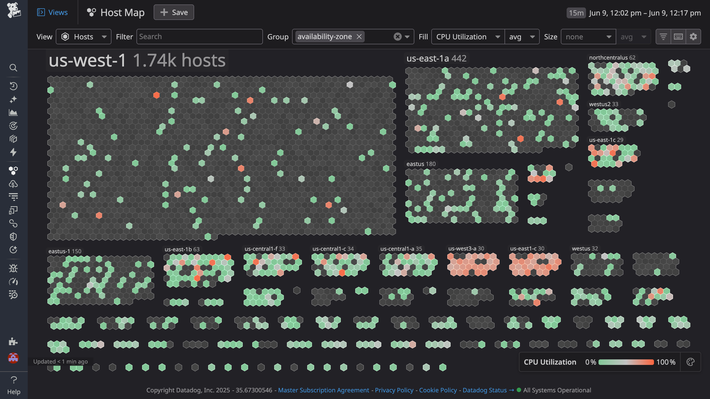
Infrastructure Monitoring is charged per host, which Datadog defines as any physical or virtual machine it watches, or a node in a Kubernetes cluster. The public list price starts at $15 per host per month on the Pro plan and $23 on Enterprise, billed annually, with multi-year and volume discounts available. A single agent installed on each machine collects metrics, traces, logs and security signals, as SK Broadband describes its setup, and more than 1,000 integrations bring in data from cloud services and databases. The first screen most engineers see is a map or catalog of hosts, with the monitors that fired.
APM, application performance monitoring, follows a single request across services. The official screen draws a demonstration web store's request as a flame graph, each bar a step inside a service, with a code profile below showing how much time went to CPU work, waiting on network reads or memory clean-up. That is the step that turns a complaint that the site is slow into a named service and query. Dongwon F&B describes the result it wanted in the same terms: one screen for APM, logs, infrastructure and real user monitoring, from what a shopper does on the front end to the database query behind it.
Log Management is where engineering meets cost. Logs are charged by volume rather than per host, and Datadog itself says that as AI volumes rise, logs grow so fast that companies face an uncomfortable choice: keep the data and absorb the cost, or delete it and lose visibility. Its answers are tiers and location. The official screen shows logs kept in a standard tier for 7 days for live search and in a Flex tier for 90 days for historical investigation, under a daily quota. Bring Your Own Cloud, announced in June 2026, processes and indexes logs within a customer's own cloud storage. Samsung Electronics does something similar: raw logs stay in its own AWS S3 storage and are pulled into Datadog only when an analysis needs them.
Who has bought it in Korea, and what they report
The Korean customer cases read for this page cover electronics, telecoms, retail, games, mobility and food. Samsung Electronics' big data center runs a unified login platform that connects more than 60 services, among them Samsung Pay, Samsung Health and Galaxy Store, for more than 2.1 billion users in 256 countries. It moved from separate network, application and database tools to one platform that runs from infrastructure metrics on its Amazon EKS clusters down to APM traces. KRAFTON's PUBG Studio had used Datadog for metrics for years and then put its whole incident process on the platform, with monitors, incidents and automated workflows; the studio reports a mean time to detect of 3.89 minutes for the year.
The other cases show the range. KT runs a GPU farm of 1,700 GPU instances that serves about 60 AI projects inside the company, and uses Datadog's incident records as the basic unit of GPU operations, with views of usage by environment and by research project. SK Broadband moved 30 to 50 people who had used their previous system for more than five years onto Datadog in a single day. TMAP Mobility's CTO says log counts doubled after the switch while the monitoring cost ratio fell. GS Retail adopted Datadog while it moved more than 100 workloads to the cloud in 2023, after its leased data center stopped service, and later used it for security as well. CJ Olive Young needed to manage the large web server logs that come with traffic up to 20 times normal during its sales.
Security is the newest door in Korea
Security buyers are the latest addition. At Datadog Secure in Seoul in August 2026, an engineer from Hanwha Vision explained why the company chose Datadog's SIEM, the product that gathers security events for investigation, and its cloud security management as its main security monitoring tools. In May 2026 Datadog launched the Bits AI Security Analyst, an AI agent inside its SIEM that the company says can cut security investigations from hours to as little as 30 seconds.
Each result above is the customer's own measure in a case Datadog published, and each describes one event or one period: one incident, one year's detection time, one migration day. Read them as a map of what Korean buyers pay to fix: one view across teams, faster detection, control over log cost, and now AI agents and security on the same data. That map is the material for an interview answer about why a Korean CTO would buy.