What changed? +
New state registrations and payroll administration would delay hires.
Vendor-published customer observation, not a universal guarantee.

The employee starts and receives pay through an agreed recurring process.
See it taking shape ↓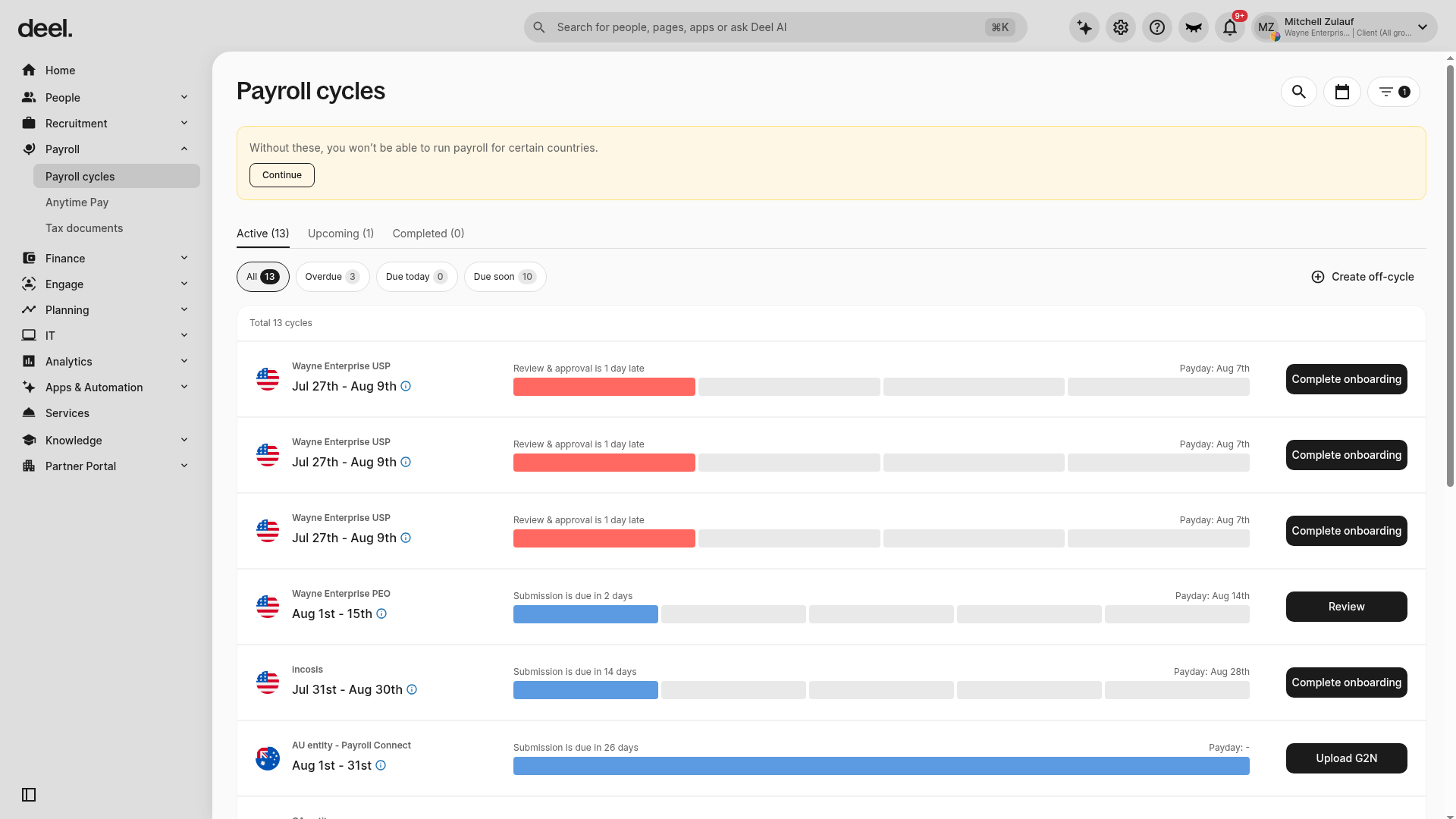
Make deadlines, inputs and outputs visible.
New state registrations and payroll administration would delay hires.
Vendor-published customer observation, not a universal guarantee.
One HR owner handled many country processes and equipment logistics.
Published customer process and shipping observations.
Illustrative own-entity payroll process.
Record employee information and changes.
Check and submit the report by the deadline.
Process payroll and provide configured outputs.
Review the cycle and resolve changes.
Deel connects international hiring, payroll and workforce administration. A company can use an employer of record to hire in a country where it does not have an employing entity, or use payroll services for employees of its own entities. It can also manage contractor relationships and workforce information. These arrangements differ in who employs the person and which responsibilities the buyer retains. The useful starting point is a hiring decision: where the person will work, which entity or service will support that relationship, and how the employee will receive the necessary documents, equipment and pay. Signet treats the platform as a way to coordinate this work across HR, finance, managers and service specialists. Country coverage alone does not explain the implementation. The buyer must choose the employment arrangement, supply correct information, agree the onboarding sequence and establish recurring payroll responsibilities. This makes the product understandable through the journey from an approved hire to a person who can work and be paid through an agreed process.
Consider a Korean business hiring employees through an overseas subsidiary. This is an illustrative workflow grounded in Deel's payroll guidance. HR records the employee information and any changes, finance or a payroll owner checks the inputs, and the team submits a complete report by the cycle's deadline. Deel processes the supplied information and delivers the agreed outputs. These may include payslips, reports, a payment file or payment execution, depending on configuration. The official Payroll cycles screen shows active, upcoming and completed cycles, with submission dates and review stages. A calendar subscription helps the responsible team follow events for a selected entity. Late or incomplete submissions can affect downstream timing, so the screen supports coordination rather than removing the client's input responsibility. Signet would evaluate the quality of the data, the clarity of ownership and the ability to review the result before the next cycle. The central benefit is making a repeated cross-country process visible enough for people to operate consistently.
LG AI Research is a Seoul-based customer that used Deel's EOR for two hires in different US states. The vendor-published case reports onboarding in one to two days and a reduction of more than fifty percent in payroll-processing time per Deel-employed hire. AIRS Medical, also headquartered in Seoul, uses EOR, contractor administration and Deel IT for its international team. Its case describes preparing a hire's profile around two weeks before the start date and receiving express-shipped equipment within approximately a week. These examples explain different parts of the same operational problem: selecting talent abroad and arranging the administration that lets the person begin working. They are attributed customer observations, with particular people, countries and circumstances. Signet would ask which part of an applicant's experience is comparable, such as coordinating a start date, resolving incomplete employee data or organizing equipment delivery. The stories provide a more useful introduction than treating every published speed figure as a universal service promise.
Deel Payroll supports a company's own employing entities through software and payroll service arrangements. The product page distinguishes managed and self-service options, with configuration that can vary by country. Its platform brings payroll status, employee changes and workforce costs into a consolidated working view. A buyer can begin with selected countries and expand the implementation, rather than replacing every provider in a single step. Payroll Connect also enables reporting with data from external payroll providers, requiring an initial mapping of the provider's gross-to-net items. Signet would compare this approach with country-specific vendors, an existing payroll suite and internal spreadsheets and handoffs. The practical evaluation concerns input ownership, country support, reconciliation, approvals and the output required by finance. The current support screen offers a concrete view of this work: an entity has a cycle, a deadline and a next action. Those details make the platform's value visible at the point where a payroll owner needs to know what must happen next.
Deel HR provides workforce records, organizational information, time off, documents and workflows. The current product page separates Core, Advanced and Elite offerings, with additional functions for areas such as performance, learning, workforce planning and compensation. The Core offering currently starts at five dollars per employee per month on that page. An older announcement describing a free HR product should therefore be read in its historical context. A manager's view also depends on the permissions configured for their organizational scope. The official support illustration shows manager roles with People and Contracts, Time Off and Time tracking permissions. Signet sees the employee record as a shared reference that still requires explicit responsibilities: who may change a field, who may approve a request and which system supplies the authoritative information. The software helps connect these actions to payroll and other processes. A useful demonstration follows a single employee change through its record, approval and downstream consequence, rather than simply touring a list of HR modules.
EOR, contractor management, IT and benefits connect software to services that support the employment relationship. EOR provides an employing arrangement in supported locations; Deel Payroll serves a different situation in which the customer has its own entity. Deel IT adds equipment procurement, deployment, management and offboarding. Benefits and mobility offerings address other parts of the workforce journey. Integrations and the public API connect information with existing applications, while workflow tools help teams organize repeated actions. These are selected capabilities whose availability and commercial scope should be matched to the actual country and arrangement. Signet would start with the customer's immediate need and show which combination supports it. For example, an employer may need one new overseas hire equipped and ready to work, while a larger company may need reporting across many existing entities. The comparison is between operating models and responsibilities as well as software features. Security review belongs in that evaluation because the platform handles employee and payroll information across the involved teams.
Disclosure dates; 2025 point is the minimum crossed earlier that year, not period-end ARR. Private company presentations, not audited annual sales. These are dated disclosures, not a continuous growth record.
| Date | Value | Basis |
|---|---|---|
| 2025-10-20 | >$1B | Announced that ARR crossed $1B earlier in 2025; threshold shown as minimum. |
| 2026-07-13 | $1.5B | Company-published profile presents $1.5B ARR. |
Deel
$300M funding at $17.3B valuation.
$1.5B company-presented ARR.
Deel's commercial model spans software access and workforce services. The price and unit depend on the chosen product and relationship, such as an employee using HR, a payroll service arrangement or an EOR hire. A company can combine offerings as its workforce needs develop. Signet would establish who pays, which employees or contracts are included, which service responsibilities are covered and how the arrangement changes as the workforce grows. That helps compare a visible unit price with the operational work the buyer is purchasing. A business hiring in one new country may value a different combination from an enterprise consolidating payroll across existing subsidiaries. Integration work, implementation and recurring service quality also shape the decision. The platform's expansion into IT, benefits and hiring increases the number of needs it can address, while increasing the importance of making the commercial scope clear. The reader should follow what the employer buys and what the employee receives before interpreting company-wide growth numbers.
The October 2025 Series E announcement reports three hundred million dollars in new funding at a seventeen-point-three-billion-dollar valuation. It says Deel had passed one billion dollars in ARR earlier that year. A July 2026 company-published profile describes the company at one-point-five billion dollars in ARR. The chart follows these dated company presentations of ARR, with the earlier point explicitly a disclosed threshold rather than an exact period-end balance. ARR is a recurring annual measure and does not represent a completed audited year of recognized sales. The financing valuation measures the company's value in that funding transaction. Payroll processed is money administered for workforce payments; it is not automatically Deel's own revenue. Signet preserves these distinctions so a reader can assess business scale without adding unlike measures. The observations also span the expansion of a platform and acquisitions. They do not establish a precise organic growth rate or imply that every customer uses every product in the current portfolio.
Deel's own infrastructure and acquisitions bring more payroll and workforce operations into the platform. The support guidance for former Safeguard Pay customers confirms purchase of that business in March 2025 and describes a structured transition to Deel. It is the payroll business, rather than the entire Safeguard company. Existing agreements remain in place until expiry or renewal, and migration plans define payrolls, dates, owners and milestones. Parallel checks apply where payroll software changes. Signet reads this as an example of how expansion creates implementation work as well as revenue opportunity. Three practical risks follow from the products and service design: incorrect or late payroll inputs, inappropriate access to sensitive workforce information, and disruption during a migration or handoff. A buyer can evaluate these through clear deadlines, permissions and tests of the agreed outputs. The relevant commercial outcome is continued customer trust and additional useful service, with the underlying process still understandable to the people responsible for operating it.

Co-founded Deel in 2019 after meeting Shuo Wang at MIT.
Build infrastructure for employers hiring internationally.

Explains the business through system thinking and building.
Connect customer needs to a scalable operating process.

Listed in the current official leadership roster.
Provide financial leadership within the platform business.
“We just want to enable amazing companies to be able to have the best people in the world”
Alex Bouaziz · Founder interview, page update date · 2026-05-27
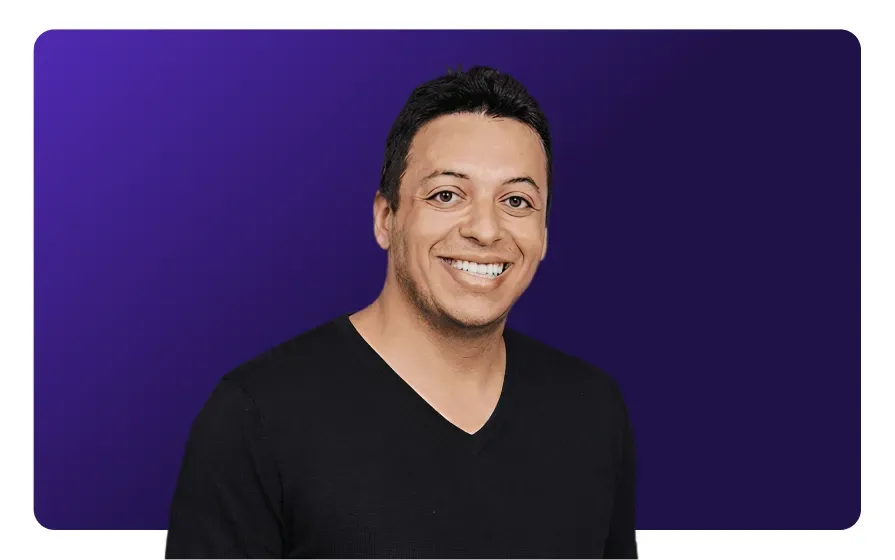
Alex Bouaziz and Shuo Wang founded Deel in 2019 after meeting at MIT. The company's account connects their mission to enabling access to talent regardless of location. Its current leadership roster identifies Bouaziz as co-founder and CEO and Wang as co-founder and CRO. Joe Kauffman is President and CFO. These titles establish the present public leadership context; they do not establish who manages a particular Korean team. The founders approach the business from a problem that combines a company's hiring ambition with the infrastructure required to act on it. Signet reads that origin through a concrete decision: make it easier for a business to employ and support someone outside its existing footprint. That ambition requires product, operations and local service work together. A candidate can connect to it by showing a cross-country process they made clearer or more dependable. The most useful evidence explains the starting constraint, the people involved, the action taken and the result the employer or employee could actually experience.
A May 2026 article presents Bouaziz discussing infrastructure for global businesses. His stated goal centers on helping companies reach the best people in the world. The company's July Deel Works profile describes Wang's emphasis on thinking about a system and then building it. The same account describes repeated changes to the early product idea during Y Combinator, informed by conversations with prospective users. Signet interprets these accounts as a link between broad ambition and the operating system needed to deliver it. A candidate might describe how they tested whether a proposed service solved the actual customer's problem, then changed the implementation when the first approach proved insufficient. This is an interpretation of the published accounts, not a new claim about a formal interview rubric. It keeps the founder story useful for readers deciding how their own work relates to the business. The dated excerpts also preserve the distinction between an author's account of earlier events and a statement about the company today.
The career page presents working principles that include taking initiative, treating problems as puzzles, raising the bar, automating routine work, building for users and showing up across borders. These are Deel's stated preferences, not an independent assessment of every employee's experience. Signet highlights two practical implications: understand the user before optimizing the process, and use automation with clear ownership of the result. The September Akai article supplies an operations example. It reports internal automation of large volumes of recurring cases and explains how people can inspect a workflow before execution. Fernando Domínguez, an Associate Operations Director quoted in the article, describes improvement in reimbursement processing. The published observation is specific to that process. A candidate can demonstrate the same reasoning by explaining how they identified repetitive work, checked exceptions and maintained accountability when an automated step failed. The point is a dependable outcome for the person who needs service, with a team able to understand and correct the process as it develops.
For a business considering employment in South Korea, the country guide presents EOR and payroll routes. The choice should start with whether the employer has an appropriate entity, which people are involved and what the service arrangement covers. For a Korean business hiring elsewhere, the same questions apply to the destination country. Signet frames this as a product and operating discussion rather than personalized legal or tax advice. An implementation owner needs employee details, a timeline, responsibilities and a way to resolve changes. An HR leader needs visibility into the employee experience and the data held across systems. Finance needs outputs it can reconcile and use. These perspectives meet at a recurring process that must work for the selected countries. A candidate's evidence can therefore involve cross-functional coordination, precise data handling or a service transition. It becomes more useful when the example identifies the person who needed help and the actual decision, rather than relying only on a general claim of international experience.
Customer coordination is documented in the Korean customer cases.
Korean employers organize international hiring and support.
Deel has a Korean-language website and a country service guide for South Korea. These show a public route to understanding the products and requesting a commercial discussion. They do not by themselves establish a Korean office or a local employee count. The strongest concrete connection comes from Korean employers managing international teams. LG AI Research's case describes coordination between its Seoul HR team, a US HR manager and a Korean-speaking Deel coordinator. AIRS Medical's case describes a Seoul-based company's HR owner supporting people across countries through EOR, contractor and equipment services. Signet distinguishes these overseas workforce uses by Korean customers from a claim that every product has a locally staffed Korean implementation team. The business context is an employer with hiring needs beyond its present legal and operational footprint. A reader interested in Korea can follow who the customer is, where the employees work and which service supports them. That gives a precise local connection while retaining the international scope of the published evidence.
For a business considering employment in South Korea, the country guide presents EOR and payroll routes. The choice should start with whether the employer has an appropriate entity, which people are involved and what the service arrangement covers. For a Korean business hiring elsewhere, the same questions apply to the destination country. Signet frames this as a product and operating discussion rather than personalized legal or tax advice. An implementation owner needs employee details, a timeline, responsibilities and a way to resolve changes. An HR leader needs visibility into the employee experience and the data held across systems. Finance needs outputs it can reconcile and use. These perspectives meet at a recurring process that must work for the selected countries. A candidate's evidence can therefore involve cross-functional coordination, precise data handling or a service transition. It becomes more useful when the example identifies the person who needed help and the actual decision, rather than relying only on a general claim of international experience.
The October tenth official career board is the reference for current recruitment. Its public location options and a search for Korea returned no matching open positions during this review. Signet therefore keeps the Korean role list empty instead of treating a historical listing or a broad remote region as a current Korean vacancy. The organization diagram also stays unfilled where a verified local reporting relationship is unavailable. Readers can still prepare relevant work evidence through the company's public operating model. A useful example shows a cross-country customer need, an agreed responsibility, accurate data and an outcome that survived repeated use. It may involve payroll implementation, employee onboarding, customer support or a systems integration. These are Signet preparation suggestions, rather than qualifications taken from a current Korean job description. When a live role appears, the applicant can compare its exact location, employer, experience and language requirements with that evidence. The board and product sources serve different purposes: one establishes recruitment status and the others explain the work around the business.
No current Korea openings were found. The company story is still available.
See overseas openings →The Akai announcement updated September second, 2026 describes an automation workspace based on Deel's internal operations. It addresses repetitive work across areas such as finance, tax, treasury, benefits and HR. The published workflow begins with a person recording or describing the process, then inspecting and approving the resulting steps before execution. The article reports ninety-one thousand hours saved per month in internal use and refers to more than one hundred thousand recurring cases. These are company-presented internal observations, not customer revenue or a guaranteed external return. The announcement still describes early access for a selected group. Signet keeps that availability stage visible while explaining the product idea: make a process understandable enough to automate and check, including the exceptions that need a person.
Deel's July thirteenth company-published profile of Shuo Wang presents the business at one-point-five billion dollars in ARR. It also discusses organizational decisions and use of AI in the company. Signet records the figure as a dated company presentation of a recurring measure. It does not convert the figure into audited annual sales or assign it to October as a newly measured balance. The profile is useful alongside the leadership roster because it connects the CRO's current public role to her account of building the business. A reader can use the dated statement to understand scale while testing product and recruiting status against current pages. This avoids treating an article's historical anecdotes as a complete present-day organization chart.
The migration FAQ updated March fifth, 2026 explains the transition from Safeguard Pay technology to Deel. It confirms the purchase of that payroll business in March 2025 and describes customer-specific plans, existing agreements and testing when software changes. The wording is evidence of an ongoing implementation program, not proof that every customer's migration has completed. Payroll identities, data mappings and the required finance outputs are practical parts of that transition. Signet would follow the agreed project milestones and the first accurate, accepted cycle in the new arrangement. For a reader evaluating the company, the update shows how an acquisition becomes operational work for customers. For a candidate, it suggests a concrete way to describe experience: a migration with clear ownership, checked outputs and continuity for the people receiving pay.
The Akai announcement updated September second, 2026 describes an automation workspace based on Deel's internal operations. It addresses repetitive work across areas such as finance, tax, treasury, benefits and HR. The published workflow begins with a person recording or describing the process, then inspecting and approving the resulting steps before execution. The article reports ninety-one thousand hours saved per month in internal use and refers to more than one hundred thousand recurring cases. These are company-presented internal observations, not customer revenue or a guaranteed external return. The announcement still describes early access for a selected group. Signet keeps that availability stage visible while explaining the product idea: make a process understandable enough to automate and check, including the exceptions that need a person.
Deel's July thirteenth company-published profile of Shuo Wang presents the business at one-point-five billion dollars in ARR. It also discusses organizational decisions and use of AI in the company. Signet records the figure as a dated company presentation of a recurring measure. It does not convert the figure into audited annual sales or assign it to October as a newly measured balance. The profile is useful alongside the leadership roster because it connects the CRO's current public role to her account of building the business. A reader can use the dated statement to understand scale while testing product and recruiting status against current pages. This avoids treating an article's historical anecdotes as a complete present-day organization chart.
The migration FAQ updated March fifth, 2026 explains the transition from Safeguard Pay technology to Deel. It confirms the purchase of that payroll business in March 2025 and describes customer-specific plans, existing agreements and testing when software changes. The wording is evidence of an ongoing implementation program, not proof that every customer's migration has completed. Payroll identities, data mappings and the required finance outputs are practical parts of that transition. Signet would follow the agreed project milestones and the first accurate, accepted cycle in the new arrangement. For a reader evaluating the company, the update shows how an acquisition becomes operational work for customers. For a candidate, it suggests a concrete way to describe experience: a migration with clear ownership, checked outputs and continuity for the people receiving pay.
Payroll, HR and workforce services
For a business considering employment in South Korea, the country guide presents EOR and payroll routes. The choice should start with whether the employer has an appropriate entity, which people are involved and what the service arrangement covers. For a Korean business hiring elsewhere, the same questions apply to the destination country. Signet frames this as a product and operating discussion rather than personalized legal or tax advice. An implementation owner needs employee details, a timeline, responsibilities and a way to resolve changes. An HR leader needs visibility into the employee experience and the data held across systems. Finance needs outputs it can reconcile and use. These perspectives meet at a recurring process that must work for the selected countries. A candidate's evidence can therefore involve cross-functional coordination, precise data handling or a service transition. It becomes more useful when the example identifies the person who needed help and the actual decision, rather than relying only on a general claim of international experience.
Follow the company from its vision through products, evidence and people to the Korea team and current roles. Use the table of contents to move within the page, and expand the sections for more context.