What changed? +
Legacy constraints limited customization and cost control.
Vendor-published customer case; workload-specific observation.

A checked application and an understandable operating process.
See it taking shape ↓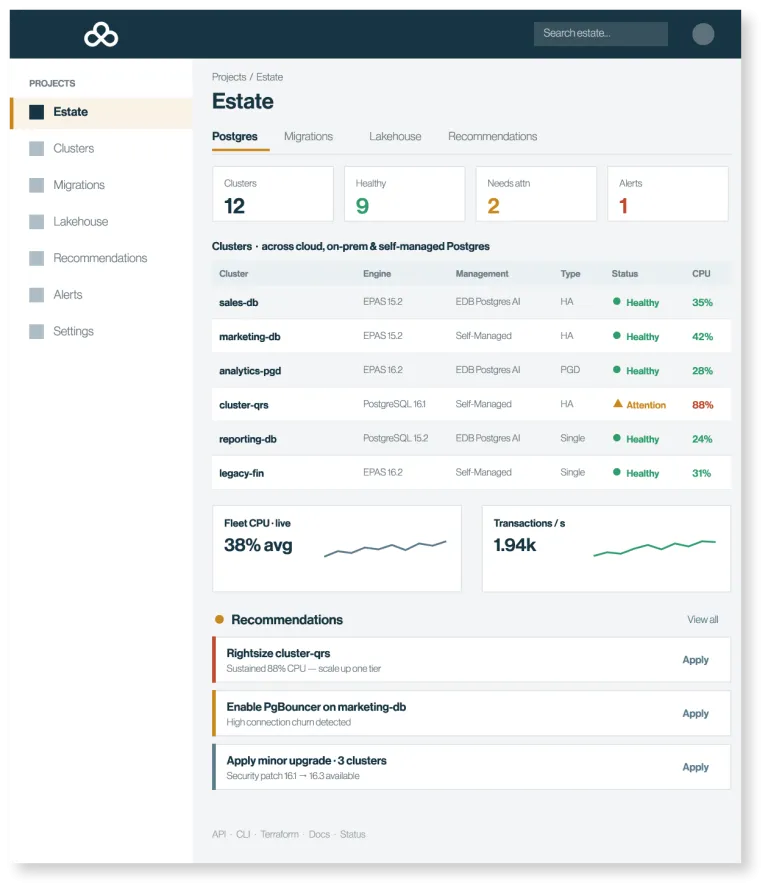
Connect system status, recommendations and responsibility.
Legacy constraints limited customization and cost control.
Vendor-published customer case; workload-specific observation.
Rising legacy costs and data scale.
Vendor-published customer case; workload-specific observation.
Illustrative legacy-to-Postgres migration.
Assess compatibility and choose the workload.
Convert supported structures and resolve exceptions.
Check data, application behavior and recovery.
Cut over and monitor ongoing performance.
EnterpriseDB, usually called EDB, builds enterprise software and services around PostgreSQL. Its current EDB Postgres AI platform brings transactional databases, analytics and AI capabilities into a data foundation that can run on premises, in cloud environments or across both. A database stores and serves information used by applications. An enterprise also needs to govern access, preserve availability, observe performance and manage changes. Signet follows those responsibilities through the people who operate the system rather than treating a database as a feature list. A business may want to modernize a legacy application, bring a warehouse under its own infrastructure control or make governed data available to an AI application. The platform addresses related needs through separate capabilities, and a buyer should identify the immediate workload and desired operating arrangement. That creates a concrete starting point for understanding the company: useful data, an application that depends on it, a team responsible for running it and evidence that the agreed service continues to work.
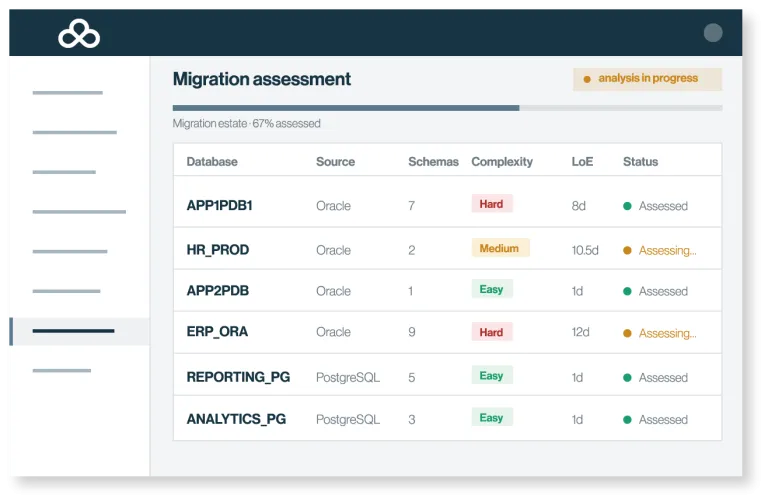
Consider an enterprise planning to move an Oracle-backed application to a Postgres environment. This is an illustrative workflow based on EDB's current migration capabilities. The team first inventories the databases and assesses schema compatibility and complexity. It chooses an initial workload, converts supported structures and examines the remaining issues that require a decision. Data replication can keep the original system operating while the team validates the destination. The owner then agrees a cutover window and checks the application's behavior and required outputs. A migration assessment screen makes individual systems and their status visible. Signet would evaluate the plan through compatibility, data correctness, performance and recovery arrangements. Automated conversion reduces some work, while application dependencies and exceptional behavior still need explicit tests. The useful result is a working application on an agreed data foundation, with the operations team able to understand what changed. This example explains why a database purchase often involves developers, architects, database administrators, security reviewers and commercial partners together.
The Industrial Bank of Korea is a named customer in EDB's current case material. It describes migrating fifteen core systems and using an internally built monitoring environment to manage fifteen EDB clusters. Kyobo Book Centre's case explains an on-premises WarehousePG foundation within a broader hybrid environment, supporting retail data and future AI or vector-based services. Shinhan EZ Insurance describes a cloud-based core system and attributes a reduction of more than fifty percent in annual operating costs to its adoption. These are customer stories published by the vendor, with different workloads and operating arrangements. They should not be reduced to one promised saving for every database buyer. Signet would compare the original constraint, the chosen architecture and the outcome the customer could observe. The bank emphasizes operational autonomy, the bookseller explains warehouse economics and the insurer describes a cloud transition. Together they demonstrate why deployment location and application requirements belong in the product conversation, alongside migration and the continued responsibilities of the customer's team.
Hybrid Manager provides a control and observability interface across a Postgres estate. Its current product page describes deployment, observation, optimization and modernization. A team can use Kubernetes-native provisioning and workload templates, examine database metrics across environments and review recommendations for performance or resource changes. The published interface shows clusters with their engine, management arrangement, status and resource use, alongside recommendations. Signet sees that screen as a conversation about operating responsibility: which systems are healthy, which need attention and who can authorize a change. The capability also covers third-party clusters such as AWS RDS according to the product page. That matters when an enterprise has an existing mixed estate rather than a clean replacement project. A buyer can compare the working view with separate monitoring tools, cloud-specific consoles and internally assembled administration. The practical evidence is a known workload, a visible issue and a checked improvement, with permissions and an audit trail suited to the organization's operating policy.
Agentic Migrations covers assessment, conversion, remediation, migration and extension through an API for agents. The product page describes schema conversion inside the customer's environment, with guidance for issues that need a human decision. Snapshots and continuous change data capture support validation before a chosen cutover. The assessment illustration shows multiple Oracle and Postgres systems with complexity and status, making it clear that a migration is a collection of scoped tasks. Signet would use that view to ask which constructs are supported, how remaining incompatibilities are resolved and how the resulting application is tested. Published reductions in manual rewriting refer to supported legacy constructs and internal testing, so the reader should retain the stated scope. The platform's proposed benefit is a more manageable path from legacy dependencies to an operating Postgres foundation. A candidate can demonstrate a migration assessment, a specific conversion problem and a checked result without claiming that every application can move automatically with identical timing or performance.
The platform includes core database, high availability, analytics, agent runtime and governance capabilities. The June 2026 release made EDB Postgres AI for ClickHouse generally available and described agent governance at the data layer as a preview. That release distinguished present functions from planned expansion later in the year. Current product pages explain declared agent purpose, database-level validation and session audit, but the June availability label should not be silently rewritten as proof of complete later rollout. Signet follows the actual selected capability and its deployment conditions. Warehouse analytics and transactional applications also have different workload requirements even when they share an open foundation. Red Hat and other infrastructure partners support deployment choices. A useful evaluation therefore ties the product name to an environment, supported workload, service terms and testable result. That makes the enterprise platform understandable without assuming that the presence of a product page gives every customer the same production entitlement or configuration.
Single minimum observed on company pages; date is review date, not a period-end balance.
| Date | Value | Basis |
|---|---|---|
| 2026-10-10 | 1,700+ | Lower-bound company wording; different older career-page count not joined into a precise trend. |
EDB
Bain investment alongside Great Hill ownership context.
EDB sells enterprise database capabilities and services that help organizations use Postgres in demanding environments. Its current plan comparison separates open source support, Enterprise Postgres, Enterprise Postgres Plus, analytics, distributed high availability and the full platform. The comparison also distinguishes support arrangements for development and production. A buyer needs to connect an entitlement to the systems and workloads covered, then agree deployment and service responsibilities. The licensing guide defines license-related scope rather than offering a universal cost for every installation. Signet would follow the commercial decision from the initial modernization project to the recurring support needed after production use begins. The Korean sales advertisement specifically covers new and renewal recurring revenue and consulting services. That is direct evidence of the work involved in selling the business. It also explains why a product introduction should include the continuing operational value, rather than focusing entirely on replacing one database or on a headline performance claim.
The current homepage and company page present more than seventeen hundred enterprise customers or organizations. The chart records seventeen hundred as the disclosed minimum observed in October 2026. It is a customer-scale observation, not company revenue, ARR or valuation. A 2024 release referred to more than fifteen hundred customers, while the career page still says nearly fifteen hundred. Those wording differences and page dates make a precise continuous growth-rate calculation inappropriate. Signet uses the current company-page observation as a single point with an explicit lower-bound label. Customer count helps introduce the business's enterprise reach, but it does not reveal average spending, profitability or the installed scope within each account. Named customer stories provide a complementary view of what organizations actually do with the products. The company can grow by winning new work, expanding useful capabilities within existing customers and retaining ongoing support. The reader should assess those mechanisms through the commercial model and dated case evidence instead of assuming a financial result from the scale count alone.
The current leadership page identifies EDB as a Bain Capital and Great Hill Partners portfolio company. The June 2022 majority investment announcement gives dated ownership context, not a current public market capitalization. Signet keeps that transaction history separate from the enterprise customer-scale chart. The product and service model creates practical operating risks. A migration may encounter application behavior that automated compatibility tools do not fully resolve. A high-availability design needs to be configured and tested against the actual service requirements. A customer's data-access rules must apply to applications, people and agents using the foundation. These issues can affect trust, support work and whether the buyer expands the relationship. A useful commercial assessment asks how the team identifies exceptions, validates the chosen architecture and handles continued production use. Partners and services can support those responsibilities, but the agreed customer environment remains central. This connects financial opportunity to the work needed to deliver a dependable enterprise system.

Previously led Wind River and held cloud and AI leadership at Microsoft.
Connect enterprise control to the data and AI platform.

Has product and AI experience at IBM and Stats Perform.
Shape the current platform product direction.
“They are building their own,”
Kevin Dallas · Official dated company release · 2026-02-11
EDB's historical company material identifies a 2004 founding, while its current pages emphasize continued contribution to Postgres and an enterprise data and AI platform. The present leadership roster names Kevin Dallas as CEO, Nancy Hensley as Chief Product Officer and Max Romanenko as Chief Technology Officer. Dallas previously led Wind River and held senior cloud and AI work at Microsoft. Hensley's profile describes product and AI experience at IBM and Stats Perform. Romanenko's profile explains responsibility for transactional, analytical and AI database technologies and hardware and security strategy. These biographies are selected public context rather than an invented account of the original founding team. Signet reads the current leadership through the decisions that shape the platform: which workloads to connect, which infrastructure customers can control and how the software can be operated. A candidate can relate to those decisions through a product, architecture or customer example with a clear problem and a verified outcome.
Dallas's dated statements in February, June and September 2026 center on enterprises retaining control of the data foundation used by AI. The June release describes bringing intelligence to live data and allowing organizations to choose which actions are automatic, approved by a person or scheduled for maintenance. Signet interprets the direction as a design question about authority and evidence. An application or agent needs access to useful information while operating within the customer's policy. A database team needs to see what happened and retain a way to respond when a change creates a problem. This framing connects an ambitious platform narrative to concrete work such as permission design, query behavior, monitoring and the review of operational recommendations. A candidate's demonstration can show a small but complete workflow with a declared purpose, scoped access and a result that can be checked. Those details explain how the person's work contributes to the direction without turning executive language into a guarantee that every AI outcome is correct.
The career page presents Win together, Own our actions, Grow and evolve and Have fun as company values. It also describes customer focus, a growth mindset and inclusion as cultural goals. These are the employer's stated principles and should be read separately from individual employee experience. Signet highlights collaboration and responsibility because the platform sits among many teams in a customer organization. A seller may work directly with a financial-services account while a partner handles the transaction. A database expert may investigate compatibility with application owners and use feedback from operations to improve the rollout. In either case, a useful account of the work identifies the original problem, the people involved and the person's own contribution. It also describes what changed after a result or assumption was checked. That approach connects the values to real decisions instead of repeating abstract cultural language. A candidate can prepare one example of resolving a cross-functional disagreement and another of correcting a technical or commercial plan after learning more from the customer.
The official board currently lists a Senior Account Executive in Seoul, with Greenhouse identifier 7775973003. The body specifies a Korean financial-services enterprise-sales remit. It asks for at least fifteen years of hands-on selling of IT solutions to Korean financial-services customers and at least five years selling databases to enterprise customers. It describes direct customer contact and says all EDB transactions pass through partners. The role covers new and renewal recurring revenue, consulting services, account expansion, new customers, account plans and accurate forecasts. Signet retains the distinction between direct customer selling and partner transaction responsibility. The advertisement's Remote tag is preserved, while no minimum English proficiency or unprovided posting date is added. The technical and commercial evidence should fit the work: a financial-services account decision, a database or infrastructure proposition and a coordinated partner path to the transaction. That gives a precise picture of the current local opportunity rather than generalizing from broad global hiring campaigns.
The advertisement identifies regional and global resources and partners.
Documented financial-services, insurance, retail and channel work.
EDB's September 2026 announcement names Korean customer and partner activity alongside international enterprise examples. The linked local stories include the Industrial Bank of Korea, Shinhan EZ Insurance and Kyobo Book Centre. C Platform is a distributor whose public case describes a partner network across financial services, the public sector and manufacturing. These sources establish concrete Korean customer and channel context without relying on an inferred employee count from a professional-network search. Signet follows each organization in the role documented by the source: a customer operating a database, an insurer describing a cloud transition, a bookseller modernizing analytics and a distributor supporting enterprise proposals. They should not be combined into a new total of Korean paying customers. The useful local theme is how enterprises choose infrastructure and operating responsibility for data-dependent applications. A reader can connect to that theme through database modernization, partner collaboration, enterprise selling or support experience, then compare it with the exact scope of the current advertisement.
The official board currently lists a Senior Account Executive in Seoul, with Greenhouse identifier 7775973003. The body specifies a Korean financial-services enterprise-sales remit. It asks for at least fifteen years of hands-on selling of IT solutions to Korean financial-services customers and at least five years selling databases to enterprise customers. It describes direct customer contact and says all EDB transactions pass through partners. The role covers new and renewal recurring revenue, consulting services, account expansion, new customers, account plans and accurate forecasts. Signet retains the distinction between direct customer selling and partner transaction responsibility. The advertisement's Remote tag is preserved, while no minimum English proficiency or unprovided posting date is added. The technical and commercial evidence should fit the work: a financial-services account decision, a database or infrastructure proposition and a coordinated partner path to the transaction. That gives a precise picture of the current local opportunity rather than generalizing from broad global hiring campaigns.
Signet suggests preparing an account example that follows the customer beyond the first presentation. Begin with the existing data environment, the business constraint and the people who must agree to change it. Explain how the team identified a workable database or platform scope, evaluated technical dependencies and involved a distributor or partner. Show the commercial decision and what happened during implementation or renewal. This preparation follows the actual advertisement's combination of direct selling, partner collaboration and recurring revenue; it is not an additional employer qualification. The case can include how a technical concern changed the proposal, how consulting supported the rollout or how account information improved the forecast. The customer stories also offer different architecture examples that a seller can understand without claiming responsibility for an engineer's work. A useful discussion separates the customer's goal, the evidence that supports the proposed solution and the people responsible for delivery. That makes the candidate's own contribution and the next steps in a complex financial-services sale easier to assess.
Current Signet catalog · 2026-10-19
Present financial-services, database and partner sales evidence.
The June twenty-third release adds agentic database and converged analytics capabilities to EDB Postgres AI. It explicitly identifies ClickHouse as generally available and agent governance as a preview, with further expansion planned for the second half of 2026. The database operations described in the release follow enterprise policy: an action can run automatically, require human approval or wait for maintenance. Signet keeps the release's stated availability separate from its roadmap. A reader evaluating a current purchase should confirm the chosen capability and entitlement against the present plan and implementation discussion. The dated release is useful evidence of direction and announced scope, while the working demonstration and service agreement establish what the customer can actually operate.
The September third announcement presents new customer and partner evidence across Europe and Asia. In Korea, it links local banking, insurance, retail and distributor stories. C Platform describes demand for hybrid and on-premises capabilities and the difficulty of turning fragmented data into a production AI foundation. Signet records that as an attributed partner view rather than a universal measurement of every Korean enterprise. The linked customer material offers concrete operating examples, including existing database work and foundations intended for future AI use. This distinction matters: a customer improving its data architecture is not automatically evidence that every planned agent deployment is already live. Readers can follow the actual workload, operating arrangement and stated next step in each case.
An official EDB and SUSE webinar page schedules a forty-minute modernization and sovereign-infrastructure discussion for October twentieth, 2026. The page names EDB Field CTO Ava Chawla and SUSE sovereign-solutions leader Andreas Prins. As of the October tenth review, that date is still ahead. A generic recording message on the event page does not make it a completed event. Signet treats the page as a scheduled opportunity to discuss Oracle modernization, governed data and hybrid or Kubernetes deployment. The practical topic aligns with the platform's current enterprise proposition, but an event invitation is not a new product release. Keeping the date and status explicit helps the reader use the information without confusing future discussion with delivered functionality.
Enterprise Postgres, estate management and migration
The official board currently lists a Senior Account Executive in Seoul, with Greenhouse identifier 7775973003. The body specifies a Korean financial-services enterprise-sales remit. It asks for at least fifteen years of hands-on selling of IT solutions to Korean financial-services customers and at least five years selling databases to enterprise customers. It describes direct customer contact and says all EDB transactions pass through partners. The role covers new and renewal recurring revenue, consulting services, account expansion, new customers, account plans and accurate forecasts. Signet retains the distinction between direct customer selling and partner transaction responsibility. The advertisement's Remote tag is preserved, while no minimum English proficiency or unprovided posting date is added. The technical and commercial evidence should fit the work: a financial-services account decision, a database or infrastructure proposition and a coordinated partner path to the transaction. That gives a precise picture of the current local opportunity rather than generalizing from broad global hiring campaigns.
Employer postings were checked on 2026-10-10. Availability can change. Mock applications request a review from Signet.
Follow the company from its vision through products, evidence and people to the Korea team and current roles. Use the table of contents to move within the page, and expand the sections for more context.