Ashutosh Kulkarni of Elastic
Elastic / THE WORLD THEY ARE BUILDING

Find what matters in all your data.

The September 2026 serverless vector database makes AI retrieval another managed workload. The opportunity is to connect useful evidence to an application or analyst without making every team operate its own search infrastructure.

See it taking shape ↓
01 / THE PRODUCTS

The products behind the promise.

Kibana Discover interface exploring Elasticsearch sample log data
Official Discover documentation screenshot of the Kibana interface for Elasticsearch data. The log records are the built-in sample dataset.
Elasticsearch

Index structured and unstructured data and build full-text, vector or hybrid retrieval.

Applications can retrieve relevant evidence from large datasets.

Siemens

Investigate security at large event volume

The vendor case reports about 5,000 analyst hours per year redirected from data-center operations to security, while the platform processes six billion events per day.

The case describes Elastic-based detection, correlation and investigation, with teams able to develop rules quickly.

What changed? +

Siemens needed global security monitoring across a large endpoint estate.

Elastic-published results for Siemens; these are customer operational measures, not Elastic revenue or a guaranteed saving.

LG CNS

Korean-language AI search, accuracy from 75% to 95%

On the public KorQuAD 2 test set, accuracy rose from 75% to 95%, and the time to search 110,000 questions and 10,000 documents fell from 0.2 to 0.1 seconds.

LG CNS combined Elasticsearch's full-text, vector and semantic search with its own algorithm, runs the platform on its own servers and is piloting the search function in knowledge management.

What changed? +

A search in Korean for a term such as blockchain missed results that used the English word, and fixing that by hand took far more hours than expected.

Elastic customer story with figures reported by LG CNS from a test on a public dataset and a pilot; it covers one internal system, not LG CNS as a whole.

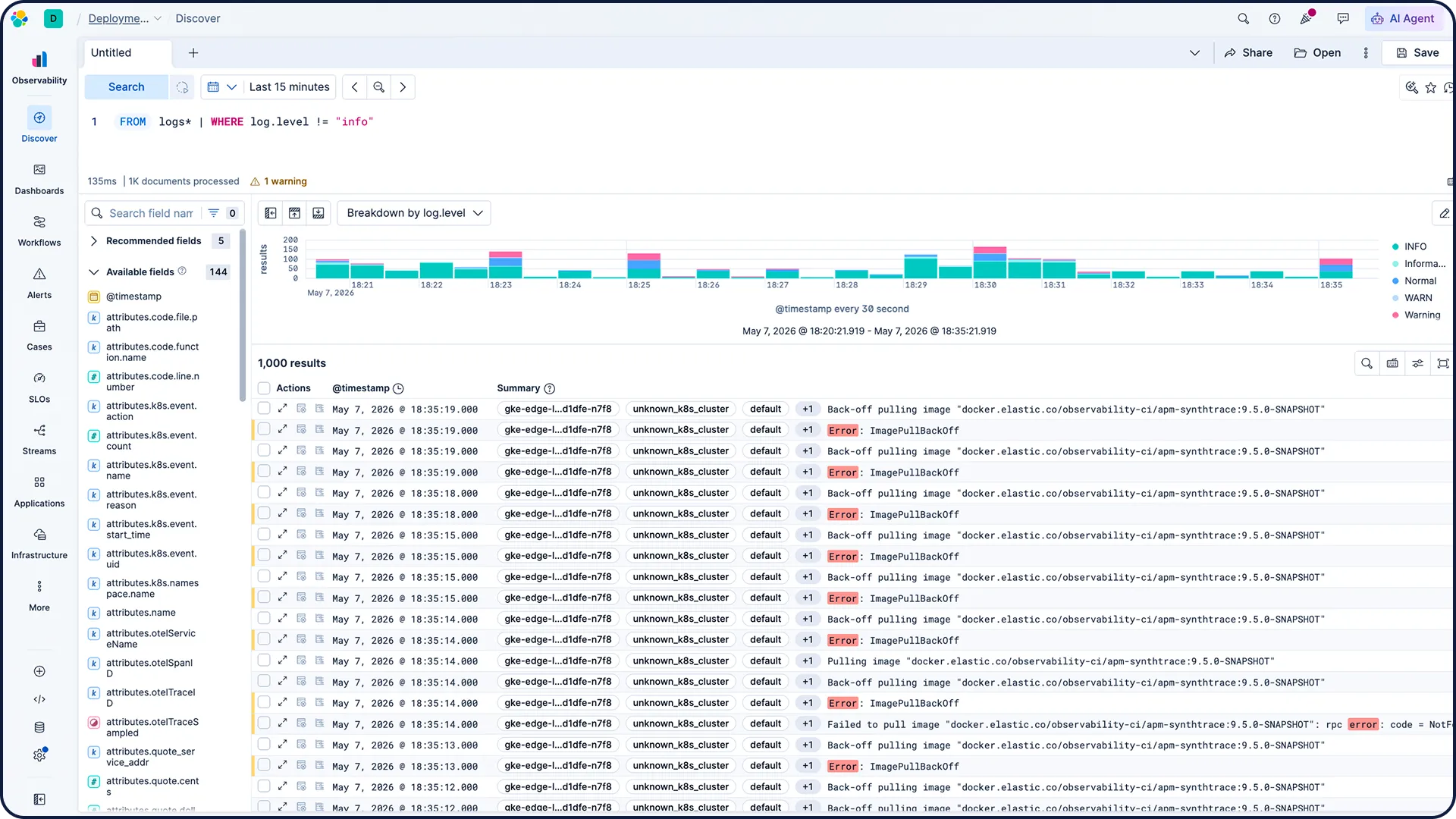
Discover in Elastic Observability filtering log records to non-routine levels, with errors highlighted
Discover in Elastic Observability, from the company's product page: one query keeps only log lines above the routine level, and errors stand out among 1,000 results. Demonstration data.
02 / HOW IT BECOMES REAL

From raw security events to an investigated alert

Illustrative SOC workflow using Elastic’s search and security capabilities.

  1. 01

    Index events from endpoints and systems

    Teams collect security data in searchable indexes. Consistent fields and access rules make later investigation more useful.

  2. 02

    Apply detection logic to the stream

    Elastic Security supports detection and analytics over collected events. Analysts tune rules to surface suspicious behavior and manage unnecessary alerts.

  3. 03

    Search related evidence around an alert

    The analyst searches and correlates activity across the affected environment. The indexed history helps explain whether an isolated signal forms part of a larger incident.

  4. 04

    Turn the investigation into better coverage

    Teams refine detections and dashboards after reviewing cases. The Siemens example shows search-based security at high event volume, without making that outcome universal.

Follow the work, step by step

The record that matters, among billions that do not

Elastic starts from a problem every large IT team lives with. Logs, metrics, documents, tickets and security alerts pile up faster than anyone can read them, and the one record that matters sits among billions of routine ones. Elastic's answer is to index that data so people and software can search it, then use the same search foundation for three jobs: building search and AI applications, watching systems run and finding attacks. It calls itself "the Search AI Company" in its annual filing and in its Seoul job posting.

The order of events explains the company. Shay Banon says his interest in search began in 2004, when he tried to build a recipe app for his wife. He wrote the first lines of Elasticsearch in 2009 and founded Elastic in 2012. Search came first; observability and security are solutions built on the same platform. In 2019 its Korea country manager put the idea in one line: what matters is not how much data a company holds but how quickly and accurately it finds the data it needs.

Three beliefs that set its shape

The first belief is one code base. The annual filing says Elastic does not build an enterprise version separate from its free distribution and keeps "a single code base across both our self-managed software and Elastic-hosted services." A developer's free download runs the same engine a bank buys on contract, so adoption can start with one engineer and end with procurement. The second belief is that open source is how the product gets found. The third is pricing by resource: paid offerings are sold by subscription "through resource-based pricing", and the security product is priced on compute and storage rather than per device.

Open source is in my DNA.

Shay Banon · Founder and Chief Technology Officer, Elastic · Company blog post announcing the return to open source · 2024-08-29

That belief was tested. In 2021 Elastic moved Elasticsearch and Kibana from the Apache 2.0 licence to the Server Side Public License to stop cloud providers offering its software as a service, and Amazon Web Services forked both projects as OpenSearch. In a 2024 interview Banon said the real struggle had been "just the trademark violation", and that August he announced the return to open source, with the AGPL as a licence option. His reason was commercial as much as personal: buyers who look for an open source vector database "see a list, and they choose between them because they care about open source." That is why the Seoul posting asks its seller to "Champion Open Source".

Why now: AI agents need context

Elastic's July 2026 announcement with OpenAI opens: "AI agents are only as useful as the enterprise context they reason over." That context sits in documents, tickets, logs, metrics, traces and security alerts "governed by different permissions." Elastic's claim is that finding the right records, and only those a user may see, is a search problem. Its then chief product officer called the work context engineering in December 2025. In October 2025 Elastic joined forces with Jina AI, which makes multilingual embedding and reranking models, and in September 2026 it launched a serverless vector database. The chief executive, Ash Kulkarni, gave staff the short version in June 2026.

We provide the data store and context engine

Ash Kulkarni · Chief Executive Officer, Elastic · Letter to employees, published on the company blog · 2026-06-24

One alert, followed from start to finish

Follow an illustrative security team through the product. Events from endpoints and systems land in searchable indexes, and detection rules over the stream raise alerts. An analyst opens one alert and searches the surrounding activity to decide whether it belongs to a larger incident, and the team then tunes its rules. Siemens gives the scale of that funnel in its own figures: 6 billion events a day correlated into roughly 11,000 alerts and about 170 cases that reach its security operations centre. Elastic's security page now describes agents that handle the work from ingestion through response, while "analysts handle judgment, verification, and approval." A person still decides.

Signet's reading: the seller in Seoul sells a platform, not one product. The posting asks for someone who speaks "fluently about cloud economics, usage-based pricing, and modern data architectures" and earns credibility with developers and executives alike. The design choices above, one engine, a free edition and pricing by resource, are what that seller explains and defends in every deal.

Understand the products and their customers

One engine, three solutions, three ways to run it

Elastic sells one platform as three solutions: Search and AI, built on Elasticsearch; Observability, for engineers who keep systems running; and Security, for the teams that hunt threats. Customers run it as Elastic Cloud Hosted, Elastic Cloud Serverless, or Elastic Self-Managed on their own servers, all on the same code base, and the paid offerings are sold by subscription with resource-based pricing, so the bill follows the data and compute a customer uses.

Elasticsearch is the engine. It indexes structured and unstructured data and answers full-text, vector and hybrid queries, where hybrid means keyword and meaning-based search fused into one ranked result. In September 2026 Elastic launched Elasticsearch Vector Database on Elastic Cloud Serverless: developers bring their documents and queries, and Elastic handles the embeddings, tuning and infrastructure, with pricing based on data and search capacity. Its rivals range from search products such as Algolia and Coveo to vector databases such as Pinecone and to MongoDB Atlas.

Developers building AI applications shouldn't need to become infrastructure engineers to get vector search working.

Ajay Nair · General manager, Elasticsearch and Platform, Elastic · Press release launching the serverless vector database · 2026-09-11

Elastic Security collects security data, runs detection rules and helps analysts investigate, as a SIEM and XDR product. Elastic tells buyers to "Repeal the endpoint tax", because per-device fees push teams to leave machines unprotected, while its SIEM and XDR are priced on compute and storage. Elastic reports a Leader placing in The Forrester Wave: Security Analytics Platforms, Q2 2025, and a Visionary placing in the 2025 Gartner Magic Quadrant for SIEM. The annual filing names Azure Sentinel, CrowdStrike, Google SecOps, Palo Alto Networks and Splunk as rivals.

Elastic Observability brings logs, metrics and traces into one place so engineers can see why a service misbehaves. Its product page cites a Leader placing in the 2026 Gartner Magic Quadrant for Observability Platforms and claims queries up to 30 times faster than Prometheus and Grafana, in Elastic's own benchmark. In August 2026 Elastic bought Deductive AI, an AI investigation platform for production incidents, for about $70 million in cash. Its named rivals include Splunk, Datadog, Dynatrace and New Relic.

Who bought it, and what changed

The fullest before and after comes from Siemens. Its security team had used Elasticsearch for more than eight years, at first on its own servers, and lost two and a half to three people a year to running data-centre infrastructure. Siemens evaluated Elastic against two other providers, as procurement required, and chose it on technical parity, more attractive pricing, manageability and the skills its team already had. After a migration that took about a year, Siemens reports reclaiming roughly 5,000 analyst hours a year and shipping new detection rules in under a week, down from a backlog of three to four weeks.

Korean customers follow the same pattern. LG CNS tested its KeyLook AI search on the public KorQuAD 2 dataset, combining Elasticsearch's full-text, vector and semantic search, and reports accuracy rising from 75% to 95% and the time to search 110,000 questions and 10,000 documents falling from 0.2 to 0.1 seconds. It runs the platform on its own servers and is piloting the function in knowledge management. POSCO replaced a Google Search Appliance on a portal used by 40,000 employees, with 85 million documents, and reports search 53% faster; its engineers had learned the software at Elasticsearch meetups in Seoul. In Japan, Nikkei reports a 22.5% infrastructure-cost reduction from its Elasticsearch and cloud search revamp decided in 2018. It later adopted managed Elastic Cloud in 2024 to reduce operational workload.

The pattern a seller reuses

These cases show different paths to a paid workload: Siemens shifted security operations to the cloud, LG CNS improved its Korean-language search, and POSCO replaced an earlier search appliance. Signet reads a common sales task in them: explain the cost of the old approach and the measured benefit of the proposed one. The figures come from customer-reported vendor cases and describe those systems, rather than a result every customer will obtain.

The Seoul posting asks for value storytelling that links search, observability and security to "measurable business outcomes like revenue gain or risk mitigation." A candidate who can retell one of these cases in a Korean buyer's terms, with the cost of the old way and the measured result, is already preparing for the panel with role-play and a product demonstration that Elastic describes for some roles.

03 / THE EVIDENCE

The story, in numbers.

DATED OBSERVATIONS

Total annual revenue

USD · B

Company-disclosed total annual revenue in USD billions. Fiscal-year end dates are shown on each point. Historical comparatives follow the cited filing; revenue includes acquisition and currency effects and is not ARR.

Figures, dates & basis +
Total annual revenue
DateValueBasis
2021-04-30$0.608BTotal recognized revenue for the fiscal year ended 2021-04-30. Includes all reported revenue categories.
2022-04-30$0.862BTotal recognized revenue for the fiscal year ended 2022-04-30. Includes all reported revenue categories.
2023-04-30$1.069BTotal recognized revenue for the fiscal year ended 2023-04-30. Includes all reported revenue categories.
2024-04-30$1.267BTotal recognized revenue for the fiscal year ended 2024-04-30. Includes all reported revenue categories.
2025-04-30$1.483BTotal recognized revenue for the fiscal year ended 2025-04-30. Includes all reported revenue categories.
2026-04-30$1.739BTotal recognized revenue for the fiscal year ended 2026-04-30. Includes all reported revenue categories.

Elastic / SEC

FY2026 revenue disclosed

Annual total revenue reached $1.739B.

Q1 FY2027 results

Quarterly total revenue was $478M.

Serverless vector database

Elastic announced a managed vector database with automated retrieval preparation.

Read the growth story

Who pays, and how the bill works

Elastic earns almost all its money from subscriptions: 94% of revenue in fiscal 2026, the year to 30 April 2026. Contracts usually run one to three years and are billed annually in advance. They are either term-based or consumption-based, and the vast majority of Elastic Cloud subscriptions are consumption-based, so the bill follows usage. Cloud customers can also pay month to month without a commitment. One customer, a channel partner, accounted for 11% of fiscal 2026 revenue and 10% in the quarter to 31 July 2026.

Total revenue for fiscal 2026 was $1.739 billion, up 17% (16% in constant currency), of which $1.634 billion was subscription revenue. Elastic Cloud brought in $837.3 million, 48% of revenue, up from 46% a year earlier. In the quarter to 31 July 2026 revenue was $478 million, up 15%, and cloud was 49% of it. Elastic now reports cloud in two parts, and the split matters: Annual Elastic Cloud revenue grew 27% to $185.0 million in that quarter, while Monthly Elastic Cloud revenue grew 1% to $50.2 million. Growth is coming from customers who commit in advance, which is the business an enterprise seller builds.

The dated numbers and what each one measures
NumberWhat it measuresDateBasis
$1.739 billionTotal revenue for the fiscal year, up 17%2026-04-30Company-disclosed
$1.634 billionSubscription revenue, part of total revenue2026-04-30Company-disclosed
$478 millionTotal revenue in one quarter, up 15%2026-07-31Company-disclosed
49%Elastic Cloud share of quarterly revenue2026-07-31Company-disclosed
About 24,000Customers2026-04-30Company-disclosed
More than 1,800Customers above $100,000 annual contract value2026-07-31Company-disclosed
About 111%Net expansion rate: trailing-twelve-month weighted average of same-customer annualized-spend comparisons2026-07-31Company-disclosed
$1.153 billionCurrent remaining performance obligations: contracted revenue due within 12 months, up 21%2026-07-31Company-disclosed
$1.998 billion to $2.010 billionGuidance for total revenue in the fiscal year to 2027-04-302026-08-27Company guidance

Where the money concentrates

The customer numbers show where the money sits. Elastic had about 24,000 customers at 30 April 2026, more than 1,720 of them with annual contract value over $100,000 and more than 240 over $1.0 million ACV. By 31 July 2026 the $100,000 group had passed 1,800. The net expansion rate, a trailing-twelve-month weighted average of same-customer annualized-spend comparisons with twelve months earlier, was about 112% at the fiscal year end and about 111% in the latest quarter: the weighted comparisons show expansion net of contraction and attrition. Contracted work gives the forward view: current remaining performance obligations of $1.153 billion, up 21%, and total remaining performance obligations of $1.854 billion, up 27%.

Elastic generates cash but reports an operating loss under GAAP. In fiscal 2026 that loss was $33 million, against a non-GAAP operating margin of 16.4% and adjusted free cash flow of $346 million, about 20% of revenue. Its net income of $367.8 million came from releasing tax valuation allowances; the annual filing says it would otherwise have made a net loss. It held $1.461 billion of cash and marketable securities at 31 July 2026 and has authorised buybacks of up to $500 million. Investors have swung both ways: shares fell more than 12% in late trading after the November 2025 results, as losses widened, and rose more than 19% in extended trading after the August 2026 results, which beat expectations and raised the year's revenue guidance.

The cited analyst interpreted Elastic’s mix of search, telemetry, security and retrieval as a possible AI advantage that investors were still evaluating in August 2026.

Competitors, position and three risks

Elastic competes on three fronts at once: against search vendors and vector databases, against observability suites such as Datadog and Splunk, and against security platforms from Microsoft, CrowdStrike and Palo Alto Networks. Its claim is consolidation; in May 2026 Kulkarni said organisations are "abandoning fragmented legacy applications to consolidate onto our high-performance platform". Three risks follow from the sources. Forks of its own code, including the one AWS offers, compete with the paid product. AI execution remains a question, while the later repurchase price sits below the board’s earlier award baseline. And the company is reorganising while one channel partner represented 11% of FY2026 revenue and 10% of the latest reported quarter. On geography, the filing puts 46% of revenue outside the United States, with no other single country at 10% or more.

Two habits help in an interview. Name the measure: total revenue, subscription revenue, cloud revenue and remaining performance obligations are four different numbers, and Elastic's headline figures are recognised revenue, not annual recurring revenue. And ask how a Korea territory is credited: committed Annual Elastic Cloud revenue, which grew 27%, or monthly usage, which grew 1%.

04 / THE PEOPLE

Someone saw it first.

Official participant photograph of Ashutosh Kulkarni
CEO

Ashutosh Kulkarni

Kulkarni joined Elastic as chief product officer in 2021. His earlier experience includes McAfee, Akamai, Informatica and Sun Microsystems.

The choice behind the company +

His fiscal 2027 commentary connects AI demand with building, observing and securing applications. The business choice is to serve several data problems through a common search foundation.

“Open source is in my DNA.”

Shay Banon · Company blog post announcing the return to open source · 2024-08-29
The decisions behind the company

A founder who went back to engineering

Shay Banon wrote the first lines of Elasticsearch in 2009, founded Elastic in 2012 and led it as chief executive until January 2022. Then he handed the role to Ash Kulkarni and went back to being chief technology officer, a job he had held before. In his email to staff he said he would "focus on innovation and product. Culture and people." That decision explains how Elastic is run today: a founder who owns the technical direction and the open source stance, beside an operator who runs the company.

Elastic is my life's work.

Shay Banon · Founder, moving from CEO to CTO · Email to employees, published on the company blog · 2022-01-12

A product executive as chief executive

Kulkarni joined Elastic as chief product officer in 2021, after senior product roles at McAfee, Akamai, Informatica and Sun Microsystems, and the board, which considered several candidates, chose him unanimously. In the same announcement he described his habit of tracing questions back to first principles. In October 2025 the board gave him a one-time performance award with a grant date fair value of $29.3 million, earned only if the share price rises in steps from a baseline of $86.61 over three to five years, to drive what it called a transformational growth strategy in generative AI. The company bought back shares at an average of $49.71 in the quarter to July 2026, which puts the award baseline and a later repurchase price in different periods. Signet treats the award as an incentive design rather than a prediction of future returns.

Three decisions that shaped the company

Three decisions explain the company's shape. The licence fight of 2021 and the return to open source in 2024 kept the free edition at the top of the sales funnel. The push into the cloud, which Banon emphasized in 2022, has made Elastic Cloud 48% of revenue in fiscal 2026. And twice in four years Kulkarni has announced workforce reductions: about 13% in November 2022, when customers, especially small and medium businesses, tightened budgets, and about 7% in June 2026. The second plan came with a new structure. Engineering was simplified into three areas whose leaders report to him, chief product officer Ken Exner left in July 2026, and in September 2026 Ajay Nair spoke for the core product as general manager of Elasticsearch and Platform.

especially customer-facing sales, we expect to keep adding to our teams

Ash Kulkarni · Chief Executive Officer, Elastic · Letter to employees, published on the company blog · 2026-06-24

The people above a seller in Seoul

For a Korea hire, the chain that matters runs through sales. Mark Dodds, the chief revenue officer, covers sales, customer success, services, solutions architecture and partner engagement; he joined after 23 years at Cisco Systems. Navam Welihinda, the chief financial officer, previously held the same role at Grammarly and HashiCorp. The Seoul posting sits in a team the job board calls Sales APJ Korea, part of Sales APJ.

How Elastic says it works and hires

Elastic publishes ten short ideas it calls its Source Code and admits that "Some are accurate to who we are while others are aspirational." Customers and community come first. The company is "distributed by intention", with 4,019 employees in over 40 countries at 30 April 2026 and 3,834 at 31 July 2026. And it prefers action to polish: "Just pick a color." Hiring follows a published path: a recruiter call of about 30 minutes, department interviews of 45 to 90 minutes, and for some roles a panel presentation with role-play and a product demonstration. A July 2026 guide allows AI for preparation but says it "shouldn't be used to create experiences and skills that aren't yours," and warns that misrepresentation can lead to termination even after joining.

Three people shape a Korea seat: Kulkarni, who decides where headcount grows; Dodds, who runs the sales, solutions architecture and partner teams a Seoul seller works with; and Banon, whose open source stance the posting asks that seller to champion. Prepare to explain your own work and reasoning in English. Elastic describes panel presentations for some roles; the exact sequence belongs to the recruiter’s process.

05 / THE NEXT CHAPTER

Translate Korean data problems into a measurable purchase

The AE discovers business impact, budget and decision criteria, then works with Solutions Architects, Customer Success and partners. Cloud consumption economics are explicitly part of the sales discussion.

Enterprise sales
  • Enterprise Account Executive
Solutions architecture
  • Principal Solutions Architect
Customer support
  • Senior Support Engineer
Cloud partnerships
  • Cloud Partner Director, Korea
Technical education
  • Principal Architect, Education

October 7 Korea-filtered LinkedIn observations show 17 associated profiles. Company-matched headlines describe sales, solutions architecture, support, cloud partnerships and education. These functions do not establish employee headcount or reporting lines.

Why Korea? Why now?+

Elastic's own account is that Korean users came first. Its June 2019 Korean release says the company entered the market five years earlier through developers who used Elasticsearch for search and logging, that the Korean community had grown past 6,300 members, and that Elastic then built local sales, services, training and support on that base. Nori, an official Korean-language analyzer released in 2018, and yearly Elastic{ON} events in Seoul served those users. The enterprise sale came through partners: Megazone, a Seoul cloud company, in April 2017, and Direa, a technical partner with financial-sector customers, in October 2017. Elastic Cloud has run in the AWS Seoul region since August 2020 and on Google Cloud in Seoul since July 2021, where Elastic spend counts toward the customer's Google Cloud commitment. Signet's reading: Korea is a market of engineers who already use the software, and the work in 2026 is to turn that use into committed contracts, which fits the chief executive's June 2026 line that customer-facing sales is where Elastic plans to keep adding people.

Developers before a company

Elastic's June 2019 Korean release dates its entry into Korea to five years earlier, through developers using Elasticsearch for search and logging at companies such as Devsisters, KakaoTalk and WeMakePrice.

Megazone becomes the cloud partner

Megazone, a Seoul cloud company and AWS consulting partner, becomes the sole partner for deploying Elastic Cloud Enterprise in the Korean market.

A partner into financial services

The Korean subsidiary, then called 엘라스틱서치코리아, signs a technical partnership with Direa, planning to start with Direa's financial-sector customers.

RSN alliance under the first named country manager

The subsidiary, led by country manager 한성엽, announces an alliance with RSN to supply search for its social big data platform.

The founder on the Seoul programme

Elastic{ON} Tour Seoul at COEX, with founder and then chief executive Shay Banon on the programme.

500 people at Elastic{ON} Seoul

The third yearly Seoul event passes 500 attendees, with talks from POSCO, 11st, Funzin, Devsisters, Builton, Direa, Megazone, Ezfarm and Imguru.

김재성 named country manager

Elastic appoints 김재성, formerly of SAP Korea and Concur, to expand its business with customers and partners including eBay, Devsisters, Megazone, Naver, POSCO and Samsung SDS.

Elastic Cloud in the AWS Seoul region

Korean customers can run Elastic Cloud on AWS in Seoul and subscribe through the AWS Marketplace.

Elastic Cloud in the Google Cloud Seoul region

Elastic Cloud runs on Google Cloud in Seoul, and its spend counts toward a customer's Google Cloud commitment.

Sales hiring planned alongside a reduction

Elastic announces a reduction of about 7% of its workforce while planning to keep growing customer-facing go-to-market headcount.

Understand the Korea opportunity

Korean developers arrived before the sales team

Elastic did not come to Korea to find users; the users were already there. Its June 2019 Korean release says Elastic entered the market five years earlier and built a community of developers using Elasticsearch for search and logging at companies such as Devsisters, KakaoTalk and WeMakePrice. By then the Korean community had more than 6,300 members, Elastic had released Nori, an official Korean-language analyzer, in 2018, and the Elastic{ON} Tour in Seoul drew more than 500 people in February 2019. Only on that base, the release says, did Elastic build local go-to-market functions: developer work, business development, engineering, sales, professional services, training and support.

Elastic is open source, so it is built to grow in step with its customers.

김재성 · Korea country manager, Elastic (2019) · Maeil Business Newspaper interview, reported in Korean; translated by Signet · 2019-11-26

In that November 2019 interview the country manager, 김재성, said Korean customers had more than doubled since Elastic set up its Korean business in 2017, and named Samsung SDS, POSCO, Hyundai Motor Group, SK Telecom, Naver and Kakao among the companies it worked with. Signet's reading: in Korea, engineers in large companies picked the software themselves, which gives a seller warm accounts and also customers who already run it for free.

Partners and the cloud carried the enterprise sale

The enterprise business was built with partners. In April 2017 Megazone, a Seoul cloud company and AWS partner, became the sole partner for deploying Elastic Cloud Enterprise in Korea. In October 2017 the Korean subsidiary, then called 엘라스틱서치코리아, signed a technical partnership with Direa to start with Direa's financial-sector customers, and in November it announced an alliance with RSN under its country manager at the time, 한성엽. Banon, then chief executive, was on the programme of the Seoul Elastic{ON} Tour that December. In June 2019 Elastic named 김재성, formerly of SAP Korea and Concur, as country manager. The cloud followed: Elastic Cloud has run in the AWS Seoul region since August 2020 and on Google Cloud in Seoul since July 2021, where Elastic spend counts toward the customer's Google Cloud commitment.

What the Seoul seat says about now

On 8 October 2026 the employer's own job board shows one role located in Korea: Enterprise Account Executive, in the Sales APJ Korea team, based at WeWork Gangnam Station2 in Seoul and first posted on 11 September 2026. A separate posting covers Korean accounts from Singapore: a sales development representative, fluent in English and Korean, who prospects into strategic Korean accounts and works with account executives. The board also defines a Korea solutions architecture team. The AE posting names solutions architects, Customer Success, Marketing and RevOps as collaborators. Public Korea-filtered profile headlines observed on October 7 also describe sales, solutions architecture, support, cloud partnerships and regional marketing. These are observed functions; Signet does not infer an account assignment from a separate posting.

Why plan sales hiring during restructuring? Elastic's June 2026 filing says it plans to keep growing headcount in customer-facing go-to-market functions while reducing its workforce by about 7%, and Kulkarni told staff the same.

especially customer-facing sales, we expect to keep adding to our teams

Ash Kulkarni · Chief Executive Officer, Elastic · Letter to employees, published on the company blog · 2026-06-24

What a Korea hire would do

The posting asks for net-new revenue and expansion within enterprise accounts in an assigned territory, across search, observability and security. The seller qualifies deals with MEDDPICC, a checklist for pain, business impact, budget and decision criteria; speaks to usage-based pricing; works with solutions architects, customer success, marketing and revenue operations; and advocates for the open source edition while selling the commercial features. Fluency in English is required. Signet's reading: the work is to find large Korean companies that already run Elasticsearch, often on their own servers, turn that use into a committed cloud or subscription contract, then widen it to a second use, the way WeMakePrice's security team, by its own 2020 account, took a stack it saw used for search and applied it to security.

Signet’s reading: consider whether you want a Seoul territory role selling technical value across three solutions, with English-speaking collaborators and usage-based economics. A separate Singapore posting shows Korea-focused prospecting there; the AE posting itself names solutions architects, customer success, marketing and revenue operations. Those are useful questions to bring to the interview. The Korea opening has an individual mock application.


KOREA OPEN ROLES

1 open role in Korea

Current Signet catalog · 2026-10-19

FOR YOU

Prepare a SaaS deal with measurable value, negotiation and forecasting.

GTM · Sales · BD

Enterprise Account Executive

South Korea

Posting checked

The work
Win new enterprise business and expand search, observability and security use.
Who fits
A record of overachievement in enterprise SaaS subscription sales.
Keep in mind
Seoul; lead complex contract/pricing negotiations and revenue forecasts; open-source experience is a bonus.
07 / NOW & NEXT

The next scene is taking shape.

FY2026 revenue grows 17%

Total revenue was $1.739B, including $1.634B of subscription revenue.

Q1 FY2027 revenue grows 15%

Quarterly revenue reached $478M and current RPO was $1.153B.

Serverless vector database launches

The launch supports managed vector and hybrid retrieval with automated preparation.

More context on what comes next

Cost reduction announced, continued sales hiring planned

Read against the thesis, the past four months tell one story: Elastic is reorganising around AI while protecting its sales force. On 24 June 2026 it announced a reduction of about 7% of its workforce, with $22 million to $25 million of expected charges, three engineering leaders reporting directly to the chief executive and plans for continued hiring in customer-facing roles. Headcount fell from 4,019 at 30 April to 3,834 at 31 July, and the chief product officer left in July.

Buying and building for AI context

Then came the product moves. On 30 July Elastic announced a collaboration with OpenAI, building on support for OpenAI models since 2023. On 21 August it bought Deductive AI, an AI investigation tool for production incidents, for about $70 million in cash; trade press had earlier reported a price of up to $85 million. On 11 September it launched a serverless vector database priced on data and search capacity. The Jina AI models Elastic took on in October 2025 are multilingual and run inside Elastic Cloud; Signet's reading is that this matters for Korean-language search, the problem LG CNS described. Results on 27 August beat expectations and raised the year's revenue guidance to $1.998 billion to $2.010 billion, and the Elastic{ON} tour, running from September 2026 to March 2027, opens with Kulkarni on why data has never been more valuable.

Engineering teams today are drowning in telemetry but starved for answers.

Ash Kulkarni · Chief Executive Officer, Elastic · Press release on completing the Deductive AI acquisition · 2026-08-24

What to watch next

Signet reads three questions from the company’s reported measures and job board. They can help a Seoul candidate discuss the company’s direction and the territory’s actual evaluation criteria.

  • Whether Annual Elastic Cloud revenue keeps outgrowing Monthly Elastic Cloud revenue (27% against 1% in the quarter to July 2026), since that is the business an enterprise seller builds.
  • Whether the AI products show up in the measures of existing accounts: the net expansion rate (about 111%) and the count of customers above $100,000 (more than 1,800).
  • Whether Elastic adds Korea-located roles after the Seoul account executive seat, one public signal of its local hiring scope.

Their future. Your next chapter.

Find your part ↑

An independent profile by Signet. No affiliation or investment recommendation. Introductions happen only with your consent.
Research reviewed 2026-10-08

A LITTLE MORE CONTEXT

Understanding Elastic.

What does Elastic do?

A security team must distinguish a real intrusion from billions of routine events. Elastic indexes data so people can search, correlate and investigate it, then applies that search foundation to security, observability and AI retrieval.

What is the opportunity in Korea?

The AE discovers business impact, budget and decision criteria, then works with Solutions Architects, Customer Success and partners. Cloud consumption economics are explicitly part of the sales discussion.

Are these confirmed job openings?

Employer postings were checked on 2026-10-08. Availability can change. Mock applications request a review from Signet.

How can I explore the company in more depth?

Follow the company from its vision through products, evidence and people to the Korea team and current roles. Use the table of contents to move within the page, and expand the sections for more context.

Back to the collection ↗