What changed? +
Growing cloud costs and storage complexity.
Vendor-published result for this customer environment; not a universal guarantee.

A checked workload and consistent ongoing service.
See it taking shape ↓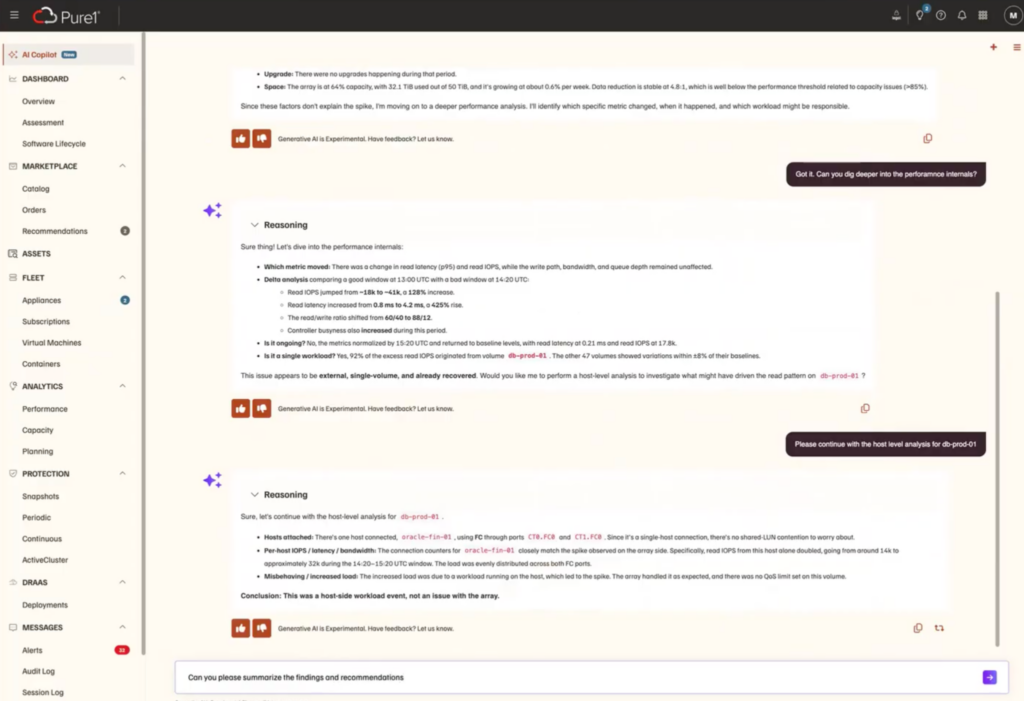
Connect telemetry to an investigated next action.
Growing cloud costs and storage complexity.
Vendor-published result for this customer environment; not a universal guarantee.
Large logs and slow replication.
Vendor-published result for this customer environment; not a universal guarantee.

Illustrative enterprise storage engagement.
Agree capacity, latency and protection needs.
Select the service and fleet policies.
Test the agreed POC outcomes.
Monitor, investigate and plan capacity.
Everpure provides the infrastructure and operating software that enterprises use to store, protect and manage data. The company formerly called Pure Storage began with flash-based storage and now describes an integrated data platform. Its Enterprise Data Cloud brings an organization's storage estate together under shared control across on-premises, cloud and edge environments. The starting problem is familiar to an infrastructure team: applications use separate systems, administrators repeat provisioning work, and capacity or protection problems appear in different consoles. Everpure proposes a common operating model so teams can apply policies and manage data without rebuilding the environment for each application. Signet reads that proposition through a specific workload and the people responsible for it. A database, a Kubernetes application and an AI pipeline need different performance and protection choices. The relevant question is how the platform makes those choices visible and repeatable as data grows, software changes and the enterprise adds new places to run its workloads.
An illustrative workflow begins by identifying the application and its capacity, latency, availability and protection needs. Fusion manages the fleet and applies workload definitions and placement policies, while Pure1 supplies health, performance and capacity information. The enterprise can use that information to plan an expansion, investigate an anomaly or check whether a workload is adequately protected. The official software demonstrations show an administrator's view rather than only the physical arrays: a Copilot investigation and a Fleet Administration screen with joined, eligible and non-eligible systems. Those states make qualification and operating responsibility part of the discussion. The product pages also describe integration with existing observability, virtualization, security and workflow tools. Signet's example is therefore a coordinated operating process, with a chosen policy, a known system state and a checked outcome. It does not assume that every environment should abandon its current tools or that an AI recommendation automatically authorizes a change. Permissions, service requirements and the customer's own procedures remain part of the working design.
Published Korean cases show how this model fits different needs. Lambda256 uses Evergreen//One with Portworx to connect on-premises storage to Kubernetes persistent volumes in a hybrid environment. Toss Bank's case focuses on financial transaction logs and scaling storage independently from servers. Chungbuk Technopark uses FlashBlade for an AI development environment and Pure1 to observe capacity and performance. These are distinct implementations, not three interchangeable examples of an identical rollout. In the bank case, the reported replication improvement concerns the customer's measured process; in the innovation hub case, the reported GPU utilization change belongs to that AI environment. Signet uses these observations to make a storage company understandable through the work it supports. A candidate might explain how a bottleneck was found, how a storage choice changed operating effort, or how a proof of concept became a production design. The strongest introduction connects the workload, evidence and responsibility, keeping the customer's result within the conditions that the published case actually describes.
Pure1 is the cloud-based management experience for an Everpure storage estate. It brings fleet telemetry, health, performance, capacity, protection and subscription information into one interface. An operator can examine alerts and logs, plan a capacity change and review service arrangements rather than switch between an independent view for every array. The official Copilot demonstration follows a performance investigation, using observed signals to reason through likely causes. Its value is the connection between infrastructure measurements and the next action a team should examine. The product is included with active subscriptions and support contracts according to the product page. That inclusion should not be presented as a separate mandatory software fee or an unrestricted free service for anyone. Public material explains integration through REST interfaces, telemetry exports and workflow connectors. Signet would evaluate the screen against an actual incident or planning task, asking whether the information is current, which systems are included, how permissions apply and how the team checks an improvement after acting on the analysis.
Everpure Fusion supplies automation and orchestration across the storage fleet. Teams define the desired workload outcome and apply consistent provisioning and protection settings across participating systems. Current product material describes topology-aware placement, workload mobility and integration with the software stack that a customer already uses. The Fleet Administration demonstration shows which arrays have joined, which are eligible and which still need a qualifying change. This is useful practical evidence because the fleet has requirements and state; it is not simply a brand name for all hardware in a building. The June technical article distinguishes Pure1's management view from Fusion's deeper fleet context. It also says both public MCP servers expose read-only operations and honor existing permissions. Signet preserves that boundary when explaining AI-assisted access to infrastructure information. Automated fleet workflows and read-only MCP queries are different capabilities. A candidate should be able to identify the systems included, the policy applied, the intervention needed for an exception and the outcome verified after provisioning or moving a workload.
The wider platform includes FlashArray for block, file and object workloads, FlashBlade for unstructured data, Portworx for Kubernetes data management and Evergreen//One for consumption-based storage services. These names describe different layers of the customer solution. A bank may need database or log performance; a platform team may need persistent Kubernetes volumes and backup; an AI team may need fast shared access to large files. Data Intelligence adds discovery, classification and context after the acquisition of 1touch. It extends the conversation from where data lives to what the data represents and how it can be used under governance. September's announced additions include catalog access through MCP, deployment through Pure1 and file-access context. The release said the new capabilities would become available in October, so an October tenth introduction preserves that announced timing. Signet connects each product to an actual workload and entitlement. Physical storage, operating software, recurring service and newly announced functions should remain recognizable parts of a design rather than blend into one undifferentiated AI claim.
Comparable fiscal years; exact filed values; period-end dates.
| Date | Value | Basis |
|---|---|---|
| 2024-02-04 | $2.83B | FY2024 audited consolidated revenue. |
| 2025-02-02 | $3.17B | FY2025 audited consolidated revenue. |
| 2026-02-01 | $3.66B | FY2026 audited consolidated revenue. |
SEC / Everpure
Expansion to an integrated data platform.
Discovery and context extend the roadmap.
Everpure's commercial model combines product revenue with subscription services. Enterprises buy storage and related capabilities, support and continuously improving services, while Evergreen//One offers a consumption-based alternative with agreed service levels. The operating decision includes more than an initial equipment order: the customer evaluates capacity needs, upgrade arrangements, performance and protection responsibilities, and the service experience after deployment. Pure1 is included with active subscriptions and support contracts according to its product page, so the management interface should not be counted as a separate required fee. Portworx and the broader platform add software and application-related use cases to the proposition. Partner collaboration also forms part of delivery and enterprise selling. Signet would explain a commercial outcome through the selected workload, procurement route and continuing value. A reduction in a customer's infrastructure costs can support a buying decision, but it is not itself Everpure revenue. Similarly, the customer's transaction volume, stored data and GPU use show operating scale rather than the amount of money the supplier recognizes from that account.
The fiscal 2026 annual report presents audited consolidated revenue for three comparable fiscal years. Revenue was $2.830621 billion in fiscal 2024, $3.168164 billion in fiscal 2025 and $3.662843 billion in fiscal 2026. Those years ended on February fourth, 2024, February second, 2025 and February first, 2026. The chart uses those period-end dates, not a calendar-year assumption or the date of a press release. It keeps annual recognized revenue separate from subscription annual recurring revenue, remaining performance obligations, market capitalization and guidance. The fiscal 2026 table also separates product and subscription-service revenue, giving the reader a clearer picture of the commercial mix. The renamed company remains part of the same reported corporate history; changing the public brand does not restart the annual revenue series. Signet uses the exact filed amounts for the stored values and rounds only the display labels. The chart introduces reported scale and growth, while the business explanation describes what customers buy and the operating relationship that can support continuing demand.
The August twenty-sixth results cover the second quarter of fiscal 2027, which ended on August second, 2026. Exact recognized revenue in the filed table was $1.185898 billion, including $686.773 million of product revenue and $499.125 million of subscription-service revenue. The headline rounded total to $1.2 billion and reported 38 percent year-over-year growth. Subscription ARR was $2.1 billion and remaining performance obligations were $4.1 billion; these are separately defined operating measures, not additional amounts to add to quarterly revenue. ARR reflects annualized recurring subscription contract value and the specified treatment of on-demand billing. The company also gave full-year revenue guidance of $5.03 billion to $5.07 billion. That range remains management's forecast, not a finished fiscal-year result. Signet's introduction therefore follows the annual actual series and provides the quarterly observation separately. Demand from AI and hyperscale deployments is part of the company's stated growth context, while timing, customer concentration, component supply and the continuing delivery of services affect how that demand becomes reported revenue.

Current public executive roster; prior Cisco leadership.
Lead the expansion from storage to data management.
Cofounded Pure Storage in 2009; storage software background.
Connect architecture to continuously improving storage.
“Q2 marks eight straight quarters of accelerating revenue growth for Everpure”
Charles Giancarlo · Q2FY2027 results · 2026-08-26
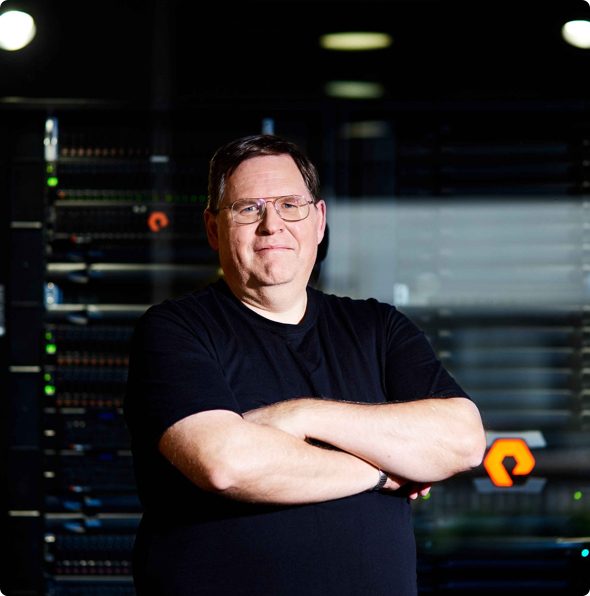
John "Coz" Colgrove is listed as Founder and Chief Visionary Officer in the current official executive roster. His public biography describes cofounding Pure Storage in 2009 after working with storage software and observing growing enterprise adoption of solid-state storage. Charles Giancarlo is the current Chairman and Chief Executive Officer. The roster also names Rob Lee as Chief Technology and Growth Officer and Tarek Robbiati as Chief Financial Officer. Those current titles matter because an introduction should not carry an old finance or technology role forward without checking it. Signet connects the founding context to the product decision that persists: storage should become easier to operate and continue improving as the customer's needs change. The company now applies that idea to a broader data platform, yet the original infrastructure experience still informs the product. A reader can understand the leadership through the technical and commercial responsibilities presented publicly, without assuming that every current executive was part of the original founding team or that the founder alone determines each contemporary decision.
On February twenty-third, 2026, Pure Storage announced the Everpure name and an agreement to acquire 1touch. The same official announcement was later updated to say the acquisition completed on May eleventh. Rob Lee's dated explanation ties the transaction to data context, discovery, classification and relationships, beyond the older focus on storage equipment. This gives the rebrand a concrete product context. The corporate name changes while familiar product names and older customer stories continue to appear. The official Korean FAQ says Portworx retains its product name under Everpure. Signet preserves Pure Storage as the former name so a reader can connect existing experience and historical sources to the current company. It also separates the acquisition agreement from the later completion and planned product integration. Owning a company and making every planned combined capability available are different events. The useful leadership story is the decision to move from managing the storage estate toward understanding and governing the information in that estate, with dated evidence for each step.
Everpure's culture material names customer first, persistence, creativity, teamwork and ownership as its values. A candidate can make those ideas concrete through a technical or customer decision: how the problem was understood, which assumption was tested, how colleagues were involved and what changed after evidence appeared. The Korean systems-engineer advertisement asks for collaboration with account executives, customers and partners, which turns those broad values into a visible working arrangement. The customer cases similarly show that an infrastructure outcome needs architecture, implementation and continued operations, rather than a persuasive slide alone. Signet's reading is that customer responsibility includes explaining the limits of a result, recognizing unresolved requirements and checking the operating design after a proof of concept. The public sustainability material adds another dimension, connecting infrastructure efficiency to power, space and resource use. Those stated priorities can guide an interview example, but they should not be treated as a guaranteed account of every team's daily practice. The reader should use them to prepare specific questions and work evidence grounded in the advertised role.
The official Greenhouse board lists one opening under the Korea office filter at the review date: Senior System Engineer (Korea), in Seoul, with identifier 8168484. Its title uses singular System, while the body describes the Senior Systems Engineer responsibility. The role works with account executives, customers and partners from discovery through a proof of concept and deployment. It includes technical discussions, workshops, architecture proposals, RFP and RFI responses, competitive positioning and expansion into AI, cloud, virtualization and Kubernetes environments. The requirements specify at least ten years of IT infrastructure experience, customer-facing presales or solution consulting, storage presales or engineering, and business-level English communication. The advertisement includes an onsite tag. It does not supply a posting date in the visible job description, so a review date should not be substituted for one. Signet keeps the existing operational catalog identity for this exact official job, connecting the former Pure Storage name to the current Everpure employer without creating a duplicate role.
The role works with account executives, customers and partners.
Published blockchain, banking and AI-infrastructure cases.
Everpure's Korean business can be introduced through named customer evidence rather than an inferred employee count. Lambda256 is based in Seoul and describes moving core blockchain-node work to on-premises Evergreen//One while keeping some operational data in the cloud. Portworx connects the new storage to Kubernetes persistent volumes. The case reports fourfold storage efficiency and doubled physical capacity. Toss Bank's published story focuses on financial transaction analysis, with FlashArray supporting demanding logs and Pure1 monitoring. The reported replication change is from up to four hours to less than one minute. Chungbuk Technopark describes an AI development environment, with storage processing doubled and GPU use moving from thirty to eighty percent. These results belong to the named customers and their stated environments. They do not establish the total number of Korean accounts or a universal outcome for every installation. Signet uses the differences to show why a local technical engagement starts with understanding the workload and then evaluating architecture, operating effort and the evidence a customer can use in making its decision.
The official Greenhouse board lists one opening under the Korea office filter at the review date: Senior System Engineer (Korea), in Seoul, with identifier 8168484. Its title uses singular System, while the body describes the Senior Systems Engineer responsibility. The role works with account executives, customers and partners from discovery through a proof of concept and deployment. It includes technical discussions, workshops, architecture proposals, RFP and RFI responses, competitive positioning and expansion into AI, cloud, virtualization and Kubernetes environments. The requirements specify at least ten years of IT infrastructure experience, customer-facing presales or solution consulting, storage presales or engineering, and business-level English communication. The advertisement includes an onsite tag. It does not supply a posting date in the visible job description, so a review date should not be substituted for one. Signet keeps the existing operational catalog identity for this exact official job, connecting the former Pure Storage name to the current Everpure employer without creating a duplicate role.
The advertised work suggests an interview example that follows the customer's decision rather than only a product demonstration. A candidate can start with an enterprise infrastructure constraint, explain how business and technical requirements were collected, and show the architecture and proof-of-concept criteria agreed with the customer. The next step is evidence: performance and capacity observations, protection or recovery checks, objections resolved and the handoff into deployment. Those are Signet's preparation suggestions drawn from the role, not a promised internal interview sequence or an assigned ninety-day plan. Experience with GPU infrastructure, Kubernetes or OpenShift, virtualization and large enterprise RFP or POC engagements appears as preferred background. The role's English requirement supports clear collaboration across technical and commercial teams, while the Korean customer cases offer concrete workload contexts to discuss. A reader should distinguish the seller's responsibility, the systems engineer's technical work and the customer's operating authority. That distinction makes the local opportunity more precise and helps candidates demonstrate their own decisions and checked outcomes within a larger team.
Current Signet catalog · 2026-10-19
Connect infrastructure, storage and customer-facing experience.
The February name-change announcement and the May eleventh editorial update establish two distinct events: the Everpure identity and the completed 1touch acquisition. Rob Lee's May explanation places continuous discovery, classification, relationships and context at the center of the intended data-intelligence expansion. The first-quarter results later confirm completion. Earlier annual-report language still described a pending transaction because it was written before closing. Signet keeps that chronology intact and uses the later completion evidence for current status. Product integration remains a capability-by-capability question. An acquisition closing does not automatically establish that every planned feature is available to every customer in production.
The second-quarter release reported $1.185898 billion of recognized revenue and thirty-eight percent year-over-year growth. It also announced a second top-five hyperscaler win on August tenth, without naming that customer. The product commentary included generally available Data Stream, Azure Native Services and FlashBlade integration with Cisco Intersight. These items give the growth story an implementation context beyond a single total. Signet does not infer the unnamed cloud company's identity. It also preserves the distinction between reported quarter results, subscription operating measures and the management forecast for the full year. Readers can assess the expanding customer and product scope while keeping the actual financial period explicit.
On September thirtieth, Everpure announced data-management additions for production AI, including MCP access to live catalogs, deployment through Pure1 and privacy-first file intelligence. The file feature describes access and staleness without reading file content. The release also introduces PureKVA, DeepReduce compression and an open-weight-model reference architecture. Its up-to-twenty-times faster time-to-first-token statement is a performance claim subject to the environment and dataset conditions disclosed in the release. Availability was stated for October. As of the October tenth review, Signet records the announcement and that timing rather than assert an exact general-release day that the source does not provide. The practical next step is to verify entitlement and availability for the customer's intended deployment.
Storage, data-management software and services
The official Greenhouse board lists one opening under the Korea office filter at the review date: Senior System Engineer (Korea), in Seoul, with identifier 8168484. Its title uses singular System, while the body describes the Senior Systems Engineer responsibility. The role works with account executives, customers and partners from discovery through a proof of concept and deployment. It includes technical discussions, workshops, architecture proposals, RFP and RFI responses, competitive positioning and expansion into AI, cloud, virtualization and Kubernetes environments. The requirements specify at least ten years of IT infrastructure experience, customer-facing presales or solution consulting, storage presales or engineering, and business-level English communication. The advertisement includes an onsite tag. It does not supply a posting date in the visible job description, so a review date should not be substituted for one. Signet keeps the existing operational catalog identity for this exact official job, connecting the former Pure Storage name to the current Everpure employer without creating a duplicate role.
Employer postings were checked on 2026-10-10. Availability can change. Mock applications request a review from Signet.
Follow the company from its vision through products, evidence and people to the Korea team and current roles. Use the table of contents to move within the page, and expand the sections for more context.