What changed? +
A closed-loop model and manual movements slowed new work.
Published customer operating account; no universal saving claimed.

A scoped transaction follows approval rules and reaches reconciled financial records.
See it taking shape ↓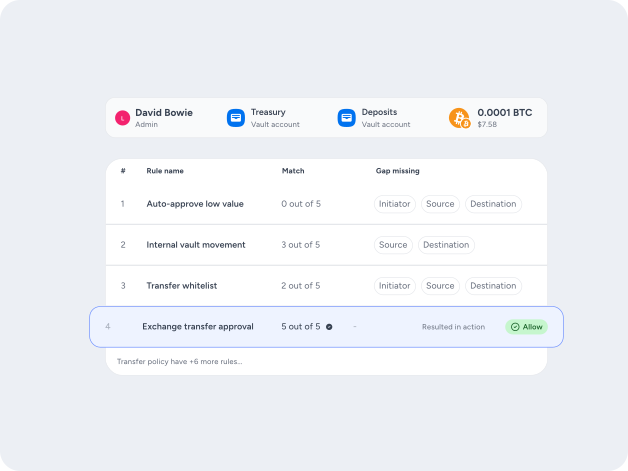
Make approvals and decisions traceable.
A closed-loop model and manual movements slowed new work.
Published customer operating account; no universal saving claimed.
A particular bulk settlement took more than twelve hours.
One major-customer bulk flow in the published account.
Illustrative institutional transfer and reconciliation.
Choose source, destination, asset and business purpose.
Evaluate transaction rules and approval conditions.
Sign and settle the approved movement.
Connect balances and fees to financial records.
Fireblocks supplies infrastructure that institutions use to hold, move and issue digital assets. The buyer is a bank, fintech, payment provider, exchange or corporate treasury rather than an individual choosing a consumer trading app. The practical problem is that a blockchain transfer must also fit an organization's authority, security and financial records. Someone needs to decide who can initiate a payment, which destination is allowed, who approves an exception and how the resulting movement reaches the books. Fireblocks combines wallet infrastructure, transaction policies, network connectivity and automation around that work. Its current offering extends to tokenization, stablecoin payments, embedded wallets and financial data. These capabilities serve different business models, so a customer first chooses the use case and operating responsibility. A bank issuing a tokenized instrument, a fintech giving users wallets and a treasury settling invoices have different owners and workflows. The platform gives them shared infrastructure while the institution still determines its service, controls and customer obligations.
An illustrative treasury transfer starts with a source wallet, a destination and a business reason. The institution configures a policy for amount, asset, destination, time window and required approvals. Compliance integrations can contribute transaction risk signals according to the organization's chosen rules. The signing process follows the approved transaction rather than letting every employee hold an unrestricted private key. MPC distributes signing responsibility across key shares; the security architecture combines that cryptography with additional software and hardware protections. A distributed key design still needs appropriate access, recovery procedures and well-configured policies. The network helps institutions connect to counterparties and reduces repeated manual address handling. Deployment choices matter as well: the published architecture allows different arrangements for hosting keys and connecting banking systems. Signet reads these components as a sequence of operating decisions. The meaningful result is a transaction that followed the agreed rules, reached the intended counterparty and produced a traceable record that the team can inspect afterward.
Execution is one part of the working loop. Fireblocks Automation lets an operating team define triggers and actions for transfers, top-ups, sweeps, rebalancing and conversions. Those rules remain subject to transaction governance. Financial Data, developed with TRES, then connects wallet activity to structured records and reconciliation. A finance team needs to understand amounts, fees, counterparties and balances rather than receive a bare list of transaction hashes. Published customer accounts make this distinction concrete. Revolut describes reducing manual treasury movements while using thresholds to route transfers for approval. Bridge describes a particular bulk-payment process that moved from more than twelve hours to less than ninety minutes with the Fireblocks team. ABN AMRO describes digital bonds and custody for corporate banking. Their results concern different implementations and cannot be combined into a universal speed guarantee. Signet's workflow therefore ends with checked settlement and finance records, making the product understandable through the people who operate and account for the movement.
Policy Engine is the governance layer for the platform's digital asset operations. An administrator configures conditions and authorization requirements, while operators can inspect pending approvals and the rules evaluated for a transaction. The official interface illustration shows matching conditions, missing criteria and the rule that resulted in an allowed action. That is a useful product view because it exposes the reasoning behind a workflow rather than only showing a wallet balance. The product material also describes approval groups, mobile approvals, API-based approvals and permissions for policy changes. An ordinary transfer, a contract interaction and a token operation can need different rules. Teams can connect screening providers, document policies and retain transaction authorization history. Signet would demonstrate this product with one normal transaction and one exception, checking that the expected approver and rule are visible. The buyer needs a workable balance between throughput and control, with a process for investigating why an action was allowed, held or refused.
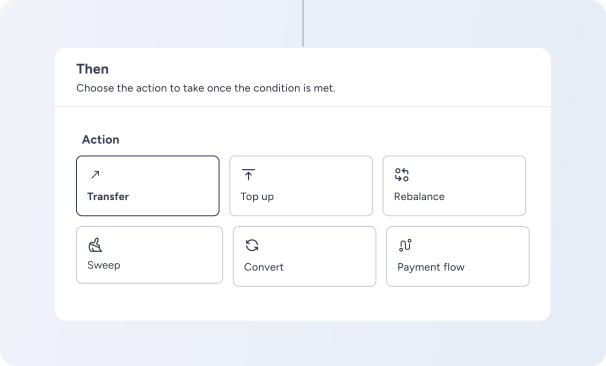
Fireblocks Automation gives payment and trading operations teams a rule builder for repeated movements. They choose a trigger, such as an incoming deposit or a balance change, then define a transfer, top-up, rebalance, sweep, conversion or payment flow. The official product illustration shows those action choices explicitly. This is useful when account balances must be maintained outside office hours or when an operating team otherwise repeats the same sequence manually. The page states that every automation still passes through Policy Engine; automation does not grant independent permission to ignore the customer's governance. Teams need to choose an appropriate source account, destination, amount and exception treatment before enabling a rule. Reported Yolo and Orbital examples concern their own operations, rather than a guaranteed saving for every buyer. A practical evaluation would run the proposed flow against realistic deposits and low-balance conditions, inspect authorization and settlement records, and establish who maintains the rule when the customer changes its payment or trading process.
The wider portfolio uses the same operating foundation in different settings. Tokenization helps institutions deploy contracts and manage issuance activity with permissions and monitoring. Embedded wallets put a wallet experience inside a fintech application. The Agentic Payments Suite separates merchant acceptance through a hosted gateway from wallet access delegated to an AI agent. Fireblocks Flow gives PSPs a way to add stablecoin acceptance while preserving their checkout experience and mapping payment records to reconciliation. Financial Data adds a ledger-oriented view rather than replacing the need to define the institution's accounting process. Coverage also needs careful reading. The current blockchain directory includes mainnets and testnets, and support levels differ by asset and capability. A candidate should show the required chain, wallet, protocol, reporting and approval scope in a concrete design. The most useful comparison is with the customer's existing fragmented tools or in-house build, judging integration work and operational ownership for the chosen use case rather than treating every module as interchangeable.
A single disclosed lower bound; not current ARR, year-end revenue or a growth trend.
| Date | Value | Basis |
|---|---|---|
| 2022-09-12 | >$100M | Announcement date; ARR had surpassed this threshold. |
Fireblocks
550 million raised; historical financing valuation above 8 billion.
Historical minimum above 100 million.
Dated product launch names 2,500+ institutional clients.
Fireblocks monetizes institutional infrastructure through subscription plans and negotiated enterprise scope. The current pricing page offers Essentials at 999 US dollars per month for up to six months and describes Custom plans starting at 36,000 dollars annually. Essentials includes specified users, workspaces, embedded wallets and quarterly outbound volume, with a stated overage rate. Those conditions matter: the entry price is a bounded plan rather than an unlimited quote for every bank or payment provider. Custom plans vary with API limits, integrations, onboarding, support and advanced capabilities. The economic reason to buy is a shorter, more manageable path from a proposed service to daily operation, with security, transaction controls and connectivity in the chosen scope. A buyer can compare the subscription with maintaining separate wallet, workflow and reporting infrastructure. Signet does not treat customer transfer volume as Fireblocks' own income. The product's operating value concerns the institution's ability to launch and maintain a service, while the vendor's subscription economics require their own measures and dates.
The dated financial milestone in the verified primary material is the September 12, 2022 announcement that ARR had surpassed 100 million US dollars. ARR is an annualized recurring-revenue measure at a point in time, not audited annual recognized revenue. Signet charts that announcement as a single historical minimum, with its disclosure date and greater-than label. It is not a current 2026 ARR estimate, a year-end observation or a complete annual trend. Earlier in January 2022, Fireblocks announced a 550 million dollar Series E round, describing a valuation above eight billion dollars in the body. The round amount is money raised; the valuation is the financing context. Neither belongs on the ARR line. Investors included D1 Capital Partners and Spark Capital as coleads, with additional institutional investors and support from existing backers. The current hiring material says more than a billion dollars has been raised overall. Signet keeps those categories apart so a reader can distinguish operating traction, financing resources and a historical private-company valuation.
More recent material provides operating scale. The Seoul description states more than 2,400 institutional customers as of January 2026. The April 15 Earn launch names more than 2,500 institutional clients and says the platform processes over 300 billion dollars in stablecoin transactions each month. The September BDACS announcement describes more than sixteen trillion dollars secured in digital asset transactions. These are customer and activity measures, with different dates and definitions from subscription ARR. Survey findings also need scope: the Financial Grid studies financial institutions and corporations who responded to the company's research, so budget commitment and production readiness percentages are not a census of every bank. The commercial opportunity is to convert a customer's planned digital asset service into an operating implementation that retains its controls and records. Risks include incorrect configurations, integration work across changing assets and networks, and a customer's ability to govern new payment flows. Growing volume may increase demand for infrastructure, but it cannot be multiplied by a headline fee to invent Fireblocks' recognized revenue.

Lacoon cofounder and former Check Point security product leader.
Connect secure operations to financial records.

Research and engineering leadership at Lacoon, Check Point and Safend.
Build the technology underlying institutional operations.

Cybersecurity, software and decentralized product experience.
Apply controlled wallet authority to agent payments.
“the digital asset infrastructure and existing finance systems are disconnected.”
Michael Shaulov · Authored TRES acquisition announcement · 2026-01-07
The current executive roster identifies three cofounders: Michael Shaulov as Chief Executive Officer, Pavel Berengoltz as Chief Technology Officer and Idan Ofrat as Chief Product Officer. Their present titles matter because older announcements describe a different division of responsibilities. Shaulov previously cofounded Lacoon Mobile Security, which Check Point acquired, and then led mobile and cloud security products at Check Point. Berengoltz's public biography describes research and engineering leadership at Lacoon, Check Point and Safend. Ofrat brings software engineering, cybersecurity and product management experience, including critical-infrastructure security and decentralized technology businesses. Together those biographies explain a starting point in protecting systems and signing authority rather than promoting an individual trading token. The company announced its first product before reaching the September 2022 ARR milestone, which described four years since inception and three since product launch. Signet uses the current leadership roster for present responsibilities and dated releases for historical milestones, so an old executive title does not silently become a current claim.
Shaulov's January 2026 TRES acquisition announcement describes an operating gap between blockchain activity and established finance systems. Institutions need records that map to their ledgers, enterprise systems and reporting workflows as digital asset operations grow. That announcement is a strategic explanation: securing a movement and accounting for it belong in a connected system. The current financial-data page makes the direction tangible through transaction classification, reconciliation and ERP connections. Payment capability had already expanded with the February 2022 First Digital acquisition, which brought specialist payment technology and engineering into Fireblocks. These are different steps in the company's development, with historical roles kept at their announcement dates. Ofrat's May 2026 launch then extends the same controls to agent-initiated payments, covering acceptance and delegated wallet authority. Signet reads the decisions as a progression from security infrastructure into repeatable institutional workflows. The leadership question is whether each added capability makes implementation, daily operations and financial evidence easier to connect for the chosen customer.
Fireblocks' careers page states values around customer focus, trust, challenging established practice, ownership and shared determination. They become meaningful when connected to work rather than repeated as abstract slogans. In an institutional sales process, customer focus means understanding the proposed service, risk concerns and integration constraints before presenting a module. Trust includes documenting what a demonstration proved and which follow-up remains with the customer or technical team. Ownership includes maintaining an accurate account plan and bringing colleagues into a complex decision. The Seoul job describes selling with sales engineers, business development representatives and the wider go-to-market team, giving a concrete setting for those principles. Official customer accounts also show that operational fit matters: ABN AMRO valued integration and scalability, while Revolut described aligning permissions with its organizational process. A candidate can bring an example where a customer's constraint changed the design or sales plan and explain how the team checked the result. That is stronger evidence of the stated culture than claiming security software eliminates every operational risk.
Fireblocks' official public post about NH NongHyup Bank describes collaboration around a Korean won stablecoin ecosystem and a proof of concept for digitized tax refunds. Its wording is exploration and joint evaluation, which Signet retains. A proposed ecosystem and a PoC are different stages from a generally available bank service or a completed commercial rollout. They still explain relevant work for an institutional seller: connect a business process, bank infrastructure and blockchain components, then help stakeholders decide what to test and which evidence makes a next step credible. Global cases offer useful comparisons without turning them into Korean results. ABN AMRO discusses digital bonds, ecosystem connectivity and integration requirements; Bridge explains large-scale payment settlement. A candidate can use those cases to ask about the Korean institution's transaction path, wallet ownership, approval rules and reporting connections. That is a more grounded local introduction than claiming a changed law guarantees a ready market or that every partnership has already produced a nationwide service.
The advertised seller works with sales engineers, business development and the go-to-market team.
BDACS adoption and NH Bank collaboration ground local institutional work.
Customer announcement covers institutional custody and stablecoin operations.
BDACS' own September 21, 2026 newsroom announcement provides direct Korean customer evidence. It says the company selected Fireblocks to run institutional custody, transfers and stablecoin operations across blockchains through a shared security and policy layer. The emphasis is operational consistency: approval controls, asset separation and governance should continue to work as the asset and network mix changes. The follow-up Korean newsletter describes Fireblocks adoption as part of its institutional infrastructure expansion. Signet records BDACS as the customer and Fireblocks as the technology provider rather than treating the customer's other banking partnerships as automatic Fireblocks customers. The custodian's assets under custody are also its own business measure, not Fireblocks revenue or funds under Fireblocks management. This distinction gives an applicant a concrete conversation: identify the service owner, the operation being secured and the evidence needed for its stakeholders. The case demonstrates actual local use of the infrastructure without assuming a particular Fireblocks Korean office size or reproducing a partner's legislative interpretation as a universal legal conclusion.
Fireblocks' official public post about NH NongHyup Bank describes collaboration around a Korean won stablecoin ecosystem and a proof of concept for digitized tax refunds. Its wording is exploration and joint evaluation, which Signet retains. A proposed ecosystem and a PoC are different stages from a generally available bank service or a completed commercial rollout. They still explain relevant work for an institutional seller: connect a business process, bank infrastructure and blockchain components, then help stakeholders decide what to test and which evidence makes a next step credible. Global cases offer useful comparisons without turning them into Korean results. ABN AMRO discusses digital bonds, ecosystem connectivity and integration requirements; Bridge explains large-scale payment settlement. A candidate can use those cases to ask about the Korean institution's transaction path, wallet ownership, approval rules and reporting connections. That is a more grounded local introduction than claiming a changed law guarantees a ready market or that every partnership has already produced a nationwide service.
The official careers page lists one Seoul opening in the current snapshot: Sales Director, ID 4698039006. Its visible heading is Sales Director, while the browser document title adds SSS. The description targets financial institutions and technology partners across APAC and places the seller alongside sales engineers, business development and the go-to-market team. Responsibilities include monthly and quarterly revenue targets, prospect relationships, territory and account planning, qualification and CRM maintenance. Enterprise software or institutional selling into relevant markets is mandatory. Financial services, cybersecurity or cryptocurrency experience and a partner coselling motion are preferred, alongside an understanding of blockchain and digital assets. The word Director does not itself prove a people-management mandate or a Korean country-head position. Signet's preparation guidance asks the candidate to show a complex institutional deal, their own qualification decisions and how a technical or partner team helped close it. Onboarding is explicitly offered. The native catalog entry keeps the same official ID and existing Seoul slug, connecting the refreshed official URL without creating a duplicate job.
Current Signet catalog · 2026-10-19
Use BDACS customer evidence and the current institutional sales requirements.
The January 7 TRES announcement extends Fireblocks' direction toward accounting, reconciliation and financial controls. Shaulov describes the gap between digital asset activity and established finance systems, with the aim of turning operating records into structured information for existing workflows. The present Financial Data page shows how wallet addresses, ledger-oriented records and enterprise-system connections fit that direction. Signet treats the dated acquisition announcement as a strategic milestone and the current product page as capability evidence. It does not imply that every customer has already migrated every finance process or that buying software automatically satisfies all reporting requirements.
May 20's Agentic Payments Suite announcement separates a PSP's acceptance gateway from a fintech user's delegated agent wallet. The key design is scoped spending authority, enforced policy and a traceable payment process. The product page offers access to the gateway and a wallet launch path, so availability should be checked for the selected component. June 2's Flow announcement addresses stablecoin acceptance, conversion and reconciliation while the PSP retains its checkout and customer relationship. The launch material explicitly places protocol operations and licensing responsibility in their respective roles. Signet explains the product as payment infrastructure and preserves those operational boundaries rather than treating Fireblocks as the merchant or a guarantee of every conversion outcome.
BDACS' September 21 selection announcement ties the institutional platform to a named Korean custody operation. The September 28 corporate Financial Grid report then discusses the services corporate respondents want from banks, with the sample and respondent scope kept explicit. On October 6, a Fireblocks technical article walks through an AI agent purchasing a dataset: authority is scoped, payment terms are discovered, rules are checked, the transaction is signed, access is delivered and evidence is recorded. That sequence is an illustrative use case, not an observed customer revenue result. It also recognizes unresolved dispute and refund handling in agent payments. Together the updates help candidates discuss controls, adoption and implementation without turning a demonstration into a completed commercial outcome.
Wallets, governance, payments and financial data
Fireblocks' official public post about NH NongHyup Bank describes collaboration around a Korean won stablecoin ecosystem and a proof of concept for digitized tax refunds. Its wording is exploration and joint evaluation, which Signet retains. A proposed ecosystem and a PoC are different stages from a generally available bank service or a completed commercial rollout. They still explain relevant work for an institutional seller: connect a business process, bank infrastructure and blockchain components, then help stakeholders decide what to test and which evidence makes a next step credible. Global cases offer useful comparisons without turning them into Korean results. ABN AMRO discusses digital bonds, ecosystem connectivity and integration requirements; Bridge explains large-scale payment settlement. A candidate can use those cases to ask about the Korean institution's transaction path, wallet ownership, approval rules and reporting connections. That is a more grounded local introduction than claiming a changed law guarantees a ready market or that every partnership has already produced a nationwide service.
Employer postings were checked on 2026-10-10. Availability can change. Mock applications request a review from Signet.
Follow the company from its vision through products, evidence and people to the Korea team and current roles. Use the table of contents to move within the page, and expand the sections for more context.