Eric Jing, co-founder and CEO of Genspark
Genspark / THE WORLD THEY ARE BUILDING

From scattered context to office work a person can inspect.

A professional can start from the purpose of a task and inspect a usable artifact instead of assembling separate answers.

See it taking shape ↓
01 / THE PRODUCTS

The products behind the promise.

GenOffice Slides presentation
AI Slides

A presentation from a topic and source material.

The user reviews the storyline and visual layout.

CBRE Moran Team

A property pitch becomes an explorable story

The published case reports first-draft time moving from four hours to 35 minutes.

Research and an interactive dashboard supported the commercial property pitch.

What changed? +

The team assembled property research and pitch materials manually.

Company-published account of one commercial real estate team and its workflow.

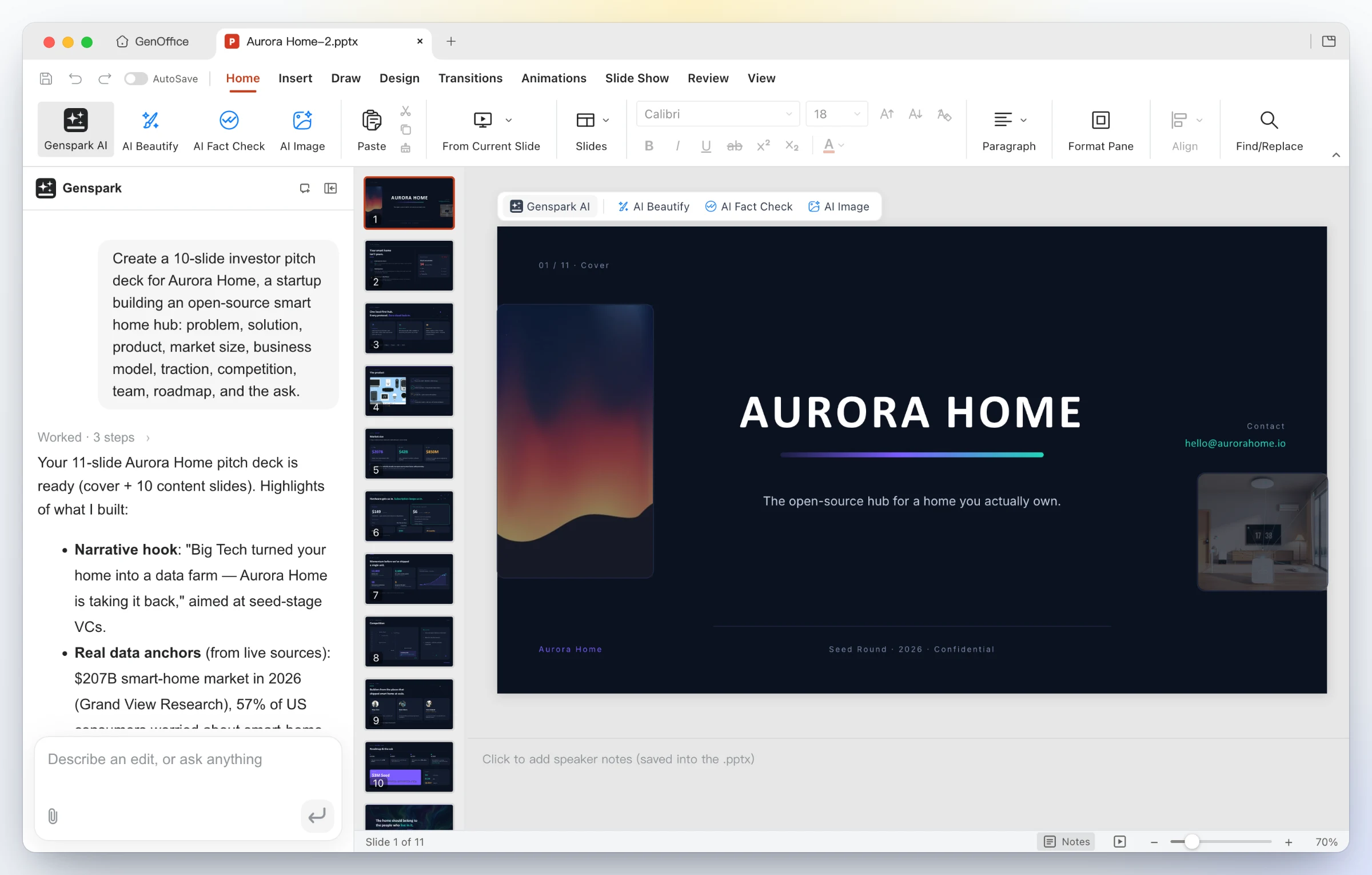
GenOffice actual editor overview
02 / HOW IT BECOMES REAL

An illustrative customer briefing

Illustration: a team assembles an account briefing from authorized research and existing office files.

  1. 01

    Choose context

    Connect authorized files and business systems for a specific task.

  2. 02

    Plan the work

    The agent chooses tools as the task progresses.

  3. 03

    Analyze

    Research and structured data become material for the deliverable.

  4. 04

    Create and inspect

    Generate office material, then inspect its sources and meaning.

  5. 05

    Share an editable file

    Colleagues can review and revise familiar office formats.

Follow the work, step by step

The deliverable replaces the answer

Genspark's first product was AI search. That starting point matters because its subsequent change was a change in the job it accepted, not merely a new chat interface. Its April 2025 explanation described the limits of a fixed search pipeline: expand a question, retrieve information, rank results and produce an answer. A request for a finished presentation demands another sequence. Someone has to choose the argument, check the evidence, decide what belongs on a slide and keep revising the material. Genspark moved toward an agent that chooses tools as the task unfolds. Signet reads this as a bet on completed work as the unit a user values. The test is practical: after a response arrives, how much assembling and correcting does the person still have to do? A long and fluent answer can still leave that burden with the user. An editable deliverable moves more of it into the product, while leaving the human responsible for the purpose of the work.

Context enters before execution

Consider an illustrative team preparing a customer briefing. The starting material is scattered across email, meeting notes, a spreadsheet and a prior deck. This is an example of the workflow, rather than a claim about a named customer. Hub made files and project instructions part of a shared work space in October 2025. SecondBrain later extended that idea to authorized business connectors and persistent context. The person first chooses which accounts and documents to connect, and which question the briefing must answer. Super Agent can then research, analyze and generate material using that context. Office editors provide the place to inspect the result. This sequence explains why Genspark groups memory, intelligence, execution and collaboration into four layers in Workspace 6. The interfaces are useful together only when information survives the handoff between them. A team still needs to decide which source controls a disputed number and who approves the final version. Those decisions make context an operating practice, rather than a pile of uploaded files.

The last decision still belongs to a person

The more an agent can execute, the more consequential the review becomes. Email connectors and meeting records carry customer details; a generated deck can turn tentative research into a confident-looking claim. Eric Jing's writing in May 2026 puts human judgment at the center of that change. His argument is about deciding which output deserves trust, not simply producing more text. Genspark's enterprise materials place administration, permissions and contractual security terms alongside the generation tools. Signet's reading is that a successful workspace must shorten production without blurring the responsibility to approve what is sent or shared. For a Korean reader, this connects personal adoption to the harder task of team adoption. A person can experiment with a draft alone. A department needs a repeatable way to connect data, review outputs and keep working in formats colleagues already use. That is where product usefulness, enterprise implementation and an applicant's understanding of real customer work meet. The relevant question is whether a workflow stays dependable when it is repeated every week.


Understand the products and their customers

Three outputs, three kinds of review

AI Slides, AI Sheets and AI Docs address different parts of office work. Slides turns a topic and supporting material into a storyline and a deck; the reader reviews the argument, layout and sources. Sheets combines gathering information with structured cells and analysis; the reviewer has to understand where values came from and whether calculations answer the question. Docs produces a structured document that can be edited as rich text or Markdown; the review focuses on meaning, tone and the intended reader. These are related tools, but they should not be judged with the same demonstration. A visually polished slide may conceal weak evidence. A convincing paragraph may overstate a conclusion. A sheet can look complete while its formulas reflect the wrong business definition. Signet therefore reads the suite through the artifact each person must inspect. The products make more of the preparation automatic, and the remaining work becomes more specific: decide whether the material is sound enough to use for the actual decision.

Editing becomes part of the agent loop

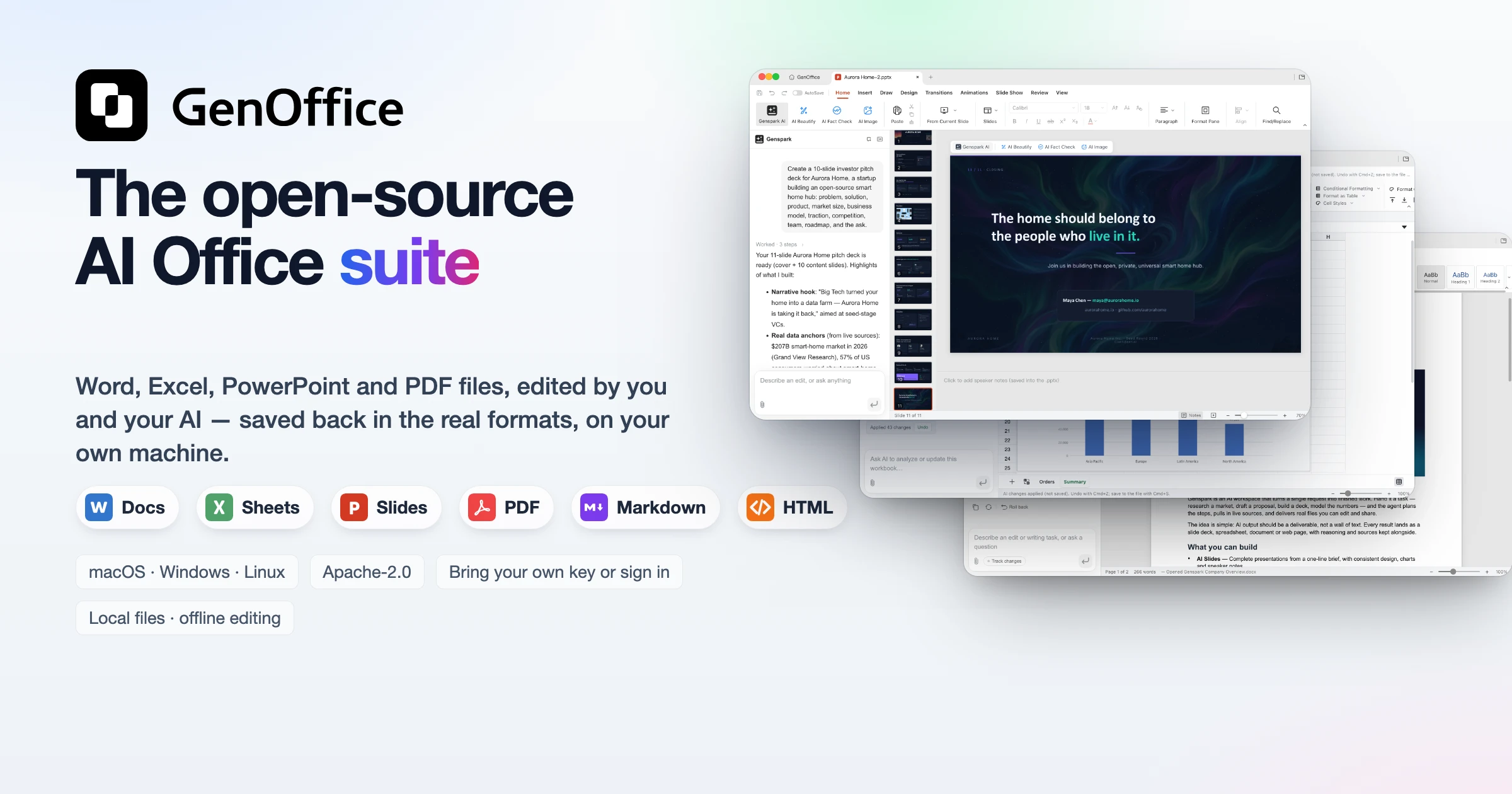
GenOffice makes the connection between generated work and conventional files especially concrete. Its official repository shows Docs, Sheets and Slides with an AI panel next to editable material. The screenshots used on this page are the actual application screens from that repository. The product supports native office formats and reviewable edits, making the point of contact a document rather than a separate conversation. This is related to, but distinct from, the cloud workspace: the August launch offered a free office core and AI actions that consume Genspark credits, while the current repository also describes bringing a user's own provider key. That distinction matters when assessing the revenue model and the deployment environment. SecondBrain works earlier in the process, connecting authorized context so the agent has relevant material to act on. Collaboration works later, when another person needs to understand and revise the result. The suite's practical value lies in how well these transitions preserve intent. An export button alone does not establish a usable office workflow; the resulting file must remain something colleagues can inspect and change.

A real estate team sells a clearer story

The CBRE Moran Team case gives this workflow a named setting: a commercial real estate team building materials around a Peninsula property. Genspark's account describes research, an interactive dashboard and a revised pitch process. It reports a research cycle reduction of 40 percent and first-draft preparation falling from four hours to 35 minutes. These are company-published results for that team and workflow. They should be read as evidence of a particular implementation, rather than a forecast for every enterprise seat. The useful mechanism is the change in what the team brings to a discussion: location, leasing and market information can be assembled into a story a prospective client can explore. The team still owns the property judgment and the relationship. Separately, Korean marketer Seulki Kang describes lecture preparation shrinking from 30 hours to five in a user interview. That is an individual workflow and community example, not a corporate deployment. Together the cases show two routes to adoption: a professional uses the tools personally, and a team fits them into a recurring commercial process. Each needs its own definition of a good result.

03 / THE EVIDENCE

The story, in numbers.

DATED OBSERVATIONS

Company-disclosed annualized run rate

USD · USD
Company-disclosed annualized run rate2025-11-18: $50,000,000 USD; 2026-03-12: $200,000,000 USD; 2026-07-21: $250,000,000 USD$50,000,000 USD2025-11$200,000,000 USD2026-03$250,000,000 USD2026-07

Dated revenue pace projected across a year; separate from completed fiscal-year revenue. These are dated disclosures, not a continuous growth record.

Figures, dates & basis +
Company-disclosed annualized run rate
DateValueBasis
2025-11-18$50,000,000 USDCompany-disclosed annualized run rate at the announcement date.
2026-03-12$200,000,000 USDCompany-disclosed annualized run rate at the announcement date.
2026-07-21$250,000,000 USDCompany-disclosed annualized run rate at the announcement date.

Genspark

Annualized run rate

$50M at the announcement date.

Annualized run rate

$200M at the announcement date.

Annualized run rate

$250M at the announcement date.

Read the growth story

Seats and work pay for the workspace

Genspark sells personal memberships, team plans and enterprise arrangements around a workspace that performs AI work. Personal plans combine storage and an allowance of credits. Team plans add seats, shared administration and billing. Enterprise arrangements address contractual security, support and organizational requirements. The structure links a user's first useful task to a broader buying decision: an individual can begin with a presentation, while a department pays to make the workflow manageable across people. GenOffice complicates the picture in a useful way. Its basic editor is free, while Genspark-powered AI work consumes credits; the current open-source project also supports bringing a provider key. Therefore an installed editor, an active user and a paying workspace seat are different measures. Signet's reading is that durable growth depends on converting useful tasks into repeated paid work. The suite can attract people through several output formats, but the business must make those formats part of a habit that justifies renewal. That is a different question from how many features have shipped.

Dated figures have different meanings

The company reported a $50 million annual run rate in November 2025, $200 million in March 2026 and $250 million in its July 2026 Workspace 6 announcement. The chart on this page keeps them as company-disclosed annualized run-rate figures at those dates. A run rate projects a current pace across a year; it is not the revenue recognized over a completed fiscal year. That distinction remains important even when the growth is steep. Funding and valuation are separate again. The June financing release put the extended Series B at $485 million and the post-money valuation at $2.6 billion. Those figures describe capital raised and the price implied by a financing round, rather than sales. The July announcement also stated more than 7,000 business customers. A customer count can indicate organizational reach, but it does not establish equal contract sizes or equal depths of adoption. Reading these measurements together gives several questions to test: whether revenue pace persists, whether businesses expand usage and whether the commercial organization can support them. None of the measures alone answers all three.

Integration competes with integration

The workspace competes with separate AI assistants and with software suites that already sit inside an organization's daily work. Genspark's Microsoft Agent 365 participation and native office plugins show that its approach includes working in existing environments, as well as offering its own editors. Signet reads the position as an execution layer that has to prove it can connect context, analysis and output better than a person switching among tools. Three risks follow from the company's own materials. First, multi-step agents can accumulate inference and retry costs; a useful workflow must be economical at its full length. Second, connected email and business systems create a permission and privacy problem; the terms and access model have to match the organization's requirements. Third, generated work still needs review. The GenOffice launch explicitly described an alpha with bugs and rough edges, and the founders emphasize judgment rather than automatic acceptance. These risks are operational tests, not predictions that the company will fail. They locate the work behind adoption: choose a suitable model, handle authorized data carefully and help users evaluate a finished artifact before relying on it.

04 / THE PEOPLE

Someone saw it first.

Eric Jing, co-founder and CEO of Genspark
Co-founder and CEO

Eric Jing

Writes about execution, prior Microsoft work and human judgment.

The choice behind the company +

Writes about execution, prior Microsoft work and human judgment.

“AI hasn't made human judgment obsolete. It has made it the only thing that still matters.”

Eric Jing · Dated company statement · 2026-05-17
The decisions behind the company

Two founders chose a different job

Eric Jing is co-founder and CEO; Kay Zhu is co-founder and CTO. Their published writing explains the company's direction more usefully than a list of credentials alone. Jing describes earlier engineering and management experience at Microsoft, and writes about how small groups execute quickly. Zhu's account of retiring AI search in April 2025 is a technical explanation of a commercial decision. A predetermined pipeline could answer queries, but it limited the range of jobs the product could finish. The replacement let an agent plan dynamically and choose tools as it worked. That decision shaped the breadth of the suite: documents, data, presentations and other outputs became part of the same execution problem. The founders' roles are complementary in the public material. Jing frames what happens to human work when production becomes cheaper. Zhu explains how planning and model choices make the system economical enough to perform it. Those are published viewpoints with dates, rather than evidence that every team inside the company operates in the same way.

The commercial organization takes shape

The leadership story also includes Wen Sang, described as COO in the July Korea event coverage, and Jamison Powell, appointed chief revenue officer in June 2026. Powell's appointment release connects his prior sales responsibility at monday.com to Genspark's enterprise expansion. That gives the company a commercial task alongside its product shipping: turn professionals' enthusiasm into organizational buying, implementation and repeated use. Sang's Korea remarks concern a planned investment over three years. They are a statement of intention, not an accounting of money already spent. Signet reads the combination as a company building the bridge between fast product adoption and an enterprise sales process. A buyer may need a procurement review, a security agreement and a clear rollout owner before a useful personal tool becomes an approved team service. The executives' titles help locate those responsibilities at the company level. They do not establish a Korean reporting line, and the current career board should be read separately from executive plans. For a candidate, the useful preparation is to understand both the user's first successful task and the organization's reason to keep paying.

Execution needs a test beyond speed

Two principles recur in the founders' public work. First, tools should be available to the agent instead of every action being locked into a narrow workflow. Zhu's engineering account explains the product as orchestration across models and tools. Second, cheaper generation raises the importance of human judgment. Jing's May essay puts taste, trust and selection at the center of professional value. These are editorial readings of explicit published ideas, rather than a substitute for an employee handbook. Together they imply a demanding standard for product work: more capability must produce better completed tasks, not just more output. The August efficiency essay adds another test. Multi-step work uses repeated calls, retries and review; the price of a token alone does not describe the cost of a successful task. That matters to product, engineering and commercial teams alike. A feature that looks fast in a short demonstration may require expensive correction in a real workflow. People evaluating the company can ask how it measures success, how it decides which model is sufficient and how customer feedback changes the next release. The questions follow the founders' reasoning without inventing an interview process.

05 / THE NEXT CHAPTER

Personal use opens the team adoption question

Evaluate how a recurring office task can move from individual use to reviewed team work.

Team interpretation follows dated executive statements; titles describe company-wide scope.

Why Korea? Why now?+

Genspark's Korea story begins with professional use, rather than treating a country label as sufficient evidence of a local organization. In a June 2026 interview, Eric Jing described Korea as one of the company's top three markets and explained an adoption route through people who pay to improve their own productivity. That is a specific account of demand: a person can first use the tool for a draft, research or a presentation, then raise the question of team adoption with a manager. The October user interview with Korean marketer Seulki Kang makes this route concrete. Her lecture preparation and community activity show a professional fitting AI tools around work she already knows. The reported time saving belongs to her workflow; it is not a measure of the Korean enterprise market. Signet reads the attraction as a product that can cross several types of office output without asking a person to build an automation system first. The next test is whether that personal usefulness survives handoff to colleagues, security review and a recurring team task.

Founder explains Korea adoption

The interview describes Korea among the top three markets and a personal-to-team adoption path.

Korea investment plan

The COO describes a $100M plan over three years.

Understand the Korea opportunity

A professional starts with their own work

Genspark's Korea story begins with professional use, rather than treating a country label as sufficient evidence of a local organization. In a June 2026 interview, Eric Jing described Korea as one of the company's top three markets and explained an adoption route through people who pay to improve their own productivity. That is a specific account of demand: a person can first use the tool for a draft, research or a presentation, then raise the question of team adoption with a manager. The October user interview with Korean marketer Seulki Kang makes this route concrete. Her lecture preparation and community activity show a professional fitting AI tools around work she already knows. The reported time saving belongs to her workflow; it is not a measure of the Korean enterprise market. Signet reads the attraction as a product that can cross several types of office output without asking a person to build an automation system first. The next test is whether that personal usefulness survives handoff to colleagues, security review and a recurring team task.

Investment plans and adoption have separate clocks

At the Seoul event reported in July 2026, Wen Sang described a plan to invest $100 million in Korea over three years. The wording matters: it is a forward plan with a time horizon. It should be evaluated through subsequent activity, rather than added to a total of completed investment. The same coverage describes executive attention to the Korean market. Signet connects that attention to the practical needs of team adoption: explain the workflow in the customer's language, connect relevant data and show how review and access work for an organization. Those are analysis of the market problem, not a list of promised local services. The company already offers team and enterprise structures that cover administration, seats and contractual requirements. A Korean buyer still has to establish which terms and deployment options fit its own use. Consumer use, an executive visit, an investment plan and an enterprise contract each represent a different stage. Keeping them distinct makes it easier to follow whether Korea becomes a recurring source of organizational business, rather than simply a country with enthusiastic users.

Use the current board to time an application

On October 10, 2026, the employer's current career board showed eight openings across US and Japan locations. The Korea jobs section therefore reflects the current board rather than historical search results. Signet does not turn a market investment plan into a Korean job description. For a reader evaluating the company ahead of a suitable opening, preparation can still be concrete: bring an example of a recurring office task, identify the context it needs and define what a reviewer must check before using the output. These are suggestions for assessing the product, not a first-quarter assignment from an employer posting. A useful example might compare a manually prepared customer deck with a workflow using authorized research and editable files. Keep the time spent reviewing and correcting in the comparison. The efficiency essay explains why successful-task cost is a better lens than a short generation demo. The Korea section's team view is based on dated executive announcements and market coverage, with titles describing company-wide responsibility. It is not a count of a Korean office or a reporting chart. When the career board changes, the role list and its original posting text are the evidence needed to decide whether a particular opportunity fits.

Korea openings

No current Korea openings were found. The company story is still available.

See overseas openings →
07 / NOW & NEXT

The next scene is taking shape.

Memory joins the workspace

Workspace 6 organizes memory, intelligence, execution and collaboration.

GenOffice becomes open source

The company releases office editors with built-in AI work.

A model for slide work

Gen-1 Slides specializes model behavior for presentations.

More context on what comes next

Memory becomes a product layer

The July Workspace 6 release organized the product around memory, intelligence, execution and collaboration. SecondBrain's role is to make authorized context useful again in later tasks. GenTeam adds people working with agents around shared work. Signet reads this as a change from isolated prompts to continuity: the next task should begin with relevant material from the last one. The question to follow is whether that continuity is understandable to the user. Permissions, the scope of connected information and the reviewer of a shared artifact become part of the product experience. A workspace can accumulate more context while still needing clear boundaries around what the agent is allowed to use.

The model choice moves inside the task

August's efficiency essay argued for measuring the full cost of a successful task. September's Gen-1 Slides release then put a specialized, post-trained model into slide generation. The company presents this as a way to tune intelligence for a specific kind of work. Its published performance comparisons are company assessments. The useful follow-up is how the specialized model affects real editing, revision and repeat use, rather than adopting a benchmark headline as a customer outcome. Open-weight support adds another dimension: the workspace wants options across model providers. More options help only if task selection and review make those choices practical for the person using the product.

Adoption has to keep earning its place

The October Korean user story returns the discussion to a person's recurring job. It is a useful counterweight to financing figures and launch volume: a tool earns its place by improving a task the user already needs to complete. Over the next year, Signet would watch three connected tests. Does persistent context reduce repeated setup? Do specialized models lower the effort and cost of a reviewed deliverable? Do teams turn personal use into an administered, renewed service? Those are questions grounded in the company's releases, pricing structure and published examples. They keep the thesis tied to useful completed work as the suite grows.

Their future. Your next chapter.

Find your part ↑

An independent profile by Signet. No affiliation or investment recommendation. Introductions happen only with your consent.
Research reviewed 2026-10-10

A LITTLE MORE CONTEXT

Understanding Genspark.

What does Genspark do?

Genspark bets that an agent workspace can turn scattered context into reviewed, editable office work.

What is the opportunity in Korea?

Evaluate how a recurring office task can move from individual use to reviewed team work.

How can I explore the company in more depth?

Follow the company from its vision through products, evidence and people to the Korea team and current roles. Use the table of contents to move within the page, and expand the sections for more context.

Back to the collection ↗