An agent needs material and authority
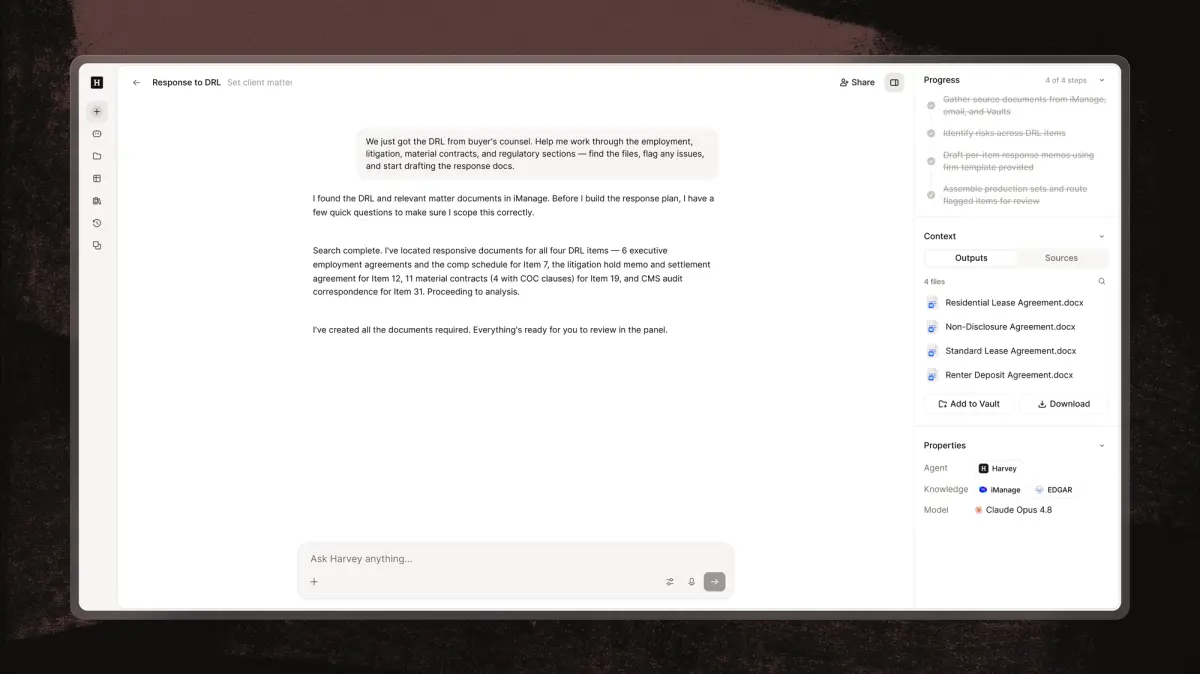
Agents, Vault and Knowledge solve different parts of a legal workflow. Agents accepts a task, organizes execution and returns a work product with citations. Vault is the place for document organization and comparison, including structured review tables across a large collection. Knowledge connects research to curated legal databases and other trusted sources. For the buyer, the distinction is functional: a research question, a batch of documents and a multi-step assignment need different controls. Giving an agent more material is not enough if the user cannot tell which source it relied on. A table is not enough if it detaches a clause from the agreement that gives it meaning. The products are therefore best evaluated together through one matter. Choose a concrete output, inspect the material behind it and see whether the next lawyer can continue the work. The official product screens on this page show the interfaces for these tasks. They illustrate functionality; their example document names should be read as demonstration material, rather than a customer list or a record of an actual transaction.
Collaboration has a boundary
Spaces extends the workflow across people and organizations. A law firm, its client and another adviser can work around shared material, but the product describes resource-level permissions, approval from administrators and audit trails. That is a concrete difference from attaching every document to an email thread. The useful unit is a controlled matter workspace in which participants can see the material intended for them. Ecosystem integrations connect Harvey to familiar tools such as Word, Outlook and document management systems, reducing the need to move every task into an isolated screen. Command Center addresses a different buyer inside the organization: the people responsible for rollout and use. It shows usage and adoption patterns and helps administrators identify where training is needed. Signet reads these products as a continuation of the same commercial problem. Access has to become regular, appropriate use. A feature demonstration can show that the product performs an action; an organization needs to know who uses it, on which work and under whose rules. Those are practical questions for both procurement and ongoing customer support.
A Korean firm makes the workflow its own
Bae, Kim & Lee's June 2026 announcement is a named Korean deployment. After a pilot, the firm selected Harvey for firmwide use across work including cross-border M&A, international disputes and regulatory matters involving several jurisdictions. The announcement also describes work on the firm's internal document repository and a proprietary retrieval-augmented knowledge base. Those are two complementary efforts: the external platform supports daily work, and the firm continues organizing the knowledge that makes its advice specific. The source describes rollout and governance rather than a universal percentage saving. Signet's interpretation is that adoption becomes meaningful when an established practice can retain its own standards while changing how it prepares work. The Seoul posting then asks a legal specialist to build relationships, train users and translate practice needs into product feedback. A candidate should connect those responsibilities to the kinds of work described in the deployment, without assuming that the posting names BKL as its particular account. The role refers to a key account and the broader Korean market; keeping that scope intact avoids turning a plausible relationship into a fabricated assignment.