Winston Weinberg official portrait
Harvey / THE WORLD THEY ARE BUILDING

Legal matter context and agent execution share one controlled platform.

Legal teams prepare work with the platform while retaining professional judgment and approval.

See it taking shape ↓
01 / THE PRODUCTS

The products behind the promise.

Agents official product screen
Agents

Plan and execute a defined legal task with cited output.

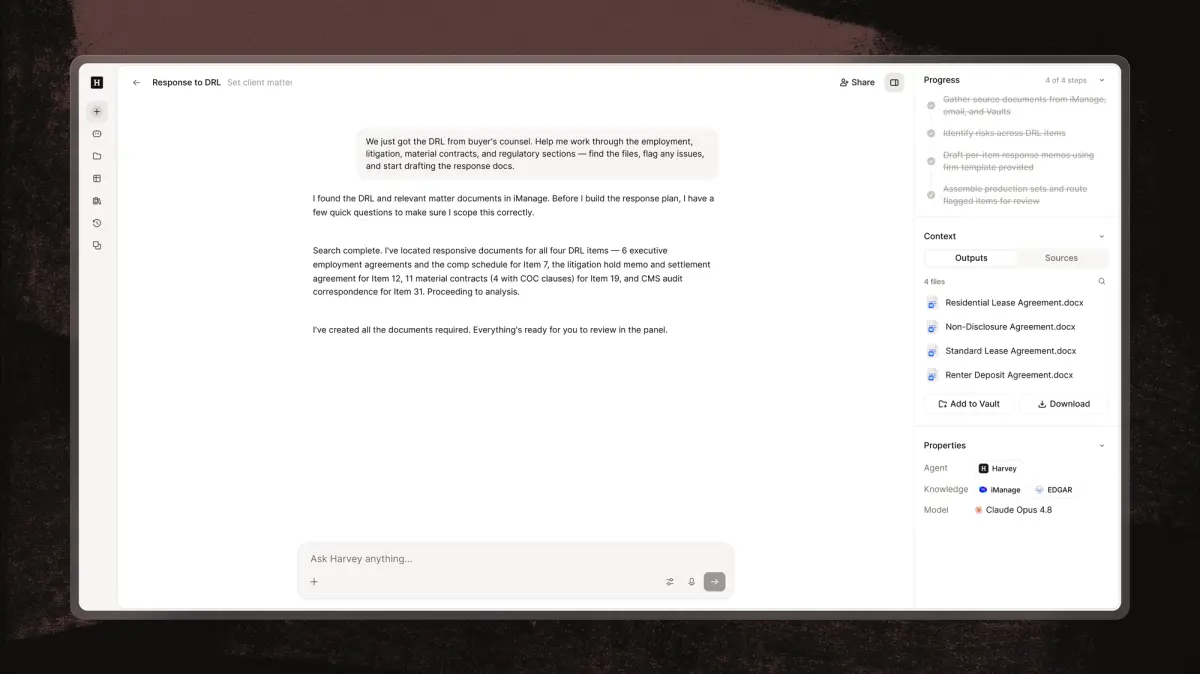
Legal teams can inspect a task plan and the resulting cited work, then decide which output is ready for the next step of a matter.

Bae, Kim & Lee

Firmwide use follows a pilot

The announcement describes rollout scope and lawyer-first governance.

BKL selected firmwide use for work including cross-border M&A, disputes and regulatory matters.

What changed? +

The firm evaluated the platform through a pilot.

Official deployment announcement for BKL dated June 30, 2026.

Harvey Agents actual product interface
02 / HOW IT BECOMES REAL

An illustrative transaction review

Illustration: a legal team reviews transaction material and prepares a cited memo.

  1. 01

    Scope

    Define the matter, permitted material and review standard.

  2. 02

    Organize

    Vault turns source documents into review tables.

  3. 03

    Research

    Knowledge connects trusted legal sources to the question.

  4. 04

    Execute

    Agents carry out a scoped task with cited output.

  5. 05

    Review

    The responsible lawyer checks the work before it moves forward.

Follow the work, step by step

A matter carries its history

A legal matter is not a series of unrelated questions. Documents arrive over months, lawyers join and leave the work, and an earlier negotiating position can determine what the next draft should say. Harvey's August 2026 product explanation starts from that continuity problem. Reintroducing every document and instruction to an AI assistant makes the lawyer do the coordination again. Harvey II puts the agent inside a Space with the matter's material, tasks and permissions. Signet reads the business bet as moving from answering a legal question to supporting the sequence in which a legal team works. The lawyer still decides the position to take and whether a work product is ready. The platform tries to make the preparatory work carry its history. That difference is material for a buyer: a convincing answer to one prompt does not establish that a tool can handle the next step of a transaction. It has to preserve the relevant context while respecting the boundaries of the matter.

Documents become reviewable work

Consider an illustrative cross-border transaction. The team receives a data room and needs to identify contracts whose terms might affect the deal. Vault organizes the source material and produces structured review tables. Knowledge brings trusted legal and regulatory material into research. Agents can work through a defined task and return cited output for review. The team then decides which issue belongs in a memo, which needs another specialist and which must be discussed with the client. This is an illustrative product journey, not a reported transaction for a named customer. It explains why collection, analysis and approval cannot be treated as independent conveniences. A clause extracted from a file is useful only if its meaning is read in the deal context. A cited memo still needs a responsible reviewer. Harvey's agent interface offers a plan to inspect before work begins and a record of actions afterward. Signet reads those controls as part of the value, because legal work is judged on the reasoning a team can defend, rather than the amount of text an assistant can produce.

Adoption connects product and legal practice

The workflow does not end when access is granted. A firm has its own precedents, drafting standards and reasons to restrict information between matters. Harvey's security materials describe permissions, audit logs and the enforcement of existing ethical walls. Its legal agreement also makes clear that generated output remains a research tool that can contain errors. Together these sources support a narrower and more useful claim than automatic legal judgment: the platform handles work that lawyers can inspect and use within their own standards. The Seoul Legal Engineer, Product Specialist posting places the same problem in a person's job. It asks for legal practice experience, training and consultative relationships that make the platform useful to Korean lawyers. Signet reads that role as the bridge between product capability and professional adoption. Someone has to identify where a workflow gets stuck, explain the tool in a legal context and send specific practice needs back to product and engineering. That is why the Korea opportunity belongs in the business story itself, rather than appearing only as a list of available jobs.

Understand the products and their customers

An agent needs material and authority

Agents, Vault and Knowledge solve different parts of a legal workflow. Agents accepts a task, organizes execution and returns a work product with citations. Vault is the place for document organization and comparison, including structured review tables across a large collection. Knowledge connects research to curated legal databases and other trusted sources. For the buyer, the distinction is functional: a research question, a batch of documents and a multi-step assignment need different controls. Giving an agent more material is not enough if the user cannot tell which source it relied on. A table is not enough if it detaches a clause from the agreement that gives it meaning. The products are therefore best evaluated together through one matter. Choose a concrete output, inspect the material behind it and see whether the next lawyer can continue the work. The official product screens on this page show the interfaces for these tasks. They illustrate functionality; their example document names should be read as demonstration material, rather than a customer list or a record of an actual transaction.

Collaboration has a boundary

Spaces extends the workflow across people and organizations. A law firm, its client and another adviser can work around shared material, but the product describes resource-level permissions, approval from administrators and audit trails. That is a concrete difference from attaching every document to an email thread. The useful unit is a controlled matter workspace in which participants can see the material intended for them. Ecosystem integrations connect Harvey to familiar tools such as Word, Outlook and document management systems, reducing the need to move every task into an isolated screen. Command Center addresses a different buyer inside the organization: the people responsible for rollout and use. It shows usage and adoption patterns and helps administrators identify where training is needed. Signet reads these products as a continuation of the same commercial problem. Access has to become regular, appropriate use. A feature demonstration can show that the product performs an action; an organization needs to know who uses it, on which work and under whose rules. Those are practical questions for both procurement and ongoing customer support.

A Korean firm makes the workflow its own

Bae, Kim & Lee's June 2026 announcement is a named Korean deployment. After a pilot, the firm selected Harvey for firmwide use across work including cross-border M&A, international disputes and regulatory matters involving several jurisdictions. The announcement also describes work on the firm's internal document repository and a proprietary retrieval-augmented knowledge base. Those are two complementary efforts: the external platform supports daily work, and the firm continues organizing the knowledge that makes its advice specific. The source describes rollout and governance rather than a universal percentage saving. Signet's interpretation is that adoption becomes meaningful when an established practice can retain its own standards while changing how it prepares work. The Seoul posting then asks a legal specialist to build relationships, train users and translate practice needs into product feedback. A candidate should connect those responsibilities to the kinds of work described in the deployment, without assuming that the posting names BKL as its particular account. The role refers to a key account and the broader Korean market; keeping that scope intact avoids turning a plausible relationship into a fabricated assignment.


03 / THE EVIDENCE

The story, in numbers.

DATED OBSERVATIONS

Company-announced financing valuation

USD · USD
Company-announced financing valuation2025-06-23: $5,000,000,000 USD; 2026-03-25: $11,000,000,000 USD; 2026-09-09: $15,500,000,000 USD$5,000,000,000 USD2025-06$11,000,000,000 USD2026-03$15,500,000,000 USD2026-09

Investment transaction values, separate from revenue and public market capitalization. These are dated disclosures, not a continuous growth record.

Figures, dates & basis +
Company-announced financing valuation
DateValueBasis
2025-06-23$5,000,000,000 USDValuation stated for the financing round.
2026-03-25$11,000,000,000 USDValuation stated for the financing round.
2026-09-09$15,500,000,000 USDValuation stated for the financing round.

Harvey

Financing valuation

$5B financing valuation.

Financing valuation

$11B financing valuation.

Financing valuation

$15.5B financing valuation.

Read the growth story

An organization pays for controlled work

Harvey sells access to its platform under organizational order forms. Its agreement places fees and payment terms in the customer's order form and makes access credentials specific to individual users. The commercial mechanism is therefore a platform purchase with an agreed scope, rather than a percentage of a legal transaction. The buyer may be a law firm, an in-house department or a professional services organization. The value has to fit that organization's work: preparation, analysis and review that can be repeated under its own controls. Command Center's adoption analytics make that requirement visible. A contract gives people access; training and repeated use determine whether the platform becomes a regular part of practice. Signet reads expansion through this distinction. More users and more workflows can deepen an account, but only if the customer understands the output and the implementation remains manageable. The Seoul posting names adoption, utilization, expansion and renewal explicitly. That aligns the local role with the revenue model: it is about sustained customer value after a purchase, rather than simply getting a demo in front of a lawyer.

Financing and use tell different stories

The financing chart records three company-announced valuations: $5 billion in June 2025, $11 billion in March 2026 and $15.5 billion in September 2026. The last announcement includes a $550 million raise. These figures describe investment transactions. They should not be read as annual revenue or as a public stock-market capitalization. Customer and lawyer figures measure another dimension. The September brand announcement describes more than 3,000 customers and 200,000 lawyers across 70 countries; the current company page lists a later snapshot of more than 3,500 customers in more than 85 countries. The dossier keeps each snapshot tied to its source and retrieval date. A customer total does not establish that every organization has the same number of users or the same depth of adoption. That is why account-level usage and professional review remain useful tests alongside growth headlines. Signet's reading is that financing supplies room to build and hire, while repeated practice use demonstrates whether the product has earned a place in the work. The measures complement one another without becoming interchangeable.

Reliability is part of the cost of adoption

Three risks follow from Harvey's own materials. Generated output can contain errors, so the organization needs review rather than automatic reliance. Sensitive client material requires suitable access, retention and confidentiality controls. Long-horizon agents also face a performance and cost problem: a sequence can satisfy many individual criteria while still failing the task as a whole. The LAB initial-results publication makes that last distinction explicit through all-pass grading. Tenet research then connects quality improvements with model and harness choices intended to improve efficiency. These are research and operating risks, not an estimate of a customer's legal exposure. Signet reads the commercial competition accordingly. Harvey's candidate guide identifies inertia and execution as important alternatives to adoption. The product also works with existing legal research sources and office tools, so a buyer compares it against the process already in place. The practical test is whether controlled automation improves a reviewed task enough to justify the change. That includes training effort, correction and the time a professional must still spend deciding. Keeping those costs in view gives a more useful business picture than treating each benchmark gain as equivalent to revenue.

04 / THE PEOPLE

Someone saw it first.

Winston Weinberg official portrait
Co-founder and CEO

Winston Weinberg

Previously a securities and antitrust litigator at O'Melveny & Myers.

The choice behind the company +

Connect customer work with an organization built to improve it.

Gabe Pereyra official portrait
Co-founder and President

Gabe Pereyra

Previously an AI researcher at DeepMind.

The choice behind the company +

Connect customer work with an organization built to improve it.

“AI isn’t just assisting lawyers. It’s becoming the system through which legal work gets done,”

Winston Weinberg · Dated company announcement · 2026-03-25
The decisions behind the company

A lawyer and a researcher define the work

Winston Weinberg is co-founder and CEO; Gabe Pereyra is co-founder and president. The company's candidate guide describes their earlier work as a securities and antitrust litigator at O'Melveny & Myers and an AI researcher at DeepMind, respectively. The pairing helps explain the product's insistence on legal work product rather than a generic conversation. One side understands how a professional assignment is framed and reviewed. The other studies how models can execute the steps. That is a sourced reading of the founders' backgrounds, not a claim that either discipline guarantees accuracy. Their March 2026 funding statement connects agents to the system through which legal work happens. The subsequent research publications make the claim testable by defining tasks, client material and review criteria. Signet reads the founder story through this connection: legal expertise shapes what a good result must contain, and engineering has to make the process dependable. A candidate can assess the company more clearly by asking how those two standards meet inside the workflow than by treating fundraising alone as evidence of product quality.

The published values ask for clear action

The founders published three values in March 2025: Decisiveness, Simplicity and Job's Not Finished. They explain decisiveness as acting on clear judgment instead of spending cycles overcomplicating a simple problem. Simplicity concerns communication, products and services that remain understandable even when the technology and legal problem are complex. Job's Not Finished is the continuing obligation to improve for customers. These values should be read as the company's stated expectations, not as a guarantee about an employee's experience. Katie Burke's August 2026 candidate guide describes how the values enter reviews and operating decisions, and characterizes the environment as fast-paced and ambitious. Signet reads the tension as relevant to the Seoul role. A legal specialist must explain a sophisticated product simply and act on adoption obstacles, while keeping professional judgment intact. Moving quickly cannot mean smoothing over a customer's legal question. The work is to turn that question into a clear next step, identify the appropriate reviewer and keep improving the implementation. That is a concrete way to evaluate the culture against the actual responsibilities in the posting.

Trust becomes organizational work

The leadership story also includes Katie Burke as COO and John Haddock as chief business officer. Burke publishes the candidate guide; Haddock speaks for Harvey in the BKL deployment announcement. Their public responsibilities locate company operations and commercial implementation alongside the founders' product and research work. The privacy team describes security as a shared responsibility across functions, while the September Guardrails AI acquisition brings additional reliability expertise into product and engineering. These sources show that trust is not a single statement at the end of a sales deck. It includes contracts, system behavior, customer feedback and a way to test failure before a user meets it. The Korean specialist works at the point where that organization meets practice: explaining the platform, listening for legal obstacles and giving product teams actionable feedback. Signet's reading is that a person suited to this role can move between legal detail and a repeatable implementation. They do not need to pretend every model output is correct. They need to understand what the customer can rely on, which controls apply and when a lawyer must take the next decision.

05 / THE NEXT CHAPTER

Legal practice becomes product adoption

Train legal users, address adoption obstacles and turn Korean practice needs into product feedback.

Post-sales adoption
  • Legal Engineer, Product Specialist

Open posting count, not team headcount

Responsibilities are read from the current posting and dated leadership statements; groups describe functions.

Why Korea? Why now?+

A firmwide Korean deployment places the platform inside established professional work.

BKL firmwide deployment

The official announcement describes rollout following a pilot.

Understand the Korea opportunity

A Korean rollout starts from practice

The BKL announcement gives Korea a concrete professional setting. The firm selected Harvey after a pilot and describes a firmwide rollout for several kinds of cross-border and international work. Its parallel investment in organizing internal documents matters: the value of a legal platform depends on the institution's own knowledge as well as general model ability. Signet reads Korea as an adoption problem with local practice depth. Lawyers need useful Korean-language support, but the task goes beyond translating a screen. An implementation has to reflect the work the firm actually handles, the material it permits people to use and the standard at which a reviewer accepts a draft. The announcement describes a lawyer-first governance model and tailored implementation. Those are the relevant elements to follow as use develops. The source supports a named deployment and its stated scope; it does not establish a result for every Korean law firm. This distinction makes the market opportunity clearer. Harvey is entering an existing professional process whose users will judge it through real matters and a relationship of trust.

The Seoul hire links adoption and product

The current employer board lists one Korea opening on October 10, 2026: Legal Engineer, Product Specialist, in Seoul, full time and remote. The role sits in the post-sales organization and works with Customer Success Managers and Account Executives. It asks for Korean legal qualification or equivalent and at least three years of experience as a qualified lawyer at a top-tier Korean or international law firm. Sales and customer-facing experience is described as a plus. Keeping that distinction intact matters when assessing fit. The responsibilities include relationships with law firm and in-house teams, onboarding and workshops, use-case content, adoption obstacles and feedback for product and engineering. Signet reads the combined need as legal credibility that can become a repeatable customer implementation. It is not simply a technical support queue or a direct copy of a practicing-lawyer job. The person has to understand why a legal workflow is difficult, help the user fit the platform into it and recognize when a product limitation calls for a specific change. The posting's remote location is Seoul; it should not be widened into a role based in another country.

Prepare a case of professional adoption

A plausible first-quarter reading, clearly Signet's interpretation, is to learn the customer's practice workflows, design relevant training and create a feedback loop with the account team. Those steps follow the posting but are not a schedule promised by the employer. Preparation should be equally concrete. Choose a legal task you know well, identify where a new user could misuse a generated result and explain how a workshop would teach both capability and review. Then show how you would distinguish a training problem from a product problem. A user may need clearer instructions; a recurring failure may need engineering attention. The role also supports renewal and expansion, so the account team needs evidence of engagement and meaningful use. A count of attended sessions is only one signal; what matters is whether users can repeat the workflow appropriately. The team view on this page is based on the posting's named functions and dated company leadership statements. It groups responsibilities rather than claiming a Korean office headcount or an internal reporting chart. A candidate can use that view to discuss working across legal practice, customer success, sales and product without inventing local authority or a promised promotion path.

Korea openings

No current Korea openings were found. The company story is still available.

See overseas openings →
07 / NOW & NEXT

The next scene is taking shape.

Harvey II carries context

Harvey II carries context.

Tenet research preview

Tenet research preview.

Guardrails team joins

Guardrails team joins.

More context on what comes next

The matter becomes the place of work

Harvey II's August release brings context, permissions and memory into the place where a task starts. Signet reads the release against the original continuity problem: a lawyer should not have to rebuild the history every time a draft needs another pass. The relevant test is whether an agent's next output fits the matter and the review standard. The Memory product also gives users a way to inspect and change stored preferences. Keeping preference and matter boundaries distinct matters when several clients or transactions share a professional's working day.

Research and reliability grow together

The Tenet research preview in August describes specialized post-training for long-horizon legal work and evaluates it through legal task rubrics. September's Guardrails acquisition adds experience in testing and controlling agent behavior. These developments connect a better-performing model with a system that can be inspected when something goes wrong. Published benchmark comparisons are company research results with a defined setup. They are useful for understanding the direction, while customer workflows still need their own review. The practical follow-up is whether better research scores reduce correction and make complex tasks manageable inside the organization's constraints.

Capital backs a demanding next stage

The September financing announced $550 million at a $15.5 billion valuation, and the brand campaign later that month emphasized the agreements lawyers help people make. Signet reads the combination as resources to build coupled with a professional reason for the product to exist. Over the next year, three tests remain useful: whether context stays dependable across a matter, whether reliable agents reduce the full effort of reviewed work and whether implementations develop into sustained use. In Korea, the BKL rollout and the live legal specialist role provide concrete places to follow those questions. The aim is not to treat each new capability as automatic success, but to see how the platform earns trust in work that a professional must sign off.

Their future. Your next chapter.

Find your part ↑

An independent profile by Signet. No affiliation or investment recommendation. Introductions happen only with your consent.
Research reviewed 2026-10-10

A LITTLE MORE CONTEXT

Understanding Harvey.

What does Harvey do?

Harvey puts legal matter context and controlled agent work in the same platform.

What is the opportunity in Korea?

Train legal users, address adoption obstacles and turn Korean practice needs into product feedback.

Are these confirmed job openings?

Employer postings were checked on 2026-10-10. Availability can change. Mock applications request a review from Signet.

How can I explore the company in more depth?

Follow the company from its vision through products, evidence and people to the Korea team and current roles. Use the table of contents to move within the page, and expand the sections for more context.

Back to the collection ↗