Ads that find buyers and agents that close the sale, on apps 3.64 billion people use every day.
Meta says it will take businesses' money the way it does for ads, when results arrive, and in September 2026 it opened an enterprise platform to sell its models and agents directly. The test over the next year is whether large advertisers, Korean exporters among them, move customer service and sales into those agents.
Official diagram from Meta's engineering blog: GEM feeds the ranking models behind Advantage+.
Meta Advantage+
Set a goal and a budget; Advantage+ chooses audience, placements, budget split and creative variations.
Lower cost per result with less manual setup; Meta reports 9% lower cost per acquisition for its sales campaigns.
Kia Italia
A Korean automaker's Italian unit sells cars through a WhatsApp agent
In 4 weeks: 144 qualified leads, 116 quote requests, 5 direct car sales, 40x return on ad spend, 53% lower cost per car sold.
With Meta and the messaging partner Infobip, ads that click to WhatsApp opened a chat with an AI agent that collected lead details in conversation, answered model, price and financing questions and passed ready buyers to the nearest dealer.
What changed? +
Car buyers needed several touchpoints, dealership visits and follow-ups before committing, and lead qualification relied on costly channels such as the call center.
Published by WhatsApp Business on October 19, 2026. Results are self-reported from Meta Ads Manager, Infobip and Kia's CRM, and the page says they are not identifiably repeatable.
Movida
A Brazilian car rental firm runs bookings end to end in WhatsApp
Conversion rate of 14.9% in week four of a one-month test, against a previous best of 9.7%; 85% of conversations resolved without staff.
A Business Agent built on the Business Agent Platform answers in under 15 seconds, pulls returning customers' profiles, connects to pricing, availability and payment systems, and can complete a booking in as few as three messages.
What changed? +
Movida, with more than 400 locations in Brazil and Portugal, already took WhatsApp bookings, but its automated replies took 30 to 60 seconds and returning customers, about 60% of visitors, re-entered their details every time.
Published by WhatsApp Business on June 30, 2026, results self-reported. On the July 2026 earnings call Meta cited a different measure from the same test, a 44% rise in daily bookings through WhatsApp.
Official diagram from Meta's engineering blog: Andromeda picks a few thousand candidate ads from tens of millions.
02 / HOW IT BECOMES REAL
One campaign, from goal to measured sale
Illustrative scene: a Korean skincare brand wants to sell in the United States and starts a sales campaign on Meta's apps.
01
Set the goal and budget
The brand chooses an objective such as purchases and a budget, and turns on Advantage+ so Meta's systems pick audience, placements and budget split. Meta says advertisers using Advantage+ sales campaigns saw cost per acquisition 9% lower on average.
02
Find the likely buyers
For each person scrolling a feed, the Andromeda retrieval engine narrows tens of millions of candidate ads to a few thousand, and larger ranking models such as GEM predict which one will lead to a purchase.
03
Generate the creative
Generative tools produce more image and video variations from the brand's existing photos and videos, and partnership ads put the brand's budget behind a creator's post with the creator's consent.
04
Answer in the chat
A click-to-message ad opens WhatsApp or Instagram instead of a web page. A Business Agent answers questions about shades and shipping from the brand's catalog, in the customer's language, and hands the chat to staff when the brand decides.
05
Prove what the ads caused
A conversion lift study holds back a control group to show how many sales the ads added, and incremental attribution steers delivery toward those added sales. The result decides next quarter's budget.
Follow the work, step by step+
Billions of people, a few right buyers
Meta's business rests on a simple trade. People use Facebook, Instagram, WhatsApp, Messenger and Threads without paying, and businesses pay to reach them. The company's own principles say it plainly: its business model is ads so its services can be free. In September 2026 an average of 3.64 billion people used at least one of Facebook, Instagram, Messenger or WhatsApp each day, and advertising produced $196.2 billion of the $201.0 billion Meta reported for 2025. The hard part sits with the buyer. A skincare brand or a mobile game studio wants the few thousand people likely to buy, not everyone. Meta's annual report says its marketers make no long-term commitments, spend only part of their budgets with Meta and move money when they doubt the return.
AI is accelerating our core business today, powering our next generation of products, and opening the door to entirely new enterprise opportunities.
Mark Zuckerberg · Founder and CEO · Second quarter 2026 results release · 2026-07-29
The belief behind Meta's recent choices is that its models pick audiences, placements and creative better than people setting filters by hand. Advantage+, which Meta says it introduced about three years before April 2025, makes those choices automatically. By the company's own research, campaigns using it returned $4.52 in revenue for each dollar spent, 22% more than standard campaigns, and by April 2025 most Meta advertisers used at least one Advantage+ product. In the second quarter of 2026 the end-to-end Advantage+ solutions passed a $75 billion annual revenue run rate, a measure that annualizes the current revenue flowing through them.
How an ad finds its buyer
Take an illustrative case: a Korean skincare brand selling into the United States. The brand uploads its catalog and sets a goal, such as purchases. For each person scrolling a feed, Meta's Andromeda engine narrows tens of millions of candidate ads to a few thousand, and larger ranking models such as GEM predict which one is most likely to lead to a sale. Meta reported in July 2026 that improved user understanding models, combined with GEM, lifted ad clicks on Facebook by 8.3% and conversions by 15.7%. Generative tools make more image and video variations from the brand's own assets, and more than 9 million small businesses use at least one of them. When a shopper taps a click-to-message ad, a chat opens on WhatsApp, Messenger or Instagram, and a Business Agent can answer, recommend and close the sale.
What still needs a person
Two jobs in that loop still need people. The first is the relationship. Someone has to understand a large client's business, budget and goals well enough to plan where Meta fits, which is how the Seoul Client Partner posting describes its work with top advertisers. The second is proof. A brand keeps spending only if it believes the ads caused the sales. Meta's Marketing Science team designs conversion lift and brand lift tests for that reason, and Meta said in January 2026 that its incremental attribution feature, which optimizes for conversions that would not have happened otherwise, raised incremental conversions 24% over standard attribution.
Meta is moving the hard parts of advertising into its own models: targeting, creative and now the conversation after the click. That shifts the value of people toward explaining results to a client and testing them honestly, and away from setting filters.
All three Seoul roles sit where Meta's systems meet a client: the commercial relationship, the measurement, and the technical design of messaging and agents. Expect to be asked how you would show that Meta, and not something else, moved a client's numbers.
Understand the products and their customers+
Three products behind the Seoul roles
Advantage+ is the product most advertisers touch. An advertiser chooses a goal, such as sales, app installs or leads, and the end-to-end campaign automates audience, budget and placement together, while single-step tools automate one part. Meta says its sales campaigns lowered cost per acquisition by 9% on average and app campaigns by 7%, and that lead campaigns cut cost per qualified lead by 10%. Underneath sit the ranking systems described in the first chapter and an Opportunity Score that suggests changes. Advertisers buy it directly, through agencies such as the 26 partners in Meta Korea's 2026 Agency First program, or through resellers, and it competes for the same performance budgets as other ad platforms.
Measurement is what keeps the budget. A lift study splits people into an exposed group and a control group and credits the difference in sales or recall to the ads. The Seoul Marketing Science posting describes designing conversion lift, brand lift and attribution tests with clients and agencies, working with third party vendors that run studies, and building learning agendas, a plan of what a client will test and act on. Incremental attribution brings the same idea into delivery itself, and Meta says it reached a multi-billion dollar annual run rate seven months after launch. For whole media plans, Meta Marketing Science publishes Robyn, an open source marketing mix model that can be calibrated with lift results.
Business messaging is the newer line of business. Click-to-message ads open a chat instead of a website, and Meta said US revenue from them grew more than 50% in the fourth quarter of 2025. WhatsApp's paid messaging, where businesses pay to send messages through the Business Platform, passed a $2 billion annual run rate in the same quarter. On June 3, 2026 Meta expanded Business Agent to businesses of all sizes. It answers in the customer's language, recommends from the catalog, books appointments and closes sales, and by July more than one million businesses were using business agents every week. Large companies build on the Business Agent Platform, which connects to hundreds of systems such as Shopify, Zendesk and Shopee, often through messaging partners.
A Korean brand's agent in Italy
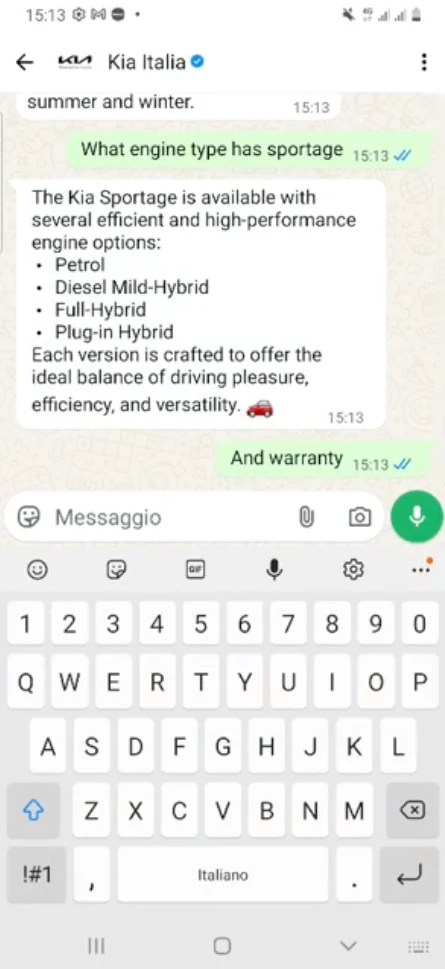
Official image from the Kia Italia case: the agent answering a buyer's questions in WhatsApp.
The clearest named case for the Seoul messaging role involves a Korean brand abroad. Kia Italia, part of the South Korean automaker Kia Corporation, wanted a faster path from ad to sale than dealership visits and call center follow-ups. With Meta and the messaging partner Infobip, it ran ads that click to WhatsApp, where an AI agent collected contact details in conversation, answered questions on models, prices and financing, and passed ready buyers to the nearest dealer. In four weeks the campaign produced 144 qualified leads, 116 quote requests and five direct car sales, with a 40x return on ad spend and 53% lower cost per car sold than Kia Italia's usual approach. The page labels the results self-reported.
Two other named cases show the same pattern. Movida, a Brazilian car rental company, rebuilt its WhatsApp bookings on the Business Agent Platform; replies came in under 15 seconds instead of 30 to 60, and in week four of a one-month test its conversion rate reached 14.9% against a previous best of 9.7%. Underneat, an Indian apparel brand that used to set up each campaign by hand, moved to Advantage+ sales campaigns and reported a 13% incremental lift in purchases.
Reading the case numbers
Each case measures something different: return on ad spend, conversion rate, incremental purchases. All are published by Meta or WhatsApp Business, and the Movida test appears with a different headline figure on the earnings call, a 44% rise in daily bookings. Treat them as evidence of what the product can do in one deployment, not as a benchmark.
In an interview, retell one of these cases with its measure and its limit, then say how you would test the same idea with a Korean client, for example a brand selling abroad through WhatsApp.
03 / THE EVIDENCE
The story, in numbers.
DATED OBSERVATIONS
Revenue by fiscal year (calendar years)
USD · B
$116.6B
$134.9B
$164.5B
$201.0B
Total revenue as reported in Meta's fourth-quarter results releases.
Figures, dates & basis +
Revenue by fiscal year (calendar years)
Date
Value
Basis
2022-12-31
$116.6B
2022: $116,609 million, down 1%.
2023-12-31
$134.9B
2023: $134,902 million, up 16%.
2024-12-31
$164.5B
2024: $164,501 million, up 22%.
2025-12-31
$201.0B
2025: $200,966 million, up 22%.
Meta Platforms
Business Agent goes global
On June 3, 2026 Meta expanded Business Agent to businesses of all sizes and introduced the Business Agent Platform for enterprises.
Enterprise platform
Meta Enterprise Platform launched on September 28, 2026.
Third quarter 2026 results
Revenue of $64.6 billion, up 26%, with a $9.89 billion charge for the attorneys general agreement.
Read the growth story+
Who pays, and for what
Advertisers pay for impressions delivered or for actions such as clicks, on Facebook, Instagram, Messenger, Threads, WhatsApp and third party mobile apps. Most of them buy through self-serve tools; Meta's sales force works with larger advertisers directly and through agencies and resellers. In the third quarter of 2026 Meta delivered 10% more ad impressions than a year earlier at a 14% higher average price, and advertising produced $63.1 billion of $64.6 billion in revenue. The rest came from Family of Apps other revenue, $1.1 billion, which includes WhatsApp paid messaging and Meta Verified subscriptions, and from Reality Labs hardware such as AI glasses, $443 million.
The dated numbers and what each one measures
Measure
Value
Period
What it is
Revenue
$116.6B
2022
Annual revenue, all segments
Revenue
$201.0B
2025
Annual revenue, up 22%
Revenue
$64.6B
Q3 2026
Quarterly revenue, up 26%
Asia-Pacific revenue
$53.8B
2025
By customer address, not by where users are
Advantage+
$75B+
Q2 2026
Annual run rate of revenue through these tools
WhatsApp paid messaging
$2B+
Q4 2025
Annual run rate
Capital expenditures
$135B to $145B
2026 outlook
Includes finance lease principal
What grew, and where Asia sits
Revenue grew from $116.6 billion in 2022 to $201.0 billion in 2025, and growth sped up in 2026, to 28% in the second quarter and 26% in the third. Meta reports Asia-Pacific in two ways, and the difference matters for Seoul. By where users are, Asia-Pacific supplies much of the impression growth but earns lower prices per ad. By the address of the paying customer, Asia-Pacific produced $53.8 billion in 2025, more than Europe's $46.6 billion, and $16.1 billion in the second quarter of 2026, up 25%. The annual report adds that a small number of resellers serving advertisers based in China produce meaningful revenue. For a Seoul seller the second view is the one that counts, because that is where Korean advertisers who sell abroad appear.
Meta's filings describe competition on every front: for people's time, for advertisers' budgets, for developers and, now, for frontier AI models. Zuckerberg told investors in July 2026 that Meta's ads business was reporting faster growth in dollars than any other company's reported ad business. When Meta asked its peers to adopt its new teen protections in August 2026, it named TikTok and YouTube. In Korea the picture includes cooperation: Meta works with Naver on advertising through Naver's ADVoost and, since September 2026, on navigation for AI glasses.
Three risks to weigh
The first risk is the dependence itself. Substantially all revenue comes from ads, and the annual report says privacy rules and platform changes have reduced Meta's ability to target and measure them; Korea's privacy regulator fined Meta 21.6 billion won in 2024 over sensitive information used in ad topics. The second is youth safety litigation: a $375 million jury penalty in New Mexico in March 2026, then an agreement with 52 attorneys general providing for payments of up to about $18.59 billion and a $9.89 billion charge in the third quarter. The third is spending. Capital expenditures of $135 billion to $145 billion are planned for 2026, free cash flow turned negative in the third quarter, and Meta expects Reality Labs to lose $18 billion to $19 billion this year.
Two habits help in an interview. Name the measure with the number: $201.0 billion is 2025 revenue, while $75 billion for Advantage+ is a run rate of revenue that already sits inside advertising. And when you cite Asia-Pacific, say whether you mean users' location or customers' address.
04 / THE PEOPLE
Someone saw it first.
Founder, Chairman and Chief Executive Officer
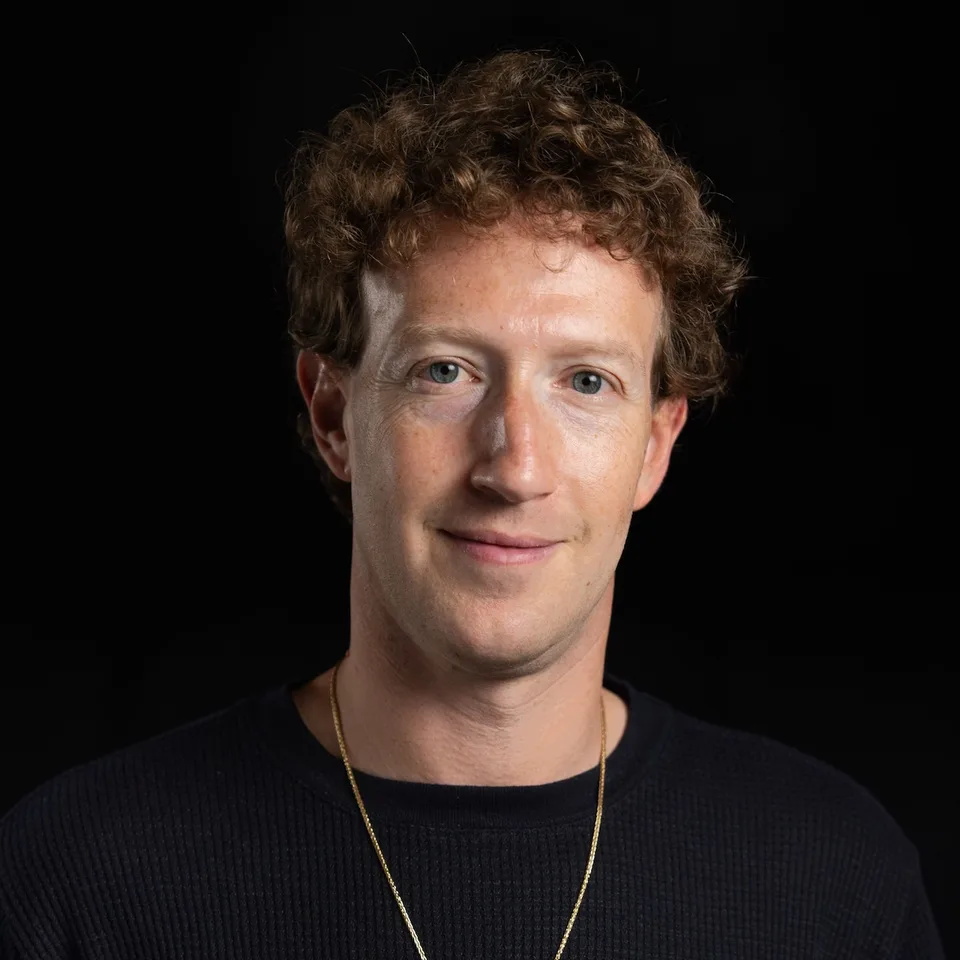
Mark Zuckerberg
Launched Facebook in 2004 and has led the company since. The 10-K says he controls a majority of the voting power of Meta's stock and can control major strategic investments.
The choice behind the company +
Rebuilt Meta's AI program in 2025, launched Meta Enterprise Platform in September 2026 as the next major pillar, and leads a company now guiding 2026 capital spending to $135 billion to $145 billion.
Vice President for Asia Pacific
Benjamin Joe
Joined Meta in 2011 and held leadership roles in the US, Korea and Southeast Asia before becoming regional vice president for Asia Pacific in 2025; he previously worked at McKinsey and IBM.
The choice behind the company +
In September 2026 Meta named a new Managing Director for Southeast Asia reporting to him; he said the work ahead is helping businesses use AI and messaging at the pace their customers already expect.
Country Director, Meta Korea
Jin Ah Kim (김진아)
Joined Facebook Korea in 2015 and led small and medium business across Korea, Taiwan and Hong Kong from the Asia Pacific headquarters before Meta named her head of the Korea business in June 2022.
The choice behind the company +
Spoke for Meta at the May 2026 Korea launch of Ray-Ban Meta and Oakley Meta AI glasses and presented Meta's AI plans at a June 2026 media demo at Meta Korea's Seoul office.
“AI is accelerating our core business today, powering our next generation of products, and opening the door to entirely new enterprise opportunities.”
Mark Zuckerberg · Second quarter 2026 results release · 2026-07-29
The decisions behind the company+
A founder who still controls the vote
Mark Zuckerberg launched Facebook in 2004 and is still Meta's founder, chairman and chief executive. The annual report says he can exercise a majority of the voting power of the company's stock, which lets him control board elections and the major strategic investments. His decisions mark each phase. The company renamed itself Meta in October 2021, named 2023 the Year of Efficiency after revenue fell 1% in 2022, and, by his account, rebuilt the foundations of its AI program in 2025. In October 2026 the board approved a new non-voting Class C stock, partly to finance growth, with a stated aim of keeping the founder-led model.
our north star is building the best place for individuals to make a massive impact.
Mark Zuckerberg · Founder and CEO · Fourth quarter 2025 earnings call, on how AI changes the way Meta works · 2026-01-28
That sentence came with specifics. Zuckerberg said Meta would invest in AI-native tooling, elevate individual contributors and flatten teams, because projects that once needed big teams were being done by one talented person. Susan Li, the chief financial officer, said output per engineer had risen 30% since the start of 2025, mainly from the adoption of agentic coding. In May 2026 Meta cut about 8,000 roles, and its headcount at the end of September was 66,775, down 15% in a year. The same thinking reaches Seoul: each of the three Korea postings lists ongoing AI skill development, such as prompt and context engineering, among its preferred qualifications.
The leaders above the Seoul roles
Three leaders sit between Menlo Park and the Seoul roles. Nicola Mendelsohn heads the Global Business Group, which Meta says manages relationships with top marketers and agencies, plus global partnerships and engineering; the Seoul Client Partner posting sits in this group, and the other two Seoul roles also serve Korean clients. Benjamin Joe has been vice president for Asia Pacific since 2025. He joined Meta in 2011, held leadership roles in the US, Korea and Southeast Asia, and earlier worked at McKinsey and IBM. In Seoul, Meta Korea is led by Country Director Jin Ah Kim (김진아), who joined Facebook Korea in 2015, ran small and medium business for Korea, Taiwan and Hong Kong from the regional headquarters, and was named head of the Korea business in June 2022.
We are now entering an era where AI accompanies us at eye level.
Jin Ah Kim (김진아) · Country Director, Meta Korea · Korea launch of Ray-Ban Meta and Oakley Meta, released in Korean on May 19, 2026; English from Meta's own English version · 2026-05-19
What Meta says it stands for
Meta publishes five principles: give people a voice, build connection and community, serve everyone, keep people safe and protect privacy, and promote economic opportunity. Two of them describe the business directly. Serving everyone means ads pay for free services, and promoting economic opportunity means tools meant to level the playing field for small businesses. Leadership is also widening beyond ads. In September 2026 Meta named CJ Desai, previously chief executive of MongoDB, Chief Enterprise Platform Officer reporting to Zuckerberg, to turn Meta's models and agents into products companies can deploy.
On the worry that headquarters decides everything: at Meta it largely does. One founder controls the vote and the products are built centrally. Seoul's weight comes from clients and from the market itself. Instagram chose Korea in October 2025 to test a Reels-first version of its app, and the Seoul messaging posting asks the hire to carry client feedback on feature gaps back to the company.
05 / THE NEXT CHAPTER
Sell Meta to Korean companies that compete worldwide
Account planning with top advertisers, technical design of messaging and agent solutions that connect to CRM and ERP systems, and lift and attribution studies with clients, agencies and third party vendors, in Korean and English.
Named head of the Korea business in June 2022; official newsroom, May 2026
Jin Ah Kim (김진아)
Country Director, Meta Korea
Advertiser sales and client solutions+
Client Partner
Client Solutions Manager
Account Manager
Agency Partner
Head of Vertical, E-commerce & Retail
Director, Global Client Lead
Measurement, creative and business engineering+
Marketing Science Partner
Head of Creative Shop North East Asia
Creative Strategist
Business Engineer
Partnerships, public policy and marketing+
Director of Public Policy, Korea
Head of Telco Ecosystem Partnerships Korea
Creator Partnerships, Korea
Product Marketing Manager
Reality Labs engineering and research+
Display and optical engineers (MR and VR)
Research Scientist Intern
Legal+
Associate General Counsel, AI and Privacy
Team shape read from public LinkedIn profiles at human speed on October 22, 2026; the org chart above is the current reading. Counts are people found, not official headcount, and grouping does not establish reporting lines.
Why Korea? Why now?+
Meta reports Asia-Pacific as one region, where customers by address paid $53.8 billion in 2025. The Seoul postings and Meta Korea's own events point to Korean companies that sell abroad, in apps, games, beauty and commerce, as the core clients. Meta's Asia Pacific head described Korea in October 2025 as a fitting test bed for new products, and Instagram tested its Reels-first app here that month.
New head of the Korea business
Meta names Jin Ah Kim head of Facebook Korea; she joined in 2015 and led small and medium business across Korea, Taiwan and Hong Kong.
Korea tests a Reels-first Instagram
Instagram starts testing a Reels-first version of its mobile app in Korea, letting users choose whether to take part.
Seminar on selling abroad
Meta Korea hosts Korean small businesses at its office on entering the US, Japan and Southeast Asia.
26 agency partners for 2026
Meta Korea names 26 official partners for its 2026 Agency First program.
AI glasses launch in Korea
Ray-Ban Meta and Oakley Meta go on sale in Korea with EssilorLuxottica; Korean live translation follows in July.
Naver partnership
Meta and Naver plan Naver Map walking navigation on Meta's AI glasses within the year; Naver is Meta's first Korean partner for AI glasses.
Instagram live ads in Korea
Instagram live ads launch in Korea after pilots with Dyson and Qoo10 Japan.
Understand the Korea opportunity+
Why Seoul sells to the world
Meta reports Asia-Pacific as one region, so the case for Seoul is read from what Meta does here. The three open postings name the clients: Korean companies in apps, gaming and e-commerce for the Client Partner, mid and large Korean companies adopting business messaging and agents for the Enterprise Technical Sales Specialist, and Korean advertisers improving their measurement for the Marketing Science Partner. Many of those clients use Meta to sell abroad. In October 2025 Meta Korea ran a seminar at its office on entering the US, Japan and Southeast Asia, and Cafe24, its 2025 agency of the year, also shared that year's cross-border trade award for helping small and mid-sized advertisers expand overseas. Meta's Asia Pacific head said in an October 2025 interview that Korea's digital infrastructure and quick uptake of new consumer trends make it a fitting test bed, and that month Instagram chose Korea to test a Reels-first version of its app.
Meta Korea is led by Country Director Jin Ah Kim. On LinkedIn's People page with the South Korea filter, read on October 22, 2026, 89 members appeared, and LinkedIn's own highlight placed 75 in the Seoul and Incheon area. Most self-described titles belong to advertiser sales and client solutions: Client Partner, Client Solutions Manager, Agency Partner and heads of verticals such as e-commerce and retail. Smaller groups cover marketing science, the Creative Shop, business engineering, public policy and partnerships, and a Reality Labs group of display and optics engineers. These are profiles found, not official headcount.
Korea customers and partners on record
Meta's Korean newsroom and case library name the ecosystem. Twenty-six agencies joined the 2026 Agency First program, among them Cafe24, Madup, Echo Marketing, CJ MezzoMedia and KT Nasmedia, and the 2025 awards cited collaborative ads run with Ably, W Concept and Kurly. Meta's Korean case library features Laneige, TIRTIR and Eqqualberry, beauty brands using partnership ads, Reels and Meta's Moment Maker format, two of them for launches or sales abroad. In 2026 Meta added launches here: Ray-Ban Meta and Oakley Meta glasses on May 25 with EssilorLuxottica, Korean live translation in July, a Naver Map walking navigation partnership on September 29, Naver being Meta's first Korean partner for AI glasses, and Instagram live ads on September 30, piloted by Dyson and Qoo10 Japan.
Official photo: the October 31, 2025 global expansion seminar at Meta Korea's office.
What the Korea hiring asks for
Read together, the three postings describe one client relationship from three sides. The Client Partner owns strategic planning with top advertisers in apps, gaming and e-commerce, with the stated aim of step-change investment growth, and asks for at least five years in sales or marketing in those industries, from either the client or the platform side. The Enterprise Technical Sales Specialist sells Meta's Business Messaging Platform and AI to mid and large Korean clients, designs solutions that connect to CRM and ERP systems, and asks for ten or more years of enterprise sales. The Marketing Science Partner designs lift and attribution studies and asks for eight or more years of measurement research, with statistical software such as R and data tools such as Hive, Python or SQL. All three ask for high-level fluency in Korean and English.
For the worry that Seoul is a satellite: these roles sell products built at headquarters, but the agent products the business messaging role sells arrived only in 2026, the Business Agent Platform in June and the enterprise platform in September. The posting asks the hire to help build global playbooks from Korean client work, which is where an early hire can shape practice.
Watch whether Muse and the paid Business Agent tiers launch in Korea, which Korean company first appears as a named Business Agent Platform case, and how Instagram live ads perform for Korean beauty and commerce brands.
KOREA OPEN ROLES
3 open roles in Korea
Current Signet catalog · 2026-10-23
FOR YOU
Use the mock application to show a Korean client result you grew and proved.
GTM · Sales · BD
Client Partner, Korea
Seoul, South Korea
Posting checked
The work
Own strategy with top app, gaming and e-commerce advertisers to drive step-change investment and new business.
Who fits
5+ years in app, gaming or e-commerce sales or marketing, client or platform side; data-driven.
Keep in mind
Escalation point for client issues; ties in Korea's app, gaming or e-commerce scene preferred.
Meta began selling its Muse agent, Business Agent, Muse API and Muse Code to businesses and named CJ Desai, previously MongoDB's CEO, Chief Enterprise Platform Officer reporting to Zuckerberg.
Instagram live ads launch in Korea
Meta launched Instagram live ads in Korea after pilots with Dyson and Qoo10 Japan; a day earlier it announced Naver Map walking navigation for its AI glasses and continued ad cooperation with Naver.
Third quarter results and a new Class C stock
Revenue rose 26% to $64.6 billion; a $9.89 billion charge for the attorneys general agreement cut operating margin to 20%, and Meta announced a non-voting Class C stock effective January 19, 2027.
More context on what comes next+
The quarter just reported
On October 21, 2026 Meta reported third quarter revenue of $64.6 billion, up 26%, with 3.64 billion daily active people. Costs included a $9.89 billion charge for the attorneys general agreement, so operating margin fell to 20%. Headcount was 66,775, and the company narrowed its 2026 capital spending outlook to $135 billion to $145 billion. It guided fourth quarter revenue to $73 billion to $76 billion and announced a non-voting Class C stock, effective January 19, 2027, to be distributed as a one-for-one stock dividend that does not change any shareholder's voting power.
Our investments are paying off, the core business is strong, and we're seeing velocity across the board.
Mark Zuckerberg · Founder and CEO · Third quarter 2026 results release · 2026-10-21
From ads to an enterprise business
The quarter's product news points the same way as the thesis. On September 28 Meta launched Meta Enterprise Platform to sell its Muse agent, Business Agent, Muse API and Muse Code to companies. A day later it extended Muse to small businesses in the US and Canada, connecting it to their Facebook Pages, Instagram analytics and ad accounts. In Korea the same week brought the Naver navigation partnership and Instagram live ads. Signet reads the common thread this way: Meta wants to be paid for finished work, such as a sale or a booking, and not only for a place on the screen.
Three things to watch
Whether the youth-related trials that Meta says are scheduled in the coming months add costs beyond the attorneys general agreement.
Whether AI spending keeps showing up in ad results, starting with fourth quarter revenue against the $73 billion to $76 billion guidance.
When Muse and paid Business Agent tiers reach Korea, and which Korean companies sign up first.
For a candidate, the third quarter is a useful interview reference. It shows the core ads business growing 26% while legal costs and AI spending weigh on margins, and it dates the enterprise push to September 2026.
A LITTLE MORE CONTEXT
Understanding Meta.
What does Meta do?
Meta's apps reach 3.64 billion people a day, and its business is selling businesses a way to find, persuade and serve the ones who will buy. Advertising still produces substantially all of its revenue. The newer line of business is conversation: ads that open a chat, and AI agents that answer and sell inside WhatsApp, Messenger and Instagram.
What is the opportunity in Korea?
Account planning with top advertisers, technical design of messaging and agent solutions that connect to CRM and ERP systems, and lift and attribution studies with clients, agencies and third party vendors, in Korean and English.
Are these confirmed job openings?
Employer postings were checked on 2026-10-22. Availability can change. Mock applications request a review from Signet.
How can I explore the company in more depth?
Follow the company from its vision through products, evidence and people to the Korea team and current roles. Use the table of contents to move within the page, and expand the sections for more context.