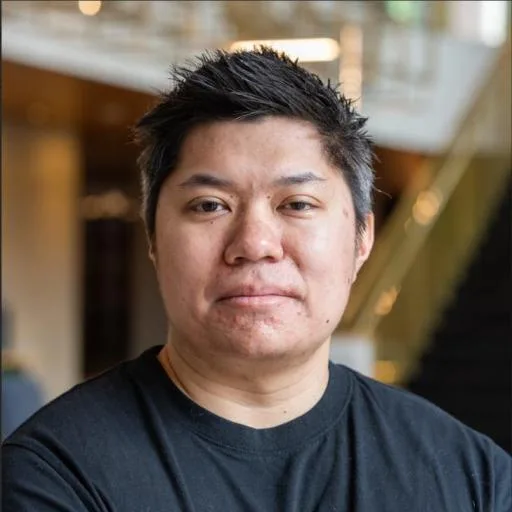
Keone Hon, co-founder of Monad
Monad Foundation / THE WORLD THEY ARE BUILDING

Familiar EVM applications run on faster shared settlement infrastructure.

Compatibility, performance and distributed participation can develop together.

See it taking shape ↓
01 / THE PRODUCTS

The products behind the promise.

Official diagram of MonadBFT consensus rounds
Official consensus diagram
Monad network

Execute EVM transactions and settle shared state.

EVM developers can use familiar contracts and connect existing wallets to a shared environment for transaction execution and settlement. Customer asset and approval controls remain part of the surrounding application.

Etherfuse and Shinhan Securities

Korean Treasury bonds onchain

The official case dates first KTB minting to January 2026.

Etherfuse issues tokens backed by Korean bonds held with Shinhan; Monad supplies settlement.

What changed? +

Asset access depends on issuance, custody and investor eligibility.

Dated ecosystem case; institutional roles are distinct from direct Foundation sales.

Official diagram of MonadBFT consensus rounds
Official consensus diagram
02 / HOW IT BECOMES REAL

An illustrative institution integration

Illustration: a partner introduces a scoped financial workflow.

  1. 01

    Scope

    Identify the institution, asset and operating constraint.

  2. 02

    Connect

    Map issuer, custodian, application and network responsibilities.

  3. 03

    Authorize

    The user signs the intended transaction.

  4. 04

    Execute

    Validators order transactions and execution updates chain state.

  5. 05

    Operate

    The partner reconciles and monitors its full service flow.

Follow the work, step by step

Keep the contract, change the engine

A business building on a public blockchain needs more than a fast demonstration. Its users must be able to move value, complete an interaction and understand when the result is final, while developers retain familiar contracts and tools. Monad approaches that problem by keeping Ethereum Virtual Machine compatibility and rebuilding the underlying execution, storage and consensus systems. Solidity code and existing EVM addresses can continue to work. The engineering change happens beneath the application rather than requiring every team to learn an entirely new programming environment. Category Labs develops the software; the Monad Foundation helps the protocol gain developers, ecosystem participants and adoption. Signet reads that division as a practical boundary for a candidate: an ecosystem role translates infrastructure into a use case that an institution can operate. It must explain who owns the asset, which obligations remain with the issuer, and how a settlement event fits the customer's existing process. Network capability supplies one part of that answer. The customer's operating rules supply the rest.

Follow one signed instruction

Consider an illustrative payment integration. A customer authorizes a transfer through an application. The application constructs a transaction, an RPC provider submits it, validators agree on its order, and the execution system updates the chain's state. These are different responsibilities, so a smooth interface should not hide the boundary between a submitted request and settled value. Monad uses optimistic parallel execution: work can proceed concurrently, while conflicts are detected and corrected to preserve the required result. Its database is designed for that access pattern, and asynchronous execution separates ordering from execution. MonadBFT handles agreement among validators. On July 23, 2026, the Foundation announced 300 millisecond block times and 600 millisecond deterministic finality, replacing the earlier 400 and 800 millisecond settings. Those are dated network claims, rather than a promise that every customer's entire payment journey takes that amount of time. Wallet checks, compliance screening, asset issuance and the customer's own approval steps still shape the journey. A candidate should be able to draw all of those steps without merging them.

Turn infrastructure into adoption

The Foundation's current Korea posting puts the commercial task in direct terms: own market strategy, identify and close strategic relationships, and represent Monad to enterprises and institutions across payments, tokenization and capital markets. That work begins by understanding the counterpart's actual reason to change. A payment company may need a settlement path, while an asset issuer needs custody, eligibility and redemption controls. A developer needs dependable integration tooling and access to the ecosystem. Treating those as the same buyer would make a proposal too vague to execute. Signet's illustrative workflow therefore starts with a scoped institution problem, maps the parties and approvals, selects a network and integration path, and ends with a repeatable operating process. The March 2026 Etherfuse case provides a concrete Korean connection through tokenized Treasury bonds backed by assets held with Shinhan Securities. It demonstrates how the chain sits inside a wider structure. The Korea candidate has to describe that structure as carefully as the blockchain, and carry constraints back to the teams responsible for the relevant part of the solution.

Understand the products and their customers

The network is a shared base

Monad is a Layer 1 network, so its core offering is a shared execution and settlement environment rather than a single end-user application. EVM compatibility makes existing contracts, wallets and infrastructure relevant to that environment. The technology page lists a design capability of 10,000 transactions per second, along with the current block and finality settings. A candidate should read throughput as a system characteristic and then ask what a customer's workload actually demands. Transaction composition, state contention, node configuration and external services can change observed experience. Monad's performance article explicitly encourages contextualizing benchmark claims instead of treating one headline number as a complete comparison. The practical product conversation is therefore about which contract does what, how its state changes, when other parties can rely on that state, and which infrastructure the customer needs to maintain. The Foundation's infrastructure directory names providers across RPC, indexing, wallets and other services. Their presence helps describe an integration path, but directory membership should not become a claim that every service has the same operating guarantees.

Payments need an integration layer

Portal adds a different part of the product story. The Foundation acquired the stablecoin infrastructure provider in July 2025, while announcing that Portal would remain an independent entity. Its SDKs and APIs help applications incorporate wallet and payment capabilities. Raj Parekh moved into the Foundation's payments and stablecoins leadership, and Portal's other co-founders took responsibility for its operating leadership. This is useful for a commercial candidate because the network itself does not automatically produce a complete payment service. An application still needs an interface, account controls, liquidity connections and the regulated services appropriate to its users. The June 2026 MetaMask Money Account announcement shows one named consumer deployment on Monad, combining a wallet experience with stablecoin balances and access to the surrounding ecosystem. Signet treats it as an announced partner use case rather than a generic promise for every country. A Korean proposal should identify which features the counterpart can deliver, what depends on another provider, and where jurisdiction or partner conditions affect availability before promising an end-to-end experience.

Separate live systems from designs

Two October announcements extend the architecture in different directions. Monad Private Settlement is a published design being developed by Category Labs with early design partners. It proposes encrypted institutional domains connected to the public network's liquidity, with institutions choosing operators, access policies and jurisdictional settings. The announcement states that the system is not yet live. Typewriter, introduced on October 8, is a prototype framework for application-specific transaction ordering and fast local responses. The application server orders signed mutations, runs contract logic locally and then sends batches for onchain settlement. Its trust model gives the operator responsibility for ordering and liveness while preserving contract authorization. That local response should not be confused with already completed onchain settlement. The article also describes compatibility limits for applications that depend on arbitrary external contract calls. These details give a Korean business development leader a better question than whether Monad is fast: does the proposed design fit the customer's operating model, and which tradeoffs must the customer accept? Current network capability, prototype functionality and future plans belong in separate parts of the proposal.

03 / THE EVIDENCE

The story, in numbers.

DATED OBSERVATIONS

Daily transaction count, company snapshot

MON · transactions per day
3,500,000 transactions per day

Count of network events, separate from Foundation revenue; one dated observation.

Figures, dates & basis +
Daily transaction count, company snapshot
DateValueBasis
2026-07-273,500,000 transactions per dayApproximately 3.5 million daily transactions in the official ecosystem review.

Monad Foundation

Read the growth story

Network activity and company accounts differ

The network economy has several financial flows, and a careful reader should keep their owners separate. Users pay transaction fees in MON, and the native token also participates in staking security. Applications can have their own fees, issuers can manage backing assets, and integration providers can operate commercial services. Those flows do not automatically constitute revenue received by the Monad Foundation. The tokenomics material describes distribution and protocol utility; the Foundation's company accounts would be a different record. Likewise, the April 2024 $225 million financing announcement concerns Monad Labs before its renaming, rather than an annual sales result for the Foundation. The same caution applies to token market capitalization and company equity valuation. Signet's reading focuses on the mechanism a candidate can influence: bringing credible applications, institutions and users onto shared infrastructure. Their activity can support ecosystem depth, but the profile should not convert a network metric into a private-company profit claim. In a commercial discussion, the candidate should identify who signs an agreement, who pays a fee, which entity provides each service and which metric the proposed partnership is intended to improve.

Read adoption by the right unit

The Foundation's July 27, 2026 ecosystem review describes roughly 3.5 million daily transactions across more than 150 applications. It also reports DeFi total value locked above $770 million, stablecoin capitalization above $550 million and tokenized real-world asset capitalization above $430 million at that snapshot. Each figure measures a different feature of the network. Locked capital concerns balances committed to protocols; transaction count concerns events; asset capitalization concerns outstanding value. None can be substituted for the Foundation's annual revenue. The same report connects payment rails, lending, trading and asset issuance into a shared economy. Signet reads that as a thesis about capital being usable in multiple applications, rather than a guarantee of attractive returns. The displayed chart therefore uses the dated daily transaction snapshot with a plainly labeled unit. This is one dated observation, rather than a series establishing growth across several periods. A candidate discussing growth should ask whether users and counterparties keep using the integration after launch and whether the operating relationship survives ordinary market conditions.

Three constraints shape the opportunity

The first constraint is operating reliability. A financial application must decide how it handles failed submissions, delayed services and the difference between local response and final settlement. The network uptime article explains consensus and recovery mechanisms, but the broader application still owns its own dependencies. The second constraint is regulated asset access. The Etherfuse case describes custody and primary-market KYC, and the StraitsX announcement explicitly conditions future integrations on technical, regulatory and compliance requirements. A technically open chain does not remove the obligations of an issuer or intermediary. The third constraint is sustainable application economics. Cheap network settlement alone does not settle the customer's whole cost equation: integration, liquidity, service operations and risk management remain real work. These are Signet's analytical categories anchored in the published architecture and case studies. For the Korea head, they are questions to resolve with a partner rather than reasons to abandon the market. A strong proposal names the required controls and a scoped outcome, then tracks whether the partner can repeat the flow at acceptable cost with the appropriate parties accountable.

04 / THE PEOPLE

Someone saw it first.

Keone Hon, co-founder of Monad
Monad Foundation leadership

Keone Hon

Named as moving to the Foundation in the December 2024 organizational announcement.

The choice behind the company +

Separate ecosystem work from software development.

“Monad gave us the settlement infrastructure we needed”

David Taylor · Official Korean Treasury bond case · 2026-03-23
The decisions behind the company

The organization split defines the work

The December 16, 2024 organizational announcement is the clearest starting point for understanding the people around this role. It introduced the Monad Foundation as an independent organization supporting development and adoption of the protocol, and said Keone Hon and Eunice Giarta would join it. Business development, ecosystem, community, marketing, developer relations and operations staff were also moving to the Foundation. The software research and development company continued under the name Category Labs, led by James Hunsaker as CEO. This division matters because a candidate joining the Foundation should understand which organization owns the task under discussion. A request about a Korean enterprise relationship is different from a change to execution software. The organizations can collaborate around the protocol without becoming interchangeable employers. Signet reads the split as an intentional division between ecosystem stewardship and performance engineering. It helps explain why the Korean opening asks for business development and institutional connectivity, while engineering research is described elsewhere. The candidate should keep counterpart expectations aligned with those responsibilities when introducing technical and commercial colleagues.

Payments brings a distinct operator

The Portal acquisition adds a second documented leadership decision. The July 2025 announcement named Raj Parekh as the Foundation's Head of Payments and Stablecoins and described his previous work as a founding member and director of Visa's global crypto product. Portal remained a separate entity under its own leaders: Parsa Attari as CEO, David Scrobonia as CTO and Rami Shahatit as COO. The structure combines ecosystem relationships with an integration business rather than requiring a network team to perform every activity itself. For a Korean candidate, that makes internal routing part of the job. An institution asking about a stablecoin use case may require a network specialist, an integration team, an issuer and a regulated service provider in the same conversation. The Korea head's expertise lies in establishing the scope and moving the relationship toward a workable agreement. It does not require inventing a single reporting line across all those parties. A useful preparation example would show how the candidate identified a counterpart's decision makers, translated a business problem into requirements and kept several organizations coordinated through implementation.

Read the stated culture through decisions

The employer's posting describes a lean team, collaboration, low ego and high-quality output. It also asks for a self-starter who takes an initiative from idea to execution. These statements are employer expectations, so a candidate can test them through examples rather than treating them as a guarantee about every working day. The technical publication record offers a related operating signal: engineers explain trust boundaries, discuss limitations, and publish code and evaluation methods. The Typewriter article identifies where the framework is a poor fit; the Ultrafuzz release discusses experiments and revisions to the team's hypothesis. Those are specific examples of making a product argument inspectable. Signet connects that habit with the Korea role's need to explain a changing market without overselling capability. A senior candidate should be able to act with incomplete commercial information while making the uncertainty explicit to colleagues. They should also show how a technical constraint changed their proposal. The strongest account of ownership ends with a counterpart using a workable solution, rather than only with an introduction, event attendance or an optimistic market narrative. Keone's August 2026 mission article adds a stated discipline: public rules, legible outcomes and measurement of progress toward open financial markets. For a candidate, this suggests making the evidence of a partnership's usefulness visible alongside its announcement.

05 / THE NEXT CHAPTER

Own institutional adoption in Korea

Negotiate strategic relationships across enterprises, institutions and the ecosystem.

Korea business development
  • Head of Korea

Open posting count, not team headcount

Functions are read from the live posting; one opening is not team headcount.

Why Korea? Why now?+

The posting names Korean institutional and retail adoption as its remit.

Korean Treasury bond case

Etherfuse issues tokens backed by Korean bonds held with Shinhan; Monad supplies settlement.

Understand the Korea opportunity

The opening owns a market

On October 10, 2026, the Monad Foundation's live career board lists Head of Korea as a full-time remote role based in South Korea. The original description places it in business development and assigns responsibility for the overall market strategy, strategic relationships and ecosystem growth. It specifically names enterprises and institutions across payments, tokenization of real-world assets and capital markets, while also discussing retail adoption. That combination makes the role broader than a community event program or a conventional software account list. It requires choosing where the network can fit a counterpart's business and negotiating relationships that can carry a use case into operation. The posting includes exchanges, media and regulatory stakeholders among the relevant regional relationships. Signet reads the task as coordination across several types of counterpart, each with its own authority and constraints. The function diagram represents the published responsibilities of this one opening. Its count means one open posting, not a measure of the existing Korea team's size or a claim about a local reporting hierarchy.

A Korean asset connects the parties

The March 23, 2026 Etherfuse case gives the Korea discussion an actual named institutional setting. It describes Korean Treasury Bonds tokenized by Etherfuse, with underlying holdings custodied by Shinhan Securities and settlement running on Monad. The case explains reserve backing, independent audit, primary-market KYC and redemption, so its value is the operating structure rather than only a claim about speed. Shinhan's role in holding the underlying assets and Etherfuse's role in issuance are distinct from the blockchain's settlement role. The article states that the first KTB tokens were minted in January 2026. Signet uses that dated case to show how a Korean asset can connect institutions and a public network. It does not infer that Shinhan is the Foundation's direct paying customer, or that the Korea head will own this particular account. The current posting names no individual assigned accounts. For a candidate, the useful preparation is to explain the custody, issuance, eligibility and settlement boundaries and then ask which similar counterpart problem can be addressed with an appropriately scoped partnership.

Prepare for institutions and execution

The required experience is specific: at least eight years in business development, including at least three in blockchain, digital assets or Web3 startups, plus deep Korean market knowledge and enterprise or institutional sales experience. The employer asks for native-level Korean and English, a regional network and the ability to connect blockchain technology with corporate strategy. Exchange, regulatory and media connectivity appear among the advantages, alongside entrepreneurial experience and technical depth. These are different criteria, so candidates should distinguish mandatory requirements from helpful background. Signet's illustrative first-quarter plan is a preparation aid: map the counterpart landscape, choose a small set of concrete use cases, identify the technical and regulated parties, and create a deal process with clear next decisions. It is not an employer-promised onboarding schedule. An interview example should show how the candidate moved a relationship beyond initial interest, handled a changing constraint and negotiated the path to execution. The role also calls for market foresight, so explaining why one opportunity should wait can demonstrate judgment as effectively as proposing a new partner.

KOREA OPEN ROLES

1 open role in Korea

Current Signet catalog · 2026-10-19

FOR YOU

Explain the operating decision and its accountable parties.

Strategy

Head of Korea

South Korea

Posting checked

The work
Own Korea strategy and negotiate enterprise and institution deals.
Who fits
Has at least eight years in business development, including three or more in blockchain or Web3.
Keep in mind
Full time, remote; the employer requires a South Korea base.
07 / NOW & NEXT

The next scene is taking shape.

StraitsX integration plan

Native stablecoins are planned for early 2027 under stated conditions.

Private Settlement design

Category Labs publishes a design that is not yet live.

Typewriter prototype

Applications can explore custom signed-mutation sequencing.

More context on what comes next

Regional currencies remain a plan

On October 1, 2026, StraitsX and Monad announced plans to bring XSGD and XUSD natively to the network in early 2027. The release also describes exploration of a stablecoin-based embedded finance stack for payment companies and consumer applications. It repeatedly conditions rollout on technical, regulatory, compliance and partner requirements. Signet reads the announcement as evidence of a specific direction for distribution. A candidate can ask how fiat access, card programs and merchant settlement might connect, while keeping the future integration separate from services already operating on Monad. The next useful evidence is a completed rollout with clearly assigned responsibilities and eligible users, rather than merely another announcement of intent.

Institutional privacy is being designed

The October 6 Private Settlement publication tackles a practical obstacle for institutions: public financial records can expose balances, counterparties and sensitive commercial activity. Category Labs proposes configurable encrypted domains that remain connected to shared network liquidity. Institutions would choose access policies and operators, with scoped access for auditors and regulators. The publication is explicit about its status as a design under development with early partners. For a Korea leader, this creates a requirements conversation about confidentiality and governance. It should lead to a distinction between what the public network does today and what a future domain is intended to provide, including the parties that would carry operating and legal responsibility.

Applications can choose an ordering model

Typewriter's October 8 prototype offers application-controlled sequencing and rapid local confirmations before onchain settlement. The article makes its trust boundary visible: users rely on the application server for ordering and availability, while signed mutations and contract rules constrain authorization. It also explains force inclusion and restrictions on arbitrary external contract calls. Signet reads this as a concrete architecture choice for exchanges, games or marketplaces with an existing offchain service. It is useful precisely because it identifies tradeoffs. A commercial candidate should be able to explain when that choice fits an application and when direct composability matters more, then keep the prototype's status clear while discussing it with a prospective Korean partner.

Their future. Your next chapter.

Find your part ↑

An independent profile by Signet. No affiliation or investment recommendation. Introductions happen only with your consent.
Research reviewed 2026-10-10

A LITTLE MORE CONTEXT

Understanding Monad Foundation.

What does Monad Foundation do?

Applications need dependable settlement without rebuilding their whole developer stack.

What is the opportunity in Korea?

Negotiate strategic relationships across enterprises, institutions and the ecosystem.

Are these confirmed job openings?

Employer postings were checked on 2026-10-10. Availability can change. Mock applications request a review from Signet.

How can I explore the company in more depth?

Follow the company from its vision through products, evidence and people to the Korea team and current roles. Use the table of contents to move within the page, and expand the sections for more context.

Back to the collection ↗