Arkady Volozh official portrait
Nebius / THE WORLD THEY ARE BUILDING

Nebius connects AI compute, storage and inference for production work.

Customers use infrastructure that fits their workload and operating responsibilities.

See it taking shape ↓
01 / THE PRODUCTS

The products behind the promise.

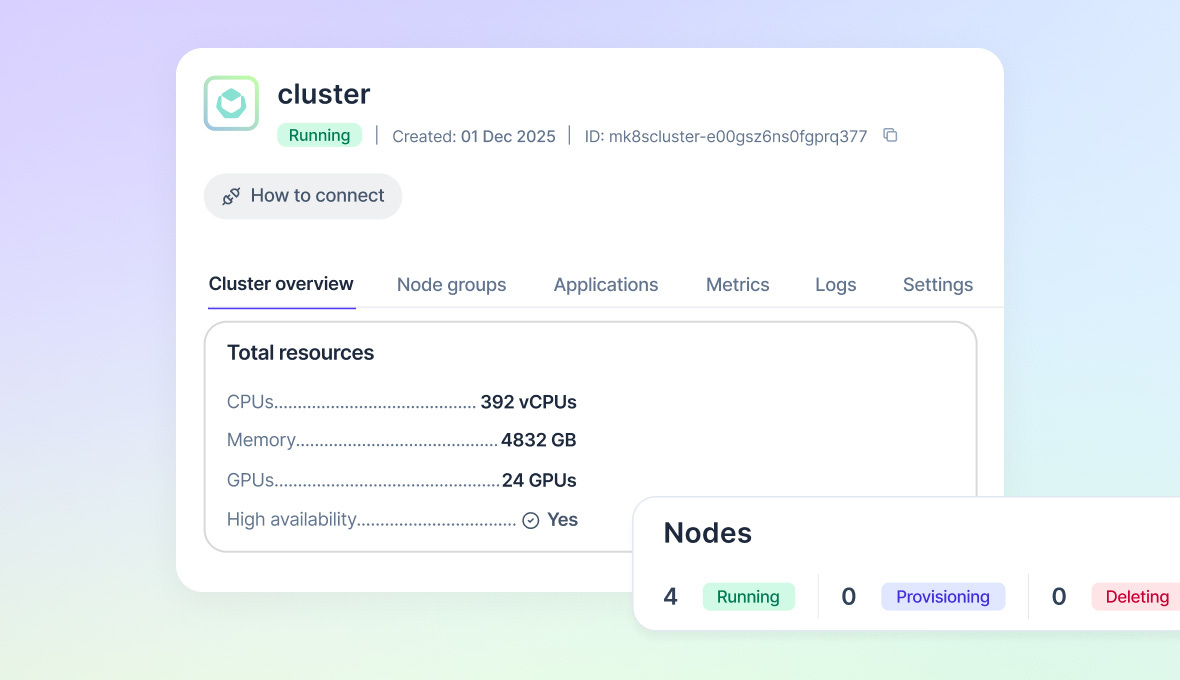
Official AI cluster console interface
Compute

Allocate accelerated instances for training and inference.

AI teams can select GPU instances and capacity commitments for training or inference, matching resources and availability conditions to the job.

Recraft

A model training cluster

Results belong to the described customer configuration.

The case describes cluster work and a faster training configuration.

What changed? +

The image-model team needed a training environment and network support.

Official Recraft customer story.

Official AI cluster console interface
02 / HOW IT BECOMES REAL

Illustrative enterprise AI deployment

Illustration: a Korean team evaluates an internal AI assistant.

  1. 01

    Scope

    Choose permitted data and a representative evaluation.

  2. 02

    Prepare

    Place data and allocate the needed compute.

  3. 03

    Train

    Schedule training or adaptation jobs.

  4. 04

    Serve

    Select an inference deployment for the traffic.

  5. 05

    Operate

    Measure service quality, access and stability.

Follow the work, step by step

An AI workload needs a connected system

Training or serving an AI model requires a chain of decisions. A team needs data in the right place, enough accelerated compute, a way to schedule work, and controls for the production service that uses the output. Buying a GPU solves only one of those needs. Nebius builds an AI cloud around the complete path from data and model preparation to deployment. Its compute, storage and orchestration services let a builder choose how much infrastructure to manage directly, while Token Factory offers managed inference. Signet reads the company as a provider of operating infrastructure for AI teams. Its practical proposition is that a customer's model can move through those stages on a connected platform. The buyer still owns the application's purpose, data decisions and quality standard. A Korean candidate should begin with that division of responsibility, because a research job, a customer chatbot and a dedicated large training cluster create different requirements. The correct sales conversation starts with the work the customer intends to perform.

Trace the work from input to service

Consider an illustrative Korean enterprise evaluating an internal assistant. The team first chooses permitted documents and a model, stores source data, and tests a representative question set. If it needs to train or adapt the model, GPU instances and shared storage support that job, while a scheduler allocates resources. When the model becomes a service, the team chooses an inference endpoint and measures response time, quality and stability under expected traffic. Nebius offers infrastructure at those steps, and the customer's specialists decide which combination fits their application. The Principal Solutions Architect posting makes that translation explicit through technical discovery, proofs of concept, architecture and the handoff to production. Signet's preparation example therefore follows the decisions rather than treating a demonstration as a completed deployment. The candidate should explain why a particular model and deployment mode were selected, what the trial measured, and which operational constraint changed the design. That explanation connects technical capability with an accountable customer decision and makes the next stage of the project easier to evaluate.

Use a customer case as a scoped example

Recraft gives a concrete training example. The customer story describes a team developing an image foundation model and working with Nebius on a GPU cluster, networking and training problems. Its reported improvement belongs to that model and configuration. Revolut offers a different example, combining model training with inference for financial-crime workflows and chat support. The published case discusses dedicated endpoints, observability and the ability to change models as workload demands develop. Those examples demonstrate why architecture and commercial work need to stay connected. An account executive may establish the commercial opportunity, but a technical team needs to determine whether the customer's traffic, data and performance conditions fit the service. A candidate should avoid transferring one customer's results to another workload without a test. Instead, use the cases to identify the questions that must be answered: which task consumes compute, which stage creates a bottleneck, and who will operate the resulting service? The value of infrastructure appears when it supports that actual process repeatedly.


Understand the products and their customers

Compute and storage carry the workload

Compute provides accelerated instances for training, adaptation and inference. The official product material describes direct access to NVIDIA GPUs without GPU virtualization, with network interfaces and instance choices designed for demanding AI workloads. On-demand, reserved and preemptible choices let customers select availability and commitment conditions appropriate to a job. AI Storage sits next to that compute. Object storage holds datasets and artifacts through an S3-compatible interface; shared filesystems support jobs that need concurrent access; block storage supports an instance's local operating environment. Signet reads these as distinct tools for different data access patterns. A team should choose based on its real read and write behavior, checkpoint needs and failure handling, rather than one maximum throughput claim. The public diagrams help explain how storage capacity and performance can grow across nodes. A Korean solutions architect can turn those components into a testable design by mapping the customer's data path, the work performed by each instance and the boundary between durable state and temporary work.

Orchestration turns resources into jobs

An organization with multiple researchers needs a method for allocating its cluster. Nebius AI Orchestration presents several paths instead of asking every customer to replace its workflow. Soperator brings Slurm scheduling into a Kubernetes-based environment, while the platform also offers SkyPilot and Ray-related options for different job and application patterns. The choice should follow the team's existing tools, scheduling rules and operating skills. Serverless AI adds another level of abstraction for workloads whose execution can be handled as a managed service. DataOps and ModelOps extend the surrounding pipeline, covering data and model activities rather than representing a GPU purchase alone. The practical product discussion asks what the customer wants to retain control of and what it wants the provider to run. Signet sees a useful interview exercise in drawing that boundary for one training job and one production application. A candidate who explains queues, credentials, resource ownership and observability in plain language can connect the product portfolio with a customer's operational process without collapsing every service into the same offering.

Managed inference has its own choices

Nebius Token Factory serves open models through a managed inference platform. A customer can use serverless endpoints for a changing request load or dedicated endpoints when it needs a more controlled serving environment. Post-training and deployment options support model adaptation alongside the service. These are operating choices: traffic shape, latency expectations and the model's behavior determine which path is useful. The Inferize acquisition announced on October 1 addresses another layer, reducing the time a large model needs before a new instance can begin serving requests. Faster readiness can help the platform use capacity more closely with actual demand, but the announcement also says integration work is beginning. Cloud 3.6 adds governance and developer features around production operations, including customer-managed encryption keys, workload identity integration and budget alerts. Signet reads these developments as work on the whole service rather than the model alone. The Korean technical role therefore needs to discuss architecture, reliability and cost together, and distinguish a released capability from the integration plan for an acquired technology.

03 / THE EVIDENCE

The story, in numbers.

DATED OBSERVATIONS

Group continuing-operations revenue

USD · USD
Group continuing-operations revenue2025-12-31: $227,700,000 USD; 2026-03-31: $399,000,000 USD; 2026-06-30: $582,300,000 USD$227,700,000 USDQ4 2025$399,000,000 USDQ1 2026$582,300,000 USDQ2 2026

Actual quarterly revenue; ARR and multiyear contract values are separate. These are dated disclosures, not a continuous growth record.

Figures, dates & basis +
Group continuing-operations revenue
DateValueBasis
2025-12-31$227,700,000 USDConsolidated continuing operations.
2026-03-31$399,000,000 USDConsolidated continuing operations.
2026-06-30$582,300,000 USDConsolidated continuing operations.

Nebius

Q4 2025

$227.7M consolidated quarterly revenue.

Q1 2026

$399M consolidated quarterly revenue.

Q2 2026

$582.3M consolidated quarterly revenue.

Read the growth story

Customers purchase working capacity

The business model begins with customers paying for AI infrastructure and services. Compute commitments, storage use and managed inference can enter the purchasing decision at different stages of a workload. Public pricing gives entry conditions, while a large deployment can involve a negotiated capacity arrangement. Signet reads growth as the conversion of usable capacity into customer work, with infrastructure delivery and service quality shaping whether an account continues to consume it. The July 15 partnership model adds an alternative source of capacity: partners finance and own facilities or hardware, and Nebius supplies its architecture, software and commercial access. The company describes possible revenue sharing, licensing, commissions and committed-capacity arrangements. Those are several economic structures, so one generic margin assumption would hide the differences. A Korean seller needs to qualify the customer's workload and commitment; a technical architect needs to define the resources and operating conditions. Together, those decisions make the proposal concrete enough for procurement and help the company allocate capacity to demand it can actually serve.

Keep annual revenue and ARR distinct

Financial reporting provides dated observations for that model. The full-year 2025 release reports consolidated revenue from continuing operations of $529.8 million, compared with $91.5 million in 2024. These group figures include businesses beyond the core AI cloud. Quarterly consolidated revenue was $227.7 million in the fourth quarter of 2025, $399.0 million in the first quarter of 2026 and $582.3 million in the second quarter. The chart keeps those periods and the group boundary explicit. Nebius also uses ARR as annualized run-rate revenue, calculated by multiplying the final month's revenue in a quarter by twelve. That describes the pace at a point in time; it is a different measure from revenue earned across a completed year or the value of contracted recurring subscriptions. A candidate should be able to state that definition before comparing a target with an actual result. The same care applies to group performance and core infrastructure performance. Signet uses completed-period revenue for the visual and discusses capacity contracts separately, so the reader can see which event each financial number describes.

Contracts create delivery obligations

The March Meta agreement illustrates why a contract value should be read alongside delivery conditions. Nebius announced $12 billion of dedicated capacity over five years, with delivery beginning in early 2027, plus up to $15 billion for additional capacity that remains available after sales to other customers. The resulting headline is a possible multiyear contract value, rather than revenue already earned in 2026. Capacity must be delivered and used under the agreement. The July secured-debt financing supports the global buildout, while the partner model can add resources with a different capital structure. Both connect funding decisions with the timing of operating capacity. The company's releases also identify risks around expansion, financing, customer retention, pricing and the ability of partners to operate the facilities required. Signet reads these as practical dependencies for the Korean roles: a successful sale requires an accurate service commitment and a workable implementation path. A candidate should explain how a forecast changes when deployment timing, customer demand or technical readiness changes, instead of treating every signed announcement as the same financial event.

04 / THE PEOPLE

Someone saw it first.

Arkady Volozh official portrait
Founder and CEO

Arkady Volozh

Leads the AI-focused group after the 2024 reorganization.

The choice behind the company +

Connect the customer workload with a working infrastructure platform.

Marc Boroditsky official portrait
Chief Revenue Officer

Marc Boroditsky

Leads revenue; the announced APJ general manager reports to him.

The choice behind the company +

Connect the customer workload with a working infrastructure platform.

“We will continue to deliver.”

Arkady Volozh · Dated official company announcement · 2026-03-16
The decisions behind the company

A reorganization created the current business

The current Nebius business should be understood through its 2024 reorganization. The July announcement followed the divestment of the Russian businesses previously held by Yandex N.V. and described a new group centered on AI infrastructure, with Arkady Volozh leading that direction. The company's present About page identifies him as founder, chief executive and a board member. It also distinguishes the core infrastructure business from Avride and TripleTen, while listing equity interests in other companies. This matters when a candidate reads historical figures: the old group and the current AI-focused group have different business boundaries. Signet starts with that boundary rather than treating every prior activity as part of the Korean employer's product proposition. The leadership decision created a company whose central work is infrastructure for builders and enterprises developing AI. A candidate can connect this history to today's operating question: how does an organization with extensive platform engineering experience turn that experience into a cloud customers will choose and continue using for real production work?

Engineering and commercial leadership meet

The current leadership roster assigns distinct responsibilities across the system. Danila Shtan is chief technology officer, Andrey Korolenko oversees infrastructure and product, and Ophir Nave is chief operating officer. Marc Boroditsky leads revenue, while the roster identifies Dado Alonso as finance chief and Lindsey Irvine as marketing chief. These are documented executive roles, rather than a claim about the size of each team or an individual candidate's reporting line. The dated announcement appointing John Haarer as general manager for Asia-Pacific and Japan supplies a more specific regional link: he is based in Singapore and reports to the revenue chief, covering Singapore, Japan, South Korea and India. Signet reads the Korean openings within that regional expansion. Commercial discovery and technical validation meet in a customer project, and each candidate needs to keep the other side informed as the requirements become clearer. The account executive should avoid promising a deployment the technical team cannot support; the architect should connect an engineering recommendation with the customer's reason to fund and operate it.

Read culture through visible practice

The careers material emphasizes engineering work and learning, and the engineering interview guide explains a structured technical process. Those are useful sources for a candidate's preparation, but published expectations should be tested against the work the candidate wants to do. The product record gives more concrete signals. Cloud 3.6 adds identity and encryption controls around the developer experience, the orchestration material accommodates multiple scheduling approaches, and the Inferize announcement describes solving readiness delays across the inference stack. Each is a decision about an operating constraint, not simply a claim that hardware is fast. The Korea architect posting similarly asks for discovery, a proof of concept, architectural design and transition into production. Signet connects that sequence with a practical habit: state the assumption, measure it on representative work, and explain the recommendation so both technical and commercial colleagues can act on it. For the account executive, the equivalent habit is to build a qualified opportunity and maintain an accurate forecast as constraints change. These interpretations help a candidate prepare examples grounded in actual decisions rather than repeating company slogans.

05 / THE NEXT CHAPTER

Commercial and technical customer work

Qualify customer demand and turn technical validation into an operating deployment.

Go-To-Market
  • Account Executive - South Korea

Open posting count, not team headcount

Solutions Architecture
  • Principal Solutions Architect, South Korea

Open posting count, not team headcount

Functions and open posting counts, separate from team headcount.

Why Korea? Why now?+

The regional expansion explicitly includes South Korea.

APJ expansion

John Haarer leads the region from Singapore, including South Korea.

Understand the Korea opportunity

South Korea sits inside the APJ expansion

The March 10, 2026 regional announcement explicitly includes South Korea in Nebius's Asia-Pacific and Japan expansion. John Haarer leads the region from Singapore and reports to Marc Boroditsky. That establishes a regional commercial context, while the live career board supplies the current local evidence. On October 10 the official board lists two South Korea openings: Account Executive - South Korea and Principal Solutions Architect, South Korea. Signet includes those roles because their posted locations explicitly name the country, rather than assuming that a generic remote opening can employ someone in Korea. The pair suggests a customer-facing buildout with commercial and technical responsibilities, but the number of open postings is not the team headcount. A candidate can use the regional announcement to understand the market remit and the job descriptions to understand the work. The useful preparation question is how a Korean enterprise's AI project will be qualified, tested and moved toward an operating deployment in coordination with the regional and central teams.

The account executive owns the sale

The account executive description asks for a customer-facing seller with more than ten years in business-to-business sales and experience around cloud, data or AI technology. Its scope covers new opportunities, existing relationships, a full sales process, senior decision makers and regional travel. It emphasizes identifying the customer's need, demonstrating business value and coordinating a technical solution with the specialists around the deal. Signet's interview preparation is an example of a complex sale whose technical and commercial questions changed during the process. The candidate should explain the initial hypothesis, who actually controlled the budget, what the technical trial resolved and how the final agreement matched the customer's operating need. An attractive demonstration can create interest, but the posted role also requires pipeline discipline, forecasting and a path to closure. A Korean seller should show how that work continued after the first meeting. This interpretation follows the official responsibilities; particular Korean accounts, a revenue quota and internal reporting relationships require separate confirmation.

The architect connects a trial to production

The Principal Solutions Architect posting locates the role in South Korea and describes remote work around the Greater Seoul area. It asks for more than ten years in senior customer-facing technical work, with fluency in Korean and English. The responsibilities span discovery, proofs of concept, architecture and production transition, alongside GPU training and inference, Kubernetes, distributed systems, infrastructure automation and performance troubleshooting. Its introductory text contains a Japan-team reference even though the location and language requirements identify Korea; the original wording is retained below so the employer's text stays inspectable. Signet reads the role through those explicit work and location statements. A useful preparation example follows one customer's problem through a representative experiment, explains why the result led to a design choice and identifies the handoff needed for a production service. The candidate should include a failure or constraint that changed the plan. That makes technical judgment visible and helps the account team communicate a promise the customer can realistically operate.

KOREA OPEN ROLES

2 open roles in Korea

Current Signet catalog · 2026-10-19

FOR YOU

Explain the customer decision and the operating constraint.

GTM · Sales · BD

Account Executive - South Korea

South Korea

Posting checked

The work
Own the customer sale from discovery through negotiation.
Who fits
Has 10+ years of B2B sales experience, ideally in AI, cloud, or data infrastructure.
Keep in mind
South Korea location on the current employer board.
Solutions Engineer

Principal Solutions Architect, South Korea

South Korea

Posting checked

The work
Translate a technical trial into a production architecture.
Who fits
Has 10+ years in a senior technical role such as solutions architect, systems architect, or ML platform engineer.
Keep in mind
South Korea and Greater Seoul remote location; original Japan-team wording retained.
07 / NOW & NEXT

The next scene is taking shape.

Palantir sovereign AI partnership

Palantir sovereign AI partnership

ClusterMAX evaluation publication

ClusterMAX evaluation publication

Inferize joins Token Factory

Inferize joins Token Factory

More context on what comes next

Sovereign deployment changes the boundary

The September 8 Palantir partnership concerns a complete sovereign AI stack for eligible Palantir customers. The announcement combines Palantir's enterprise perimeter with Nebius infrastructure and open models, emphasizing customer control over data and model deployment. Signet reads it as a specific partnership direction rather than a claim that every customer already has the same service. For a Korean enterprise, it raises an architecture question: where must data and execution remain, and how do those requirements affect the available deployment? The regional seller can connect the commercial need with that question, while the architect evaluates the resulting design. The partner and customer still need to determine the scope of the implementation. This development also connects the company's growth story with operating responsibility, because infrastructure is useful only when it fits the boundary the enterprise can accept.

Production readiness includes governance

Cloud 3.6, released on June 24, adds controls and developer features around production operations. Encryption-key management, workload identity and budget monitoring all sit outside the model's own quality, yet they influence whether an enterprise can run a service responsibly. The September ClusterMAX publication adds a dated external evaluation discussed by the company. Such an assessment supplies a scoped signal about the evaluated infrastructure, while a customer's own workload still requires validation. Signet connects both items with the Korean architect's requirement to move beyond a proof of concept. The candidate needs to describe the credentials, observation and operating process that make a trial service ready for continuing use. A seller benefits from understanding those conditions before treating a successful demo as a finished customer decision.

Inferize addresses the idle interval

On October 1 Nebius acquired Inferize and brought its technology and engineers into Token Factory. The announced focus is the interval when a new instance is loading a model and cannot yet serve a request. Reducing that interval can make capacity respond more closely to changing demand and reduce the need to keep spare resources ready. The company says the team will begin with technology integration and work across the inference stack. Signet treats this as an acquisition with implementation ahead, alongside the platform's existing managed-inference choices. For a candidate, the important reasoning is that useful capacity depends on the whole serving system. A GPU can be assigned yet idle, and a model can perform well in a test yet respond poorly when traffic changes. The technical and commercial roles have to translate those conditions into a design and a service commitment that match the customer's real workload.

Their future. Your next chapter.

Find your part ↑

An independent profile by Signet. No affiliation or investment recommendation. Introductions happen only with your consent.
Research reviewed 2026-10-10

A LITTLE MORE CONTEXT

Understanding Nebius.

What does Nebius do?

Nebius connects AI compute, storage and inference for production work.

What is the opportunity in Korea?

Qualify customer demand and turn technical validation into an operating deployment.

Are these confirmed job openings?

Employer postings were checked on 2026-10-10. Availability can change. Mock applications request a review from Signet.

How can I explore the company in more depth?

Follow the company from its vision through products, evidence and people to the Korea team and current roles. Use the table of contents to move within the page, and expand the sections for more context.

Back to the collection ↗