George Kurian, CEO of NetApp
NetApp / THE WORLD THEY ARE BUILDING

NetApp connects stored enterprise data with governed AI and hybrid-cloud work.

Customers operate useful workloads with clear performance, access and recovery conditions.

See it taking shape ↓
01 / THE PRODUCTS

The products behind the promise.

Official AFX disaggregated architecture
AFX

Scale storage performance and capacity independently on ONTAP.

Storage teams can expand performance and capacity separately as workload needs change, while using ONTAP as the data-management foundation.

World Wide Technology

Test before the customer deployment

A scoped partner testing and implementation case.

WWT used its technology center for customer simulations and NetApp-related designs.

What changed? +

Customers needed help choosing and validating infrastructure.

Official WWT customer story, not a universal performance result.

Official Keystone subscription screen
02 / HOW IT BECOMES REAL

Illustrative document-assistant data path

Illustration: a Korean enterprise prepares permitted data for an internal assistant.

  1. 01

    Map

    Identify source repositories and access rules.

  2. 02

    Classify

    Discover metadata and sensitive or obsolete material.

  3. 03

    Design

    Choose available data and storage capabilities for the workload.

  4. 04

    Protect

    Set a tested recovery and access process.

  5. 05

    Observe

    Monitor use, health and service conditions.

Follow the work, step by step

The data needs an operating foundation

An enterprise's data rarely lives in one place. Applications use files, databases and objects across company facilities and public clouds, while storage teams protect that material and keep it available. An AI project adds another demand: a model or agent must reach the appropriate data without discarding the permissions and recovery process around it. NetApp starts from the storage layer and extends it into data management, protection and activation. ONTAP supplies a common operating foundation across several storage systems and cloud services. Signet reads the business as a way to make an existing data estate usable for changing workloads. A candidate should therefore connect the product with the customer's actual operating decisions: which application reads which data, where it needs to run, and who controls access or restores it after a failure. The commercial proposition becomes clearer when those decisions are explicit. A new application may need more performance, but an existing business also needs continuity, governance and a manageable path for changing its infrastructure.

Follow one enterprise workload

Consider an illustrative Korean company preparing an internal document assistant. Its infrastructure team first identifies the source repositories and the access rules that determine which employees can read each file. AI Data Engine can discover and classify material where it already resides, creating a metadata catalog instead of requiring a separate copy of every source file. The current product page distinguishes available discovery and metadata services from previewed understanding and retrieval capabilities, and from later roadmap items. That distinction is useful because the company's overall direction is broader than a feature a customer can purchase today. The next steps are to select the application and its model, validate the data path, and monitor the service while preserving protection and recovery. NetApp's platform supplies data infrastructure around those steps; the customer still owns the application's purpose and approval standard. Signet's workflow is an explanation of responsibilities rather than an assertion that the product alone implements the entire assistant. A candidate can show how a trial would verify access, performance and recovery against that customer's real operating conditions.

A partner helps turn a design into use

World Wide Technology provides a named example of the surrounding work. Its published customer story describes using an Advanced Technology Center to simulate customer environments, evaluate designs and demonstrate solutions that include NetApp products. The case concerns the partner's testing and implementation work, rather than a guarantee that every customer will obtain the same result. The current Korean Partner Manager posting similarly centers on building offerings with managed service providers and cloud partners. The partner needs a commercial model, a technical configuration and an operating service it can take to a customer. NetApp's Technical Account Manager then connects technical health, adoption and renewal inside an account. Signet reads these roles as two different points in the same process: establish a workable route to market, then help the resulting workload stay useful. A candidate should be able to explain where a problem was discovered, which team owned the next decision, and how the project advanced after the first presentation. The data platform gains practical value when someone turns its components into an operation the customer can sustain.

Understand the products and their customers

ONTAP links several deployment choices

ONTAP is the data management software foundation beneath a broad portfolio. Unified systems support file, block and object workloads; other configurations focus on SAN or disaggregated file and object storage. AFF supplies all-flash storage, while AFX separates the storage controllers from capacity so the two can grow independently for demanding workloads. The official AFX documentation explains a shared storage pool connected through a switched network, with volume mobility based on metadata movement within that pool. That is a specific architectural boundary, so a candidate should avoid translating the term zero copy into a claim that every transfer between every environment is instantaneous. Public cloud services provide related ways to use familiar data capabilities: Amazon FSx for NetApp ONTAP, Azure NetApp Files and Google Cloud NetApp Volumes are distinct native services. A customer chooses the deployment according to application needs, access protocols and the surrounding operating environment. Signet reads the portfolio through those decisions rather than asking the candidate to memorize every array name. The important skill is matching a real workload with an appropriate architecture.

Discovery comes before agent context

AI Data Engine works on the information around the stored content as well as its eventual use by an AI application. The current page describes discovery and classification across ONTAP, StorageGRID and third-party storage using common file and object protocols. A catalog can help a storage team identify obsolete material or overly broad access, and it gives data teams a starting point for further preparation. Some semantic understanding, permission-aware retrieval and analytics integrations remain in preview, while a knowledge graph, Decision Fabric and disconnected sovereign operation sit on the roadmap. Signet keeps those stages separate. The September activation announcement adds the connection with Commvault recovery orchestration, bringing detection and protection signals into a recovery workflow. That does not replace the customer's responsibility to test restoration and define who can approve it. A Korean implementation discussion should ask which available feature resolves the immediate problem and how later capabilities would be evaluated when released. This keeps the proposal usable today while explaining where the product direction may take the existing data estate.

Keystone changes the purchase and operation

Keystone offers storage as a service with performance levels and committed capacity. Customers can select an operating model involving their own team, a partner or NetApp, so a subscription does not imply that every operational task belongs to the same party. The official subscription interface shows capacity use, alerts, service levels and contract timing. NetApp Console provides the surrounding management surface and has replaced the BlueXP name in current documentation. Its product material describes discovery, observation and policy-based administration across the estate. Signet connects those interfaces with the Korean Partner Manager's responsibility to grow cloud and subscription offerings through managed service providers. The seller must explain the service level, the customer's commitment and who operates each part; the TAM must turn the purchased service into technical health and adoption. A useful candidate example starts with an actual capacity or application problem, explains the selected contract and operating model, and follows the service after deployment. The practical comparison includes purchase timing, support and continuing control, rather than reducing storage as a service to one headline price.

03 / THE EVIDENCE

The story, in numbers.

DATED OBSERVATIONS

Completed fiscal-year net revenue

USD · USD

Fiscal April year ends; annualized run-rate and billings are separate.

Figures, dates & basis +
Completed fiscal-year net revenue
DateValueBasis
2022-04-29$6,320,000,000 USDReported fiscal-year total.
2025-04-25$6,572,000,000 USDReported fiscal-year total.
2026-04-24$6,925,000,000 USDReported fiscal-year total.

NetApp

FY2022

$6.32B completed fiscal-year revenue.

FY2025

$6.572B completed fiscal-year revenue.

FY2026

$6.925B completed fiscal-year revenue.

Read the growth story

Read the portfolio's several economic paths

NetApp receives revenue through storage products, related support and services, public cloud offerings and consumption models such as Keystone. The fiscal reporting separates Hybrid Cloud and Public Cloud segments, while the customer experience can combine several pieces of the portfolio. Signet reads that distinction as useful for understanding a role: a partner may build a subscription offering, a customer may purchase an array and support, and a native cloud service may enter a workload through a hyperscaler's procurement process. Those are different commercial paths to usable data infrastructure. The current Korean Partner Manager explicitly owns Keystone, first-party and third-party cloud marketplace business, partner-sourced opportunities and bookings. It asks for joint account planning and forecast accuracy as the opportunity progresses. A candidate should explain which partner contributes the customer access, who operates the service and how the agreement becomes continuing use. The proposition needs enough operational detail to survive after the initial purchase. Signet does not infer a single unit margin or contract value across these different models, because product mix, commitment and support responsibilities can change their economics.

Compare completed fiscal periods

The completed-period numbers show a different picture from a single recent growth headline. Fiscal 2022 revenue was about $6.32 billion, while fiscal 2025 revenue was $6.572 billion. Fiscal 2026 ended April 24, 2026 with $6.925 billion in net revenue, including $6.237 billion from Hybrid Cloud and $688 million from Public Cloud. The company reported that total revenue grew five percent for that completed year. Its first quarter of fiscal 2027 ended July 31, 2026 and produced $2.025 billion, with Public Cloud contributing $206 million. That quarter's growth is a separate period and should not be relabeled as full-year growth. Signet's chart uses fiscal-year revenue and identifies the year-end dates, while the latest chapter discusses the new quarter as a dated update. A candidate should keep net revenue, billings, annualized run-rate and management guidance separate. The numbers describe different events, and a clear explanation connects each figure with the time and scope it actually measures before using it to discuss market momentum.

Adoption and resilience support renewal

The TAM posting connects technical activity with continuing commercial outcomes. It names onboarding, health checks, utilization, technical asset management and collaboration with renewal specialists and field sales. Its stated indicators include retention, customer health, adoption and portfolio expansion. These are responsibilities for making the purchased workload useful, rather than a claim that every technical intervention causes a renewal. Signet sees a concrete preparation exercise in choosing an account problem, explaining the evidence of underuse or risk, and showing how the account team agreed on a health plan. The partner role adds another dependency: a managed service provider must build an offering that it can sell and operate, not just refer a prospect. Competition comes from other storage systems, cloud services and the choice to retain existing infrastructure. Customer budgets and workload priorities can change the buying decision, while cyber incidents make access and recoverability consequential. A candidate should be ready to describe how technical information altered the commercial plan and how continuing service quality was measured after implementation.

04 / THE PEOPLE

Someone saw it first.

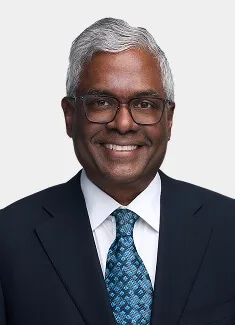
George Kurian, CEO of NetApp
Chief Executive Officer

George Kurian

Became CEO in June2015 after joining NetApp in2011.

The choice behind the company +

Connect the data platform with customer operating requirements.

“We achieved our target operating margin”

George Kurian · Dated official company announcement · 2026-05-28
The decisions behind the company

Keep the current leadership in view

The company has developed from enterprise storage into a broader data platform, while ONTAP's official technical history traces the software back to 1992 and describes its evolution across protocols, protection and cloud deployments. That product history helps explain continuity without assigning every current decision to an original founder. The present leadership roster names George Kurian as chief executive and a director, with his CEO appointment in June 2015 after joining the company in 2011. Syam Nair is chief product officer, and César Cernuda leads the global go-to-market organization as president. Signet focuses on those documented responsibilities when explaining the work a Korean candidate may encounter. A product and engineering decision, a customer implementation and a partner's route to market are connected but have different owners. The candidate can use the company's history to understand the established data foundation, then use the current executive roles and postings to identify how that foundation is being extended for AI and hybrid cloud workloads today.

Architecture choices carry strategy

The recent product decisions make the strategic direction concrete. AFX keeps ONTAP while separating performance from capacity. Novus addresses a different scale of AI infrastructure by separating metadata services from the data path under a shared namespace. The September announcement says its initial architecture combines Data Director metadata software with qualified Supermicro infrastructure and ONTAP data services on AFF systems. These are decisions about how stored data reaches a workload and how the operator can grow the system. They should be evaluated under the published configuration and release conditions, rather than a universal claim about every workload's speed. The proposed PEAK:AIO acquisition concerns metadata and parallel-file architecture, while the financial release identifies a completed DataPelago acquisition for AI data infrastructure. Signet reads those actions as investment in the layers around data access and activation. A candidate can explain why compute performance alone does not determine an AI system's usefulness, then connect that reasoning with the partner offering or customer health plan they would be responsible for delivering.

Public values describe expected behavior

NetApp's careers page states three high-achievement principles: Innovate to Elevate, Drive Results and Excel as a Team. Its explanation emphasizes curiosity, accountability, respectful challenge and collective execution. The values also ask employees to place the customer at the center, think and act like owners, and keep a growth mindset. These are employer expectations, so Signet translates them into preparation questions instead of claiming that every team has an identical daily experience. The Korean Partner Manager can prepare a case where several commercial and technical parties built a joint offering and overcame a constraint. The TAM can explain how customer feedback or a health check changed an account plan, with clear ownership of follow-through. The implementation engineer can describe the handoff and escalation process for a project. Each example should show the action that connected a stated priority with a result. That lets the candidate discuss the company's values through evidence of their own work and assess whether the responsibilities match the way they prefer to operate.

05 / THE NEXT CHAPTER

Partners, account health and implementation

Connect a partner offering, technical adoption and customer implementation.

Partner Manager
  • Partner Manager

Open posting count, not team headcount

Technical Account Manager
  • Technical Account Manager

Open posting count, not team headcount

Professional Services Engineer
  • Professional Services Engineer

Open posting count, not team headcount

Function and posting counts, separate from team headcount.

Why Korea? Why now?+

Current postings explicitly locate customer and partner work in Seoul.

Understand the Korea opportunity

The live board defines the current scope

The official South Korea board and Seoul board both show three local openings when checked on October 10, 2026: Partner Manager, Technical Account Manager and Professional Services Engineer. The locations explicitly name Seoul in South Korea. Signet includes the current country-specific postings and excludes the older cloud roles that still appear in some indexed search results but no longer appear on the live board. The count indicates open postings, not the size of the local organization. Each role occupies a different point in the customer's operating journey. The partner manager develops a route to market and a recurring service offering, the TAM supports technical adoption and account health, and the professional services role carries implementation responsibilities. A Korean candidate should choose the role through that work rather than treating every customer-facing title as the same sales job. The original descriptions are preserved below so the reader can examine the employer's exact requirements and any unusual wording alongside Signet's interpretation. That keeps the role analysis tied to the actual current hiring evidence.

Partner growth requires a usable offering

The Partner Manager, MSP and Subscription Business description focuses on Korean managed service providers, cloud partners and strategic service providers. It asks for more than eight years in relevant partner, channel, cloud, alliance or business development work. The responsibilities include recruiting and activating partners, building business plans, coordinating sales and technical resources, and growing cloud consumption and subscription opportunities. Signet reads this as ownership of a partner's commercially workable service, with joint account planning and a disciplined review cadence around the opportunity pipeline. A useful interview case would explain why a partner was selected, which customer problem justified the joint offering, and how the teams removed an obstacle between interest and a real contract. The candidate should be able to state both the business proposition and the operating model. The TAM follows a different path: its posting asks for five to seven years of business-to-business customer-facing experience and places technical success planning, health checks and renewal collaboration at the center. Both roles require coordination, while their deliverables and measures of progress differ.

Read the implementation posting carefully

The Professional Services Engineer is published on NetApp's official career site with a Seoul location, but its description refers to Extreme Network product suites and the Extreme Professional Services PDIO methodology. Signet preserves that text and identifies the discrepancy rather than rewriting it as an ONTAP implementation assignment. The posted responsibilities cover project support, implementation documentation, technical leadership, liaison between sales and the customer, and prompt escalation of issues. Its individual-contributor education section states a typical minimum of five years of related experience. A candidate can use those explicit responsibilities to prepare an example of planning, designing, implementing and operating a customer project, while asking the employer to clarify the actual product scope during recruitment. Across the three openings, the employer's standard statement describes a hybrid working environment and says in-person expectations are shared during the hiring process. The posting does not specify a fixed number of office days. The useful interview conversation keeps location, project duties and product scope separate so the candidate can evaluate the job on concrete terms.

KOREA OPEN ROLES

3 open roles in Korea

Current Signet catalog · 2026-10-19

FOR YOU

Explain a customer decision, its evidence and the next responsible team.

GTM · Sales · BD

Partner Manager

Seoul, South Korea

Posting checked

The work
Build MSP cloud and subscription offerings across Korea.
Who fits
8+ years in relevant partner, cloud or alliance roles.
Keep in mind
Employer hybrid expectations are discussed during hiring.
Engineering · AI

Professional Services Engineer

Seoul, South Korea

Posting checked

The work
Support customer implementations, documentation and escalation.
Who fits
Needs 5+ years of related experience as an individual contributor, or 3+ years at manager level.
Keep in mind
Employer hybrid expectations are discussed during hiring.
Customer Success

Technical Account Manager

Seoul, South Korea

Posting checked

The work
Support technical adoption, health and renewal inside customer accounts.
Who fits
Has a bachelor's degree and 5-7 years of B2B customer-facing experience (customer success, sales engineering, technical support, TAM, etc.).
Keep in mind
Employer hybrid expectations are discussed during hiring.
07 / NOW & NEXT

The next scene is taking shape.

Q1 FY2027 results

Q1 FY2027 results

Planned PEAK:AIO acquisition

Planned PEAK:AIO acquisition

AIDE activation and Novus

AIDE activation and Novus

More context on what comes next

AIDE separates release and roadmap

The September 29 activation announcement extends the data platform's direction toward enterprise agents. Its current discovery capability spans NetApp and non-NetApp storage, while the product FAQ separates available metadata services from previewed understanding and governed retrieval, and from longer-term context and coherence work. Signet reads the release through those stages instead of presenting every listed capability as generally available. The Commvault integration links primary-storage protection signals with recovery orchestration and validation. A Korean candidate can connect the update with a practical customer question: which data is suitable for the next application, who is permitted to use it, and how will the team restore a trusted state after a problem? The announcement addresses infrastructure around that process. The customer still needs to define and test the operating policy.

Novus focuses on the data path

Novus, also announced September 29, targets AI infrastructure providers with large GPU environments. Its design separates metadata services from the data path so capacity, bandwidth and concurrency can scale independently under a single namespace. The initial announced configuration combines specific metadata software, qualified hardware and ONTAP services, and the company says it is orderable. The planned PEAK:AIO acquisition concerns related metadata and parallel-file technology, with completion still described as an intent in the dated announcement. Signet uses those distinctions to explain both the product and the corporate action. The practical lesson is that a system's output depends on moving appropriate data to compute, not just adding accelerators. A candidate should evaluate the declared configuration against the customer's workload and deployment conditions.

Cloud expansion has delivery conditions

The Oracle partnership announces a native OCI storage service planned for general availability within the next twelve months. It should be described as a forthcoming service rather than an existing deployment available in every region. Keystone Sovereign is similarly specific: initial pilots are planned for Germany and France, with regional support, access and data-handling controls for eligible European customers. Signet does not transfer those geographic conditions to Korea. The latest financial update supplies a separate completed event, reporting the first quarter of fiscal 2027 with a July 31 period end. Product plans, regional pilots and earned revenue are three different kinds of evidence. Keeping them separate helps a Korean candidate explain where the business is heading, what a customer can use today and what would still need to be verified before a proposal becomes an operating service.

Their future. Your next chapter.

Find your part ↑

An independent profile by Signet. No affiliation or investment recommendation. Introductions happen only with your consent.
Research reviewed 2026-10-10

A LITTLE MORE CONTEXT

Understanding NetApp.

What does NetApp do?

NetApp connects stored enterprise data with governed AI and hybrid-cloud work.

What is the opportunity in Korea?

Connect a partner offering, technical adoption and customer implementation.

Are these confirmed job openings?

Employer postings were checked on 2026-10-10. Availability can change. Mock applications request a review from Signet.

How can I explore the company in more depth?

Follow the company from its vision through products, evidence and people to the Korea team and current roles. Use the table of contents to move within the page, and expand the sections for more context.

Back to the collection ↗