Photograph of Ivan Zhao.
Notion / THE WORLD THEY ARE BUILDING

The workspace becomes a teammate.

The opportunity is a workspace where people and agents use the same organizational knowledge. That only works when the information model, permissions and operating ownership are deliberate.

See it taking shape ↓
01 / THE PRODUCTS

The products behind the promise.

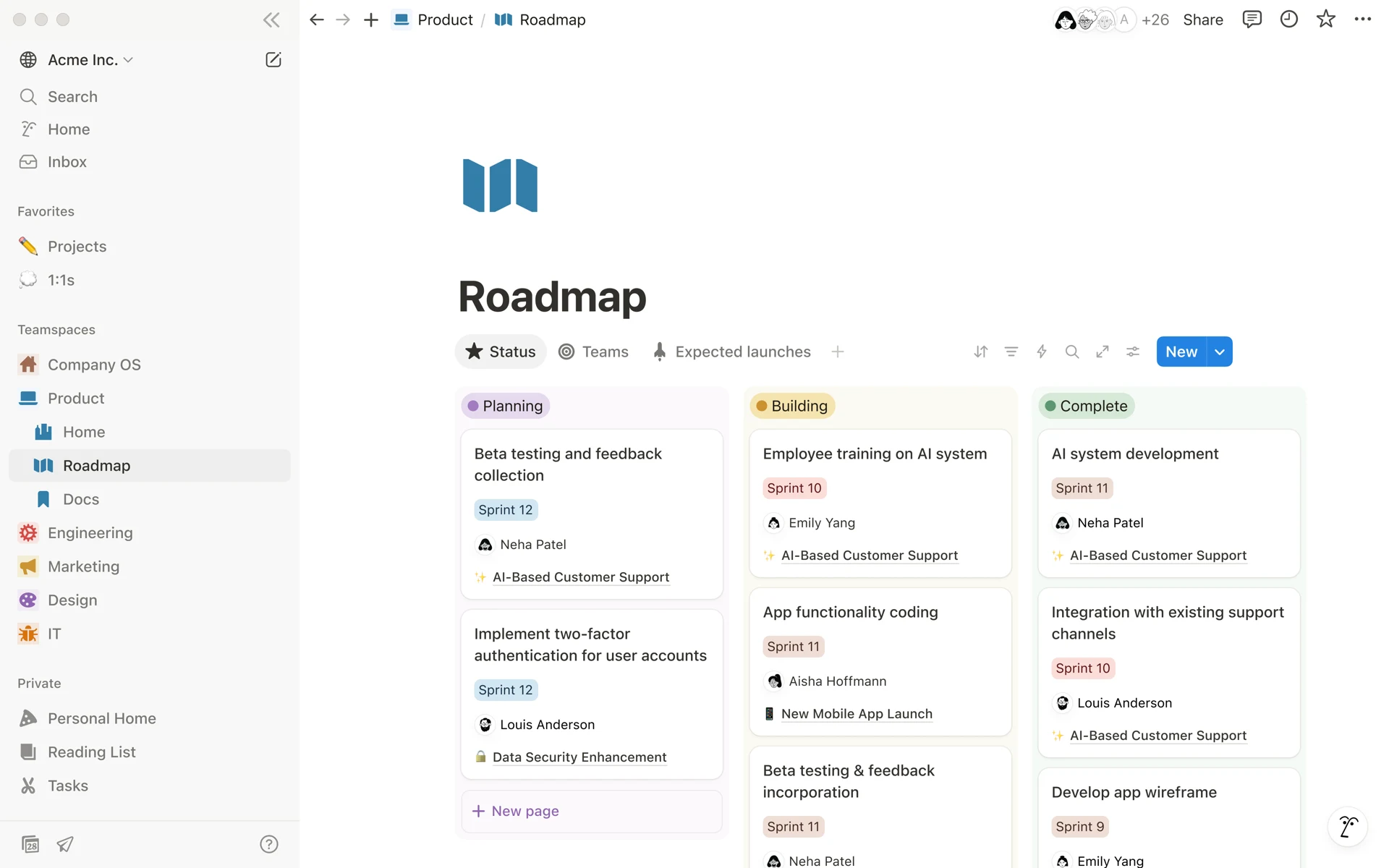
Notion company wiki: a roadmap and shared workspace. Official demonstration.
Notion workspace

Build shared knowledge and project structures.

Keep context near the work it explains.

Ramp

Turn company context into product answers

Notion’s February 2026 release reports over 300 agents at Ramp and dozens of daily Product Oracle questions.

Ramp built Custom Agents including a Product Oracle for everyday product questions.

What changed? +

Repeated questions about product behavior and the roadmap required people to find and explain context.

Agent count and questions describe usage, not a measured cost saving or worker replacement.

GS Group

Group-wide adoption pushed from the top

230 DX staff on one dashboard: a usage figure from Notion, reported in Korean press on 21 September 2025.

The holding company has subscribed since 2020 and every affiliate now uses Notion. The group's DX unit, 52g, runs a workflow dashboard with the work status of 230 DX staff on one page, and GS Engineering & Construction shares material requests, high-risk work and schedule changes in real time and runs a trading community for construction materials, 자이마켓 (Xi Market), in Notion.

What changed? +

At GS Engineering & Construction, work from meal orders for site workers to reports for the CEO was written by hand or entered manually, as the Korea country head described it in October 2025.

Korean press reports from 2025 that cite Notion and GS; they describe how the group adopted and uses the tool.

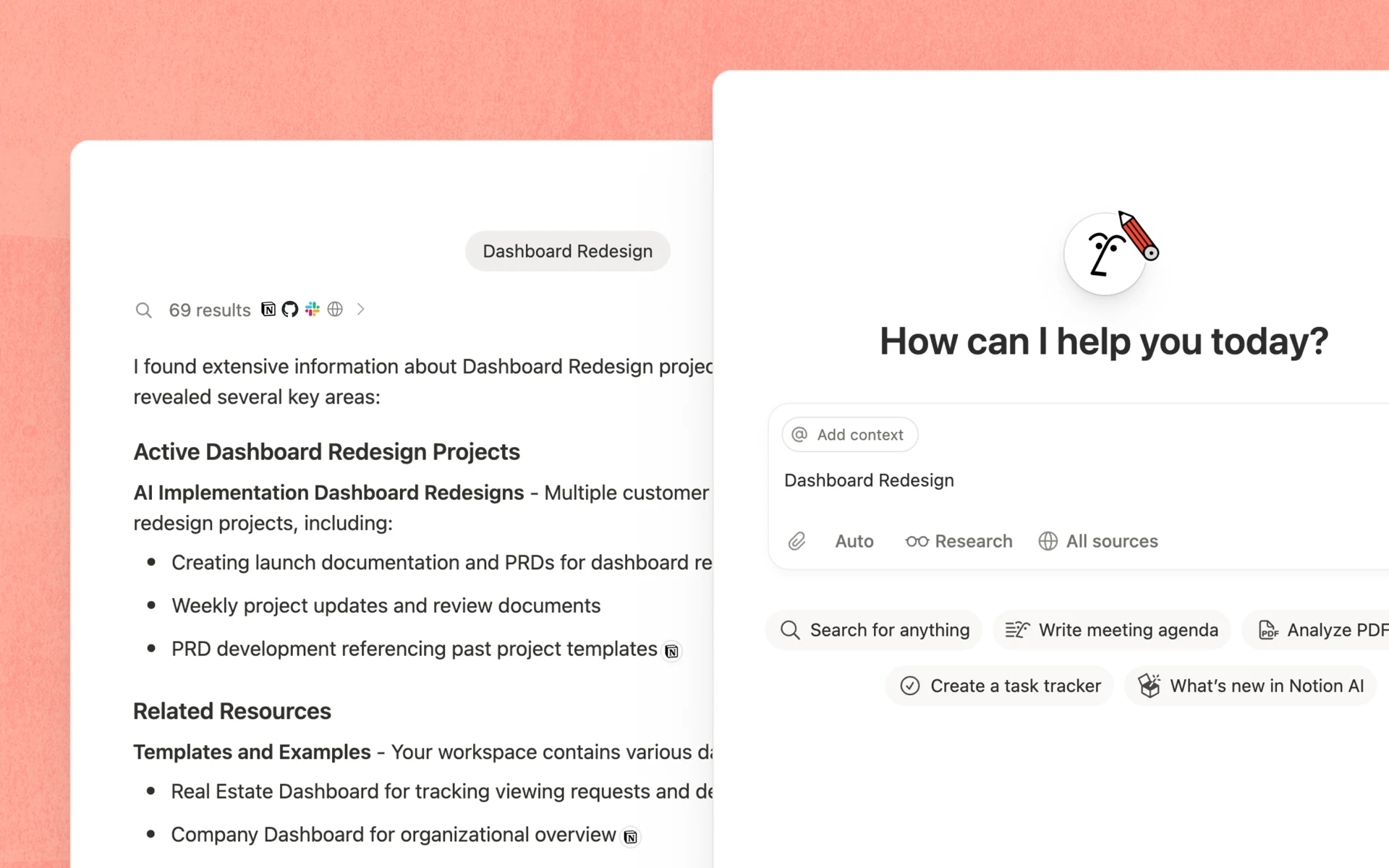
Notion Enterprise Search: a research question answered using connected sources. Official demonstration.
02 / HOW IT BECOMES REAL

From a repeated Slack question to a maintained answer

This illustrative product-knowledge journey follows the published Ramp example and Notion’s Custom Agent controls. It depends on a trustworthy source workspace.

  1. 01

    Give project knowledge a shared structure

    A team defines pages, databases, owners and permissions. The architect decides what Notion owns and where existing systems stay connected.

  2. 02

    Bring the question into the workspace context

    Enterprise Search and connectors retrieve context across tools. An agent should use only the sources and actions its permissions allow.

  3. 03

    Set a trigger for a recurring task

    Custom Agents can answer questions, route tasks or compile updates when triggered. The workflow is shared with the team rather than requiring each person to ask again.

  4. 04

    Review runs, usefulness and cost

    Run logs and usage controls expose what the agent did and consumed. Customer champions refine the instructions and keep source knowledge current.

Follow the work, step by step

Work lives in too many places

Notion starts from a complaint most office workers know: the facts for a decision sit in one tool, the discussion in another and the plan in a third. In 2024 its CEO, Ivan Zhao, described more than 1B people working inside the Microsoft or Google suite, surrounded by software he called too rigid and too uncreative. In December 2025 he named the cost for the AI era: coding keeps its context in one place, while general knowledge work is scattered across dozens of tools. Co-founder Akshay Kothari put the daily version simply: teams spend as much time aligning, updating and routing work as doing it.

The belief behind the company is older than the AI wave. Zhao writes that Notion is built on the 1970s vision that software can "augment human intellect", and that the world needs building blocks for software: a few parts, chiefly pages and databases, that anyone can combine into the tool a team needs. He admits the cost of that choice: in the early years Notion struggled to build a horizontal tool and almost died.

Why agents, and why now

What changed is the material. Zhao describes GPT-4 class models as a new material, like the relational database, and calls the language model the steel beam of organizations: it lets a company grow its output without adding people just to pass information along. Such models still need two things for office work, he argues: context gathered in one place, and output someone can check. A workspace that already holds a team's pages, databases and meeting notes answers the first. Zhao said in March 2026 that Notion had re-architected its core agent layer five or six times; Notion 3.0, in September 2025, rebuilt Notion AI from the ground up as agents.

AI is steel for organizations.

Ivan Zhao · Co-founder and CEO · Essay on the Notion blog · 2025-12-22

One recurring question, followed through the workspace

Take an illustrative case modelled on the published Ramp example: employees keep asking in Slack how a product feature works. First the team organizes product knowledge into pages and databases with owners and permissions, and decides what stays in other systems. Then it connects: Enterprise Search and connectors bring in context from surrounding tools, and an agent may use only the sources its permissions allow. Then it automates: a Custom Agent with a trigger answers the question each time it comes up. Ramp's version, the Product Oracle in Slack, answers dozens of questions a day about its roadmap and features, by Notion's account.

The last step is where people stay in charge. Run logs and the credits dashboard show what an agent did and what it consumed, and someone on the customer side has to keep the source pages current and refine the instructions, because an agent answers from whatever the pages say. That is why Notion's Seoul architect posting talks about permission design, AI evaluation and human-in-the-loop controls, and not only about features.

The time savings in Notion's stories come from Notion and its customers: Remote's 20 hours a week, Heidi's up to 60 hours a month, Ramp's roughly 70% cut in productivity-tool costs. They are chosen by the vendor and partly self-reported. The firmer company figure is about adoption: at the end of 2025 more than 50% of Notion's ARR came from customers using its AI, a share that more than doubled in a year. Carry the savings as the pitch, and the adoption share as the fact.

A Korea hire sells and delivers these steps, not a document editor. The postings ask Solutions Consultants to run discovery as a live build, "the discovery is the demo", and ask the architect to decide where Notion should own, complement or connect to a customer's existing systems. If you enjoy turning a messy process into a clear structure with the customer watching, the work fits.

Understand the products and their customers

One workspace, sold in three layers

Notion sells one workspace in layers. The base is pages and databases that a person or team arranges into wikis, project trackers and documents. Individuals start free; the KRW price display lists Plus at ₩14,000 and Business at ₩30,000 per member per month when paid yearly, with Enterprise by quote. Most money comes from teams: in September 2025 Kothari said about 90% of the business came from "multiplayer usage". The usual path, an analyst report says, runs from one person to their team and then to the company.

The second layer is Notion AI, folded into the Business and Enterprise plans in 2025 at no extra charge. Notion Agent completes multi-step work using context from Notion, connected apps and the web; the company says the Notion 3.0 version can run more than 20 minutes of multi-step actions. AI Meeting Notes captures meetings, and Enterprise Search finds answers across connected tools. Customers can switch the model underneath, and on Enterprise plans no data is stored with the model providers.

The third layer, Custom Agents, is the one the business model now leans on. Anyone who can describe a task can write one; Kothari compares the instructions to describing a job to a new hire. It then runs on a trigger or schedule for the whole team, across Notion, Slack, Calendar, Figma, Linear and custom MCP servers. Usage pricing began on 4 May 2026, with enforcement from each workspace’s next monthly service date; recurring monthly Notion credits cost $10 per 1,000 on top of the seats. Within two months of the beta, users had created more than 1M Custom Agents, a count of agents built rather than agents in daily use.

In May 2026 Notion added a developer layer: Workers that run custom code on Notion's hosted runtime, a command line tool called ntn, and access for outside agents such as Claude Code, Cursor and Codex. Max Schoening, then head of product, described earlier limits on reaching external data and running custom logic. Signet reads this platform as part of why Notion now hires architects and engineers who work inside customer accounts. Current guidance keeps Workers free during beta on Business and Enterprise, describes future credit use; the change applies to Workers, while Custom Agent actions already consume credits.

Who buys it, and what they report

Ramp is the fullest named case. Before, by Notion's account, its work was spread across too many duplicate and legacy tools, and it was hard to know what was true. Ramp moved its work into Notion as the system of record, added AI meeting notes and search, and from mid-2025 built agents; more than 300 now run every day, including the Product Q&A Oracle in Slack. Notion's story says Ramp cut productivity-tool costs by roughly 70% and that teams reported moving about three times faster.

Korea has references of its own. GS Group adopted Notion across its affiliates after its chairman pushed it to speed up digital transformation; its DX unit, 52g, puts the work status of 230 DX staff on one dashboard. JOYCITY, a Korean game developer, moved hundreds of employees off Jira, Confluence and Microsoft tools with MegazoneCloud, a Korean partner that trained staff on site while the old systems ran in parallel. Outside Korea, Notion cites Toyota's Frontier Research Center, which it says cut approval timelines by 3x, and Affirm, which reached 95% adoption for knowledge management.

Reading the case studies like a buyer

Every outcome number in these cases comes from Notion or the customer, chosen for a sales story. The useful pattern is the order of steps: a company first consolidates where its knowledge lives, then adds search and meeting notes, then builds agents on top. Ramp went from that foundation to agents in less than a year, by Notion's account. In Korea the visible pattern is top down: a group chairman at GS, a company-wide move at JOYCITY with a partner doing the training.

A Solutions Consultant in Seoul would repeat this sequence account by account and price it. The postings make the consultant responsible for ensuring that credits sold become credits consumed, which means knowing, before the contract is signed, which workflows justify an always-on agent.

03 / THE EVIDENCE

The story, in numbers.

DATED OBSERVATIONS

Sacra-estimated ARR

USD · M
Sacra-estimated ARR2025: $610M; 2026: $865M$610M2025 year-end$865MJul 2026

Dated analyst ARR estimates. These points measure annual recurring revenue pace, while annual recognized revenue is a separate accounting measure. These are dated disclosures, not a continuous growth record.

Figures, dates & basis +
Sacra-estimated ARR
DateValueBasis
2025$610MSacra year-end estimate.
2026$865MSacra estimate for July 2026, not 2026 full-year revenue.

Sacra

DATED OBSERVATIONS

Financing and tender valuations

USD · B
Financing and tender valuations2021-10-08: $10B; 2026-01-26: $11B$10BOct 2021$11BJan 2026

Different private transactions and valuation bases. These points are not operating revenue or a like-for-like investment return. These are dated disclosures, not a continuous growth record.

Figures, dates & basis +
Financing and tender valuations
DateValueBasis
2021-10-08$10BThe 2021 article prices the round at $10B before the new capital. The tender point prices an employee share sale in 2026.
2026-01-26$11BEmployee tender valuation; shares were bought from employees, not new primary funding.

Forbes · Notion

100M users

Notion passed the user milestone.

Employee tender

Investors purchased about $270M of employee shares at an $11B valuation, rather than new primary capital.

Agent usage pricing

Custom Agents exited beta and usage pricing began.

Read the growth story

Seats, AI and credits

Notion makes money in three layers, and all three appear on its Korean price page. The first is seats: a price per member per month for the Plus, Business and Enterprise plans, while individuals can stay free. The second was once an AI add-on; in 2025 Notion folded AI into the Business and Enterprise plans at no extra charge. The third, since 4 May 2026, is credits: Custom Agents consume Notion credits, priced at $10 per 1,000, on top of the seats. Kothari gave the logic in the company's own post: one person builds an agent and whole teams benefit, so the value scales independently of the number of seats.

Each number has to be read with its measure. In September 2025 Notion told the press it had passed $500M in annualized revenue, a run-rate figure supplied by the company. At the end of 2025, by its own statement, more than 50% of its ARR came from customers using AI, a share that more than doubled in a year; that describes the customer mix, not revenue from AI products. An analyst firm estimates ARR at $610M at the end of 2025 and $865M in July 2026, which it puts 53% above a year earlier. Those are estimates, not company figures.

The dated numbers and what each one measures
DateWhat it measuresValueBasis
Aug 2024Registered usersmore than 100Mcompany-disclosed
Sep 2025Annualized revenue, as the company told the pressmore than $500Mcompany figure, press-reported
Sep 2025Total outside capital raised to date$330Mpress-reported
Dec 2025Employees, and internal agents working alongside themabout 1,000, and more than 700company-disclosed
End 2025Share of ARR from AI-enabled customersmore than 50%company-disclosed
End 2025ARR, analyst estimate$610Mresearch estimate
Jul 2026ARR, analyst estimate (53% above a year earlier)$865Mresearch estimate
Oct 2021Series C round, and its valuation$275M at $10Bpress-reported
Jan 2026Employee share sale (tender), and its valuation$270M at $11Bcompany-disclosed

What has grown, and where

Growth shows most clearly in use. Notion passed 1M users in 2020, just before Covid, and 100M in August 2024; these are user milestones, not counts of monthly active users. About 80% of users are outside the United States, a share the company gave Korean press in 2023 and an analyst repeated for 2025. Paying for AI spread fast: Kothari said that 10% to 20% of customers paid for AI add-ons in 2024, and that the share had crossed 50% by September 2025. In January 2026 the company said its growth over the previous 12 months was happening worldwide, "especially in the Asia-Pacific (APAC) region", the reason it opened an office in Singapore alongside Tokyo, Seoul and Sydney.

The available cash statement is dated. Kothari said in September 2025 that Notion held more cash than the $330M it had raised, and Zhao wrote in June 2026 that the company had been profitable from early in its history. The $11B valuation of January 2026 came from GIC, Sequoia Capital and Index Ventures buying about $270M of shares from current and former employees: a sale of existing shares, not new capital.

Who it competes with, and three risks

The main rivals are the suites most offices already pay for: Zhao counts more than 1B people in the Microsoft or Google suites, and Microsoft introduced Loop, a direct competitor, in November 2021 as part of Microsoft 365 collaboration plans. In AI the picture is tangled: Notion's agents run on models from Anthropic, OpenAI and others, and an analyst report notes that Notion resells Claude and Codex through its credits while competing with them for the same budget. Notion's answer is context: it aims to be the system of record any model or agent draws on. A business news list of private disruptors ranked Notion 10th in May 2026, up from 34th in 2025.

Three risks matter for someone selling Notion in Seoul. First, enterprise selling is a newer muscle: an analyst report says winning large companies requires a new motion of selling into procurement cycles, and the CEO says sales is the function being changed now. Second, the model makers are suppliers and rivals at once, so credit prices and margins move with their costs; Notion cut the cost of running agents by up to 50% in two months. Third, flexibility meets governance: large organizations want standards, and in Notion's own 2026 Korean survey 52.7% of workers said AI output is hard to trust.

In an interview, say "more than $500M in annualized revenue, as the company told the press in September 2025" rather than quoting an analyst's ARR estimate as fact, and keep the $11B valuation apart from funding: it priced a sale of employee shares. If you will sell credits, be ready to explain how a customer forecasts its consumption, because the postings make the seller answerable for credits sold becoming credits consumed.

04 / THE PEOPLE

Someone saw it first.

Photograph of Ivan Zhao.
Co-founder & CEO

Ivan Zhao

Zhao’s retrospective describes Notion’s 2013 start and repeated rebuilding before the 2018 product gained traction.

The choice behind the company +

Zhao and Simon Last went to Japan to rewrite the product after deciding the technology stack was wrong. The commitment remained flexible software building blocks.

▶ Ivan Zhao and Simon Last, in their own words.

“AI is steel for organizations.”

Ivan Zhao · Essay on the Notion blog, Steam, Steel, and Infinite Minds · 2025-12-22
The decisions behind the company

Four rebuilds before the product worked

Ivan Zhao co-founded Notion in 2013 with Simon Last and runs it as CEO. He describes the first five years as a struggle to build a horizontal tool while lacking business experience, which brought the company close to failure. The company rebuilt the product four times in what he calls the lost years. In 2015, by an analyst's account, the two founders laid off their staff, left San Francisco and moved to Kyoto to start again; Zhao's own version is that they had the right product on the wrong technology stack, which is why the main code repository is still called notion-next. Traction came only with the Notion 2.0 launch in 2018.

Three decisions from those years still shape the company. It stayed small: Zhao says Notion found product-market fit in 2019 or early 2020 with fewer than about ten people and became profitable because it was small. It stayed independent: no outside capital since a $275M Series C at a $10B valuation in October 2021, and, Zhao wrote in June 2026, no investors forced onto its first board, because it had been profitable from early on. And it sold late: "In retrospect, I should have started a sales team earlier," he said in a podcast interview, calling his attempt to invent a new kind of product-led growth a mistake.

The fourth decision is the current one: turn Notion AI into agents and charge for the work they do. Akshay Kothari, co-founder, wrote the launch posts for Custom Agents and their pricing, and said in September 2025 that the company was doubling and would likely double its sales team in 2026. Simon Last and Sarah Sachs, head of AI, led the agent work; Last said in April 2026 that the capability had been rebuilt "probably the fourth or fifth time" before it was ready. Rama Katkar, the chief financial officer, signed the January 2026 announcement of the employee share sale.

Who runs product and engineering now

On 24 September 2026 Zhao named Max Schoening chief technology officer. Schoening had led product and design for the previous year and shipped Custom Agents and the Developer Platform; Zhao described him as an engineer by trade. Zhao wrote that Notion refuses to treat engineering and design as separate jobs. Titles at the top move quickly: in October 2025 the CTO who came to Seoul for the Korean launch of Notion 3.0 was Fuzzy Khosrowshahi.

fewer boundaries between disciplines

Ivan Zhao · Co-founder and CEO · Notion blog post naming the new CTO · 2026-09-24

How Notion says it works and hires

The careers page lists four values: customer in every room, own the outcome, why not today, and direct and kind. Notion is an in-person company. Its careers page presents seven locations, Seoul and Tokyo among them, and says staff meet in the office on Mondays, Tuesdays and Thursdays. Zhao frames the culture as a jazz band rather than a marching band: listening, adapting and picking up what the moment needs.

Hiring has changed with the AI push. Zhao describes talent as capability multiplied by taste multiplied by agency, and says the company now optimizes for agency, energy, optimism and curiosity rather than experience. Sales, he says, is the function changing "right now", after engineers and designers two years earlier and go-to-market and marketing about six months earlier. He also says the first interview changed: instead of reading a resume, Notion asks candidates to build something and send a Notion link.

The people a Korea hire would meet

In Korea the business is led by 박대성, appointed country head in June 2023 with charge of the Korean business. He had headed Korean operations for Datadog and Limelight Networks and worked in IBM Korea’s software group. His 2026 interviews discuss selling completed work and data residency. An official February 2026 webinar and May Developer Platform launch show local sales and solutions engineering work. LinkedIn’s Korea filter also shows account executives, business development, Outcomes Architects, support, partnerships and marketing functions.

The record shows founders who still own the main bets, and a sales function that was the last to be rebuilt. For a Korea hire this cuts both ways: the playbook is being written now, so early people shape it, and it can change under them. Zhao also says he believes organizations should be hierarchical, so expect clear reporting lines rather than a flat team.

05 / THE NEXT CHAPTER

Design AI-native workflows for Korean enterprises

The role decides architecture, permissions and integration boundaries, then owns launch, adoption and handoff with engineers where needed.

LOCAL & REGIONAL LEADERSHIP

박대성

General Manager, Korea

Sales, business development and partnerships

Functions observed in profile headlines and official Korea events.

Solutions, Outcomes Architects and support

Functions observed in profile headlines; no inferred staffing count or reporting hierarchy.

Korea marketing and startup programs

Functions observed in Korea profile headlines.

Jazz’s 2026-10-07 LinkedIn Korea filter showed 97 associated profiles, including ambassadors, campus leaders and people with other employers. Groups reflect observed functions and official events, rather than employee counts or reporting relationships.

Why Korea? Why now?+

Notion came to Korea because Korea had already come to Notion. Its country head says users appeared on their own before any official app, from school pupils to executives, and by 2025 several million people in Korea used it; Korean, released in August 2020, was the first language Notion added after English. He says Notion picks its top-tier markets on size and growth, and Korea scored on both: a large self-grown base, high recognition and, in his words, substantial revenue. Since then the company has built the enterprise side that a self-grown base does not supply: a branch in 2022, a country head in June 2023, a reseller for the Enterprise plan in 2024, and in 2026 a Korean data region aimed at companies, especially in finance and the public sector, that rules on data location had held back.

Korean version released

Notion releases Korean as its first language after English.

Korean branch opens

Notion sets up its Korean branch, according to the company's statements to Korean press.

Country head appointed

Notion Labs announces 박대성 as Korea country head, in charge of the whole Korean business.

Enterprise reseller signed

MegazoneCloud signs a reseller agreement to supply the Notion Enterprise plan to Korean companies and to win new Enterprise customers together.

Café Notion Seoul

Notion holds its first offline event in Korea, in Seongsu, for university students and startups, after Berlin, London, Paris and New York.

Notion 3.0 launched in Korea

The chief technology officer and the head of product marketing come from San Francisco for the Seoul press conference on Notion 3.0 and its agents.

Seoul named among APAC offices

The tender announcement says growth is concentrated in the Asia-Pacific region and names regional offices in Tokyo, Seoul and Sydney, plus a new one in Singapore.

Korean data region announced

The official March announcement sets Japan and Korea residency rollout from May 2026, starting with new Enterprise workspaces. Current help lists Seoul and describes requested migration for existing workspaces.

Developer Platform presented in Seoul

The country head and a Korean solutions engineer present the Developer Platform to Korean press in Seongsu.

Korean AI survey published

Notion publishes a survey with 508 Korean respondents on how far Korean organizations have taken AI and how much workers trust it.

Summit talk on workflow change

At a summit at COEX, Notion shows how its own Korea business development team cut a 24 step process to 6 steps.

Understand the Korea opportunity

Korea found Notion before Notion came to Korea

Notion did not arrive in Korea with a plan; the users came first. Its country head says users appeared on their own before the official app, from primary school pupils to executives and religious groups. Notion answered early: in August 2020 it released Korean, its first language after English. By 2025, by his count, several million people in Korea used it, six Korean universities ranked in the world's top 20 by cumulative use, and nowhere else did as many people build portfolios and resumes in it. He calls Seoul one of the cities with the most active Notion users in the world.

market size and growth.

박대성 · Korea country head (한국 지사장) · Interview with Financial News, printed in Korean; English rendering of the published Korean text · 2025-01-05

The reasoning he gives is the one an investor would check: size and growth. Korea had a large base of users who adopted Notion without being sold to, which meant recognition and, in his words, revenue that is already substantial. Signet reads the steps since then as turning that base into paying companies: a Korean branch in 2022, a country head in June 2023, a reseller agreement in August 2024 under which MegazoneCloud sells the Enterprise plan to Korean companies, and in October 2024 Café Notion Seoul, the first Korean offline event, aimed at students and startups.

From community to enterprise accounts

The enterprise push became visible in 2025. When Notion 3.0 launched in Korean in October 2025, the chief technology officer and the head of product marketing came from San Francisco, and Notion named eleven Korean customers, among them GS, Hyosung, Danggeun Market, SOCAR, Kakao Style and LG AI Research; Toss was named in 2026. Notion's own Korean research frames the sales story: in a 2026 survey, 15.7% of Korean organizations were at the advanced stage of AI use against 12.4% across 16 markets, yet 52.7% of Korean workers found AI output hard to trust.

The clearest commitment is infrastructure. Notion’s official 23 March 2026 announcement says Japan and Korea data residency would start in May, first for new Enterprise workspaces, then existing ones. Current help lists Seoul as a region and asks existing Enterprise customers to request migration and receive completion confirmation. The coverage is stored page content, files, search indexes and stored integration content; account information, subprocessors and AI processing have separate scope. The country head ties residency to enterprise buyers with security and storage requirements.

an era of selling work.

박대성 · Korea country head (한국 지사장) · Interview with Yonhap News at the Seoul office, printed in Korean; English rendering of the published Korean text · 2026-03-26

The team on the record, and the five open seats

박대성 leads the Korean business from an office in Gangnam. An official February 2026 webinar shows local sales and solutions engineering, and the Korean launch in May presents the Developer Platform. Notion also sells through MegazoneCloud, which resells the Enterprise plan and implemented Notion at JOYCITY. At a COEX summit in September 2026 the company showed its own Korea business development team as the example: a redesigned workflow cut a 24 step process to 6 steps and the handling time from 100 minutes to 17, about 83% less, by Notion's account.

The five open Seoul postings, all in the sales organization, form one chain from first call to working system. The Business Development Representative (BDR) books meetings through outbound email, calls, LinkedIn and events, and hands over only those that are "ready to build". Three Solutions Consultants, split by customer size and seniority, own their accounts from first meeting to renewal: the Commercial role asks for 1 to 3 years of selling technical products, the Mid-Market role covers companies with 500 to 2,999 employees, and the Enterprise role asks for 8 to 15+ years. The Forward Deployed Architect, on the Services team, leads the most complex multi-workstream engagements in Korea, decides when Forward Deployed Engineers are needed and builds up a Korea Services practice.

The postings went up between April and October 2026. On the board on 7 October 2026 Tokyo listed 15 postings, including managers, Outcomes Architects and a Forward Deployed Engineer, against 5 in Seoul, and Notion says Japan is its second largest country by revenue outside North America. Kothari said in September 2025 that the sales team would likely double in 2026; Signet reads the Seoul postings as the Korean part of that build.

On the worry that Seoul is a satellite, the record points both ways. For: Korea got Notion's first language after English, a branch in 2022, a country head with Korean enterprise software experience, data residency offered with eligibility and migration steps alongside Japan, and launches presented in Seoul, with the chief technology officer present in October 2025. Against: Tokyo carries three times as many open postings, and the revenue rank the company has given in public belongs to Japan.

Whichever seat you look at, the job is the same chain seen from a different point: find the company that is ready to rebuild a workflow, prove it live in Notion, price it in seats and credits, and make sure the agents keep running after the contract. Four of the five postings ask for both Korean and English, and the office expects you in three days a week.


KOREA OPEN ROLES

5 open roles in Korea

Current Signet catalog · 2026-10-19

FOR YOU

Compare the five responsibilities and each posting’s required conditions.

GTM · Sales · BD

Business Development Representative

Seoul, South Korea (Hybrid)

Posting checked

The work
Identify prospective customers, qualify their workflow needs and book initial decision-maker meetings.
Who fits
Fluent Korean and business-level English.
Keep in mind
Hand off customer fit, needs, workflow hypotheses and stakeholder context through Salesforce.
Solutions Engineer

Commercial Solutions Consultant

Seoul, South Korea (Hybrid)

Posting checked

The work
Co-build AI workflows with customers and own opportunities through close, adoption, expansion and renewal.
Who fits
1-3 years selling technical products to technical buyers.
Keep in mind
Navigate procurement, legal and security reviews, and demo and troubleshoot live with customers.
Solutions Engineer

Enterprise Solutions Consultant

Seoul, South Korea (Hybrid)

Posting checked

The work
Co-build AI workflows with customers and own opportunities through close, adoption, expansion and renewal.
Who fits
8-15+ years of full-cycle, quota-carrying enterprise software sales and large complex deal success.
Keep in mind
Keep ownership of relationships, commercial outcomes and credits consumed while partnering on adoption, expansion and renewal.
See all 5 roles
Solutions Engineer

Forward Deployed Architect

Seoul, South Korea (Hybrid)

Posting checked

The work
Lead complex Korea AI-workflow implementations from scope to handoff.
Who fits
5+ years in technical services, consulting, solutions architecture, implementation, customer engineering or similar customer-facing work.
Keep in mind
Design permissions, AI evaluation and human review; bring in engineers for code-intensive work.
Solutions Engineer

Mid-Market Solutions Consultant

Seoul, South Korea (Hybrid)

Posting checked

The work
Co-build AI workflows with customers and own opportunities through close, adoption, expansion and renewal.
Who fits
Technical sales to technical buyers in mid-market organizations with 500-2,999 employees.
Keep in mind
Partner with Outcomes Architects on adoption, expansion and renewal while owning the commercial relationship.
07 / NOW & NEXT

The next scene is taking shape.

Tender confirms AI-led expansion

Notion disclosed that more than half of year-end 2025 ARR came from AI-enabled customers.

Custom Agents launch

Shared agents introduced triggers for recurring questions, routing and updates.

Beta ends and credits begin

Notion reported over one million agents created and activated usage pricing.

More context on what comes next

Agents became the product, and then the price

Read against the bet, the past twelve months have three threads. The first is commercial. Notion rebuilt its AI as agents in September 2025, launched Custom Agents in February 2026, began charging credits for them on 4 May 2026 and opened a Developer Platform nine days later. Users had built more than 1M Custom Agents by May. Whether credits grow into a second revenue line beside seats is the number to watch.

A company organizing for its next size

The second thread is governance. In January 2026 investors bought about $270M of employee shares at an $11B valuation; in June the company named its first board of directors; in September Max Schoening became chief technology officer. The CEO's December 2025 essay set the direction for all of it: the world is still in the "swap out the waterwheel" phase, with AI chatbots bolted onto existing tools, and companies need to stop asking AI to be merely their copilots.

Korea, and what to watch next

The third thread is Korea and enterprise controls. The official March announcement set Korea and Japan residency rollout from May 2026, first for new Enterprise workspaces; current help describes eligibility and migration for existing ones. In September, workspace owners gained separate model controls for Notion Agent and Custom Agents on Business and Enterprise. Workers remain in a free beta as of this review and are expected to use credits later. Korean launch events and survey findings make these governance and cost boundaries part of the local sales discussion.

  • How Enterprise customers configure Korea residency and complete workspace migration, with data at rest and AI processing read as separate scopes.
  • Whether the sales team doubling that Kothari forecast for 2026 shows up as more Seoul postings; on 7 October 2026 Tokyo listed 15 and Seoul 5.
  • Whether credits grow into a second revenue line beside seats, and how Notion prices agent work as the cost of the underlying models keeps falling.

These threads set the subject matter of an interview: agents priced by the work they do, enterprise governance, and where data is stored. A candidate who can discuss all three with a Korean example will sound like someone already doing the job.

Their future. Your next chapter.

Find your part ↑

An independent profile by Signet. No affiliation or investment recommendation. Introductions happen only with your consent.
Research reviewed 2026-10-08

A LITTLE MORE CONTEXT

Understanding Notion.

What does Notion do?

A team’s project history often sits apart from the conversation where decisions happen. Notion puts knowledge, projects and AI together so recurring questions and updates can draw on shared context.

What is the opportunity in Korea?

The role decides architecture, permissions and integration boundaries, then owns launch, adoption and handoff with engineers where needed.

Are these confirmed job openings?

Employer postings were checked on 2026-10-08. Availability can change. Mock applications request a review from Signet.

How can I explore the company in more depth?

Follow the company from its vision through products, evidence and people to the Korea team and current roles. Use the table of contents to move within the page, and expand the sections for more context.

Back to the collection ↗