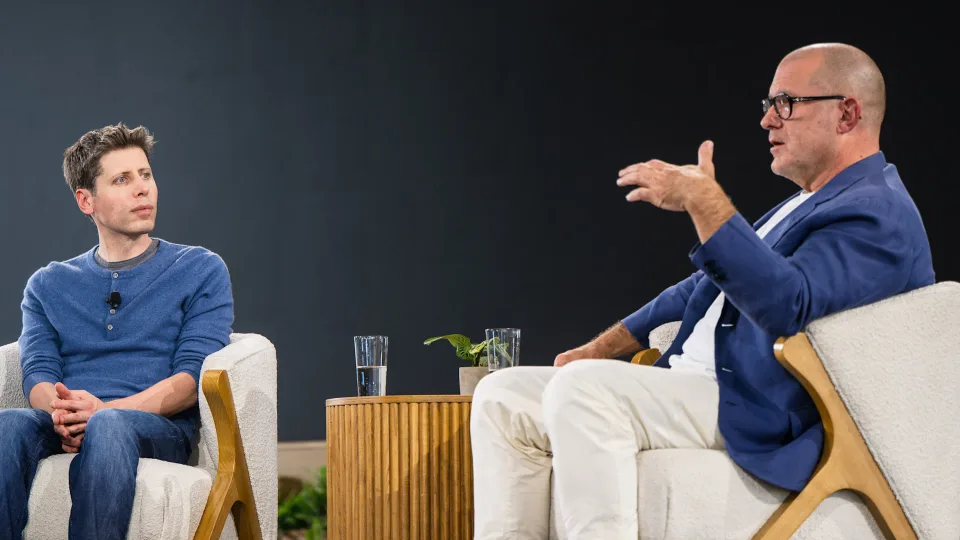
Sam Altman and Jony Ive in conversation at OpenAI DevDay
OpenAI / THE WORLD THEY ARE BUILDING

When intelligence becomes infrastructure.

The next step is continuous work across tools and organizational context. Useful deployment needs evaluations, security boundaries and people who own the resulting workflow.

See it taking shape ↓
01 / THE PRODUCTS

The products behind the promise.

ChatGPT Enterprise: connected-data analysis and a generated dashboard.
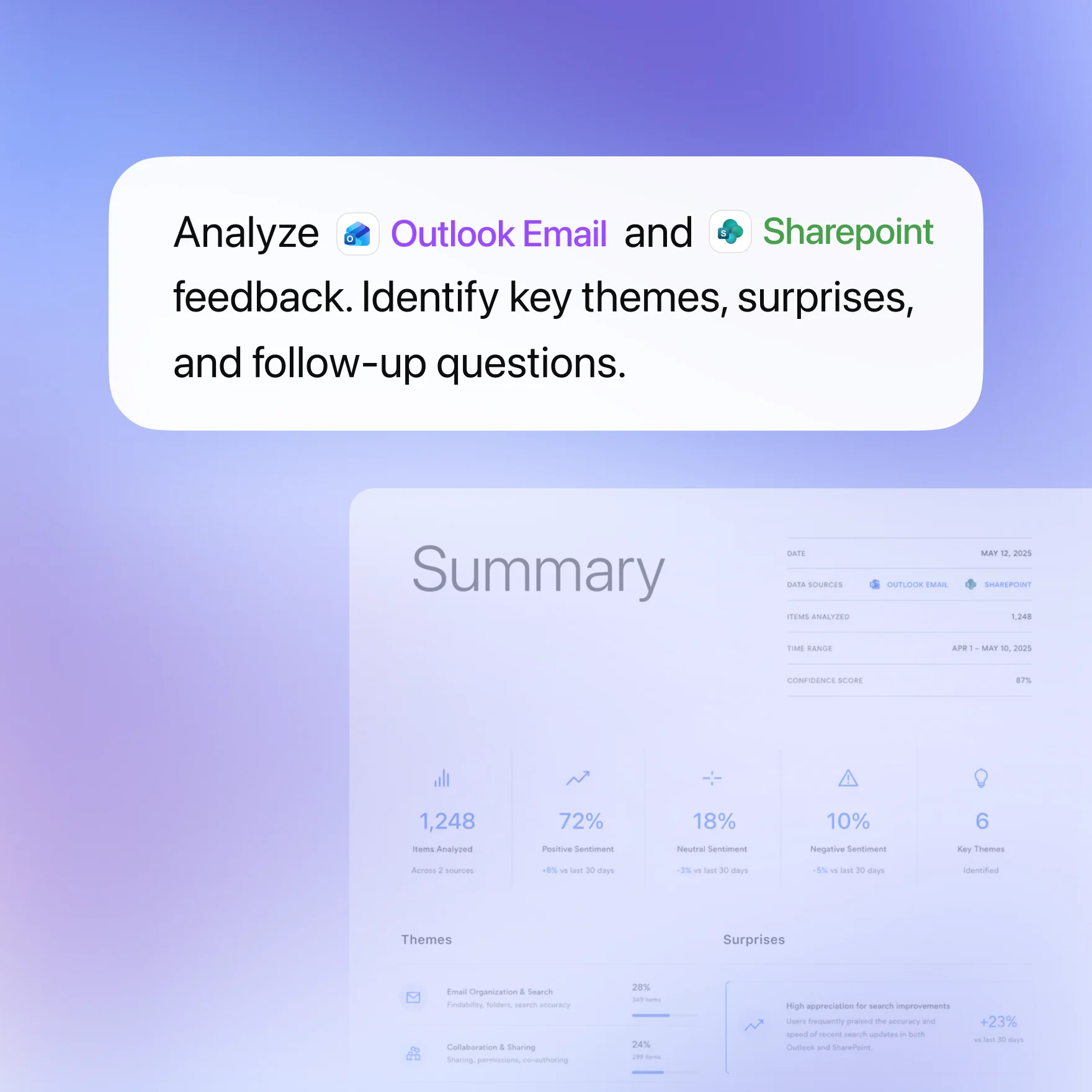
Official ChatGPT Enterprise page graphic showing connected-data analysis and a generated summary (illustrative data).
ChatGPT Enterprise

Support research, analysis and drafting under enterprise access and security controls.

Give technical and non-technical teams a common starting point for AI work.

Morgan Stanley Wealth Management

Deploy an evaluated knowledge assistant

The official case reports over 98% of advisor teams actively using the Assistant.

The firm embedded GPT-4 in an internal Assistant and used Whisper/GPT-4 for Debrief summaries with consent and advisor review.

What changed? +

Financial advisors need dependable internal information and accurate records after client meetings.

Adoption is limited to the named advisor-team scope; it is not a whole-company productivity or investment-performance result.

Samsung Electronics

Broaden employee access in Korea and DX

Deployment confirmed, with planned use across research, manufacturing, marketing and office work.

The June 2026 announcement makes ChatGPT Enterprise and Codex available to all employees in Korea and all worldwide DX employees.

What changed? +

The agreement expands a relationship previously involving AI infrastructure into employee workflows.

Availability does not prove every eligible employee is active. The global scope specifically covers DX, not every Samsung division worldwide.

OpenAI marketing graphic for ChatGPT Enterprise: a prompt asking for themes and follow-up questions from email and SharePoint feedback, above a faded summary panel.
OpenAI's own marketing graphic for ChatGPT Enterprise. The data shown inside it is illustrative and is not a customer's result.
02 / HOW IT BECOMES REAL

From a customer meeting to an approved follow-up

This journey follows Morgan Stanley’s published Assistant and Debrief example. It shows one specific use of OpenAI models rather than promising that every organization already has an autonomous agent.

  1. 01

    Retrieve the firm’s knowledge

    An advisor uses the internal Assistant to locate information from the firm’s knowledge base. Evaluation questions test whether retrieval and answers meet professional standards.

  2. 02

    Use meeting material with consent

    Debrief turns Zoom recordings into meeting outputs with client consent. Adoption includes the recording process and operating controls, not just choosing a model.

  3. 03

    Extract notes and action items

    Whisper and GPT-4 power summaries, CRM-integrated client notes and draft follow-ups. The team evaluates different meeting types for missed or incorrect actions.

  4. 04

    Refine the message before sending

    The advisor reviews and refines follow-ups. A regression evaluation suite helps the implementation team detect quality changes in the service.

Follow the work, step by step

A charter, then release in public steps

OpenAI began in December 2015 as a non-profit research company. Its founding post said the goal was to advance digital intelligence in the way most likely to benefit humanity as a whole. The Charter names the target: artificial general intelligence, or AGI, meaning highly autonomous systems that outperform humans at most economically valuable work. It commits the company to use any influence over AGI's deployment for the benefit of all and to avoid uses that unduly concentrate power.

What sets OpenAI apart from a lab that publishes and waits is how it releases, which Altman calls iterative deployment. The company's plan page adds the other half: AI should be available to everyone to use as much as they need.

So part of the reason that we deploy the way we do, we call it iterative deployment, rather than go build in secret until we got all the way to GPT-5, we decided to talk about GPT-1, 2, 3, and 4. And part of the reason there is I think AI and surprise don't go together.

Sam Altman · CEO, OpenAI · Lex Fridman Podcast #419 (timestamp 01:04:22; episode published 2024-03-18) · 2024-03-18

What Altman expected five years ahead

In a March 2025 interview, Altman was asked what would be worth more five years later: a destination with a billion daily users or the state-of-the-art model. He expected the billion-user site to be worth more, describing a future in which AGI would be cheap and widespread. He also identified frontier research and model capability as an important source of value in the same discussion. This was a forecast about future asset value. Separately, OpenAI’s CFO calls computing capacity the scarcest resource in AI and describes securing it years in advance.

Why now has two parts. The first is scale. Altman says scaling laws meant the lab needed far more capital and a structure to raise it. The company's figures show the result: compute capacity grew from about 0.2 gigawatts in 2023 to about 1.9 in 2025, and annualized recurring revenue (ARR: a recent pace of recurring income stated as a yearly figure, general background) rose from $2B to more than $20B, both company-reported. The second part is what the CFO calls practical adoption. Her January 2026 post set the 2026 priority as closing the gap between what AI now makes possible and how people, companies and countries use it day to day.

A customer meeting, step by step

The clearest published picture of this in daily work is Morgan Stanley's wealth management business, in an OpenAI customer story that describes the GPT-4 generation of models. An advisor prepares for a call by asking an internal assistant that answers from the firm's own knowledge base, which the firm tested against evaluation questions before rollout. With the client's consent the call is recorded on Zoom. Afterwards a tool called Debrief uses Whisper and GPT-4 to turn the recording into client notes and a draft follow-up. The advisor reads, edits and sends the message, and a regression suite of repeat tests tells the implementation team if quality shifts later.

Two points matter more than the model names. A person decides at each hand-off: the advisor judges the answer, the client consents, the advisor approves the message and a quality owner watches for drift. And the results are the customer's own figures as presented in OpenAI's story, not an independent measurement, with limits that chapter 02 sets out.

Seoul faces the same hand-offs. In September 2026 the General Manager of OpenAI Korea said organisations are now entering an era in which AI can be trusted with more difficult tasks, where before work given to AI needed heavy human review. The seven open Seoul roles split those hand-offs between them: the account directors find and grow the customers, the applied AI architect, the applied AI engineer and the forward deployed engineer design and build the deployments, the consumer marketing lead grows everyday use, and the strategy and operations lead sets the KPIs and resource rhythm that let deployments like this repeat across Korean customers. That is Signet's reading of the postings, not an OpenAI statement.

Understand the products and their customers

Three products, three different buyers

OpenAI sells three products to organisations, with the consumer ChatGPT app behind them. In March 2026 the company said ChatGPT had more than 900 million weekly active users and over 50 million subscribers, both company-reported. Each product has a different buyer and a different rival.

ChatGPT Enterprise is the version a company buys for its staff. Inside it, ChatGPT Work is the company's new enterprise agent. It plans a task, takes actions across the company's apps and files and produces finished materials, using the tools, files and team processes the company has approved. Administrators decide who can use agents, connected tools and actions, and OpenAI says business data is not used to train its models by default. In Korea the product reaches buyers directly and through channel partners. Samsung SDS and LG CNS act as official resellers, while KT chose a separate strategic partnership model, according to press coverage of an April 2026 event.

The API lets a company's developers build OpenAI models into their own software. OpenAI said in March 2026 that its APIs process more than 15 billion tokens per minute, a company-reported rate at that date. Kakao's February 2025 announcement is the Korean example, with ChatGPT technology to be embedded in its services. The buyer is an engineering or product team, not an employee.

Codex is a coding agent. An engineer hands it a task in a code repository and checks the changes, logs and tests it returns. OpenAI's March 2026 release said Codex had over 2 million weekly users, up fivefold in three months. The Samsung announcement cites more than 5 million. Both are company-reported. Korea is where the company shows wider use: in May 2026 it said more than half of Codex requests in Korea came from non-development work such as writing, analysis, research and operations. The rival the press names is Anthropic's Claude Code. In July 2026 OpenAI's board chair, an interested party, said some customers who ran up very high Claude Code bills started looking for an alternative.

An engineer between product and customer

Between product and customer sits a role that appears on the Seoul list, the forward deployed engineer (FDE). OpenAI describes FDEs as engineers who lead complex deployments of its models in production alongside its most strategic customers, embed with customer teams and pass field feedback to Research and Product. The Seoul posting expects about 50% travel. OpenAI Korea put forward deployed engineering next to Codex and workspace agents at its first Exec Summit in May 2026.

What customers report, and its limits

The customer story with the most detail is Morgan Stanley's, and its limits matter. Before, the firm's assistant could answer 7,000 questions and document access stood at 20%. Afterwards it could answer questions across a corpus of 100,000 documents, access rose to 80% and over 98% of advisor teams used it. All of this is customer-reported, on an OpenAI page about a GPT-4 era deployment. It is scoped to advisor teams and is not an investment result.

Samsung Electronics made ChatGPT Enterprise and Codex available to all employees in Korea and all Device eXperience (DX) staff worldwide. Seoul National University gave ChatGPT Edu to faculty, students and staff from June 2026, and OpenAI Korea said in September that nearly 50,000 students and faculty use ChatGPT and Codex. Musinsa's CTO said Codex improved development speed and productivity.

Korea's customer evidence shows breadth and growth. Access (Samsung, Seoul National University) and usage growth (about 28-fold more ChatGPT Enterprise users at Korean organisations in a year, company-reported) are public. A candidate who can say which measure would persuade a Korean company to widen a deployment is answering a question the Seoul team is likely to face.

03 / THE EVIDENCE

The story, in numbers.

DATED OBSERVATIONS

Reported annual revenue

USD · B

Fortune relays FT reporting; separate from ARR.

Figures, dates & basis +
Reported annual revenue
DateValueBasis
2024$3.7BReported financials.
2025$13.07BReported financials.

Fortune

DATED OBSERVATIONS

Funding-round valuation

USD · B
Funding-round valuation2024-10-02: $157B; 2025-03-31: $300B; 2026-03-31: $852B$157BOct 2024$300BMar 2025$852BMar 2026

Private transaction prices at dated funding events, not revenue or a continuously quoted stock price. These are dated disclosures, not a continuous growth record.

Figures, dates & basis +
Funding-round valuation
DateValueBasis
2024-10-02$157BPost-money valuation in the funding announcement.
2025-03-31$300BPost-money valuation in the announced funding.
2026-03-31$852BPost-money valuation; committed capital is reported separately.

OpenAI

Updated corporate structure

The Foundation retained control of the Group under the announced structure.

CFO publishes growth basis

The account labels revenue scale $2B ARR for 2023, $6B for 2024 and $20B+ for 2025. These are the source’s ARR figures.

Committed funding

The round closed with $122B in committed capital at $852B post-money valuation; commitment is not identical to all cash received.

Read the growth story

Four groups pay, advertisers newest

OpenAI is paid by four groups. Consumers buy ChatGPT subscriptions. Organisations buy workplace subscriptions, and the company added usage-based pricing so that cost scales with the real work done. Developers pay to build the models into their own products. Advertisers are the newest group: an ads pilot passed $100 million in ARR in under six weeks, the company said in March 2026, and in September 2026 the ad business hit a billion dollars in seven months, in the CFO's words. The January 2026 post also says licensing, intellectual property agreements and outcome-based pricing will share in the value created. That is a plan, not a revenue line today.

Eight numbers, each for what it measures
NumberWhat it measuresPeriodBasis
$20B+Annualized recurring revenue (ARR)2025Company-reported
$13.07BRevenue recognized in the yearCalendar 2025Press-reported, relaying a leak first reported by other outlets
$20.92BOperating loss, reported with $34B of total costs and expensesCalendar 2025Press-reported, from the same leak
$2B a monthMonthly revenueMarch 2026Company-reported
$40BAnnualized revenue run rateAugust 2026Press-reported
$852BPost-money valuation after the roundMarch 2026Company-reported
$122BCommitted capital in the round, not cash receivedMarch 2026Company-reported
About $600BTotal compute spend target through 2030, against earlier talk of $1.4 trillion in commitmentsReported February 2026Press-reported from unnamed sources

Read these as different numbers. ARR and run rate take a recent pace and state it as a yearly figure, so in a fast-growing year they sit above revenue actually recognized (general background). The company's $20B+ ARR for 2025 sits beside $13.07B of revenue recognized in 2025, a figure the press relayed from leaked financial statements. The same leak shows $34B of costs and a $20.92B operating loss for 2025, and the press separately reported about $8B of cash burned against a $9B target. Monthly revenue of $2B in March 2026 and a $40B run rate in August 2026 show the pace since. Valuation is a private price set at a funding event. The $122B of committed capital is a promise from investors and not cash on hand. None of these can stand in for another.

Enterprise pulls ahead, compute sets the cost

The mix is changing. In March 2026 the company said enterprise was more than 40% of revenue and on track to match consumer by the end of 2026. By August the CFO told investors that the lines had crossed and enterprise was the majority. The cost side is compute. OpenAI said its capacity grew from about 0.2 gigawatts in 2023 to about 1.9 in 2025, and the press reported in February 2026 that investors were told to expect about $600B of compute spend through 2030. A 2030 revenue forecast of more than $280B came in the same report. That is a forecast, not a result.

We entered the year at 60-40, but enterprise has accelerated much faster than expected and those lines have now crossed.

Sarah Friar · CFO, OpenAI · To investors, as reported by CNBC · 2026-08-14

Rivals close enough to compare

The nearest comparison is Anthropic. Anthropic said in May 2026 that its revenue run rate had topped $47B, and the press reported it earned roughly $10B across all of 2025. OpenAI's $40B run rate was reported in August, so the months differ, and each company defines run rate for itself. The two figures are not a like-for-like score. In July 2026 the CFO told staff that annualized recurring revenue in that month exceeded the whole second quarter, and the report named GPT-5.6, ChatGPT Work and Codex as drivers. Other pressure comes from open-weight models. The CFO said customers raise them, many of them Chinese, and one Chinese lab claims its Kimi K3 beats OpenAI and Anthropic systems on some benchmarks. Altman says he is confident the market will not be winner take all. The press also names Google among OpenAI's rivals.

Three risks

  • Compute costs. The largest cost is also the scarcest input, and 2025 closed with a reported $20.92B operating loss on $13.07B of recognized revenue.
  • Rivals and cheaper models. Anthropic's run-rate claim, open-weight models and customer questions about where data is held all test the idea that a good model keeps a customer.
  • Governance and continuity. A Foundation controls the company, and two senior executives left within days of each other in August 2026.
04 / THE PEOPLE

Someone saw it first.

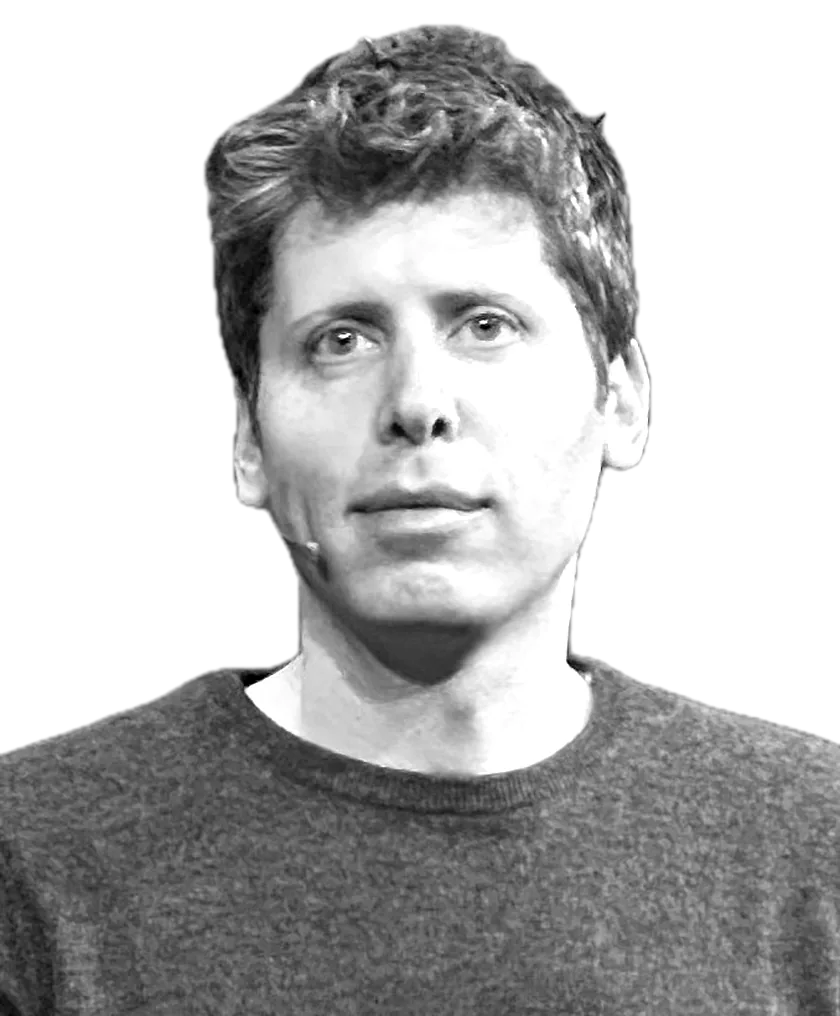
Photograph of Sam Altman.
CEO; founding co-chair

Sam Altman

The 2015 launch named Altman as a co-chair of the nonprofit research organization. The current structure page identifies him as CEO and a Foundation board member.

The choice behind the company +

The organization moved into commercial research and deployment while keeping Foundation control over the Group. This is a governance record rather than a personal quote.

Photograph of Sarah Friar.
CFO

Sarah Friar

Friar authored the January 2026 explanation connecting compute capacity, product adoption and revenue.

The choice behind the company +

Her operating account favors diversified compute providers and capacity commitments tied to demand. The stated aim is practical adoption in 2026.

“My favorite historical analog is the transistor for what AGI is going to be like. There's going to be a lot of it, it's going to diffuse into everything, it's going to be cheap, it's an emerging property of physics and it on its own will not be a differentiator.”

Sam Altman · Stratechery interview with Ben Thompson, in answer to a follow-up on whether a billion-user destination or the state-of-the-art model is worth more · 2025-03-20
The decisions behind the company

From research lab to company

Sam Altman is OpenAI's CEO. The 2015 launch named him a co-chair of the non-profit, and the current structure page lists him as CEO and a member of the OpenAI Foundation's board. Two of his statements explain the company's shape. In March 2025 he described how the plan was to publish research, with no product, no revenue and no business model. Then the team found that scaling needed far more money and a structure to raise it, and launching GPT-3 in the API told them they had to offer products. In an earlier long interview he called the 2023 board episode a perfect storm of weirdness and a preview of what happens as the stakes rise.

We literally had no idea we were ever going to become a company.

Sam Altman · CEO, OpenAI · Stratechery interview with Ben Thompson · 2025-03-20

The decision that followed shapes what an employee deals with today. In October 2025 the non-profit became the OpenAI Foundation and the for-profit became a public benefit corporation, OpenAI Group PBC. The Foundation continues to control the Group, and it holds a 26% equity stake that the company said was worth approximately $130B at the recapitalization announced on 2025-10-28. The Foundation's board has ten independent directors, chaired by Bret Taylor, plus Altman. Operating scale and formal control sit in different bodies: the Group runs the business and the Foundation holds control.

The CFO who explains the money

Sarah Friar, the CFO, is the person who explains the money. She is credited with the January 2026 post that connects compute, adoption and revenue, and in August 2026 she told investors that enterprise had overtaken consumer in revenue. Her operating view is plain: compute is the scarcest resource, and securing it takes commitments made years in advance. Her August message arrived in the same week as two senior departures. The revenue chief, Denise Dresser, stepped down eight months into the job. Brad Lightcap, an executive of eight years, said he was leaving to start something new.

Who leads Korea, and who sits above

Three more names matter for a Seoul role. Kim Kyoung-hoon is the General Manager of OpenAI Korea, named its first head on 2025-09-29. He ran Google Korea from 2021 until earlier in 2025 and grew its advertising business. Before that he was Google's head of strategy and operations for marketing solutions in Asia Pacific, and he earlier worked at Bain & Company's Seoul office. He holds a computer engineering degree from Seoul National University and an MBA from Duke. Oliver Jay, head of international, welcomed the appointment. Kiran Mani was reported in March 2026 as OpenAI's new managing director for Asia Pacific, moving to Singapore and, according to unnamed sources, reporting to Chief Strategy Officer Jason Kwon. Kwon announced the Seoul office in May 2025 and returned for the Korea Exec Summit in 2026.

Kim told a Korean newspaper after his first press conference that he joined because OpenAI is a startup at the front of the AI market where more can be done, closer to headquarters. At the same conference he said OpenAI is still a startup. The first statement is the pitch. The second sets expectations for a reader asking how large and settled the Korea office is.

Written values and a long final interview

The company publishes how it wants people to work. Its Charter lists four principles: broadly distributed benefits, long-term safety, technical leadership and a cooperative orientation. Its careers page names four values, humanity first, act with humility, feel the AGI and ship joy, and four operating principles: find a way, creativity over control, update quickly and intense focus. On hiring, the interview guide says OpenAI is not credential-driven and wants to understand a candidate's unique background. Final interviews typically run four to six hours with four to six people over one to two days, and a recruiter may ask for references at the decision stage that follows.

05 / THE NEXT CHAPTER

Help Korea adopt OpenAI, from the first sale to daily use

Seven Seoul roles are open: two account directors who own consumption revenue targets, an applied AI architect, an applied AI engineer and a forward deployed engineer who design and build with customers, a consumer marketing lead, and a strategy and operations lead who reports to the Korea GM. Six of the seven postings ask for three office days a week.

LOCAL & REGIONAL LEADERSHIP

김경훈

General Manager, OpenAI Korea

Engineering profiles
  • LinkedIn functional category
Business development profiles
  • LinkedIn functional category
Sales profiles
  • LinkedIn functional category

Read at human speed on 6 October 2026 with LinkedIn’s South Korea filter: 57 associated profiles. LinkedIn also showed Education 11 and Research 9. These are profile and category counts; categories can overlap. Individual titles are self-described. The Korean leader is verified separately in press reporting.

Why Korea? Why now?+

The sources support three reasons, and Signet reads them together. Demand: at the Seoul launch in May 2025 OpenAI said Korea had the second-highest number of paid ChatGPT subscribers after the United States, that weekly users had grown more than fourfold in a year, and that Korea ranked in the top five countries for ChatGPT business users. A Korean analyst told the press the ranking was real but needed context. Supply: Samsung Electronics and SK hynix plan to scale advanced memory production toward 900,000 DRAM wafer starts a month between them, and OpenAI signed agreements to explore AI data centres in Korea with the Ministry of Science and ICT. In December 2025 Kim described the Stargate projects with Samsung and SK as at a very early or planning stage. Customers: large Korean companies and a major university already use the products. Signet's reading: Korea is both a market and an input to OpenAI's own infrastructure, which fits the economic blueprint for Korea that OpenAI published in October 2025.

Kakao partnership announced

Kakao said ChatGPT technology would be embedded in its services, including Kanana, with technology sharing and co-development of AI products for its 50 million users. The partnership predates the Seoul office.

Korean entity registered

OpenAI registered a Korean limited company with capital of 100 million won. The press report names an American as its representative director, a different person from the General Manager named in September.

Seoul office announced

Chief Strategy Officer Jason Kwon announced the office at a press event in Seoul. The press describes it as the company's third major base in Asia after Tokyo and Singapore. OpenAI said Korea ranked second for paid ChatGPT subscribers.

Kim Kyoung-hoon named first head

OpenAI named the former head of Google Korea, who ran it from 2021 until earlier in 2025, as the first head of OpenAI Korea. Oliver Jay, head of international, welcomed the appointment.

Samsung and SK join Stargate

OpenAI announced strategic partnerships with Samsung and SK, including initial agreements on advanced memory supply, and a memorandum of understanding with the Ministry of Science and ICT to evaluate AI data centres, around Altman's October 2025 Seoul visit. OpenAI's Korea blueprint dates this first country-level partnership in APAC to October 1.

First press conference

Kim said OpenAI Korea concentrates on business customers, that research stays together at headquarters, and that ChatGPT daily messages in Korea reached 2.63 billion in June 2025, up from 450 million a year earlier (company-reported).

Musinsa Codex event in Seoul

OpenAI and Musinsa held an event in Seongsu-dong on Musinsa's use of Codex. The caption of an OpenAI-provided photo names three OpenAI Korea staff.

First Korea Exec Summit

About 130 business and technology executives attended. OpenAI's Chief Strategy Officer and its vice president of enterprise travelled for it. The event date is read from the report's phrase 'Wednesday' in a piece published on 2026-05-29.

Seoul National University adopts ChatGPT Edu

The university said all faculty, students and staff would have access to ChatGPT Edu from June 2026, with complementary tools such as Codex planned.

Game Builders Seoul announced

OpenAI named 12 Korean game developers as mentors for a Codex game-development hackathon on 2026-08-31, which the report calls the first of its kind in the world.

First anniversary scorecard

OpenAI Korea reported about 28-fold growth in ChatGPT Enterprise users at Korean organisations over a year, and that Work and Codex made up 64% of output tokens generated by Korean users across ChatGPT products in August (company-reported).

Understand the Korea opportunity

Three reasons OpenAI came to Korea

OpenAI's stated reasons for Korea fall into three strands, and the sources let a reader test each. Demand: at the Seoul launch in May 2025 the company said Korea had the second-highest number of paid ChatGPT subscribers after the United States, and ranked in the top five countries for ChatGPT business users. A Korean analyst told the press the ranking was real but needed context. These are company statements, not independent data. Supply: Samsung Electronics and SK hynix plan to scale memory production toward 900,000 DRAM wafer starts a month between them, and OpenAI signed agreements with the Ministry of Science and ICT to explore AI data centres in Korea. Customers: large Korean companies and a major university already use the products.

Research at headquarters, customers in Seoul

What the Korean organisation does is narrower than the demand suggests. At his first press conference Kim said OpenAI Korea concentrates on business customers and that the research-led technology organisation is kept together in one place. The Korean entity's role in running ChatGPT itself is limited because the service is run from headquarters and he named a long-term aim of hiring local technology developers. On influence over product his answer was modest: Korea asks to test new features and headquarters projects first, and many of those requests are accepted. Korea can still start things. In August 2026 OpenAI announced Game Builders Seoul, which the report calls the first hackathon in the world built around Codex game development.

OpenAI Korea concentrates on B2B, meaning sales to companies and other organisations, in Korea.

Kim Kyoung-hoon · General Manager, OpenAI Korea · First press conference after taking office, as reported by ETNews (Korean original, translated by Signet) · 2025-12-04Signet interpretation

Korean customers, by name

The enterprise motion shows in named cases. Samsung Electronics has ChatGPT Enterprise and Codex available to all its employees in Korea. Seoul National University, Kakao and Musinsa add access, a partnership announcement and an executive's comment. Channel partners Samsung SDS and LG CNS resell ChatGPT Enterprise, and about 130 executives came to the first Exec Summit in May 2026. In September 2026 OpenAI Korea reported about 28-fold growth in ChatGPT Enterprise users at Korean organisations in a year, and that Work and Codex made up 64% of output tokens generated by Korean users across ChatGPT products in August. Both figures are company-reported.

Seven open roles, from selling to running Korea

On 6 October 2026, LinkedIn’s South Korea filter showed 57 associated profiles; their self-described titles include account directors and applied AI engineers. An OpenAI-provided photo from April 2026 names a solutions engineer, a solutions architect and a strategic account director. The six roles posted in May 2025 were in sales, customer success and technical pre-sales, with three office days a week and relocation support. On 2026-10-08 the employer API listed seven Seoul roles out of 821 company-wide postings: two in sales, two in technical success, one forward deployed engineer, one consumer marketing lead and one strategy and operations lead. Signet's reading is that Korea began as a team that sells and deploys, and the current list keeps that core while adding consumer growth and a country operating rhythm.

Read together, the seven postings show what each seat is measured on. The two account directors manage key accounts and own consumption revenue targets and forecasts. The applied AI architect owns the technical account plan beside them, and the applied AI engineer and the forward deployed engineer build and ship production systems, judged by adoption rather than demonstrations; the forward deployed engineer is expected to travel about 50% of the time. The consumer marketing lead grows weekly active users and brand preference with Korean agencies and creators. The strategy and operations lead reports to the General Manager, Korea, and turns the company's overall strategy into a Korean operating plan with KPIs, reporting cadences, resource allocation, market entry readiness and an operations team to build.

Satellite risk: Korea has an incorporated entity, a General Manager who is the former head of Google Korea, an anniversary scorecard and visits from headquarters executives, but Kim described the biggest infrastructure projects as early or at the planning stage. Title against job: revenue targets sit with the account directors, the engineering seats are judged on production adoption, and the operations seat is judged on how well Korea runs. Headquarters decides: research stays there, and Korea's influence over product rests on Kim's own account.

KOREA OPEN ROLES

9 open roles in Korea

Current Signet catalog · 2026-10-19

FOR YOU

Korea ranks No. 2 in paid ChatGPT subscribers. Whatever the role, you share the work of turning that demand into real use.

GTM · Sales · BD

Account Director, Digital Native

Seoul, South Korea (Hybrid)

Posting checked

The work
Owns about 12 digital native accounts, plans for them and carries the usage based revenue they generate.
Who fits
7+ years selling PaaS and/or SaaS; achieve annual revenue targets above $1M for more than 3 years.
Keep in mind
Based in Seoul, in office three days a week; relocation support for new hires.
GTM · Sales · BD

Account Director, Large Enterprise

Seoul, South Korea (Hybrid)

Posting checked

The work
Owns a few key large enterprise accounts from evaluation to adoption and carries their usage based revenue.
Who fits
10+ years selling PaaS and/or SaaS; fluent Korean and English.
Keep in mind
Based in Seoul, in office three days a week; relocation support for new hires.
GTM · Sales · BD

Account Director, Mid-Market | Korea

Seoul, South Korea

Posting checked

The work
Win Korean mid-market customers and build AI-native sales motions with partners.
Who fits
7+ years of direct selling experience in Data and AI or Cloud.
Keep in mind
Based in Seoul with three office days per week. Seeks 7+ years of direct selling in Data and AI or Cloud, plus hands-on AI tool experience.
See all 9 roles
Solutions Engineer

Applied AI Architect

Seoul, South Korea (Hybrid)

Posting checked

The work
Acts as the customer's technical lead, taking ChatGPT Enterprise and Codex adoption through to production.
Who fits
The suitable profile includes substantial customer-facing technical experience and guiding enterprise clients from evaluation to production and measurable impact.
Keep in mind
Based in Seoul, in office three days a week, paired with an Account Director; relocation support available.
Engineering · AI

Applied AI Engineer

Seoul, South Korea (Hybrid)

Posting checked

The work
Designs AI systems with enterprise clients, coding prototypes, evals and integrations into production.
Who fits
A demonstrated record of building enterprise AI or ML systems from prototype to production, with substantial personal coding, architecture, evaluation or debugging contributions.
Keep in mind
Seoul, in office 3 days a week, relocation support; no specific industry or OpenAI product experience needed.
GTM · Sales · BD

Enablement Lead, Knowledge Work

Seoul, South Korea

Posting checked

The work
Lead enterprise enablement and adoption programs for ChatGPT and Agents.
Who fits
6+ years in customer-facing, enablement or instructional work with executive, business and technical enterprise audiences.
Keep in mind
Hybrid from the Seoul office with three days onsite each week; relocation assistance is offered to new employees.
Engineering · AI

Forward Deployed Engineer - Seoul

Seoul, South Korea (Hybrid)

Posting checked

The work
Puts frontier models into real services with key customers, building everything from prototype to production.
Who fits
The suitable profile includes 5+ years of engineering or technical deployment with customer-facing work, and scoping and delivering complex systems.
Keep in mind
Seoul, 3 office days a week; 50% travel expected; relocation support.
GTM · Sales · BD

Partner Director, Korea

Seoul · Hybrid

Posting checked

The work
Finds Korean partners and leads them from onboarding through to joint commercialization.
Who fits
Brings seven or more years of experience across alliances, partner success, and sales roles at enterprise software or systems integration companies.
Keep in mind
Read the role details for the full responsibilities and requirements.
Strategy

Strategy & Operations Lead, Korea

Seoul, South Korea (Hybrid)

Posting checked

The work
Works with the Korea GM to turn global strategy into a Korea execution plan and builds KPIs and reporting.
Who fits
Substantial regional or international operating experience in fast-scaling complex companies, with work across markets, functions and business lines.
Keep in mind
Based in Seoul, in office three days a week, reporting to the Korea General Manager.
07 / NOW & NEXT

The next scene is taking shape.

ChatGPT agent

OpenAI introduced a tool-using agent combining research and action.

Funding and operating scale

The $122B committed round accompanied monthly revenue and active-user disclosures.

Samsung employee deployment

ChatGPT Enterprise and Codex expand to the stated Korean and worldwide DX employee scope.

More context on what comes next

Distribution turns into enterprise revenue

The developments since July tie back to the thesis in three steps. First, distribution is turning into enterprise revenue. On 2026-07-29 the CFO told staff that annualized recurring revenue in July exceeded the whole second quarter. On 2026-08-14 the press reported a $40B annualized run rate and quoted her telling investors that enterprise had overtaken consumer. Signet reads that as the practical adoption that the January 2026 post set as the 2026 priority.

Use spreads from engineers to legal

Second, the Korea numbers show what that looks like inside companies. At the first anniversary press conference on 2026-09-09, OpenAI Korea said ChatGPT Enterprise users at Korean organisations grew about 28-fold in a year, weekly users of ChatGPT Work and Codex grew about 14-fold in six months from March, and those two products made up 64% of output tokens generated by Korean users across ChatGPT products in August. All three are company-reported. Kim said use is spreading from engineers to legal, finance, HR, accounting, marketing and sales, and that legal is where users are growing fastest. The company also said it is preparing inference residency in Korea and plans to pick more than five Korean partners for its Daybreak cybersecurity initiative. The CFO has said customers raise data sovereignty. Signet reads local inference as a response to that.

Cost and control, still in question

Third, the cost and control questions remain. The week of the investor update also carried two senior departures, and the company said confidentiality around an SEC filing limited what it could say about IPO timing. Altman said in June 2026 that going public is a financing event and not one the company is focused on timing. The CFO said in September 2026 that an IPO is a milestone in the journey.

New work surfaces, with access conditions

On September 29, DevDay introduced GPT-6.1 Sol, cloud Codex and Dots. Dots is an always-on agent, offered on Pro and Business Premium in eligible markets; Enterprise, Edu and Healthcare beta access requires an administrator to enable it.

Atlassian brings company context to agents

The October 6 partnership brings OpenAI models to Rovo. More than 3,000 Atlassian developers use Codex. Teamwork Graph plugins connect project and document context to ChatGPT and Codex with permissions. Deeper Jira integrations for assigning and tracking agent work are being explored.

Three things would change this dossier. Whether any Korean customer publishes an outcome rather than access or usage. Whether the Korea inference and data centre plans move from agreements to working capacity, given that Kim called them early. Whether the revenue organisation settles after the August departures, and what any IPO preparation does to the work of the Seoul team.

Their future. Your next chapter.

Find your part ↑

An independent profile by Signet. No affiliation or investment recommendation. Introductions happen only with your consent.
Research reviewed 2026-10-08

A LITTLE MORE CONTEXT

Understanding OpenAI.

What does OpenAI do?

A professional may have the right information somewhere, yet spend time finding it, summarizing a meeting and translating decisions into follow-up work. OpenAI offers models, ChatGPT and coding agents that can take on parts of this sequence.

What is the opportunity in Korea?

Seven Seoul roles are open: two account directors who own consumption revenue targets, an applied AI architect, an applied AI engineer and a forward deployed engineer who design and build with customers, a consumer marketing lead, and a strategy and operations lead who reports to the Korea GM. Six of the seven postings ask for three office days a week.

Are these confirmed job openings?

Employer postings were checked on 2026-10-08. Availability can change. Mock applications request a review from Signet.

How can I explore the company in more depth?

Follow the company from its vision through products, evidence and people to the Korea team and current roles. Use the table of contents to move within the page, and expand the sections for more context.

Back to the collection ↗