Ayman Antoun official portrait
OpenText / THE WORLD THEY ARE BUILDING

OpenText connects enterprise information with governed business and AI workflows.

Customers operate tested workflows with appropriate context and access.

See it taking shape ↓
01 / THE PRODUCTS

The products behind the promise.

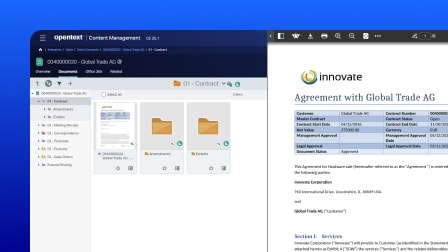
Official Content Management document screen
Content Management

Connect documents, workspaces and enterprise applications.

Helps teams use relevant documents inside enterprise applications and business workspaces, with access and workflow requirements defined for the deployment.

Binders

Digital content connects construction work

A named Latvian construction implementation and adoption case.

Content Management connected central documents and redesigned digital processes.

What changed? +

Paper-based processes complicated tender and administrative work.

Customer-specific process results; separate from guaranteed Korean ROI.

Official Content Management document screen
02 / HOW IT BECOMES REAL

Illustrative content-to-process path

Illustration: a Korean enterprise evaluates documents connected with SAP work.

  1. 01

    Discover

    Map the process, content and owners.

  2. 02

    Connect

    Link the document with its business context.

  3. 03

    Validate

    Run a scoped proof of concept.

  4. 04

    Operate

    Hand off the tested workflow and support needs.

Follow the work, step by step

Enterprise information needs context

OpenText builds information management software around the content, operational records and transactions that organizations use to work. Documents may sit in separate repositories while the business process lives in an enterprise application. IT events may describe a service problem without making its business impact clear. A supply-chain transaction may cross several companies and systems. OpenText's portfolio addresses these different information boundaries through content management, business networks, IT operations and security products. Signet reads the common thread as turning stored information into usable, governed context. That does not mean every product is one universal data store or that a software installation makes the customer's records trustworthy automatically. The customer must identify the source, ownership, permissions and purpose of the information being used. An illustrative Korean enterprise could start with one document-heavy business process, connect the relevant enterprise application and repository, and establish how people can find the permitted information. The practical work begins with a clear process and ends with a system that the organization can operate, review and extend as its responsibilities change.

Content connects with business processes

Content Management, formerly Extended ECM, connects documents with enterprise applications such as SAP, Microsoft, Salesforce and Guidewire. The relevant decision is not simply where a file is stored: teams need its relationship with an invoice, employee case, contract or engineering project, along with the permissions and record policies around that work. The official product page describes business workspaces, document management, workflow and governance. Content Aviator adds conversational assistance and agent-related work within the governed content environment, with deployment requirements tied to the specific product. Signet would ask a candidate to describe how a person finds a document, sees its business context and completes the next permitted action. The workflow needs a responsible owner, an access boundary and a testable outcome. In an illustrative SAP-related project, a solutions consultant could map the business process, define the document relationship, configure a demonstration and agree on proof-of-concept success criteria. That sequence is candidate preparation derived from the posting and product material, rather than a claim that every Korean customer uses the same configuration.

A customer case makes the change visible

The official Binders story describes a Latvian construction company replacing paper-based work with a central content platform and digital processes. Its stated challenge involved competitive public tenders and the cost of cumbersome administration. The solution used OpenText Content Management and focused on process design and user adoption. Signet uses the case to show the work between a product purchase and an operating change, while keeping reported improvements within the named project. Dairy Farmers of America's content story supplies a separate example of connecting document processes across operations. These are customer-specific results, not a guaranteed Korean return on investment. A candidate can learn from the sequence: identify the costly process, understand the documents and people involved, test the proposed configuration, and follow adoption after deployment. The Korean solutions roles make much of that sequence explicit through discovery, demonstrations, proofs of concept and coordination with services and product teams. The broader AI direction builds on the same groundwork. An assistant can only use information responsibly when the source and permissions around the underlying process remain clear and the customer can validate the resulting action.

Understand the products and their customers

Content products have distinct deployments

The content portfolio includes OpenText Content Management, Core Content Management and Documentum Content Management. Their official pages address related document and governance problems through different product and deployment choices. Signet keeps those names separate rather than describing one product's feature as automatically available in every content offering. Content Management connects existing enterprise applications with documents and business workspaces; Core Content Management presents a cloud path; Documentum serves its own established content environment. Content Aviator applies AI inside these product contexts, and the current page states that agentic AI is included in the relevant Core Content Management subscription. The practical evaluation needs to confirm the customer platform, version, intended capability and governing policy. An enterprise buyer may care about retention, metadata, workflow, access and integration with SAP as much as the conversational interface itself. A solutions consultant must therefore translate the process into requirements and a demonstration that uses representative information. The answer is not only whether a model can produce text; it is whether the permitted content and configured workflow support a useful action that the organization can validate and operate.

Operational and transaction products serve other work

AI Operations Management, whose earlier name is Operations Bridge, connects observability information with a model of services, infrastructure and dependencies. Its current page describes event correlation, investigation and governed remediation, with several deployment choices. Service Management and Service Management Aviator address support and service workflows. Trading Grid provides B2B integration around trading partners and transactions, while Trading Grid Aviator adds AI assistance in that context. Fortify on Demand addresses application security assessment. These products share an information-management theme but have different buyers, data sources and validation needs. Signet highlights the distinction because the Korean ITOM consultant posting asks for deep core-domain knowledge and the ability to build cross-product scenarios. A demonstration should show a specific connection between information and a customer decision rather than placing every portfolio label in one slide. For an IT operations example, the evidence might include the relevant service dependency, event, proposed cause and approval needed before remediation. For a content or transaction example, it would instead follow the document or business exchange. The candidate should be able to keep each product's role clear while explaining a justified integration.

Aviator Studio and Cohere occupy different stages

Aviator Studio is presented as a platform for building, governing and connecting enterprise agents, with no-code and pro-code interfaces, orchestration, a model broker and guardrail settings. The official page describes the product's intended operating capabilities across OpenText and external integrations. Signet reads that page alongside the dated Cohere partnership rather than merging the two announcements. The September partnership is expected to reach clients in early 2027; it joins OpenText's data and context layer with Cohere North, its privately deployable agent platform, and models. The parties describe product development, integration, coordinated commercial work and a reseller relationship. This is a future integrated offering with a stated schedule, separate from today's individual OpenText product pages. A Korean proposal must identify which available product can address the immediate need and which later integration is being evaluated. The data location, security requirements, permitted actions and operating owner remain customer decisions in either case. Presenting a clear stage and a testable workflow makes the product direction useful without converting a partnership plan into a completed customer deployment.

03 / THE EVIDENCE

The story, in numbers.

DATED OBSERVATIONS

Consolidated completed revenue

USD · USD

Consolidated June fiscal-year totals; acquisitions and portfolio changes affect comparability.

Figures, dates & basis +
Consolidated completed revenue
DateValueBasis
2022-06-30$3,494,000,000 USDConsolidated June fiscal-year totals; acquisitions and portfolio changes affect comparability.
2025-06-30$5,168,400,000 USDConsolidated June fiscal-year totals; acquisitions and portfolio changes affect comparability.
2026-06-30$5,246,400,000 USDConsolidated June fiscal-year totals; acquisitions and portfolio changes affect comparability.

OpenText

FY2022

$3.494B consolidated fiscal-year revenue.

FY2025

$5.1684B consolidated fiscal-year revenue.

FY2026

$5.2464B consolidated fiscal-year revenue.

Read the growth story

Information management has several buying paths

OpenText reports cloud services and subscriptions, customer support, licenses, and professional services and other revenue as separate categories. The portfolio therefore includes different commercial arrangements rather than one uniform usage fee. Product pages describe purchase or consultation paths, deployment options and relevant service support. A Korean buyer’s actual price and contract term depend on the selected product and service scope. An enterprise engagement may involve a license or cloud subscription, a managed operating environment and an implementation project, with the exact contract determined by the selected product and customer need. The Korean solutions consultants help establish the business requirements and validate the proposed configuration before that purchase. Sales development discovers and qualifies opportunities, while cybersecurity selling owns its own account and pipeline work. These functions connect a broad software portfolio with a specific customer decision. Continuing growth needs the product to operate usefully after the agreement, along with appropriate support and adoption. An interview example should therefore follow what was sold, what was implemented and what the customer continued to use, while keeping those separate from the seller's activity count or the size of a future opportunity.

Completed revenue has a June year end

OpenText's fiscal years end on June 30. The company reported about $3.494 billion of total revenue in fiscal 2022, $5.1684 billion in fiscal 2025 and $5.2464 billion in fiscal 2026. The chart keeps these as consolidated reported annual results. The series spans the 2023 Micro Focus acquisition and subsequent portfolio changes, so Signet does not label the entire historical increase organic growth. The fiscal 2026 release separately reports cloud revenue of $1.9586 billion and customer support of $2.2874 billion. OpenText defines annual recurring revenues as the sum of those two categories. Its ARR label therefore represents recognized recurring revenue for the stated period; the quarterly table can carry that label for a quarter. It should not be confused with a startup-style annualized recurring run-rate. Enterprise cloud bookings have another definition based on new, committed and incremental contract value. Keeping the metric and period attached to each number helps a candidate explain the company's operating direction without turning contract value, annual revenue and a quarterly result into interchangeable growth claims.

The business depends on an operating fit

The fiscal 2026 release describes investment in the core portfolio, sales capacity and partners, together with cash generation, debt reduction and capital allocation. Signet reads these as management priorities tied to a reported period, without treating them as the outcome of an individual Korean account. A broad acquired portfolio creates a practical need to maintain product knowledge and explain integration boundaries. Customers also need a deployment that satisfies their data location, access and operating requirements. The European sovereign-cloud announcements serve that regional purpose and do not establish a Korean sovereign deployment. AI creates another validation task: an integration plan and its expected availability need to be separated from a currently available product. These are ordinary business risks around product fit, execution and timing. A candidate should be prepared to discuss an actual tradeoff, such as where content is hosted, who governs access, how a proof of concept is assessed and which service team supports the customer afterward. The seller or consultant builds credibility by making those decisions clear. A large company revenue number provides business context, while a grounded customer example provides evidence that the candidate can perform the work.

04 / THE PEOPLE

Someone saw it first.

Ayman Antoun official portrait
Chief Executive Officer

Ayman Antoun

Became CEO April 20,2026 after IBM leadership.

The choice behind the company +

Connect enterprise data and commercial execution.

Shannon Bell official portrait
Chief Product and Technology Officer

Shannon Bell

Leads product, R&D and AI strategy in the current biography.

The choice behind the company +

Coordinate AI direction across the product portfolio.

“Data is not the supporting act,”

Ayman Antoun · Dated official company announcement · 2026-09-16
The decisions behind the company

The origin was searchable information

OpenText grew out of a University of Waterloo and Oxford University project to put the Oxford English Dictionary online. It incorporated in June 1991, began shipping product that September, developed web-search technology and listed publicly in 1996. Finding information and using it in context remains a connection with its present business. Product development and acquisitions widened the information it serves, including the enterprise content division containing Documentum and the 2023 Micro Focus acquisition. Today the portfolio covers content, business networks, IT operations, application delivery and security. The Korean SAP and content role works around business documents, while the ITOM role draws on the broader enterprise software portfolio. Signet reads the history through a practical question: which information does a customer need to use, who uses it, and what integration makes that work possible?

The current leadership changed in 2026

Ayman Antoun became CEO and a board member on April 20, 2026, following the January appointment announcement. His current official biography describes prior IBM leadership, including IBM Americas. James McGourlay moved from interim CEO to a client leadership role in April; the current executive list presents him as executive vice president and chief client officer. Shannon Bell's current page names her chief product and technology officer, with responsibility for product strategy, research and development and AI strategy. Her earlier dated statements as chief digital officer and CIO retain those historical titles in their own context. Steve Rai is the current chief financial officer. Signet keeps these changes visible because an older company profile can otherwise misidentify the people who own present decisions. Antoun's recent statements emphasize enterprise data and disciplined commercial execution, while Bell's current responsibilities connect product domains with the AI roadmap. A candidate can use that distinction to ask about how their own customer work feeds product priorities or implementation support. It does not establish a Korean reporting line or prove how a local team resolves each everyday decision.

The public values connect listening with execution

The OpenText Way page states expectations around putting customers first, facing challenges, supporting teams, caring for people and acting ethically. Signet treats these as the employer's public principles, separate from a measured description of every team's experience. The Korean consultant descriptions make listening and execution concrete through business requirements, demonstrations, proof-of-concept scope, technical recommendations and coordination across services, product teams and partners. The sales development posting adds a disciplined process for prospecting, qualification and updating the sales system. A candidate can prepare a customer conversation that changed the planned solution, a proof of concept with a clear success criterion, and an example of coordinating with another specialist instead of treating the result as individual work alone. Ethical execution matters when information includes sensitive business records or when an AI workflow can act on a customer's systems. The candidate should be able to describe the boundaries of access and the need for customer validation. Public values become useful preparation when they are tied to such decisions and supported actions, rather than repeated as an unsupported claim that the company will provide a particular culture or career outcome.

05 / THE NEXT CHAPTER

Work in Korea

Qualify prospects, validate solutions and sell cybersecurity.

Principal Solutions Consultant - SAP & Content Management
  • Principal Solutions Consultant - SAP & Content Management

Open posting count, not team headcount

Principal Solutions Consultant
  • Principal Solutions Consultant

Open posting count, not team headcount

Solution Sales Executive - CyberSecurity
  • Solution Sales Executive - CyberSecurity

Open posting count, not team headcount

Commercial Sales Development Representative
  • Commercial Sales Development Representative

Open posting count, not team headcount

Posting counts describe current functions, separate from team headcount.

Why Korea? Why now?+

Current roles explicitly connect Seoul with enterprise information work.

Understand the Korea opportunity

The live board lists four Seoul functions

On October 10, 2026, the official careers site listed four openings under its KOR country filter, all with Seoul as their stated location. Signet includes the full original descriptions rather than combining them with older search results or nearby-country roles. Two postings are solutions consulting: Principal Solutions Consultant for ITOM, AI and cross-portfolio work, and Principal Solutions Consultant - SAP & Content Management. The other postings are Solution Sales Executive - CyberSecurity and Commercial Sales Development Representative. This count describes current postings, not the number of employees in Korea. The roles place customer acquisition, solution validation and specialized selling beside each other. The candidate should choose the actual function they want: qualifying prospects is different from constructing a technical demonstration, and both differ from carrying a cybersecurity sales target. The common link is understanding a customer's information or operating problem and moving the decision to the appropriate next stage. Signet keeps the source, location, posting date and catalog relationship attached to each role so that the account of the company remains connected to work a candidate can actually investigate and apply for.

Consultants turn requirements into a test

The SAP and Content Management posting asks the consultant to work with sales executives, define business and technical requirements, build customized demonstrations and lead proofs of concept. It explicitly includes scope, success criteria, configuration, client alignment and presentation of outcomes. Required knowledge spans SAP modules and modern SAP architecture, content and records management, access, governance and AI-related enterprise information use. The ITOM posting asks for deep IT operations expertise, AI technical competency and the ability to explain either a focused product or an integrated portfolio scenario. It names Operations Bridge, Operations Orchestration, Server Automation and Network Operations Management or comparable platforms. Both descriptions call for effective Korean and English communication. Signet reads these as evidence that a candidate must connect a technical configuration with a business decision. A useful preparation artifact is one customer problem, its requirements, a scoped demonstration and a measurable acceptance criterion. The candidate should explain the part they built or coordinated and the next handoff to services, product support or a partner. That is more informative than claiming familiarity with a long list of products without demonstrating how the customer evaluated a proposed change.

Sales roles have different commitments

The cybersecurity executive posting centers on quota, account business planning, relationships, deal processing, forecast accuracy and pipeline management. It prefers direct enterprise cybersecurity sales experience and describes cooperation with the country leader, without naming that person. Its wording makes English an advantage rather than a mandatory requirement. The Commercial SDR role covers outbound prospecting, inbound lead qualification, early opportunity support and accurate activity records in Salesforce. It requires professional Korean and English and states a two-year fixed-term contract with the possibility of conversion to a permanent position. Signet preserves that possibility as conditional, rather than implying that conversion is assured. The official system's broader Regular type label is not used to erase the contract wording. For candidate preparation, a seller can show an account plan and forecast evidence, while an SDR can show how a prospect was researched, qualified and moved to the next team. The role comparison should retain those differences in experience, responsibility and employment arrangement. Choosing between them is easier when the reader can connect the company's information-management business to the exact work and terms in the current employer description.

KOREA OPEN ROLES

3 open roles in Korea

Current Signet catalog · 2026-10-19

FOR YOU

Connect a customer requirement with evidence and the next operating responsibility.

GTM · Sales · BD

Commercial Sales Development Representative

Seoul, KOR, 03152

Posting checked

The work
Research, qualify and progress prospects with sales and solutions teams.
Who fits
Professional Korean and English; two-year fixed-term with possible conversion.
Keep in mind
The contract and language wording follows the original posting.
Solutions Engineer

Principal Solutions Consultant - SAP & Content Management

Seoul, KOR, 03152

Posting checked

The work
Build SAP and content demonstrations and lead scoped proofs of concept.
Who fits
SAP, content governance and client-facing PoC experience; Korean and English.
Keep in mind
The contract and language wording follows the original posting.
GTM · Sales · BD

Solution Sales Executive - CyberSecurity

Seoul, KOR, 03152

Posting checked

The work
Own cybersecurity quota, account plans, forecasts and pipeline.
Who fits
Direct enterprise cybersecurity sales is preferred; English is a plus.
Keep in mind
The contract and language wording follows the original posting.
07 / NOW & NEXT

The next scene is taking shape.

Fiscal2026 completed results

Completed June fiscal-year revenue and commercial priorities.

Cohere partnership, early2027 plan

Data and context are planned to connect with North and models.

Intelligent content assessment

Dated IDC recognition connects content and governed AI.

More context on what comes next

The completed year establishes a baseline

The August 6 fiscal 2026 results describe the completed year ended June 30. Total revenue and cloud revenue are reported separately, with a clear definition of recurring revenues. Management discusses sales capacity, partner reach and organic investment for the next fiscal year. Signet keeps those forward priorities separate from the finished result. A candidate can use the release to understand how cloud adoption and the broader information portfolio contribute to the business, while retaining the difference between a license, support, cloud subscription and incremental contract booking. The period is the anchor for the financial story; it is not a projected value for a current Korean account.

Cohere integration has a future delivery date

On September 16, OpenText and Cohere announced a strategic partnership that joins enterprise data and context with North and Cohere models. The release expects client delivery in early 2027 and names product integration, commercial coordination and a reseller relationship. Deployment choices include on-premises and different cloud forms according to customer requirements. Signet treats these as the stated design and schedule of the partnership. A Korean proposal should identify its immediate product capability separately and ask what later integration would need to be validated. The announcement broadens the product direction, while the data location, access and accountability remain decisions to establish for the actual customer workflow.

Content recognition has a bounded meaning

The September 24 announcement describes recognition in IDC's 2026 intelligent content services assessment. It connects governed content with enterprise AI and deployment choice. Signet uses the dated assessment as company context, not a guarantee that a particular implementation will meet its target. For a candidate, the more useful follow-up is how the content product connects with the customer's process and permissions, and what the proof of concept must demonstrate. The recent news therefore returns to the same practical thread as the Korean consulting roles: requirements, current capabilities, validated outcomes and a responsible operating handoff.

Their future. Your next chapter.

Find your part ↑

An independent profile by Signet. No affiliation or investment recommendation. Introductions happen only with your consent.
Research reviewed 2026-10-10

A LITTLE MORE CONTEXT

Understanding OpenText.

What does OpenText do?

OpenText connects enterprise information with governed business and AI workflows.

What is the opportunity in Korea?

Qualify prospects, validate solutions and sell cybersecurity.

Are these confirmed job openings?

Employer postings were checked on 2026-10-10. Availability can change. Mock applications request a review from Signet.

How can I explore the company in more depth?

Follow the company from its vision through products, evidence and people to the Korea team and current roles. Use the table of contents to move within the page, and expand the sections for more context.

Back to the collection ↗