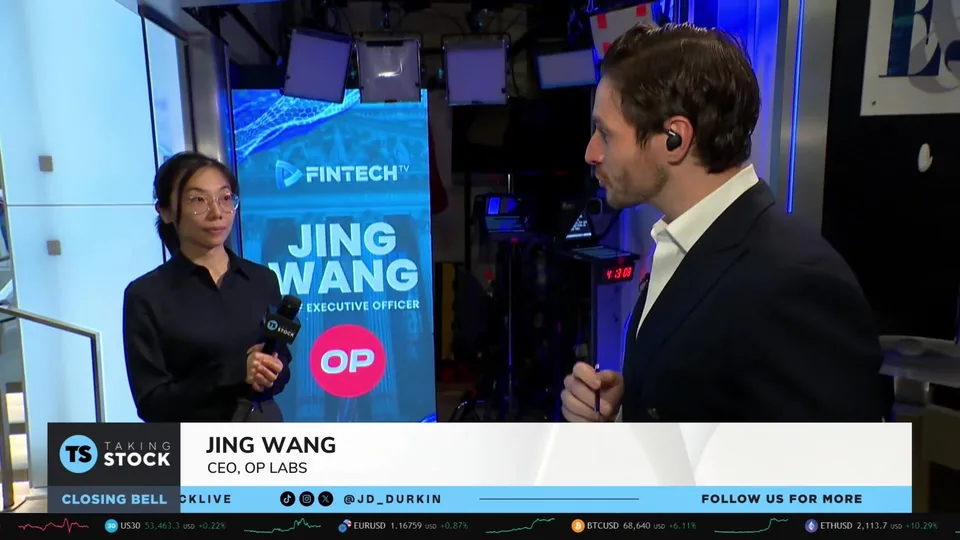
Jing Wang, co-founder and CEO of OP Labs
OP Labs / THE WORLD THEY ARE BUILDING

Make shared Ethereum infrastructure usable for institutional financial products.

A financial product can have a polished application while still depending on somebody else's transaction network.

See it taking shape ↓
01 / THE PRODUCTS

The products behind the promise.

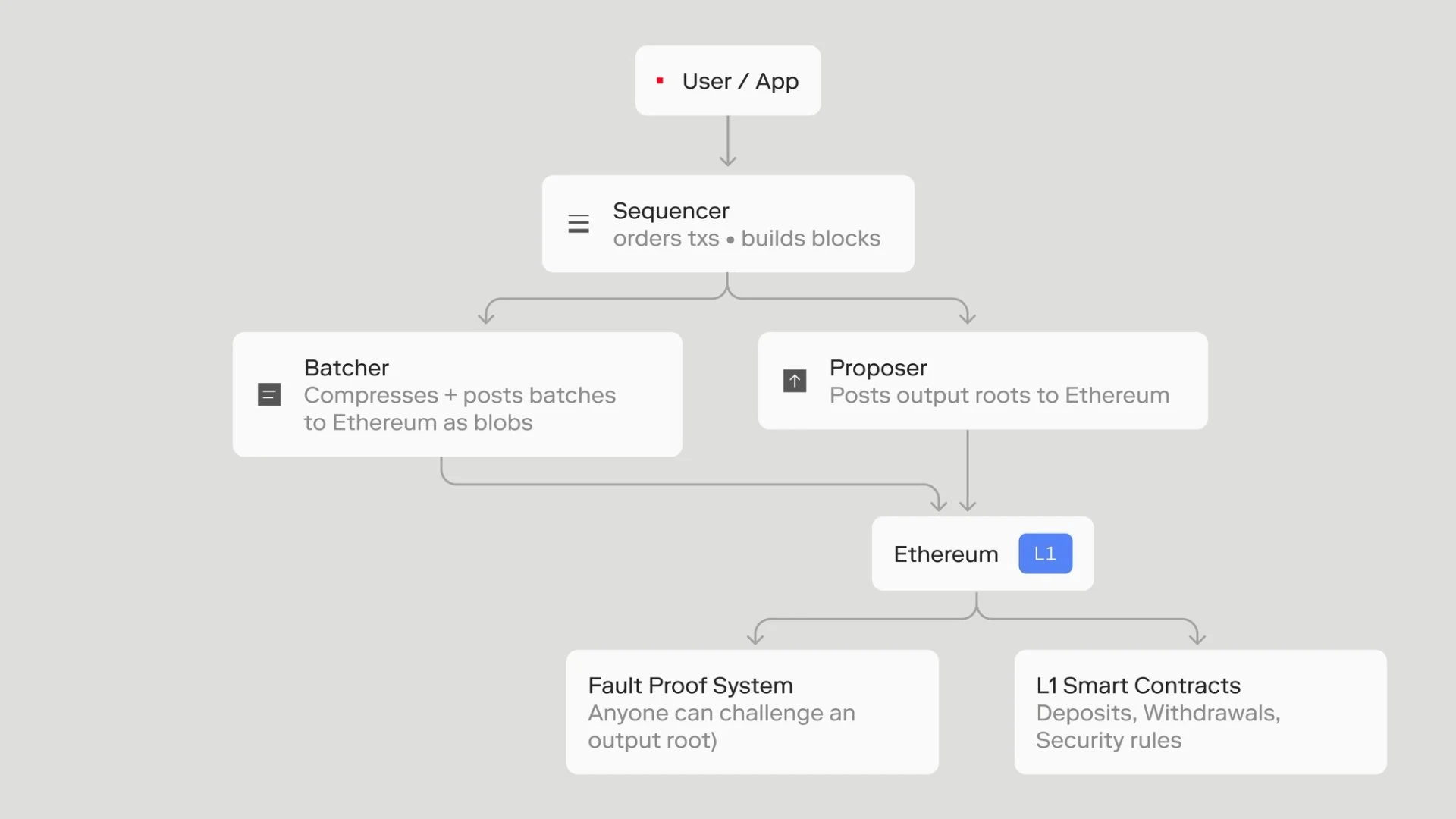
OP Stack architecture: user/app, sequencer, batcher, proposer, Ethereum and fault-proof components. Official diagram.
OP Stack

Configure and run an Ethereum layer two chain.

Reuse common infrastructure and developer tools.

Ether.fi

Move a working card product onto OP Mainnet

The reported migration covered $220M in TVL.

The joint April 2026 post describes a three-day migration with cards continuing to operate.

What changed? +

A live card product needed infrastructure for its next product stage.

The joint customer/provider post describes the migration and card continuity; TVL is customer asset scope.

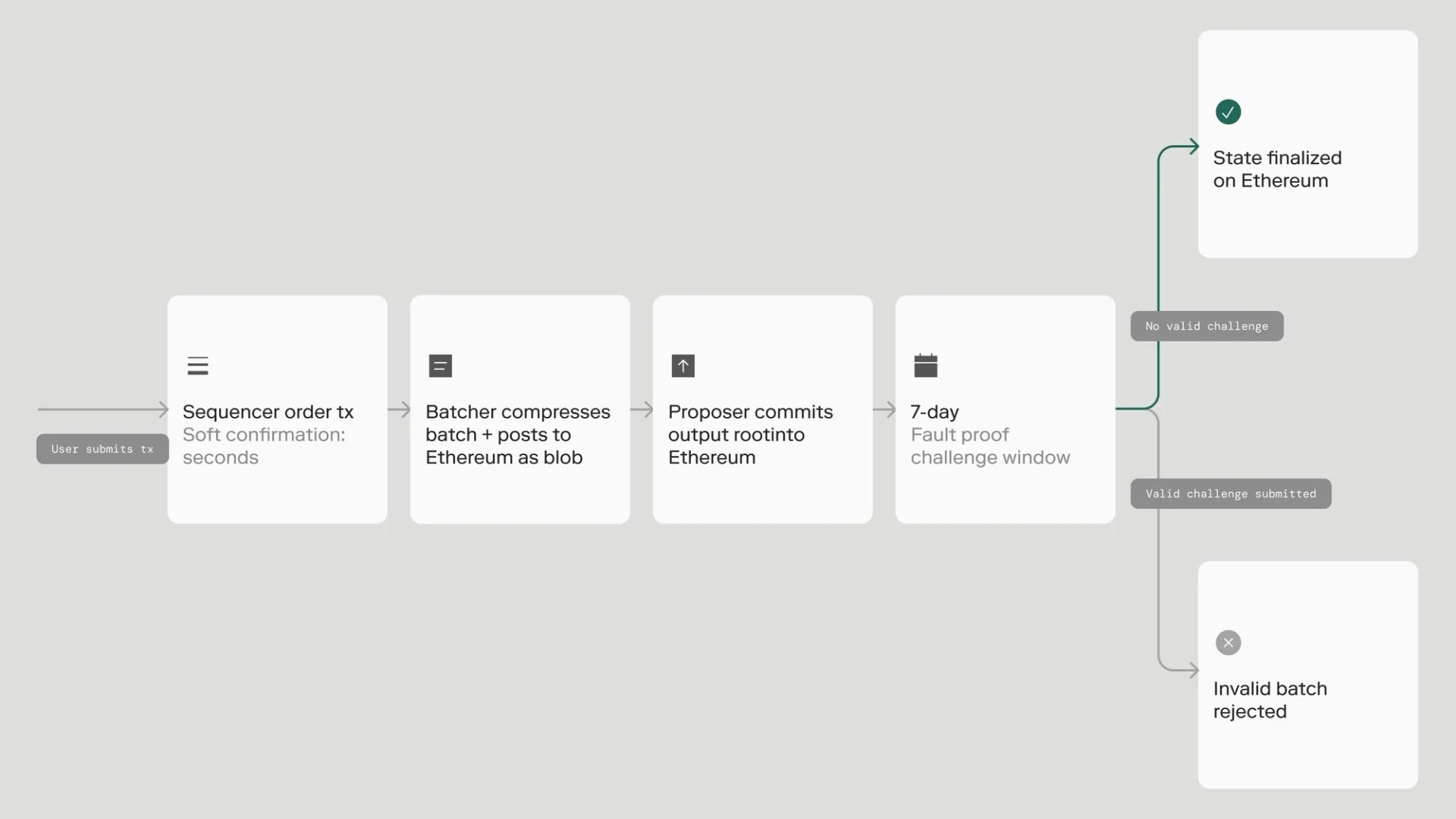
OP Stack transaction lifecycle: user submission, sequencer ordering, batches posted to Ethereum and final state. Official diagram.
02 / HOW IT BECOMES REAL

An institution moves from use case to operations

Illustrative workflow, based on the published enterprise delivery process.

  1. 01

    Map the payment or asset workflow and its operating constraints.

    Map the payment or asset workflow and its operating constraints.

  2. 02

    Choose settlement, data, access and observability requirements.

    Choose settlement, data, access and observability requirements.

  3. 03

    Deploy a production-like environment and test integration and performance.

    Deploy a production-like environment and test integration and performance.

  4. 04

    Move the product into live operations with support and handoffs.

    Move the product into live operations with support and handoffs.

  5. 05

    Monitor the chain, coordinate upgrades and manage capacity.

    Monitor the chain, coordinate upgrades and manage capacity.

Follow the work, step by step

A business needs its own rails

A financial product can have a polished application while still depending on somebody else's transaction network. OP Labs starts underneath that application. Its team develops the OP Stack, an open source set of components for building Ethereum layer two chains, and now offers institutional operators a managed version through OP Enterprise. Signet reads the business direction as a move from supplying shared code to helping institutions turn that code into a system they can actually run for customers.

Layer two means a network that executes transactions outside Ethereum's main chain while using Ethereum as part of its settlement and security design. The OP Stack separates jobs such as execution, ordering transactions, publishing data and proving state. A customer can reuse those components rather than inventing each one. This is a technical choice with a business consequence: the team can spend more attention on the financial product and still decide how its chain should behave.

One codebase, several independent businesses

The Superchain adds a common operating framework around participating chains. Optimism describes shared upgrades, security, governance and an economic contribution back to the Collective. It is different from saying that every application lives on one chain or that every company gives up its own product roadmap. In Signet's reading, shared infrastructure becomes valuable when independent operators can cooperate on difficult protocol work while retaining a reason to build distinct services for their own users and market.

The application builder still makes consequential decisions. A payments team needs a rule for who can transact, which asset pays transaction costs, how data is available, and how failures reach its operations staff. The stack page lists configurable fee logic, gas tokens and data availability. The managed product adds operations and vendor coordination. Signet's interpretation is that technical flexibility only becomes an institutional buying reason after the seller connects each choice to a real constraint in the customer's workflow.

From a use case to a live chain

An illustrative institution begins with a payment or asset issuance use case, not with a request for a fashionable chain. The published delivery process starts with discovery of throughput, latency and compliance constraints, then architecture design, a pilot, production rollout and continuing operations. Engineers, security staff and legal teams participate in those handoffs. Signet would test the proposed system against the work it replaces: who authorizes a transaction, who reconciles it, and which person takes responsibility when a transfer behaves unexpectedly.

That work explains the Korean sales opportunity. The official Korea posting asks the Enterprise Sales Lead to identify market entry points, structure institutional partnerships and influence product requirements. The candidate is selling an operating change involving business, engineering and compliance stakeholders. A convincing account of the company therefore follows money and decisions through one specific customer scene. The key question is how shared Ethereum infrastructure makes that scene more useful to an institution, and what has to be built or agreed before that usefulness becomes repeatable.

Understand the products and their customers

The code and the operations are separate choices

OP Stack is the technical foundation. Its modules give chain builders an execution environment compatible with Ethereum tools, a transaction ordering path, data publication and settlement components. The original introduction explains why the team moved toward separating execution from proving: a modular system can accommodate different implementations without making every improvement a complete redesign. For a Korean enterprise buyer, the useful explanation is concrete. Existing Solidity applications and familiar developer tools can form the starting point, while the chain's operating choices remain part of the architecture discussion.

OP Enterprise is an infrastructure and support offering around that foundation. Its three routes are to deploy an application on OP Mainnet, operate a dedicated chain with support, or have OP Labs operate the dedicated chain. Those routes reflect different allocations of engineering responsibility. Signet would compare who controls cloud infrastructure, who applies upgrades, who monitors the bridge and who answers a critical incident. The current product page presents contracted uptime and response options; an institution should evaluate the actual tier and agreement against its own operating requirements.

The app can use protocols through one integration

Actions SDK sits closer to the application. The official page describes a frontend integration for swaps, lending and borrowing instead of separate integrations with many DeFi protocols. DeFi here means financial activities implemented through blockchain software. The developer still has to decide which user action is appropriate and explain the financial behavior to the user. Signet reads the SDK as reducing integration work, not as substituting for a product team's judgement about risk, disclosures or the suitability of a particular transaction.

Unichain provides one example of the foundation and service working together. The October 2024 announcement introduced a DeFi-focused chain built on the OP Stack and described it as live on testnet at that time. The 2026 enterprise launch material identifies Unichain as a launch customer using Mission Critical support. These dated descriptions should remain separate. Signet's lesson for the applicant is to follow a partner from its initial technical choice through the operating relationship, instead of treating a launch announcement as a permanent account of deployment status.

Customer evidence is about the implemented work

Ether.fi's April 2026 announcement is about a live consumer card product moving onto OP Mainnet. The joint post reports a three day migration and continued card operation, with bridge engineering, oracle support and asset metadata involved in the move. Those details show why an infrastructure sale contains operational work after the commercial agreement. The post's product and asset figures refer to Ether.fi and the migration's scope. Signet would use the case to ask about continuity and coordination, keeping the customer's activity separate from OP Labs' financial performance.

Bitpanda illustrates a different decision. Its March 2026 announcement describes Vision Chain as a planned, fully managed OP Enterprise chain for European institutions. The stated purpose is asset issuance and settlement with the operator retaining product focus. The article gives a rollout sequence and a later mainnet target, which are plans in that announcement. Together, the cases give a seller useful contrasts: an application migration onto a shared network, support for an existing dedicated chain, and a managed dedicated chain launch. Each has a different implementation and buying conversation.

03 / THE EVIDENCE

The story, in numbers.

DATED OBSERVATIONS

Chains using OP Stack

chains
50+

One company-disclosed adoption snapshot, not a growth curve.

Figures, dates & basis +
Chains using OP Stack
DateValueBasis
2026-10-1050+The product page states more than 50 chains.

Optimism

The OP Stack was introduced.

The OP Stack was introduced.

Permissionless fault proofs reached OP Mainnet.

Permissionless fault proofs reached OP Mainnet.

OP Enterprise grouped deployment and operations routes.

OP Enterprise grouped deployment and operations routes.

Read the growth story

Separate the company from the network

There are different economic layers around OP Labs. An institution can buy engineering support or managed chain operations through OP Enterprise. An application user can pay transaction fees on an OP Chain. Participating chains also contribute to the Optimism Collective under the network's economic rules. Signet keeps those layers separate when evaluating the business. A fee earned by a chain operator, assets held in an application and money flowing to the Collective each answer a different question from revenue earned by the company that provides infrastructure services.

The August 2024 fee explanation reported more than 14,000 ETH of cumulative Collective revenue at that time. That is a historical network disclosure, expressed in ETH. The current OP Stack product page says more than 50 chains use the stack; that measures adoption of the codebase. The official jobs material separately describes $178 million raised from investors. Funding supplies capital, chain count describes usage, and protocol revenue describes a network cash flow. They should retain their own dates and units when a candidate explains whether this is a substantial business.

An operator pays to keep a product running

The managed offering has a clear payer and task. A chain operator wants its financial product to run while the provider handles infrastructure responsibilities. Published routes include customer managed infrastructure with support and provider managed infrastructure with uptime commitments. Signet reads account expansion through the next workload, stronger operating requirements or additional integrations, rather than through a token price. The useful sales question is which continuing work the institution would otherwise have to staff, coordinate and maintain, and why the proposed agreement fits that specific operating burden.

The company publishes a measurement framework that warns against treating every crypto count as demand. It distinguishes transaction fees, Collective revenue, locked assets, compute consumption and transaction cost. It also notes that active wallet addresses can be misleading when people create addresses to farm incentives. For Signet, this makes a disciplined enterprise conversation possible: evaluate the customer's real product use and its willingness to pay for operations. A large activity figure can be relevant evidence, but its definition and the behavior behind it decide what it actually proves.

Three risks change the buying conversation

The first risk is security during a withdrawal or upgrade. Published incident response work and the fault proof roadmap show that protecting user funds is continuing engineering work, involving emergency response and governance. The second is coordination across independently operated chains: interoperability requires common standards and upgrades, and customers must distinguish released behavior from planned capabilities. These risks affect a seller's delivery promises. Signet would prepare a concrete response path and a version specific capability list rather than assuming that membership in a network removes operational responsibilities.

The third risk is whether a financial institution can turn technical access into permitted, repeatable demand. The enterprise material discusses institutional operating and compliance needs, and the Korea role requires understanding custody, cards, stablecoins and compliance tooling. Signet treats regulation and customer adoption as conditions to investigate with each buyer, not a guarantee that every use case can launch. Competing choices include operating the open source stack directly, working with another infrastructure partner, or keeping the product on its existing rails. The argument for OP Labs has to survive that comparison.

04 / THE PEOPLE

Someone saw it first.

Jing Wang, co-founder and CEO of OP Labs
CEO, OP Labs; cofounder, Optimism

Jing Wang

The August 2026 interview identifies her as CEO and cofounder.

The choice behind the company +

Her interview focuses on institutional adoption and Korea/Japan expansion.

“This is what OP Mainnet is for.”

Jing Wang · Joint Ether.fi announcement · 2026-04-15
The decisions behind the company

The builders changed the architecture

The company's history is best read through engineering decisions. The October 2022 OP Stack introduction credits talks by Karl Floersch and Kelvin Fichter and describes an earlier decision to discard the OVM design in favor of a modular approach. Execution and proving became separate concerns. Signet reads this as a willingness to change the core design when a simpler shared standard becomes possible. A candidate can explain the business consequence without reciting a founder biography: a common codebase becomes easier for independent teams to extend and maintain.

Jing Wang speaks for the company on the enterprise direction. An August 20, 2026 interview identifies her as OP Labs CEO and Optimism cofounder. She emphasizes institutional adoption and discusses expanding work in Korea and Japan. Her comments are an executive account of the company's focus, with their interview date attached. Signet would connect that focus to the actual Korean posting: the sales lead is asked to shape institutional partnerships and bring the product, engineering and ecosystem participants into the same commercial effort.

Commercial delivery must follow technical commitments

Karl Floersch's January 2026 post offers a second window into decision making. It describes a proposed transition away from ECDSA externally owned accounts over ten years, subject to governance approval. The significance is coordination among wallets, applications, chain operators and Ethereum, rather than a feature that a seller can announce as already delivered. Signet would ask how long term technical commitments become customer migration plans and contractual expectations. The author is relevant because his published roadmap shows which infrastructure changes enterprise conversations may eventually need to accommodate.

The company is also part of a wider governance structure. Optimism's public explanation distinguishes the OP Stack development work, the Superchain, OP Mainnet and the Collective's two house governance. An OP Labs employee therefore works in an ecosystem where engineering, commercial relationships and protocol governance have different decision paths. Signet would not turn that arrangement into an invented reporting chart. For a sales candidate, the practical task is to identify which partner requirement the product team can deliver and which commitment requires coordination with the wider network.

The posting gives an operating style

Two published ideas give the work a recognizable style. The protocol material stresses open code and modular development, so useful improvements can be reused by other contributors. The Korea posting says results matter more than recognition and asks for someone who can create partnerships with minimal oversight while collaborating across functions. These are the company's stated principles and hiring expectations. Signet's interpretation is that a candidate needs evidence of independent judgement alongside evidence of getting business and technical people to finish the same piece of work.

A useful interview story has a decision, an opposing constraint and an operating result. For this company, examples might involve a bank's compliance condition, a wallet integration, or a multi party contract that changed the rollout. Those are Signet's preparation suggestions, not claims about the interview script. The role asks the candidate to translate among people with different levels of crypto knowledge. Explaining a technical compromise in plain language may therefore demonstrate more relevant judgement than listing token terminology or repeating the company's optimism about the future of finance.

05 / THE NEXT CHAPTER

Originate institutional partnerships in Korea

The Enterprise Sales Lead, Korea role combines market selection with deal execution. It asks the person to identify entry points such as stablecoin corridors, embedded finance and business or consumer payment rails, then source, structure and close partnerships. It also asks for product feedback on compliance, wallet experience and account abstraction. Account abstraction means making a wallet's behavior programmable through a smart account rather than relying only on a basic externally owned account. Signet reads the role as owning a commercial thesis and testing it through a difficult institutional transaction.

The team view follows functions explicitly named in the employer posting; it describes collaboration rather than staff counts or reporting lines.

Why Korea? Why now?+

The CEO's August 2026 interview describes a push to expand headcount in Korea and Japan and connects it to financial institutions and clearer rules. That is her dated account, rather than a verified Korean staff count or a claim about every local regulation. The official board on October 10 shows one Korea located position: Enterprise Sales Lead, Korea. Taken together, the sources support a commercial focus on institutions. Signet would investigate which Korean partner has an executable use case, the authority to commit, and the operating team required to launch it.

The CEO discussed Korea and Japan expansion.

A dated interview connects the regional hiring push with institutional infrastructure.

Understand the Korea opportunity

Korea is a financial product market

Korea enters the story through an actual operator and an actual hiring decision. GIWA's official site describes an OP Stack based layer two chain made by Upbit, with Ethereum compatible applications and tools and a connection to Upbit's users and liquidity. The site currently directs builders to a testnet. Signet reads this as concrete Korean infrastructure work around a financial distribution business, keeping the site's testnet language intact. It is a more useful starting point for the candidate than treating the country as an abstract source of crypto enthusiasm.

The CEO's August 2026 interview describes a push to expand headcount in Korea and Japan and connects it to financial institutions and clearer rules. That is her dated account, rather than a verified Korean staff count or a claim about every local regulation. The official board on October 10 shows one Korea located position: Enterprise Sales Lead, Korea. Taken together, the sources support a commercial focus on institutions. Signet would investigate which Korean partner has an executable use case, the authority to commit, and the operating team required to launch it.

The posting asks for strategy and closing

The Enterprise Sales Lead, Korea role combines market selection with deal execution. It asks the person to identify entry points such as stablecoin corridors, embedded finance and business or consumer payment rails, then source, structure and close partnerships. It also asks for product feedback on compliance, wallet experience and account abstraction. Account abstraction means making a wallet's behavior programmable through a smart account rather than relying only on a basic externally owned account. Signet reads the role as owning a commercial thesis and testing it through a difficult institutional transaction.

The requirements are specific: at least ten years of enterprise sales, a record of complex institutional deals, and deep familiarity with fintech infrastructure including wallets, custody, card issuing, stablecoins, compliance tools and developer platforms. The posting asks for independent work with executive stakeholders and multi party partnerships. It does not turn the title into a promise about formal country management authority. A strong application would explain one institutional buying chain in detail: who sponsored the deal, who could block it, how the technical requirements changed, and what was implemented after signature.

Prepare a first-quarter hypothesis

Signet's reading of a plausible first quarter has three parts, derived from the posting rather than a promised onboarding plan. First map one institutional use case and its decision makers. Then develop a partnership proposal with the product and engineering constraints written plainly. Finally test the proposal with partners and bring the response into the product discussion. The role explicitly names collaboration with leadership, product, marketing, engineering and partner teams. Those are functions in the hiring design; they should not be presented as the Korean office's measured organization chart.

The official metadata lists South Korea, full time and remote. The body also contains company wide New York office language and location dependent benefits, so a candidate should discuss how that general policy applies to this particular Korea role. For interview preparation, Signet suggests a market entry memo, a complex partnership case and an integration tradeoff that affected rollout. Someone who wants to finish a repeatable institutional deal while tolerating ambiguity may find the work compelling. Someone whose record mainly covers a mature territory with fixed products should consider the market building expectations carefully.

KOREA OPEN ROLES

1 open role in Korea

Current Signet catalog · 2026-10-19

FOR YOU

Explain a complex institutional partnership through its implementation.

GTM · Sales · BD

Enterprise Sales Lead, Korea

South Korea

Posting checked

The work
Select institutional entry points, structure and close partnerships, and shape product requirements.
Who fits
Has at least ten years of enterprise sales experience.
Keep in mind
South Korea, full time, remote; discuss how the company-wide New York policy applies to this role.
07 / NOW & NEXT

The next scene is taking shape.

OP Enterprise grouped three operating routes.

OP Enterprise grouped three operating routes.

Bitpanda announced its Vision Chain plan.

Bitpanda announced its Vision Chain plan.

Ether.fi announced its OP Mainnet migration.

Ether.fi announced its OP Mainnet migration.

More context on what comes next

The enterprise service became a product

The January 29, 2026 launch article, updated July 31, presents OP Enterprise as a suite with public network deployment, self managed support and fully managed chain operations. That date matters because the article gives a product structure and partner claims at a particular point. The current product page has its own support and integration descriptions. Signet would compare the proposal an institution actually receives with that current description, rather than combine hours, response commitments or performance figures from different versions into a single attractive specification.

A plan and a migration answer different questions

The March 24 Bitpanda announcement describes a planned institutional chain and rollout. The April 15 Ether.fi joint post describes a completed product migration with cards operating throughout. These are different kinds of evidence for the enterprise direction. The former shows a partner's intended use case; the latter describes an operational handoff for an active application. Signet would follow what partners put into continuing production and what their users do afterwards. Those observations connect the shared code thesis to actual financial products more directly than a count of partnerships alone.

Watch security, interoperability and Korean conversion

Two technical threads are especially relevant to the institutional buyer. The post-quantum roadmap proposes a long migration window subject to governance, while the interoperability material describes a shared path for assets and messages across chains. Each requires coordination beyond one seller's promise. Signet would watch the released versions, customer migration tools and division of responsibility during an incident. A market entry memo should treat these as dependencies of the customer's operating design, with a clear distinction between the system available now and the direction the protocol teams are working toward.

The local commercial thread is easier to observe. GIWA provides a Korean builder entry point, and the Korea sales posting is an invitation to originate institutional partnerships. Signet would follow which use cases move from exploration to operating agreements and how partner requirements change the product. For the applicant, the next step is to explain one Korean institutional scene using the company's actual delivery choices. A mock application can test whether their experience joins market selection, deal structure and technical implementation into one account of work they have already done.

Their future. Your next chapter.

Find your part ↑

An independent profile by Signet. No affiliation or investment recommendation. Introductions happen only with your consent.
Research reviewed 2026-10-10

A LITTLE MORE CONTEXT

Understanding OP Labs.

What does OP Labs do?

A financial product can have a polished application while still depending on somebody else's transaction network. OP Labs starts underneath that application. Its team develops the OP Stack, an open source set of components for building Ethereum layer two chains, and now offers institutional operators a managed version through OP Enterprise. Signet reads the business direction as a move from supplying shared code to helping institutions turn that code into a system they can actually run for customers.

What is the opportunity in Korea?

The Enterprise Sales Lead, Korea role combines market selection with deal execution. It asks the person to identify entry points such as stablecoin corridors, embedded finance and business or consumer payment rails, then source, structure and close partnerships. It also asks for product feedback on compliance, wallet experience and account abstraction. Account abstraction means making a wallet's behavior programmable through a smart account rather than relying only on a basic externally owned account. Signet reads the role as owning a commercial thesis and testing it through a difficult institutional transaction.

Are these confirmed job openings?

Employer postings were checked on 2026-10-10. Availability can change. Mock applications request a review from Signet.

How can I explore the company in more depth?

Follow the company from its vision through products, evidence and people to the Korea team and current roles. Use the table of contents to move within the page, and expand the sections for more context.

Back to the collection ↗