Sushanth Raman, official author photo on the Pallet blog
Pallet / THE WORLD THEY ARE BUILDING

AI agents that learn each customer's unwritten rules and do logistics back office work.

Pallet is moving from typing orders to making planning decisions; the next test is whether customers in Asia trust it with both.

See it taking shape ↓
01 / THE PRODUCTS

The products behind the promise.

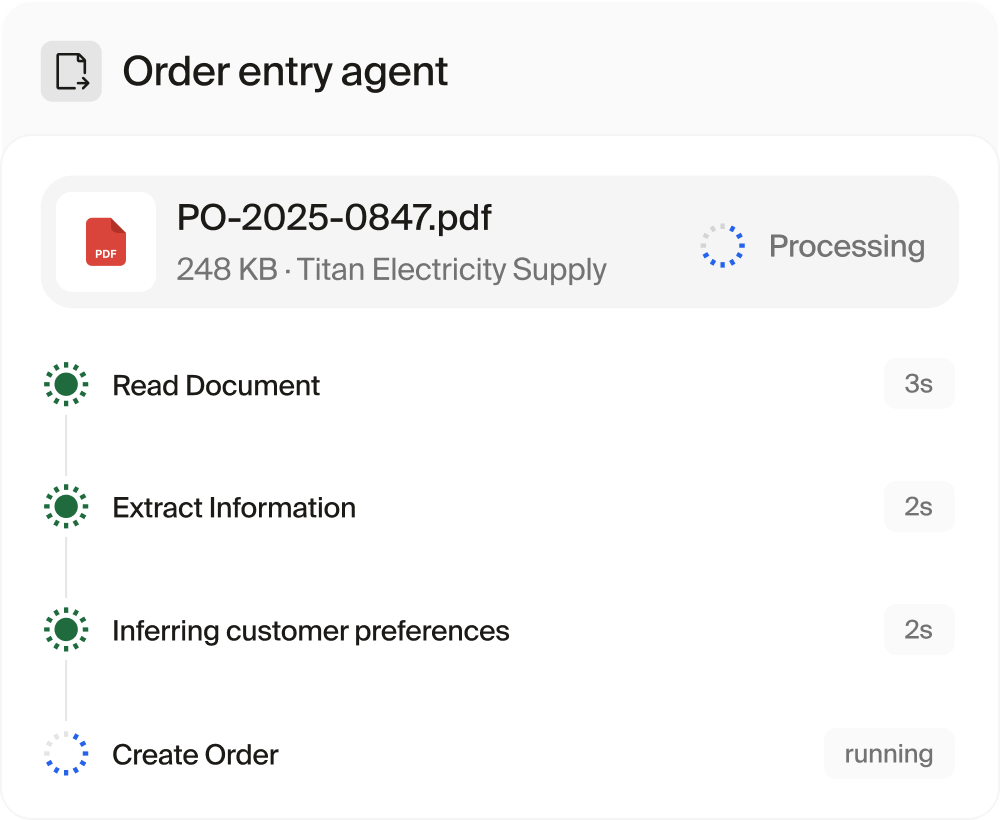
Pallet order entry agent reading a purchase order PDF, extracting information, inferring customer preferences and creating an order
Official product image: an order entry agent working through a PDF.
Pallet Agents

Hand order entry, tracking, billing and customs filings to agents that work in email, voice, EDI, browsers and remote desktops.

Volume grows without adding coordinators at the same rate.

Lineage

Three agents across receiving, forwarding and warehouse orders

2 million AI runs a year at 99% average accuracy; order entry from 15 to 2 minutes; live in 49 days.

A Receiving Agent, an Order Intake Agent writing into CargoWise and an Order Management Agent matching orders to WMS records.

What changed? +

Operators keyed shipment packets, forwarding emails and warehouse orders by hand, 10 to 15 minutes each, with rules that lived in their heads.

Company-published case with Lineage executives quoted. The page counts 2 million AI runs a year; the CEO's September 2026 LinkedIn post gives the same 49 days and describes the volume as 2 million shipments a year.

Mallory Alexander

Import filings at 100% accuracy

3x imports per operator; 100% accuracy on ISF filings and letters of credit; $18M of enterprise value created, as the CEO puts it.

Agents handle importer security filings, letters of credit and arrival notices; the company is extending them to payables and receivables.

What changed? +

Every import needed manual processing of commercial invoices, letters of credit and arrival notices, and costs rose in step with volume.

Company-published case quoting CEO Paul Svindland, who gives the enterprise value figure.

Pallet dashboard counting total and monthly agent runs by order entry, quoting and tracking agents
Official image from the May 2025 Series B post: agent runs by type, illustrative data.
02 / HOW IT BECOMES REAL

One email order, from inbox to system of record

Illustrative scene: a freight forwarder receives a customer's shipping request by email with a PDF attached.

  1. 01

    Read whatever arrives

    The agent watches the inbox and reads the email and its attachments, whether PDFs, spreadsheets or scanned photos. Pallet's agents also take work from phone calls, APIs and EDI.

  2. 02

    Bring the customer's rules

    Memory retrieves what this customer never writes down: default terms, facility hours, preferred carriers. Forge built those memories from historical emails before go live.

  3. 03

    Test the draft before it goes out

    A judge model checks that every rule was applied, and several models from different providers compare answers. Disagreement or low confidence sends the item to a person.

  4. 04

    Create the order in the customer's system

    The agent checks for duplicates and creates the order in CargoWise, in a TMS through EDI, on an AS/400 screen or in a browser portal. Fabric exposes each system as tools the agent can call.

  5. 05

    Turn each fix into a rule

    When an operator resolves an exception and explains why, Pallet turns the explanation into a memory, backtests it against past cases and applies it the next time.

Follow the work, step by step

Coordinators retyping what someone already wrote

Pallet starts from a scene its founder describes in the company's Series B letter. In the early days he visited a trucking company whose owner had a stack of more than 100 paper work orders to key into a computer, six hours every weekend. Pallet's account is that this is ordinary in logistics. A single shipment passes between shippers, carriers, drivers, warehouses and brokers, each working in a different system, and the coordination happens through email, PDFs and web portals. The company says about 10% of supply chain spend goes to that administrative work, and its company page says two thirds of operations teams still run on spreadsheets and tribal knowledge, the unwritten rules experienced staff carry in their heads.

An order starts and gets sent to you, and you can deliver it without a human in the loop. I think that’s where the whole industry is headed.

Sushanth Raman · CEO and co-founder · TechCrunch, at the Series A · 2024-10-02

Why the old automation stalled

Sushanth Raman, the CEO, says he got his start in supply chain building an OCR system, software that reads documents by fixed templates. In an October 2025 post he writes that one mid sized carrier needed 500 bill of lading templates, and that the real work began after extraction: customer names coded differently in the TMS, liftgates no one writes down, loads that must be consolidated when they go to the same place in the same week. When GPT-4 arrived in 2023, he writes, he concluded that template tools would become obsolete, because a language model can read open formats and follow instructions written like training for a new employee. That is the belief that sets Pallet apart: the scarce skill is not reading the document but knowing which rule applies to which customer, and software can capture and apply those rules.

The company has turned that belief into named layers. Its CTO, Nilkanth Patel, wrote in September 2025 that the Memory Layer stores rules as plain English facts, such as a chassis rental price or an approval threshold for a discount, and that a second model acts as a judge before an agent's work goes out. Pallet's posts describe brokerages averaging 20 custom rules per customer across 200 customers, about 4,000 rules for one operation. The reason this works now is partly the models and partly the plumbing. By 2026 the agents could also work inside AS/400 green screens, remote desktops and browser portals, the places where much logistics work still happens.

One order, followed through an agent

Take an illustrative case: a freight forwarder that receives shipping requests by email. The agent reads the email and its attachments, whether PDFs, spreadsheets or scanned photos. It pulls the memories tied to that customer, such as default terms the customer never states, the facility's receiving hours and the carrier to prefer on a lane. It drafts the order, checks it against those rules, and writes it into the system of record, CargoWise for a forwarder or a TMS through EDI for a carrier. Pallet says a task can run through several models from different providers, and that disagreement sends the item to a person. When an operator fixes an exception and explains why, Pallet turns the explanation into a new memory, tests it against past cases and applies it the next time.

People's judgement stays in two places. Operators handle the items the system flags and decide which rules are true. During deployment, Pallet's own engineers sit with those operators: the Eassons story describes the team working on site in Nova Scotia, and the Prism story says Pallet was in Prism's Poland office within days of signing. The commercial promise rests on that last step. Pallet's product pages say customers start with a proof of concept and pay for what the agents deliver, not for seats or licenses.

What a buyer actually checks

The case Pallet makes is arithmetic, not novelty: minutes per order, people per desk, error rates on filings a bank or customs office will reject. A buyer can check that arithmetic in a pilot, which is why the Seoul posting is built around discovery and structured pilots rather than demos.

The Seoul Sales Director sells this loop to Korea's largest logistics providers. The posting asks for discovery sessions that map a customer's workflows to agent capabilities, then pilots that show measurable ROI. In practice that means learning a forwarder's or a 3PL's order intake well enough to name the minutes and errors a pilot should move.

Understand the products and their customers

Agents: the work customers pay for

Pallet sells one core product, its agents, and two products that sit around them. The agents, sold in 2025 under the name CoPallet, take on order entry, shipment execution, customer service, billing and settlement, and customs filings. They work in the channels operators already use: email, phone, documents, APIs and EDI, browsers and remote desktops. Underneath sit three parts the company names. Memory holds each customer's rules. Fabric, which Pallet calls its MCP layer, connects agents to systems of record, down to AS/400. Forge, announced in May 2026, builds an agent by learning from a customer's historical emails, chats and operational data, then runs thousands of simulations before go live. Pallet says most custom agents go live in about six weeks.

Atlas, launched in March 2026, is the second product. It pulls data from a customer's TMS, WMS, ERP, email and documents, and links customers, subsidiaries, facilities, lanes and contracts into one model of the network. The launch post sold it as a way to find growth, such as lanes a carrier could win near customers it already serves. The current product page frames it as planning: whether to buy, transfer or expedite parts, how to allocate scarce inventory, which production slot to promise. An approved decision can be handed to agents to carry out. Atlas competes with business intelligence tools and with the spreadsheets planners build by hand.

The third is Custom Models, announced in July 2026: a model trained on one customer's workflow data, never shared with another customer, and able to run on infrastructure the customer controls. Pallet's research group reported that its first fine tuned production model reached frontier level accuracy at roughly one third of the cost, and that for that deployment the break even point was about $750 a day of frontier model spend. The pitch is cost and ownership. As an operation adds rules, a general model has to carry more context on every call, while a dedicated model learns the stable patterns once.

Who has bought it, and what they report

Pallet publishes five named customer stories, each quoting the customer's own executives. Lineage, which its story describes as the largest temperature controlled warehouse operator, with more than 480 facilities, runs three agents across receiving, freight forwarding and warehouse orders. The page reports 2 million AI runs a year at 99% average accuracy, order entry cut from 15 minutes to 2, and a forwarding agent live in 49 days, and it expects more than 3 million shipments in 2026. STG Logistics, a port to door provider, reports 95% of orders processed with no human touch and an 80% cost saving in order entry. Eassons Transport, a Canadian refrigerated carrier, went live in 40 days at 98% touchless load building. Prism Logistix runs 20 agents and reports a 10% margin improvement.

With our custom model, we deliver faster and better service to our customers. The model just knows every customer and lane preference, without having to look it up in our system every time.

Gene Welsh · Chief Transportation Officer, Mallory Alexander · Pallet Custom Models announcement · 2026-07-15

The fifth, Mallory Alexander, is the clearest test of accuracy. Its CEO, Paul Svindland, had paused an AI project with another vendor and chose Pallet for its freight forwarding knowledge and its CargoWise integration. The story reports three times more import files per operator and 100% accuracy on importer security filings and letters of credit, documents that banks and governments require. It also quotes him putting the enterprise value Pallet created at $18 million.

How to read these numbers

Customer results as Pallet publishes them, read October 20, 2026
CustomerWork automatedReported resultBasis
LineageReceiving, forwarding order intake, warehouse orders2 million AI runs a year; 99% average accuracy; live in 49 daysCompany story, Lineage executives quoted
Mallory AlexanderImport filings, letters of credit, arrival notices3x imports per operator; 100% accuracy on ISF and letters of creditCompany story, CEO quoted
STG LogisticsTender processing into a custom TMS95% touchless orders; 80% cost saving in order entry; 5x ROICompany story, CIO quoted
Eassons TransportLoad entry into TruckMate98% touchless; 85% cost saving; live in 40 daysCompany story, IT director quoted
Prism LogistixQuote to cash, 20 agents10% margin improvement; new hire ramp from 13 weeks to 4Company story, CEO quoted

Every result here comes from Pallet's own case pages, with customer executives quoted. The measures differ: Lineage counts AI runs, STG counts touchless orders, Prism counts margin and ramp time for new hires, Mallory counts files per operator. Each figure describes one deployment as the customer and Pallet report it, so in an interview ask which measure Pallet tracks across all accounts.


03 / THE EVIDENCE

The story, in numbers.

DATED OBSERVATIONS

Customers Pallet reported

organizations
Customers Pallet reported2024-10: About 60; 2026-02-09: 70+About 60Series A, told to TechCrunch70+Pallet Core launch

Two company counts with different definitions: customers of the TMS and WMS in October 2024, and organizations using Pallet in production in February 2026. These are dated disclosures, not a continuous growth record.

Figures, dates & basis +
Customers Pallet reported
DateValueBasis
2024-10About 60About 60 customers of the unified TMS and WMS, as told to TechCrunch.
2026-02-0970+More than 70 supply chain organizations using Pallet in production; a lower bound.

TechCrunch · Pallet

Atlas

Atlas linked customers' TMS, WMS, ERP and email data into one network model.

Forge

Forge assembles agents from historical data; Pallet says agents go live in six weeks.

Custom Models

Pallet began training a dedicated model per customer, deployable on infrastructure the customer controls.

Read the growth story

How the money works

Pallet is paid by logistics operators, shippers and manufacturers to do work their staff do now. Its product pages say a customer starts with a proof of concept and then pays for what the agents deliver rather than for seats or licenses, and a November 2025 FreightCaviar summary described the model as paying per shipment processed. The customer's side of the arithmetic shows in the case pages. At Eassons each manually entered ticket cost about $4 of labor, and at STG 15 people spent 60% of their day on order entry. When an agent takes that work, the customer saves labor and Pallet earns more as volume grows. The Seoul posting asks for a seller who has closed six and seven figure enterprise software agreements, which gives a sense of deal size.

This wasn’t a story about hype, it was a story about math. Customers ran the numbers. A midsized carrier was able to reallocate 25 employees who were doing repetitive order entry, saving millions.

Sushanth Raman · CEO and founder · Series B announcement · 2025-05-27

The dated numbers, and what each measures

The financial record is short and mixed in kind. Bain Capital Ventures led a $3 million seed round. On 2 October 2024 Pallet announced an $18M Series A, also led by Bain Capital Ventures, bringing total funding to $21 million. The same day it told TechCrunch it had reached a $3M annual run rate, current revenue annualized forward, with about 60 customers. On 27 May 2025 it announced a $27M Series B led by General Catalyst, with Bain Capital Ventures, Activant Capital and Bessemer Venture Partners, for total funding of $50M. In February 2026 it said more than 70 supply chain organizations used Pallet in production. The September 2026 job postings state 700% revenue growth in under two years and describe a clear path to $100M ARR, which is a target rather than a result.

Pallet's dated numbers and what each one measures
DateNumberWhat it measuresSource
2024-10-02$18M Series A; $21M totalFunding raisedCompany press release
2024-10$3M annual run rateRevenue pace told to TechCrunchPress
2024-10About 60 customersCustomers of the TMS and WMSPress
2025-05-27$27M Series B; $50M totalFunding raisedCompany press release
2026-02-0970+ organizationsOrganizations using Pallet in productionCompany blog
2026-09700% revenue growth in under two yearsGrowth rate the company statesJob posting
2026-09$100M ARRA stated targetJob posting

Who else is chasing the same work

Pallet names its alternatives itself. Its February 2026 launch post lists business process automation that works only with clean inputs, general AI models that lack supply chain operating procedures, and consulting led projects that look good in demos but are slow to deploy. The CEO's OCR post adds the template tools that every TMS once bolted on. Two other kinds of rival show up in the sources. Large operators build their own: C.H. Robinson said in April 2025 that its in-house AI agents had performed more than 3 million shipping tasks. New startups raise money for the same back office: Augment launched in March 2025 with a $25 million seed round for an AI assistant for freight operators. Pallet's own stories show the buyer's choice in practice. Prism weighed building in house before choosing Pallet, and Mallory Alexander paused another vendor's project.

Three risks

Three risks come from Pallet's own language. The first is access. Agents log into carrier and government portals, and the company's own CAPTCHA post notes that some websites restrict automated access under their terms of service; Pallet says it works on behalf of customers with their authorized access. The second is the gap between pilot and production. Pallet's Forge announcement says most supply chain AI deployments are six months in and still not live, and in this market a wrong customs filing or letter of credit is costly, which is why Mallory's CEO asked for 100%. The third is the model layer. Pallet's agents rely on models from several providers, and its Custom Models post lists outages, retention policy changes, price changes and geopolitical restrictions as risks when one provider sits in the critical path. Owning models lowers that risk but adds training and hosting costs that Pallet has to recover.

Two habits help in an interview. Call the $3M figure a run rate and date it to October 2024, and present the 700% as growth the company states and the $100M ARR as its target. Then ask what unit Pallet charges on, per shipment, per workflow or per agent, because that is what a Seoul seller will write into a contract.

04 / THE PEOPLE

Someone saw it first.

Sushanth Raman, official author photo on the Pallet blog
CEO and founder

Sushanth Raman

Early engineer at Retool, where General Catalyst says he held engineering and sales roles. Before Pallet he built an OCR system for supply chain documents, and his grandfather ran a food distribution business.

The choice behind the company +

Moved Pallet from an all-in-one TMS and WMS to AI agents that work on top of customers' existing systems, priced on delivered work.

Nilkanth Patel, official author photo on the Pallet blog
Chief Technology Officer

Nilkanth Patel

Signs Pallet's engineering, security and governance posts as CTO from June 2025.

The choice behind the company +

Set agent governance around one identity per agent, workflow-scoped permissions and auditable logs (August 2026).

“We started Pallet to bring logistics software into the 21st century.”

Sushanth Raman · Series A announcement · 2024-10-02
The decisions behind the company

An engineer who also sold

Sushanth Raman is Pallet's CEO and founder. TechCrunch described him in October 2024 as an early engineer at Retool, a low code software company, and General Catalyst, which led the Series B, wrote that he held both engineering and sales roles there. He grew up in the United States and chose to attend boarding school in India. His grandfather ran a food distribution business, a story he tells in the Series B letter. He started Pallet in 2021, according to his conference biography, with Andrew Spencer, another Retool engineer, whom the October 2024 announcements name as his co-founder. The product launched in April 2023.

Always go to places that others are not looking and pick the path of most discomfort.

Sushanth Raman · CEO and founder · FreightCaviar podcast · 2025-07-08

Nilkanth Patel is the chief technology officer. His title appears on the company's engineering posts from June 2025. Those posts explain how the agents are built: every tool action has strict input and output schemas, and every step is traced so engineers can replay what an agent did. His security overview describes the platform running on Google Cloud under SOC 2 Type II controls. In August 2026 he set out how agents should fit enterprise governance: each agent gets its own identity, permissions scoped to one workflow, and logs a security team can audit. In his example, a quoting agent can prepare a quote but should not be able to create an order.

Decisions that explain the company

Three decisions explain Pallet's shape. The first was to stop replacing customers' systems and work on top of them. In October 2024 Pallet sold a unified TMS, WMS and billing system, and told TechCrunch it had about 60 customers and a $3M annual run rate. By May 2025 it was raising its Series B for CoPallet, an AI workforce that runs repetitive processes on top of existing systems. Raman's Series B letter explains why the company raised again within seven months: early customers kept bringing new use cases. The second was to charge for outcomes, starting with a proof of concept rather than seats. The third, in 2026, was to own more of the intelligence: custom models per customer, and a research group, Pallet Labs, launched in July 2026 to study tribal knowledge, model reliability and freight economics.

How Pallet says it works and hires

Pallet publishes five values on its company page: speed with a long term quality mindset, extreme ownership, ruthless prioritization, persistence under pressure, and team first problem solving. Its job postings add that it is an in-person company where most staff work in the office five days a week, in San Francisco, New York and London. On hiring, the Series B letter says a third of the team comes from supply chain companies such as Worldwide Express, CEVA and Uber Freight, alongside former founders and people from Meta, Scale AI and Rippling. A July 2025 FreightCaviar summary of a podcast with Raman adds that every employee spends a week a month on site with customers.

For the Seoul hire, the people who shape the role are the founder and senior leadership, whom the posting names as partners on international go to market, and the Head of Sales, who runs weekly pipeline reviews and forecasting with the hire and aligns the sales process with the US team. Expect an in-person culture that measures work against customer outcomes: the interview process includes a deal review and a mock discovery session.

05 / THE NEXT CHAPTER

Open Korea with the first Sales Director

Discovery, structured pilots with measurable ROI and executive business cases, with about 75% travel across Korea and Asia and weekly pipeline reviews with the Head of Sales.

Korea enterprise sales
  • Sales Director - Seoul, the first in Seoul
Sales leadership
  • Head of Sales: weekly pipeline reviews and forecasting
Partner teams
  • Product, Engineering, Solutions, Customer Success

Team view read from the Seoul posting on October 20, 2026: it describes Pallet's first Sales Director in Seoul, remote until the Seoul office opens. Groups describe the work the posting advertises, not headcount or reporting lines.

Why Korea? Why now?+

The Seoul posting gives the reasoning: build commercial presence across Korea, win the largest logistics providers, and write the playbook for international expansion with founders and senior leadership. Seoul and Tokyo were posted as twin Asian sales roles beside London, Zurich and Dubai. The workflows Pallet already automates, forwarding orders in CargoWise, import filings and ocean carrier portal tracking, are cross-border work, which Signet reads as the reason the product can travel to Korean logistics providers.

Understand the Korea opportunity

Why Korea, read from the posting

Pallet's case for Korea is written in its job posting rather than a press release. The Sales Director role, first published on 24 September 2026, says Pallet is hiring its first Sales Director in Seoul to build its commercial presence across Korea, to build relationships with the largest logistics providers in the country, and to help write the playbook for international expansion. It is one of a set. On 20 October 2026 the same board listed sales roles for London, Zurich, Dubai and Tokyo, and the Tokyo posting, first published in July, uses the same structure for Japan. Signet reads this as Pallet's first international sales wave, with Seoul and Tokyo as its Asian entry points.

Why a logistics AI company would look here follows from what its product already does. Much of the work Pallet documents crosses borders. Lineage's forwarding agent creates orders in CargoWise from shipping request emails, Mallory Alexander's agents handle import filings and letters of credit, and Pallet's agents now get through the CAPTCHA screens on ocean carrier portals to retrieve proof of delivery. The posting names the buyers it wants in Korea by title: the COO, the CIO and the vice presidents of operations, supply chain and technology at the largest logistics providers. In the US case studies, the people quoted sit in the same seats, such as the CIOs of Lineage and STG. A Korean buyer is likely to ask for a local reference, so the first seller's pilots become the evidence.

What the first hire is for

The posting describes a builder's job inside a sales title. The Sales Director owns the full enterprise cycle, from outbound prospecting to signature, builds and maintains a 3x to 4x qualified pipeline and sources at least 30% of opportunities personally. The method is consultative: discovery sessions that map a customer's workflows to agent capabilities, structured pilots that must show measurable operational ROI, and executive business cases that tie operational change to financial results. The hire is also asked to document repeatable use cases and market feedback for the product roadmap and the international go to market strategy, which is how Korea's needs reach San Francisco.

The conditions matter as much as the duties. The role starts remote from Seoul and moves to the office five days a week once the Seoul office opens, on days the person is not with customers. The posting estimates about 75% of time travelling to customer meetings, executive workshops, pilots and industry events across Korea and Asia. Working hours are 9am to 6pm Seoul time, with early mornings used for overlap with the US sales, product and engineering teams. The person works closely with the Head of Sales on weekly pipeline reviews and forecasting, and with sales, product, engineering, solutions and customer success.

Reading the Korea hiring

  • Interview step 1: a 30 minute chat with a business recruiter.
  • Interview step 2: a 30 minute deal review.
  • Interview step 3: a discovery mock interview of 45 to 60 minutes.
  • Interview step 4: a final interview of about 3 hours, then background and reference checks.

For the worry that Seoul is a satellite: the posting puts this hire beside founders and senior leadership on international strategy and asks for feedback that shapes the roadmap. For the worry that the title is grander than the job: it is first an individual seller's quota job, and the strategy work follows from being first.

Three things will show whether Korea becomes a real market for Pallet: when the Seoul office opens, which Korean logistics provider first agrees to be named as a customer, and whether Pallet adds deployment or solutions engineers in Asia to run the pilots the seller signs.

KOREA OPEN ROLES

1 open role in Korea

Current Signet catalog · 2026-10-21

FOR YOU

Use the mock application to show how you open a market and turn a pilot into a contract.

GTM · Sales · BD

Sales Director - Seoul

Seoul, South Korea

Posting checked

The work
Win Pallet's first Korean enterprise logistics customers, from outbound to signature, via ROI-backed pilots.
Who fits
8+ years in enterprise SaaS or logistics sales; six- and seven-figure closes; logistics strongly preferred.
Keep in mind
Remote until the Seoul office opens, then five office days; about 75% travel across Korea and Asia.

See every opening at this company →

07 / NOW & NEXT

The next scene is taking shape.

Custom models per customer

Pallet announced Custom Models, trained on one customer's workflows and deployable on infrastructure the customer controls. Two weeks later Pallet Labs reported its first fine tuned production model at about a third of the cost of a frontier model.

Agents get past portal CAPTCHAs

After adding browser automation in August, Pallet said its agents can solve CAPTCHAs on ocean carrier and third party portals, using Kernel as its browser infrastructure partner, and escalate to an operator when unsure.

Signals for supply chain disruptions

Pallet introduced Signals in Atlas and Agents. It monitors public events and customer data for storms, supplier delays, recalls, fuel benchmarks and tariff changes, then has agents coordinate the response.

More context on what comes next

Reaching every screen an operator uses

Read against the thesis, the last six months have one thread: getting agents into every place where logistics work still happens by hand. In July 2026 Pallet added AS/400 support through Fabric and Remote Desktop support for Citrix and similar environments. In August it added browser automation, and on 13 October it said agents can now solve CAPTCHAs on carrier and third party portals, starting with ocean carriers such as Yang Ming, Wan Hai and CMA CGM. When an agent cannot resolve a challenge with confidence, Pallet says it escalates to an operator rather than guessing.

Our customers shouldn't have to step in just because a workflow hits a CAPTCHA.

Sushanth Raman · CEO and founder · LinkedIn post · 2026-10-15

From doing the work to deciding it

The second thread moves Pallet up the chain of decisions. Custom Models in July and Pallet Labs' first fine tuned model put more of the intelligence under the control of Pallet and its customers. On 19 October Pallet introduced Signals, available in Atlas and Agents. Signals watches public events and a customer's own data for disruptions such as storms, supplier delays, recalls, diesel benchmarks and tariff changes, then sets agents to work on the response: new arrival times, rescheduled appointments, customer notices and revised surcharges.

What to watch next

  • Whether customers buy Atlas and Signals as separate products or as part of an agents contract, which will show if Pallet can sell decisions as well as labor.
  • How portal access holds up as agents automate more third party websites under customers' credentials and the sites' own terms.
  • Whether the Seoul and Tokyo searches turn into offices and named Asian customers within the next year.

For a seller in Seoul, this release pace is both sales material and work. Each new surface, from AS/400 to a carrier portal, opens a workflow a Korean customer can test in a pilot, and each one has to be explained to a CIO in plain terms, with its limits.

Their future. Your next chapter.

Find your part ↑

An independent profile by Signet. No affiliation or investment recommendation. Introductions happen only with your consent.
Research reviewed 2026-10-20

A LITTLE MORE CONTEXT

Understanding Pallet.

What does Pallet do?

Pallet says much of the work of making and moving goods is still manual: coordinators retype orders from emails and PDFs, chase updates across portals and keep each customer's rules in their heads. Its mission, on the company page, is to grow the physical economy with AI systems that understand, plan and execute that work.

What is the opportunity in Korea?

Discovery, structured pilots with measurable ROI and executive business cases, with about 75% travel across Korea and Asia and weekly pipeline reviews with the Head of Sales.

Are these confirmed job openings?

Employer postings were checked on 2026-10-20. Availability can change. Mock applications request a review from Signet.

How can I explore the company in more depth?

Follow the company from its vision through products, evidence and people to the Korea team and current roles. Use the table of contents to move within the page, and expand the sections for more context.

Back to the collection ↗