Official photograph of Will Marshall
Planet / THE WORLD THEY ARE BUILDING

The Earth, visible as it changes.

Pelican expands the tasking system while software integrations make imagery usable in operational workflows. The opportunity is better evidence about change, not automatic certainty about what caused it.

See it taking shape ↓
01 / THE PRODUCTS

The products behind the promise.

PlanetScope satellite image of a city waterfront and bridge
Official Planet product-page sample labeled PlanetScope imagery.
Planet Monitoring / PlanetScope

Access repeat imagery to monitor areas through time.

Analysts get a changing visual record instead of relying only on occasional site visits.

Norway NICFI / Forests of the World

Make forest monitoring available to local teams

The historical 2022 case documents imagery use for community alerts, forest management and compliance.

The 2022 case describes Forests of the World using NICFI imagery for indigenous-community alerts, forest management and compliance work across several countries.

What changed? +

Forest-protection work requires evidence across large tropical areas that are difficult to inspect frequently on the ground.

Norway funded the program and Forests of the World is a documented user in the 2022 case.

Uzcosmos (Uzbekistan)

Virtual water gauges for more than 50 reservoirs

Against a ground sensor from July 2024 to April 2025, the satellite water level stayed within about 10 cm under validation conditions.

Uzcosmos fed near-daily 3 m PlanetScope imagery into its own GIS platform and now watches more than 50 reservoirs at once with satellite based virtual gauges.

What changed? +

Reservoirs were monitored with manual field inspections, water level staff gauges, fragmented reporting and paper records.

Planet case study published 2026-09-30, with a quote from Uzcosmos's deputy director. The comparison covers one validation reservoir and is reported by the vendor.

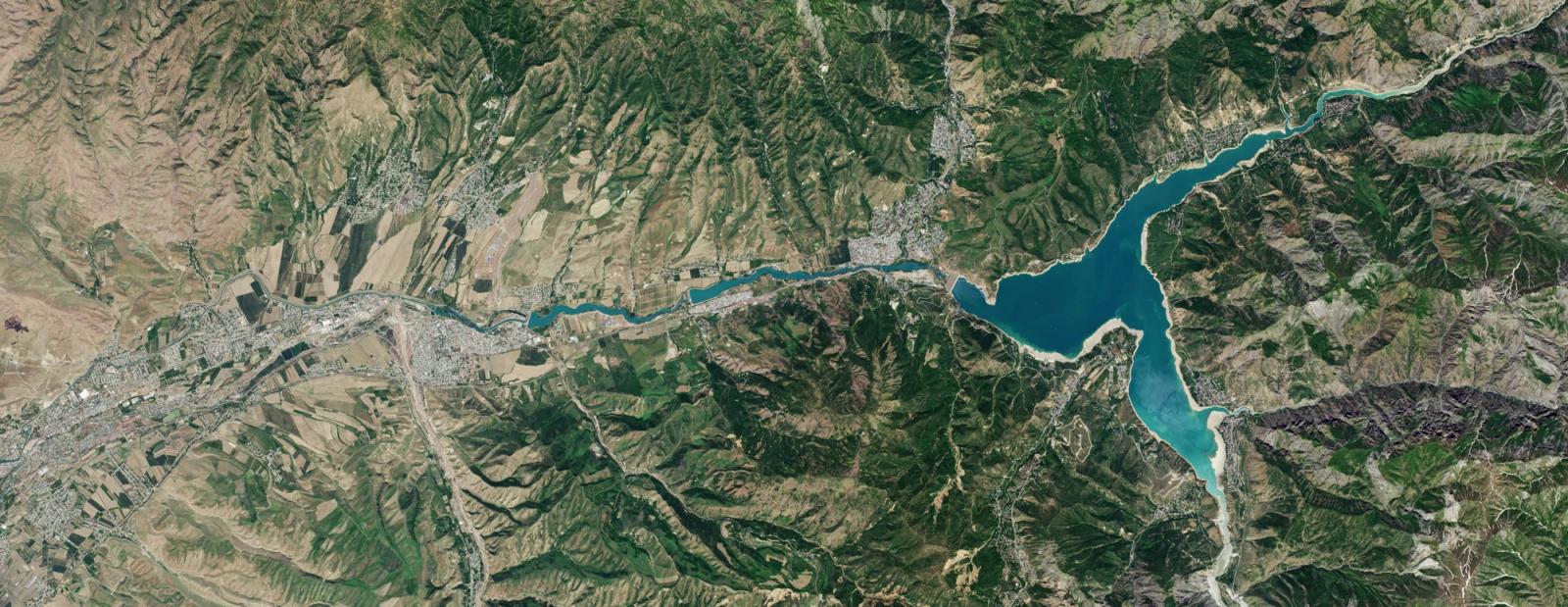
PlanetScope satellite image of Lake Charvak in Uzbekistan, a reservoir among green mountains.
PlanetScope image of Lake Charvak, Uzbekistan, captured on 15 May 2025, from Planet's Uzcosmos case study on watching reservoirs from orbit.
02 / HOW IT BECOMES REAL

From a monitored area to an analyst’s decision

Illustrative geospatial workflow; image availability and useful detail depend on the selected product and capture conditions.

  1. 01

    Select the place and the decision

    An analyst defines an area and the change that matters. The question determines whether broad monitoring or detailed tasking is more useful.

  2. 02

    Compare imagery through time

    Monitoring imagery and basemaps give an analyst a history of the area. Repeated views support investigation of where visible change has occurred.

  3. 03

    Request detail for a selected location

    Tasking products use SkySat and Pelican capabilities for higher-resolution imagery. A detailed view can add evidence after broad monitoring identifies a location of interest.

  4. 04

    Put the evidence into the customer’s workflow

    The customer uses imagery within its geospatial workflow. The CSM agrees on mission requirements, visible KPIs and an adoption plan, and passes feedback to Product, Sales and Engineering.

Follow the work, step by step

A place changes before anyone goes back to look

Planet starts from a gap in how people watch the physical world. A forest, a port or a border area can change long before a field team returns, and the sharpest satellites see only a small patch at a time. Planet's defense writing calls this the soda straw problem: detailed spy satellite photos cover a tiny area and are usually sent to look only after another source has raised an alarm. The CEO, Will Marshall, made the same point in March 2026 about the satellite layer in map apps, which he said was three or five years old. Planet's stated mission answers that gap: to use space to help life on Earth, by imaging the world every day and making global change visible, accessible and actionable.

a daily scan of the Earth

Will Marshall · Co-founder and CEO · Curious Worldview podcast, episode 224 (machine transcript) · 2026-03-25

The belief behind the company is that a complete daily record is worth more than a single sharp photo, and two choices made that record affordable. The first was size. Marshall describes taking satellites the size of a double-deck bus and shrinking them with the electronics that sit in a phone. The second was how to sell. Planet's annual report describes a one-to-many subscription: an image can be sold and used for analysis an unlimited number of times, unlike older providers that sell an image to one customer exclusively. The result is scale. Planet says it has built and deployed 450 satellites, operates at least 200 and collects over 350M sq km of imagery a day, and its archive holds about 3,000 images of an average point on land.

Cheap satellites, AI in orbit and governments that want their own eyes

Three changes made this the moment. The hardware got small and cheap enough to fly in large numbers, and Planet built a working habit around it that it calls agile aerospace: release early and often, then improve, as software teams do. Computing moved closer to the camera: Planet's newest Pelican satellites carry NVIDIA Jetson processors so that some analysis happens in orbit, and the executives' January 2026 essay argues that AI trained on internet text still cannot see the physical world as it changes. And the buyers changed. A dated Korean report traces the jump in large government orders to the start of the war in Ukraine in February 2022, and in the quarter to July 2026 Planet's defense and intelligence revenue grew more than 90% from a year earlier.

transparency drives accountability, accountability drives better decisions and action.

Will Marshall · Co-founder and CEO · Essay "Planetary Intelligence", republished on Planet's blog · 2026-05-27

Winning, in the company's words, is an Earth that can be searched like the web. Marshall wrote in May 2026 that Google indexed the internet and Planet is indexing the Earth, a line he first used at a 2018 TED talk, and that Planet is building an AI app that makes its archive queryable in natural language. In September 2026 he gave the near term version in one sentence: pair AI-enabled analytics with sovereign satellite services, meaning satellites that a government owns or reserves, built and run by Planet.

One question, followed from scan to decision

Take an illustrative case: an analyst at a coastal agency wants to know whether anything changed along a stretch of shoreline. First the analyst sets the area and the question. Then the daily scan, near-daily 3.7 m imagery of all of Earth's landmass, shows where something looks different from the day before. Planet calls the next step tip and cue: an unusual signature in the daily scan tips the sharper SkySat or Pelican satellites to look at that exact place, and Planet says a tasked 50 cm image can reach the customer less than four hours after capture. Finally the images flow into the tools the analyst already uses, through APIs and GIS connections. The Korean customer success posting names the kinds of work this feeds: border security, disaster response and urban planning.

A person still makes the call. The daily picture shows that a place changed; the reason still has to come from an analyst, and the sharper tasked image adds evidence, not certainty. What Planet sells a government is a faster and wider first look that leaves the judgement with its own people. For a Korea hire, the useful question in every meeting is what that first look adds beyond what the customer's own satellites and aircraft already show.

Understand the products and their customers

Three ways to buy a view of the Earth

Planet Monitoring is the daily scan sold as a subscription. Customers get near-daily 3.7 m imagery of all of Earth's landmass through APIs, a web application and GIS integrations, sized to the area and analysis they need. Its historical imagery supports comparisons through time. Because one image can be sold many times, a single pass can in principle serve a forestry agency, a crop analyst and a defense ministry. Buyers range from national agencies to companies such as BASF, which Planet says uses analytics from its near-daily imagery to help growers keep yields while using crop protection products more efficiently. Monitoring stands in for site visits and aircraft when the area is wide.

Planet Tasking is the close look on request. SkySat and Pelican satellites photograph a chosen place at 50 cm, and Planet says images and insights arrive less than four hours after capture. Customers either order through the Planet Select portal and pay as they go, or use a Tasking Dashboard with tasking credits for steady, integrated work. The Tasking page also describes access to an Earth-data archive of approximately 50 PB. Pelican is the new generation: it entered general availability for eligible customers in December 2025, carries six multispectral bands and an NVIDIA Jetson processor, and ten high resolution Pelicans were on orbit after a July 2026 launch. A 30 cm class second generation is planned. The January 2026 operational review describes 50 cm class imagery; the current product page lists 30 to 50 cm class capability. Applicants should distinguish those descriptions and the planned second-generation capability.

Planet Insights Platform is where both kinds of data live, a cloud platform for daily Earth data and analytics. On top of it sit analytics for defense buyers, such as automated vessel recognition and tracking at sea and monitoring of military installations and critical infrastructure, and a new agentic AI app that was free while in beta in August 2026. The AI app is the product form of what Marshall calls a queryable Earth: a user asks a question in plain language and the archive answers.

The fourth product is a satellite a country owns

Since January 2025 Planet has also sold its factory. In satellite services a government or partner funds a set of Pelican satellites that Planet builds and runs, with capacity reserved for that customer and operating services on top. The first was the largest contract in the company's history, $230M over several years with a long standing Asia Pacific partner, Japan's SKY Perfect JSAT. Germany followed in July 2025 with a EUR 240M multi-year agreement funded by its government for dedicated capacity and direct downlink over European regions, and Sweden in December 2025 with a low nine-figure deal under which its armed forces own the satellites. Planet counts more than $500M signed across the three in about twelve months, and pitches the model as a cheaper, lower risk and faster route to space capability than a nation building its own system.

Europe needs its own eyes

Will Marshall · Co-founder and CEO · Planet release on the Sweden agreement, as reported by trade press · 2026-01-14

What one customer measured, and what others bought

The clearest before and after comes from Uzbekistan. Uzcosmos used to watch reservoirs with field inspections, staff gauges, scattered reports and paper records. It then fed near-daily 3 m PlanetScope imagery into its own GIS platform to build virtual gauges over more than 50 reservoirs at once. Checked against a ground sensor from July 2024 to April 2025, the satellite water level stayed within about 10 cm under validation conditions. Planet reports the result in a September 2026 case study, with one reservoir used for the comparison.

This significantly increased confidence in using satellite intelligence for national-scale water management.

Mukhiddin Ibragimov · Deputy Director, Uzcosmos (customer) · Planet case study · 2026-09-30

Most other named customers are governments buying access for many users. In Germany, the federal mapping agency BKG gives more than 400 federal institutions access to Planet data, a partnership renewed and expanded in the quarter to January 2026. Rwanda's space agency launched a national program in June 2026 that feeds Planet imagery to ministries, public universities and selected startups for farming, forest and urban planning work. The US National Geospatial-Intelligence Agency awarded $8M in August 2026 to deploy Planet's Global Monitoring Service, and Marshall says the US Navy uses Planet to monitor developments in the South China Sea.

The government examples show different kinds of evidence. Uzcosmos reports a comparison against a ground sensor at one validation reservoir; German and Rwandan announcements describe access, contract scope and intended uses. Signet reads that distinction as useful preparation for Korea: an adoption or renewal case should state what the agency actually measured, which users adopted the workflow and what mission result was observed. The customer-success posting makes leadership-visible KPIs a core responsibility.


03 / THE EVIDENCE

The story, in numbers.

DATED OBSERVATIONS

Total annual revenue

USD · B

Company-disclosed total annual revenue in USD billions. Fiscal-year end dates are shown on each point. Historical comparatives follow the cited filing; revenue includes acquisition and currency effects and is not ARR.

Figures, dates & basis +
Total annual revenue
DateValueBasis
2021-01-31$0.113BTotal recognized revenue for the fiscal year ended 2021-01-31. Includes all reported revenue categories.
2022-01-31$0.131BTotal recognized revenue for the fiscal year ended 2022-01-31. Includes all reported revenue categories.
2023-01-31$0.191BTotal recognized revenue for the fiscal year ended 2023-01-31. Includes all reported revenue categories.
2024-01-31$0.221BTotal recognized revenue for the fiscal year ended 2024-01-31. Includes all reported revenue categories.
2025-01-31$0.244BTotal recognized revenue for the fiscal year ended 2025-01-31. Includes all reported revenue categories.
2026-01-31$0.308BCompleted fiscal year ended 2026-01-31; total recognized revenue from the earnings release, whose financial tables are unaudited. Not calendar-year 2026 guidance.

Planet / SEC · Planet

NICFI coalition award

KSAT, Planet and Airbus announced a Norway-funded forest-monitoring contract; its total coalition value is not Planet revenue.

Pelican general availability

The January 2026 review dates general availability for eligible tasking customers to December 2025.

FY2026 revenue disclosed

Annual revenue was $307.7M and RPO was $852M.

Read the growth story

Who pays, and for what

Planet reported $307.7M revenue for the year ended January 2026, up 26%. In the quarter ended July 2026, recognized revenue reached $116.1M, up 58%; defense and intelligence accounted for $81.0M, about 70% by Signet's calculation. Its 98% recurring metric applies to end-of-period data ACV, excluding satellite services and exclusively self-service platform users. Net dollar retention compares existing customers' period-end ACV with those same customers' contract ACV at the start of the fiscal year. The company reported 116% for FY2026 and 109% for the six months ended July 2026, different measurement periods. These are contract measures, separate from recognized revenue and cash received.

The dated numbers and what each one measures
NumberWhat it measuresWhen
$307.7MRevenue recognized in the fiscal year, up 26%FY2026, year to 31 January 2026
$116.1MRevenue recognized in one quarter, up 58%Q2 FY2027, quarter to 31 July 2026
$753.1MRemaining performance obligations: contracted, still to be recognized31 July 2026
$814.9MBacklog: RPO plus cancelable contract value and written orders awaiting funding appropriation; excludes unexercised options (non-GAAP)31 July 2026
More than $4BIdentified satellite services opportunities, 25% near term; opportunities, not contractsEarnings call, 3 September 2026
$430M to $441MRevenue guidance for the fiscal year, a forecastFY2027, set 3 September 2026
$15.5MAdjusted EBITDA profit (non-GAAP)FY2026
$52.9MFree cash flowFY2026

Satellite services make the money lumpier

Satellite services alter revenue timing. For the $230M Asia Pacific agreement, Planet estimated revenue recognition across approximately seven years of construction and operations. Other obligations are recognized when satellite control transfers. In the July 2026 quarter, when Planet also reported handing a satellite to Sweden, total point-in-time revenue was $14.075M, about 12% of $116.052M revenue by Signet's calculation, versus $0.830M a year earlier. The filing attributes quarterly growth mainly to large existing-customer expansions and partly to hardware deliveries; the table covers all point-in-time revenue. The next-quarter forecast was $101M to $105M. RPO stood at $753.117M in July, compared with $852.435M in January. Backlog added $61.746M of cancelable contract value and written orders awaiting appropriation, reaching $814.863M. RPO and backlog describe future obligations; delivery timing, new commitments and contract changes can affect their balances.

strengthen our financial position without taking on dilutive capital or debt

Ashley Johnson · President and Chief Financial Officer · Release announcing the $230M Pelican agreement · 2025-01-31

The question for the coming year is conversion. Marshall told investors in September 2026 that the satellite services pipeline held more than $4B of identified opportunities, 25% of them near term; these are opportunities, not signed contracts. Meanwhile the business has turned positive on its own measures: adjusted EBITDA profit of $15.5M and free cash flow of $52.9M in FY2026, with gross margin of 56% (59% non-GAAP). On standard accounting it still lost $246.9M that year, about $161.4M of it from revaluing warrants, and it held $865.4M of cash, cash equivalents and short-term investments in July 2026.

Where Asia Pacific fits

Asia Pacific and Japan generated $19.094M revenue in the quarter ended July 2026, compared with $16.150M a year earlier, about 18.2% growth by Signet's calculation. Europe, the Middle East and Africa generated $55.200M versus $23.467M, about 135.2% growth. Geography is based on customers' billing addresses. Planet's company-authored APAC article identifies the $230M SKY Perfect JSAT agreement in Japan and describes adoption in Korea, Japan, Taiwan and India. Regional totals and regional contracts provide context; they do not identify Korean revenue.

Competitors, and three risks for a seller in Korea

Planet's annual report identifies competition from commercial imaging operators, governments selling satellite data and technology companies aggregating imagery. Its product distinction is the combination of frequent broad monitoring, detailed tasking and customer-funded satellite capacity. Signet sees three questions for a Korean account owner: how delivery schedules affect a customer's contract and renewal, how commercial imagery complements Korea's own reconnaissance systems, and how partners and direct teams divide support. The filing warns about regional reseller capability and competing interests; the current customer-success posting makes retention, expansion and government stakeholder coordination concrete responsibilities.

Two habits help in an interview. Keep the measures apart: revenue is what was recognized, RPO and backlog are contracted work still to come, and the $4B pipeline is opportunities. And remember that Planet's fiscal year ends on 31 January, so FY2027 runs from February 2026 to January 2027.

04 / THE PEOPLE

Someone saw it first.

Official photograph of Will Marshall
Co-founder and CEO

Will Marshall

Planet’s current leadership page identifies Marshall as co-founder and CEO of a company that builds and operates satellites and delivers Earth-observation data.

The choice behind the company +

The company combines repeated monitoring with high-resolution tasking rather than relying on a single imaging workflow. Pelican’s commercial rollout extends that documented product choice.

“a daily scan of the Earth”

Will Marshall · Curious Worldview podcast, episode 224 (machine transcript) · 2026-03-25
The decisions behind the company

Scientists who wanted to put satellites in a pocket

Planet was founded in 2010 by three NASA scientists, according to the current official earnings release. Will Marshall is its co-founder, CEO and chairperson. Robbie Schingler is co-founder and Chief Strategy Officer. In a March 2026 interview, Marshall described shrinking large satellites through the miniaturized sensors, radios, positioning systems and processors used in mobile phones. Planet's company page connects that technical approach to the mission of making global change visible, accessible and actionable.

a daily scan of the Earth

Will Marshall · Co-founder and CEO · Curious Worldview podcast, episode 224 (machine transcript) · 2026-03-25

Schingler co-wrote the January 2026 Planetary Intelligence essay and presented the idea at TED. The company's August article describes an AI app that combines satellite data, AI-enabled change detection and public information in a map-based chat interface. Ashley Johnson is President and Chief Financial Officer on the current leadership page. In the $230M agreement announcement, she explained that customer-funded opportunities can strengthen finances without raising dilutive capital or debt. The product vision and contract design thus meet in the same business: frequent imagery and analytics supported by a satellite fleet that serves multiple customers.

Four decisions that explain the company's shape

Four choices recur. Build in house: Planet says it controls every part of hardware design, manufacturing, data processing and software, and calls its method agile aerospace. Sell many times: the one-to-many subscription turned images into repeat revenue, 98% of end-of-period data annual contract value by July 2026. Sell the factory: since January 2025 governments and partners pay Planet to build satellites for them, more than $500M in contracts in about twelve months. Go local where sovereignty matters: Planet has been in Germany since it bought the satellite operator RapidEye in 2015, and its German managing director wrote in September 2026 that the team there has more than 150 people, with about 70 more roles planned through 2027 and satellite manufacturing scheduled to start in Berlin in 2026.

Sovereignty is not simply about where a satellite is built.

Martin Polak · Managing Director, Planet Labs GmbH · Planet blog post on expanding operations in Germany · 2026-09-21

The executives responsible for selling and building

The current company page identifies Charlie Candy as Chief Revenue Officer and UK Managing Director, Kevin Kirn as Chief Product and Technology Officer, James Mason as Chief Space Officer and Andrew Zolli as Chief Impact Officer. Its Defense and Intelligence Advisory Board includes former public-sector leaders such as Sir Jeremy Fleming, Michèle Flournoy and Gen. (Ret.) Tod Wolters. The company-authored regional article identifies Kian Kang as Head of Sales, APAC. For the Korean customer-success role, the employer directly names Product, Sales and Engineering collaboration; applicants can ask how regional commercial leadership connects to that work.

How Planet says it works and hires

Planet publishes five values: do good, dream big, drive for results, be collaborative and strive for openness. Its drive-for-results explanation emphasizes hypothesis, testing, measurement and improvement. Current postings invite people to apply even if they do not meet every listed qualification. With consent, selected interviews may use an AI notetaker, and applicants can opt out without affecting candidacy. Candidate use of AI during live interviews or active assessments is strictly prohibited unless an interviewer or assessment instructions explicitly permit it. Those hiring practices sit alongside a global workforce that the annual report describes as spread across countries, including remote employees.

Signet reads the leadership choices as three layers to prepare for: Marshall's product direction, Johnson's explanation of contract economics, and the APAC commercial context described by Kian Kang. A Korean account owner can connect a government's mission need to imagery adoption, a measurable customer outcome and a renewal decision. That is an interview preparation frame, rather than a confirmed reporting relationship.

05 / THE NEXT CHAPTER

Embed imagery in Korean defense and intelligence work

The account owner supports Korean military and government agencies through the contract, builds success plans, owns renewal and expansion, and brings customer requirements to Product, Sales and Engineering.

Regional APAC sales leader identified by Planet

Kian Kang

Head of Sales, APAC

Government customer success

Current Korea JD: adoption, mission KPIs, renewal and expansion.

Defense accounts

Company-authored APAC account role and a Korean public profile observation.

Regional pre-sales and services

The company article names an APAC function; this group represents regional support scope.

The October 8 employer board, company-authored APAC article and October 8 Korean-filtered public profiles describe customer, sales and regional solution work. The three profile results are observations, separate from staff totals and reporting relationships.

Why Korea? Why now?+

Planet's Korea country sheet offers countrywide intraday imagery for territorial and natural-resource monitoring. A company-authored APAC article describes growing adoption in Korea and names Japan's $230M SKY Perfect JSAT agreement as a regional example. Korean defense reporting describes the planned final launch of the five-satellite 425 Project and future small-satellite plans. Signet reads the current customer-success role as work on adoption and renewal with Korean agencies: the commercial value must be shown in customers' own workflows and mission outcomes alongside their existing capabilities.

Planet images a Korean site

A SkySat image of the Hanul Nuclear Power Plant in Uljin, captured on 9 March 2022, leads Planet's Korea country sheet, which pitches countrywide intraday coverage to Korean ministries and agencies.

A neighbour buys a constellation

Planet announced a $230M multi-year agreement in January 2025, with revenue expected across approximately seven years. Its company-authored APAC article identifies the partner as Japan's SKY Perfect JSAT.

Korea announces its fifth reconnaissance-satellite launch

On October 31, 2025, the Defense Ministry announced that the fifth 425 Project satellite would launch on November 2. The report describes a planned two-hour revisit capability once the constellation is operational.

Korean investors meet Planet as a defense story

Korean financial press reports Planet's record quarter of $81.3M and lists NATO, the US Navy, the NRO, NASA and the German government among its main customers.

Planet names South Korea as a competitor

Planet's annual report lists South Korea among governments that sell their satellite data commercially.

Asia Pacific keeps growing

Quarterly Asia Pacific and Japan revenue was $19.094M for the period ended July 2026, compared with $16.150M a year earlier.

Understand the Korea opportunity

Why Planet is hiring for Korea now

Planet's Korea country sheet describes territorial protection and natural-resource monitoring, offering countrywide intraday imagery that can reduce aircraft collection needs. Its company-authored APAC article places Korea among markets adopting commercial geospatial intelligence and describes a shift toward persistent monitoring, time-series analysis and early warning. These are the company's regional and product arguments. The customer-success posting turns them into local work: help Korean military and government agencies use imagery in mission-critical workflows, including border security, disaster response and urban planning.

understand threats in and around their region

Will Marshall · Co-founder and CEO · Second quarter fiscal 2027 earnings call, as reported by trade press · 2026-09-03

Japan supplies a regional example: Planet's company-authored article names SKY Perfect JSAT as the $230M Pelican-agreement partner. The same article identifies Kian Kang as Head of Sales, APAC and describes regional additions in pre-sales/services and defense accounts. That gives a picture of regional commercial work, while the Korean opening specifies local account responsibilities. Signet reads the connection as a question for applicants: how are Korean customer requirements, renewal decisions and support coordinated with APAC sales and technical specialists?

A buyer that also builds its own satellites

Korea invests in domestic satellite reconnaissance. On October 31, 2025, the Defense Ministry announced the planned November 2 launch of the fifth 425 Project satellite. The reported design combines one optical/infrared satellite with four radar satellites and aims to revisit selected North Korean sites every two hours once operational. Radar adds observation across weather and lighting conditions. The ministry also described further small-satellite development. Planet's annual report identifies South Korea among governments selling satellite data. Signet reads this as a market in which a commercial provider must explain its additional use and fit alongside national capabilities.

we will continue advancing micro-satellite development

Jeong Kyu-heon · Head of the Future Power Project Division, Defense Acquisition Program Administration · Korean English-language press · 2025-10-31

Signet reads three product questions into the Korean government market. Breadth: how does frequent broad imagery reveal changes outside selected reconnaissance targets? Sharing: how can commercial, unclassified imagery move through ministry and agency workflows? Capacity: what can a dedicated commercial constellation add, as the agreements in Japan, Germany and Sweden illustrate? Those are proposed buyer questions, rather than a comparison proving the limitations of Korea's own systems. An account owner needs evidence from the customer's actual use case before arguing for adoption or renewal.

What the Korea team looks like today

Planet's current Korean customer-success role is remote and based in South Korea. It works with Product, Sales and Engineering and supports strategic military and government agency relationships. The company also publishes a partner testimonial from Korea's SI Analytics about imagery used for Asia Pacific intelligence agencies. Three Korean-filtered LinkedIn profiles were observed on October 8; one identifies a Korea representative, while the company-authored APAC article identifies that person's industry account-executive role. The public view therefore groups customer success, sales and regional solution support by evidence, with Kian Kang named only as the APAC sales leader.

The open role: government adoption, renewal and expansion

On October 8, the employer board listed Customer Success Manager (D&I - South Korea). It is the main customer contact across the contract, builds success plans with leadership-visible KPIs, owns renewal and expansion, and channels Korean government requirements internally. Required experience is at least four years working directly with South Korean Defence Forces and/or Federal Government agencies, a relevant bachelor's degree, procurement knowledge and understanding of GIS, remote sensing or imagery analysis. Excellent spoken and written Korean and professional working English are required. ArcGIS, QGIS and Google Earth Engine familiarity, military or reserve experience and relevant customer-success/account experience are among the preferred qualifications. It is commission eligible, remote in Korea and asks for willingness to travel.

Signet reads this as a role that links customer outcomes with commercial continuity. A renewal argument needs a clear account of how imagery helped the agency, what its analysts adopted and which new mission need supports expansion. Working remotely calls for explicit coordination with the global Product, Sales and Engineering colleagues named in the posting. Applicants can ask about the current account portfolio, travel pattern and decision ownership in the interview.

Korea openings

No current Korea openings were found. The company story is still available.

See overseas openings →
07 / NOW & NEXT

The next scene is taking shape.

Norway forest-monitoring contract

A KSAT-led coalition with Planet and Airbus received the NICFI contract.

Pelican commercial rollout reviewed

Planet reported December 2025 general availability for eligible customers and described future capability demonstrations as plans.

FY2026 revenue grows 26%

Planet reported $307.7M annual revenue and $852M RPO.

More context on what comes next

Sovereign deals keep landing

Read against the thesis, the last quarter added weight on both of Planet's growth paths. On sovereign work, August 2026 brought an $8M award from the US National Geospatial-Intelligence Agency to deploy Planet's Global Monitoring Service and a German Interior Ministry tender for dedicated satellite capacity worth up to EUR 25M over five years, while Planet handed a satellite over to the Swedish Armed Forces. In September it described preparations for satellite manufacturing in Berlin, scheduled to begin in 2026, with about 70 more roles planned there through 2027.

AI moves from essay to product

On AI, Marshall said in March 2026 that 'Queryable Earth is happening this year', and by August Planet's agentic AI app was available at no cost while in beta. In his May essay he named the larger goal Large Earth Models, AI that learns from data about the physical world. Planet also opened a London office as a national hub for AI and analytics partnerships, and Marshall counted an R&D partnership with Google to explore data centers in space among the past year's milestones. On hardware, the July 2026 launch brought the number of high resolution Pelicans on orbit to ten.

The results connect the company's strategy to recognized revenue. Defense and intelligence revenue increased about 93.3% in the July quarter by Signet's calculation, while EMEA revenue grew about 135.2%. Full-year revenue guidance moved from $415M to $440M in March to $430M to $441M in September. These are forecasts for the year ending January 2027. The filing attributes quarterly growth mainly to existing-customer contract expansion and partly to hardware deliveries. Signet reads delivery schedules as one reason to compare quarter-to-quarter forecasts carefully; the next quarter was guided to $101M to $105M.

What to watch over the next year

  • Whether full year revenue lands inside the $430M to $441M guidance as satellite handovers move between quarters.
  • How much of the more than $4B satellite services pipeline turns into signed contracts, and in which regions.
  • How adoption, renewal and new use cases develop across Asia Pacific, which recorded $19.094M revenue in the latest reported quarter.
  • Pelican's planned 30 cm class second generation, and how the AI app is sold once its free beta ends.

Their future. Your next chapter.

Find your part ↑

An independent profile by Signet. No affiliation or investment recommendation. Introductions happen only with your consent.
Research reviewed 2026-10-08

A LITTLE MORE CONTEXT

Understanding Planet.

What does Planet do?

A forest, port or construction site can change faster than a field team can revisit it. Planet operates imaging satellites and delivers imagery that analysts can compare over time, combining broad-area monitoring with higher-resolution tasking for selected locations.

What is the opportunity in Korea?

The account owner supports Korean military and government agencies through the contract, builds success plans, owns renewal and expansion, and brings customer requirements to Product, Sales and Engineering.

Are these confirmed job openings?

Employer postings were checked on 2026-10-08. Availability can change. Mock applications request a review from Signet.

How can I explore the company in more depth?

Follow the company from its vision through products, evidence and people to the Korea team and current roles. Use the table of contents to move within the page, and expand the sections for more context.

Back to the collection ↗