Game marketing research
Two weeks to two days, June 2025 customer case.The case reports a two-day research workflow.
What changed? +
Competitor-ad analysis took two weeks.
ThumbAge’s reported competitive research workflow.


A game publisher sees downloads rise while engagement weakens, and a brand notices new traffic arriving through an AI assistant.
See it taking shape ↓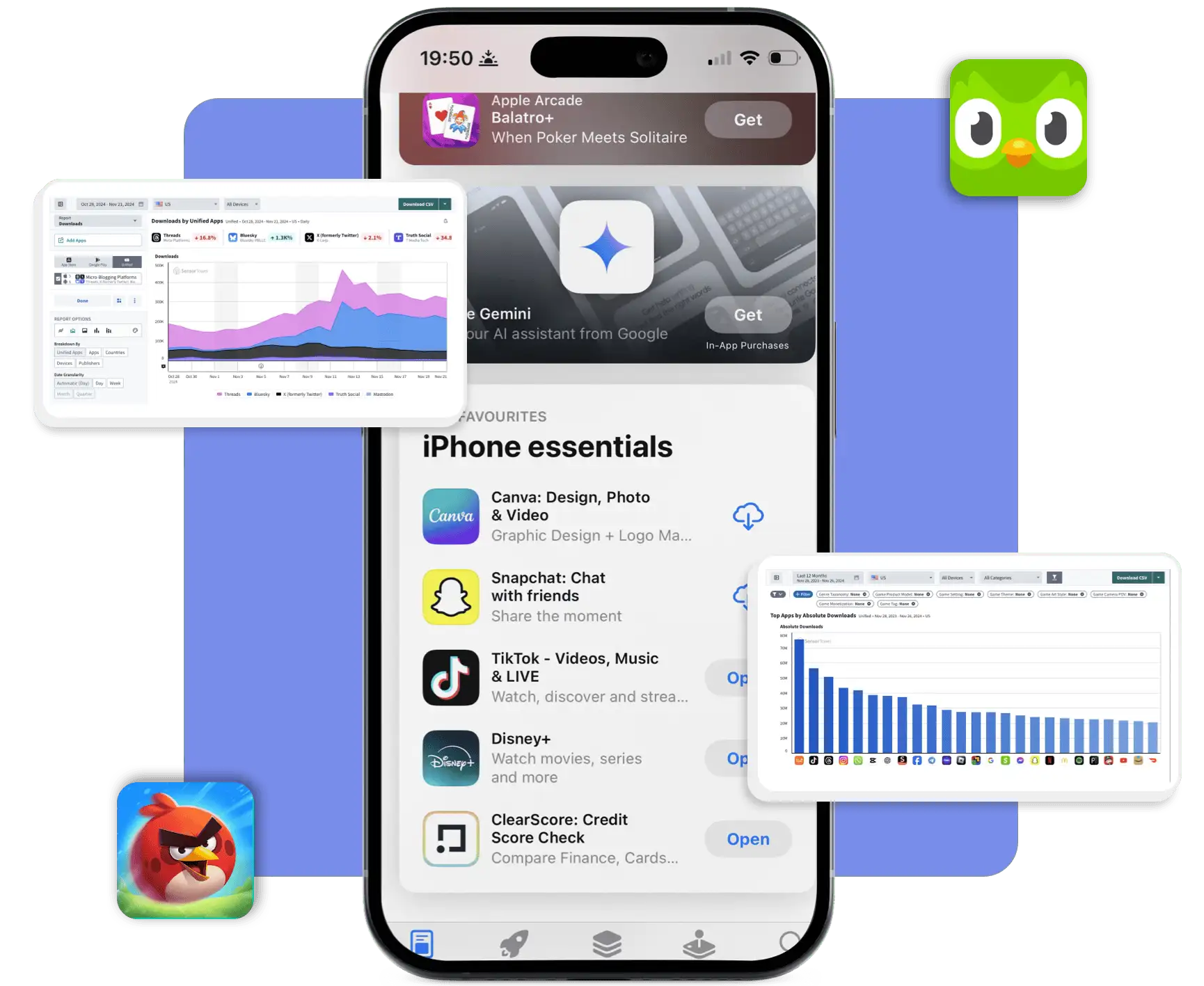
Put an app’s metrics in market context.
The case reports a two-day research workflow.
Competitor-ad analysis took two weeks.
ThumbAge’s reported competitive research workflow.
Illustrative scene: a Korean game publisher reviews a new overseas campaign.
Choose the question, category and market.
Inspect app, audience and advertising estimates.
Connect the result with a customer’s next action.
A game publisher sees downloads rise while engagement weakens, and a brand notices new traffic arriving through an AI assistant. Sensor Tower supplies a way to compare those signals with other apps, websites and advertising activity. Its homepage organizes the proposition around the consumer’s digital journey. Signet starts with a defined business question, such as which market or channel deserves investigation, then chooses the corresponding dataset. The practical deliverable is a comparison a team can use in a product or marketing decision. Different measurements answer different questions, so downloads, engagement and advertising exposure need their own definitions.
App Performance Insights estimates downloads, revenue and usage across the Apple App Store and Google Play. A team can compare a category, country and platform before investigating an individual app. Advanced Usage Insights adds engagement, retention and overlap between applications. Signet would follow an illustrative puzzle-game launch from category demand to the apps that retain an audience. The comparison is useful when the period and market stay consistent. An increase in new downloads can coexist with weaker returning usage, so the analyst should show both the entry into an app and the behavior after that entry.
The sourcing page describes a proprietary panel of more than ten million consumers, with opt-in utility, wellbeing, gaming and browser applications. Sensor Tower combines panel signals with first-party and public information, then models broader behavior. Its descriptions emphasize deidentification before data leaves the device, privacy controls and quality monitoring. Signet treats the resulting measure as an estimate grounded in observed behavior. A panel observation is a starting input, and a model extends it to a defined population. The distinction matters when an analyst explains why the number differs from a customer’s own directly measured sales or audience.
Pathmatics makes advertising comparisons through estimated spend and impressions alongside the observed creative, placement and campaign timing. Web Insights connects website traffic, app behavior and AI discovery signals; True Audience deduplicates reach across supported surfaces. Signet would keep the country, date range and covered channel visible beside every comparison. A competitor’s higher estimated spending gives a team a hypothesis about its campaign, while the creative shows what the audience saw. A decision can then connect the hypothesis with the customer’s own results rather than assuming that spending alone explains a commercial outcome.
Audience Insights describes behavioral segments, other apps used by an audience and its advertising exposure. That adds a practical question to a category comparison: who overlaps with the customer’s audience and where might that audience be reached? Signet would prepare a short brief with the selected segment, a comparison group and an action the customer can test. The supporting chart should retain its measurement basis. A useful account review connects product, marketing and commercial colleagues around the same business question, so each participant can understand which evidence is shared and which part of the decision depends on their own data.
The live MCP interface lets compatible AI clients query Sensor Tower data through an existing API subscription and credentials. It changes how a user asks a question while retaining the underlying dataset permissions. Signet would demonstrate a bounded request with the country, category and period stated, then inspect the supporting result before using it in a recommendation. The Seoul Account Director posting connects this workflow to quarterly business reviews and product feedback. Explaining a customer’s question clearly, choosing suitable evidence and managing expectations around a feature request are connected parts of the service rather than separate presentation exercises.
App Performance Insights is the mobile market analysis product. Downloads, revenue estimates, active usage, rankings and country comparisons help a developer, publisher or investor understand an application’s position. The product page also describes app-store optimization, prospecting and investment research. Signet would select a narrow workflow before describing all the features: compare a game with a defined peer group, inspect its recent trend and identify the next question for the team. The official product illustration shows app-store content and analysis charts. Its charts illustrate the interface, while the customer’s own selected report supplies the evidence for a decision.
App Advertising Insights focuses on user acquisition through ad networks and creative analysis. Advanced Usage Insights adds deeper engagement and retention, while gaming solutions organize games by genre, monetization and mechanics. Video Game Insights extends the suite to Steam, Xbox and PlayStation, and Playliner covers live operations in mobile games. These components answer related but distinct questions about discovery, continued usage and changes inside a game. Signet would explain a launch followed by a live event, using a consistent cohort and observation period. The analysis then connects an acquisition hypothesis with a later engagement signal without treating the two measures as interchangeable.
Pathmatics supplies digital advertising intelligence for brands, agencies and publishers. It compares spending and impression estimates, share of voice, creative messages and placements across supported channels. Retail Media Insights adds onsite, offsite and co-branded retail campaigns to that analysis. Signet would show the buyer a creative, the period in which it ran and the market comparison around it. That makes the question concrete: whether to investigate a competing message, a retail partnership or a different channel. Coverage varies with the selected geography and product access, so the demonstration should use the channel the buyer actually needs.
Web Insights follows traffic sources, onsite behavior, paths and AI discovery. Audience Insights adds behavioral context about the people using apps and the ads they encounter. Together, the products support a broader view of how an audience discovers and returns to a digital service. Signet would compare desktop and mobile behavior, then inspect whether a referral or an AI citation accompanies the change. The analysis should name the observed relationship and keep causal claims proportional to the evidence. Seeing two signals move together can justify a closer investigation, while an experiment or the customer’s internal records can establish a stronger account of the outcome.
The MCP server is a current access route for customers with an active Sensor Tower API subscription. The January 2026 product review also describes Salesforce integration and natural-language Sense AI navigation delivered during 2025. Those tools put the same market evidence closer to an existing sales or analysis workflow. Signet would distinguish finding a report from retrieving authorized data and from acting on the result in another system. A short demonstration can show the question, the report reached and the fields transferred to the customer’s workflow. The user can then judge how the integration changes a task they already perform.
The July 2026 Google Ads integration connects an advertiser’s existing Meta and TikTok creative assets with new Performance Max and Demand Gen campaigns. The May AppMagic acquisition adds a dedicated small-business direction to the mobile intelligence suite. These developments broaden the places where intelligence is used and the kinds of customers served. Signet would choose a product introduction based on the buyer’s actual task: an enterprise portfolio review, a smaller studio’s market research or an advertiser’s asset reuse. The introduction should describe the available workflow and keep future team or technology integration attached to the acquisition announcement’s stated plans.
One current lower-bound operating snapshot.
| Date | Value | Basis |
|---|---|---|
| 2026-10-10 | 2,500+ | Customer enterprises, separate from sales or valuation. |
Sensor Tower
On May 12, 2026 Sensor Tower released enhanced Web Insights with expanded coverage, path-conversion data and AI discovery analysis. The announcement describes more than four million websites across 56 countries and a deduplicated True Audience view across supported web and mobile surfaces. Signet reads the release through a customer trying to understand a change in traffic: compare channels, inspect the path and examine whether AI referrals or citations accompany the movement. The announced coverage is a dataset measure, separate from Sensor Tower’s own customer count or sales. A useful review keeps that distinction visible with the date and chosen geography.
The July 28, 2026 integration lets advertisers access their own existing Meta and TikTok creative assets from Google Ads when building Performance Max or Demand Gen campaigns. The announcement says the earlier beta has become available for campaign use, with suggestions based on recency and relevance. Signet would assess the change by tracing an advertiser’s asset from its existing campaign into the new setup. The commercial question is whether this reduces the work of preparing a cross-platform campaign. The release concerns reuse of the advertiser’s assets; the explanation should keep that scope clear instead of presenting it as permission to copy another company’s creative.
The August 2026 product article introduces ChatGPT advertising in Digital Advertising Insights for US campaigns. It describes spend, impressions, share of voice and creative analysis, with mobile-app advertiser data beginning April 1 and desktop history beginning June 1. Signet would compare this channel with the customer’s other supported media over a shared period and keep the different history start dates visible. This is a new measurement surface in the advertising product. Its reported category or campaign figures remain market estimates, and the product announcement’s broader predictions about the advertising ecosystem are separate from the delivered tracking capability.
Sensor Tower sells access to digital intelligence products to developers, publishers, brands, agencies and financial institutions. The App Performance product page describes paid plans whose scope depends on markets, features and access level; the MCP page requires an active API subscription. Signet reads the business through what the buyer receives: continuing access to comparable evidence and tools for using it in decisions. The account relationship includes support, product feedback and reviews of the customer’s use cases. A product with broader coverage can serve additional questions, while the commercial result depends on what each customer actually purchases and continues to use.
The current company page reports more than 2,500 enterprise customers. The chart records the lower bound at the October 10, 2026 check as a single operating snapshot. It describes the breadth of the customer base, with named examples including Microsoft, P&G, Tencent and UBS in the investment announcement. Signet would use the measure to ask about customer segments and the kinds of decisions the product supports. A count of enterprises is distinct from revenue per account, recurring revenue or margin. The same company may buy a narrow dataset or a broader suite, so customer count alone does not price the relationship.
The May 2020 announcement reports a $45 million Riverwood growth investment following an earlier $1 million seed investment. It also reports 65% year-over-year ARR growth for 2019 and historical profitability. Those statements belong to the dated financing announcement. Signet keeps investment amounts separate from sales and company value, and treats the growth rate as a relative change rather than an annual revenue total. The financing account explains an intention to improve execution and scale the team. That context helps a reader understand how capital was meant to support product development without converting it into a financial performance series.
The October 2025 Shinhan Securities announcement describes a strategic investment aimed at Web and generative-AI datasets. It reports revenue growing at a 60% compound annual rate over the preceding five years. Signet keeps the stated window and measure attached to that claim. A compound rate summarizes change over a period and does not supply a year-by-year amount or a single year’s ARR. The announcement also describes acquisition-led expansion in gaming and data.ai. A reader can therefore connect the financing purpose with the product direction while examining organic adoption and acquired capabilities as different contributors to the broader offering.
The Korea Account Director role uses renewals, upsells and net revenue retention as core commercial KPIs. That makes the ongoing value of the product part of the local business model. Signet would review the customer’s adopted datasets, the decisions they inform and the next useful expansion before proposing a broader contract. Quarterly business reviews provide a venue for that discussion. A credible expansion starts with a customer question the existing workflow cannot yet answer, then demonstrates the relevant capability. The account owner needs to connect the proposed access with a result the customer can evaluate and continue using.
For the buyer, the economic benefit may be faster competitive research, better planning or a more focused experiment. ThumbAge’s dated case describes competitor-ad analysis shrinking from two weeks to two days in its game marketing workflow. Signet keeps that result within the specific customer account and asks which step saved time. Three business questions follow from the product: whether estimates remain useful as coverage changes, whether acquired datasets form a consistent experience, and whether customers keep finding a reason to renew. These are Signet’s analytical risks, grounded in the sourcing model, the product integration history and the account role’s responsibilities.

Sensor Tower’s company page dates its founding to 2013. Oliver Yeh’s March 2020 anniversary article describes an early mobile analytics service growing through App, Store, Advertising and Usage Intelligence. Alex Malafeev’s May 2020 company article identifies Yeh and Malafeev as co-founders. Signet uses these accounts to explain an origin around a developer’s market question. An app team wants to understand discoverability and performance beyond its own dashboard; a shared intelligence product gives it a view of the surrounding market. The history becomes useful when the reader can connect the original question with the current app and advertising products.
The 2025 review describes integration of data.ai metrics, new Web Insights, gaming acquisitions and retail-media additions. Yeh’s May 2026 Web Insights statement emphasizes users moving between web, mobile, advertising and AI tools. Signet reads those decisions as a broader measurement problem. A single app’s downloads show only one part of a consumer’s behavior; the team needs related evidence to understand a path or a competing use of attention. Product breadth therefore creates work in taxonomy, coverage and interpretation. A useful explanation shows which new signal answers the customer’s question and how it fits with the earlier measurement.
“We believe this new chapter will allow us to accelerate our growth, innovate, and develop comprehensive solutions for an ever-changing mobile ecosystem.”
Alex Malafeev · Riverwood investment announcement · 2020-05-04
Sensor Tower’s company page dates its founding to 2013. Oliver Yeh’s March 2020 anniversary article describes an early mobile analytics service growing through App, Store, Advertising and Usage Intelligence. Alex Malafeev’s May 2020 company article identifies Yeh and Malafeev as co-founders. Signet uses these accounts to explain an origin around a developer’s market question. An app team wants to understand discoverability and performance beyond its own dashboard; a shared intelligence product gives it a view of the surrounding market. The history becomes useful when the reader can connect the original question with the current app and advertising products.
The May 4, 2020 financing announcement identifies Malafeev as co-founder and CEO at that time. The May 12, 2026 AppMagic announcement identifies Yeh as co-founder and CEO. Signet preserves the date with each leadership reference. The 2020 article explains the Riverwood partnership through operational experience, product execution and the growth of the team. That is a practical leadership choice: the company sought additional capability around the product as well as investment capital. A reader can use the dated decision to understand what the founders wanted the business to do next, while treating historical titles as historical titles.
The 2025 review describes integration of data.ai metrics, new Web Insights, gaming acquisitions and retail-media additions. Yeh’s May 2026 Web Insights statement emphasizes users moving between web, mobile, advertising and AI tools. Signet reads those decisions as a broader measurement problem. A single app’s downloads show only one part of a consumer’s behavior; the team needs related evidence to understand a path or a competing use of attention. Product breadth therefore creates work in taxonomy, coverage and interpretation. A useful explanation shows which new signal answers the customer’s question and how it fits with the earlier measurement.
The AppMagic acquisition statement connects the broader enterprise platform with smaller mobile studios and independent developers. The Google Ads announcement puts creative intelligence inside the advertiser’s campaign setup. These are different expansion choices: one changes the customer segment, and the other changes the place where a customer uses evidence. Signet would assess each through its intended user and the concrete task affected. For an account leader, that means understanding which product belongs in a customer’s workflow and which part of an announcement is still a future integration plan. The founder’s direction becomes reviewable through those product and customer decisions.
The careers page names Deliver Magic, Go First, Journey Together and Light the Way. The descriptions connect customer understanding, taking initiative, sharing experience and using knowledge to guide decisions. Signet would ask a candidate for a specific example of turning an ambiguous customer question into an actionable comparison. That preparation links initiative with the quality of the final explanation. Moving quickly can still include a careful definition of the period, the segment and the expected result. A colleague should be able to follow the reasoning and use the same evidence in the next conversation with the customer.
The current Korea posting makes collaboration concrete through product, marketing, data science and support. It assigns account ownership to an individual contributor who communicates with customer executives and manages feature expectations. Signet reads that combination as a need for commercial judgment and precise explanation. The candidate’s example can show what the customer wanted, which evidence changed the discussion and how the team agreed on the next action. A successful explanation also names the limit of the dataset. That gives the customer a reason to trust the judgment and helps colleagues handle product feedback without promising a capability ahead of its release.
The stated hybrid schedule is two office days, Tuesdays and Thursdays, with three work-from-home days. The account owner collaborates with global product, engineering and technical teams to improve the Korea offering and manage expectations around feature requests. Signet would distinguish a current capability, a customer request and an agreed next release when explaining a case. That is especially useful when a local customer needs a country or channel view. A clear internal record can carry the customer’s question to the appropriate colleagues and return an accurate response without treating a request as a committed product feature.
The current posting defines the local account function.
ThumbAge is a named Korean customer in the June 2025 company case. It describes using Sensor Tower to analyze competing creatives, segment the RPG market and understand overlapping audiences for Godraid’s overseas marketing. The case reports competitor-ad analysis moving from two weeks to two days. Signet uses that as a specific workflow example, keeping the customer, product and date beside the result. The October 2025 Shinhan Securities investment is a separate relationship: Shinhan supplies strategic investment capital for product development. A Korean investor and a Korean product customer contribute different evidence about the company’s connection with the market.
A Korean game customer describes its research workflow.
Strategic product-development investment.
The company page lists Seoul among Sensor Tower’s offices. On October 10, 2026 the official careers page’s Seoul filter showed one opening, Account Director, linked to the employer’s Ashby detail. The posting locates the role in Seoul, South Korea, under Sales & Account Management, with full-time employment and hybrid work. Signet treats the posting as evidence of a current customer-facing function in Korea. The role’s title alone does not define its level of management: the body explicitly describes an individual contributor with no direct reports or people-management responsibilities, owning a portfolio of strategic Korean customers.
The account owner manages the customer journey through renewals, upselling and account expansion. The posting names NRR as the central commercial measure and assigns executive discussions, quarterly business reviews and interpretation of market trends. Signet reads the work as connecting a customer’s business question with product adoption and a commercial next step. A useful example could begin with a game publisher preparing an overseas campaign, then show the peer comparison, the review with the customer and the agreed action. This is Signet’s preparation suggestion based on the posting, rather than an additional employer assignment or a promised interview exercise.
The employer asks for fluent Korean and English, experience in SaaS sales or an equivalent account executive or account manager role, and an understanding of Korea’s brands, gaming, commerce or financial-services ecosystem. It also requires clear explanation of complex data to nontechnical audiences and initiative in a small, fast-moving team. Signet would prepare a candidate to describe one customer case in both languages, preserving the metric definitions and commercial decision. The posting sets no specific minimum number of years, so the preparation should focus on demonstrated account ownership and the ability to explain an analytical product.
The stated hybrid schedule is two office days, Tuesdays and Thursdays, with three work-from-home days. The account owner collaborates with global product, engineering and technical teams to improve the Korea offering and manage expectations around feature requests. Signet would distinguish a current capability, a customer request and an agreed next release when explaining a case. That is especially useful when a local customer needs a country or channel view. A clear internal record can carry the customer’s question to the appropriate colleagues and return an accurate response without treating a request as a committed product feature.
ThumbAge is a named Korean customer in the June 2025 company case. It describes using Sensor Tower to analyze competing creatives, segment the RPG market and understand overlapping audiences for Godraid’s overseas marketing. The case reports competitor-ad analysis moving from two weeks to two days. Signet uses that as a specific workflow example, keeping the customer, product and date beside the result. The October 2025 Shinhan Securities investment is a separate relationship: Shinhan supplies strategic investment capital for product development. A Korean investor and a Korean product customer contribute different evidence about the company’s connection with the market.
Korean-language reports also show analysis of local and overseas gaming behavior. The November 2025 gaming report explicitly defines store-based revenue and downloads and excludes third-party Android markets, predownloads and repeated downloads. It discusses mobile, PC and console titles as subjects of research. Signet keeps those researched companies distinct from contracted customers. For an applicant, the report is useful preparation for interpreting a country, platform and measurement boundary. The next step is to turn that interpretation into a customer discussion, explain where a dataset answers the question and connect the finding with a decision the customer can test.
Current Signet catalog · 2026-10-19
Prepare an IC account example in Korean and English.
On May 12, 2026 Sensor Tower released enhanced Web Insights with expanded coverage, path-conversion data and AI discovery analysis. The announcement describes more than four million websites across 56 countries and a deduplicated True Audience view across supported web and mobile surfaces. Signet reads the release through a customer trying to understand a change in traffic: compare channels, inspect the path and examine whether AI referrals or citations accompany the movement. The announced coverage is a dataset measure, separate from Sensor Tower’s own customer count or sales. A useful review keeps that distinction visible with the date and chosen geography.
The July 28, 2026 integration lets advertisers access their own existing Meta and TikTok creative assets from Google Ads when building Performance Max or Demand Gen campaigns. The announcement says the earlier beta has become available for campaign use, with suggestions based on recency and relevance. Signet would assess the change by tracing an advertiser’s asset from its existing campaign into the new setup. The commercial question is whether this reduces the work of preparing a cross-platform campaign. The release concerns reuse of the advertiser’s assets; the explanation should keep that scope clear instead of presenting it as permission to copy another company’s creative.
The August 2026 product article introduces ChatGPT advertising in Digital Advertising Insights for US campaigns. It describes spend, impressions, share of voice and creative analysis, with mobile-app advertiser data beginning April 1 and desktop history beginning June 1. Signet would compare this channel with the customer’s other supported media over a shared period and keep the different history start dates visible. This is a new measurement surface in the advertising product. Its reported category or campaign figures remain market estimates, and the product announcement’s broader predictions about the advertising ecosystem are separate from the delivered tracking capability.
A game publisher sees downloads rise while engagement weakens, and a brand notices new traffic arriving through an AI assistant. Sensor Tower supplies a way to compare those signals with other apps, websites and advertising activity. Its homepage organizes the proposition around the consumer’s digital journey. Signet starts with a defined business question, such as which market or channel deserves investigation, then chooses the corresponding dataset. The practical deliverable is a comparison a team can use in a product or marketing decision. Different measurements answer different questions, so downloads, engagement and advertising exposure need their own definitions.
The stated hybrid schedule is two office days, Tuesdays and Thursdays, with three work-from-home days. The account owner collaborates with global product, engineering and technical teams to improve the Korea offering and manage expectations around feature requests. Signet would distinguish a current capability, a customer request and an agreed next release when explaining a case. That is especially useful when a local customer needs a country or channel view. A clear internal record can carry the customer’s question to the appropriate colleagues and return an accurate response without treating a request as a committed product feature.
Employer postings were checked on 2026-10-10. Availability can change. Mock applications request a review from Signet.
Follow the company from its vision through products, evidence and people to the Korea team and current roles. Use the table of contents to move within the page, and expand the sections for more context.