Official portrait of Sridhar Ramaswamy
Snowflake / THE WORLD THEY ARE BUILDING

Data moves. The business moves with it.

Cortex extends the platform from SQL analysis into retrieval and AI applications. The practical opportunity is to make enterprise knowledge usable while retaining the access rules of the data platform.

See it taking shape ↓
01 / THE PRODUCTS

The products behind the promise.

Snowsight homepage with navigation, quick actions, and recent projects
Official Snowsight documentation screenshot, annotated to explain the homepage. Names and recent items are masked in the source image.
Snowflake AI Data Cloud

Store and query business data using virtual warehouses.

Teams can scale workloads separately while using a common data foundation.

Siemens Energy

Make paper-based knowledge searchable

The case describes 800,000 pages of documentation.

The published customer story describes converting the material into digital resources and using Cortex to support a document chatbot.

What changed? +

Critical documentation contained knowledge that was difficult to access as paper material.

Snowflake customer story; page count describes the project’s source material, not revenue or a measured time-saving result.

GS E&C (GS건설)

AI-ready construction data in one or two days

Data creation and validation work that took two working weeks or more now takes one to two days, about 90 percent less time.

GS E&C built a data lakehouse on Snowflake, used CoCo to automate the creation of AI-ready data, and gave staff a chatbot that answers questions about site data in plain language. People review and approve what CoCo prepares.

What changed? +

Data silos between departments blocked combined analysis, each team kept its own data models and standards, and a complex permission setup made safe sharing hard.

Snowflake customer case in Korean on snowflake.com; the result is GS E&C's own measure, as published by Snowflake.

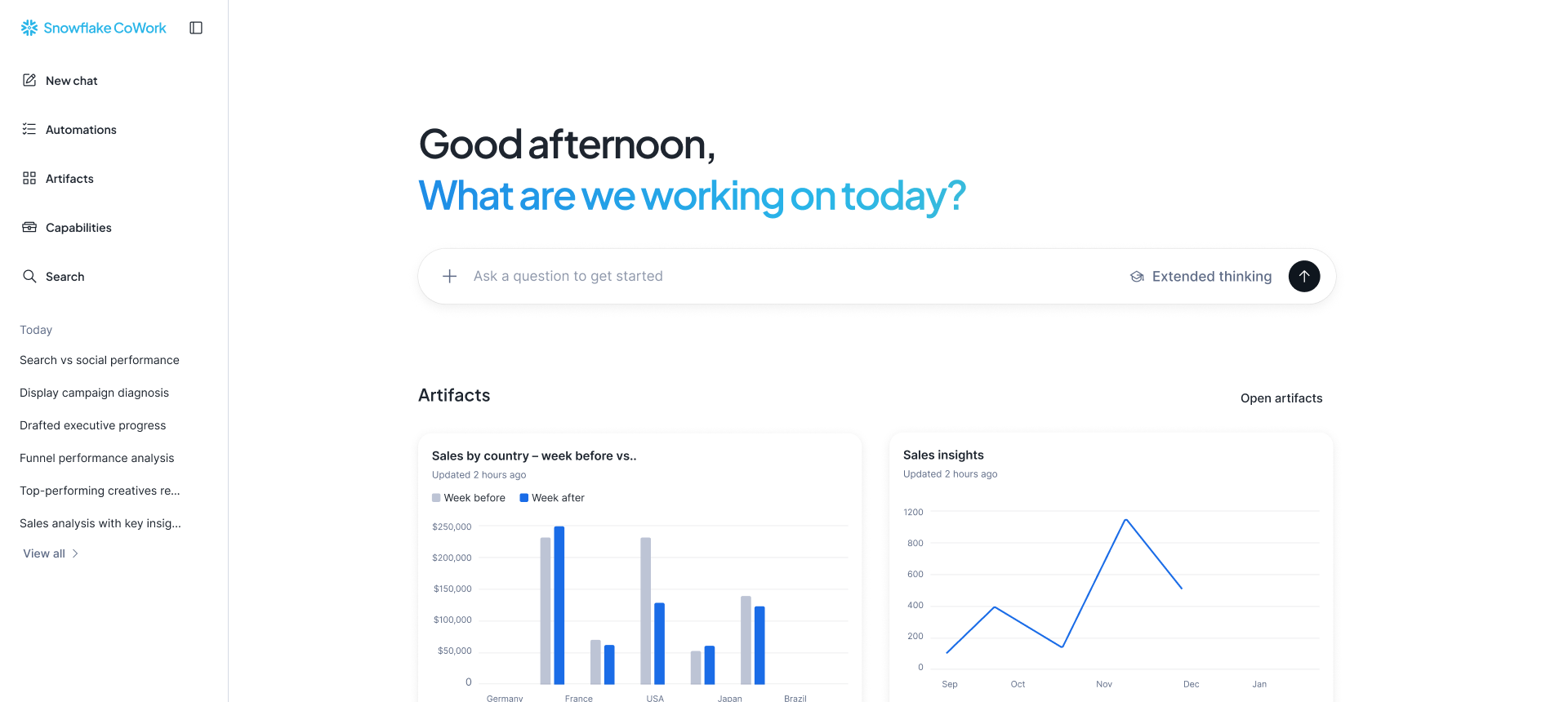
Snowflake CoWork home screen with a question box and two sales charts
CoWork, the agent for business users, on its product page: a question box, and saved answers shown as charts built from company data. The figures are demonstration data.
02 / HOW IT BECOMES REAL

From scattered records to an answer grounded in company data

An illustrative workflow built from Snowflake analytics and document-search capabilities.

  1. 01

    Load the data and assign access

    A data team organizes source records in shared storage. Roles determine which datasets an analyst or application may use.

  2. 02

    Run workloads on independent compute

    Virtual warehouses provide separate compute for different teams. An analyst can query business data without making every workload share one compute queue.

  3. 03

    Find evidence inside technical documents

    Cortex Search supports retrieval over enterprise content. A useful answer begins with finding the relevant material rather than relying only on a model’s general knowledge.

  4. 04

    Build an application people can question

    Cortex Analyst and AI services let builders connect natural-language interactions to company data. Teams evaluate the answer and its supporting evidence before using it in decisions.

Follow the work, step by step

One copy of the data, many teams at work on it

Snowflake starts from a problem every large company knows. Customer records live in one system, production data in another and documents in a third, and each team copies what it needs into its own tool. The copies drift apart, and so do the rules on who may see them. The annual filing states the company's answer in one line: Snowflake "solves the decades-old problem of data silos and data governance." Its founders built a data platform for the cloud from scratch so that one copy of the data could serve every team.

The design behind that promise is simple to state. The documentation describes three layers: storage, compute and cloud services. Compute comes as virtual warehouses, and each one is an independent cluster that does not slow the others down. A finance team's month-end report and a data scientist's model can run on the same data at the same time without queuing for one machine. Instead of moving data into a separate system for each task, the documentation says, "you can bring all of your workloads directly to their data".

The winners will be the platforms that combine trusted enterprise data, governed business metrics, secure execution, and broad model choice, and make all of it easy to use.

Sridhar Ramaswamy · Chief Executive Officer · Q4 fiscal 2026 earnings call · 2026-02-25

Why now: agents need governed data first

The belief that sets Snowflake apart today is about where AI should run. Many AI products ask a company to send its data to a model. Snowflake argues the reverse. Its CEO and an Accenture executive wrote in June 2026 that Snowflake enables model choice, "bringing AI to your data rather than moving your data to the model." The access rules a company has already set for its people then apply to its AI agents as well. Amorepacific, a Korean customer, describes exactly this: its existing role-based permissions carry over to AI work unchanged.

Why now comes down to three moves. In May 2023 Snowflake bought Neeva, a private AI-powered search engine, and Neeva's co-founder Sridhar Ramaswamy took charge of Snowflake's AI strategy; in February 2024 he succeeded Frank Slootman as chief executive. By February 2026 the CEO was calling two agents, Snowflake Intelligence and Cortex Code, meaningful steps in the company's evolution, and in June 2026 they were renamed CoWork, for every knowledge worker, and CoCo, for data engineers. Then the numbers turned. Product revenue growth accelerated for three quarters in a row, from 30 percent to 34 percent to 37 percent in the quarter ended July 2026, which the CFO linked in part to "a meaningful step-up in AI revenue".

One manufacturer's path through the platform

Follow an illustrative manufacturer, the kind of customer a seller in Seoul meets. Its data team first loads production records, quality logs and manuals into shared storage and decides, role by role, who may use which data. Analysts query on their own virtual warehouse, so a heavy report slows no one else. Cortex Search then finds the relevant passages inside technical documents, and an agent built with Cortex answers questions in plain language, with governed data and the retrieved passages behind each answer. A person still decides at every step: which data is trusted, what a good answer looks like, and whether to act on it.

GS E&C, the Korean construction company, has published the real version of this path. With CoCo preparing AI-ready data and people reviewing and approving it, data creation and validation work fell from two working weeks or more to one to two days, about 90 percent less time. Site staff can now simply ask which site had welding work yesterday.

The pitch has moved from storing data to acting on it, but the money still comes from one place: work running on Snowflake's computers. Each new agent gives a customer another reason to run more work on data it already keeps there. The question to watch is whether that holds when Databricks, the cloud providers and the model makers make the same promise to the same buyers.

Every Korea role sits somewhere on this path. A large Korean group has scattered data, a regulator asks where that data lives, and many AI projects stall at the proof of concept stage, as the Korea country manager put it in August 2026. The job is to move a customer along the path and keep the data inside the governed platform while doing it.

Understand the products and their customers

A place for the data, and agents that use it

Snowflake sells one platform through two doors. The first is the AI Data Cloud: storage, compute and services that run on Amazon Web Services, Microsoft Azure or Google Cloud and that Snowflake manages, so the customer installs nothing. It cannot be installed on a company's own servers. That matters in Korea, where regulated buyers check where data sits, and one of the open Seoul roles is a security architect for local cloud rules. Editions step up from Enterprise to Business Critical, for regulated industries, and Virtual Private Snowflake, a fully separate environment.

The second door is Cortex AI, the AI services that run inside the same security boundary. Builders call large language models from Anthropic, Meta and Mistral in SQL or through APIs, search documents with Cortex Search and combine structured and unstructured data with Cortex Agents. A newer Cortex AI Gateway manages identity, access, security and cost between models, agents and company systems. On top sit two named agents. CoWork, "the personal work agent for every knowledge worker", answers questions on company data, runs cited research and acts in Slack, Gmail, Jira and Salesforce. CoCo, formerly Cortex Code, is a coding agent for data engineers that reads a customer's catalog, lineage and access policies, so the code it writes points at real tables with the right permissions.

we remain intentionally model-agnostic. Enterprises need choice, and we do not believe in locking customers into a single provider

Baris Gultekin · Vice President of AI, Snowflake · Email to TechCrunch on the OpenAI deal · 2026-02-02

How far the agents have spread

The earnings release counts weekly account use averaged over the final four weeks of the quarter ended July 31, 2026: more than 9,100 accounts for CoCo and 5,800 for CoWork, across capacity and on-demand accounts. Snowflake reported over 2,000 additional CoCo accounts during the quarter. On the earnings call the CEO attributed approximately half of the recent growth acceleration to AI products, including CoCo, CoWork, AI functions and the AI gateway. The company also uses the agents internally to analyze sales pipelines and prepare customer conversations.

The products a Korea team sells, and what each competes with
ProductWhat it doesMain usersCompetes with
AI Data CloudStores data once and runs analytics, data engineering and applications on separate computeData platform owners and analystsThe cloud providers' own data services; Databricks
Cortex AIRuns models from several makers, search and agents inside Snowflake's security boundaryAI application teamsModel makers' and cloud providers' AI services
CoWorkAnswers questions on company data and acts in Slack, Gmail, Jira and SalesforceEvery knowledge workerAgents that reach company data across outside connections
CoCoWrites data engineering code that respects the customer's catalog and permissionsData engineersClaude Code, Codex and other coding agents

Who has bought it, and what changed

The named Korean cases show what buyers pay for. GS E&C chose Snowflake for three stated reasons: compute separated from storage, AI that runs inside the platform without taking data out, and governance through masking and role-based access. Amorepacific used to spend one to two hours on a sales report and two hours every morning sending supply chain indicators to more than 100 people; its Sales Insight tool now answers in about 40 seconds on average. A member of its big data platform team credits teaching the AI the company's own definitions, rather than the choice of model.

Nepes, a semiconductor packaging company, says it cut cost by 35 percent, improved performance by at least 40 percent and needed at least 70 percent less storage after moving its factory data, and that a 1.9 million row query its old database could not run returned in 24 seconds. Lotte Shopping merged four data platforms in its e-commerce division into one and reported about 32 percent lower operating cost. Outside Korea, Siemens Energy made more than 800,000 pages of documentation searchable through a chatbot whose first version took a couple of weeks to build.

Each result above is the customer's own measure, published by Snowflake. Read together they show three reasons to buy: fewer copies of the same data, faster answers, and AI that keeps the permissions a company already has. In an interview, cite them as customer claims and ask which ones the Korea team helped deliver.

For a seller, the agents are the growth story and the platform is the bill. A CoWork or CoCo account turns into revenue only when it leads the customer to run more work on Snowflake, so the selling continues long after the first demo.

03 / THE EVIDENCE

The story, in numbers.

DATED OBSERVATIONS

Total annual revenue

USD · B

Company-disclosed total annual revenue in USD billions. Fiscal-year end dates are shown on each point. Historical comparatives follow the cited filing; revenue includes acquisition and currency effects and is not ARR.

Figures, dates & basis +
Total annual revenue
DateValueBasis
2021-01-31$0.592BTotal recognized revenue for the fiscal year ended 2021-01-31. Includes all reported revenue categories.
2022-01-31$1.219BTotal recognized revenue for the fiscal year ended 2022-01-31. Includes all reported revenue categories.
2023-01-31$2.066BTotal recognized revenue for the fiscal year ended 2023-01-31. Includes all reported revenue categories.
2024-01-31$2.806BTotal recognized revenue for the fiscal year ended 2024-01-31. Includes all reported revenue categories.
2025-01-31$3.626BTotal recognized revenue for the fiscal year ended 2025-01-31. Includes all reported revenue categories.
2026-01-31$4.684BCompleted fiscal year ended 2026-01-31; total recognized revenue from the earnings release, whose financial tables are unaudited. Not calendar-year 2026 guidance.

Snowflake

AI leader becomes CEO

Snowflake appointed Ramaswamy as CEO.

FY2025 revenue disclosed

Total annual revenue reached $3.626396B.

FY2026 scale and retention disclosed

The annual release reported $4.683946B total revenue and 125% net revenue retention.

Read the growth story

Paid when the work runs, not when the contract is signed

Snowflake earns its money when customers use it. Compute is metered per second, with a 60-second minimum each time a warehouse starts. Storage is billed by average daily bytes stored over the month at a fixed rate per terabyte. Bringing data in is free and taking it out is charged. Customers either pay on demand or buy capacity in advance, and the company recognizes product revenue as that capacity is consumed, "not based on the amount and duration of contract terms". Implementation and other services are booked separately and are small: $211.6M of $4,683.9M in fiscal 2026.

Three numbers measure different things. Product revenue is recognized platform usage: $4.47B in the fiscal year ended January 2026, up 29 percent, and $1.49B in the quarter ended July 2026, up 37 percent. Remaining performance obligations were $9.00B at July 31; Snowflake expected about 54 percent to become revenue within twelve months. Net revenue retention of 126 percent divides one capacity-contract customer cohort's product revenue in the latest twelve months by that cohort's revenue in the preceding twelve months. Customers who stopped using Snowflake remain in the cohort with zero revenue. It means that cohort's annual product revenue grew about 26 percent. These measures describe usage, signed obligations and existing-customer revenue separately.

The dated numbers and what each one measures
WhenNumberWhat it measuresBasis
FY2026, year to 2026-01-31$4.68BTotal revenue: product plus services, auditedAnnual filing
FY2026$4.47B, +29%Product revenue: what customers consumedAnnual filing
Q2 FY2027, quarter to 2026-07-31$1.49B, +37%Product revenue in one quarterEarnings release
2026-07-31$9.00BRemaining performance obligations: signed, not yet consumedEarnings release
2026-07-31126%Net revenue retentionEarnings release
2026-07-31828Customers above $1M of trailing 12-month product revenueEarnings release
2026-07-3114,554Total customersQuarterly filing
Issued 2026-09-02$6.07B, +36%FY2027 product revenue guidance, a forecastEarnings release
FY2026$1.3BGAAP net lossAnnual filing

Growing faster, still in the red on GAAP

Growth has sped up. The full-year product revenue guide moved from $5.66B, up 27 percent, in February 2026 to $5.84B, up 31 percent, in May and $6.07B, up 36 percent, in September. Large customers are growing: 828 spent more than $1M over the trailing twelve months at the end of July 2026, up 27 percent, and 65 spent more than $10M. In the quarter to January 2026 the company signed its largest contract so far, more than $400M of total contract value, and seven contracts of nine figures, against two a year earlier. The 829 Forbes Global 2000 companies among its customers produced about 41 percent of revenue in the first half.

Balancing growth with discipline remains a top priority, and we are raising our full-year product revenue growth guidance to 36% year-over-year.

Brian Robins · Chief Financial Officer · Q2 fiscal 2027 earnings release · 2026-09-02

Profit is the other half of the story. Snowflake has posted a GAAP net loss in every period since it began, $1.3B in fiscal 2026. In the July 2026 quarter its GAAP operating loss was 17.0 percent of revenue, while its own non-GAAP operating margin was 15.3 percent, and free cash flow reached $1,120.3M in fiscal 2026. The largest gap between the two views is stock-based pay, 34 percent of revenue in fiscal 2026 with 27 percent planned for fiscal 2027. Management targets GAAP profitability in the fourth quarter of fiscal 2028, the quarter ending January 2028, and says fast-growing AI workloads carry a lower contribution margin today.

Who else wants the same customers

The annual filing names Amazon Web Services, Microsoft Azure and Google Cloud as competitors in all of Snowflake's markets, and also as the infrastructure it runs on, whose prices shape its costs and gross margins. They are a sales channel too: Snowflake says its customers' spending on AWS doubled in 2025 to $2B, and in May 2026 the two companies signed a new $6B multi-year agreement. The other main rival is Databricks, which said in August 2026 that it had passed a $7B revenue run rate, growing more than 80 percent, at a $190B valuation; its data warehousing product, the part most like Snowflake's core, is at a $1.5B run rate.

Three risks follow. Usage can shrink, because customers decide how much they consume and Snowflake's own sellers coach them to spend efficiently. The hosts are also rivals, and Databricks, Microsoft, SAP and others are competing to become the same control layer for company data and AI. And trust is on the record: in August 2026 a hacker pleaded guilty to hacking more than 165 companies in a 2024 case that reached dozens of Snowflake customers, with sentencing set for 27 October 2026.

Two habits help in an interview. Say product revenue, not ARR, and give the period: $1.49B is one quarter of consumption. And keep unlike numbers apart: the AWS $6B is a multi-year agreement, the Databricks $7B is a run rate, and RPO is signed but unused commitment. Asking how the Korea team's targets weigh new commitments against actual consumption shows you understand the model.

04 / THE PEOPLE

Someone saw it first.

Official portrait of Sridhar Ramaswamy
CEO

Sridhar Ramaswamy

Ramaswamy became CEO in February 2024 after leading Snowflake’s AI work. He co-founded Neeva, acquired by Snowflake in 2023, and helped bring Cortex to market.

The choice behind the company +

His appointment brought the leader of the AI product effort into the chief executive role. That documented succession supports the company’s focus on AI workloads.

“The winners will be the platforms that combine trusted enterprise data, governed business metrics, secure execution, and broad model choice, and make all of it easy to use.”

Sridhar Ramaswamy · Q4 fiscal 2026 earnings call · 2026-02-25
The decisions behind the company

Database engineers built it; a search veteran runs it

Snowflake was founded in 2012. Its co-founders, Benoit Dageville and Thierry Cruanes, set out to build a data platform for the cloud from scratch. Dageville later retired as President of Products and now serves on the board and as a strategic advisor; Cruanes still oversees the company's technology vision. Frank Slootman was chief executive from April 2019 to February 2024, took the company public in 2020 and remains chairman of the board.

Sridhar Ramaswamy has been chief executive since 27 February 2024. He spent 15 years at Google, where he was part of the growth of AdWords and Google's advertising business from $1.5 billion to over $100 billion, and co-founded Neeva in 2019. Snowflake bought Neeva in 2023, and he led its AI strategy as senior vice president before taking the top job. In July 2026 the board granted him a performance award of 1,000,000 shares in five tranches tied to the share price, to retain him "within a highly competitive environment for AI talent".

every such case where they go to a customer and point out things that they could be doing better is a trust building exercise that is going to more than pay for itself in new projects

Sridhar Ramaswamy · Chief Executive Officer · Q2 fiscal 2027 earnings call, on how Snowflake sellers handle customer spend · 2026-09-02

Four decisions explain the company's shape. It separated storage from compute, which made pricing a matter of consumption: customers pay for the work they run, so revenue follows usage. It runs on the three largest cloud providers instead of its own data centers, which makes them its hosts, a sales channel and its competitors at once. It chose model neutrality, signing $200M multi-year deals with both Anthropic, in December 2025, and OpenAI, in February 2026. And in 2024 it put its AI leader in charge.

The people whose decisions reach Seoul

Brian Robins, the chief financial officer, sets the guidance and the pace. In February 2026 he said the focus was on "driving stability and operational rigor to support sustained, long-term growth"; by September the company had raised its full-year product revenue guide twice. Jon Beaulier became Chief Revenue Officer on 31 March 2026, responsible for the revenue and go-to-market teams. He has been at Snowflake since 2016, was GVP of US Majors Sales from August 2024, and his company biography says he ran a team of more than 200 sellers serving Snowflake's largest customers across industries. Christian Kleinerman, EVP of Product, gave the keynote at Snowflake's Seoul customer event in March 2026.

In Korea the country manager is 이용석, announced on 18 August 2026. He spent 16 years at Microsoft Korea and six years at Google Cloud from 2020, where he led digital transformation and go-to-market strategy for large enterprise customers. He has also headed enterprise commercial for manufacturing and retail, running the organization that served major Korean conglomerates. At Snowflake he oversees the whole Korea business, including sales and partnerships. The announcement quoted John Robertson, Snowflake's vice president for Asia-Pacific and Japan, welcoming him as the new leader for the Korean market.

How Snowflake says it works and hires

The company publishes eight values. Two say the most about daily work. Integrity Always asks people to "Speak up and communicate candidly, even when it makes you uncomfortable", to treat respectful disagreement as the route to better decisions, and to commit fully once a decision is made. Be Excellent says common sense, practicality and simplicity matter. On hiring, the careers site says most roles have phone screens and onsite or video interviews, that the first meeting may well be with the future manager, and that references and a background check follow. Every Korea posting opens by asking for "AI-native thinkers" and "low-ego individuals".

Does headquarters decide and Seoul execute? The evidence points both ways. The Chief Revenue Officer came up through US Majors sales, and the Seoul Majors posting asks the hire to align "domestic (Korea) and international (HQ, APAC, global) stakeholders". Yet the Seoul security architect is asked to scope feature changes for the local market with Product and Engineering, and the new country manager was hired from inside Korea's own enterprise market.

05 / THE NEXT CHAPTER

Sell, validate and deliver data and AI work for Korean customers

The account postings describe four industry-aligned Korea sales teams. Sellers, technical specialists, delivery and marketing work together on customer workloads, with regional and global colleagues named in the postings.

LOCAL & REGIONAL LEADERSHIP

이용석

Country Manager, Korea · appointed August 2026

Sales
  • Enterprise and global account executives
  • Sales development representatives
Engineering
  • Solution and partner solution engineers
  • Account engineers
Marketing
  • Field, campaign and marketing leadership
Information technology
  • Information technology profiles
Business development
  • Partner development and alliances

Team shape read from public LinkedIn profiles on October 7, 2026. The org chart is the current reading; counts describe LinkedIn function classifications and the grouping shows observed work.

Why Korea? Why now?+

Snowflake's own explanations, read in order, give three reasons. The first is industry fit: at the November 2021 launch the company said Korea's core industries, automobiles, financial services, manufacturing and retail, could use one platform as the single source for all their data, and SK C&C was already building on it. The second is regulation turned into access: Financial Security Institute evaluations in June 2023, as a software service, and June 2025, as a platform provider, opened first non-critical and then critical work at Korean financial firms. The third is AI demand: in August 2026 the country manager said most AI projects stall at proof of concept and that Snowflake would help companies build AI where their data already sits. The results the company cites are about 18 times the revenue and more than 10 times the customers from the 2021 launch to 2025, and eight of the ten largest Korean business groups as users. The region it reports, Asia-Pacific and Japan, grew about 44 percent in fiscal 2026 against 29 percent for the company, by Signet's arithmetic. Signet's reading: Korea is a market Snowflake is still building, with named customers and some churn at the top.

Korea office announced

Snowflake announced its Korea office at a Seoul press conference and named 강형준, formerly head of Cloudera Korea, as the first country manager. SK C&C was already a partner building on the platform.

First financial regulator evaluation

Snowflake completed the Financial Security Institute's evaluation as a software service, which let Korean financial firms use it for non-critical work.

Second country manager

최기영, formerly Korea head of Google Cloud, Adobe and Autodesk and chief operating officer of Microsoft Korea, was named country manager.

CEO briefing in Seoul

Then chief executive Frank Slootman told a Seoul press briefing that Korea was a very important and strategic market and that the Korea business was growing fast, as the Korean press translated him.

Critical financial workloads opened

Snowflake passed the Financial Security Institute's evaluation as a platform provider, so Korean financial firms can use it for critical work.

Product chief keynotes in Seoul

Christian Kleinerman, EVP of Product, gave the keynote at Data for Breakfast Seoul with the Korea team; E-Land presented its move from a traditional data warehouse to conversational AI analysis.

Country manager moves to Anthropic

최기영 led Snowflake Korea until mid May 2026 and was then named Anthropic's first Korea head.

Third country manager

이용석, after 16 years at Microsoft Korea and six at Google Cloud, was named country manager with charge of the whole Korea business, including sales and partnerships.

World Tour Seoul growth claim

At the fifth World Tour Seoul the country manager said Korea revenue grew about 18 times and customers more than 10 times from 2021 to 2025; 17 Korean companies presented their own use.

Understand the Korea opportunity

Why Snowflake came to Korea, in its own words

Snowflake announced its Korea office at a press conference on 10 November 2021. The reasons it gave were about industry. Its first country manager, 강형준, hired from Cloudera Korea, said Korea's core industries, automobiles, financial services, manufacturing and retail, could use the platform as the single source for all their data. A partner was already building on it: SK C&C used the Data Cloud as the base of its digital platform. John Robertson, who leads Asia-Pacific and Japan, said the office and strong local leadership would let Snowflake meet Korean companies' needs.

Regulation was the second reason. In June 2023 it completed the Financial Security Institute's evaluation as a software service, which let Korean financial firms use it for non-critical work. In June 2025 it passed the same institute's evaluation as a platform provider, which opened critical financial workloads. When then chief executive Frank Slootman visited Seoul in September 2023, he called Korea a very important and strategic market whose business was growing fast, as the Korean press translated him. The country manager at the time added the idea the 2026 job postings still carry in their own words: a company's AI strategy needs a data strategy alongside it.

What the numbers say, and who the customers are

The filings report Korea within the Asia-Pacific and Japan region, and no single country in that region accounted for more than 10 percent of company revenue. The region is small and growing faster than the whole: $271.0M of revenue in fiscal 2026, about 5.8 percent of the total, up about 44 percent on the year against 29 percent for the company, by Signet's arithmetic on the filed figures. In the quarter to July 2026 it grew about 40 percent against 35 percent overall. Asked about Asia on the September call, the CFO said "all regions are performing".

Many companies try AI, but most projects stop at the proof of concept stage.

이용석 · Country Manager, Snowflake Korea · Keynote at Snowflake World Tour Seoul, as reported by inews24; English rendering of the published Korean text · 2026-08-27

On stage at World Tour Seoul on 27 August 2026, the new country manager said Korea revenue had grown about 18 times and the customer count more than 10 times from the 2021 launch to 2025, and that the first half of 2026 was ahead of the same period a year earlier. He said eight of the ten largest Korean business groups run data and AI work on Snowflake, alongside technology companies such as Nexon, Kakao and Toss. Seventeen Korean companies presented their own use, among them KB Kookmin Bank, KT, GS E&C, Amorepacific and Nepes. His priorities: wider use of AI and Cortex, the partner ecosystem, and basic training across the market from the second half of 2026.

Who leads Korea, and what the open roles are for

Snowflake Korea is a Korean limited company with its office in POSCO Tower Yeoksam in Gangnam. Its sales organization runs as four industry-aligned teams, according to the account postings. 이용석, appointed in August 2026, is the third country manager since 2021: 강형준 opened the office, 최기영 led it from July 2023 until mid May 2026 and then became Anthropic's first Korea head, and 이용석 came from Google Cloud and Microsoft Korea.

Seven Korea roles were open on Snowflake's own job board on 8 October 2026, all posted between 13 July and 4 October, six in Seoul and one remote within Korea. Together they describe a full account team: two account executives for very large customers, one a single electronics conglomerate whose divisions run from semiconductors to enterprise IT and the other major telecom accounts; a sales development representative; a solution engineer for manufacturing and Hi-Tech customers; a security architect for Korean cloud rules; a project manager for fixed-fee implementations; and a product marketing lead whose posting calls Korea "a strategic growth market".

Will Seoul stay a satellite? Three country managers in under five years, by Signet's count from press reports, is real churn at the top. Against it stand a Korean company since 2021, two financial regulator evaluations, named Korean customers on stage, and seven roles opened in under three months, including a security architect whose job exists because of Korean rules. Even a Tokyo posting for customer education adds that Korean fluency is a strong plus "as the Korea book grows". That reads as a market being built, not a sales desk.

Across the seven roles, a Korea hire would help large Korean groups move AI from pilot to production on data they already keep in Snowflake, working in Korean with customers and in English with APAC and headquarters.


KOREA OPEN ROLES

7 open roles in Korea

Current Signet catalog · 2026-10-19

FOR YOU

Pick one of the seven roles and test your story in a mock application.

GTM · Sales · BD

Enterprise Account Executive (Telco)

KR-Seoul (On-site)

Posting checked

The work
Grow major telecom accounts through data and AI use cases.
Who fits
5 to 7+ years of quota-carrying field sales in enterprise software, cloud or data/AI, with consistent target attainment.
Keep in mind
Own prospecting through closure and expansion; Korean telco relationships are a significant advantage.
GTM · Sales · BD

Majors Account Executive

KR-Seoul (On-site)

Posting checked

The work
Own a global electronics account across its business units.
Who fits
At least 10 years of technology field sales with enterprise or major-account experience.
Keep in mind
Seoul; lead a global electronics account across divisions, with executive accountability for the account.
Customer Success

Project Manager

KR-South Korea-Remote

Posting checked

The work
Deliver fixed-fee projects and manage scope, schedule and revenue.
Who fits
The ideal profile typically has 2 to 5 years in services delivery/implementation and 5 to 8 years in technical project management.
Keep in mind
Korea remote; SnowPro Core required, PMP preferred.
See all 7 roles
GTM · Sales · BD

Sales Development Representative

KR-Seoul (On-site)

Posting checked

The work
Find prospects and turn outreach into qualified sales meetings.
Who fits
At least one year of direct new-customer prospecting or customer-facing sales engineering experience.
Keep in mind
Seoul on-site; measured call, email and prospecting activity.
Marketing · Content

Senior Product Marketing Manager and Evangelist

KR-Seoul (On-site)

Posting checked

The work
Own Korea product marketing, launches and technical evangelism.
Who fits
The stated ideal is 12 to 15+ years across technology, product and market-facing work, with deep data-management and AI/ML exposure.
Keep in mind
Own Korea launches end to end: internal/external briefings, sales enablement and PR/marketing coordination.
Solutions Engineer

Senior Security Architect, Applied Field Engineering Office

KR-Seoul (On-site)

Posting checked

The work
Shape security architecture and Korean cloud compliance work.
Who fits
At least 10 years of customer-facing implementation, 7 to 10+ years in information security and 5+ years focused on cloud security architecture.
Keep in mind
Design for Korea network separation/data residency; CSAP and K-FSI evaluation experience highly desired.
Solutions Engineer

Senior Solution Engineer

KR-Seoul (On-site)

Posting checked

The work
Demonstrate and validate solutions for manufacturing and Hi-Tech customers.
Who fits
At least 10 years in customer-facing solution engineering.
Keep in mind
Serve existing manufacturing/high-tech accounts; lead proofs of value, workshops and reference designs.
07 / NOW & NEXT

The next scene is taking shape.

Ramaswamy appointed CEO

The former AI leader succeeded Frank Slootman.

FY2025 revenue exceeds $3.6B

Total revenue was $3.626396B; product revenue was $3.462422B.

FY2026 revenue and large-customer cohort grow

The release reported 733 customers above $1M in trailing annual product revenue.

More context on what comes next

A year of turning the bet into products and partners

The past year has three threads. The first is product. In June 2026 Snowflake renamed Snowflake Intelligence and Cortex Code as CoWork and CoCo. For the final four weeks of the quarter ended July 31, CoCo averaged over 9,100 weekly accounts. Snowflake's June 2 product blog reports a 72.1 percent pass rate on ADE-Bench, against 65.1 percent each for Claude Code and Codex, from its own internal testing. Signet's reading: treat this as a vendor-run benchmark whose task set, model, harness and data environment determine the result; use customer outcomes to judge fit for a real workload.

The second is partners and money. Snowflake signed $200M multi-year deals with Anthropic in December 2025 and OpenAI in February 2026 and a new $6B multi-year agreement with AWS in May 2026. It closed the purchase of Observe, for about $600M, in February 2026 to enter IT operations, and agreed in May 2026 to buy Natoma, an enterprise Model Context Protocol platform for AI agents. In September 2026 it sold $2.0B of 0% convertible notes due 2029 and $1.75B due 2031, debt rather than revenue, for net proceeds of about $3.70B. The third thread is people: a new Chief Revenue Officer in March, a retention award for the CEO in July and a new Korea country manager in August.

The Agentic Enterprise runs on Snowflake, and we're just getting started.

Sridhar Ramaswamy · Chief Executive Officer · Q2 fiscal 2027 earnings release · 2026-09-02

What to watch over the next year

  • Whether product revenue for the year ending January 2027 lands near the $6.07B guide, and whether AI keeps supplying about half of the acceleration.
  • Whether GAAP profitability arrives in the quarter ending January 2028 as lower-margin AI workloads grow.
  • Whether the new Korea leadership holds and the seven open Korea roles are filled.
  • The 27 October 2026 sentencing in the 2024 data theft case, a subject regulated Korean buyers may raise.

Reading the news as a candidate

Snowflake is growing with fewer new people per dollar. The CFO said AI is reducing the company's reliance on headcount growth, and it added 334 employees in the first half of fiscal 2027, 173 of them from Observe, against 35 a year earlier. Seven open Korea roles in that climate look like a deliberate choice to invest in the market.

Their future. Your next chapter.

Find your part ↑

An independent profile by Signet. No affiliation or investment recommendation. Introductions happen only with your consent.
Research reviewed 2026-10-07

A LITTLE MORE CONTEXT

Understanding Snowflake.

What does Snowflake do?

A manufacturer may have structured production data and years of manuals, while analysts and AI builders compete for access. Snowflake separates shared storage from compute, allowing teams to run different workloads against governed data without building a separate database for each question.

What is the opportunity in Korea?

The account postings describe four industry-aligned Korea sales teams. Sellers, technical specialists, delivery and marketing work together on customer workloads, with regional and global colleagues named in the postings.

Are these confirmed job openings?

Employer postings were checked on 2026-10-08. Availability can change. Mock applications request a review from Signet.

How can I explore the company in more depth?

Follow the company from its vision through products, evidence and people to the Korea team and current roles. Use the table of contents to move within the page, and expand the sections for more context.

Back to the collection ↗