Sonatus co-founder and CEO Jeff Chou
Sonatus / THE WORLD THEY ARE BUILDING

The car keeps learning after delivery.

The opportunity is faster investigation and validated improvements over a vehicle lifecycle. Production readiness depends on integration, verification and the automaker’s safety process.

See it taking shape ↓
01 / THE PRODUCTS

The products behind the promise.

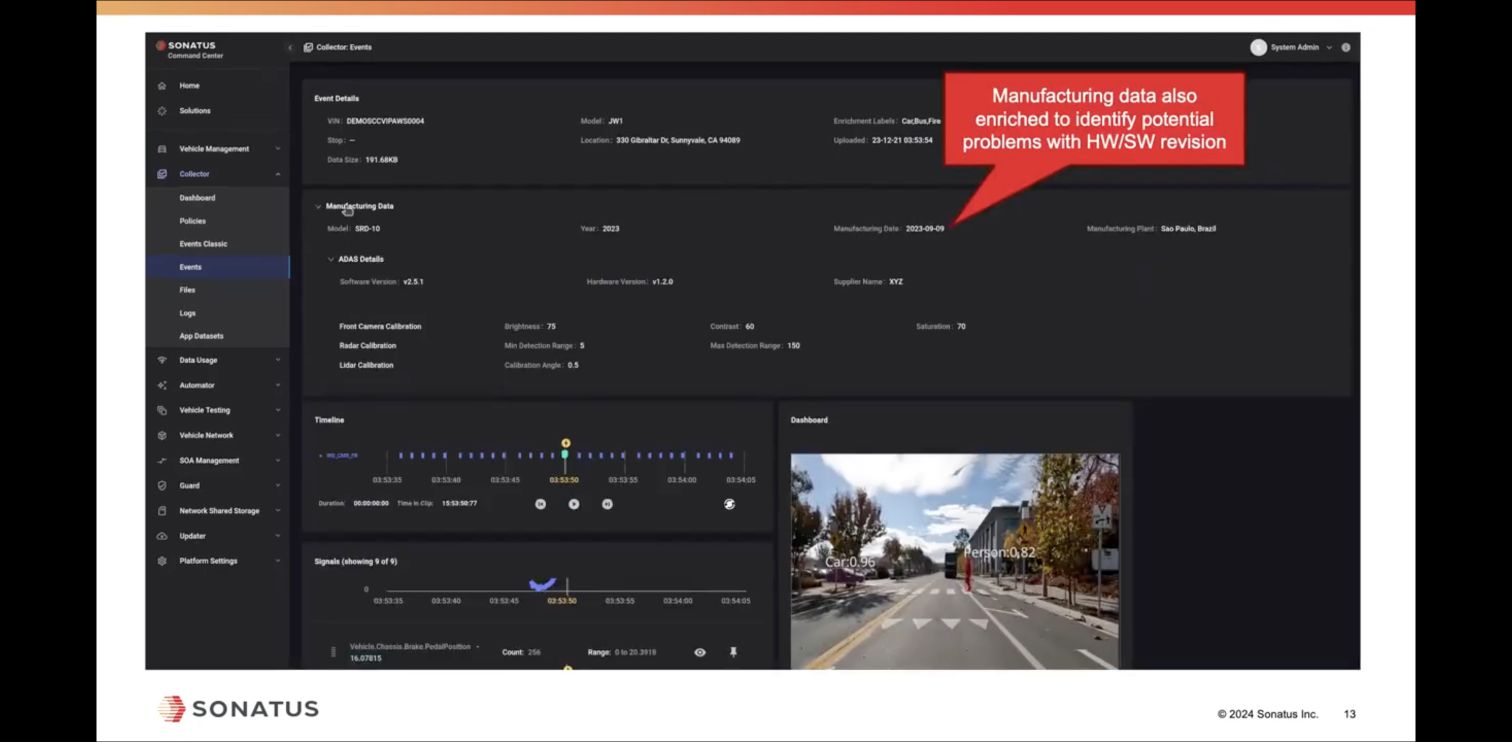
Sonatus Collector events in the Command Center demo
Frame at 13:45 from the official AWS integration demo. This historical Collector/Command Center interface appears in a presentation marked 2024; it is not a claim about the current Fastlane interface. Values are demonstration data.
Fastlane Collector

Create collection policies and execute them inside vehicles.

Find the context needed for investigation and validation.

Genesis GV60

A production vehicle incorporates a software foundation

The Genesis GV60 was announced as the first production vehicle incorporating the second-generation Digital Dynamics platform.

The GV60 was announced as the first production vehicle using the second-generation Digital Dynamics platform.

What changed? +

Genesis wanted a flexible foundation for in-vehicle data and connectivity as electrical architectures evolved.

November 2021 Sonatus announcement; historical Digital Dynamics deployment is distinct from current Fastlane products.

Nissan Technical Centre Europe

A development centre moves fault-finding from the test track to remote data

During the proof of concept, the time for a root-cause investigation fell from two weeks to two days, by the Nissan engineer's own account.

With Sonatus Collector AI and AI Technician, engineers deploy collection policies remotely and analyse test data with AI, so global teams work on the same data in real time.

What changed? +

Data loggers on prototype cars started recording when the battery was connected, and engineers saw the data only after the car reached the end of the line, someone collected the logger and uploaded it. Engineers often travelled to collect data, and prototype cars are expensive and scarce.

Company release of December 2025 and a customer podcast transcript dated April 2026; the result comes from a proof of concept and early trials of a tool still under development, and the same figure is repeated across company materials.

Diagram of the Fastlane Platform from the Sonatus platform page
The Fastlane Platform diagram on the company's platform page, where it sits beside the four product names: Insight, Collector, Edge and Copilot. The company describes the platform as a closed loop of observation, analysis, action and learning.
02 / HOW IT BECOMES REAL

Turn a fleet symptom into a validated change

Illustrative workflow: an OEM engineer needs evidence from affected vehicles before deciding what to change.

  1. 01

    Ask for the relevant signals

    Collector policies identify which vehicle signals to gather and when. Selective collection gives engineers context without treating every byte as equally useful.

  2. 02

    Compare behavior across vehicles

    Fastlane Insight analyzes vehicle data in the cloud. Engineering teams use the result to form a hypothesis that can be checked against a test vehicle.

  3. 03

    Make software fit the vehicle

    Fastlane Edge supports in-vehicle model deployment. Integration engineers must fit software to the vehicle’s compute, network and customer requirements.

  4. 04

    Prove the change before release

    The squad verifies its implementation with automated tests and vehicle or bench events. Build failures and integration documentation are part of delivery, not work deferred after coding.

Follow the work, step by step

A car that is finished on the day it is sold

Sonatus starts from a complaint that automotive engineers know well. Most vehicles still log data the way they were programmed at the factory: engineers choose months ahead which signals a car will record, and changing that means rewriting software and pushing an update. Alexandre Corjon, who runs engineering at Sonatus, added in July 2026 that validation still leans on physical fleets and long test cycles, even for minor software changes. The company's June 2026 launch post put the cost in human terms: engineers spend significant time gathering data, investigating issues and deploying fixes after problems occur.

It’s like a laptop

Jeff Chou · CEO and co-founder, Sonatus · Interview with The Drive · 2022-11-16

The belief behind the company is that a car should behave less like a finished product and more like a computer that improves through its life. Co-founder and CEO Jeff Chou has used one image for five years: the 2021 funding release spoke of turning vehicles into "data centers on wheels", and at CES in January 2026 he called the car "a moving data center on wheels". His co-founder, CTO Yu Fang, describes the company setting out from its first day to carry data-center ideas into the car: software-defined networking, storage and compute.

Software first, then the brain

What changed in 2025 and 2026 is the word the company leads with. Its 2024 releases spoke of software-defined vehicles (SDV), cars whose functions are controlled and updated by software. Its 2026 company page opens with "cloud-to-edge AI for smart vehicles". Yu Fang explains the order: without the SDV layer's ability to collect, govern and execute on data, AI cannot be deployed in the vehicle, so the plumbing has to come first.

SDV is the infrastructure; AI is the brain

Yu Fang · Co-founder and CTO, Sonatus · Interview with Gasgoo · 2025-12-18

Why now, in the company's telling, comes from the car's hardware. Suppliers such as Schaeffler now sell central control units that help automakers centralise their software, and Sonatus argues that much useful AI work can run on the compute a car already carries, without waiting for new chips. Generative AI also lets an engineer ask a car for data in plain language. A forecast that Sonatus sponsored puts the in-vehicle AI market in Europe, North America and Japan at $43 billion in 2025 and $238 billion in 2030; it is a forecast of a market, not of Sonatus revenue.

One fault, followed through the loop

Take an illustrative case: an automaker's engineer sees the same fault across part of a fleet. To observe, a Collector policy decides which signals to gather from the affected cars and when, so nobody has to log every byte. To analyze, Fastlane Insight compares behaviour across vehicles in the cloud and helps form a hypothesis to check on a test car. To act, Fastlane Edge puts a model, a virtual sensor or new diagnostic logic into the vehicle, and an integration engineer fits it to the car's compute, its network and the customer's requirements. Finally the change is proven on benches and test vehicles, and what was learned shapes the next policy.

Human judgement stays at every step. In the Nissan proof of concept, a senior Nissan research executive called AI a tool for engineers, not a replacement, and the engineer leading the project said her colleagues still make the decisions, only faster and with more reliable data. Yu Fang sets the bar for diagnostics: there, AI must guarantee deterministic correctness.

For someone joining in Korea, the act and prove steps are the job. Five of the seven open Korea roles sit in the company's Customer Success department and make Sonatus modules run, pass tests and pass audits inside a specific automaker's architecture; the other two run the build servers and lab hardware those engineers depend on.

Understand the products and their customers

Four products in one loop

Sonatus sells the Fastlane Platform, named in June 2026, as four products that work alone or together: Collector gathers vehicle data, Insight analyses it in the cloud, Edge acts inside the vehicle, and Copilot packages Collector and Edge for test cars. Buyers are automakers (OEMs) and their system suppliers (Tier-1s). Older articles use older names: Insight grew out of AI Technician, and Edge out of AI Director.

Fastlane Collector decides what a car records. Engineers write targeted collection policies, with generative AI helping to turn plain language into a policy; the policy is deployed into the vehicle and runs entirely there. The product page claims compression of up to 28 times. The company says Collector has run in production since 2020 and, as of June 2026, supports more than 8 million vehicles across multiple automaker programs.

Fastlane Insight is the analysis layer. It correlates vehicle data, logs, diagnostics and engineering knowledge to reach a root cause faster, and keeps diagnostic knowledge so it can be reused across programs and vehicle generations instead of living in a few engineers' heads.

Fastlane Edge is the execution layer inside the car. It deploys AI models, virtual sensors and diagnostic logic into production vehicles, manages rollouts over the air and supports several kinds of ECU, the small computers that run a car's functions. Its key claim is that it uses the compute a car already has; partners' models run on it, and Michelin deployed its tire models through the earlier AI Director. Fastlane Copilot is a gateway box on an Arm-based automotive processor, pre-loaded with Collector and Edge and wired to the car's CAN-FD, Ethernet and LIN networks, so an automaker can use the platform on prototype cars without embedding Sonatus software.

The anchor customer

The deepest customer relationship is with Hyundai Motor Group. A partnership across Genesis, Hyundai and Kia was announced in August 2021, starting with the Genesis GV70, and in November 2021 the Genesis GV60 became the first production vehicle with the second generation of the Sonatus platform, then called Digital Dynamics. The work produced a central communication unit (CCU) that carries over-the-air updates, data collection and remote diagnosis; Hyundai Motor Group's own newsroom names Sonatus as its partner on it, and it won a 2022 PACE Innovation Partnership Award.

It is quite meaningful to win such an award at a time when we are striving to transition to SDVs

Hyung Ki Ahn · Vice President, Electronics Development Group, Hyundai Motor Group · Hyundai Motor Group newsroom · 2022-09-21

The relationship reaches beyond passenger cars. A company case study describes Hyundai Commercial Vehicles launching the XCIENT Fuel Cell Truck and ELEC CITY Bus against traditional development cycles of 24 to 36 months. Hyundai adopted Sonatus Foundation for a modular vehicle network shared across vehicle lines and put Collector AI into its Blue Link Truck & Bus service. The case describes potential savings during design, alongside trigger-based diagnostics, predictive maintenance and driver logging. Those are design-phase estimates and described service capabilities, rather than measured benefits for every vehicle or fleet.

What was measured, and how far it goes

The clearest before and after comes from Nissan Technical Centre Europe, which announced a development partnership in December 2025. Before, data loggers on prototype cars recorded from the moment the battery was connected, and engineers saw the data only after the car reached the end of the line and someone uploaded the logger. With Collector AI and AI Technician, policies are deployed remotely and test data is analysed with AI.

The Nissan development-centre engineer described the result as a proof of concept: a root-cause investigation moved from two weeks to two days. The December 2025 announcement likewise calls these early trials of a tool still under development. In the April 2026 customer transcript, remote access and shared data let colleagues in different locations review the same evidence while engineers retain responsibility for decisions.

Signet reads these examples at their stated scope: a production component recognised with an industry partnership award, a commercial-vehicle architecture with estimated design savings, and a Nissan proof of concept whose investigation-time result recurs in company materials. For an applicant, the useful question is how the team reproduces an outcome across a new vehicle program. The Korea integration and compliance roles supply part of that answer through automated tests, documented interfaces, static analysis and release evidence.

03 / THE EVIDENCE

The story, in numbers.

DATED OBSERVATIONS

Vehicles with Sonatus technology (cumulative, company count)

M
Vehicles with Sonatus technology (cumulative, company count)2023-12-11: 1M+ vehicles; 2024-11-12: 2M+ vehicles; 2024-12-10: 3M+ vehicles; 2025-06-04: 4M+ vehicles; 2025-09-03: 5M+ vehicles; 2025-12-09: 6M+ vehicles; 2026-04-16: 7M+ vehicles; 2026-06-10: 8M+ vehicles; 2026-09-09: 9M+ vehicles1M+ vehiclesDec 20232M+ vehiclesNov 20243M+ vehiclesDec 20244M+ vehiclesJun 20255M+ vehiclesSep 20256M+ vehiclesDec 20257M+ vehiclesApr 20268M+ vehiclesJun 20269M+ vehiclesSep 2026

Cumulative count of vehicles with Sonatus technology from the company's own press releases, each value a 'more than' figure on that date. Not annual shipments. Until October 2025 the count was described as Hyundai, Kia and Genesis vehicles. These are dated disclosures, not a continuous growth record.

Figures, dates & basis +
Vehicles with Sonatus technology (cumulative, company count)
DateValueBasis
2023-12-111M+ vehiclesDeployment in over 1 million production vehicles across Hyundai, Kia and Genesis models, as stated in the CES 2024 release.
2024-11-122M+ vehiclesMass production in over 2 million vehicles from Hyundai, Kia and Genesis, as stated in the India design center release.
2024-12-103M+ vehiclesOver 3 million passenger vehicles incorporating Sonatus technology, as stated in the CES 2025 release.
2025-06-044M+ vehiclesMass production in over 4 million vehicles from Hyundai, Kia and Genesis, as stated in the 2025 survey release.
2025-09-035M+ vehiclesMass production in over 5 million vehicles from Hyundai, Kia and Genesis, as stated in the AI Director release.
2025-12-096M+ vehiclesMore than 6 million production vehicles; from this release the company says the vehicles come from automakers worldwide.
2026-04-167M+ vehiclesMore than 7 million production vehicles worldwide, as stated in the SDVerse release.
2026-06-108M+ vehiclesMore than 8 million vehicles, as stated in the Schaeffler partnership release.
2026-09-099M+ vehiclesMore than 9 million vehicles, as stated in the Hagiwara collaboration release.

Sonatus

Genesis GV60 integration

The second-generation platform entered the GV60 architecture.

$75M funding round

Sonatus raised a second round led by Foxconn.

Engineering leadership expands

Alexandre Corjon became SVP of Engineering; Sonatus reported technology in over six million production vehicles.

Read the growth story

Who pays, and for what

Sonatus earns its money from automakers and their system suppliers, with a pitch of shorter time to production, lower lifecycle costs and vehicles that keep improving. Four routes are visible in public. Automakers buy directly, starting with Hyundai, Kia and Genesis programs from 2021. Hyundai AutoEver, Hyundai Motor Group's software affiliate, listed Sonatus among its five largest purchase vendors for 2024, in its annual report as read by Korean trade press. Schaeffler, a Tier-1 supplier, pre-integrates Sonatus software into its control units under a June 2026 partnership. And Hagiwara, a Japanese distributor, announced in September 2026 that it will distribute Sonatus technology in Japan, North America, Europe, India and China.

What automakers want from the data has shifted. In 2022 Chou expected subscriptions to carry automaker software and said Sonatus also offered data brokering. By May 2026 a survey Sonatus sponsored, of 559 automotive professionals in seven markets, reported that selling vehicle data to third parties is losing appeal as automakers see more value in using it internally; 34% named smart diagnostics and predictive maintenance their top AI priority. The products launched since then point the same way.

The numbers, and what each one measures

Sonatus's dated adoption and financing figures measure different things. Releases report deployment in more than 1 million vehicles in December 2023, more than 3 million in December 2024, more than 6 million in December 2025 and more than 9 million in September 2026. Each is a cumulative company milestone expressed as a lower bound, so the sequence does not establish an exact growth rate. Financing includes the $35M July 2021 Series A led by Translink Capital, with Kia and LG Electronics among the investors; the $75M December 2022 round led by Foxconn; and the September 2023 strategic investment from NEC and Translink Orchestrating Future Fund. The company has stated total funding of more than $110M.

The dated numbers and what each one measures
NumberWhat it measuresDateBasis
More than 9 millionVehicles with Sonatus technology, cumulative2026-09-09Company statement
More than 8 millionVehicles supported by Fastlane Collector2026-06-29Company statement
More than 1 millionProduction vehicles, Hyundai, Kia and Genesis models2023-12-11Company statement
$35MSeries A funding2021-07-21Company statement
$75MSecond funding round, led by Foxconn2022-12-07Company statement
Over $110MTotal funding, including money from customers2022-12-07 and 2025-03-05Company statement
250+Employees worldwide2026 job postingsCompany statement
30%Share of company revenue generated by the Korea engineering siteCurrent postings read 2026-10-08Company statement in job postings

Two current Korea DevOps postings, read on October 8, 2026, describe the engineering site as responsible for critical product delivery to major automakers and state that it generates 30% of company revenue. Signet treats this as the employer's description of the site in a hiring advertisement. It is a share attributed to the Korea engineering site. A candidate can ask which accounting period and customer programs underpin that share, and how the build and lab infrastructure supports those deliveries.

Where it stands, and three risks

An outside company database groups Sonatus with AVL, Huxelerate, Airbiquity, QNX, dSPACE, Veecle and Applied Intuition, firms in simulation, vehicle operating systems, over-the-air updates and validation, which says more about how hard Sonatus is to place than about one head-to-head market. The same database records 72 patents filed. Sonatus's own claim to position rests on production use in more than 9 million vehicles and on software that runs across chips and Tier-1 hardware; in many programs its real rival is the automaker's habit of fixed logging and large reflashes.

Signet reads three questions from the business. Customer concentration: how do Hyundai Motor Group programs compare with newer customer work in the Korea squads? Expansion capacity: how do customer revenue, invested capital and infrastructure spending support the next vehicle program? AI verification: how are early-trial and estimated design results reproduced under production release requirements? A failed vehicle update can affect availability, and the CTO places a high bar on diagnostic correctness. These questions connect business prospects to an engineer's daily responsibility.

Two habits help. Say "more than 9 million vehicles with Sonatus technology" and call it a cumulative company count, not annual sales. Call the $110M funding, never valuation or revenue. If the 30% comes up, ask what it measures; it shows you read the posting closely.

04 / THE PEOPLE

Someone saw it first.

Photograph of Jeff Chou
CEO and Co-founder

Jeff Chou

Chou co-founded Sonatus in 2018 after building compute and infrastructure businesses.

The choice behind the company +

He applied software-defined infrastructure concepts to vehicle architecture and led the 2022 expansion financing.

Photograph of Yu Fang
CTO and Co-founder

Yu Fang

Fang has worked across cloud systems, data analytics and edge AI, including Nauto.

The choice behind the company +

He leads end-to-end AI software across embedded vehicles and the cloud.

“It’s like a laptop”

Jeff Chou · Interview with The Drive · 2022-11-16
The decisions behind the company

Two founders from data centers and edge AI

Jeff Chou co-founded Sonatus in 2018 and is its CEO. The company describes a career spent in shifts of compute and infrastructure across finance, media and cloud, and says he saw early that the car industry was ready for the same change. In 2021 he argued that digital capabilities would become a competitive differentiator. In a November 2022 interview, he compared vehicle software with printer economics: the platform creates opportunities for services over its life. Signet reads that analogy as a reason to build software that keeps improving a car after sale.

Yu Fang, co-founder and CTO, has more than 25 years as an entrepreneur and engineer. At Nauto he led computer vision and deep learning models on edge devices that improved the safety of commercial fleets. At Sonatus he leads the AI software systems, from data collection and analytics to agentic applications, across vehicles and the cloud. His recent talks aim AI at the car's whole life cycle, from development and testing to after-sales, not only at driving and the cockpit.

in vehicle diagnostics, AI must guarantee deterministic correctness.

Yu Fang · Co-founder and CTO, Sonatus · AI-Defined Vehicle Forum 2026 in Munich, as reported in English by Gasgoo · 2026-09-17

Four decisions that shaped the company

Four decisions explain the company's shape. Hardware agnosticism: its software runs on POSIX-compliant operating systems, is compatible with AUTOSAR, and uses abstraction layers to cut the cost of reuse across vehicles. Hosting AI rather than building it: its APAC sales head said "We don't build large models", and AI Director launched with NXP, Arm, AWS and model makers such as COMPREDICT, Qnovo, Smart Eye and VicOne. Production first, with one anchor customer: Hyundai Motor Group was its first production customer and, through Kia, an investor. Engineering in many countries: Paris in 2022, Shanghai, Japan and Taiwan in 2023, Dublin and an India design center in 2024.

The 2025 hires add automotive operators around the founders. Alexandre Corjon joined in March 2025 with more than 30 years in automotive and aerospace, at automakers and Tier-1 suppliers including Renault-Nissan Software Labs and OPmobility, and in December 2025 became Senior Vice President of Engineering, charged with scaling an engineering organisation that spans multiple countries. Philip Hughes became Chief Revenue Officer in September 2025 after automotive sales roles at Luminar, Wind River and NVIDIA.

hardware agnosticism and a rigorously defined service-oriented architecture.

Alexandre Corjon · Senior Vice President of Engineering, Sonatus · Interview with ADT · 2026-07-23

The leaders closest to a Korea role

Three leaders matter most to a Korea hire. Corjon runs the engineering organisation the Pangyo squads deliver into. Chris Yang, Country Manager, Korea, leads regional strategy and partnerships with automakers adopting AI-defined vehicle software; he was head of country sales at NTT and spent more than a decade at Cisco in senior roles supporting Hyundai Motor Group globally. Wallie Leung, Senior Vice President of Sales for APAC, joined in October 2019. Signet's reading: Chris Yang's remit is commercial, while engineering direction in the postings runs through Squad Leads.

How it says it works and hires

The company lists five values, among them customer success and executing commitments: "Discipline and reliability are non-negotiable in how we deliver." The Korea postings describe the working model. Engineering runs as Mission-Driven Squads, each owning one module end to end. "Testing is Engineering": engineers may split time between development and verification up to 50:50, review code for testability and safety, and fix pipeline failures as their own. AI tools such as GitHub Copilot and Claude are part of the job, and the compliance posting asks for "Fastest yet Safest" software.

The founders' bet on Korea shows in what they built more than in what they said: production with Hyundai Motor Group came first, Kia invested, and the company now lists Seongnam among its three main office hubs. A useful interview question is how a product decision for a Korean customer travels between Pangyo and Sunnyvale, and who signs off on it.

05 / THE NEXT CHAPTER

Deliver and prove vehicle software for automakers, from Pangyo

The work spans embedded C/C++ on Linux, Python test automation, in-vehicle networks, on-site partner test events, compliance evidence for automakers, and the build and lab infrastructure that ties code to physical control units.

Korea country leadership

Chris Yang

Country Manager, Korea

LinkedIn ↗
Publicly identified Korea roles1 profiles
  • Chris YangCountry Manager, Korea

The official leadership page names the Korea Country Manager. Public profile observations describe functions found and do not establish total staff or reporting lines.

Team shape read from public LinkedIn profiles with the Korea filter on October 7, 2026, checked against current employer postings and the official leadership page on October 8. Groups describe observed functions; profile counts are observations and grouping does not establish reporting lines.

Why Korea? Why now?+

Sonatus came to Korea through its first customer, not through a market launch. Hyundai Motor Group's Kia and LG Electronics were among the investors in its July 2021 Series A, and a month later the company announced a partnership with Hyundai Motor Group across Genesis, Hyundai and Kia, starting with the Genesis GV70. In November 2021 the Genesis GV60 became the first production vehicle with the second generation of its platform, and the two companies built a central communication unit that won an industry partnership award in 2022. Korean suppliers followed: HL Klemove signed a memorandum of understanding at CES 2023, and Hyundai AutoEver listed Sonatus among its top five purchase vendors for 2024. Until October 2025 the company's standard description said all its production vehicles came from Hyundai, Kia and Genesis. Where the company marked its entries into France, China, Japan, Taiwan, Ireland and India with a release each, its Korea site grew out of that customer relationship. It is now one of three main office hubs, with Sunnyvale and Dublin, and two Korea job postings say the Korea engineering site delivers to major automakers and generates 30% of company revenue. Signet's reading: Korea is where Sonatus learned to ship to production, and it remains the site closest to the customer that made that possible.

Kia and LG Electronics invest

Sonatus raised a $35M Series A led by Translink Capital, with Hyundai Motor Group's Kia and LG Electronics among the investors.

Partnership with Hyundai Motor Group

The companies announced a partnership on the electrical and electronic architecture of Genesis, Hyundai and Kia vehicles, starting with the Genesis GV70.

Genesis GV60 goes into production

The GV60 became the first production vehicle to integrate the second generation of the Sonatus platform, then called Digital Dynamics.

Award for the jointly built CCU

Hyundai Motor Group and Sonatus won the 2022 PACE Innovation Partnership Award for a central communication unit, first fitted to the Genesis GV60 and G90.

HL Klemove collaboration

HL Klemove and Sonatus announced a collaboration on next-generation vehicle electronics architecture and signed a memorandum of understanding at CES 2023.

One million production vehicles

Sonatus reported deployment in more than 1 million production vehicles across Hyundai, Kia and Genesis models including the IONIQ 6, GV60 and EV9.

A top purchase vendor of Hyundai AutoEver

Hyundai AutoEver's annual report for 2024, as read by Korean trade press, lists Sonatus among its five largest purchase vendors.

Seongnam named a main office hub

The careers page, read in October 2026, lists Seongnam, South Korea, as one of three main office hubs with Sunnyvale and Dublin.

Understand the Korea opportunity

Korea came with the first customer

Sonatus's Korea story starts with a customer rather than a market launch. Hyundai Motor Group's Kia and LG Electronics were among the investors in its July 2021 Series A, and the head of investment at Hyundai CRADLE, the group's open innovation arm, explained the logic in the company's release. A month later the partnership with Hyundai Motor Group was announced, and in November the Genesis GV60 went into production with Sonatus software. Where the company marked its entries into France, China, Japan, Taiwan, Ireland and India with a release each, its Korea presence grew out of this customer relationship.

When Hyundai Motor Group is making an investment decision, we often consider if we could envision working with that supplier.

Stefan Heuser · VP, Head of Investment, Hyundai CRADLE · Sonatus Series A release · 2021-07-21

The Korean supply chain followed the carmaker. HL Klemove, a Korean automotive electronics supplier, signed a memorandum of understanding with Sonatus at CES 2023, and its CEO tied the CCU shown there to that work. Korean trade press reading Hyundai AutoEver's annual report placed Sonatus among the software affiliate's five largest purchase vendors in 2024. Until October 2025 the company's standard description said its production vehicles, more than 5 million by September 2025, came from Hyundai, Kia and Genesis.

The CCU we showed at CES was the first result of our work with Sonatus.

윤팔주 (Yoon Pal-joo) · CEO, HL Klemove · Statement at CES 2023, reported by Yonhap Infomax; English rendering of the published Korean text · 2023-01-07

What the Korea site is

The careers page lists three main office hubs: Sunnyvale, Seongnam and Dublin. Sonatus's contact page locates the Korea office at U-Space 1 in Pangyo, Seongnam. Six actual openings carry Pangyo metadata and the compliance role carries Seoul metadata. The two DevOps bodies explicitly require on-site work at the Seoul office because the role owns physical servers and lab hardware. They describe the site as responsible for critical product delivery to automakers and generating 30% of company revenue, a hiring-ad description of the site's business contribution. The site runs build servers, storage and hardware test environments that connect a software change to a vehicle control unit.

The company's leadership page lists Chris Yang as Country Manager, Korea, leading strategy and partnerships with automakers; he spent more than a decade at Cisco supporting Hyundai Motor Group. The engineering squads deliver into the organisation led by Alexandre Corjon.

Seven roles, one job: deliver and prove

The October 8 employer board returns eight Korea-related postings, including one talent-community registration. The seven actual openings comprise four Customer Integration engineers, a Senior Compliance Engineer and two DevOps engineers. The Senior and Staff integration postings require 6+ and 10+ years respectively; the general integration posting states its skills, and the Network variant requires 3+ years with either a network-specialist or embedded-engineer growth track. All four combine C/C++ on Linux, Python tests and development with verification up to 50:50. Compliance asks 3 to 7 years and assists release quality gates, cybersecurity evidence and audits. Staff and Senior Staff DevOps require 8+ and 15+ years, on-site hardware ownership and estimated travel to Sunnyvale or Dublin once or twice per year.

Published vehicle-deployment milestones, a Schaeffler integration partnership and Hagiwara's announced distribution arrangement put the team's work in context. Each additional vehicle program brings hardware, network and customer requirements that need integration, testing and audit evidence. Signet reads the Korea roles as a way to make that delivery repeatable: the squads own modules from implementation through verification, compliance engineers turn scans and process work into evidence, and DevOps engineers make the build and lab infrastructure reproducible.

Signet reads Korea as a delivery hub: Seongnam is one of three main office hubs, current DevOps postings attribute 30% of company revenue to its engineering site, and the roles own build infrastructure, customer integration and release evidence. Public profiles reviewed with the Korea filter show software engineering, customer integration, QA and people or workplace functions. Those observations describe functions found, rather than total staff or reporting lines. A candidate can ask which customer programs the squads serve and how customer priorities become module and infrastructure decisions.

A Korea hire would make Sonatus software run, pass tests and pass audits inside automakers' cars: writing and verifying C/C++ modules, debugging on a customer's bench, producing compliance evidence, or rebuilding the infrastructure that ties code to control units.


KOREA OPEN ROLES

7 open roles in Korea

Current Signet catalog · 2026-10-19

FOR YOU

Use the mock application to connect your record with the exact role conditions.

Finance · Legal

Senior Compliance Engineer

Seoul, South Korea

Posting checked

The work
Assist release gates, TARA, OSS risk and automaker static-analysis evidence.
Who fits
B.S. or higher in Computer Science, Electrical Engineering or a related field.
Keep in mind
Seoul; review release quality gates, support automotive audits and deliver customer static-analysis reports.
Engineering · AI

Senior Embedded AI Engineer

Seoul, South Korea / South Korea

Posting checked

The work
Integrate and validate edge AI runtimes and models for Korean automotive customers.
Who fits
Relevant CS, electrical, mechanical/control or related bachelor’s degree; 5+ years in ML or embedded software, including 2+ years deploying ML on edge/embedded Linux.
Keep in mind
The body specifies hybrid work in Pangyo, reporting to the Engineering Director, with customer vehicle and onsite-test support.
Engineering · AI

Senior Software Engineer - Customer Integration

Pangyo, South Korea

Posting checked

The work
Build and verify C/C++ modules on Linux, Python tests and customer integration guides.
Who fits
6+ years of embedded software development or engineering experience.
Keep in mind
Pangyo; development and verification up to 50:50; partner tests in Korea and abroad.
See all 7 roles
Engineering · AI

Senior Staff DevOps Engineer

Pangyo, South Korea

Posting checked

The work
Own physical Korea build servers, storage and labs; codify infrastructure and remove fragility.
Who fits
15+ years of infrastructure, DevOps or SRE experience.
Keep in mind
On-site required; travel to Sunnyvale/Dublin estimated at 1 to 2 times per year.
Engineering · AI

Software Engineer - Customer Integration

Pangyo, South Korea

Posting checked

The work
Develop and verify C/C++ modules, Python tests, guides and customer integrations.
Who fits
Strong embedded C/C++, including pointers, memory management and data structures.
Keep in mind
Pangyo; development and verification up to 50:50; partner testing in Korea and abroad.
Engineering · AI

Staff DevOps Engineer

Pangyo, South Korea

Posting checked

The work
Own Korea physical servers, storage and lab hardware; make builds and configuration reproducible.
Who fits
8+ years of infrastructure, DevOps or SRE experience.
Keep in mind
On-site required; travel to Sunnyvale/Dublin estimated at 1 to 2 times per year.
Engineering · AI

Staff Software Engineer - Customer Integration

Pangyo, South Korea

Posting checked

The work
Own integration modules, code safety, Python verification and reusable customer documentation.
Who fits
10+ years of embedded software development or engineering experience.
Keep in mind
Pangyo; development and verification up to 50:50; on-site partner test support.
07 / NOW & NEXT

The next scene is taking shape.

Genesis GV60 integration

The second-generation platform entered the GV60 architecture.

$75M funding round

Sonatus raised a second round led by Foxconn.

Engineering leadership expands

Alexandre Corjon became SVP of Engineering; Sonatus reported technology in over six million production vehicles.

More context on what comes next

From SDV supplier to AI platform

The last year ties back to the thesis in three moves. The company rebuilt what it sells around AI: AI Director for in-vehicle models in September 2025, a sponsored forecast of the in-vehicle AI market in December 2025, and in June 2026 the Fastlane Platform, which folded its products into Collector, Insight, Edge and the new Copilot test box. It added automotive leadership, naming Philip Hughes Chief Revenue Officer in September 2025 and Alexandre Corjon Senior Vice President of Engineering in December 2025, when Chou said "Sonatus continues to exceed every milestone we set for ourselves." And its count kept climbing, to more than 9 million vehicles by September 2026.

Selling through other companies' hardware

The newest growth runs through partners. Schaeffler pre-integrates Sonatus software into its control units, Hagiwara has agreed to distribute it in Japan, North America, Europe, India and China, and the CES 2026 booth showed work with Nissan Technical Centre Europe, Michelin, Bosch Engineering, Renesas, AWS and NXP, next to a live feed from a production Hyundai Kona. Hughes said adoption has grown worldwide since the Fastlane launch. Partners widen the market, and they also multiply the hardware Sonatus has to run on. In September 2026 Yu Fang told a Munich forum that, in the end, only two things truly matter: time and risk control.

What to watch over the next year

  • How newer customer and partner programs expand the named production history with Hyundai Motor Group, and which programs the Korea squads deliver.
  • How Insight and Edge diagnostic results are validated and measured across production use cases, building on the Nissan early-trial and Hyundai design examples.
  • How customer revenue, invested capital and build infrastructure support hiring and the next vehicle program.

For a Korea candidate, each of these lands on the Pangyo squads: a new automaker means a new integration, a production AI program means new verification and compliance work, and new capital or revenue may influence how fast the Korea site keeps hiring.

Their future. Your next chapter.

Find your part ↑

An independent profile by Signet. No affiliation or investment recommendation. Introductions happen only with your consent.
Research reviewed 2026-10-08

A LITTLE MORE CONTEXT

Understanding Sonatus.

What does Sonatus do?

Sonatus provides vehicle and cloud software that lets automakers collect selected data, analyze behavior and deploy controlled actions. Its Fastlane platform now organizes those tasks into a cloud-to-edge AI cycle.

What is the opportunity in Korea?

The work spans embedded C/C++ on Linux, Python test automation, in-vehicle networks, on-site partner test events, compliance evidence for automakers, and the build and lab infrastructure that ties code to physical control units.

Are these confirmed job openings?

Employer postings were checked on 2026-10-08. Availability can change. Mock applications request a review from Signet.

How can I explore the company in more depth?

Follow the company from its vision through products, evidence and people to the Korea team and current roles. Use the table of contents to move within the page, and expand the sections for more context.

Back to the collection ↗