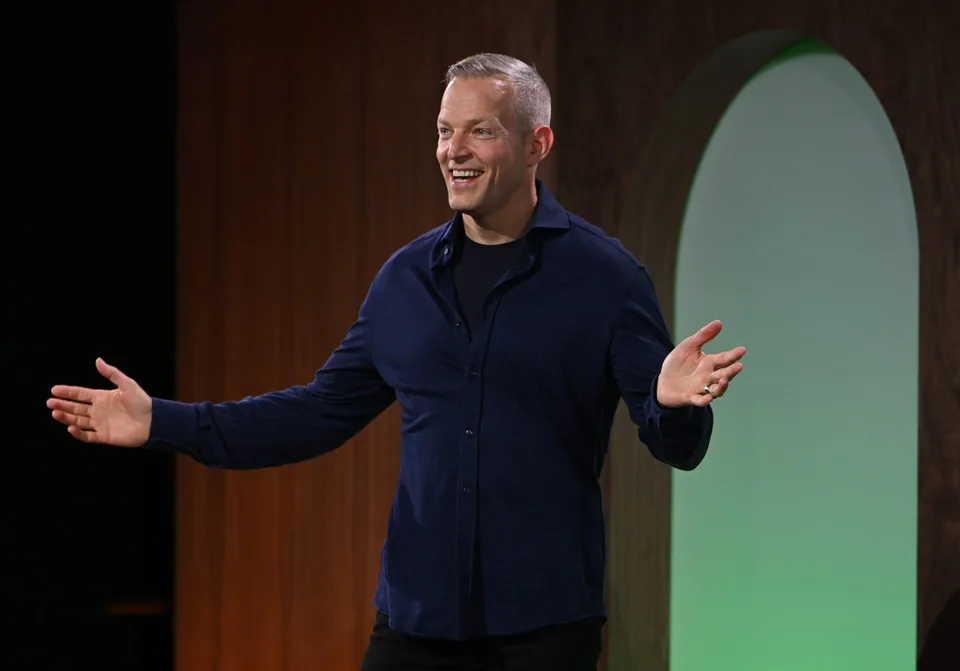
Spotify leader Gustav Söderström speaking at Investor Day
Spotify / THE WORLD THEY ARE BUILDING

The right audio finds its listener.

The opportunity is a lasting listening habit and a sustainable creator marketplace. Distribution can acquire users, but retention and rights economics determine whether that reach becomes durable business.

See it taking shape ↓
01 / THE PRODUCTS

The products behind the promise.

Korean-language Spotify app screens: home, Release Radar, an artist page and search
Korean app screens published with the Korea launch announcement of 1 February 2021, when Korea opened with Premium Individual and Duo plans. The interface has changed since.
Spotify Premium

Choose a supported subscription for ad-free music and offline listening.

Listeners pay for access and listening features.

Samsung

Device distribution makes listening easier to start

Selected Galaxy preinstallation and eligible trial offers announced in March 2019.

The 2019 partnership expansion preinstalled Spotify on selected new Galaxy devices and offered a trial to eligible users in specified markets.

What changed? +

Spotify sought to reach listeners through devices they already buy and use.

Historical Samsung distribution partnership, with a six-month trial for eligible U.S. buyers.

NAVER

Premium Basic inside a Korean paid membership

NAVER reported that new Gen Z sign-ups to its membership rose 17% in December 2025 against November. A panel estimate put Spotify's December 2025 return-visit rate in Korea at 82.3%, the highest among Korean music apps.

From November 27, 2025 NAVER Plus Membership, at ₩4,900 monthly including VAT, offers Premium Basic as a selectable digital-content benefit at no extra cost. Using it alongside another selected benefit costs an additional ₩5,900 monthly under the announced example. Search previews and a navigation icon providing quick access to the Spotify app connect the services; NAVER sign-in followed on March 19, 2026.

What changed? +

In Korea Spotify sold Premium mostly on its own, with Premium Basic at ₩7,900 a month before VAT, and had offered a free tier since October 2024.

NAVER's own membership figure and a third-party panel estimate of app return visits, both for December 2025; they measure membership sign-ups and app visits, not paying Spotify subscribers.

Alex Norström and Gustav Söderström on stage at Spotify's Investor Day 2026, with their names and the title Co-CEO on the screen behind them
Spotify's co-CEOs at Investor Day 2026 in New York, where they set out the Freemium, ubiquity and personalization strategy.
02 / HOW IT BECOMES REAL

From a partner channel to a recurring listening habit

Illustrative workflow: a device or telecom partner brings Premium to potential listeners, then measures whether they remain active.

  1. 01

    Meet the listener in an existing channel

    A partner agreement defines placement, eligible users and the offer. Device integration or another distribution channel lowers the effort to discover Spotify.

  2. 02

    Make the offer usable

    Users need a clear route from the partner surface to an account and the intended plan. Product, legal and finance teams resolve the implementation and contract details.

  3. 03

    Build a reason to return

    Premium offers ad-free music listening and offline downloads in supported plans. The listening experience must justify continued use after an initial promotion.

  4. 04

    Measure value for both sides

    The partnership team reviews adoption, engagement and commercial impact. Creator tools separately help artists understand audiences and plan their own activity.

Follow the work, step by step

Every song, legally, in one app

Spotify's founder describes the starting point as an idea that seemed impossible. In his letter of 30 September 2025, Daniel Ek recalls a makeshift office in Stockholm where a few people set out to make every song available instantly and legally, in a product people would love. Two decades later the co-CEOs describe the company as being in the business of delivering creativity and culture to the world, helping artists, creators and authors reach audiences and grow their careers. The two sentences carry the tension of the business. Listeners want everything at once, and the people who make the music must be paid: for music subscriptions, royalties are generally the greater of a share of revenue and a per-user amount.

to make every song available instantly, legally

Daniel Ek · Founder and Executive Chairman, Spotify (CEO when he wrote it) · Letter to employees · 2025-09-30

The way Spotify chose to resolve that tension is its central bet. At Investor Day in May 2026 the co-CEOs named three choices. Freemium: a free tier that maximises reach and lowers the barrier to entry. Ubiquity: be everywhere, across devices and ecosystems, instead of building a walled garden. Personalization: an app that learns each listener. Gustav Söderström put the logic in one line.

use Freemium to build global scale

Gustav Söderström · Co-CEO, Spotify · Investor Day 2026 remarks, New York · 2026-05-21

From a free listener to a paying one

Follow one listener through the machine, as the company's own playbook describes it. The journey begins with Free, which builds engagement and habits. Spotify's annual filing says new Premium subscribers come mainly from converting those free users, and trial campaigns offer Premium free or at a discount for a period. After conversion the company invests in value, works to keep the subscriber and raises revenue per user over time. In Q2 2026 monthly Premium revenue per subscriber (ARPU) was €4.89, up 7% on a year earlier, mainly because of price increases. The annual filing defines subscribers as registered users with an activated payment method, including Family and Duo sub-accounts and up to 30 days of payment grace. MAUs count accounts that consumed content during the final 30 days of a reporting period. These are operating measures alongside, rather than substitutes for, subscription revenue.

Partners are a second road into the same funnel. A telecom company, a device maker or a platform puts Spotify in front of its own customers, bundles Premium with its service or bills it on its own invoice, and pays Spotify a negotiated rate per subscriber. Samsung, Telkomsel in Indonesia and NAVER in Korea are examples. In each case a person still has to judge the offer: how long the free period runs, what price follows, and whether the people it brings in keep listening.

Why scale is the whole point

The bet pays only at very large scale, and the numbers show how far it has come. At the end of June 2026 Spotify counted 777 million monthly active users and 300 million Premium subscribers in 184 markets. Alex Norström turned that around at Investor Day: it means 3.5% of the world subscribes, which leaves more than 96% still to win. That is why the company keeps pushing into markets where paying for music is less common, and why its free tier and its partners matter as much as its app.

The product and the business are one funnel. Free listening is the way in, and Premium is the money: 89% of FY2025 revenue came from subscriptions. Anyone who joins Spotify on the business side works on some part of moving people from the first door to the second.

In Korea the funnel is still young. Spotify launched there in February 2021 with paid plans only and added a free tier in October 2024. The open Korea role works on the partner road: finding the telcos, platforms and payment companies that bring in new listeners and payers across Asia Pacific, from a base in Seoul or Singapore.

Understand the products and their customers

Two doors into one app

Spotify sells one service through two doors. The free door is the Ad-Supported service: anyone can listen, and advertisers pay to reach them with audio, video, display and carousel ads. The paid door is Premium, a monthly subscription with ad-free music listening, which brought in €15,350 million in FY2025, 89% of revenue. Behind both doors sits a catalogue the company counts at more than 100 million tracks, 7 million podcast titles and 700,000 audiobooks.

On 8 October 2026 Spotify's Korean page showed four plans, all including VAT: Premium Basic at ₩8,690 a month without downloads, Premium Individual at ₩11,990 after an eligible one-month introductory trial, Duo with two accounts sharing an address at ₩17,985 and verified Student at ₩6,600. Premium Individual cost the same ₩11,990 at the 2021 launch. Most subscriptions are sold directly to listeners, but partners can also bundle Premium with their own services or sell it as an add-on, collect the payment and pass Spotify a negotiated rate per subscriber.

The free service does two jobs. It earns advertising revenue, the remaining 11% of FY2025 revenue, and it is the main source of new Premium subscribers, since most of them convert from free use. In Korea the free tier arrived in October 2024 with an ad about every 15 minutes, and a panel estimate shows Spotify's Korean monthly users more than doubled soon after.

Spotify for Artists serves the other side of the market. Artists and their teams use it to manage their presence and to read audience and release data, such as the Release Details analytics introduced in October 2021. Here the money flows the other way: Spotify paid more than $11 billion to the music industry in 2025, with independent artists and labels accounting for half of all royalties.

the R&D department for the music industry

Gustav Söderström · Co-CEO, Spotify · Q4 2025 earnings summary, Spotify Newsroom · 2026-02-10

Who buys it: the partner road

For a business role, the customers that matter most are the partners who carry Premium to their own users. Four are on public record with their terms. Samsung, in 2019, preinstalled Spotify on millions of new phones and gave eligible U.S. buyers six months of Premium free. Telkomsel, in 2020, gave Indonesian postpaid customers three months free, then billed Premium at 53,459 IDR a month on the phone bill, aimed at people without credit cards. LG U+, in 2021, gave its 5G and LTE customers in Korea three to six months free, depending on plan. NAVER, in 2025, put Premium Basic inside its paid membership.

The NAVER case, before and after

Before the NAVER offer, Basic cost ₩7,900 monthly excluding VAT as a direct subscription. From November 27, 2025 NAVER Plus Membership offers it as a selectable digital-content benefit at no extra cost within its ₩4,900 VAT-inclusive monthly fee, or ₩3,900 annual-plan monthly equivalent. The release’s example charges an additional ₩5,900 monthly to use Basic alongside another selected content benefit. NAVER called this Spotify’s first Korean membership-and-platform partnership. It provides music-search previews and a Map navigation icon that opens the Spotify app; NAVER sign-in followed on March 19, 2026.

What was measured is narrower than the headline. NAVER said new Gen Z sign-ups to its membership rose 17% in December 2025 against November. A panel estimate put Spotify's December return-visit rate at 82.3%, up 14.6 points and the highest among Korean music apps. Each figure measures something different: membership sign-ups and app visits. Treat these as membership acquisition and app-return measures, alongside separate Premium subscriber outcomes.

Bundles bring listeners in cheaply, and rivals use them too: Melon became free inside SK Telecom's T Universe pass package from 4 December 2025. One industry voice quoted in Korean press expects people to choose music apps by how well they bundle with memberships they already use. The test of a partnership is whether the people it brings in keep listening and, in time, pay.

03 / THE EVIDENCE

The story, in numbers.

DATED OBSERVATIONS

Annual revenue

EUR · B

Audited IFRS consolidated revenue in euros, combining Premium and Ad-Supported revenue. Subscriber counts and MAUs are separate operating measures.

Figures, dates & basis +
Annual revenue
DateValueBasis
2021-12-31€9.668BFull fiscal year ended 2021-12-31; consolidated company revenue.
2022-12-31€11.727BFull fiscal year ended 2022-12-31; consolidated company revenue.
2023-12-31€13.247BFull fiscal year ended 2023-12-31; consolidated company revenue.
2024-12-31€15.673BFull fiscal year ended 2024-12-31; consolidated company revenue.
2025-12-31€17.186BFull fiscal year ended 2025-12-31; consolidated company revenue.

Spotify / SEC

Samsung distribution expansion

Spotify announced preinstallation on selected new Samsung devices.

Leadership transition announced

Spotify announced Ek’s executive-chairman transition and two co-CEOs effective January 2026.

Q4 2025 results

Spotify reported 751M MAUs and 290M Premium subscribers.

Read the growth story

Who pays, and for what

Spotify's revenue is simple to state. In FY2025 it was €17,186 million, up from €15,673 million in 2024. Premium subscriptions brought in €15,350 million of that, 89%; advertising on the free service brought in the rest. The United States accounted for €6,470 million, and no other single country reached 10% of revenue. Premium revenue is booked in the country where a membership originates, so a membership that starts in Korea counts as Korean revenue.

Two measures of scale sit next to the money, and they are not interchangeable. Monthly active users (MAU) count everyone who used the service in a month, free or paid: 751 million at the end of 2025 and 777 million at the end of June 2026. Premium subscribers count registered users with an activated payment method, including Family/Duo sub-accounts and payment grace of up to 30 days: 290 million and 300 million on the same dates. At the end of June 2026, by the company's regional split, Europe held 36% of subscribers, North America 25%, Latin America 24% and Rest of World 15%.

The dated numbers and what each one measures
MeasureValuePeriodBasis
Revenue (IFRS, total)€17,186MFY2025Company annual report, audited
Premium revenue€15,350M (89%)FY2025Company annual report, audited
Operating income€2.2BFY2025Audited company annual report
Revenue (quarter)€4,777M, up 14%Q2 2026Company quarterly update, unaudited
Gross margin (quarter)33.4%Q2 2026Company quarterly update
Monthly active users777MEnd of June 2026Company quarterly update
Premium subscribers300MEnd of June 2026Company quarterly update
Premium ARPU€4.89 a monthQ2 2026Company quarterly update
Free cash flow (non-IFRS)€797M; €3.3B over 12 monthsQ2 2026Company quarterly update

Profitable, and choosing where to spend

The business now makes money. Operating income for 2025 was €2.2 billion, the second full year of operating profit, and gross margin rose to 32% from 25% in 2022. In Q2 2026 revenue was €4,777 million, up 14%, gross margin reached a record 33.4% and operating income was €655 million. Free cash flow over the last twelve months was €3.3 billion. Management also chose to spend more in 2026, on compute for AI and on marketing for new features, and to make the free tier less generous in select emerging markets. It guided Q3 to 788 million monthly users, about 11 million more than Q2 as a forward-looking estimate on August 4.

capture more value

Gustav Söderström · Co-CEO, Spotify · Investor Day 2026 remarks, New York · 2026-05-21

Where Spotify stands against rivals

Spotify's filing names Apple Music, YouTube Music, Amazon Music, Deezer, Joox, Pandora and SoundCloud as competitors for music and for listeners' time, and says the device makers among them, Apple, Alphabet and Amazon, preload their own services, which it calls a significant competitive disadvantage. That is one reason partners matter: they put Spotify on devices and in channels it does not own. In Korea the field is local. A panel estimate put Spotify third by monthly users in May 2025, at 3.59 million and 14%, behind YouTube Music and Melon. By listening time it was third in January to May 2026, at 390 million minutes a month against Melon's 460 million, after growth of 1,200% from the same months of 2022.

Korean user figures come from different data panels and do not agree. One panel estimated 3.59 million monthly users in May 2025 and 4.24 million in August 2025; another, commissioned by a newspaper, counted about 1.95 million in December 2025. Quote each with its panel and month, never as one number, and say users, not subscribers.

Three risks to weigh

Three risks matter most for someone joining the business side. First, rivals own the devices: services preloaded on Apple, Google and Amazon hardware keep pressure on Spotify to win distribution elsewhere. Second, partnerships can cost money before they pay: the filing warns that commitments to rights holders tied to strategic partnerships do not always produce all the expected benefits, and Universal, Sony, Warner and Merlin supplied about 72% of label-delivered streams in 2025. Third, growth now depends on conversion in markets where few people pay, a cycle that, as Norström said on the Q2 2026 call, grows differently and takes time to play out.

In an interview, specify the metric and its period. €17,186 million is FY2025 consolidated revenue; 300 million is June 2026 Premium subscribers; 777 million is June 2026 monthly active users; ₩38.62 billion is the Korean service entity's reported FY2025 revenue from Spotify AB. The Korean entity's service revenue and subscriptions originating in Korea measure different transactions.

04 / THE PEOPLE

Someone saw it first.

Photograph of Daniel Ek
Founder and Executive Chairman

Daniel Ek

Ek founded Spotify and moved from CEO to executive chairman on January 1, 2026.

The choice behind the company +

The company assigned day-to-day leadership to Alex Norström and Gustav Söderström, while Ek focuses on capital allocation and long-term direction.

Alex Norström speaking on stage at Spotify's Investor Day 2026
Co-Chief Executive Officer

Alex Norström

Norström was co-President and Chief Business Officer before becoming co-CEO on January 1, 2026.

The choice behind the company +

His appointment with Gustav Söderström formalized the shared strategic and operating leadership model used since 2023.

Gustav Söderström speaking on stage at Spotify's Investor Day 2026
Co-Chief Executive Officer

Gustav Söderström

Söderström was co-President and Chief Product and Technology Officer before becoming co-CEO on January 1, 2026.

The choice behind the company +

The transition made the company’s product and technology leader a co-CEO alongside its business leader, Alex Norström.

“to make every song available instantly, legally”

Daniel Ek · Letter to employees, Spotify Newsroom · 2025-09-30
The decisions behind the company

A founder who changed seats, not companies

Daniel Ek founded Spotify and ran it as chief executive until the end of 2025. On 1 January 2026 he became executive chairman, a role the company compares to a European chairman: he decides capital allocation, maps the long-term future and supports the senior team. In his letter to employees he wrote that he has always thought about roles as missions, about nine of them under the same title, from assembling furniture and negotiating the first deals to, now, strategy, capital allocation, regulatory efforts and the calls that will shape the next decade. He added that he is not leaving.

This change simply matches titles to how we already operate.

Daniel Ek · Founder, then CEO, now Executive Chairman, Spotify · Leadership announcement · 2025-09-30

Two co-CEOs, one from business and one from product

Alex Norström and Gustav Söderström became co-CEOs on the same day. Each has more than fifteen years at the company, and since 2023 the two co-presidents had largely led strategy and operations already, so the change formalised how Spotify worked. Norström came from the business side: he was co-president and Chief Business Officer, and as Chief Freemium Business Officer in 2021 he announced the Korea launch. Söderström came from product and technology. The split shows in how they talk. Norström speaks about markets and money; Söderström says the company's job is to understand technology early and deeply and turn it into something people love.

The decisions that explain Spotify's shape come from this pair and the founder. Freemium first, to win reach. Ubiquity, to be on every device and in every ecosystem instead of a walled garden. Personalization as the edge of the product. And in 2026, two deliberate moves: price increases, which the company credits for higher revenue per subscriber, and more friction in the free tier in select emerging markets to push conversion. Norström told analysts that the free-to-paid cycle in emerging markets grows differently from established ones, so the move will take time to play out.

The people who matter for the Korea role

Below the co-CEOs, three positions connect to the Korea role. Gustav Gyllenhammar, SVP of Markets & Subscriptions, presented the subscriber growth playbook at Investor Day 2026, including the conviction of one day reaching one billion subscribers; the open role sits in the Markets and Subscriber Growth department. Gautam Talwar holds the title General Manager of Asia Pacific and spoke for Spotify when the NAVER partnership was announced; in 2019, as head of Southeast Asia, he called telco partners and payment options critical to reaching the region. The role itself reports to the APAC Director of Business Development.

Relevant payment options and regional telco partners are also critical.

Gautam Talwar · Managing Director, Southeast Asia, Spotify (now General Manager of Asia Pacific) · 5 Questions and Answers, Spotify Newsroom · 2019-05-10

How Spotify says it works and hires

Spotify's careers site names three values. One Team means breaking down silos and sharing context freely. Human Judgment means trusting people to make the right calls, learn from mistakes and own the results. Make It Happen is a bias toward action, measured by outcomes, not hours. Offices are called the primary arena for building connections, with flexibility under a Work From Anywhere programme, and the Korea posting says there will be some in-person meetings, with flexibility to work from home. Hiring usually runs in three steps: a recruiter call, an interview with one or two team members, then a final round with several people across the business.

Signet's reading: the current role identifies an approval process across Legal, Finance, Accounting and Product, and a reporting line to the APAC Director of Business Development. Those specifics are the basis for asking who approves a Korean partnership, how regional priorities are set and which support teams join a deal. The Korean entity's group service revenue describes its accounting relationship; it does not by itself establish every local decision right.

05 / THE NEXT CHAPTER

Own APAC Premium partnerships from Seoul or Singapore

It covers partner strategy, negotiation, launch, performance and internal approval across legal, finance, accounting and product.

Korea music strategy, editorial direction and partnerships

John Han

Head of Music, Korea

LinkedIn ↗
Korea growth and subscriber work
  • Korea growth and growth analytics headlines.
Business development and partnerships
  • Korea partnership and APAC OEM/app business development headlines.
Music, editorial and artist partnerships
  • Korea music, global K-pop editorial and artist/label partnership headlines.
Marketing and communications
  • Korea marketing, partner marketing, PR/communications and media headlines.

The October 8 LinkedIn Korea filter showed 45 associated profiles. Groups summarize observed headline functions, including APAC roles; they are not a staffing census or reporting hierarchy. John Han is separately identified as Korea Head of Music in the company’s June 2026 announcement.

Why Korea? Why now?+

Spotify gave three reasons for Korea, and they still hold. At launch in February 2021 Alex Norström, then Chief Freemium Business Officer and now co-CEO, said the company wants to be where listeners and artists are, and that South Korea is rich in both. The Korea managing director at the time, David Sang Wook Park, called Korea the sixth-largest music streaming market in the world and one of the few countries that export their content. Gautam Talwar, General Manager of Asia Pacific, added in 2023 that K-pop streams more in the United States, Indonesia, the Philippines, Japan and Mexico than in Korea. Korea is therefore both a listening market and a source of music the rest of Spotify plays. The listening market was hard: Spotify arrived as its 93rd market, against local apps, with paid plans only. It has since added a free tier (October 2024) and a NAVER membership bundle (November 2025), and its co-CEOs met NAVER in Stockholm in March 2026. Signet's reading: Korea matters to Spotify for its music as much as for its subscribers, and the current push is distribution through Korean platforms.

Spotify Korea set up

The Korean entity was set up in January 2020, with Peter Grandelius as representative director from then on, as reported from its audit filing.

Korea launch

Spotify announced its launch in South Korea, its 93rd market, with Premium Individual and Duo plans. Korean press dates the launch 2 February.

First questions from Korean listeners

At the first press conference listeners asked about the paid-only launch, pricing against local apps and access to the Kakao M catalogue.

LG U+ telecom partnership

LG U+ signed an exclusive telecom partnership and gave its 5G and LTE subscribers three to six months of Premium free, depending on plan.

Free tier in Korea

Spotify launched free, ad-supported listening in Korea, with an ad about every 15 minutes.

Premium Basic in NAVER Plus Membership

NAVER Plus Membership added Premium Basic as a selectable digital-content benefit at no extra cost; NAVER announced it on November 28.

Co-CEO meeting with NAVER in Stockholm

Spotify's co-CEOs and NAVER's chief executive met at Spotify's headquarters with business development and marketing teams from both sides, days after NAVER sign-in came to Spotify on 19 March.

Understand the Korea opportunity

Where listeners and artists are

Spotify came to Korea late and on purpose. It launched in February 2021 as its 93rd market. Alex Norström, then Chief Freemium Business Officer and now co-CEO, gave the reason in one sentence. The Korea managing director at launch, David Sang Wook Park, added two facts at the first press conference: Korea was the sixth-largest music streaming market in the world, and one of the few countries that export their content. In a Q&A seven weeks after the launch, he called the market highly mature, unique and complex.

We always want to be where the listeners and artists are, and South Korea is rich in both.

Alex Norström · Chief Freemium Business Officer, Spotify, in 2021 (now Co-CEO) · Korea launch announcement, Spotify Newsroom · 2021-02-01

The export point explains why Korea matters beyond its own subscribers. Gautam Talwar, General Manager of Asia Pacific, said in 2023 that Spotify had gone from bringing the world's audio to Asia Pacific to taking Asia Pacific's audio to the world. Spotify told Korean press that streams of Korean indie music grew 68% worldwide in 2025. Signet's reading: Korea supplies music the rest of the platform listens to, which gives Spotify a reason to invest there even while it is a smaller player at home.

streaming is outsizing Korea

Gautam Talwar · General Manager of Asia Pacific, Spotify · For the Record Q&A, Spotify Newsroom · 2023-10-17

Five years of fixing the launch

The first year showed what Korean listeners wanted. At the launch press conference they asked about the paid-only launch, pricing against local apps and access to the Kakao M catalogue. Spotify answered in steps. In August 2021 LG U+ gave its 5G and LTE subscribers three to six months of Premium free. In October 2024 Spotify added a free tier with an ad about every 15 minutes. In November 2025 NAVER put Premium Basic inside its paid membership, and in March 2026 Spotify's co-CEOs met NAVER's chief executive, Choi Soo-yeon, and both companies' teams in Stockholm.

What the Korea organisation looks like

The Korean legal entity, Spotify Korea, was set up in January 2020. Its representative director since then, according to its audit filing as reported in Korean press, is Peter Grandelius, a Swedish lawyer from Spotify's head office legal team. The same filing, as reported, shows FY2025 revenue of ₩38.62 billion, all of it from Spotify AB, and ₩30.95 billion spent on advertising and promotion, 85.8% of its operating costs and 147.6% more than the year before. The Korean company is a service entity that headquarters pays to market and support Spotify in Korea. Commercially, Korea is one market inside Asia Pacific, the region the open role covers. Spotify's June 8, 2026 official announcement separately identifies John Han as Head of Music, Spotify Korea. That music leadership role is distinct from the legal representative and the APAC reporting line in the current business development posting.

What Korea hiring asks for

Spotify's own board listed one open role with a Korea location on 8 October 2026, out of 76 postings: Business Development Senior Manager, APAC, in the Premium Business team, based in Seoul or Singapore. It is a regional job: the manager finds, negotiates, closes and manages Premium distribution partnerships across Asia Pacific, acts as the partners' main contact from the C-suite down, and works existing deals for more value. Korean and English are required. The posting record dates from January 2026 and was still listed on 8 October 2026.

Signet's reading: Seoul is one permitted base for the regional partnership role. Its responsibilities connect offer terms, billing, launch and deal performance, as illustrated by NAVER and LG U+ in Korea. Korean music leadership, observed local marketing/editorial functions and the APAC commercial reporting line show different areas of work; ask which teams and approvals would support the role you join.

If you join, the first questions are which Asia Pacific partners can bring Spotify its next large group of listeners and payers, and how to show that they stay. Seoul puts Korean partners within reach; the remit is the region.

KOREA OPEN ROLES

1 open role in Korea

Current Signet catalog · 2026-10-19

FOR YOU

Prepare an APAC deal case with negotiation, internal approvals and measurable results.

GTM · Sales · BD

Business Development Senior Manager, APAC

Singapore / Seoul

Posting checked

The work
Own APAC Premium distribution deals from strategy through launch and performance.
Who fits
At least 5+ years of significant business development or strategic partnership experience within APAC.
Keep in mind
Seoul or Singapore; travel as needed; strong BA/BS and basic AI tools required.
07 / NOW & NEXT

The next scene is taking shape.

Samsung distribution expansion

Spotify announced preinstallation on selected new Samsung devices.

Leadership transition announced

Spotify announced Ek’s executive-chairman transition and two co-CEOs effective January 2026.

Q4 2025 results

Spotify reported 751M MAUs and 290M Premium subscribers.

More context on what comes next

300 million, and what it took

Read the last year against the thesis. In Q2 2026 Spotify reached 300 million Premium subscribers, a milestone the company says no audio streaming service had reached before, with 777 million monthly users and a record 33.4% gross margin. Its 20th-anniversary in-app campaign reached almost 100 million people in its first six days and helped drive the single biggest day of new subscribers in the company's history. Revenue per subscriber rose 7%, mostly from price increases.

Our job remains the same: understand the technology early and deeply, and turn it into something people love.

Gustav Söderström · Co-CEO, Spotify · Q2 2026 earnings summary, Spotify Newsroom · 2026-08-04

Changes at the top and in the free tier

Two decisions change how the bet is run. Since 1 January 2026 Ek has been executive chairman and the co-CEOs run the company; from the same date some revenue moved from the Ad-Supported segment to Premium to match how the co-CEOs review the business. And in Q2 2026 management began adding friction to the free tier in select emerging markets, accepting slower user growth for more conversion. It guided Q3 2026 to 788 million monthly users and 305 million Premium subscribers.

Korea in 2026

In Korea the NAVER partnership deepened. NAVER sign-in for Spotify arrived on 19 March 2026, and Spotify's March 25 release reports that the two companies' leaders met that week at Spotify's headquarters in Stockholm. By listening time Spotify reached a monthly average of 390 million minutes across January to May 2026, against Melon's 460 million.

local creativity and global connection

Alex Norström · Co-CEO, Spotify · Spotify Newsroom, after the NAVER meeting in Stockholm · 2026-03-25

For a partnerships hire, the message of 2026 is that Spotify now values the quality of growth over raw user numbers. Partners who bring paying subscribers who stay are worth more to it than partners who bring trial sign-ups.

What to watch next

  • Compare the August Q3 outlook with the later reported quarter; retain the distinction between a forecast and actual performance.
  • In Korea, keep panel-estimated reach, return visits and Premium subscriber outcomes as separate measures.
  • For a NAVER or telecom offer, ask about activation, retention after the trial and subscriber economics.

Their future. Your next chapter.

Find your part ↑

An independent profile by Signet. No affiliation or investment recommendation. Introductions happen only with your consent.
Research reviewed 2026-10-08

A LITTLE MORE CONTEXT

Understanding Spotify.

What does Spotify do?

Spotify connects listeners with music, podcasts and other audio through discovery, playback and subscription products. Creator tools supply audience insight while distribution partners make the service easier to encounter on devices and in existing channels.

What is the opportunity in Korea?

It covers partner strategy, negotiation, launch, performance and internal approval across legal, finance, accounting and product.

Are these confirmed job openings?

Employer postings were checked on 2026-10-08. Availability can change. Mock applications request a review from Signet.

How can I explore the company in more depth?

Follow the company from its vision through products, evidence and people to the Korea team and current roles. Use the table of contents to move within the page, and expand the sections for more context.

Back to the collection ↗