David Casem of Telnyx
Telnyx / THE WORLD THEY ARE BUILDING

Communications become programmable.

The practical opportunity is to make real-time agents reliable enough for production. Network placement, language evaluation and human handoff still determine whether a caller gets useful help.

See it taking shape ↓
01 / THE PRODUCTS

The products behind the promise.

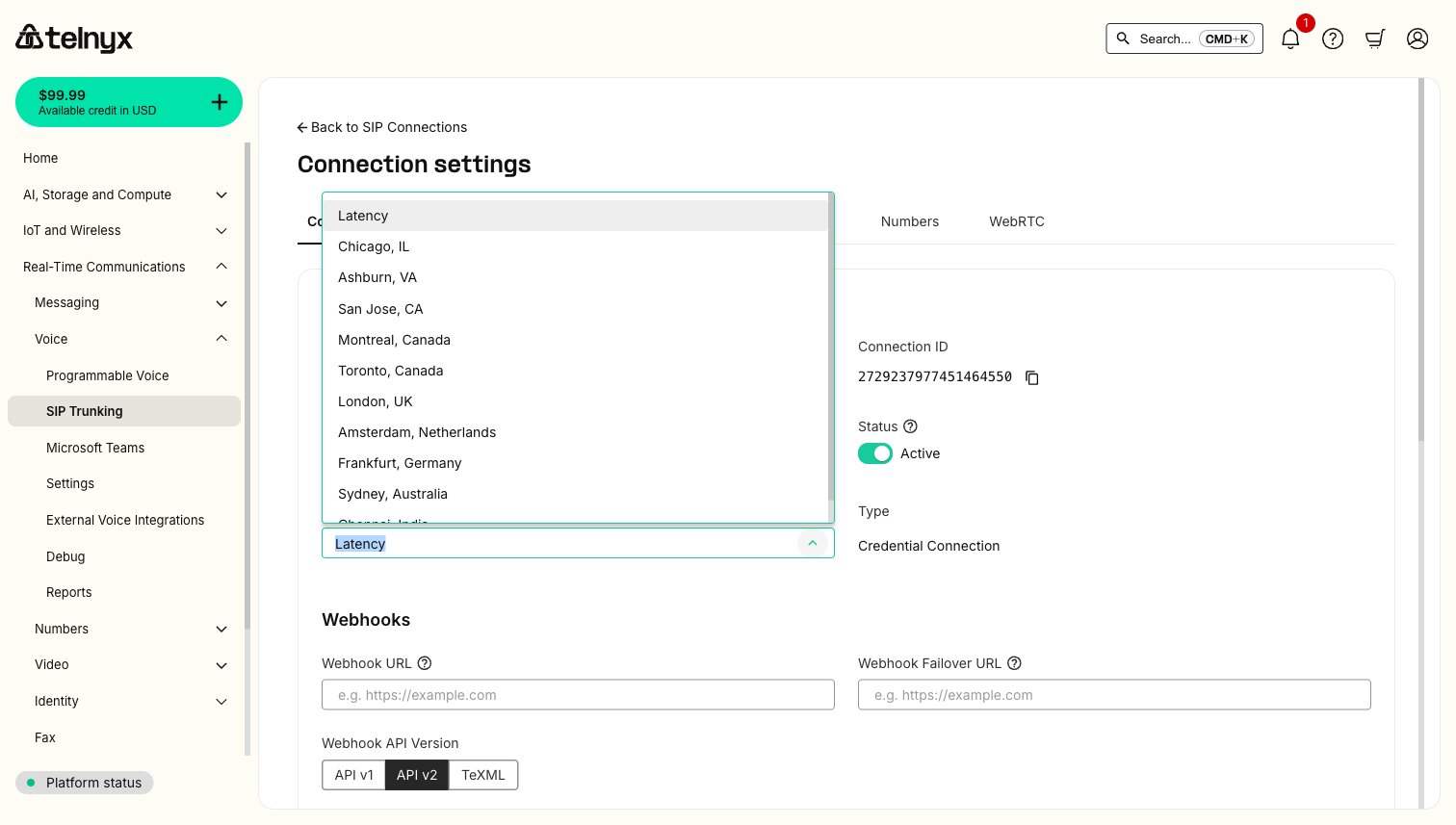
Telnyx portal: SIP connection settings with the AnchorSite menu of points of presence
SIP connection settings in the Telnyx portal, from the developer docs. The menu picks which point of presence carries the call's media.
Voice API / SIP Trunking

Route, bridge and control business calls using APIs or an existing SIP system.

Communications become part of a customer workflow and remain compatible with existing telephony.

Reinvent Telecom

A reseller can offer its own AI receptionist

First order closed on launch day, according to Reinvent’s published account.

It selected Telnyx after evaluating more than 20 vendors and built the white-label MyCloud AI Receptionist with business knowledge and human escalation.

What changed? +

Reinvent needed a flexible, multi-tenant voice platform that could work with its own and third-party phone systems.

Company customer story first published April 28, 2026; it describes Reinvent’s launch and early distribution.

Cisco

Enterprise voice for two Cisco product lines

500 concurrent ports on a high-availability pair; 10 calls per second per trunk.

Over more than five years the relationship grew into SIP trunking, numbering, private connections in San Jose, Frankfurt and London, and messaging across three continents, extending into connected-device connectivity. WebEx Calling and Contact Center run on separate accounts with their own commits and billing.

What changed? +

Cisco began with SIP trunking and numbers on Telnyx.

Telnyx-written customer story dated 24 September 2026; the figures are the production specification Telnyx describes, not a measured business result.

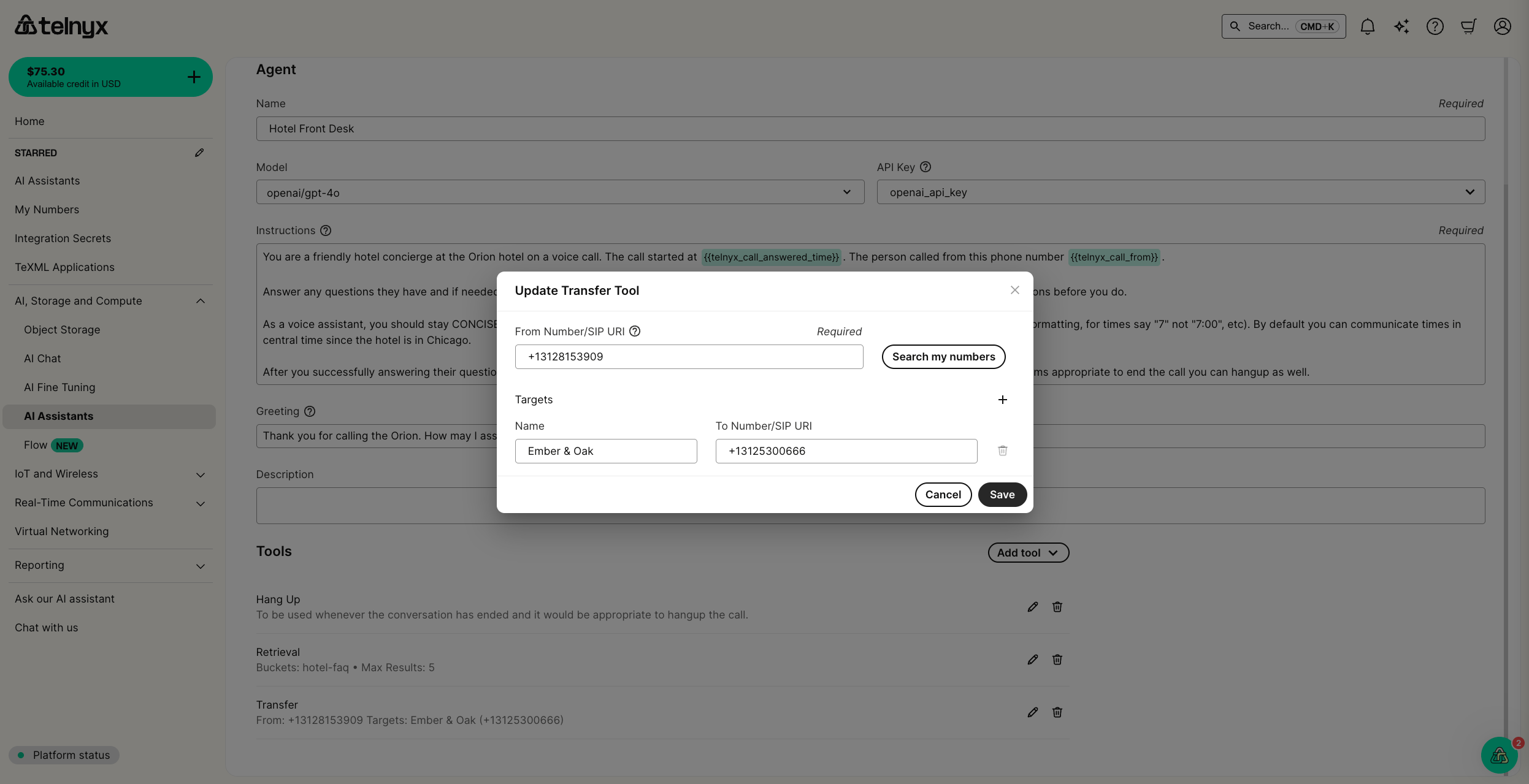
Telnyx portal: an illustrative hotel front desk assistant with a model, instructions, retrieval and a transfer tool
An assistant in the Telnyx portal, from the developer docs. It answers from a knowledge base and can transfer the caller to a person. The hotel is a documentation example.
02 / HOW IT BECOMES REAL

From an incoming call to a resolved request

Illustrative workflow: a service company wants an AI receptionist connected to its existing telephone system and customer records.

  1. 01

    Keep the telephone identity

    The engineer provisions or ports numbers and connects SIP or Voice API call routing. The business decides which calls the agent handles and which reach staff directly.

  2. 02

    Teach the agent the actual business

    A developer supplies instructions, business knowledge and tool connections. The receptionist can answer within its approved scope and send requests to downstream systems.

  3. 03

    Run a conversation with a latency budget

    Speech recognition, model inference and speech generation operate along the live call path. Tests must include interruptions, silence and unfamiliar Korean names, rather than just a fluent scripted demo.

  4. 04

    Hand over a service that can be supported

    Calls requiring judgment transfer to a human; other requests complete through integrations. Logs, traces and runbooks give the operations team a way to investigate failures after launch.

Follow the work, step by step

Distance and vendor boundaries, not the model

Telnyx starts with the infrastructure beneath a phone call. Its company description argues that a business using several aggregators, connectivity partners and carriers pays for each layer and coordinates several support boundaries. Its current network page carries the same argument into AI: distance and vendor boundaries can dominate the latency budget even when the model itself is fast. Signet reads this as a concrete engineering claim to test on a customer's call path. The company wants to own the pieces that move the audio, run the model and send the reply, then price them together. That can place a technical engineer inside an enterprise sale because the buyer needs a working system, with measurable behavior under load.

The hard part of real-time AI is not the model.

David Casem · Co-founder and CEO, Telnyx · Edge Compute launch press release · 2026-08-03

The belief that sets Telnyx apart is ownership. The company holds carrier licenses, runs its own private network and points of presence, and puts GPUs next to its telephony equipment, so that a call, the speech models and the reply travel one path. Its network page calls ownership "the load-bearing claim" and lists price, latency, reliability, identity and sovereignty as consequences of it. The rival it names most is Twilio. Telnyx says resellers buy capacity and add margin while it owns the switch, and prices itself 50% below Twilio, a comparison that is the company's own. A 2025 podcast host summed up Casem's view the same way: Twilio is a software company that depends on cloud and carrier partners, and Telnyx is a carrier.

Why now: the phone call became software

The timing comes in steps. Telnyx spent its first years building a carrier business with APIs for calls, numbers and messages. In February 2025 it launched Voice AI, arguing that speech processing, orchestration and its private network could support live business conversations. It then added open-weight inference on owned GPUs, in-country inference in Dubai in July 2026 and Edge Compute in August, which runs the agent's own code on Telnyx infrastructure. In a May 2025 sponsored interview, Casem emphasized that multimodal systems must keep voice, text and visual conversations connected. Signet's reading is that the phone call is becoming one interaction in an application that can retrieve information, take an action and communicate through several channels.

One call, followed through the stack

Take an illustrative service business that wants an AI receptionist on existing numbers. An engineer first connects the numbers, by porting them to Telnyx or connecting the customer's phone system over SIP, and chooses which calls go to the agent or staff. A developer then writes instructions and a greeting, adds a knowledge base and tools such as retrieval or transfer, chooses a model and voice, and assigns a number. The developer guide walks through an initial phone assistant. Production preparation adds customer-specific evaluation, access controls and a handover plan. Those steps matter because the configuration screen is only the beginning of the operating system the customer will use.

The conversation must then fit a measured latency budget. The current network page presents about 460 ms for an illustrative voice-agent composition and under 200 ms round trip between its points of presence. These are distinct company estimates, rather than an observed guarantee for every Korean call. Speech recognition, model inference and speech generation each occupy part of the path. Signet suggests testing interruptions, silence, unfamiliar Korean names, background noise and concurrent calls against the customer's own success criteria. The handover also needs logs, traces, alerts and a runbook, so the operations team can diagnose failures after the initial launch.

Ownership helps most where distance and data location decide the outcome, and least where the customer's own systems are the bottleneck. A private network does not fix a messy knowledge base or an unclear escalation rule. That is why Telnyx attaches engineers to its biggest Voice AI deals. The Seoul posting lists rate limits, timeouts, retries, fallbacks and failures under concurrency as problems the engineer must already understand.

For someone joining in Korea, the work is to make the one-stack promise true for Korean callers: Korean speech, Korean names and numbers, and Korean rules on where personal data is processed. The person in this seat shows, call by call, whether owning the path makes a difference a customer can hear.

Understand the products and their customers

Three doors onto one network

Telnyx sells many products, and a buyer meets three doors. The oldest is programmable telephony: phone numbers, the Voice API and SIP trunking, which connects a company's phone system or contact center to the public phone network. The second, launched in February 2025, is Voice AI Agents, assistants that answer or place calls with speech recognition, speech generation and orchestration in one stack. The third is Inference: open-weight models served on GPUs Telnyx owns, through an interface compatible with OpenAI's. Messaging, IoT SIMs, an Email API and Edge Compute sit around them, so one contract and one bill can cover a whole customer workflow.

SIP trunking is where the network shows. A customer points its phone system at a Telnyx connection, and the portal lets it choose which point of presence carries the call's media, either automatically by measured latency or by picking a site. Local numbers come from Telnyx in 140+ countries, according to its network page. This door competes with other carriers and communications platforms on price, reach and uptime. Casem says carrier-grade infrastructure ensures five-nines uptime, meaning 99.999 percent.

Voice AI Agents list $0.05 per minute for the voice engine, including orchestration, speech-to-text and text-to-speech. Model tokens and telephony are billed separately. Telnyx's pricing example estimates about $0.06 per minute for a US-local inbound call using Kimi with a stated token and caching profile. Voice-engine billing rounds each call to 60-second increments, so short calls can cost more than the estimate suggests. The product page advertises 1,400+ voices and 80+ languages. A builder picks a model and voice, writes instructions, adds a knowledge base and tools, and attaches a phone number. A Korean deployment needs its own measured cost and language evaluation.

Models, and engineers as part of the deal

Inference is the newest door and connects the model choice with the deployment location. The Seoul posting lists GLM, Kimi, DeepSeek, Qwen and MiniMax through Telnyx Inference and describes self-hosted models for sovereign-cloud or air-gapped customer environments. Telnyx also offers Forward Deployed Engineering as professional services. Its current FAQ makes free help available to customers and prospects with a Voice AI use case and a minimum $5,000 monthly communications spend with Telnyx. It describes initial prototypes in days and full deployments spanning weeks to months. These are the company's offered terms and delivery expectations; the actual scope is agreed for the customer project.

Who buys it, and what the cases show

The named customers fall into two groups. Platform and reseller companies make up most of the stories. Cisco has run communications on Telnyx for over five years, from SIP trunking and numbers to private connections and messaging across three continents, and the case lists 500 concurrent ports on a high-availability pair and 10 calls per second per trunk. Dialpad started with SIP trunking into Mexico and launched its own AI agent platform in 2026. UpLync, a small hosted voice provider, says 98 percent of its backend runs on Telnyx.

The second group is newer: companies buying voice AI for a specific language or rule. Alibaba.com's team in Pakistan had over 100 sales representatives making roughly 50 outbound calls a day each, about 5,000 calls, mostly in Urdu. Alibaba's team and Telnyx's solutions engineers worked through prompt versions, Urdu dialect edge cases and speech settings until recorded calls passed internal QA. Agents now qualify leads in Urdu and English before handing promising ones to people, and the same setup is scoped for Vietnam and India.

Noota's case connects the network choice with procurement. The Paris-based AI notetaker previously processed part of its phone audio through US infrastructure. Its enterprise buyers in France wanted European storage and processing. The vendor-written account says moving core telephony to Telnyx's European infrastructure helped those deals start closing and reduced voice-quality complaints and troubleshooting. It also describes plans to add automated recruiter screening on the Inference API. That planned service is a next step, while the telephony migration is the reported completed change.

Reinvent Telecom evaluated more than 20 vendors before building a white-label AI receptionist on Telnyx, and closed its first order on launch day.

The cases support different kinds of evidence. Cisco's 500 concurrent ports and 10 calls per second are a production specification; Alibaba describes a QA process and current lead qualification; Reinvent reports an initial order on launch day. Signet reads the Alibaba and Noota stories as useful analogies for a Korean enterprise discussion: agree the language test, data-processing location and business workflow, then iterate with the customer until its test passes. The analogy guides preparation. Each case remains the customer's vendor-published account, with its own scope and date.


03 / THE EVIDENCE

The story, in numbers.

DATED OBSERVATIONS

Companies building on Telnyx

companies
14,000+ companies

The company's own count of companies that build voice, messaging and AI on Telnyx, across all products, read from its customer-stories page.

Figures, dates & basis +
Companies building on Telnyx
DateValueBasis
2026-10-0814,000+ companiesCustomer-stories page re-read October 8, 2026: 14,000+ companies build voice, messaging and AI on Telnyx.

Telnyx

Voice AI launch

Telnyx announced a voice AI platform for live business conversations.

Reinvent customer story

Reinvent described selecting Telnyx and launching its branded AI receptionist.

Published adoption snapshot

The website lists 14,000+ companies building on Telnyx.

Read the growth story

Paid by the minute, the message and the token

Telnyx makes money from use. A customer pays per minute for calls and for the voice AI engine, per message, per phone number each month, per megabyte on an IoT SIM and per token for models, all on one bill. Committed customers sign a monthly minimum: $2,000 on the Growth plan, which buys a 15% discount on voice, messaging and numbers, and $5,000 on the Enterprise plan, which buys custom pricing on dedicated infrastructure. A Korean local number starts at $6 a month.

Enterprise work adds an implementation relationship to usage revenue. The current FDE FAQ links free engineering to a Voice AI use case and at least $5,000 in monthly communications spend, so the eligibility threshold is a communications commitment. The Japan founding-AE posting gives a separate example of the sales design: 30 to 40 named accounts, about ten Tier 1 accounts with $1M+ annual potential, and a goal of expanding an account from $500K to $2M. Those are the Japan posting's targets, rather than booked revenue or a Korea quota. Seoul's own FDE posting describes working with a dedicated enterprise AE. Signet reads this pairing as a way to convert a proof of concept into continuing production use.

The numbers Telnyx publishes, and what each one measures

Telnyx's scale figures describe platform activity. The customer-stories page says 14,000+ companies build on Telnyx. The global-communications page lists 500M+ SIP calls, 1.3B+ messages and 750M+ API requests per month; the global-communications page lists 7M+ active phone numbers managed. These are company figures re-read on October 8, 2026. The jobs also describe Telnyx as financially stable and profitable, which remains the employer's characterization. A November 18, 2014 report records an additional $1.1M bringing that seed round to $2.1M. That historical financing belongs to its own date. Signet uses the current activity figures to describe adoption and network use, with the historical round providing company context.

Telnyx's published numbers and what each one measures
NumberWhat it measuresDateBasis
14,000+Companies that build voice, messaging and AI on Telnyx, any product2026-10-08Company figure
500M+SIP calls per month2026-10-08Company figure
1.3B+Messages per month2026-10-08Company figure
7M+Active phone numbers managed2026-10-08Company figure
$5,000Enterprise monthly minimum; FDE eligibility requires a Voice AI use case and minimum monthly communications spend2026-10-08Company price list
$2.1MSeed round total2014-11-18Press report

Where Telnyx stands

Telnyx competes on two fronts. Against communications platforms such as Twilio it argues price and control: it says it is 50% cheaper because it owns the switch, and a 2025 analyst ranking of 23 communications-platform providers, relayed on Telnyx's own site, placed it among the leaders. Against new voice AI companies it argues completeness. A 2025 podcast summary relays Casem saying Twilio does not keep him up at night, while new entrants such as Vapi do. Customers also switch for reasons beyond price: Noota left Twilio so its data could be processed in Europe.

Three risks a seller should know

The regulatory example is the FCC's notice adopted February 3 and released February 4, 2025. It proposed $4,492,500, calculated as $2,500 for each of 1,797 calls the agency says the accounts placed. The agency alleged customer-verification failures in connection with scammers impersonating FCC staff. Telnyx's February 27 response uses a different measure, 1,117 completed calls, says it closed the customer within 17 hours and disputes liability. The proposal and the company's response must be read together. Signet treats customer verification and abuse handling as operating questions for a communications platform, while keeping the proposed amount distinct from a paid or final penalty.

A second example is SDK distribution security. Telnyx's notice says unauthorized Python SDK versions 4.87.1 and 4.87.2 were published on March 27, 2026, beginning at 03:51:28 UTC and quarantined by 10:13 UTC. The company describes the event as confined to the PyPI distribution channel and says its production platform and APIs remained intact. That is the company's account of scope. A third issue is the policy environment for model serving. The current Seoul role names open-weight models including Kimi, DeepSeek and Qwen, and Telnyx appears among signatories of the July 24 open-weight letter. Signet reads the choice of available models and deployment locations as a product exposure to monitor as policy develops.

Preparation starts by stating the measure and date: companies building on the platform, monthly calls, active numbers, a unit price or historical financing. The engineer can then ask how its own Seoul workload is evaluated: technical success criteria, production usage, customer adoption and expansion. Japan's targets illustrate a sales approach; the local performance agreement should be read with the Seoul hiring team. The most useful case is a system that reached stable production and produced a result the customer could check.

04 / THE PEOPLE

Someone saw it first.

Photograph of David Casem
Co-founder and CEO

David Casem

Casem leads Telnyx and publicly represents the company on telecommunications policy and network infrastructure.

The choice behind the company +

The company builds its agent offering on a carrier network it operates, making infrastructure ownership part of the product strategy.

“The hard part of real-time AI is not the model.”

David Casem · Edge Compute launch press release · 2026-08-03
The decisions behind the company

Two founders who built a phone company first

David Casem and Ian Reither founded Telnyx in Chicago in 2009. It began with call-center systems work, moved into reselling voice minutes between 2010 and 2013, and became a licensed carrier along the way. Casem, the CEO, is described in his published bios as a self-taught engineer who built the first version of a phone company from open source software, a few relationships and a license from the FCC. Reither, as COO, spoke for the company when its seed round reached $2.1M in November 2014, after it graduated from the Techstars Chicago accelerator; Telnyx had 14 employees then.

In November 2016 Telnyx announced a plan to hire up to 20 network and site-reliability engineers in Dublin to support global deployments. The date belongs to the hiring plan. The current careers page lists Denver, San Francisco, Dublin, Amsterdam, Sydney and Dubai, while current company announcements give Austin, Texas as headquarters. These sources show how the company's public geographic description developed over time. For a Korea candidate, the current Seoul posting is the direct source for location and travel. The global office list describes the broader company, rather than a Korean employment arrangement.

AI-powered voice is the future of customer interactions,

Ian Reither · COO at the February 2025 launch, Telnyx · Voice AI launch press release · 2025-02-24

Four decisions that explain the company

Four decisions explain Telnyx's shape. The first was to own the network instead of renting it, the choice behind every price and latency claim in the earlier chapters. The second is to charge less. A podcast host summarising Casem in 2025 relays a philosophy of charging customers less so they can do more with Telnyx, and the pricing page sets $0.05 a minute against what it calls $0.12 to $0.42 for a stitched-together stack. The third is to sell through people as well as through the website. Casem said in April 2026 that Telnyx had spent six to 12 months building a partner channel, and by October 2026 the employer board listed 20 forward deployed engineer and 17 founding account executive postings across countries.

The fourth decision is to contest regulation publicly. The FCC's February 2025 notice proposed a $4,492,500 penalty for customer-verification failures it alleged. Telnyx disputed the facts and sought cancellation; its February 27 statement counted 1,117 completed calls and described shutting down the customer within 17 hours. In April 2025 the company reported that the FCC recommended restoring its Industry Traceback Group supporting-partner status. It separately invoked an AT&T court ruling to support its own arguments. Those are dated positions and events, rather than a final disposition of Telnyx's proposed penalty. Telnyx is also listed as a signatory to the July 24, 2026 open-weight letter, which urges policymakers to support an open model ecosystem.

We will never stop fighting to clear our name

David Casem · Co-founder and CEO, Telnyx · Telnyx statement responding to the FCC notice · 2025-02-27

How Telnyx says it works and hires

Telnyx describes its way of working in a few lines. Its careers page promises small teams with short paths to production, products the staff use daily, and leadership that expects experimentation, including with AI tools. An engineer quoted there says people are trusted to make the call and own the product they ship. The Seoul posting adds the commercial version: "We sell the workload, not the SKU," with the engineer and the account executive winning together with a clear joint handover. The founding account executive posting for Japan adds a rule of discipline: every proof of concept has an executive sponsor, written success criteria and a decision date, and it ends in production or it ends.

For a Korea hire, the people who shape the job are few. The founders are the company's public voice on the network, pricing and models, and one hiring manager is listed on all 20 forward deployed engineer postings on the board, which suggests a central FDE function. In interviews, ask who leads sales in APAC and who the Seoul engineer reports to.

05 / THE NEXT CHAPTER

Build Korean production systems alongside enterprise sales

Work covers voice, messaging, model gateways, observability and production integration with a dedicated enterprise AE.

Enterprise account ownership
  • Dedicated Enterprise AE
Customer production engineering
  • Forward Deployed Engineer, SEA

Functional work view from the current Seoul job description, which describes an AE/FDE pod under construction.

Why Korea? Why now?+

Dated product releases provide Korean numbers with two-way voice from May 2025 and an Asia SIP Region beta from January 2026. The current Seoul FDE posting supplies the employment context: bilingual customer deployment, model routing, production engineering and Korean regulatory frameworks as advertised work and bonus knowledge. Signet reads the Dubai and Noota examples as analogies for a buyer who needs a measured language test and a specified processing location.

Operator Connect reaches APAC

Telnyx's first APAC wave for Operator Connect covered Australia, Japan, New Zealand, Singapore and Thailand, for 54 supported locations in total.

Numbers and local calling in more Asian markets

Two release notes added number types and local calling in markets including Indonesia, the Philippines and Taiwan.

Korean numbers go live

Telnyx added Korean geographic and national numbers with two-way voice, one of seven countries in that release.

Asia SIP Region in beta

Telnyx launched an Asia SIP Region in beta for lower latency and regional redundancy across Asia-Pacific.

Understand the Korea opportunity

Korea arrived as a product line first

Korea appears in a dated product release. On May 19, 2025 Telnyx added Korean geographic and national numbers with two-way voice as part of a seven-country expansion. The current Korea number page lists local numbers from $6 per month and porting. Telnyx also markets IoT SIM connectivity for South Korea and provides a Korean-language product page. Its broader Voice AI page advertises multilingual voices. Across Asia, dated releases added Operator Connect coverage in five APAC countries in August 2024, further number types and local calling in October 2024 and an Asia SIP Region in beta in January 2026. These are product availability statements; the Seoul employment opportunity is described in its own current posting.

The employer's API returned 50 current postings on October 8, 2026, including 20 forward deployed engineer and 17 founding account executive postings globally. Fourteen of the FDE publications first appeared on September 11, Seoul among them; the seventeen founding-AE publications first appeared that September. Seoul's Forward Deployed Engineer, SEA is the one current Korea-located role. The Japan, Singapore and Hong Kong FDE originals share a customer-embedded deployment approach while naming their own location and language requirements. Signet reads the simultaneous hiring as a distribution effort built around enterprise accounts and local technical execution. It establishes the current hiring pattern, while Seoul's original determines the candidate's actual conditions.

Why Korea, read from what Telnyx sells elsewhere

Telnyx's case for Korea can be read from the Dubai infrastructure launch and the Noota account. In Dubai the company argues that enterprises need to specify where AI runs; in France the customer says European processing helped procurement. Seoul's original describes Korean and English evaluation sets and regional model deployment. Its bonus section names Korean models EEVE-Korean, Polyglot-KR and Kanana, sovereign AI efforts at Naver, KT and SK Telecom, and familiarity with the listed Korean regulatory frameworks. Those are the employer's desired project knowledge. Signet uses the cases as preparation analogies, while the actual customer's processing and legal requirements are established for its specific workload.

Signet reads the Seoul posting as customer-embedded engineering inside a commercial pod. The account executive owns the account and commercial close; the FDE owns discovery, architecture, proof of concept and stable production delivery. Similar international postings make the pattern visible, but the Korean original gives the local requirements: excellent spoken and written Korean and English, Seoul residence or relocation, hybrid work and Korea plus broader SEA travel. The candidate should discuss the specific account ownership, reporting relationship and success criteria during hiring. This is a reading of the advertised work design, rather than a count of employees already working in Korea.

What the advertised engineer owns

The posting says Telnyx is building local pods with one enterprise AE and one FDE. The AE owns the named accounts, executive relationships and close. The engineer owns technical discovery, architecture, the proof of concept and production go-live, then stays until the solution is stable and hands over runbooks. The advertised outcomes include an AI contact center, SOC or NOC agents, global communications, connected mobility and enterprise inference. The FDE is also expected to send insights from South Korea and the broader Southeast Asia region back to Product and Engineering. The two functions describe the posting's pod design; the current Korea board directly offers the engineer seat.

The original asks for a computer-science degree or equivalent experience and 3+ years of building and shipping production software, including debugging and on-call work. It calls for multiple programming languages, naming Python, Node.js/TypeScript and Go; cloud-native containers and Kubernetes; metrics, logs and tracing; high-concurrency event streams; API design; and SIP, WebRTC or real-time voice exposure. Excellent written and spoken Korean and English are required. The location is Seoul or relocation to Seoul, with hybrid work and travel across South Korea and broader SEA. Candidates must have Korean work authorization or eligibility for sponsorship. The bonus section separately covers voice AI, production model gateways, GPU serving and regulated-sector experience.

Three practical questions make the discussion concrete. Which countries and customer sites fall under the SEA title's travel scope? How will the dedicated AE and Product/Engineering counterparts share decisions and handovers? Which processing region, media route and model setup does the customer workload require? Telnyx's AnchorSite guide explains how a SIP connection selects its media site, and its January Asia SIP Region release describes beta access. Signet suggests drawing the actual call and data path for a proposed Korean workload, with the hiring team confirming the customer and deployment scope.

KOREA OPEN ROLES

1 open role in Korea

Current Signet catalog · 2026-10-19

FOR YOU

Use the mock application to explain shipping, debugging and bilingual customer work.

Solutions Engineer

Forward Deployed Engineer, SEA

Seoul, South Korea

Posting checked

The work
Own discovery, architecture, gated POCs and stable production beside an enterprise AE.
Who fits
CS degree or equivalent experience is required.
Keep in mind
Seoul or relocation; hybrid, Korea/SEA travel; Korean work authorization or sponsorship eligibility.
07 / NOW & NEXT

The next scene is taking shape.

Voice AI launch

Telnyx announced a voice AI platform for live business conversations.

Reinvent customer story

Reinvent described selecting Telnyx and launching its branded AI receptionist.

Published adoption snapshot

The current site describes 14,000+ companies building voice, messaging and AI on Telnyx.

More context on what comes next

Putting every part of an agent on Telnyx's own stack

Read against the thesis, the last year has three threads. The first is closing the stack. Telnyx put inference on GPUs it owns in Dubai in July 2026, starting with the Kimi K2.6 model. On 3 August 2026 it launched Edge Compute, which runs an agent's own code on Telnyx infrastructure, and two days later an Email API, so that email joins SMS, voice and WhatsApp under one API key and one bill. Casem's line for the launch was that the hard part is everything around the model, and the Seoul engineer is the person who has to show that in a customer's building.

One API key, one bill, one vendor.

David Casem · Co-founder and CEO, Telnyx · Email API launch press release · 2026-08-05

Selling through people

The second thread is distribution. In April 2026 Casem described a partner channel built over the previous six to 12 months and called that month's channel-partner conference in Las Vegas the company's debut there in a meaningful way. Reinvent Telecom's white-label receptionist is that channel at work. In June 2026 Casem was listed as a speaker at London Tech Week, and on 11 September 2026 Telnyx first published 14 forward deployed engineer postings in one day, Seoul among them, beside founding account executive postings for 17 markets that month.

What to watch from Korea

The security notice, FCC proposal and open-weight letter also expose the operating responsibilities that come with the stack. Signet's watch points are practical: changes to model availability and regional deployment options, the handover between the Seoul FDE and its commercial partner, and production evidence from customers. The March SDK incident is a dated distribution-security event according to Telnyx; the FCC amount belongs to a February 2025 proposal; the July 2026 letter is a policy position. Keeping those dates and scopes attached prevents a past event or company argument from becoming an unsupported statement about today's outcome.

The 2026 launches change what a Seoul engineer can put in front of a Korean buyer. Calls, messages, email, models and the agent's own code can now come from one vendor, so the first conversation is about which workload to move first and where its data has to run, not about a single product.

Their future. Your next chapter.

Find your part ↑

An independent profile by Signet. No affiliation or investment recommendation. Introductions happen only with your consent.
Research reviewed 2026-10-08

A LITTLE MORE CONTEXT

Understanding Telnyx.

What does Telnyx do?

Telnyx lets developers connect telephone numbers, voice, messages and AI to the same network. A business can receive a caller, retrieve its own information and hand the conversation to a person through one programmable stack.

What is the opportunity in Korea?

Work covers voice, messaging, model gateways, observability and production integration with a dedicated enterprise AE.

Are these confirmed job openings?

Employer postings were checked on 2026-10-08. Availability can change. Mock applications request a review from Signet.

How can I explore the company in more depth?

Follow the company from its vision through products, evidence and people to the Korea team and current roles. Use the table of contents to move within the page, and expand the sections for more context.

Back to the collection ↗