The buyer purchases a research path
The public services describe how the economic exchange works without requiring a speculative company revenue estimate. Institutional investors, consultants, lenders and corporate teams use expert conversations, survey responses, research content or advisory access to address a defined research need. The Surveys page explicitly connects price with the number of questions and completed responses. Expert participation is remunerated according to the Experts page, which makes the cost of acquiring relevant knowledge part of the service system. Library and data access also require the appropriate client entitlement. Signet reads the business model as commercializing useful access and research delivery across several formats, with the account relationship connecting those formats to a continuing client workflow. The commercial team must establish which service fits the need and then coordinate delivery. The current Seoul sales role carries a new-business quota, full-cycle prospecting and conversion, and a handoff to account management. That posting supplies a concrete commercial mechanism, while the exact economics of any customer agreement remain tied to its own terms.
Client scale is distinct from financial performance
The January 2021 investment announcement says Third Bridge served more than 1,000 private equity funds, hedge funds, mutual funds and management consulting firms at that time. Signet records that historical customer-scale observation with its date and lower-bound wording. The chart uses a single reported observation rather than inventing earlier or later customer totals to create a growth curve. Current product pages also describe the expert network, transcript archive and company coverage, but those measure different parts of the research system. A company represented in the Library is not necessarily a paying client, and an expert relationship is not a revenue unit. Candidates should keep the units and period visible before discussing scale. The Astorg transaction involved the founders, management and the exit of IK's stake; it is an ownership event, not a statement of yearly sales or present valuation. The historical customer measure is useful as business context because it shows the diversity of institutional users. It describes the scale of the client base at that date; it does not disclose contract prices or company revenue.
Repeat use depends on relevance and trust
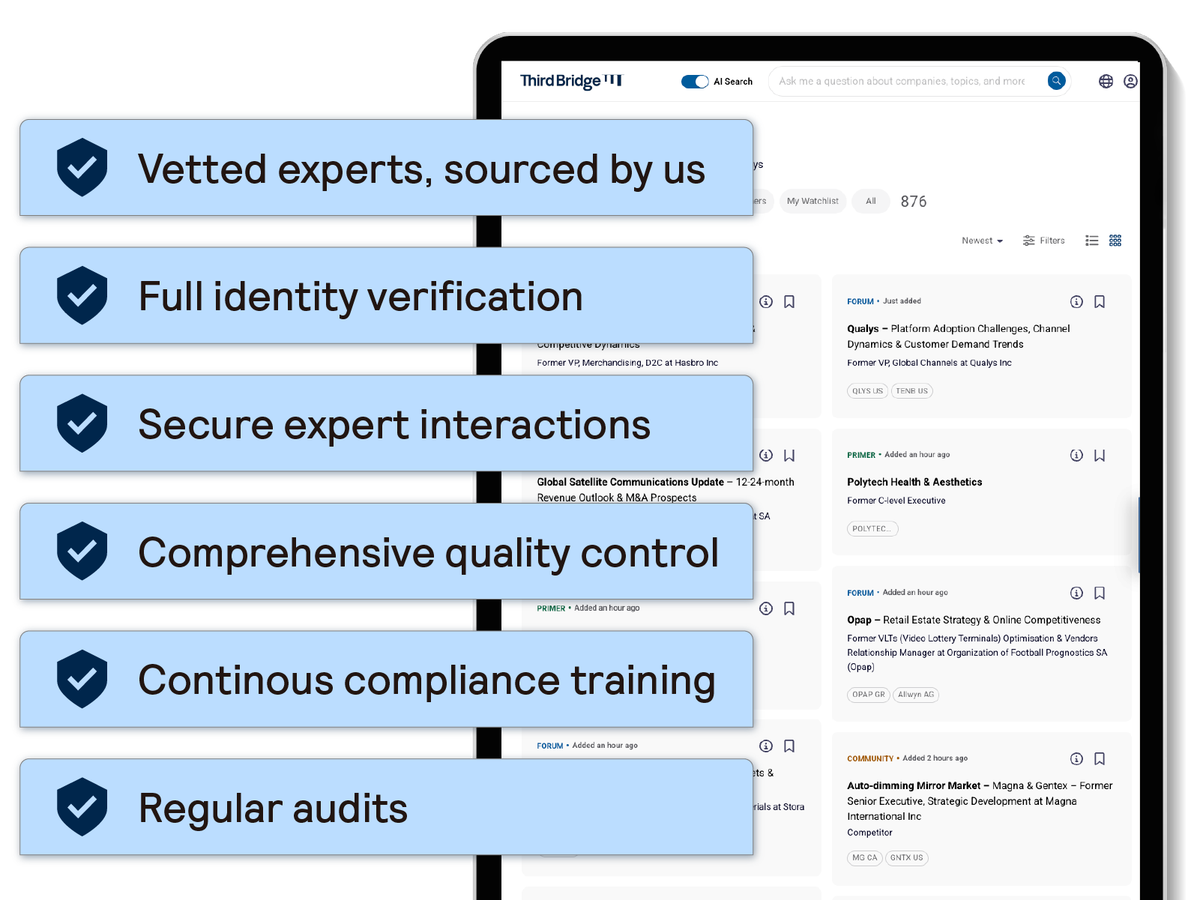
Signet interprets repeat use through the service's operating requirements: a client needs relevant expertise, dependable coordination, compliant interactions and content that remains usable in its research process. The Account Management description puts ongoing client understanding and research partnerships at the center of existing relationships. Integrated delivery through data feeds and partnerships can reduce workflow friction, while custom calls and advisory work can address questions that a stored transcript cannot resolve alone. These are plausible operating connections grounded in the company's service descriptions, not a promised retention rate or margin improvement. Risk appears when the expert does not match the question, when confidentiality or conflicts are mishandled, or when the content reaches the client without enough context for interpretation. The public compliance material describes vetting, obligations, reviews and access controls in response. A candidate can use those mechanisms to discuss how delivery quality supports a commercial relationship. The appropriate preparation is to trace a client's need, the chosen service, the resulting evidence and the next responsible account or research team.