Daniel Dines official leadership portrait
UiPath / THE WORLD THEY ARE BUILDING

UiPath coordinates agents, robots and people across enterprise work.

Deliver an observable process across existing systems and responsible people.

See it taking shape ↓
01 / THE PRODUCTS

The products behind the promise.

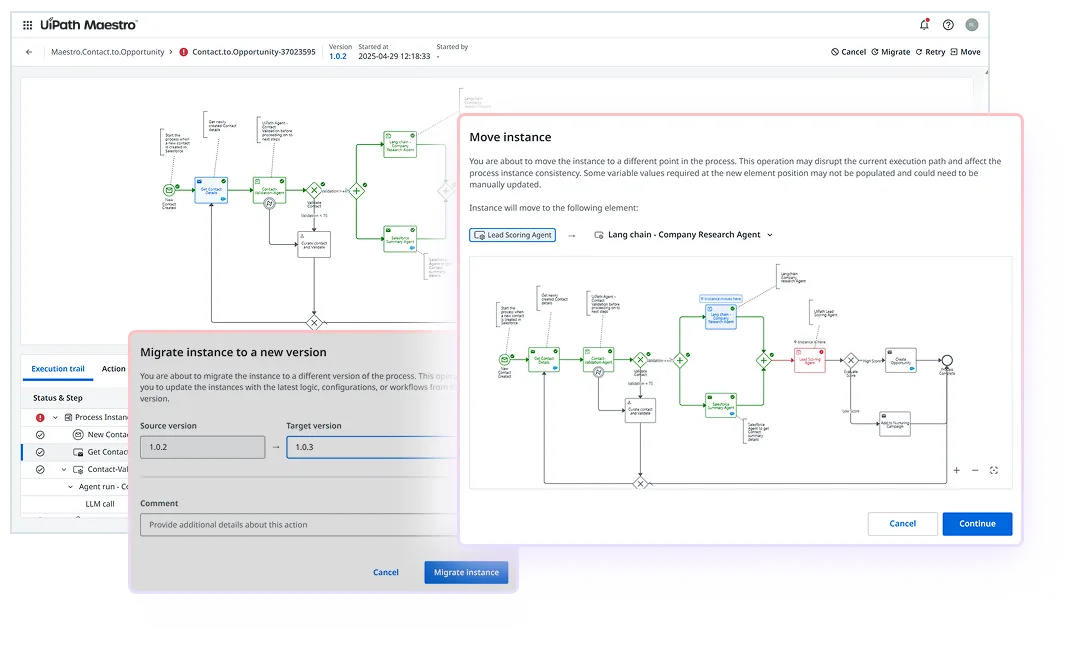
Official Maestro process performance view
Maestro

Coordinate long-running agents, automations and human decisions.

Helps business teams keep agents, robots and human decisions coordinated across a process that can run for days or change as information develops.

One NZ

Enterprise mobile provisioning

10 days to under10 minutes in the described workflow.

Orchestrated existing systems without replacing them.

What changed? +

Disconnected Salesforce, Oracle and internal handoffs.

Customer-reported process result; not a universal service guarantee.

Official Maestro process interface
02 / HOW IT BECOMES REAL

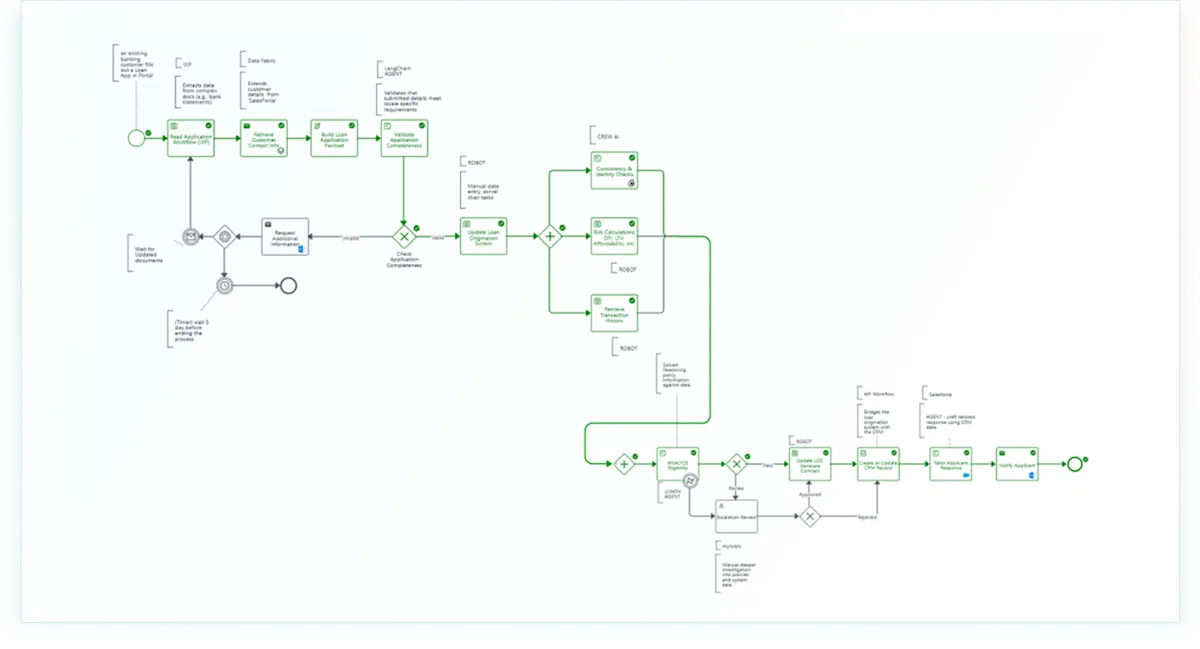
Illustrative enterprise workflow

Illustration: coordinate an order across applications and approvals.

  1. 01

    Understand

    Interpret context and identify a next step.

  2. 02

    Coordinate

    Keep the process and approvals connected.

  3. 03

    Execute

    Use robots and APIs in business systems.

  4. 04

    Observe

    Review execution and recover exceptions.

Follow the work, step by step

The handoff is the unit of work

A business process rarely stays inside one application. An enterprise customer order may start in a CRM, require a billing change, depend on a legacy screen, wait for a person to approve an exception, and finish only after another system records the result. UiPath approaches that gap as work to coordinate, rather than assuming a smarter language model can replace every existing application. Its current platform combines AI agents that interpret context, software robots that carry out repeatable actions, APIs that connect services, and people who retain authority over decisions. The connecting layer is orchestration: maintaining process state, deciding which step can run next, and keeping an operator able to see what happened. This explanation is an illustrative process, not a claim about a particular Korean customer. It helps distinguish task automation, such as entering a record, from coordinating an entire service outcome across teams. A useful implementation therefore starts by identifying the business trigger, systems of record, decision owner and evidence of completion.

A customer example with a defined boundary

One NZ provides a named example of this approach. Its enterprise mobile provisioning workflow crossed Salesforce, Oracle and internal platforms, with manual handoffs and limited visibility. The customer and UiPath describe a Maestro deployment that connected those existing systems instead of replacing them. The published case reports a reduction from ten days to under ten minutes for the described provisioning process, a five-week move from proof of concept to production, and return on investment in less than six months. Those figures belong to that customer's defined workflow; they are not a universal UiPath service level or a forecast for another company. The operational mechanism matters as much as the number. Teams could see stalled steps, investigate bottlenecks and coordinate agents, robots and human tasks while the underlying applications continued to run. A candidate can use the example to explain where measurable value comes from: removing a waiting period, avoiding a failed handoff and giving the responsible team enough information to resolve an exception.

Control remains part of the process

Maestro describes long-running process execution with history, retries, pause and resume, migration and operator actions. Its BPMN, Case and Flow canvases address different process structures while sharing the orchestration engine. A predictable sequence can use BPMN; an evolving investigation can use case management; developers can express a process in Flow, whose current public page labels it a preview. These are different modeling choices, so a diagram alone does not prove production availability for every capability. Orchestrator manages the operational side of automations, including deploying and monitoring execution. Integration Service and Data Fabric connect applications and governed enterprise data. In practice, reliable work still depends on application permissions, correct source data, explicit exception routes and test coverage. This is analysis drawn from the product design, not a promise that the platform makes every process safe automatically. The central question is whether the team can reconstruct a decision and recover a interrupted process without losing the business state or bypassing the responsible human.

Understand the products and their customers

Different surfaces for different work

UiPath's product portfolio is easiest to read as a set of responsibilities. Studio is the builder environment for automations; Orchestrator controls their operational execution. Maestro coordinates larger processes involving agents, robots, systems and people. Within Maestro, BPMN gives a familiar visual notation for prescribed process flows, Case supports work whose sequence changes as information develops, and Flow gives developers an artifact they can design, run, observe and govern. The current Flow page marks that experience as public preview, which a buyer should consider separately from the established execution capabilities. The important distinction is between designing an individual action and maintaining a business process that may run for days or change direction. A Korea customer engineering discussion should identify the actual owner of each layer, how an existing automation is reused, what an exception looks like, and where the operator intervenes. The official Maestro product image included here shows the company's own process interface; it is not a simulated customer deployment.

Documents, data and integration

IXP addresses information extraction and interpretation from documents and communications, where a process cannot begin with a clean structured record. Integration Service provides connectors and API-centered integration, reducing the need to treat every system interaction as a screen operation. Data Fabric supplies governed data and context to the work being automated. These responsibilities overlap in a real project: a document may trigger a process, an API may update a record, and an agent may need permission-controlled context to interpret an exception. The September Snowflake announcement describes a two-way integration, zero-copy data access through Data Fabric, and automation skills callable from Snowflake CoCo. It does not mean that all enterprise data is physically migrated into UiPath, or that access control can be removed. The reader should ask which source remains authoritative and which credentials are used at execution time. This distinction helps a seller avoid reducing an integration project to a feature checklist and helps an engineer frame proof-of-concept tests around data freshness, access scope and recovery behavior.

Testing belongs beside orchestration

Test Cloud extends the platform into software quality workflows, including designing tests, automating execution, managing results and applying agents while people remain responsible for quality decisions. Its October Oracle Marketplace announcement names Oracle Fusion Cloud Applications, E-Business Suite, PeopleSoft, Siebel and JD Edwards alongside connected custom, web, API and mobile applications. A marketplace listing is a distribution and purchasing path, not proof that a customer has completed an implementation. Pricing separates access and capacity choices across platform plans; enterprise scope should be read with the selected capabilities and actual contract. Automation Cloud supplies a managed deployment option, while other deployment choices serve different operational requirements. For a practical comparison, assess required builders, runtime workloads, environments, governance, connectors, support and test execution rather than assuming a single robot count explains the whole bill. This is a buying framework derived from public product material, not a quotation of an unpublished deal. The product boundary also determines which evidence a candidate should bring: a useful test result, recoverable automation, or a governed process that delivers the intended business outcome.


03 / THE EVIDENCE

The story, in numbers.

DATED OBSERVATIONS

Annual revenue

USD · USD

Fiscal years end January31; values are recognized USD revenue.

Figures, dates & basis +
Annual revenue
DateValueBasis
2022-01-31$892,300,000 USDFiscal years end January31; values are recognized USD revenue.
2025-01-31$1,429,700,000 USDFiscal years end January31; values are recognized USD revenue.

UiPath

Read the growth story

The account grows through delivered work

UiPath monetizes an enterprise platform rather than charging for a single business outcome in every case. Its financial reporting separates licenses, subscription services, and professional services and other revenue. Product pricing presents plans with different capabilities and capacity, while enterprise contracts determine the actual purchased scope. The commercial work therefore includes identifying processes worth automating, demonstrating fit, agreeing deployment and capacity, enabling adoption and maintaining the relationship as usage changes. Current Korea account executive postings explicitly include account plans, revenue forecasting, quota ownership, customer satisfaction and expansion of strategic relationships. A customer engineering leader supports this chain by connecting technical value, scoped services and operational adoption. This description is a reading of the public business model and postings, not a statement about a specific customer contract. It also explains why replacing a manual action is only the first step. The company must show that an automation continues to run, that people can manage exceptions, and that the customer sees enough value to retain or expand the platform.

Keep revenue, ARR and profit separate

The historical chart uses annual recognized revenue: USD892.3 million for FY2022 and USD1.4297 billion for FY2025, with both fiscal years ending on January 31. It compares the same metric, not an ARR observation with a revenue figure. FY2025 also reported a GAAP operating loss of about USD163 million, despite positive non-GAAP operating income. Those accounting views should retain their labels. The later Q2 FY2027 report covers the quarter ended July 31, 2026: approximately USD410 million revenue, USD1.938 billion ARR and USD32 million GAAP operating income. The quarter should not be presented as an annual result. UiPath defines ARR as annualized invoiced subscription license and support amounts, excludes professional services, and says it is not a forecast of future revenue. Its reported dollar-based net retention measures expansion and contraction within an existing customer cohort. These definitions matter when evaluating whether new AI capabilities are producing sustained customer spending rather than simply increasing activity in demonstrations or product launches.

Commercial scale has operational costs

The software model creates an opportunity to reuse a platform across many processes, but implementation effort does not disappear. A large account may need integration work, security review, model evaluation, business ownership, testing and services to become a durable customer. The Q2 reporting distinguishes revenue sources and their costs, which cautions against treating every services dollar as a high-margin license dollar. Public results and forward-looking statements also describe competition, execution, product adoption and dependency on third-party cloud and model providers as relevant risks. For a prospective Korea employee, these translate into practical questions: how a proof of concept becomes a contract, who owns deployment quality, how account teams work with partners, and how adoption or renewal signals affect priorities. The Seoul technical leadership posting explicitly includes pipeline contribution, technical strategy, statements of work and delivery governance. The sales postings add executive relationships and long-term account planning. An informed candidate should prepare evidence of outcomes and handoffs across that whole chain, while keeping actual results separate from forecast revenue or future product promises.

04 / THE PEOPLE

Someone saw it first.

Daniel Dines official leadership portrait
Founder and CEO

Daniel Dines

Leads UiPath and its enterprise orchestration direction.

The choice behind the company +

Connect AI reasoning with controlled execution.

Ashim Gupta official leadership portrait
Chief Operating Officer

Ashim Gupta

Leads sales, demand generation and delivery execution.

The choice behind the company +

Focus operating accountability.

Hitesh Ramani official leadership portrait
Chief Financial Officer

Hitesh Ramani

Promoted to CFO in September2026.

The choice behind the company +

Own financial discipline and reporting.

“AI is expanding what enterprises can automate”

Daniel Dines · Dated official announcement · 2026-09-03
The decisions behind the company

From a small team to enterprise work

UiPath dates its beginnings to 2005, when a ten-person team worked from an apartment in Bucharest. That history provides context for a company whose original automation tools dealt with the awkward interfaces and repetitive actions inside existing software. The current business has expanded toward coordination of agents, robots, people and enterprise systems, while preserving deterministic automation as part of the execution layer. Daniel Dines is listed as Founder and Chief Executive Officer in the current leadership page. His September results statement frames AI as expanding the scope of automation while increasing the need for orchestration and governance. That is the company's stated direction; it should not be read as a guarantee that every autonomous workflow is ready for production. A useful interpretation is that the founder is trying to connect the established ability to act inside business applications with a newer ability to reason across context. Candidates should be able to distinguish that strategic direction from the concrete maturity, permissions and operational tests of the product they would sell or implement.

Current responsibilities changed in September

The September 2026 leadership changes are material when reading the company. Ashim Gupta now focuses exclusively on the Chief Operating Officer role, with responsibility for execution across sales, demand generation and delivery. Hitesh Ramani was promoted to Chief Financial Officer after serving as Deputy CFO and Chief Accounting Officer. Brad Brubaker became Chief Legal and Administrative Officer, with expanded oversight including the People organization. The current page also lists Raghu Malpani as Chief Product and Technology Officer. These are present responsibilities rather than a reconstruction from older executive titles. A company's transition toward enterprise orchestration affects both product development and commercial delivery: a process that looks impressive in a demo still needs an account plan, implementation resources, support and a renewal outcome. The role split therefore helps explain why current Korea postings combine senior enterprise selling with leadership across pre-sales, adoption and professional services. That connection is editorial analysis of the published structure and job requirements, not a claim that a Korea hire reports directly to any global executive.

Values become decisions in customer work

The company's public values describe humility, boldness, immersion and speed. Humility emphasizes an open mind and collaboration; boldness asks people to speak up; immersion emphasizes ownership and customer understanding; speed favors agility and simple execution. A candidate should translate those statements into examples rather than repeat slogans. In technical consulting, humility can mean testing a customer's constraints before defending a preferred design. Boldness can mean raising an implementation risk early enough for the account team to act. Ownership can mean following a scoped services engagement through delivery rather than stopping after the demonstration. Speed can mean choosing the smallest useful proof of concept while keeping security and success criteria intact. These are illustrative applications of published values, not formal internal performance criteria. They align with a Korea Customer Engineering Director posting that explicitly includes coaching, executive communication, technical judgment, team development and delivery governance. The practical question is whether the candidate can combine commercial understanding with credible technical execution and can show the tradeoffs made under real customer constraints.

05 / THE NEXT CHAPTER

Work in Korea

Sell enterprise value and lead technical consulting, adoption and services.

LOCAL & REGIONAL LEADERSHIP

Won-Joon Hyoung

Korea Country Manager in May2026 announcement

Customer Engineering Director
  • Customer Engineering Director

Open posting count, not team headcount

Senior Enterprise Account Executive
  • Senior Enterprise Account Executive

Open posting count, not team headcount

Senior Strategic Account Executive (Agentic AI Automation)
  • Senior Strategic Account Executive (Agentic AI Automation)

Open posting count, not team headcount

Posting counts describe current functions, separate from team headcount.

Why Korea? Why now?+

Local data residency and enterprise implementation shape the market.

Launch of the Azure-based Korea Automation Cloud region.

Understand the Korea opportunity

A domestic cloud region changes the discussion

UiPath's May 19, 2026 announcement launched Automation Cloud on Microsoft Azure in South Korea as a locally managed Korea region. The release lists orchestration, agents, document processing, developer tools and Test Cloud among the local capabilities, and frames domestic data residency as a reason for the investment. Won-Joon Hyoung is identified in that dated announcement as Country Manager for Korea. This is a concrete local operating development, rather than an inference from a remote job listing. At the same time, local hosting does not remove the need to evaluate a customer's particular data flows, access permissions or sector requirements. The source's broad regulatory claims are company statements, not independent certification for every deployment. The current offices page lists a Seoul address on Teheran-ro. Together these materials support an explanation of Korea as a customer-facing market with local infrastructure and office presence, while avoiding an invented local headcount, revenue allocation or internal reporting tree.

Three published roles with distinct requirements

The current official board and full original descriptions were checked on October 10. Three postings are located in Seoul, South Korea and marked on-site and full-time. Customer Engineering Director, requisition R15100, was published June 22 and leads Korea customer-facing technical consulting and professional services across pre-sales, deployment, adoption and delivery. It explicitly requires fluency in both Korean and English. Senior Enterprise Account Executive, R15404, was published September 28 and requires at least fifteen years of enterprise SaaS or cloud field selling, including five years on large enterprise accounts. Senior Strategic Account Executive (Agentic AI Automation), A-1502, was published October 9 and raises that large-enterprise experience requirement to ten years while retaining the fifteen-year field-sales requirement. The two sales descriptions explicitly require exceptional Korean communication; the text should not be silently expanded into an English-fluency requirement. These are three current postings, not three total Korea employees, and the application requirements should be assessed role by role.

Prepare the transition from sale to sustained use

The technical leadership description connects account planning, technical strategy, coaching and scoped professional services. It includes discovery and proof of concept, executive communication, services opportunity definition, statements of work and delivery milestones. The account executive roles connect senior customer relationships, multi-year plans, revenue forecasts, customer satisfaction and cross-functional feedback. Read together, these indicate a local commercial team that needs both a credible enterprise value story and the execution discipline to deliver it. An illustrative preparation plan is to bring an account strategy, an implementation example with explicit success criteria, and a case where a technical or delivery risk was handled without damaging the customer relationship. This is editorial interview preparation, not an announced first-ninety-day schedule or an official assessment rubric. Applicants should compare the published on-site requirement with their own work constraints, explain the required language ability accurately, and use the full original description as the authority for experience thresholds and duties. The roles offer different responsibilities, so one combined summary should never replace their individual requirements.

KOREA OPEN ROLES

3 open roles in Korea

Current Signet catalog · 2026-10-19

FOR YOU

Read each Seoul posting for its experience and language thresholds.

Solutions Engineer

Customer Engineering Director

Seoul

Posting checked

The work
Lead Korea technical consulting and professional services.
Who fits
Have led customer facing technical teams such as sales engineering, solution consulting, or technical account management.
Keep in mind
On-site in Seoul; review the exact posting requirements.
GTM · Sales · BD

Senior Enterprise Account Executive

Seoul

Posting checked

The work
Grow enterprise accounts and own revenue plans.
Who fits
15+ years of field sales experience selling enterprise application SaaS, cloud or software solutions to C-level executives.
Keep in mind
On-site in Seoul; review the exact posting requirements.
GTM · Sales · BD

Senior Strategic Account Executive (Agentic AI Automation)

Seoul

Posting checked

The work
Grow strategic Korea accounts for AI automation.
Who fits
15+ years field sales; 10+ years large enterprise accounts.
Keep in mind
On-site in Seoul; review the exact posting requirements.
07 / NOW & NEXT

The next scene is taking shape.

Snowflake two-way data integration

Governed context connects with automation.

Test Cloud on Oracle Marketplace

A new purchase path for application testing.

Gartner testing assessment recognition

Company-reported analyst positioning, with stated qualifications.

More context on what comes next

September 30: connect governed Snowflake data

UiPath's September 30 announcement expands its Snowflake partnership with a two-way integration and marketplace availability. Data Fabric reads and models Snowflake data without copying it, while Integration Service and platform tools connect that governed context with automation. Snowflake CoCo can call UiPath agentic skills through the integration; the release explicitly distinguishes those available skills from capabilities built into CoCo itself. The business implication is a path from governed enterprise data to action across applications, rather than another isolated AI assistant. This is an interpretation of the announced design, not a guarantee that every customer configuration is already enabled. Permissions, data lineage and the operational context of an action remain important parts of an implementation discussion.

October 6: a testing purchase path

Test Cloud became available on Oracle Marketplace on October 6. The announcement names Oracle enterprise application families and connected custom systems, and describes test design, automation, execution and management. This gives Oracle customers an additional way to discover and purchase a testing platform; it does not provide a named customer deployment or a measured outcome. The operational relevance is the breadth of systems a quality team may need to validate before releasing a change. A candidate can connect this distribution announcement to a concrete testing conversation about application coverage, test data, execution results and the human decision to approve a release.

October 9: read an analyst claim with its scope

UiPath announced its Leader positioning in Gartner's 2026 assessment of agentic software quality assurance platforms on October 9. The source attributes the evaluation to Gartner and includes the qualification that analyst publications are opinions rather than statements of fact or product endorsements. Its practical product discussion focuses on agents assisting testing while people control quality decisions. This belongs beside the marketplace and data integration updates as evidence of the company's current testing and orchestration emphasis. It should not become a claim that UiPath is universally best, nor replace a customer's own fit assessment. For Korea applicants, the freshest dated sales posting on the same day shows the local commercial direction: a Senior Strategic Account Executive for agentic AI automation, with extensive enterprise selling and large-account experience required.

Their future. Your next chapter.

Find your part ↑

An independent profile by Signet. No affiliation or investment recommendation. Introductions happen only with your consent.
Research reviewed 2026-10-10

A LITTLE MORE CONTEXT

Understanding UiPath.

What does UiPath do?

UiPath coordinates agents, robots and people across enterprise work.

What is the opportunity in Korea?

Sell enterprise value and lead technical consulting, adoption and services.

Are these confirmed job openings?

Employer postings were checked on 2026-10-10. Availability can change. Mock applications request a review from Signet.

How can I explore the company in more depth?

Follow the company from its vision through products, evidence and people to the Korea team and current roles. Use the table of contents to move within the page, and expand the sections for more context.

Back to the collection ↗