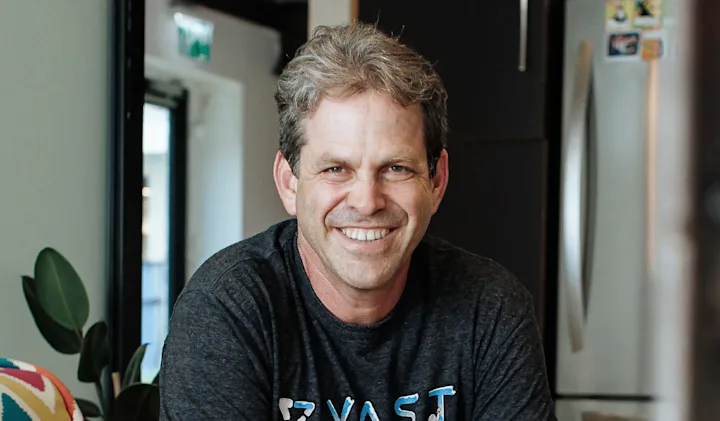
Alon Horev official leadership portrait
VAST Data / THE WORLD THEY ARE BUILDING

VAST connects data, compute and control beneath enterprise AI.

Operate reliable AI infrastructure with measured performance and clear access boundaries.

See it taking shape ↓
01 / THE PRODUCTS

The products behind the promise.

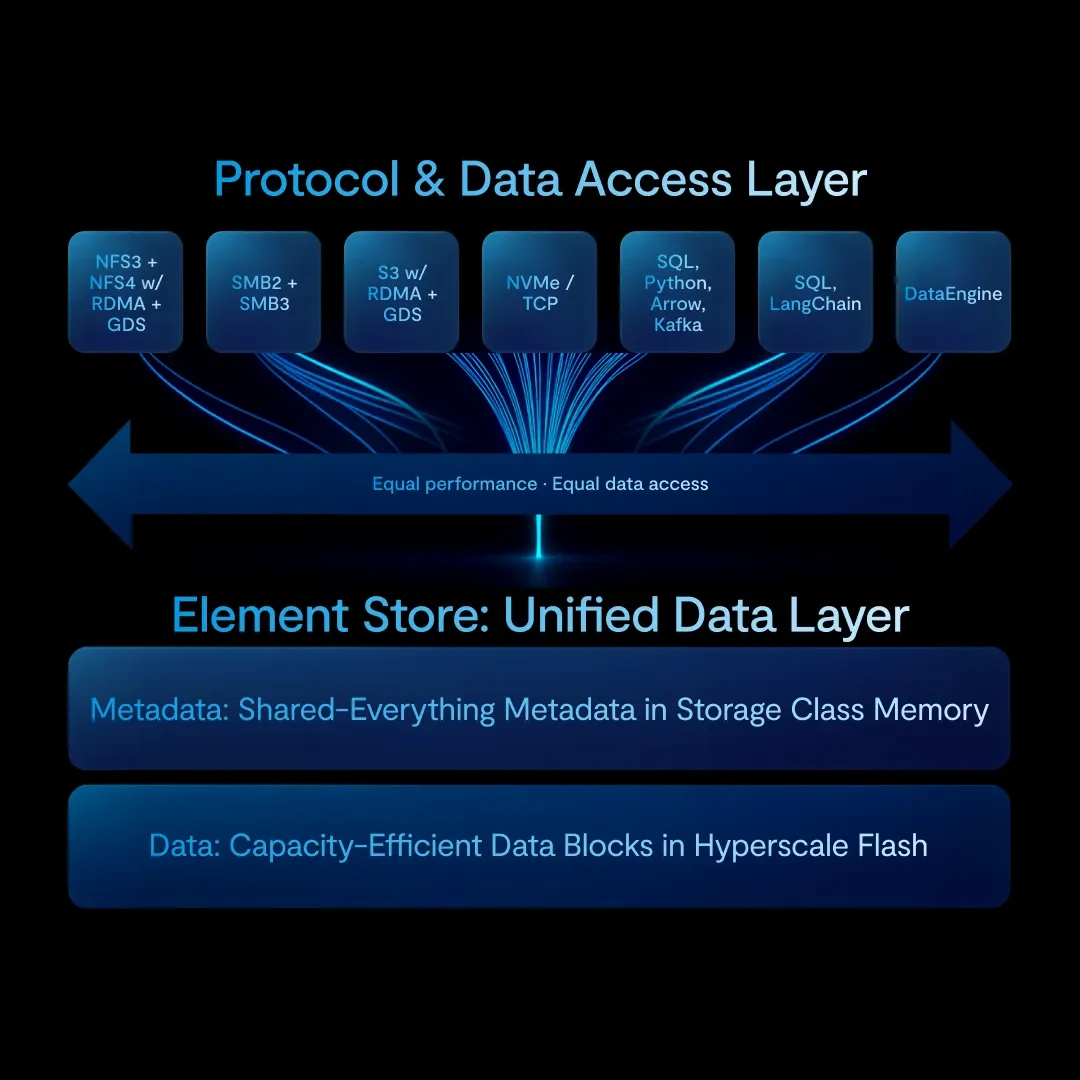
Official DataStore access-layer diagram
VAST DataStore

Serve files and objects from the shared data foundation.

Gives applications file and object access to a shared all-flash data foundation, supporting data use across storage and AI workflows.

SK Telecom

Petasus AI Cloud and Haein

As little as10 minutes provisioning in the described stack.

Integrated virtualized GPU service with shared data and tenant controls.

What changed? +

Bare-metal provisioning limited flexibility for GPU services.

Reported SKT stack result, separate from a universal VAST guarantee.

Lablup

Backend.AI integration

Named technical integration, separate from the later benchmark.

Connected datasets, checkpoints and tenant access on domestic infrastructure.

What changed? +

Training workloads strained data throughput and concurrency.

Training described as current; future inference scope remains distinct.

Official DataStore access-layer diagram
02 / HOW IT BECOMES REAL

Illustrative AI data workflow

Illustration: ingest, organize, compute and serve approved data.

  1. 01

    Store

    Supply data through file and object interfaces.

  2. 02

    Organize

    Connect structured data and vectors.

  3. 03

    Compute

    Run event-driven processing near data.

  4. 04

    Share

    Use a namespace across controlled environments.

Follow the work, step by step

Feed the system, not just the GPU

A GPU cluster does useful work only when its data infrastructure can keep up. Training jobs read large datasets, write checkpoints and share artifacts; inference and retrieval workloads need relevant data with predictable access and appropriate permissions. VAST Data approaches these requirements as one infrastructure problem rather than a set of disconnected storage products. Its Disaggregated Shared Everything architecture, abbreviated DASE, separates compute resources from a shared data foundation so they can scale independently. The company's explanation links this design to a platform for files, objects, tables, vectors and event-driven computing. This is a description of the architecture, not a promise that adding VAST makes every model faster. The result of a deployment still depends on GPU configuration, network design, workload shape, data access patterns and operating controls. A useful way to read the company is to follow the path of one dataset: where it is ingested, which service makes it available, who can read it, and what happens when a model or an application needs to act on it.

A unified data path with distinct services

DataStore supplies the shared storage layer and supports common access protocols, including file and object interfaces. DataBase adds structured and vector-oriented data capabilities, bringing transactional and analytical responsibilities into the platform. DataEngine provides computing and event-oriented execution near that data. DataSpace gives a namespace across distributed environments so teams can organize access to datasets and artifacts across locations. Those names describe complementary services, not interchangeable labels for one feature. In an illustrative AI workflow, a team ingests data, records the relevant tables or vectors, runs a transformation when a new object appears, and makes approved content available to a model. The responsible owner must still define retention, tenant boundaries, permissions, quality checks and failure handling. The official diagrams included here describe the company's data access and security layers; they are architecture illustrations rather than screenshots of a customer's private environment. A candidate can use them to explain where a proposed benchmark tests storage behavior and where it tests the application built above it.

A Korean example makes the path concrete

SK Telecom is a named Korean deployment in VAST's public materials. The Haein cluster combines NVIDIA Blackwell infrastructure with SKT's Petasus AI Cloud and the VAST data platform to support a virtualized GPU service. The dated announcement reports GPU environments provisioned in as little as ten minutes, with performance compared with bare-metal operation. That is a reported result of the described stack, not a universal VAST provisioning guarantee. Lablup's Backend.AI integration provides another concrete path: training datasets, checkpoints and artifacts move through the shared data layer with quota and identity controls across tenants. The November 2025 announcement distinguishes training work already running on the sovereign AI cluster from future inference expansion. This distinction matters because a platform vision can be broader than a deployment's present scope. For a Korea applicant, the meaningful problem is not simply selling faster storage. It is helping customer and partner teams connect GPU utilization, data access, isolation and operational reliability into an infrastructure service they can actually run.

Understand the products and their customers

Storage, data and computation have different jobs

The VAST platform brings several infrastructure services into a common architecture. DataStore provides file and object access to a shared all-flash data foundation, using familiar interfaces so applications can work with the data. DataBase is the platform's structured data service, combining transactional, analytical and vector workloads rather than requiring every query to cross a separate system. DataEngine supplies event-driven computation and functions that can process data as it arrives. The product pages describe these as related capabilities supported by DASE, but an implementation should still name the actual required service and release scope. A buyer running a training pipeline may start with throughput and checkpoint behavior; a retrieval application may care about ingestion, indexing and authorized context; an event-driven workflow may care about when a function runs and how it recovers. These are illustrative buying questions derived from the public portfolio. The official product diagrams explain data and access layers rather than show a live application interface.

Global data and the hardware boundary

DataSpace extends the platform across locations through a global namespace. This can help teams organize distributed datasets and access without treating each site as a completely isolated island. It does not eliminate the laws, network behavior or permissions of the environments involved. The supported platforms page gives the hardware context for deployment, while the partner program connects the software with infrastructure vendors and delivery channels. Gemini is the commercial model: customers license VAST software and buy required hardware directly from verified providers. Capacity and compute are licensed separately, which aligns the buying structure with the architecture's independent scaling. Co-Pilot support accompanies a Gemini subscription and covers operational monitoring, planning, upgrades and expansion. The relevant practical question is which resource is limiting the customer's workload and which change is necessary to address it. That may be storage capacity, compute, a network path or application behavior. A simple all-in-one claim would hide that diagnostic work and make a proposal less useful.

Confidential AI and release maturity

The September DataEnclave announcement adds a confidential AI runtime within DataEngine using NVIDIA Confidential Computing. It describes hardware isolation and attestation before sensitive models and data are decrypted for execution, with separate trust domains for customer data and model-builder intellectual property. The claim is about a defined runtime and supporting hardware; it should not be stretched into a guarantee that every model or every deployment satisfies every regulation. The September CrowdStrike announcement makes release maturity especially clear. Native Falcon sensor support is certified and available, while the Next-Gen SIEM and Falcon Guardian integrations are in private preview. A candidate should preserve that difference in a technical or commercial conversation. The platform's direction is to bring security visibility closer to the data and AI pipeline, but actual purchase decisions still depend on generally available capabilities. The product pages and announcements provide enough substance to ask about access telemetry, model trust, workload isolation and operational recovery without claiming that announced future integrations already run everywhere.

03 / THE EVIDENCE

The story, in numbers.

DATED OBSERVATIONS

Investment valuation

USD · USD
Investment valuation2023-12-06: $9,100,000,000 USD; 2026-04-22: $30,000,000,000 USD$9,100,000,000 USDSeries E$30,000,000,000 USDSeries F

Private round values inUSD, separate from annual revenue or market capitalization. These are dated disclosures, not a continuous growth record.

Figures, dates & basis +
Investment valuation
DateValueBasis
2023-12-06$9,100,000,000 USDPrivate round values inUSD, separate from annual revenue or market capitalization.
2026-04-22$30,000,000,000 USDPrivate round values inUSD, separate from annual revenue or market capitalization.

VAST Data

Read the growth story

Software and hardware are purchased separately

Gemini explains VAST's commercial model in terms of resource-managed software. Customers license the VAST software, including separate capacity and compute resources, and buy required hardware directly from verified hardware providers. The architecture allows compute and storage to grow independently; the commercial model aims to avoid coupling every software decision to a forced hardware replacement. Co-Pilot service is included with a Gemini subscription and supports monitoring, capacity planning, upgrades and expansion. Those are published terms of the model, not a price quotation for a specific Korea customer. A buyer should identify licensed resources, supported hardware, deployment services and actual workload requirements before comparing total cost. The company sells enterprise infrastructure value through direct and partner-led account work, so a sales manager must connect performance, reliability and operational fit to the customer's buying cycle. The sales engineer must provide the technical evidence behind that proposal. Neither function can responsibly derive a customer's bill from one marketing performance number or from the company's investment valuation.

The chart is an investment valuation

The historical comparison uses investment-round valuation, not annual revenue. VAST announced USD9.1 billion at its December 6, 2023 Series E and USD30 billion at its April 22, 2026 Series F. The later transaction totaled approximately USD1 billion and included primary and secondary capital; the total is different from new cash raised by the company. The same announcement reported more than USD4 billion cumulative bookings and over USD500 million committed annual recurring revenue at the preceding fiscal-year exit. These are company-disclosed contract metrics with different scopes, not interchangeable measures of recognized annual revenue. It also reported positive operating margin and free cash flow without publishing a full public-company income statement in that release. The responsible interpretation is that the company reports substantial commercial momentum while remaining privately valued. A candidate should preserve each metric's definition, date and scope when discussing scale, rather than turning the largest number into a revenue headline.

Customer infrastructure creates delivery obligations

The buying decision sits inside a larger infrastructure investment. GPU capacity, network design, data movement, storage durability and security controls all affect whether the service delivers a useful result. VAST's public customer materials show that partner integration and operational support are part of that work: SKT combines cloud management and accelerated hardware, Lablup coordinates tenant workloads, and CoreWeave operates infrastructure at large scale. A software vendor's growth therefore depends on deployments that remain reliable after a benchmark or initial sale. This is analysis of the named cases and role descriptions, not disclosure of a private renewal rate or gross margin. Risks include workload-specific performance assumptions, dependency on supported hardware and partner configurations, and the gap between announced security capabilities and generally available releases. For a Korea applicant, good commercial evidence would connect an agreed account plan with technical evaluation, delivery and expansion. Good engineering evidence would document the benchmark conditions, configuration changes, acceptance criteria and support handoff that made the account referenceable. These are the practical mechanisms through which infrastructure software creates sustained customer value.

04 / THE PEOPLE

Someone saw it first.

Alon Horev official leadership portrait
Co-Founder and Chief Technology Officer

Alon Horev

Leads the technical direction.

The choice behind the company +

Connect architectural direction and execution.

Shachar Fienblit official leadership portrait
Co-Founder and Chief Research and Development Officer

Shachar Fienblit

Leads research and development.

The choice behind the company +

Develop the platform and its engineering delivery.

“Models are becoming a resource”

Renen Hallak · Dated official company announcement · 2026-09-22
The decisions behind the company

An architectural starting point in2016

VAST dates its founding to January 2016 and describes the company as beginning with a new distributed architecture rather than modifying a conventional storage product. Renen Hallak is the current Founder and Chief Executive Officer. The public story centers on DASE and its separation of compute from a shared data foundation, followed by expansion from storage into database and computing services. This history matters because the company's AI positioning is linked to an existing infrastructure design, not only a recent label. It does not prove that one architecture is best for every workload. The current portfolio should be judged through its stated behaviors, deployment requirements and customer evidence. Hallak's September DataEnclave statement treats models as a resource the operating system must manage, alongside data. That is a direction for the platform: determine where a model runs, what it can access and who can use it. A candidate can connect the founder's stated direction to a concrete customer security or performance problem rather than repeating a claim about the future of all AI.

Current founders and responsibilities

The current leadership page lists Jeff Denworth as Co-Founder, Alon Horev as Co-Founder and Chief Technology Officer, and Shachar Fienblit as Co-Founder and Chief Research and Development Officer. It separately lists Andy Pernsteiner as Field Chief Technology Officer, so that field title should not be substituted for the company's CTO. These distinctions matter when older biographies or event pages use different labels. Denworth's March 2026 company article frames AI as a continuous flow of data, decisions and feedback, arguing that fragmented infrastructure creates unnecessary movement and delay. Horev and Fienblit's published leadership responsibilities connect the company's technical direction with research and engineering delivery. This is the public division of responsibility, not a complete internal organization chart. The official portraits shown here are Horev and Fienblit as identified by their company leadership pages. The text keeps all founders' stated roles visible without using an unrelated face or treating a field spokesperson as a different executive.

Translate the vision into field judgment

The public careers material emphasizes innovation, customer focus and willingness to work in an evolving environment. The Korea sales engineer description makes those ideas operational: evaluate systems, build benchmarks, define configurations, support installations and turn repeatable designs into architecture blueprints. The sales descriptions add customer relationships, quota ownership, channel collaboration and account expansion. An illustrative cultural test is whether a person can communicate a technical limitation clearly while helping the team find a workable path, rather than making a broad platform claim that an implementation cannot support. Another is whether a benchmark documents the conditions under which a result was obtained. These examples are editorial interpretations of the public roles, not internal performance criteria. They reflect the company's position between software engineering and demanding infrastructure customers. The strongest candidate story would connect a real workload, a measured constraint, a decision made with the customer and the way the system operated after deployment. That shows how a platform vision becomes an accountable service instead of remaining an impressive presentation.

05 / THE NEXT CHAPTER

Work in Korea

Extend enterprise sales and technical evaluation within an existing Korea team.

Regional Sales Manager (N)
  • Regional Sales Manager (N)

Open posting count, not team headcount

Regional Sales Manager - South Korea
  • Regional Sales Manager - South Korea

Open posting count, not team headcount

Senior Sales Engineer (N)
  • Senior Sales Engineer (N)

Open posting count, not team headcount

Posting counts describe current functions, separate from team headcount.

Why Korea? Why now?+

GPU services need data throughput, tenant controls and accountable deployment.

SK Telecom infrastructure collaboration.

Lablup Backend.AI integration.

Understand the Korea opportunity

Named deployments establish the local context

VAST has a named Korean infrastructure relationship with SK Telecom, announced in August 2025, and a Lablup collaboration announced in November of that year. SKT's Haein cluster connects accelerated hardware, Petasus AI Cloud and the VAST platform for a virtualized GPU service within South Korea. Lablup integrates Backend.AI with the data foundation for datasets, checkpoints and tenant workloads, with the announcement explicitly describing training already supported and inference as a future direction. These sources demonstrate concrete local technical work rather than a generic claim that every global customer is a Korean reference. The June 2026 joint cache-offload benchmark is a separate technical experiment whose results depend on the tested configuration and workload. It should not be substituted for the production service's performance or generalized across all models. The local business context is therefore a combination of enterprise infrastructure customers, AI service operators, technical partners and demanding deployment requirements. Local team size and the company's Korea revenue are not inferred from these materials.

Three active listings are not one generic role

The current official careers feed and complete Comeet descriptions were checked on October 10. Three distinct public posting IDs are located in Seoul, South Korea and marked on-site and full-time: Regional Sales Manager (N), Regional Sales Manager - South Korea, and Senior Sales Engineer (N). The first sales role requires at least seven years of direct enterprise selling and knowledge of storage protocols and architectures. The Korea-specific sales role explicitly describes an established local team, live customers, partners and regional pre-sales support, with additional headcount to extend coverage. It requires native Korean and working English across APAC and the United States, and emphasizes demonstrated local sales results and customer networks. The engineering role requires at least five years supporting enterprise storage sales, with knowledge of virtualization, high-performance computing, networking and enterprise security. Language criteria are not added to postings that do not explicitly state them. The two sales roles have different original IDs and requirements, so they are preserved separately instead of being merged by title similarity.

Prepare a shared commercial and technical account story

The Korea sales descriptions connect an individual quota with account strategy, channel relationships, buying-cycle management, forecasting and expansion. The more detailed Korea-specific posting says territory and account boundaries will be agreed with the existing team, and asks for someone who contributes within a team rather than claiming the whole market alone. The engineering description connects evaluations, benchmarks, configuration and installation with product requirements and reusable architecture blueprints. An illustrative preparation plan is to bring a customer account case and a technical evaluation that shows the workload, acceptance criteria, configuration and decision made after testing. That is editorial preparation based on the role, not a stated first-ninety-day schedule. A candidate should also explain how they worked with partners, pre-sales and support after the commercial decision. The work is demanding enterprise infrastructure selling and execution, with substantial experience thresholds and published on-site requirements. Read each full description before applying, because one shared company explanation cannot replace the distinct sales, language and engineering criteria of the individual postings.


KOREA OPEN ROLES

3 open roles in Korea

Current Signet catalog · 2026-10-19

FOR YOU

Read each Seoul posting for sales, language and engineering criteria.

GTM · Sales · BD

Regional Sales Manager - South Korea

Seoul, South Korea

Posting checked

The work
Extend the existing Korea team with an individual quota.
Who fits
Has demonstrated success selling enterprise infrastructure or data platforms into the Korean market.
Keep in mind
Seoul on-site; read role-specific requirements.
GTM · Sales · BD

Regional Sales Manager (N)

Seoul, South Korea

Posting checked

The work
Sell enterprise infrastructure and develop channels.
Who fits
Has a consistent record of exceeding quota with large enterprise customers.
Keep in mind
Seoul on-site; read role-specific requirements.
Solutions Engineer

Senior Sales Engineer (N)

Seoul, South Korea

Posting checked

The work
Own technical evaluations, benchmarks and architecture.
Who fits
Has 5+ years supporting enterprise storage sales to large IT organizations.
Keep in mind
Seoul on-site; read role-specific requirements.
07 / NOW & NEXT

The next scene is taking shape.

CrowdStrike security integration

Available Falcon sensor; other integrations in private preview.

DataEnclave confidential AI

Runtime protects model and data execution.

Arkane Cloud deployment in France

A named data foundation for enterprise AI services.

More context on what comes next

September1: separate security availability

VAST and CrowdStrike announced security integrations across infrastructure, data access and AI pipelines on September 1. The release says native Falcon sensor support is certified and available, while Falcon Next-Gen SIEM and Falcon Guardian integrations are in private preview. The planned telemetry and pipeline integrations would connect data activity with threat context and protection for content prepared for AI. The important reading is that available sensor support and future integration work have different maturity. A production design should use the documented available behavior and treat preview capabilities as a separate evaluation. The announcement itself advises buying based on generally available products, which should remain visible in any commercial summary.

September22: bring models to controlled data

DataEnclave introduces a confidential AI capability within DataEngine using NVIDIA Confidential Computing. The described runtime protects model and data assets during execution and verifies the environment before releasing sensitive material. The announcement names model and ecosystem partners and frames the problem as allowing useful models to work with data that cannot simply be moved to an external service. This is a concrete technical direction, with hardware and trust requirements, rather than a blanket sovereignty certification. For candidates, it creates a practical conversation about customer-controlled keys, model-builder trust domains, authorized access and the distinction between protecting stored data and protecting a computation while it runs.

September29: a France-based AI service case

Arkane Cloud selected VAST as the data foundation for its enterprise AI cloud in France, with PNY Technologies supporting delivery. The September 29 release describes a progression from shared GPU consumption and APIs to dedicated infrastructure once a workload and its economics are proven. It emphasizes multi-tenancy, quality of service, cost predictability and governance, rather than GPU availability alone. The customer example is geographically French and should not be silently recast as a Korea deployment. Its relevance to a Korea reader is the transferable implementation question: how to prove a service on a shared foundation before committing to a larger dedicated environment. That is an editorial lesson from the case, not a forecast of identical results in another market.

Their future. Your next chapter.

Find your part ↑

An independent profile by Signet. No affiliation or investment recommendation. Introductions happen only with your consent.
Research reviewed 2026-10-10

A LITTLE MORE CONTEXT

Understanding VAST Data.

What does VAST Data do?

VAST connects data, compute and control beneath enterprise AI.

What is the opportunity in Korea?

Extend enterprise sales and technical evaluation within an existing Korea team.

Are these confirmed job openings?

Employer postings were checked on 2026-10-10. Availability can change. Mock applications request a review from Signet.

How can I explore the company in more depth?

Follow the company from its vision through products, evidence and people to the Korea team and current roles. Use the table of contents to move within the page, and expand the sections for more context.

Back to the collection ↗