Aneel Bhusri official portrait
Workday / THE WORLD THEY ARE BUILDING

Workday connects people and money records with AI that can perform permitted work.

Employees complete useful work while the organization can review actions and outcomes.

See it taking shape ↓
01 / THE PRODUCTS

The products behind the promise.

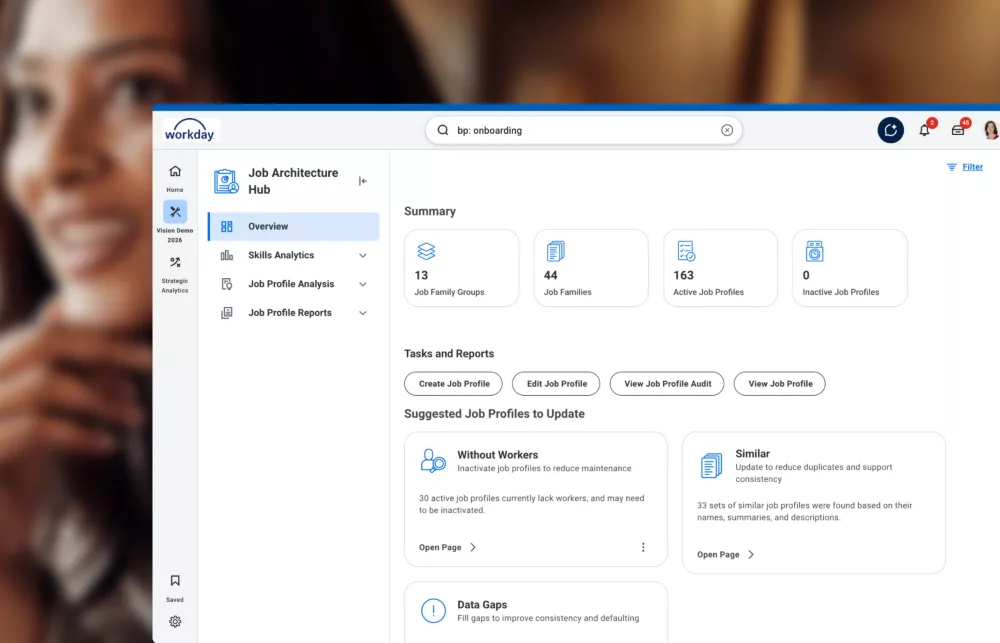
Job Architecture Hub overview screen
Workday HCM

Connect employee records, talent and workforce decisions.

Give HR and managers a coherent view as the organization changes.

Kolmar Holdings

Feedback and learning support organizational change

Over 70% of team members contributed more than 5,000 comments in the first quarter of Peakon use.

Peakon feedback and Workday learning connect employee sentiment with personalized development.

What changed? +

HR wanted employees to feel supported during digital transformation.

Customer case on participation, people management and learning; the participation figure covers initial Peakon use.

Dongwha

HR supports established and new businesses

The case describes more detailed people insights and flexible processes.

Digitized HR processes connect individual skills and aspirations with people decisions.

What changed? +

HR needed to support an established manufacturing business and growth in battery materials.

Company-published customer account of Dongwha HR practices, read October 10, 2026.

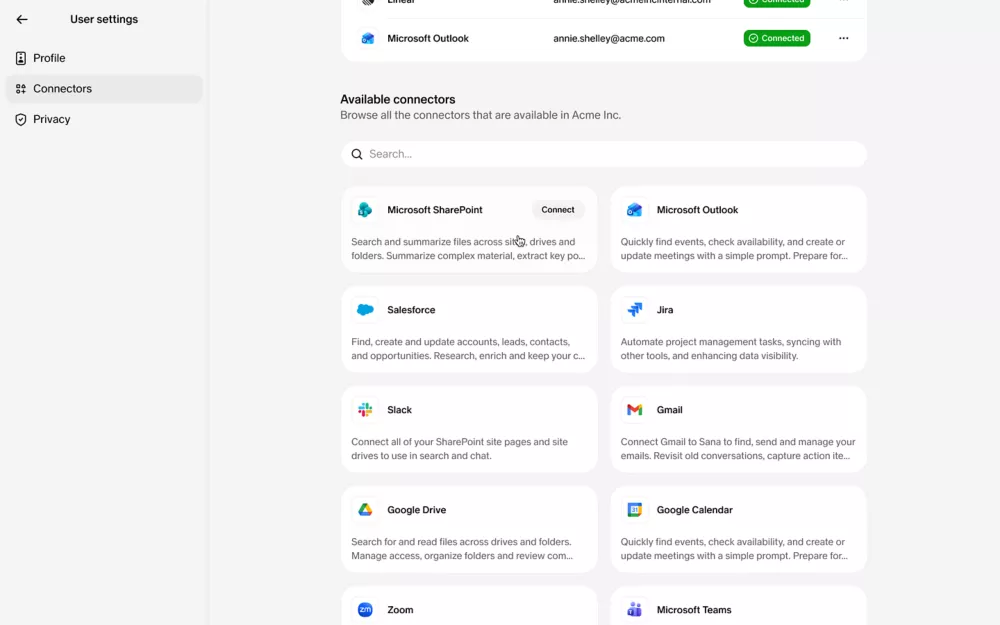
Sana connector settings screen
02 / HOW IT BECOMES REAL

Illustration: a manager requests an HR action

Illustrative workflow, grounded in the published Sana capabilities and setup.

  1. 01

    Ask

    State the task in Sana or a supported work interface.

  2. 02

    Find

    Retrieve permitted company information with citations.

  3. 03

    Review

    Pause for human review where the action requires approval.

  4. 04

    Act

    Execute the permitted transaction in connected systems.

  5. 05

    Inspect

    Inspect completed work and cross-system audit records.

Follow the work, step by step

A request has to become an authorized action

An employee changing a home address appears to be a small administrative event. In a large company, that change can affect tax documents, benefits and the records that another team uses. A conversational answer alone does not complete the work. Workday's March 2026 Sana announcement uses this kind of request to explain its next product direction: let a person state what they need, find the relevant information, and perform a permitted transaction in the systems where the business already operates. Signet reads the company's bet as connecting an easier entrance to the existing machinery of responsibility. The important question is whether the system understands both the request and the boundaries of the action. A user should be able to distinguish a cited explanation, a proposed change and a completed transaction. This is why the HR and finance foundation matters. The interface is useful because it connects to organizational context, rather than because it can produce fluent answers about employment in general.

The same permissions follow the person

Consider an illustrative workflow in which a manager asks a question about the team, checks a relevant policy, and starts an appropriate HR action. Sana Core serves work inside Workday; Sana Enterprise adds connectors and orchestration across other applications. The public administrator documentation describes role and permission mirroring, citations and a place to manage pending approvals. These details give a buyer something concrete to test. Can the manager retrieve the material they are allowed to see? Does an action that needs a person stop for that review? Is the resulting cross-system action available for audit? Configuration precedes the demonstration: administrators prepare security domains, activate changes and provision the relevant users. A convincing sales conversation therefore needs more than a prompt that works once. It needs a customer-specific account of who will use it, which data will be involved and how the organization will retain control. Those are implementation decisions that an AI interface makes more visible, not decisions that the interface eliminates.

The front door can be somewhere else

Workday is also putting that entrance into tools employees already use. The May 2026 Microsoft integration makes the Sana Self-Service Agent available in Microsoft 365 Copilot, while the Google Cloud announcement places it in Gemini Enterprise. The Microsoft explanation keeps the underlying Workday data and transactions in the trusted Workday system even when interaction history appears in Copilot. This gives the product strategy a useful tension: employees may enter from several interfaces, but execution still has to respect a consistent business foundation. For a Korean enterprise buyer, Signet would turn that into a practical evaluation of everyday requests, approval steps and integration choices. For someone joining the company, the work begins with understanding the customer's organization rather than reciting a model benchmark. The opportunity is to demonstrate that easier access improves a real process while the customer can still inspect what happened. A polished answer is the beginning of that proof; a correctly governed outcome is the stronger test.

Understand the products and their customers

People data supports a sequence of decisions

Workday Human Capital Management brings several HR activities into a suite: core employee records, talent management, workforce management, planning and employee experience. The product page connects those activities to a shared data foundation. The commercial question is not whether another system can store a name or show a chart. It is whether people responsible for hiring, development and workforce choices can work from a coherent picture as the organization changes. An HR buyer still has to decide which processes to adopt and how managers will use them. A useful demonstration follows one decision from the information entering the system to the action a person takes. Signet would look for the point at which an HR team stops reconciling separate versions and begins making a decision with the people who will carry it out. That is an interpretation of the suite's design, rather than a promise that every customer receives the same operating result.

Finance needs traceable operating context

Workday Financial Management combines accounting and reporting with the context of financial operations. Its official product visual shows operating expenses by cost center and a quarterly profit-and-loss view, giving a concrete picture of the decisions the product supports. A finance team needs to connect a reported total to the operations behind it, while executives need a reliable view when priorities change. Sana adds a different way to enter that work: a person can ask a question or initiate an action without walking through the traditional menu structure. The core record and the interface have different jobs. One holds the transaction and its controls; the other makes an appropriate part of that system easier to reach. Signet's reading is that an enterprise evaluation should test both. A demonstration that explains a variance can be helpful, but a buyer also needs to examine permissions, the underlying records and the review process. For a sales candidate, that distinction supports a conversation with finance and IT together, rather than separate presentations that assume both teams want the same thing.

A customer case is a bounded example

Kolmar Holdings provides a specific Korean example of connecting employee information, feedback and learning. Its case describes the deployment of Peakon Employee Voice and Extend, monthly anonymous feedback, and personalized learning through Workday Learning. In the first quarter of Peakon use, more than seventy percent of team members contributed over five thousand comments. Those figures describe participation in that customer's early use of a particular product; they do not establish companywide productivity or Workday's performance across every account. Dongwha offers a different example. Its HR leaders describe managing established businesses while recruiting and developing people for a newer business in battery materials. The case emphasizes a more detailed view of individual skills and aspirations and the flexibility to adjust HR processes. Read together, the two cases show why an account conversation has to start with the organization. One emphasizes employee participation during change; the other links people decisions with business diversification. The job of the product team and its partners is to connect the chosen functionality to that purpose and help the buyer decide what evidence would demonstrate progress.

03 / THE EVIDENCE

The story, in numbers.

DATED OBSERVATIONS

Annual reported revenue

USD · USD

Fiscal years end January 31; points are reported actuals, with no interpolated years.

Figures, dates & basis +
Annual reported revenue
DateValueBasis
2022-01-31$5,138,798,000 USDFull-year total revenue, year ended January 31, 2022.
2024-01-31$7,259,000,000 USDFull-year total revenue, year ended January 31, 2024.
2025-01-31$8,446,000,000 USDFull-year total revenue, year ended January 31, 2025.
2026-01-31$9,552,000,000 USDFull-year total revenue, year ended January 31, 2026.

Workday

Co-founder returns as CEO

Aneel Bhusri returns; Carl Eschenbach becomes strategic advisor.

Sana becomes available

Sana from Workday becomes available to customers worldwide.

Revenue and agent adoption update

Q2 FY2027 total revenue is $2.649B; 5,500+ customers use organic agents.

Read the growth story

A subscription funds the continuing system

Workday's main revenue source is subscription services, alongside professional services. Enterprise customers pay for the platform and its functionality over a continuing relationship, while deployment and other services support adoption. The fiscal 2026 results put those parts in perspective: total revenue was $9.552 billion, including $8.833 billion of subscription revenue, for the year ended January 31, 2026. The product has to remain useful after a new account signs. Renewals, expansion and successful implementation connect the initial sale with the ongoing business. That gives a Korean account executive a practical responsibility: build a commercial agreement around a customer problem the organization can actually pursue. A broad platform presentation may create interest, but the buyer still needs to decide which process changes, people and integrations will make the investment worthwhile. Signet reads the business model as a reason to care about the quality of the initial promise, rather than only the size of the signed contract. Customer service and continued use are connected to that economic structure.

Fiscal years and adoption measure different things

The historical series uses actual annual results, with January fiscal year ends made explicit. Fiscal 2022 revenue was $5.138798 billion in the financial table. Fiscal 2024 was $7.259 billion in the subsequent comparative results, followed by $8.446 billion in fiscal 2025 and $9.552 billion in fiscal 2026. The chart shows the annual results confirmed in those reports. The August 2026 update concerns the second quarter of fiscal 2027, ended July 31, 2026: total revenue of $2.649 billion and subscription revenue of $2.471 billion. Those are quarterly results, not a replacement annual figure. That release also reports more than 5,500 customers using at least one organic Workday agent. An adoption count describes organizations using a capability, not revenue earned from each organization. Similarly, the total subscription backlog represents future contracted business under its disclosed definition; it should not be displayed as revenue already recognized. A candidate assessing momentum should ask what is being counted, when it was measured and how it relates to the work they would perform.

AI pricing adds another adoption question

Workday's Flex Credits page describes a pooled approach to AI consumption, with completed agent tasks rather than token counts as the basis it emphasizes. The administrator setup guide also describes the entitlement policy that applies after complimentary consumption is used. This means an account conversation needs to distinguish availability, configuration and commercial consumption, even when a launch announcement says a feature comes to customers without a separate license. Signet would evaluate whether users complete valuable tasks and whether the buyer understands the cost of repeated use. The broader enterprise purchase still competes with existing systems and a customer's choice to delay change. The company's earnings risk language points to competition, deployment delays, privacy and security, service reliability, and realizing benefits from acquisitions. These are concrete risks for this strategy. Customers may move more slowly than an announcement suggests, controls may take work to configure, and an acquisition may need substantial integration. A useful commercial plan connects the opportunity to those operating constraints. Forecasts for the next fiscal year remain forecasts, even when management is confident in the platform's direction.


04 / THE PEOPLE

Someone saw it first.

Aneel Bhusri official portrait
Co-founder, CEO and chair

Aneel Bhusri

Co-founded Workday with Dave Duffield in 2005 after senior roles at PeopleSoft.

The choice behind the company +

Returned as CEO in February 2026 for the next AI-focused chapter.

Gerrit Kazmaier official portrait
President, product and technology

Gerrit Kazmaier

Previously led data and analytics at Google Cloud and held product leadership roles at SAP.

The choice behind the company +

Connect the product suite, AI agents, infrastructure and security.

“AI is a bigger transformation than SaaS”

Aneel Bhusri · Official company announcement, excerpt · 2026-02-09
The decisions behind the company

The co-founder returns for a new transition

Aneel Bhusri co-founded Workday with Dave Duffield in 2005 after holding senior roles at PeopleSoft. The current leadership biography traces a series of CEO, co-CEO and executive-chair responsibilities over the company's development. In February 2026, the board announced his return as CEO. Carl Eschenbach stepped down as CEO and as a director and became a strategic advisor to Bhusri. That is the relevant distinction for a candidate reading today's organization: a former operating leader can remain involved without remaining the current chief executive. Bhusri framed the return around AI's importance to enterprise software. Signet reads the decision as placing a co-founder with longstanding product involvement at the center of another platform transition. The historical relationship with PeopleSoft explains experience in enterprise applications, but it does not by itself prove the current strategy. That proof has to come from what the company ships, what customers adopt and how the operating organization executes.

Product leadership connects data and agents

Gerrit Kazmaier is president of product and technology. His remit covers platform strategy, delivery, infrastructure and security, together with the solution portfolio and AI agents. Before Workday, he led data and analytics at Google Cloud and held product leadership responsibilities at SAP. These are relevant backgrounds for a company trying to connect enterprise records with AI execution. They should be read as verified responsibilities and experience, rather than as a forecast of how a specific product will perform. The November 2025 completion of the Sana acquisition provides a documented decision in that remit. Workday brought enterprise search, agents and learning into its portfolio, then made Sana from Workday available in March 2026. An acquisition announcement describes intended combinations; a later release and the administrator documentation let a candidate examine the resulting product more closely. The organization has to make the connection usable for customers whose data, access rules and existing applications differ. That practical work gives a more useful picture of product leadership than a list of executive titles alone.

Local leadership has a defined business task

In March 2026, Workday appointed Mike Hur, 허정열, as Korea country manager. The official Korean announcement identifies previous experience at AWS, Google and Salesforce and assigns responsibility for Korean business strategy, customer AI transition and the partner ecosystem. The May Seoul event gives that remit a more specific expression: work with customers on an enterprise architecture that combines probabilistic reasoning with controlled execution. Signet would read the Korean sales role against that stated direction, while keeping the appointment separate from an inferred reporting line for any individual hire. The company also publishes values that matter to the work: customer service asks for meaningful customer value, and integrity asks for clear expectations, accountability and ownership of outcomes. Those principles are useful interview material when connected to a real example of selling or implementing enterprise change. A candidate can explain a difficult stakeholder decision, what they promised, and how they checked the result. The strongest fit argument connects the company's stated responsibility with the candidate's demonstrated behavior, without assuming a title or a brand guarantees the working experience.

05 / THE NEXT CHAPTER

Complex accounts connect strategy with implementation

Win new Korean enterprise accounts by connecting customer strategy with an executable platform agreement.

Korean business, customer AI transition and partners

허정열

Korea country manager

Enterprise sales
  • Senior Account Executive

Open posting count

Functions come from the current posting and dated country-manager announcements. Counts measure open postings, not headcount or reporting lines.

Why Korea? Why now?+

Customer organizations need people and finance processes suited to their growth and transformation.

Mike Hur appointed country manager

The remit covers Korean strategy, customer AI transition and partners.

Understand the Korea opportunity

Existing customers give the platform a local context

Workday's Korean customer material names organizations including Dongwha and Kolmar Holdings. These cases give the Korean market a practical context beyond a translated global product page. Dongwha's account connects HR information with the demands of an established manufacturing business and newer growth areas. Kolmar's account focuses on employee feedback, performance communication and personalized development during organizational change. The cases describe particular deployments and experiences; they do not establish the size of Workday's Korean office or the current purchasing plans of every named customer. Signet reads them as evidence of the kinds of organizational decisions a Korean commercial team needs to understand. Selling a people platform requires knowledge of how a customer works, what managers need and which processes can change. Selling finance functionality adds other stakeholders and operating questions. The local opportunity is therefore not a simple claim that every company needs AI. It is the work of connecting a specific organization to a product and a change it can justify.

The current role seeks a complex enterprise seller

On October 10, 2026, the official careers system lists Senior Account Executive in Korea, Seoul. The role focuses on net new revenue and large enterprise prospects, with particular attention to core financials. It calls for account planning, coordination with presales, relationships with new customers, negotiation with C-suite executives and disciplined pipeline and forecast data. The basic qualifications ask for at least ten years of enterprise sales in B2B technology and experience owning a large strategic account with a multi-million-dollar annual quota and multi-stakeholder, multi-year deals. The posting also requires selling to and through the CIO and broader CIO organization in cloud and AI adoption, plus relationships across HR, finance, digital transformation and business leadership. Those conditions describe a buying process with several centers of authority. Signet would prepare an application around an actual complex deal: how the candidate selected the opportunity, understood the stakeholder map, worked with specialists and handled a decision that changed the plan. An impressive brand list alone is a weaker answer than a clear account of the decisions the candidate made.

Local strategy is a basis for preparation

Mike Hur's appointment puts Korean business growth, customer AI transition and the partner ecosystem in the country manager's remit. The subsequent Seoul event emphasizes trusted enterprise execution and architecture workshops. Those statements help explain the commercial direction, while the actual posting remains the source of the job's requirements. The original job description includes Korean and business English, regional and global coordination, and experience leading transformation sales where AI, data and platform strategy influence decisions. The short role summary highlights the work and distinctive experience; the full description retains the remaining qualifications. Signet's first-quarter reading would be to learn the assigned accounts and their buying processes, align an opportunity plan with presales and relevant partners, and build a clear evidence trail for the forecast. These are preparation prompts, rather than a promised onboarding plan. A candidate can use them to assess fit: do they enjoy an uncertain market, take ownership of an account, and connect customer strategy with an executable commercial process? The Korea team diagram groups publicly described functions and the single open posting; its counts measure postings, not office headcount or reporting lines.

KOREA OPEN ROLES

1 open role in Korea

Current Signet catalog · 2026-10-19

FOR YOU

Explain how you guided a complex enterprise decision.

GTM · Sales · BD

Senior Account Executive

Korea, Seoul / Korea, Republic of

Posting checked

The work
Win new enterprise accounts through account plans, executive relationships and core financials sales.
Who fits
10+ years in enterprise B2B sales; own large strategic accounts and complex multi-year deals.
Keep in mind
Sell to CIO and C-suite teams, coordinating Korea with regional and global organizations.
07 / NOW & NEXT

The next scene is taking shape.

Co-founder returns as CEO

Aneel Bhusri returns; Carl Eschenbach becomes strategic advisor.

Sana becomes available

Sana from Workday becomes available to customers worldwide.

Revenue and agent adoption update

Q2 FY2027 total revenue is $2.649B; 5,500+ customers use organic agents.

More context on what comes next

Acquisition becomes a working interface

The November 2025 Sana acquisition and the March 2026 release should be read as two different milestones. The first put enterprise knowledge, agent and learning capabilities inside Workday's portfolio. The second made the combined Sana experience available to customers. Public setup documentation then shows the practical work of security configuration and provisioning. Together, those sources let a candidate follow a sequence from strategic choice to product availability to customer use. Signet would watch the quality of that transition: whether buyers understand what is included, whether administrators can configure appropriate access, and whether employees complete useful work. That is a narrower and more testable question than treating an acquisition as automatic customer success.

Agents enter established work tools

The May Microsoft and Google announcements place Workday agent access in applications employees already use. This broadens the possible entrance without changing the need to govern the underlying transaction. For the commercial organization, integrations can make a demonstration more relevant to a customer's current environment. They also raise specific deployment questions: which entry points are supported, what access is configured and where a reviewer sees the result. Signet would ask a candidate to explain one complete customer workflow across those boundaries, rather than assume that the presence of a connector proves the process is ready. Customer architecture and operating ownership remain part of the work.

The next evidence is repeated use

The August 2026 fiscal 2027 second-quarter results combine revenue progress with an agent adoption count. More than 5,500 customers use at least one organic agent, while quarterly total revenue is $2.649 billion. These measure different parts of the story and should remain separate. Signet's questions for the next year are whether useful agent work leads to sustained adoption, how the customer manages permissions and consumption, and how new enterprise accounts turn a platform evaluation into an implementable agreement. The Korean appointment and Seoul event give that last question a local setting. The company has a large existing system foundation; the current strategy asks it to make that foundation easier to act on. Watching shipped capabilities, repeated customer use and the quality of enterprise execution provides a clearer assessment than treating every announcement as the same kind of progress.

Their future. Your next chapter.

Find your part ↑

An independent profile by Signet. No affiliation or investment recommendation. Introductions happen only with your consent.
Research reviewed 2026-10-10

A LITTLE MORE CONTEXT

Understanding Workday.

What does Workday do?

Workday connects people and money records with AI that can perform permitted work.

What is the opportunity in Korea?

Win new Korean enterprise accounts by connecting customer strategy with an executable platform agreement.

Are these confirmed job openings?

Employer postings were checked on 2026-10-10. Availability can change. Mock applications request a review from Signet.

How can I explore the company in more depth?

Follow the company from its vision through products, evidence and people to the Korea team and current roles. Use the table of contents to move within the page, and expand the sections for more context.

Back to the collection ↗