Three doors into one money system
Airwallex sells one network through three doors. Most customers come in through the Business Account: the CEO said in April 2026 that more than 90% land on it first, and that payments and spend management follow. The second door is Payments and Spend, for collecting money from customers and controlling what employees spend. The third is Platform APIs, which let other companies put Airwallex accounts, FX and payouts inside their own products. All three lead to the same balances and the same network, which is why the company tracks how many products each customer uses. In June 2026 it said more than 90% of its revenue came from customers using more than one product; in November 2025 the CEO wrote that roughly half of customers used several.
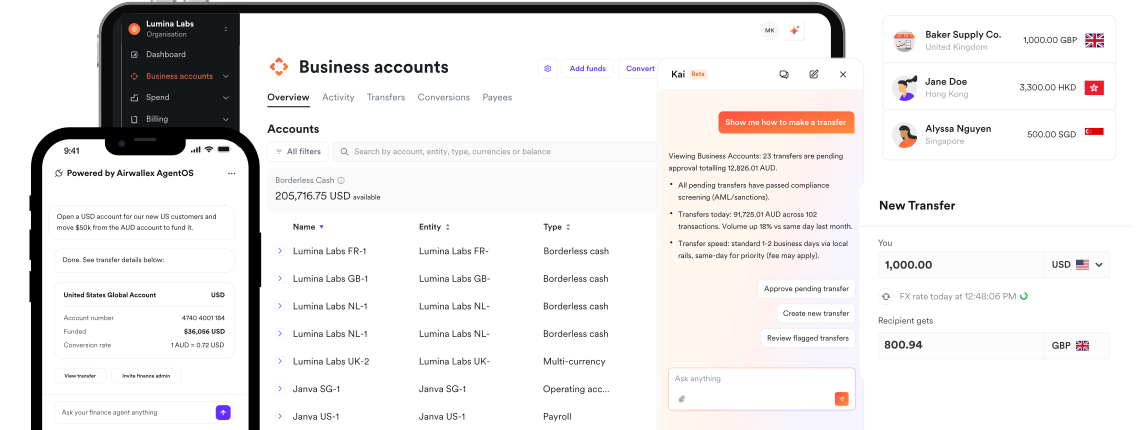
The Business Account is the core. A company opens it online, receives money into local currency accounts (the Korean site says in more than 20 currencies), holds balances in several currencies and sends transfers in 60+ currencies to 200+ countries; the company says 93% of funds arrive the same day. The current US pricing page separates Explore, Grow and Accelerate. Grow charges $12 per active spend user each month plus a platform fee based on team size; purchase orders sit in Accelerate. Regional plans and product availability should be read separately. It is built to replace slow bank transfers: one small travel firm in the case studies moved off SWIFT transfers that took days.
Payments and Spend covers both directions of a company's cash. Payment acceptance takes card and local payment methods online and settles in the currency the merchant picks; Arsenal now runs all hospitality payments at Emirates Stadium through it. Spend issues multi-currency corporate and employee cards with limits, plus expense and bill management. In May 2026 Airwallex added billing for invoices, subscriptions and usage-based pricing at no added cost to existing plans, which it presents as a response to AI companies that charge by usage. Its head of data and AI describes Kai as a live assistant for plain-language requests. The October governance explanation keeps transfers and foreign exchange subject to human approval.
On 30 September 2026 Airwallex introduced a redesigned Business Account that brings account balances, transactions and permissions for multiple legal entities into one view. Customers can separate accounts by purpose, including cash, yield and credit, and connect their preferred AI tools within the organization's permissions and approval rules. The announcement describes local payout rails in more than 120 countries, a narrower scope than the company's broader 200+ country payout coverage. Account, entity and payment-route choices matter because a payment must be funded and recorded against the right legal entity.
Platform APIs turn Airwallex into infrastructure for other companies. A marketplace, software platform or fintech opens accounts for its own customers through the API, converts currencies, pays out and issues cards, while Airwallex supplies the licences and handles KYC and AML checks. Pricing is agreed with the sales team. This door explains the gap between two customer counts published a day apart in June 2026: more than 250,000 companies use Airwallex, and more than 676,000 businesses are served directly or through platform customers.
We hold licenses, operate payment infrastructure, price FX, and build the products and APIs customers use.
Dan Kim · VP Product Partnerships and Developer Ecosystem, Airwallex · Airwallex careers blog · 2026-09-17
Who buys it, and what changed for them
The named customer evidence comes in two kinds. The first is case studies with numbers, all from the customers' own statements as published by Airwallex. McLaren Racing's finance team used to make 30 international payments one at a time; with a batch template a run takes a little under an hour, which the team says saves about half a day a month. Authentic Vacations, a US travel firm with 10 to 50 staff, says it saves $10k a month on FX and 3% per card transaction, and that supplier transfers arrive in a few hours instead of the 2 to 5 days SWIFT took.
The second kind is named payment deployments. Arsenal integrated Payment Acceptance across its hospitality operation in January 2026. Turing, which works with about 4 million experts worldwide, replaced several regional payout providers with one Airwallex payouts platform. McLaren and Arsenal are also Airwallex sponsorship partners, so their stories are partnerships as much as purchases. The company's own lists add TikTok, SHEIN, Qantas and Navan, and Zhang has said SHEIN has been a customer since 2016, but a name on a list says little about product, size or result.
What a Korean customer will see
In Korea the product is on the website ahead of the licensed launch. Airwallex's Korean site describes accounts, spend, payments and platform APIs, including local currency accounts in more than 20 currencies and multi-currency cards with spending limits. Under the Korean licences the launch comes in steps: global business accounts and payment acquiring first, with core services scheduled for Korean customers in the second half of 2026. One Korean payment flow is already running: Korean Arsenal fans can buy the club's hospitality products with KakaoPay and Naver Pay.
Take an illustrative Seoul cosmetics brand selling on overseas marketplaces. Today it receives dollars and yen through several providers, converts each payment to won, then converts back to pay a Japanese packaging supplier. With a global business account it could hold dollars and yen, pay the supplier from the yen balance and reconcile both sides in one place. This is an example built from the product pages, not a customer case.