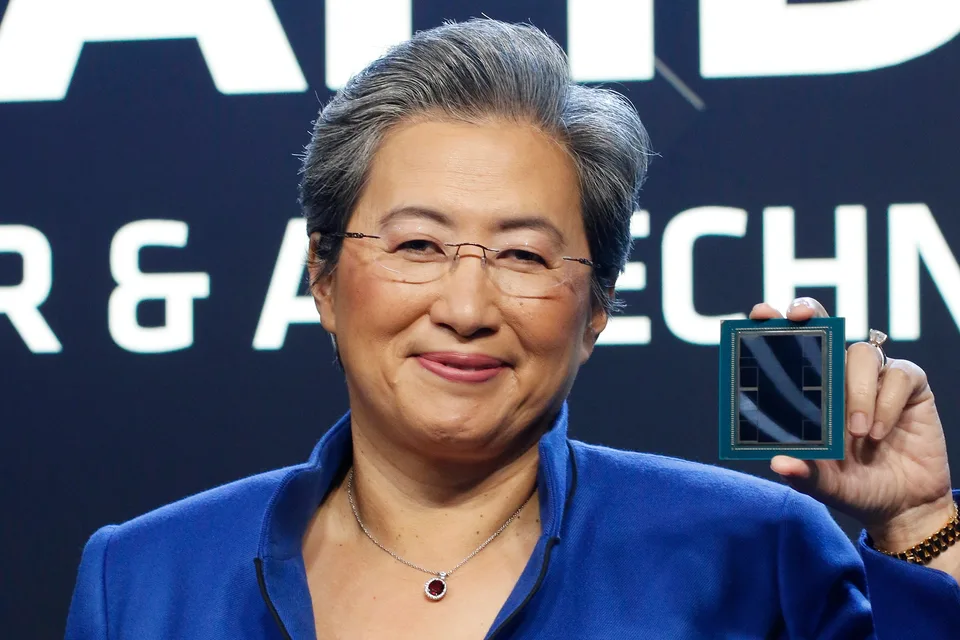
AMD CEO Lisa Su presenting an AMD chip
AMD / THE WORLD THEY ARE BUILDING

Make AI compute work for more builders.

Customers can deploy AMD CPUs and GPUs in workloads supported by the software and system ecosystem.

See it taking shape ↓
01 / THE PRODUCTS

The products behind the promise.

The official page shows an AMD Instinct MI350 Series platform.
AMD Instinct

Run AI and HPC workloads on AMD GPU platforms.

Accelerated compute and memory capacity for target workloads.

Microsoft Azure

MI300X becomes a cloud deployment option

The May 2024 announcement identifies Azure OpenAI workloads and Hugging Face as the first ND MI300X v5 customer.

Azure ND MI300X v5 virtual machines became generally available in May 2024, with Hugging Face identified as the first customer.

What changed? +

Cloud users needed a supported route to AMD-accelerated AI workloads.

The dated partner announcement describes instance availability and named workloads.

HUMAIN

MI355X infrastructure serves customers

Live infrastructure; expansion up to 250MW in 2027 and 1GW by 2030 is planned.

AMD, Cisco and HUMAIN reported live MI355X infrastructure serving customers on 31 August 2026.

What changed? +

HUMAIN develops AI infrastructure and services in Saudi Arabia.

The joint announcement separates the operating deployment from future capacity plans.

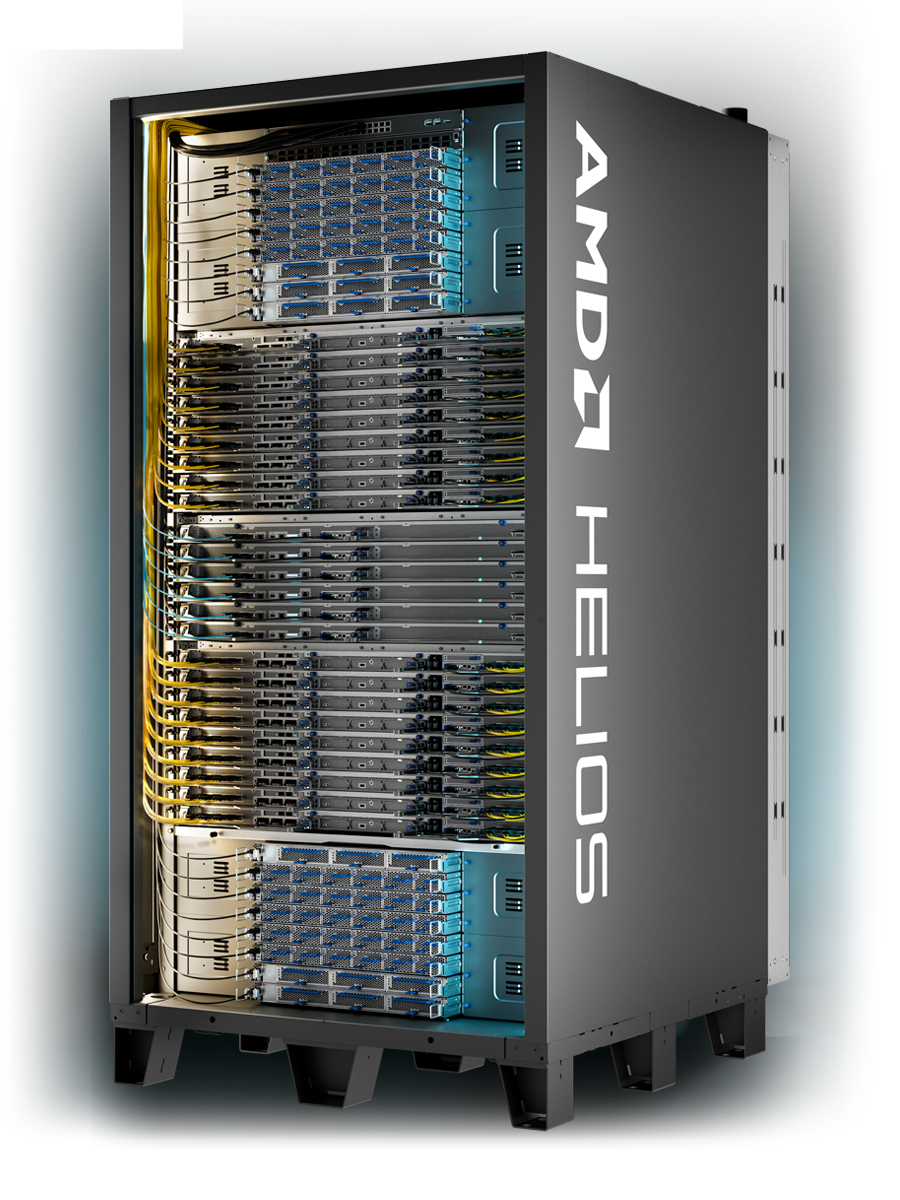
Official AMD Helios rack product image
Helios rack, official product image.
02 / HOW IT BECOMES REAL

Turn enterprise AI demand into a validated deployment

Illustrative workflow: an enterprise evaluates Instinct for an on-premises or cloud workload.

  1. 01

    Define the customer workload

    The team identifies models, software dependencies, memory and service targets. Vertical requirements affect architecture and commercial fit.

  2. 02

    Choose hardware and software together

    Instinct accelerators run with ROCm and supported frameworks. OEM or cloud partners provide the server and deployment environment.

  3. 03

    Test the actual model

    A proof of concept measures the customer’s workload rather than substituting a generic benchmark. Teams investigate compatibility and bottlenecks before procurement.

  4. 04

    Convert the proof into adoption

    The customer and partners settle supply, deployment and support responsibilities. Training and coordinated go-to-market work help extend the initial deployment.

Follow the work, step by step

A second route to usable compute

A model becomes a service through a whole computing system: processors, accelerator memory, networking, software and an operating team. AMD supplies several of these pieces. Its AI thesis is that customers can assemble an alternative using Instinct GPUs, EPYC CPUs, Pensando networking and ROCm software, with server makers and cloud providers taking the platform into deployment. That is a systems proposition. The buyer still needs a model to run correctly, a service to respond within its target and infrastructure that the team can operate. AMD’s product documentation and partnerships connect those tasks to the hardware roadmap.

The commercial pull comes from large customers planning computing capacity over several years. OpenAI’s October 2025 agreement covers 6 gigawatts, with the first gigawatt scheduled for the second half of 2026. Meta’s February 2026 agreement also covers 6 gigawatts and starts with a custom GPU based on the MI450 architecture. These are capacity commitments with future deployment milestones. They explain why AMD is investing in racks and software, while the company’s reported financial results provide the separate evidence of revenue already earned. A gigawatt describes power-scale capacity; it is a different measurement from GPU units or dollars.

From workload to validation

Consider an illustrative enterprise evaluation. The team first identifies the model, memory needs, framework and latency or throughput target. It chooses a supported ROCm configuration and suitable hardware, then measures the actual workload. ROCm combines compilers, libraries, runtime components and tools; supported frameworks can provide an established route, while custom GPU code may need porting and tuning. HIP and translation tools help that work, but the application still needs correctness testing. The engineering decision is therefore about a complete workload and its dependencies. A chip specification is one input to that evaluation.

The newer developer experience follows that same sequence. ROCm.AI brings AMD-specific guidance into coding assistants, a console exposes runtime and workload state, and Hyperloom profiles and optimizes code while validating performance and correctness. The August 2026 release describes ROCm.AI as generally available with ROCm 10, while the CLI retains Technology Preview status. That distinction matters to an enterprise choosing which components to operate. Human teams still set acceptance criteria, review changes and decide whether the measured result is suitable for production. The software work is part of making AMD hardware adoptable.

The Korea connection is specific

Korea connects the roadmap to memory suppliers, national AI infrastructure and local technology companies. The 2026 record includes Samsung memory cooperation, Upstage’s planned Instinct deployment and government work on heterogeneous infrastructure combining AMD processors with domestic NPUs. These are distinct relationships with different stages of delivery. Current Seoul hiring is equally specific: game-studio graphics optimization, test-vehicle engineering and embedded distributor sales. Signet reads the company as offering several routes to useful compute, with local work anchored in a particular product and customer problem. A candidate should connect their chosen opening to that product rather than assume every Korea job is an AI data-center position.

Understand the products and their customers

GPU, software and CPU do different work

Instinct is AMD’s data-center accelerator family for AI training, inference and high-performance computing. The July 2026 platform announcement connects MI455X GPUs with EPYC Venice CPUs, Pensando networking and ROCm in the Helios rack. Its stated configuration contains 72 GPUs and 18 CPUs. The rack is a system offering: interconnects, memory movement and software coordination matter alongside the individual accelerator. Cloud providers and server makers bring it to different deployment environments. The official MI350 platform photograph shown here depicts an earlier product generation; the Helios image identifies the newer rack separately.

ROCm is the software route from a model to the GPU. It supplies programming models, compilers, libraries, runtime and development tools, with documented hardware and framework support. HIP provides a path for GPU programming and porting, including translation tooling for CUDA code. That path includes dependency checks, correctness testing and workload tuning. ROCm.AI adds guidance for coding agents and an optimization workflow; the official July illustration shows a terminal and console inside that developer experience. Read the image as a dated demonstration of the tools, and the August release for their current availability and preview distinctions.

General compute and embedded designs

EPYC supplies server CPU compute for cloud, enterprise and other data-center workloads. Microsoft’s July 2026 collaboration connects Helios to Azure and describes two EPYC Venice-based VM families for agent data and semiconductor design, alongside Pensando networking. The scheduled rollout begins in the second half of 2026. This gives the CPU a role next to accelerated AI as well as in general computing. For a buyer, the choice depends on the workload, supported server configuration and software. Intel, Arm-based processors and customers’ own silicon are part of the competitive context identified in AMD’s annual filing.

Embedded and adaptive products follow another purchasing cycle. A customer chooses FPGA, adaptive SoC or embedded x86 components for a system design, and distributors and field application engineers help that design reach production. AMD’s Korea channel opening names two distributor partners, pipeline and forecast management, design wins and cross-selling between FPGA, SoC and embedded x86. The current local sales role asks for expertise in this portfolio and its customer-design process.

A deployment and a future plan

The customer evidence has stages. Azure ND MI300X v5 became generally available in May 2024, with Hugging Face identified as its first customer. In August 2026, AMD, Cisco and HUMAIN described live MI355X infrastructure in Saudi Arabia serving customers. The same announcement outlines up to 250 megawatts for 2027 and up to a gigawatt by 2030 as expansion plans. Anthropic’s July agreement instead schedules its first gigawatt for the first half of 2027. These examples show deployment routes and future demand. Evaluate a claimed performance advantage using the stated model, hardware, software and test conditions, then test the intended workload.

03 / THE EVIDENCE

The story, in numbers.

DATED OBSERVATIONS

Annual revenue

USD · B

Audited consolidated net revenue for actual 52- or 53-week fiscal years; segment totals sit within the company total.

Figures, dates & basis +
Annual revenue
DateValueBasis
2021-12-25$16.434BFull fiscal year ended 2021-12-25; consolidated company revenue.
2022-12-31$23.601BFull fiscal year ended 2022-12-31; consolidated company revenue.
2023-12-30$22.68BFull fiscal year ended 2023-12-30; consolidated company revenue.
2024-12-28$25.785BFull fiscal year ended 2024-12-28; consolidated company revenue.
2025-12-27$34.639BFull fiscal year ended 2025-12-27; consolidated company revenue.

AMD

Azure MI300X availability

Azure ND MI300X v5 became generally available with Hugging Face as the first named customer.

Open AI platform direction

AMD introduced MI350-series products and an integrated open AI systems roadmap.

2025 annual filing

AMD reported $34.639B revenue and $16.635B Data Center revenue.

Read the growth story

Products become reported sales

AMD earns revenue from processors, accelerators and related semiconductor products sold through manufacturers, cloud providers, distributors and other customers. Its fiscal year uses 52 or 53 weeks and ends on the last Saturday in December. The annual chart follows actual fiscal-year end dates. FY2025 consolidated net revenue was $34.639 billion, compared with $25.785 billion in FY2024 and $22.680 billion in FY2023. Those are full-year company totals. Acquisition, business mix and the timing of product cycles all matter when interpreting the series; an annual comparison should use the same consolidated metric and the stated accounting period.

The annual filing gives the segment view. FY2025 Data Center revenue was $16.635 billion and includes EPYC CPUs and Instinct GPUs. Client and Gaming contributed $14.550 billion, covering a different mix of PC and gaming activity. These amounts sit inside company revenue. In the second quarter of 2026, consolidated revenue reached $11.536 billion and Data Center revenue was approximately $6.7 billion, up 107% year over year. That quarter shows the scale of the current data-center business. The comparison is quarterly and uses the corresponding prior-year quarter, rather than a full-year denominator.

Economics and competitive choices

Reported profitability has accounting labels as well. Q2 2026 GAAP gross margin was 54%; non-GAAP gross margin was 56%. The reconciliation excludes specified expenses, so the two measures should retain their names. Export controls affected the prior-year comparison through MI308 inventory charges, and the company’s FY2025 results also describe related charges and reserve releases. For a buyer, AMD competes with Nvidia accelerators and Intel CPUs, alongside Arm designs and customers’ custom silicon. Software support, system supply and the cost of running a particular workload influence the decision as well as hardware performance.

Capacity agreements are another type of evidence. OpenAI and Meta each receive performance-based warrants for up to 160 million AMD shares tied to deployment and other milestones. These instruments connect commercial adoption and equity incentives. Anthropic’s agreement includes AMD’s commitment to make a future investment of up to $5 billion. The planned World Labs acquisition is an approximately $8.2 billion all-stock transaction subject to approval and closing conditions. Each arrangement has its own financial meaning. Use the reported revenue series for earned sales, and the agreement terms for the incentives and obligations behind future deployments.

Three execution risks

Three risks follow from AMD’s filing and roadmap. First, manufacturing depends on outside foundries and a supply chain that includes advanced packaging and memory; availability and yields affect delivery. Second, competitors and custom silicon can change purchasing decisions, while software compatibility shapes how readily a customer adopts the hardware. Third, export regulation and the timing of large deployments can change inventory, revenue and investment needs. Management’s multiyear growth targets and Q3 2026 revenue guidance describe expectations, with explicit forward-looking conditions. Signet reads the opportunity through actual deployments, repeat customer demand and reported profitability, while keeping those forecasts separate from the historical chart.

04 / THE PEOPLE

Someone saw it first.

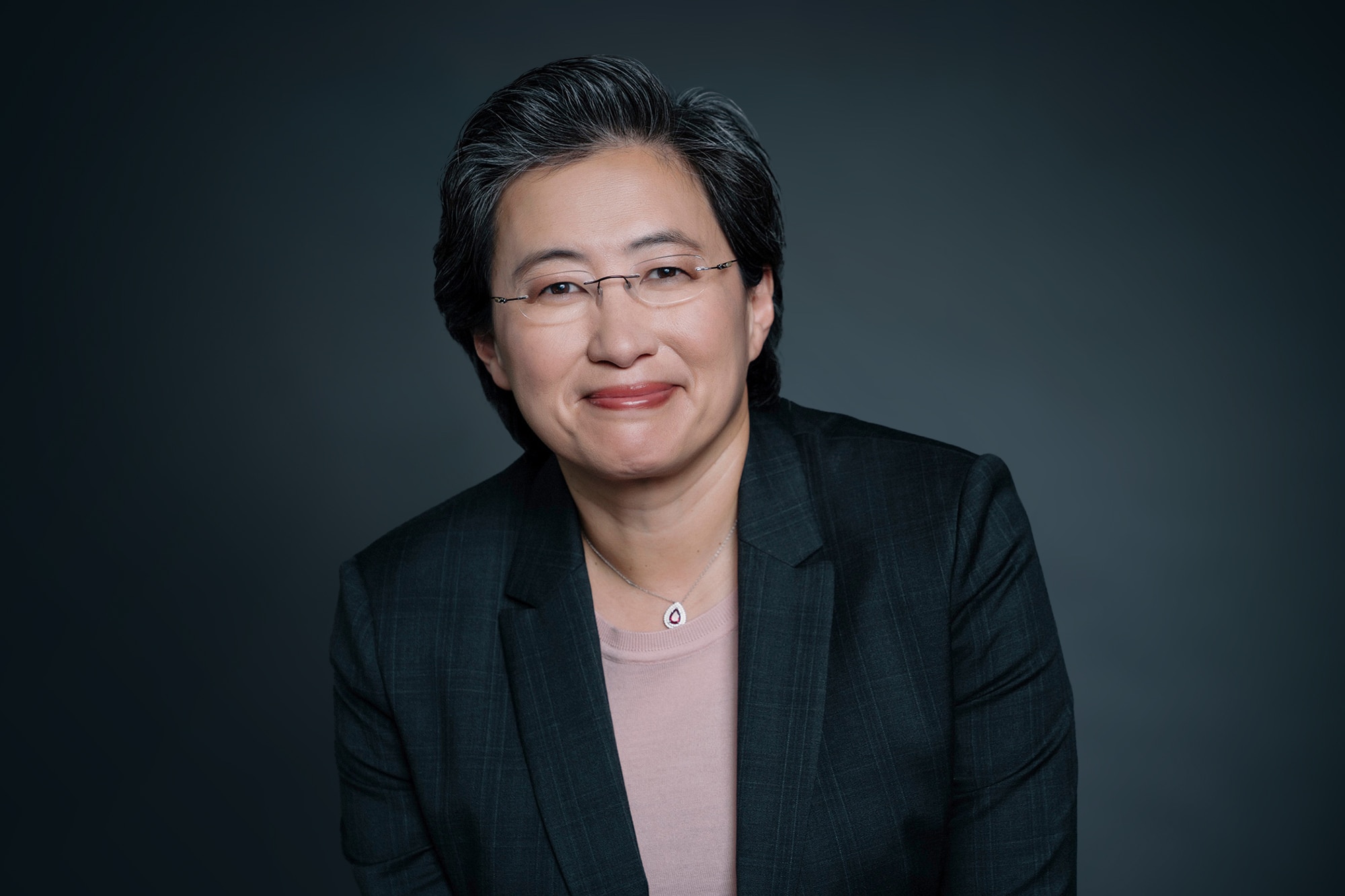
Lisa Su, AMD official portrait
Chair and CEO

Lisa Su

Su leads AMD and has a semiconductor engineering background, including prior executive work at Freescale and IBM.

The choice behind the company +

Su connects AMD’s processors, software and systems with model and cloud partners.

“The key to achieving success, of course, is flawless execution.”

W. J. Sanders III · 1995 shareholder letter · 1996-02-22
The decisions behind the company

A semiconductor company with a long history

AMD was founded on 1 May 1969 and established its headquarters in Sunnyvale, California, according to its investor FAQ. Early leader Jerry Sanders III connected semiconductor design, manufacturing and delivery to customers. Its historical record puts the company in a long competition over computing platforms. A 1996 shareholder letter signed by W. J. Sanders III, then chair and CEO, discussed acquiring NexGen and bringing a new processor design to market. The letter’s emphasis on execution provides a useful historical lens: designing a product, manufacturing it and reaching customers have always been connected tasks. The current AI platform extends that coordination across GPUs, CPUs, networking and software.

Lisa Su is chair and CEO. Her official biography connects her current leadership to engineering and operating work: she joined AMD in January 2012, later served as chief operating officer, and previously worked at Freescale, IBM and Texas Instruments. The operating role brought business units, sales, operations and infrastructure into a market-facing organization. That background is relevant to an AI roadmap whose delivery depends on many teams. In the September 2026 World Labs agreement, Su explains the intended connection between understanding models and developing computing platforms. The transaction remains subject to closing conditions.

Leaders and consequential choices

Jean Hu is executive vice president, chief financial officer and treasurer in the August 2026 earnings release. Her comments connect the quarter’s revenue increase to the Data Center segment and describe expectations for the second half. Read that financial role alongside Su’s product and customer roadmap. In Korea, the dated commercial-sales record names 이재형 as AMD Korea’s commercial sales head; a 2026 column carries that title and a 2024 press conference documents the earlier role. His scope is commercial sales. The page keeps that title specific when discussing local leadership and the wider Korea ecosystem.

The 2026 choices link AMD to both model builders and systems partners. The Anthropic agreement combines a planned GPU deployment, software collaboration using Claude and a commitment to make a future equity investment. The World Labs agreement would add model research expertise through an approximately $8.2 billion all-stock acquisition. Fei-Fei Li would become executive vice president and chief scientist after closing. The proposed role belongs to that future transaction, so the current cast shows Su, Hu and the Korea commercial-sales leader. For a candidate, the question is how their work contributes to a delivered product or customer outcome within those plans.

How the company describes working together

AMD’s careers page describes pushing limits, driving excellence, being direct and humble, collaborating deeply and being inclusive. Current Korea postings repeat this language and give it a practical setting: a game engineer communicates with external studios and architecture specialists, a test engineer leads reviews and publishes data for decisions, and a channel manager coordinates business units, distributors and field engineers. Signet’s reading is to prepare examples that show both technical or commercial judgment and coordination. Explain the initial problem, your evidence, the choices you made and the result. Preserve the posting’s required and preferred distinctions when assessing your own fit.

05 / THE NEXT CHAPTER

Games, testing and embedded distribution in Seoul

Game studios and architecture specialists; cross-functional test teams; distributors, FAEs, business units, marketing and operations.

Korea commercial sales

이재형

Head of Commercial Sales, AMD Korea

Sales
  • Commercial sales
  • Channel enablement
Engineering
  • Field application engineering
  • Package engineering
IT
Business development
Customer work

Manual LinkedIn reading on 8 October 2026 found associated profiles and overlapping function facets; the grouped view describes observed work.

Why Korea? Why now?+

Korea connects memory supply, local AI workloads and government plans for heterogeneous infrastructure.

Korea commercial-sales briefing

이재형 spoke as Korea commercial sales head.

Memory and platform cooperation

Samsung and NAVER cooperation connects memory and AI workloads.

Government cooperation

A memorandum connects AMD compute with domestic NPUs and infrastructure work.

Research-center plan

Coverage describes a planned Korea research center and researcher hiring.

Understand the Korea opportunity

Memory, infrastructure and local workloads

Korea appears in several parts of AMD’s computing system. Samsung’s March 2026 agreement covers HBM4 supply for MI455X and DDR5 for EPYC Venice, extending a memory relationship across GPU and CPU products. Upstage’s March partnership describes deploying MI355 accelerators over the following year for Korea’s AI work. NAVER signed a memorandum around a computing environment for HyperCLOVA X. These relationships explain local relevance through component supply and model workloads. They have distinct scopes and delivery stages. A supplier agreement, a planned accelerator deployment and a memorandum each answer a different question about the Korea business.

Government cooperation adds a systems layer. The July memorandum connects AMD CPUs and GPUs with domestic NPUs, networking and orchestration for heterogeneous infrastructure. August coverage describes an AI center of excellence planned by year end, with engineering and product-management participation. October coverage adds plans for a research center and several hundred researchers. These are announced plans. The demonstration project discussed for 2027 would combine processors, networking and software, with local semiconductor and systems companies participating. Signet reads the effort as a test of whether several vendors’ components can work together in useful workloads and be operated locally.

What the current team view shows

The manual LinkedIn People reading on 8 October found 77 associated Korea profiles. Its function facets include sales, engineering, IT, business development and customer work, and the sampled profile titles also show field applications and package engineering. These are profile observations and overlapping classifications. The organization view groups functions and gives the commercial-sales leader the title supported by dated press. It establishes a view of the local mix of work rather than a reporting chart. Current hiring offers a more direct view of the specific responsibilities a new applicant can choose today.

All three current Korea postings are in Seoul. Staff Software Development Technology Engineer - Games works directly with studios to optimize rendering and resolve graphics problems; Direct3D 12 and native or near-native Korean are explicitly required, while Vulkan and Unreal Engine are pluses. Product Development Engineer (Test vehicle) owns objectives, schedules, post-silicon reviews and test flows, with relevant test-system experience preferred. Channel Sales Manager - Embedded Sales (APAC) develops Korea distribution for FPGA, adaptive SoC and embedded x86, with eight or more years listed under preferred experience. The degree requirements and each posting’s location or hybrid tags remain in their own detail sheets.

Choose a role through your own evidence

Signet’s first-quarter reading is role-specific. For games, bring a profiling example that traces a performance issue through the engine, API and GPU. For test vehicles, explain how you derived a test plan and turned measurement into a decision. For channels, show a design-win pipeline, distributor enablement and forecast discipline. These are preparation themes drawn from the postings, rather than promised interview questions or a company onboarding schedule. Assess the required languages and degrees, then separate them from preferred experience. The current hiring spans engineering and sales across established product lines; the announced AI-center plan belongs to the broader Korea roadmap.

KOREA OPEN ROLES

3 open roles in Korea

Current Signet catalog · 2026-10-19

FOR YOU

Choose among graphics engineering, test vehicles and embedded channel sales.

GTM · Sales · BD

Channel Sales Manager - Embedded Sales (APAC)

Seoul, South Korea

Posting checked

The work
Grow Korea embedded distribution, enabling partners and managing design-win pipelines.
Who fits
Bachelor’s or master’s in Electronic Engineering or a related field.
Keep in mind
Seoul, hybrid tag; two Korea distributors and FPGA/SoC/embedded x86 portfolios.
Engineering · AI

Product Development Engineer (Test vehicle)

Seoul, South Korea

Posting checked

The work
Own test objectives, schedules, post-silicon reviews, equipment and measurement data.
Who fits
Bachelor’s or master’s in electrical, computer, manufacturing engineering or a related technical field.
Keep in mind
Seoul, full time; Advantest/V93K and MCC BI Systems experience preferred.
Engineering · AI

Staff Software Development Technology Engineer - Games

Seoul, South Korea

Posting checked

The work
Optimize partner games and resolve engine, graphics API and GPU performance issues.
Who fits
Direct3D 12 is required.
Keep in mind
Seoul, hybrid tag; Vulkan, Unreal Engine and console experience are pluses.
07 / NOW & NEXT

The next scene is taking shape.

Azure MI300X availability

Azure ND MI300X v5 became generally available with Hugging Face as the first named customer.

Open AI platform direction

AMD introduced MI350-series products and an integrated open AI systems roadmap.

2025 annual filing

AMD reported $34.639B revenue and $16.635B Data Center revenue.

More context on what comes next

Software catches up with the platform

The July 2026 announcements connect Helios, new processors and software into a rack-scale offering. The August ROCm 10 release then makes ROCm.AI generally available, adding AMD Skills, Hyperloom and the CLI developer experience. Their statuses are component-specific: the CLI remains a Technology Preview, with the release describing support beginning with ROCm 7.13 and official ROCm 10 support coming soon. The direction is to reduce the steps between hardware access and a working workload. For a technical reader, the relevant evidence is supported configurations, diagnostics and correctness checks alongside performance measurements.

Customer commitments give that platform a delivery calendar. OpenAI and Meta begin their first gigawatt deployments in the second half of 2026 under their announced agreements. Anthropic plans the first gigawatt in the first half of 2027 within an up-to-two-gigawatt agreement. Microsoft’s Azure collaboration includes Helios and EPYC-based services scheduled from the second half of 2026. These schedules describe deployment plans at the announcement dates. As the calendar advances, operating customer infrastructure and reported financial results provide the next evidence to follow. Capacity commitments and realized revenue remain separate measurements throughout that transition.

Model expertise through a proposed acquisition

On 28 September, AMD agreed to acquire World Labs through an approximately $8.2 billion all-stock transaction. The company develops spatial-intelligence models for interactive environments and related simulation work. AMD’s announcement connects that research to understanding how future models change hardware, software and system requirements. Closing is expected by the end of 2026, subject to regulatory approval and other conditions. Fei-Fei Li’s proposed AMD executive role begins after closing. The agreement is a concrete strategy decision with a future integration task: connect model research to product development while preserving the milestones and conditions of the transaction.

The Korea roadmap gained another research component in October. Coverage of Su’s visit describes a research-center plan, collaboration with Korean semiconductor companies and a 2027 demonstration project for heterogeneous computing. The company’s existing memory relationships and local product work give those plans a setting. They also make delivery practical: processors, memory, domestic NPUs, networking and operating software have to align. Read the announcement alongside the current Seoul job list, whose three openings serve games, test vehicles and embedded distribution. An announced research ambition and an advertised position are different entry points for a candidate.

What to follow over the next year

Signet would follow three developments over the next year: the conversion of capacity plans into operating systems, the software experience for real customer workloads, and the connection between Korea research plans and concrete collaboration. Each has a different test. Customer and cloud announcements can establish deployment status; supported software versions and workload validation can establish usability; local program details and new postings can establish the scope of Korea work. These signals connect back to AMD’s central proposition of usable alternatives across the computing stack. Use the dated sources to compare progress against the original commitment, then connect that progress to the responsibilities of your chosen role.

Their future. Your next chapter.

Find your part ↑

An independent profile by Signet. No affiliation or investment recommendation. Introductions happen only with your consent.
Research reviewed 2026-10-08

A LITTLE MORE CONTEXT

Understanding AMD.

What does AMD do?

AI deployment depends on processors, memory, networking and software working together. Teams need a validated route from a model to an operating service.

What is the opportunity in Korea?

Game studios and architecture specialists; cross-functional test teams; distributors, FAEs, business units, marketing and operations.

Are these confirmed job openings?

Employer postings were checked on 2026-10-08. Availability can change. Mock applications request a review from Signet.

How can I explore the company in more depth?

Follow the company from its vision through products, evidence and people to the Korea team and current roles. Use the table of contents to move within the page, and expand the sections for more context.

Back to the collection ↗