Aidan Gomez of Cohere
Cohere / THE WORLD THEY ARE BUILDING

AI that understands the business it serves.

The opportunity is to make AI a governed part of regulated work. Quality includes finding the right evidence and operating within the customer’s infrastructure.

See it taking shape ↓
01 / THE PRODUCTS

The products behind the promise.

North workspace: reviewing and editing a contract with an AI agent.
North

Connect knowledge and build agent-powered workflows.

Put a usable interface around models, retrieval and access controls.

RBC

Build North for Banking

RBC’s cited executive describes secure, efficient development and positive results to date.

RBC and Cohere jointly developed a customized North for Banking platform.

What changed? +

A bank needs generative AI within demanding privacy and security requirements.

Customer statement on the North page; not a claim about all banks.

LG CNS

Use North internally and deliver it to Korean customers

Qualitative implementation evidence from LG CNS’s named executive, describing internal use and delivery to Korean customers.

The March 2025 partnership planned Korean models and North integration. In October 2026, LG CNS’s AI Center head described internal North use and delivery to customers across Korea.

What changed? +

Korean regulated enterprises need language capability, sector knowledge and secure deployment.

LG CNS is both an internal user and a delivery partner. Its statement does not establish revenue or results for every downstream customer.

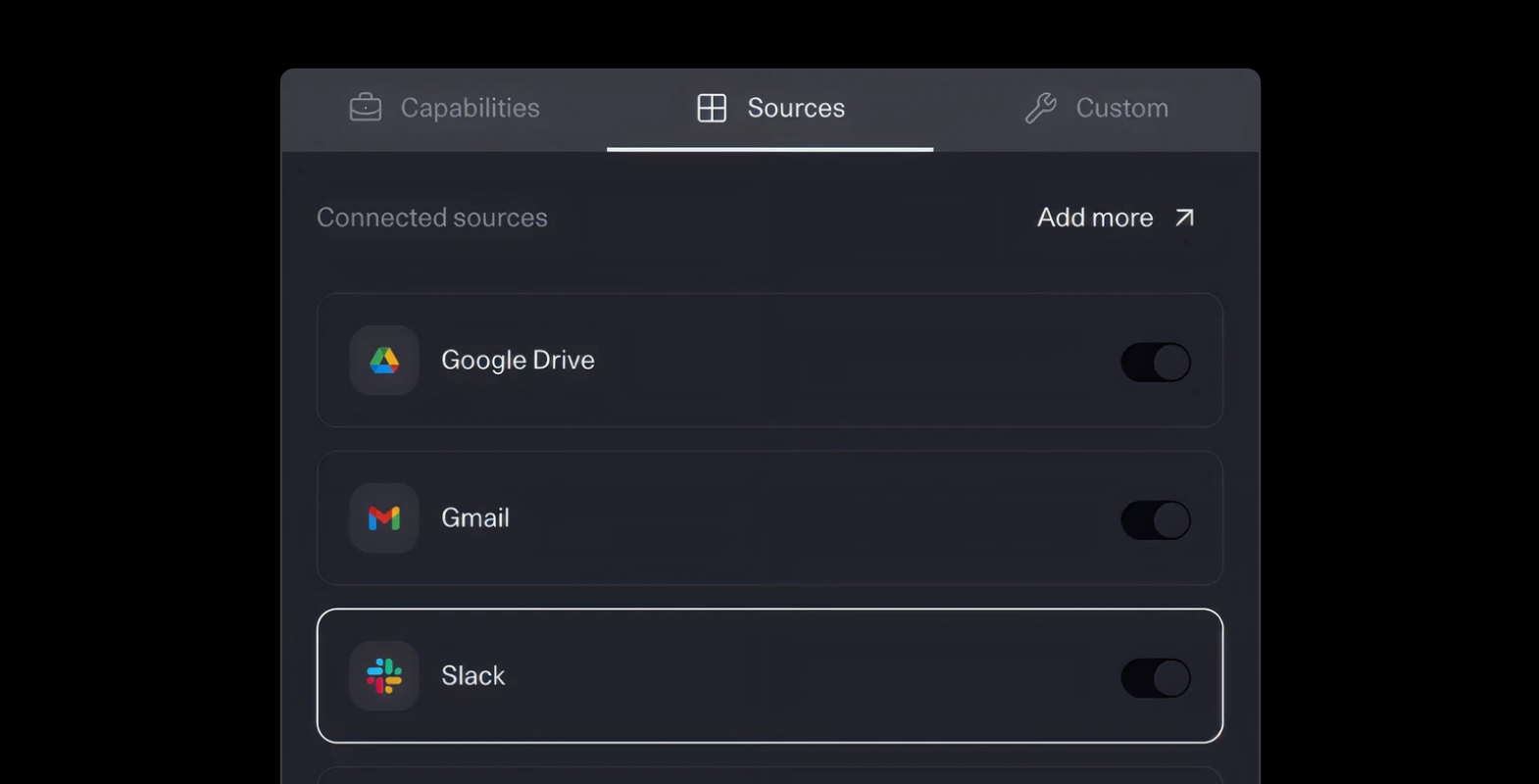
North's Sources panel with Google Drive, Gmail and Slack switched on as connected sources
The first step of any North deployment: an administrator chooses which company sources the agents may read. Screen from Cohere's CoreWeave case study.
02 / HOW IT BECOMES REAL

From an internal question to a controlled workflow

This illustrative policy-review journey combines North with Command and retrieval models. The buyer must agree on document access and deployment before expanding employee use.

  1. 01

    Bring authorized business sources together

    Administrators connect existing tools and define permissions. Private infrastructure choices help align the application with security requirements.

  2. 02

    Find evidence by meaning

    Embed represents content for semantic retrieval, rather than relying only on exact words. Retrieval supplies business context for the language model.

  3. 03

    Use the context to produce a useful answer

    Command supports grounded answers and tool use. A team can evaluate whether the response fits its task before it becomes a wider workflow.

  4. 04

    Run the workflow with enterprise control

    North brings agents and connected tools into a shared work surface. Audit visibility and precise access controls make ongoing ownership part of deployment.

Follow the work, step by step

The data that cannot leave the building

Cohere starts from a customer most AI products are not built for. Its Asia Pacific job posting describes them in one line: banks, telcos, industrials and governments who cannot send their data to someone else's cloud, and who are past experimenting and into production. Such a customer cannot copy client records, contracts and internal policies into a service that runs outside its own systems, however useful the model is.

I run a company that builds AI systems deployed inside banks, telecommunications networks, and defense ministries.

Aidan Gomez · Co-founder and CEO · Essay on the Cohere blog · 2026-09-13

The belief that sets Cohere apart is about where the model sits. In August 2025 the company described its market as a security-first category of enterprise AI that repurposed consumer models do not meet. Co-founder Nick Frosst put the logic in one line: language models are only as good as the data they can reach. If the data cannot move to the model, the model has to move to the data. So Cohere builds models efficient enough to run on two GPUs in a customer's own building, and a workspace, North, that runs in the customer's cloud account, its data centre or a network cut off from the internet.

Why this became a business now

Two things changed. The first is agents: software that takes steps, calls tools and finishes a task instead of only answering. A Cohere engineer wrote in August 2026 that the bottleneck has moved from experiments to production, citing a survey in which only 25% of organisations had moved 40% or more of their AI pilots into production. The second is control as a buying criterion. In a survey Cohere commissioned in April and May 2026 among large companies in Canada, the US, the UK and Germany, 82% of financial services leaders named data leakage and privacy as a top issue that sovereign AI could address.

One question, four steps

Take an illustrative compliance team at a bank that wants answers grounded in its own policies. First, administrators connect the sources an agent may read, such as SharePoint, Outlook, Slack or Jira, and set who may see what; the system runs in the bank's private cloud or its own data centre. Second, Embed finds the relevant passages by meaning rather than exact words, and Rerank puts them in order. Third, a Command model reads the question with that evidence and drafts an answer with citations. Fourth, North runs the result as a workflow, with guardrails set for each agent, audit records and, since North 2, controls on spending.

The diagram hides where people still decide. At CoreWeave, a cloud computing company, Cohere staff spent two days on site mapping the support process and the knowledge its agents would need, and North was in broad production about three months later inside CoreWeave's own data centres. Someone has to choose which documents an agent may read, who checks its answers and when an automated step becomes the rule. Cohere sells that work with the software, through forward deployed engineers placed with the customer and solutions architects who design the fit.

The story hangs together: private deployment, a workspace on top and engineers on site. Much of the evidence comes from the company itself, in launch posts, a survey it sponsored and case studies it wrote. Read the claims as Cohere's pitch, and test them by whether named customers keep expanding.

What this means for a hire in Seoul

In Korea the same logic runs through a partner. LG CNS tailors North for its Korean customers and uses it internally, and a multilingual model co-developed with Cohere is one of the engines of the Foreign Ministry AI platform that LG CNS contracted to build on a private cloud. A hire in Seoul works where the data cannot leave: installing North on a customer's servers, running delivery for strategic accounts, or heading the architects who win the technical decision. The architecture posting says Cohere cares more about what you have deployed, and what broke, than about which models you can name.


Understand the products and their customers

A workspace on top, models underneath

Cohere sells in layers. On top is North, launched in 2025, the workspace employees use; enterprise business and IT teams buy it. Underneath are the models: Command writes and reasons, Embed and Rerank find the right evidence. Around both sits the deployment work of engineers who install the system inside the customer's infrastructure.

North is where the agents live. Employees chat with them, run automations and reuse skills, libraries and memory, connected to their company's tools such as Slack, SharePoint, Outlook, Jira and GitHub. It runs in a VPC, a private section of a cloud account, on premises, fully air-gapped, or in Cohere's managed Model Vault. Administrators set guardrails for each agent, and a customer can bring other companies' models. The product page lists uses from contract review and redlining to compliance work over large volumes of data.

Command is the generative model family. In May 2026 Cohere released Command A+ as open weights under the Apache 2.0 licence, so anyone may download and run it. It has 218B parameters in total, 25B of them active at a time, and covers 48 languages, up from 23. The company measured a 16% gain in Korean tokenization efficiency: the same Korean text takes fewer tokens to process. Cohere says the model grew out of a year of deploying North and runs on as little as two NVIDIA H100s at W4A4 quantization. Giving the flagship away moves the paid part of the business to hosting, the workspace and deployment.

Embed and Rerank do the finding. Embed turns documents and questions into numbers that capture meaning, so a search finds the right passage even when the words differ, and Rerank orders the results before the generative model reads them.

How each product is sold, from Cohere's pricing and product pages as read on 2026-10-07
ProductWhat the buyer getsHow it is priced
NorthAn employee workspace with agents, run inside the customer's infrastructure or in Model VaultCustom enterprise pricing
Command A+A generative model with open weights since May 2026Free to download; managed instances in Model Vault
Legacy CommandAPI usage for existing customers$1.00 per 1M input tokens, $2.00 per 1M output tokens
Embed 5 FastRetrieval model, small dedicated instance$3.00 an hour or $2,000 a month
Rerank 4 ProRanking model, large dedicated instance$10.00 an hour or $6,500 a month

Who has bought it, and what was measured

The clearest before and after is at CoreWeave. Its support team handles customer tickets, and with North deployed inside its own data centres, sensitive customer data stays within its security perimeter. After a two-day on-site, North was built into CoreWeave's Slack-based support workflows and was in broad production about three months later. Cohere's case study reports average resolution time falling from 4 to 8 days to 2 to 5 days, which it credits to improved procedures together with North automation, and satisfaction scores of 4.9 to 5.0 that continued for most tickets after the first few months. These are the vendor's figures in its own write-up.

Other named customers show a pattern more than a measurement. RBC, a Canadian bank, announced in January 2025 that it would co-develop North for Banking with Cohere and explore deployment over the following months. Fujitsu built Takane, a Japanese model for regulated industries, on Cohere's Command series and sells it inside its own AI services. Oracle worked with Cohere on more than 100 generative AI use cases in its Fusion Applications. In each case a large company in its own market carries Cohere's technology to its own customers.

The Korean version of the pattern

In Korea that company is LG CNS. In March 2025 the two agreed to build custom models with Korean language capabilities connected to North, starting with finance and moving on to manufacturing and retail, and LG CNS became the first Korean company to tailor North for its own customers, delivering it on premises. In October 2026 the head of LG CNS's AI Center said LG CNS uses North internally and brings it to customers across Korea. The named public project is the Ministry of Foreign Affairs: LG CNS holds a contract of about 30 billion won for an AI platform that loads several models, including LG's EXAONE and a multilingual model co-developed with Cohere, on a private cloud only the ministry can reach.

The 30 billion won is LG CNS's contract, and Cohere's share sits inside that partnership. The next proof point is a Korean bank or manufacturer that reports its own results on North, the way CoreWeave did.

03 / THE EVIDENCE

The story, in numbers.

DATED OBSERVATIONS

ARR: 2024 research estimate, 2025 company investor memo

USD · M
ARR: 2024 research estimate, 2025 company investor memo2024: $62M; 2025: About $240M$62MEnd of 2024About $240M2025

Annual recurring revenue, not revenue recognised in audited accounts. The end of 2024 point is a research firm's estimate; the 2025 point comes from Cohere's February 2026 investor memo as reported in the press. These are dated disclosures, not a continuous growth record.

Figures, dates & basis +
ARR: 2024 research estimate, 2025 company investor memo
DateValueBasis
2024$62MResearch firm estimate of ARR at the end of 2024.
2025About $240MAbout $240M of ARR for 2025, above a $200M target, from Cohere's investor memo as reported in the press.

Sacra · CNBC · TechCrunch

DATED OBSERVATIONS

Valuation

USD · B
Valuation2024-07: $5.5B; 2025-08-14: $6.8B; 2025-09-24: About $7B$5.5BJul 2024$6.8BAug 2025About $7BSep 2025

The company's value as set by funding rounds. The 2024 figure is press-reported; the 2025 figures are Cohere's own announcements. These are dated disclosures, not a continuous growth record.

Figures, dates & basis +
Valuation
DateValueBasis
2024-07$5.5BAbout $5.5B, the valuation as of July 2024 reported by the press.
2025-08-14$6.8B$6.8B after the $500M round led by Radical Ventures and Inovia Capital.
2025-09-24About $7BAbout $7B after a $100M second close of the same round.

전자신문 (ETNews) · TechCrunch · Cohere

Cohere founded

Aidan Gomez, Nick Frosst and Ivan Zhang co-founded the company.

Korean enterprise partnership

LG CNS and Cohere announced Korean model and North collaboration.

North 2 announced

North 2 adds reusable Skills, Libraries and Memory, model-agnostic orchestration and administrative cost controls.

Read the growth story

Three ways the money comes in

Cohere earns money in three ways, and its price list shows the split. Large organisations sign custom contracts for North and for private deployments of the models, priced per customer. Companies that want a model hosted for them rent a dedicated instance in Model Vault, billed by the hour or by monthly or annual commitment. Existing customers can pay per use for the legacy Command model, at $1.00 per million input tokens and $2.00 per million output tokens. A research firm estimates that about 85% of revenue comes from private deployments, with multi-year contracts from customers including Oracle, Fujitsu, RBC, LG and Notion; that share is an estimate.

The main number is ARR, annual recurring revenue: the yearly value of contracts expected to recur. Cohere's February 2026 investor memo, as reported in the press, put ARR at about $240M for 2025, above the company's own $200M target, with quarter over quarter growth above 50% in every quarter of 2025 and gross margins averaging around 70%. Earlier in 2025 the press reported annualized revenue, a recent month multiplied to a year, of $35M in March and more than $100M in May. A research firm estimates ARR at the end of 2024 at $62M. These measures come from different sources and count different things, so the chart keeps them apart, and none of them is revenue recognised in audited accounts.

The dated numbers and what each one measures
DateNumberWhat it measuresBasis
End of 2024$62MARRResearch estimate
March 2025$35MAnnualized revenuePress-reported
May 2025More than $100MAnnualized revenuePress-reported
2025About $240M (target $200M)ARRCompany investor memo, press-reported
2025Around 70%Average gross marginCompany investor memo, press-reported
2021 to 2024Nearly $1BFunding raised in Series A to DCompany-disclosed
August 2025$500M at $6.8BFunding round and valuationCompany-disclosed
September 2025$100M at about $7BSecond close and valuationCompany-disclosed

What grew, and what the plan missed

The growth is steep and recent. In May 2025 Gomez said revenue had more than doubled since the start of the year and that profitability was "not far away". The same month, a business publication reported that Cohere had fallen more than $350M short of revenue projections it made in 2023. Signet's reading is that both hold: the business started from a small base and accelerated once North and private deployments took hold in 2025. Cohere explains its margin by where the computing happens: customers run its models through managed cloud services or on their own hardware, so it avoids heavy infrastructure costs.

In the press Cohere is measured against much larger companies. A tech outlet wrote in September 2025 that it had been overshadowed by the rise of OpenAI and Anthropic, and in August 2025 that its models had fallen behind the state of the art. Cohere's answer is to compete where scale matters less: deployment inside the customer's walls, engineers on site and partners who carry the product into each country, from RBC in Canada and Fujitsu in Japan to stc in Saudi Arabia and, since October 2026, PwC. In Korea the competition is close at hand. LG CNS, Cohere's partner, leads with LG's EXAONE model and also works with OpenAI and Palantir.

Three risks a Korea hire should weigh

  • One partner carries the visible Korean business. LG CNS is user, reseller and prime contractor, and it also sells LG's EXAONE and works with OpenAI and Palantir.
  • Models are getting cheaper and the rivals are larger. Cohere gave its own flagship model away in May 2026, so its edge rests on service, partners and price.
  • Plans have outrun results before, and a merger is pending. The 2023 projections were missed by more than $350M, and the Aleph Alpha deal still needs regulatory approval.

Two habits help in an interview. Say ARR when you cite the $240M and annualized revenue when you cite the $100M of May 2025, because they measure different things. And ask how much of the Korean pipeline runs through LG CNS, and how a direct contract with a Korean customer would be structured.

04 / THE PEOPLE

Someone saw it first.

Photograph of Aidan Gomez.
Co-founder & CEO

Aidan Gomez

Gomez co-founded Cohere in 2019 and co-authored the Transformer research paper Attention Is All You Need.

The choice behind the company +

Cohere’s company history centers practical enterprise AI and added the North product in 2025.

“I run a company that builds AI systems deployed inside banks, telecommunications networks, and defense ministries.”

Aidan Gomez · Essay on the Cohere blog, "Who Gets to Define the Rules for AI?" · 2026-09-13
The decisions behind the company

A research founder who chose the enterprise

Aidan Gomez, Nick Frosst and Ivan Zhang founded Cohere in Toronto in 2019. Gomez, the chief executive, co-authored Attention Is All You Need, the research paper that introduced the Transformer. The company's own history reads as a series of choices about where to stand in that technology: four funding rounds from 2021 to 2024 that raised nearly $1B, Cohere Labs for open research in 2022, which now counts more than 4,500 community members and more than 100 papers, and in 2025 North, a product for the workplace rather than a model alone. Zhang spoke for Cohere when RBC announced North for Banking in 2025, and he signed the Hanwha memorandum in Toronto in 2026.

Four decisions explain the shape of the company. The first is the customer: Cohere has always focused on the enterprise market. The second is not to live on model access. In 2024 Gomez warned that selling models alone was becoming a zero margin business because of price dumping, and that it is dangerous to make yourself a subsidiary of your cloud provider. The answer was private deployment and partners who own the hardware relationship, such as Dell, which agreed in 2025 to sell servers preloaded with North.

If you’re only selling models, for the next little while, it’s gonna be a really tricky game

Aidan Gomez · Co-founder and CEO · 20VC podcast with Harry Stebbings, as quoted by TechCrunch · 2024-08-19

The third decision followed from the second: in May 2026 Cohere gave its flagship model away as open weights and kept the hosting, the workspace and the deployment as the paid parts. The fourth is scale by combination. In April 2026 Cohere announced plans to combine with Germany's Aleph Alpha and signed a definitive agreement in September. Gomez put the result plainly: Cohere will become a Canadian-German company, with headquarters in Toronto and Berlin if the deal closes.

The leaders a Korea hire will meet

Above the Korea roles sit a few people. Andrew Chang (장화진) leads Asia Pacific: Cohere appointed him VP of APAC in July 2025, and he came from Confluent, where he was area vice president and country manager for Korea, after executive roles at Google Cloud, Microsoft, IBM and Samsung SDS. Korean press in August 2026 reported that until a separate head of the Korean entity is named, Chang heads it as well. Frank O'Dowd, the chief revenue and commercial officer, explained the Seoul hub to Korean reporters. Joelle Pineau, who led research at Meta for many years, joined in August 2025 as chief AI officer over research, product and policy. Phil Blunsom is chief technology officer, and Nick Morales, a Cohere vice president, spoke at LG CNS's AI fair in Seoul in May 2026.

A lot of players out there are quite singularly focused on AGI, superintelligence, and so on

Joelle Pineau · Chief AI Officer · Interview with TechCrunch on joining Cohere · 2025-08-14

How Cohere says it works and hires

The careers page names three values. Momentum: move quickly, trust each other and push forward with purpose. Openness: inclusivity and diverse perspectives. Autonomy: the flexibility and ownership each person needs, with equity because, in the page's words, everyone is a co-owner. The hiring process it describes runs from an application review to a recruiter conversation, sometimes a take-home assignment, a hiring manager interview and a final round with team members. Its engineers add a working principle of their own: build the customer's capability, not its dependency, so the customer can run and extend the system after Cohere leaves.

On the worry that headquarters decides and Seoul executes, the evidence is mixed. Leadership sits in Toronto, and in Berlin too once the merger closes. Korea's voice runs through Chang and through the open APAC solutions architecture director, who the posting says will be one of a handful of people telling the product organisation what the region needs. The Korea head role is held by the APAC head for now, and that director seat is still being filled.

05 / THE NEXT CHAPTER

Korean enterprise AI requires local buying alignment

Four Korea roles are open on Cohere's own job board: solutions architecture leadership for Asia Pacific, forward deployed engineering for private installs of North, technical program management for AI delivery, and on-site IT support in Seoul. Each role below has its own mock application.

Concurrent Korea entity head, reported August 2026

Andrew Chang (장화진)

President and Head of APAC

Engineering
  • Engineering profiles
Sales
  • Sales profiles
Business Development
  • Business Development profiles
Information Technology
  • Information Technology profiles
Media and Communication
  • Media and Communication profiles

The team view combines the 7 October 2026 public Korea-profile review with the August 2026 leader announcement. Function counts describe LinkedIn classifications and the named role describes the reported leadership remit.

Why Korea? Why now?+

Cohere gives its own reasons. Its July 2025 announcement cited Korea's technology ecosystem, its talent base and rising demand for sovereign AI. In March 2025 the CEO said Korean companies are friendly to technology but held back by security and privacy, which is the problem Cohere sells against, and that success in finance matters first in Korea. In August 2026 the chief revenue officer added that no market is as dynamic and competitive in AI, so growth in Korea should carry across Asia Pacific. Signet's reading: Korea combines fast-adopting large companies, strict data concerns and a local partner, LG CNS, that already sells into finance and the public sector, which makes it a proving ground for the private deployment model in Asia.

LG CNS partnership

Cohere and LG CNS agreed to co-develop custom models with Korean language capabilities and to tailor North for Korean companies, starting with finance. At that point Cohere had hired one person for a planned Korea branch.

Foreign Ministry AI platform

LG CNS signed a contract of about 30 billion won to build the Ministry of Foreign Affairs AI platform, running EXAONE and a multilingual model co-developed with Cohere on a private cloud only the ministry can reach.

Seoul office as APAC hub

Cohere announced its Seoul office, its first in Asia, as the Asia Pacific hub and appointed Andrew Chang (장화진) as VP of APAC.

Hanwha memorandum

Hanwha Ocean and Hanwha Systems signed a memorandum with Cohere in Toronto to develop AI for shipbuilding and submarines.

Korean entity announced

At a Seoul press briefing Cohere said it would set up a Korean legal entity in the fourth quarter, separate from the APAC hub, and hire forward deployed engineers, developers and sales in double digits. Andrew Chang heads the entity until a separate Korea head is named.

LG CNS in the North 2 launch

The head of LG CNS's AI Center said LG CNS uses North internally and brings it to customers across Korea.

Understand the Korea opportunity

Why Seoul came first in Asia

Cohere's first office in Asia is in Seoul, announced in July 2025 as its Asia Pacific hub. The company gave three reasons: a strong technology ecosystem, a deep talent base and rising demand for sovereign AI, meaning AI a country or company controls on its own infrastructure. Four months earlier the CEO had named the obstacle it sells against: Korean companies adopt technology readily, but security and privacy hold back AI, and in Korea success in finance comes first. In August 2026 the chief revenue officer added the strategic reason.

No market is as dynamic and competitive in AI as Korea. We judged that if we can grow and expand in Korea, we can grow effectively with other companies and countries in Asia Pacific.

Frank O'Dowd · Chief Revenue and Commercial Officer · Press briefing in Seoul, printed in Korean by ETNews; English rendering of the published Korean text · 2026-08-05

The route ran through a partner before it ran through an office. In March 2025 Cohere and LG CNS agreed to build Korean language models and tailor North for Korean companies, starting with finance; at that point Cohere had hired one person for a Korea branch still to open. Within three months LG CNS won the Foreign Ministry platform. The Seoul office followed in July 2025. In January 2026 Hanwha Ocean and Hanwha Systems signed a memorandum with Cohere in Toronto to develop AI for shipbuilding and submarines. In August 2026 Cohere said it would set up a Korean legal entity in the fourth quarter.

Who runs it, and who the customers are

Andrew Chang (장화진) leads. Cohere appointed him VP of APAC in July 2025 from Confluent, where he was area vice president and country manager for Korea, and Korean press now introduces him as president and head of Asia Pacific. In August 2026 the company said a separate head of the Korean entity will be named later and that until then Chang heads it. He told reporters that Cohere's APAC customers had grown five times in a year and that many are Korean, a multiple that shows pace rather than size. The company also said it would hire forward deployed engineers, developers and salespeople in Korea in double digits.

The named customers are three kinds of relationship. LG CNS is partner, user and reseller of North. The Ministry of Foreign Affairs is a public client reached through LG CNS. Hanwha signed a memorandum, an intent to work together. At the August briefing Cohere also pointed to 집현 (Jiphyeon), a Korean model developed with LG CNS.

Is Seoul a satellite? The signals point both ways. For a lasting base: the APAC hub; a Korean entity planned for the fourth quarter of 2026; double-digit hiring plans; and an on-site role to anchor IT operations for the APAC time zone from Seoul. For caution: one partner carries most of the visible business, and that partner leads with LG's own model.

What the open roles say about the work

Four Korea roles are open on Cohere's own board, and together they describe a team built to deliver what has been sold. The Senior Director, Solutions Architecture, APAC, based in Singapore or Korea, takes over an architecture team that covers Korea, Japan and Southeast Asia, in a job the posting calls a build, requiring 15+ years in architecture or related technical roles including 7+ years of customer-facing technical team leadership, and shares the number with the Asia Pacific sales leader. The Forward Deployed Engineer, Infrastructure Specialist (South Korea) leads deployments of North in private clouds and on premises, with Kubernetes, fluent Korean and anticipated travel of 20 to 40%. The Technical Program Manager, AI Delivery, Korea is Cohere's technical voice to strategic customers. The IT Support Specialist works on site in Seoul.

The shared job is making private AI work inside a Korean customer's own systems: the architecture that wins the technical decision, the install on the customer's servers, the programme that keeps a strategic account on schedule, and the office systems that keep the Seoul team running. Pick the role that matches work you have already done, and test your story with its mock application.

KOREA OPEN ROLES

4 open roles in Korea

Current Signet catalog · 2026-10-19

FOR YOU

Choose a role from its actual responsibilities and language criteria.

Solutions Engineer

Forward Deployed Engineer, Infrastructure Specialist (South Korea)

Korea / APAC (Remote)

Posting checked

The work
Deploy and run North inside customers’ private and hybrid infrastructure.
Who fits
Experience working directly with customers and deploying enterprise software in private or hybrid clouds.
Keep in mind
Deploy North in private clouds and on-premises environments; 20 to 40% travel anticipated.
Operations

IT Support Specialist

Korea (On-site)

Posting checked

The work
Support staff devices, identity, onboarding and office IT across APAC.
Who fits
At least five years in help desk, internal IT support or a similar technical-support role.
Keep in mind
Anchor APAC IT support from Korea, managing employee onboarding, offboarding and access readiness.
Solutions Engineer

Senior Director, Solutions Architecture, APAC

Singapore / Korea (Remote)

Posting checked

The work
Build APAC architects and own technical wins alongside the sales leader.
Who fits
At least fifteen years in solutions architecture, solutions engineering, technical consulting or enterprise architecture.
Keep in mind
Singapore primary, Seoul secondary; grow technical coverage across Korea, Japan and Southeast Asia.
See all 4 roles
Engineering · AI

Technical Program Manager, AI Delivery, Korea

Korea (Remote)

Posting checked

The work
Coordinate strategic AI delivery across engineering, product and customer teams.
Who fits
At least five years as an Engineering or Technical Program Manager, including at least two in customer-facing technical delivery and operations for enterprise AI software.
Keep in mind
Korea remote; LLM training or optimization knowledge is a differentiator.
07 / NOW & NEXT

The next scene is taking shape.

LG CNS partnership

The partners announced customized Korean enterprise AI and North integration.

Financing extension

TechCrunch reported an additional $100M and a $7B valuation.

North 2

Cohere introduced North 2 with reusable agent capabilities, memory and configurable deployment and spend controls.

More context on what comes next

North 2 and a consulting channel

On 5 October 2026 Cohere launched North 2, which it calls its biggest upgrade: one platform for security, intelligence, cost governance and control, with reusable skills, libraries and memory, agent-level guardrails, new enterprise connectors and the option to orchestrate other companies' models. The company says it rolled North out over the past year across finance, healthcare, telecoms, manufacturing, energy and the public sector, and LG CNS is the Korean voice in the launch. The same day it announced an alliance with PwC, starting in Canada, to help organisations deploy Cohere's AI in private cloud, on premises and air-gapped settings. It repeats the Korean pattern: a large services firm carries the product to its clients.

Becoming a Canadian and German company

The larger change is structural. In September 2026 Cohere signed a definitive agreement to combine with Aleph Alpha. If regulators approve, the company will have more than 1,000 employees, headquarters in Berlin and Toronto, and a research centre in Heidelberg, with Aleph Alpha's co-CEO as chief operating officer. Schwarz Group, an Aleph Alpha backer, committed about $600M as lead investor in Cohere's Series E, and press reports put the combined company's value at around $20B. Gomez said in October 2025 that he hopes to list Cohere on a stock market soon.

No government or enterprise should have to choose between capable AI and control over their technology

Aidan Gomez · Co-founder and CEO · Cohere blog, on the Aleph Alpha agreement · 2026-09-16

What to watch over the next year

  • The Korean legal entity planned for the fourth quarter of 2026, and the person named to head it.
  • A Korean bank, manufacturer or public body that reports its own results on North, beyond the LG CNS partnership.
  • Whether the Aleph Alpha deal closes, and whether Asian languages, where Command A+ made Korean text 16% more efficient to process, keep their weight in a Berlin and Toronto company.

For a reader in Korea, the last year sharpens the bet rather than changing it. The product is more complete, the partner channel is wider, and the company is about to become much larger, while the Korean team is still being built role by role.

Their future. Your next chapter.

Find your part ↑

An independent profile by Signet. No affiliation or investment recommendation. Introductions happen only with your consent.
Research reviewed 2026-10-07

A LITTLE MORE CONTEXT

Understanding Cohere.

What does Cohere do?

A banking employee needs an answer grounded in internal policy, with access limited to the right documents. Cohere combines enterprise models, retrieval and North workflows with private deployment choices.

What is the opportunity in Korea?

Four Korea roles are open on Cohere's own job board: solutions architecture leadership for Asia Pacific, forward deployed engineering for private installs of North, technical program management for AI delivery, and on-site IT support in Seoul. Each role below has its own mock application.

Are these confirmed job openings?

Employer postings were checked on 2026-10-08. Availability can change. Mock applications request a review from Signet.

How can I explore the company in more depth?

Follow the company from its vision through products, evidence and people to the Korea team and current roles. Use the table of contents to move within the page, and expand the sections for more context.

Back to the collection ↗