What changed? +
People needed to complete fixes and internal tools through existing queues.
Vendor-published September 2026 case; organizational scope, not a Korean contract.

A person can direct work and verify the resulting behavior.
See it taking shape ↓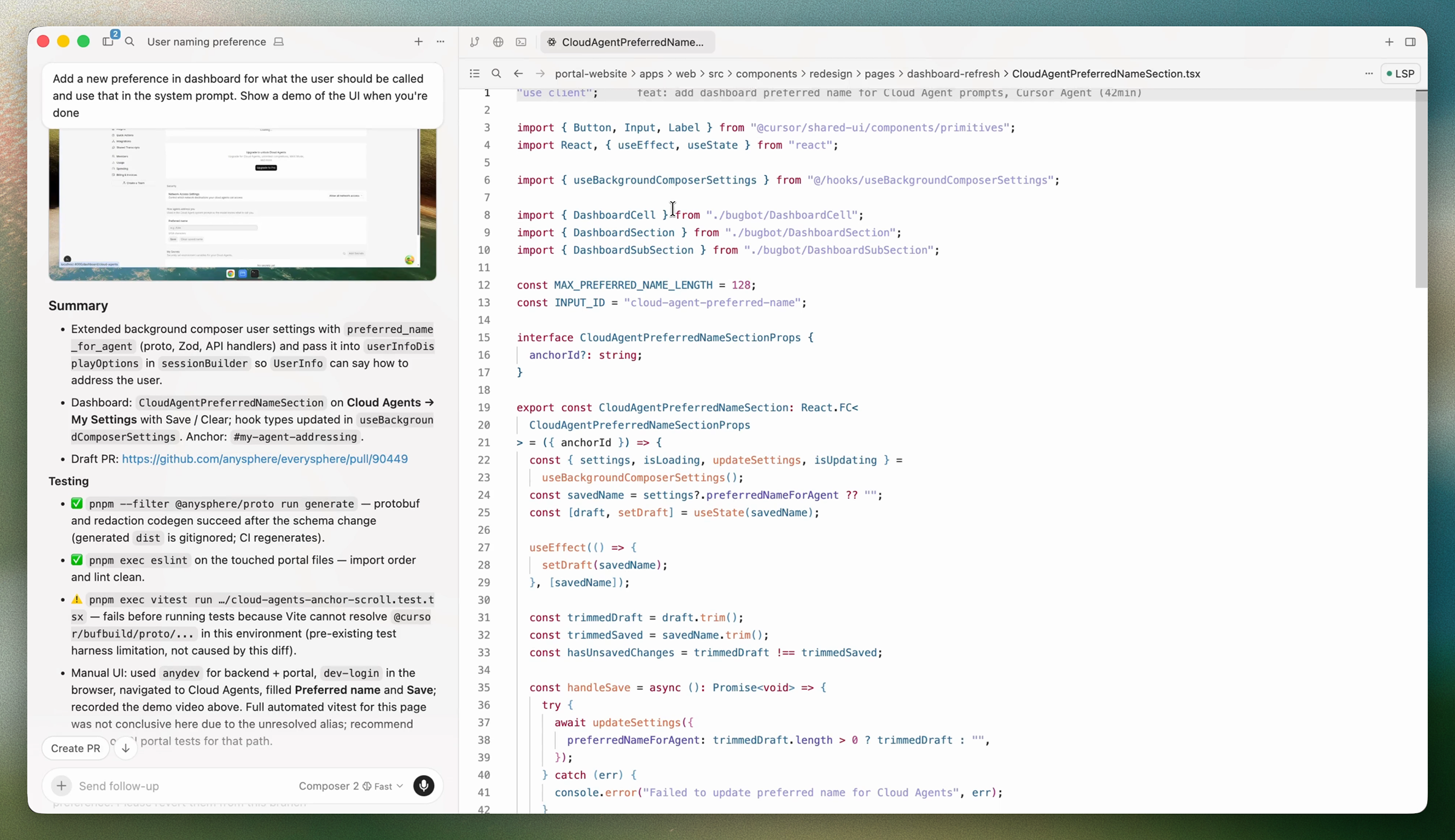
Keep context, execution and outputs understandable.
People needed to complete fixes and internal tools through existing queues.
Vendor-published September 2026 case; organizational scope, not a Korean contract.
Illustrative application-error workflow grounded in current capabilities.
Reproduce the error and agree expected behavior.
Provide repository context and the execution environment.
Inspect and change files, then run checks.
Compare evidence with the agreed result and correct the change.
Cursor builds software for working with coding agents. A developer describes a task, gives the agent relevant context and tools, then reviews the resulting changes and evidence. Its present workspace supports local and cloud agents alongside access to files and the familiar editor. The company has been part of SpaceX since the acquisition completed in August 2026. That ownership change sits beside an enduring product problem: helping people move from an intention to software that works. Signet follows the product through a concrete change rather than the volume of text a model produces. The developer needs to establish what should happen, what must remain reliable and how the result will be checked. An agent can explore a repository, propose an implementation and run available checks. The surrounding environment determines what it can access and execute. A useful introduction therefore connects the task, repository context, execution environment and review. Those choices explain how the tool becomes part of a development process and why a generated answer alone is only one stage of the work.
Consider an application team investigating a checkout error. This is an illustrative workflow based on advertised capabilities, not a claim about a named Korean customer. A developer first reproduces the error and defines the expected behavior. They give Cursor the repository and relevant instructions, ask it to trace the failing path and review a proposed approach. The agent edits the necessary files and runs the available test or browser workflow. The developer inspects the changes, compares the observed result with the original problem and asks for corrections where needed. For parallel work, another agent might inspect an adjacent component or prepare an additional check. A cloud environment can keep a task running after the laptop is offline, while a local session can use the developer's own environment. Signet would make the review criteria explicit before comparing tools. The meaningful outcome is a change that solves the problem and remains understandable to the team. The example also shows why repository permissions, environment setup and the ability to reproduce a result belong in a product evaluation.
Grab is a named customer example published by Cursor in September 2026. The Southeast Asian technology company reports approximately ninety-eight percent monthly active usage within its technology organization. Designers, engineers and colleagues outside engineering use the product for different tasks. The case describes designers making production interface fixes after Git training, with design managers reviewing their changes. It also describes people creating internal tools instead of waiting in an engineering queue. These observations connect adoption to the work a person can actually complete. They do not establish the same outcome for every team or turn Grab into a Korean customer reference. Signet would use the case to ask who owns a change, what training they need and which review makes that change acceptable. An organization may introduce a coding tool to experienced developers and later support other functions, with different permissions and guidance. The useful comparison is the original work, the changed workflow and the evidence of successful use. The customer story provides an attributed example of that sequence at a defined organizational scope.
Cursor's Agents Window places sessions and their outputs in a workspace that also lets the developer inspect files. The April 2026 release describes parallel agents, work across multiple repositories and movement between local and cloud execution. A developer can bring a cloud session to the desktop to edit or test it, or move a local session to the cloud for continued work. The familiar IDE remains available. Rules and other extensions give teams ways to supply reusable instructions and tools. These capabilities address the coordination around generated code, including discovering context and reviewing the result. Signet would compare the workspace with a conventional editor plus separate assistants, terminal agents or internally built orchestration. The relevant difference depends on the actual task: keeping sessions understandable, providing the right environment and examining evidence without recreating the whole conversation. The official file-viewing illustration shows an agent summary beside source code. That visible relationship helps explain the product as a working environment in which a person can examine the implementation and the agent's account of its checks.
Bugbot examines proposed repository changes and comments on potential bugs, security issues and code-quality problems. Its current documentation describes automatic reviews when a pull request changes, manual triggers and configuration at individual, team and repository levels. Suggested fixes can be opened in the editor or the web agent experience. Autofix adds another stage by preparing a correction that can be reviewed. The official illustration shows a review comment explaining a potential issue and offering a prepared change. A team still chooses how findings interact with its approval and branch rules. The documentation distinguishes a successful check from the default neutral status when findings exist; requiring a check alone does not necessarily block merging a reported issue. Signet sees that distinction as part of the product's value discussion. The buyer wants useful findings and a workable review process, not simply more automated comments. A candidate can demonstrate how they evaluated a finding, checked the proposed correction and incorporated it into existing engineering responsibility. That makes code review a clear product task with an observable output.
Cloud agents use a separate development environment for repository work. Current runtime guidance distinguishes Cursor-managed virtual machines from customer-controlled machines and worker pools. The agent loop and inference remain in Cursor's cloud even when tool calls run on the customer's hardware. That boundary matters when a company evaluates repository checkout, internal services and model access. It should not be described as fully local inference. Organizations can set repository, model and network controls under their plan. Privacy Mode governs training use, with the data-use page describing exceptions for abuse investigations and specifically designated non-zero-retention models. Signet would map the actual information flow and administrative requirements to the customer's policy. Models are another layer: Composer is Cursor's coding model, while the workspace also exposes other supported models. Choosing a model and choosing an execution environment are related decisions with different consequences. A useful technical demonstration shows the chosen task, the environment it runs in and the evidence returned for review. This makes enterprise adoption understandable without relying on a vague claim that every deployment has the same security properties.
Financing observations before the August 2026 acquisition; November explicitly post-money, June as stated. These are dated disclosures, not a continuous growth record.
| Date | Value | Basis |
|---|---|---|
| 2025-06-06 | $9.9B | Series C stated valuation; not sales. |
| 2025-11-13 | $29.3B | Series D post-money valuation; not present standalone value. |
Cursor
Current ownership changes; earlier financing is history.
Cursor sells access directly through individual, team and enterprise plans. The current monthly pricing page lists a twenty-dollar Pro starting option and a forty-dollar per-user Teams starting option, with other selectable tiers and a custom Enterprise arrangement. Plans include a defined amount of model use, and additional on-demand consumption can be billed afterward. Prices exclude applicable taxes. Team and enterprise plans add administration, shared context and controls to the underlying developer workflow. Signet would read a purchase through the users receiving access, the included usage, any additional consumption and the administrative requirements. A price per seat alone does not establish a customer's final bill or the vendor's margin. Expansion can come from more users and broader use, while renewal depends on continuing value for the buyer. A sales candidate can prepare a concrete account example connecting developer adoption to the organization's decision process. A technical candidate can show how usage and environment choices support the intended work. Both stories help explain why someone pays without treating product popularity as recognized sales.
The company announced more than five hundred million dollars in ARR in June 2025, alongside a nine-hundred-million-dollar Series C at a stated valuation of 9.9 billion dollars. In November it announced crossing one billion dollars in annualized revenue, alongside a 2.3-billion-dollar Series D at a 29.3-billion-dollar post-money valuation. The labels matter. ARR describes recurring revenue under the company's presentation; annualized revenue is a run-rate measure; neither establishes audited revenue earned over a completed fiscal year. Funding is capital raised and valuation is a financing assessment of the company. Signet charts the two stated 2025 valuations as historical financing observations, preserving the November post-money definition and the June source's wording. The ARR and annualized-revenue statements stay as separately labeled metrics. They are not joined into a comparable revenue trend. The August 2026 acquisition subsequently changes the ownership context, so the older private financing valuation is dated history. This presentation lets a reader understand commercial scale and capital events while avoiding a false claim about current standalone market value or audited annual sales.
Developer enthusiasm can introduce a tool into an organization before a formal enterprise purchase. The current enterprise page presents administration and controls for scaling that use, while the Korean seller advertisement explicitly includes security, legal, procurement and multiple approvers. Signet sees three business questions in that transition. First, does the generated change meet the team's quality and review requirements? Second, can the organization understand usage, spend and the continuing benefit of its chosen plan? Third, do repository access, data handling and execution fit the organization's obligations? These are interpretation questions grounded in the published product and purchasing scope, not a claim that the company has suffered a specific failure. The source-control review tools and runtime choices address parts of those questions, but implementation remains tied to the actual customer environment. An account can grow when a well-defined use becomes repeatable across teams. A useful candidate example therefore includes adoption, a measured outcome and the handoff to ongoing operation. Keeping these details visible connects revenue opportunity to the work required to make customer value durable.
Publishes the direction from autocomplete to agents.
Make larger agent work reviewable.
“The human role shifts from guiding each line of code to defining the problem and setting review criteria.”
Michael Truell · The third era essay · 2026-02-26
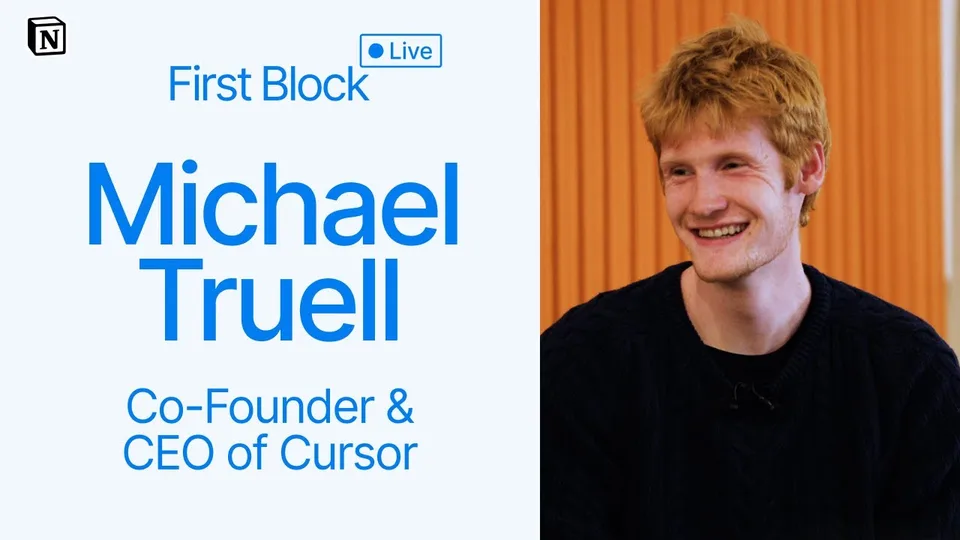
Michael Truell and Sualeh Asif are co-founders who continue to publish the company's product direction. Their April 2026 article introduces the agent-centered workspace and explains the move from managing individual conversations to coordinating software work. Accel's earlier investment account also identifies Aman and Arvid among the founding team, while its August acquisition account names Michael Truell, Aman Sanger and Sualeh Asif. Signet keeps that historical founding context separate from an invented current executive roster. The dated product writing is direct evidence of the decisions its authors describe: retaining access to the editor, supporting multiple repositories and improving movement between local and cloud agents. Those choices address how a person stays able to understand work as agents do more of it. A candidate can connect to that direction through an example of designing a tool, clarifying a complex workflow or making a result easier to inspect. The founders' stated ambition provides context; the candidate's own implementation and evidence show what they can contribute to pursuing it.
Truell's February 2026 essay organizes the product's development into autocomplete, interactive agents and agents that can carry larger tasks over longer periods. It describes a human role focused on defining problems, equipping agents and reviewing artifacts. This is an authored view of the industry's direction, not a guarantee that every development process is already autonomous. The September Projects release gives that view a concrete product form: a coordinator maintains shared context and delegates work, with subscriptions for recurring signals. It was released in beta with a gradual rollout to users. Signet reads the sequence as a product organization turning a hypothesis into an interface and operating model that can be tested. The important question for a candidate is how they would preserve clarity as task duration and concurrency increase. Examples might include explicit acceptance criteria, a reliable environment or a preview that helps a reviewer inspect behavior. A thoughtful demonstration explains the decision, the result and where human attention was needed. This links the founders' ambition to work a person can actually show.
The current job introduction describes a flat, talent-dense organization that values truth-seeking, passion, creativity, spirited debate and shipping code. These are the employer's stated working preferences, rather than an independently measured description of every team's experience. Signet interprets two practical principles from that language: test a claim against evidence, and bring an idea through to a usable result. Sualeh's historical account of the early team highlights backgrounds in models, infrastructure, design and developer tools. Those examples help explain why the company combines research and product work, while the current career board shows the range of functions it is recruiting. The live Korean roles translate that combination into customer-facing work. A Field Engineer must demonstrate a technical workflow and communicate its value; a seller must coordinate technical evaluation and commercial decisions. An applicant can therefore prepare a project with a clear initial problem, a decision they made and evidence of the outcome. The public principles become useful when they illuminate an actual choice, including how the person responded when an assumption or proposed solution did not hold up.
The Field Engineer partners with account executives on technical discovery, demonstrations and proofs of concept. The advertisement names engineering leaders, architects and developers as customer stakeholders and Sales, Product, Engineering and post-sales colleagues as collaborators. Its responsibilities include solution design, rollout guidance, prompt strategy, context configuration and the handoff to onboarding. The requirements emphasize hands-on technical fluency, understanding the software-development lifecycle and communication with both developers and executives. The language line has an original wording error, saying fluent Korea alongside business-level English; the source is retained exactly, with Korean language interpreted in the editorial description. The criteria center on technical fluency and communication. Signet suggests preparing an evaluation in which a customer had a clear obstacle, the candidate demonstrated a working approach and the team checked whether it helped. The application asks about convincing a technical audience to adopt a tool and handling resistance. That is direct preparation evidence, while a proposed first-quarter plan remains Signet's suggestion rather than an employer promise. The distinction keeps actual requirements and useful preparation aligned.
The roles identify collaborators and region-building responsibilities.
Advertised enterprise selling and technical evaluation.
The official career board lists two openings with South Korea as their location on October tenth, 2026: Field Engineer and Strategic Account Executive, Enterprise. Both are full-time, with Solutions and Sales listed as their respective functions. The board's other regional or remote advertisements should retain their own location definitions; a broad APJ or global label alone does not turn them into additional Korean openings. These two advertisements provide direct evidence of customer-facing work in Korea. The account executive description discusses building an enterprise presence and early references, which is a prospective responsibility rather than proof of a completed office opening or a particular customer contract. Signet reads the hiring together with the enterprise product: local evaluation, technical adoption and commercial purchasing need to work together. The two functions have different evidence to prepare. A technical candidate can reproduce a useful evaluation and explain the outcome, while a seller can show the account strategy and decision process. The roles connect the global product to specific work advertised for Korea; the postings do not establish a complete local reporting structure.
The Field Engineer partners with account executives on technical discovery, demonstrations and proofs of concept. The advertisement names engineering leaders, architects and developers as customer stakeholders and Sales, Product, Engineering and post-sales colleagues as collaborators. Its responsibilities include solution design, rollout guidance, prompt strategy, context configuration and the handoff to onboarding. The requirements emphasize hands-on technical fluency, understanding the software-development lifecycle and communication with both developers and executives. The language line has an original wording error, saying fluent Korea alongside business-level English; the source is retained exactly, with Korean language interpreted in the editorial description. The criteria center on technical fluency and communication. Signet suggests preparing an evaluation in which a customer had a clear obstacle, the candidate demonstrated a working approach and the team checked whether it helped. The application asks about convincing a technical audience to adopt a tool and handling resistance. That is direct preparation evidence, while a proposed first-quarter plan remains Signet's suggestion rather than an employer promise. The distinction keeps actual requirements and useful preparation aligned.
The Strategic Account Executive advertisement asks for at least ten years of enterprise B2B selling, preferably involving technical products such as developer tools, infrastructure, cloud, security or AI. It also asks for experience with large Korean accounts, active pipeline creation, forecasting and fluent Korean. English is not separately specified in this advertisement. The role owns prospecting through negotiation and closing, with security, legal, procurement, finance and executive stakeholders involved in the buying process. The current text uses Cursor, SpaceXAI and Grok in describing the product and enterprise presence; these names are preserved in the original rather than silently normalized into a different employer statement. Signet would prepare an account story showing the initial customer objective, technical evaluation, buying committee and final agreement. A second useful example explains how the person built pipeline and learned from a deal. The description's foundational regional work also calls for processes and local market insight as the territory develops. Candidates can assess those responsibilities against their own evidence without assuming that the two Korean openings share the same seniority or language conditions.
Current Signet catalog · 2026-10-19
Match the exact role to technical or strategic account evidence.
Cursor announced on August fourteenth, 2026 that it had officially been acquired by SpaceX. The statement connects the completed transaction to an earlier AI training partnership and expanded compute resources. Accel separately published an acquisition account that day. Signet therefore describes current ownership as part of SpaceX and retains the 2025 private financing observations as history. A completed ownership change is separate from the current availability of an individual feature or the exact wording of every job advertisement. The live Korean sales text already uses SpaceXAI and Grok alongside Cursor, while the technical role retains Anysphere in its description. Those original texts are useful evidence of the present hiring context and should keep their stated brands and responsibilities.
The September tenth Projects release introduces persistent shared context and a coordinator that delegates work. The announcement calls it beta and describes a rollout beginning that day. On September twenty-third, Cursor released Rollouts and Security Reviewer for Teams and Enterprise through automations. The former follows a change into production, while the latter examines code for potential security issues and proposes fixes. Rollout responses follow their configured approval conditions. Feature-flag ramping and release-freeze awareness were described as coming later. Signet keeps those stages visible: a current release, a beta rollout and a planned capability have different implications for evaluation. A candidate can explain a delivered workflow and identify the next product evidence to watch without turning future scope into a present guarantee.
The October sixth change lets the iOS app show and reply to local agents running on a computer. It requires pairing the computer and keeping that machine online. The release enables the feature by default except for Enterprise, where an administrator must opt in. It also distinguishes remote control from moving an agent to a cloud environment: the work remains on the paired computer. Signet reads this as a continuity feature for an existing session, with device availability and organizational policy shaping how it can be used. The practical demonstration is a person checking progress and supplying direction while their local task continues. That scope is narrower and clearer than claiming every agent can now run indefinitely without the original machine.
Agent workspace and repository code review
The Field Engineer partners with account executives on technical discovery, demonstrations and proofs of concept. The advertisement names engineering leaders, architects and developers as customer stakeholders and Sales, Product, Engineering and post-sales colleagues as collaborators. Its responsibilities include solution design, rollout guidance, prompt strategy, context configuration and the handoff to onboarding. The requirements emphasize hands-on technical fluency, understanding the software-development lifecycle and communication with both developers and executives. The language line has an original wording error, saying fluent Korea alongside business-level English; the source is retained exactly, with Korean language interpreted in the editorial description. The criteria center on technical fluency and communication. Signet suggests preparing an evaluation in which a customer had a clear obstacle, the candidate demonstrated a working approach and the team checked whether it helped. The application asks about convincing a technical audience to adopt a tool and handling resistance. That is direct preparation evidence, while a proposed first-quarter plan remains Signet's suggestion rather than an employer promise. The distinction keeps actual requirements and useful preparation aligned.
Employer postings were checked on 2026-10-10. Availability can change. Mock applications request a review from Signet.
Follow the company from its vision through products, evidence and people to the Korea team and current roles. Use the table of contents to move within the page, and expand the sections for more context.