Bill Staples of GitLab
GitLab / THE WORLD THEY ARE BUILDING

Ship software with control.

Duo Agent Platform adds AI agents to that lifecycle. The opportunity is coordinated assistance with project context and permissions, while organizations remain responsible for approving and validating software changes.

See it taking shape ↓
01 / THE PRODUCTS

The products behind the promise.

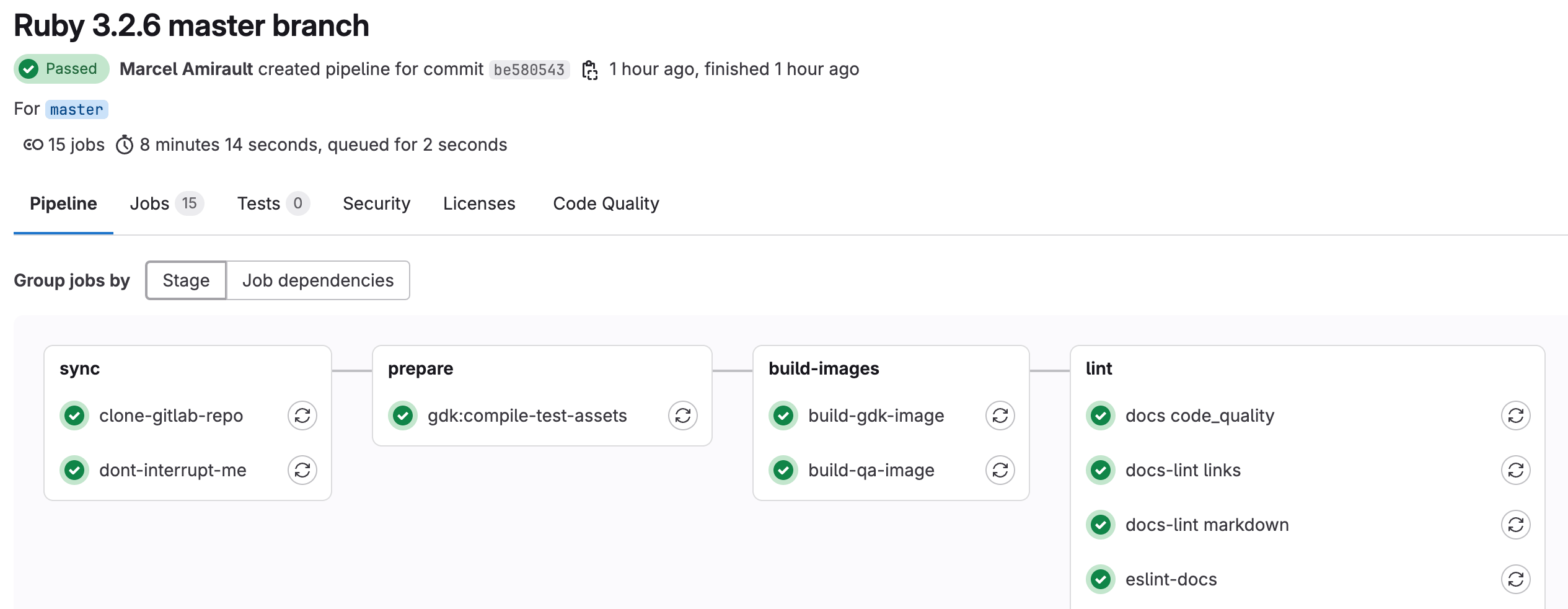
GitLab pipeline details with stages, jobs, and pass indicators
Official GitLab CI/CD documentation screenshot, version 17.9, showing an example pipeline grouped by stage.
GitLab CI/CD

Configure build, test and deployment workflows alongside the code.

Teams can automate repeated validation and delivery steps.

Agoda

Consolidate a fragmented delivery toolchain

GitLab reports more than 98% lower build queue time and 3,000 developer hours saved per quarter.

The case describes consolidating work on GitLab Ultimate, simplifying the pipeline and developer experience.

What changed? +

Agoda used at least nine tools across its software lifecycle.

Vendor-published results for Agoda. The case describes AI adoption as a plan at the time it was written.

Fujitsu Cloud Technologies

Approvals that fit Japanese business practice

The case reports development cycles falling from up to six months to as little as a few days, and deployments from about a day to about five minutes.

The team chose GitLab Premium because it could manage approvals in line with Japanese business practice and gave an all-in-one DevOps environment.

What changed? +

Each project had its own Git and SVN tool. Engineers from outside the company joined project by project, and managing what they could access alongside internal engineers was hard.

Vendor-published case study on GitLab's customer site; figures are as reported by GitLab and the customer, for a Fujitsu group cloud company in Tokyo.

GitLab diagram of the DevSecOps lifecycle: plan, code, build, test, release, deploy, operate and monitor inside a loop bounded by security and compliance
GitLab's own picture of the lifecycle its platform covers, from its press kit. Security and compliance wrap every stage.
02 / HOW IT BECOMES REAL

From an issue to a reviewed release

Illustrative software-delivery workflow based on the platform and CI/CD capabilities.

  1. 01

    Connect the requested work to the code

    Teams record an issue and coordinate the change in the same development environment. Shared context helps reviewers understand why the change exists.

  2. 02

    Propose and review a code change

    Developers use repositories and merge requests to expose a change for review. The record connects discussion and approval to the code being delivered.

  3. 03

    Run tests and security checks in the pipeline

    CI/CD automates build and test work; platform security capabilities add checks to the lifecycle. A failed check becomes evidence to resolve before release.

  4. 04

    Use agents with project context

    Duo agents can support work across the software lifecycle. Teams must keep generated changes within review and permission controls rather than treating assistance as proof of correctness.

Follow the work, step by step

Every handoff between tools is drag

GitLab starts from a complaint most engineering managers in a large company will recognise. A change to software passes through planning, code, review, tests, security checks and deployment, and in many organisations each step lives in a different tool. GitLab's mission page, rewritten in May 2026, calls the cost drag: handoffs between tools, gates between teams, security as an afterthought, compliance as a tax, and weeks lost to coordination that should have taken minutes. Its October 2026 press release calls the result a shadow software factory, with no shared identity, common policy or record of how a change was made.

The answer GitLab gives is older than the AI era. When the company registered for its stock market listing in 2021, co-founder Sid Sijbrandij explained in his letter to investors why GitLab had moved from a set of tools to one application.

easier to understand, faster to use

Sid Sijbrandij · Co-founder, then Chief Executive Officer · Letter From Our CEO in GitLab's Form S-1 · 2021-09-17

The annual report filed in March 2026 still describes GitLab around that idea, now as an intelligent orchestration platform for DevSecOps on an open-core model: customers and outside contributors can add to the core product, and users contributed more than 6,500 merge requests in calendar 2025. The bet is that one shared record of every change is worth more than the best individual tool at each step.

Why now: agents write code faster than companies can check it

What changed is volume. In May 2026 the CEO, Bill Staples, set out a division of work: machines build software, while people direct it. The mission page lists the work agents take on: planning, coding, reviewing, deploying and repairing. People keep responsibility for architecture, customer problems and judgment about trade-offs. GitLab argues that this moves more of the hard work toward checking and shipping code. In its September results release the CEO described lifecycle context, security, governance and control as increasingly valuable as AI creates more work. On 6 October the company reported 200% year-over-year growth in active users of agentic software development, measured over the preceding three months. That is its own platform activity measure, rather than a count of paying customers or a three-month sequential growth rate. The same release reported 40% year-over-year growth in CI/CD pipelines over that period.

One change, followed through the platform

Take an illustrative case: a platform team at a large Korean company has to change a payment service. The request starts as an issue on a board, where product owners and developers agree on the work. A developer opens a merge request, GitLab's word for a proposed change with its discussion and approvals attached. The pipeline builds and tests the change and runs security scans, and a failed check becomes something to fix before release. Duo Agent Platform can pick up after the code is written: GitLab says its agents carry the change through review, tests, security and pipelines under the customer's own rules and identity, with a human checkpoint wherever policy calls for one.

Where judgment stays human is part of the pitch: every agent action is traced to a real user's identity and permissions. For a regulated buyer, where GitLab runs matters as much as what it does: customers can run it on their own servers, use GitLab.com, or use GitLab Dedicated, a single-tenant service, and they can run self-hosted AI models on their own installation.

In Korea the pitch a buyer hears is control as much as speed. The South Korea solutions architect is the person who proves that pitch on a customer's own workflow in a proof of value, and the support engineer is the person who keeps a self-managed installation healthy when something breaks. Both jobs sit exactly where GitLab's bet is tested: whether one governed platform holds up when agents multiply the work.

Understand the products and their customers

One platform, sold in tiers and run where the customer wants

GitLab sells a common platform in different plans. Free covers individual and open-source work. Premium lists at $29 per user per month, billed annually. Ultimate, for advanced security and compliance, has custom pricing. The current pricing page offers Premium users $12 and Ultimate users $24 of included GitLab Credits per month as a limited-time promotion, subject to change. Free, Premium and Ultimate have GitLab.com and self-managed options. GitLab Dedicated is a separate managed, single-tenant service that includes Ultimate, rather than an option bundled into every tier. A buyer chooses the plan, hosting arrangement and usage budget together.

GitLab CI/CD is the automation at the centre. Teams configure build, test and deployment steps alongside their code, and every proposed change runs through the same pipeline before anyone approves it. In Korea, a 2020 project by GitLab's partner Megazone Cloud moved a conglomerate refinery affiliate off Bitbucket and Jenkins. Activity is still rising: CI/CD pipelines on GitLab grew 40% year over year in the three months before 6 October 2026.

GitLab Ultimate is where the money concentrates. It adds security scanning, vulnerability reports and security policies a team can set and enforce, and it is the tier built for enterprises with security and compliance requirements. In Q2 fiscal 2027 Ultimate made up 59% of ARR and eight of the ten largest deals.

GitLab Duo Agent Platform, generally available since January 2026, is the AI layer. GitLab's own framing is that coding agents get a change to the merge request and its agents carry it the rest of the way, through review, tests, security and pipelines, under the customer's permissions. GitLab Orbit, a context graph linking code, work items, pipelines and deployments, feeds those agents; since its June 2026 beta more than 3,500 organisations have used it for over 280,000 agent queries. Agent work is paid with GitLab Credits.

What customers report, and what the reports cover

The most detailed case is Agoda, the online travel company. Before GitLab its six DevOps teams, about 50 people, maintained a toolchain of at least nine tools. After consolidating on GitLab Ultimate, GitLab reports a more than 98% decrease in build queue time and 3,000 developer hours saved per quarter. The case is candid about AI: Agoda's team said other AI tools had sped up coding without improving quality, and that it was keen to adopt GitLab's.

Fujitsu Cloud Technologies in Tokyo shows what matters when outside engineers join project by project. The case describes choosing GitLab Premium for approval management that fits Japanese business practice and for a common DevOps environment. It reports development cycles shortening from up to six months to as little as a few days. Its deployment comparison is separate: about a day to about five minutes, with frequency moving from once in six months at the longest to once every few weeks at the shortest. Hilti bought Ultimate to bring source code under its own control and reports deployment time falling from an average of three hours to fifteen minutes. Goldman Sachs adopted Premium to roll out a common application to thousands of bank engineers; some teams ran one thousand or more CI feature-branch builds a day. These are individual customer accounts published by GitLab, with different baselines and scopes. They describe why buyers consolidate tools, rather than promise an identical result for the next customer.

Where the next sale comes from

All four cases are published by GitLab, and the figures are GitLab's and the customers' own. Read together, they show buyers paying for control as much as speed: who approves a change, who can touch source code, where the platform runs. That is the language of a Korean bank or conglomerate security team, and it matches where GitLab's money sits: Ultimate is 59% of ARR and self-managed subscriptions 59% of revenue.

In a Korean evaluation, the architect's job is to show which layer a customer needs now and what the next one would change, with a proof of value on the customer's own workflow. The support engineer then keeps that promise when the same customer runs it on its own servers.

03 / THE EVIDENCE

The story, in numbers.

DATED OBSERVATIONS

Total annual revenue

USD · B

Company-disclosed total annual revenue in USD billions. Fiscal-year end dates are shown on each point. Historical comparatives follow the cited filing; revenue includes acquisition and currency effects and is not ARR.

Figures, dates & basis +
Total annual revenue
DateValueBasis
2021-01-31$0.152BTotal recognized revenue for the fiscal year ended 2021-01-31. Includes all reported revenue categories.
2022-01-31$0.253BTotal recognized revenue for the fiscal year ended 2022-01-31. Includes all reported revenue categories.
2023-01-31$0.424BTotal recognized revenue for the fiscal year ended 2023-01-31. Includes all reported revenue categories.
2024-01-31$0.58BTotal recognized revenue for the fiscal year ended 2024-01-31. Includes all reported revenue categories.
2025-01-31$0.759BTotal recognized revenue for the fiscal year ended 2025-01-31. Includes all reported revenue categories.
2026-01-31$0.955BTotal recognized revenue for the fiscal year ended 2026-01-31. Includes all reported revenue categories.

GitLab / SEC

Staples appointed CEO

GitLab announced a new CEO with developer-platform operating experience.

FY2026 results and ARR milestone

Annual revenue was $955.2M and the company reported crossing $1B ARR.

Q2 FY2027 results

Quarterly revenue was $286.3M, up 21%.

Read the growth story

Seats, tiers and now credits

GitLab earns most of its money from per-user subscriptions. In fiscal 2026, the year to 31 January 2026, recognized revenue was $955.2M, up 26%. Self-managed subscriptions, where customers run GitLab on their own servers, brought $568.5M or 59%; SaaS brought $296.2M or 32%; self-managed licences $68.9M or 7%; and professional services $21.7M or 2%. That mix matters for Korea: the majority of revenue comes from customers who keep the platform inside their own walls.

Two other numbers are often quoted with that one and measure different things. Annual recurring revenue (ARR), the yearly value of subscriptions in force, passed $1B during fiscal 2026, according to the CFO. The latest quarter, Q2 fiscal 2027 to 31 July 2026, brought $286.3M of revenue, up 21%, and on 1 September 2026 GitLab guided fiscal 2027 revenue to $1,129M to $1,133M. AI is paid separately: GitLab Credits for agent work, and since Q2 fiscal 2027 a Flex commitment covering seats and credits together, to which more than 130 customers committed more than $20M in its first six weeks.

The dated numbers and what each one measures
NumberWhat it measuresDateBasis
$955.2MRecognized revenue, fiscal 2026, up 26%2026-01-31company-disclosed
> $1BARR, a run-rate of subscriptions in forceFY2026company-disclosed
$286.3MRecognized revenue, Q2 fiscal 2027, up 21%2026-07-31company-disclosed
117%Dollar-Based Net Retention Rate2026-07-31company-disclosed
1,571Customers paying more than $100,000 of ARR2026-07-31company-disclosed
$22.237MAsia Pacific revenue by region of the contracting entity, fiscal 20262026-01-31company-disclosed

Growth is real, and slower than GitLab wants

Growth has slowed, and management says so. Revenue rose 26% in fiscal 2026, 23% in Q1 fiscal 2027 to $264.2M, and 21% in Q2. In March 2026 the CEO was blunt.

In the March earnings call, as transcribed by Quartr, Staples said management wanted stronger revenue growth than its guidance implied. He described five areas of work: first orders, sales capacity, product packaging, support for price-sensitive customers and AI capabilities. Those are management's chosen responses, rather than evidence that the slower growth has already been reversed.

He gave reasons. A 50% Premium price increase a few years earlier coincided with AI code experimentation and flat SaaS budgets, the move toward larger customers left fewer technical staff for small ones, and a price-sensitive group worth roughly 20% of ARR came under pressure. The fixes are a dedicated first-order sales team, new product-led on-ramps, account executive capacity up about 30% year over year, and new pricing after customers called the old model too coarse-grained. The expansion engine still works: ARR from the same customers held twelve months earlier, including expansion, price changes, contraction and attrition, was 117% of that prior cohort's ARR at 31 July 2026, the Dollar-Based Net Retention Rate, against 123% for fiscal 2025, and customers above $100,000 of ARR rose 17% to 1,571.

Who else sells this, and the three risks

Microsoft's GitHub is the principal competitor named in the annual report, with Atlassian, JFrog and Harness among the others. GitLab argues it wins on deployment choice inside enterprise security rules, neutrality about AI models, cloud flexibility and its open core. The ground is moving: GitLab began a rebuild of Git itself intended to support 100x growth. Three risks follow from the filings and calls: a smaller footprint after the June 2026 restructuring, growth below management's own bar, and a pricing shift from seats toward agent usage that GitLab is still building.

Say recognized revenue ($955.2M for fiscal 2026) and ARR (above $1B) as two different numbers, and ask how the Korea team is measured against each. Know that Asia Pacific, by contracting entity, was $22.237M or about 2.3% of fiscal 2026 revenue, and that this counts where a contract is booked, not where the customer is.


04 / THE PEOPLE

Someone saw it first.

Official photograph of Bill Staples
CEO

Bill Staples

Staples became GitLab CEO in December 2024 after serving as New Relic CEO. The appointment release describes roughly three decades of developer-platform experience.

The choice behind the company +

His September 2026 commentary emphasizes a platform where humans and agents share context and control. This keeps the lifecycle platform central to the AI strategy.

“built by machines, directed by people.”

Bill Staples · GitLab Act 2 letter to customers and investors · 2026-05-11
The decisions behind the company

Built from a house in Ukraine, run without an office

GitLab began in 2011, when Dmitriy Zaporozhets created it from his house in Ukraine. In his letter for the 2021 listing, co-founder Sid Sijbrandij recalled that the house had no running water, and that Zaporozhets felt the lack of a good collaboration tool was the bigger problem. In its first year the project received just over 300 code contributions. The company was all-remote from day one, with its first team members in the Netherlands, Ukraine and Serbia.

Sijbrandij's listing letter describes investors questioning whether an all-remote company could manage and scale its operations. The response was to write down how GitLab works in its public handbook and make contributions to that record part of daily work. This is a historical account of the company's founding approach, rather than evidence about the manager or reporting line of today's Korea positions.

Three founding decisions still explain the company's shape. One application instead of a toolkit. An open core, under the old mission "everyone can contribute", so users could improve the product themselves. And no office at all: GitLab is remote-only, has no headquarters, and at 31 January 2026 had about 2,580 team members in 60 countries. It runs on a public handbook and works asynchronously so that teams do not depend on time-zone overlap.

A new CEO and a second act

In December 2024 Sijbrandij stepped back from the day-to-day role to focus on his cancer treatment and became executive chair. Bill Staples succeeded him. He brought nearly 30 years of building developer platforms, most recently as CEO of New Relic and before that in executive roles at Microsoft and Adobe.

In May 2026 Staples published what he calls Act 2. He changed the mission toward helping teams ship trusted software quickly, and the handbook describes a shift from contributing to shipping. He retired CREDIT, the six-value framework of the founder era, in favour of three operating principles, and planned fewer countries, up to three fewer layers of management in some functions, and about 60 smaller research and development teams.

The May letter presented a restructuring process and a product strategy together. Staples described an ambition to rebuild infrastructure for agent-scale traffic and to invest in shared context, orchestration and governance. The proposed management changes and smaller research teams were plans at that date. A candidate can separate that direction from releases already available and ask how the new operating principles affect the team's decisions.

The leaders above a Korea hire

Four executives on the current leadership page shape the Korea roles. Bill Staples is Chief Executive Officer. Jessica Ross is Chief Financial Officer. Ian Steward is Chief Revenue Officer, and Sherrod Patching is Chief Customer Officer. The Korean architect posting expressly places the Solutions Architect team in Sales, as the technical counterpart to account executives. The support posting places its role in Engineering and describes collaboration with Product, Development, Infrastructure, Customer Success and Sales. These current postings are a firmer guide to the two openings than an undated handbook roster. The executives' company-wide responsibilities and the role descriptions explain the surrounding functions; they do not establish a personal reporting line from Seoul to a particular executive.

GitLab says how it hires in public. Its AI policy states that it does not use AI to make hiring decisions, lets candidates use AI in take-home and technical work if they disclose it and can explain their choices, and asks them not to read AI answers in interviews.

For a Korea candidate, influence is likely to come from customer evidence and clear written work. That is Signet's interpretation of the current postings: the architect collaborates asynchronously with Sales, Product Management, Engineering and Marketing, and support describes pairing and cross-team work across regions. A useful interview question is who owns a decision when the customer, partner and product team disagree, and how the answer is recorded. The jobs are remote in South Korea; the recruiting process can establish the manager, time-zone overlap and practical escalation arrangements.

05 / THE NEXT CHAPTER

Help Korean enterprises choose GitLab and keep it running

The architect works with account executives and partners on technical evaluations, from discovery to the technical parts of tenders. The support engineer works with customers' engineers on the hardest cases, inside a support team spread across the Americas, Europe, the Middle East and Africa, and Asia-Pacific.

Enterprise sales

Company-matched headlines include account executives.

Alliances and partners

Company-matched headlines include Korea alliances and channel sales.

Solutions architecture

Matched headlines and the current Korea architect posting.

Customer success

A company-matched headline covers Korea, Japan and Southeast Asia.

Technical support

A company-matched headline and the current Korea support posting.

Functional view from current postings and company-matched public headlines. It describes observed work, not payroll size or reporting relationships.

Why Korea? Why now?+

GitLab's July 2020 release says it entered Korea in 2019 and connected its opportunity to Korean enterprises adopting cloud-native development. The April 2020 Megazone announcement and August 2026 Plateer services announcement describe a partner route to implementation. Current South Korea architect and support openings cover technical evaluations, partner enablement and customer troubleshooting. The September filing lists South Korea among subsidiary jurisdictions. Signet reads these dated sources as evidence of customer-facing technical work alongside partners. Asia Pacific revenue of $22.237M in fiscal 2026 and $7.244M in Q2 fiscal 2027 belongs to the contracting-entity geography, which can differ from customer location.

Entry into Korea

GitLab's 2020 Korean release says the company entered the Korean market in 2019.

Megazone Cloud partnership

GitLab announced a partnership with Megazone Cloud, which the release calls the largest cloud managed service provider in Korea, to reach more enterprise customers.

First briefing for Korean media

Then CEO Sid Sijbrandij held GitLab's first online press briefing with Korean media. The release named nine Korean partners and promised direct technical support, local support partners and Korean-language material.

Partner certifications defined

A Korean-language release introduced the Professional Services Partner (PSP) and Certified Training Partner (CTP) credentials in GitLab's partner program.

Restructuring and 22 country exits

GitLab filed a plan affecting about fourteen percent of the workforce and expecting to exit twenty-two countries.

Local benefit change in Korea

A child care leave change for GitLab Korea Limited team members took effect, according to the entity's handbook benefits page.

First Korean services partner

Plateer said it became the first Korean company certified as a GitLab Professional Services Partner and was moved to the Select Partner tier.

Korea appears in the later filing

The September quarterly report lists South Korea among subsidiary jurisdictions and describes country exits as expected.

Understand the Korea opportunity

GitLab came to Korea through partners, and still works that way

GitLab says it entered Korea in 2019. In April 2020 it announced a partnership with Megazone Cloud, which the release called the largest cloud managed service provider in Korea, arguing that CI/CD and DevOps were still at the laboratory stage in most Korean companies. In July 2020 the then CEO, Sid Sijbrandij, held GitLab's first online briefing with Korean media. His reasoning was that Korean enterprises were moving to cloud-native deployment and GitLab could help them run more efficiently. The release named nine Korean partners, said companies in IT, finance, insurance and refining were using GitLab, and promised direct technical support, local support partners and Korean-language material.

The Korean market is a very interesting market for GitLab.

Sid Sijbrandij · Co-founder, then Chief Executive Officer · Korean-language release on his first online briefing with Korean media (Korean as printed); English rendering of the published Korean text · 2020-07-01

The partner route has deepened since. A 2021 Korean-language release defined two partner credentials, one for professional services and one for training. On 31 August 2026 Plateer said it had become the first Korean company certified as a GitLab Professional Services Partner, able to deliver architecture design, large migrations and pipeline and security consulting itself, and that it would target semiconductor, finance, public sector and gaming companies.

What the filings and the job board say in 2026

South Korea appears among GitLab's subsidiary jurisdictions in both the March annual report and September quarterly filing. GitLab Korea Limited also has an entity-specific benefits page describing local insurance, pension arrangements and leave. The current evidence about work comes from two remote South Korea postings and fourteen company-associated profiles observed under LinkedIn's South Korea filter on 7 October. Matching headlines describe enterprise sales, alliances, solutions architecture, customer success and support. Those profiles are a public observation, rather than a payroll count. Asia Pacific revenue by the region of GitLab's contracting entity increased from $13.593M in fiscal 2024 to $22.237M in fiscal 2026. In Q2 fiscal 2027 it was $7.244M against $5.215M a year earlier, approximately 39% growth. That accounting geography can differ from the customer's location, so the figures describe regional contracting entities.

Current job descriptions give the partner model a practical shape. The architect supports Korean go-to-market partners that act as GitLab's professional-services arm. The engineer supports customers directly and contributes fixes and reusable documentation. A candidate can ask how those responsibilities meet at a handover: who owns the implementation, how a technical issue escalates, and how both sides learn from a resolved case.

The country exits, read carefully

The June restructuring plan covered approximately fourteen percent of the global workforce and an expected exit from about twenty-two countries. The September quarterly report still described country exits as expected and said employee separations were expected to be substantially complete by the end of fiscal 2027. The May CEO letter said customers in affected markets would continue to be served through partners. South Korea's presence in the September subsidiary list, its local benefits page and the two current job postings are evidence of operations and hiring at those observation dates. They do not settle how the whole restructuring will finish. A candidate should ask the hiring team about the current team structure, employer and customer coverage relevant to that position.

Signet reads the current openings and partner announcements as complementary work: a technical sales role that helps enterprises evaluate and adopt the platform, partners that deliver services, and a support role that resolves difficult incidents afterward. This describes responsibilities visible in the postings and announcements, rather than an estimate of the local team's total size or a guarantee about its future shape.

What the two hires are for

The Senior Solutions Architect works while a Korean enterprise evaluates and expands: discovery, demonstrations, proofs of value, workshops, the technical parts of tenders and audits, and enabling the partners who act as GitLab's professional services arm in Korea. The posting values chaebol experience and asks for Korean and English. The Senior Support Engineer works once the platform is running: the escalation point for hard cases on self-managed GitLab and GitLab.com, reading Linux systems, logs and Ruby on Rails code, fixing problems with merge requests, and joining weekday and weekend daytime on-call shifts, with fluent Korean required.

If you have taken a technical decision through a Korean conglomerate's security review, or fixed a production system on a Saturday morning and written up why, these roles use exactly that. The roles below each carry a mock application.

KOREA OPEN ROLES

3 open roles in Korea

Current Signet catalog · 2026-10-19

FOR YOU

Choose evaluation work or deep troubleshooting, then prepare a real case.

GTM · Sales · BD

Commercial Account Executive - South Korea

Remote, South Korea / South Korea

Posting checked

The work
Own commercial DevSecOps sales, adoption and expansion across South Korea.
Who fits
Ability to lead complex B2B software sales and build trusted commercial relationships.
Keep in mind
Remote role covering South Korea, with regular onsite meetings with key customers.
Solutions Engineer

Senior Solutions Architect

Remote, South Korea

Posting checked

The work
Own enterprise evaluations and enable Korean delivery partners.
Who fits
Enterprise technical presales, consulting or similar experience guiding solution design and evaluation.
Keep in mind
Conglomerate experience highly valued; enable Korea partners delivering regional professional services.
Customer Success

Senior Support Engineer

Remote, South Korea

Posting checked

The work
Resolve difficult customer cases, mentor teammates and contribute fixes.
Who fits
Own complex customer-facing cases from first contact through triage, reproduction, bug reporting, resolution and clear communication.
Keep in mind
Regular weekday/weekend daytime on-call; investigate Ruby on Rails code and contribute fixes.
07 / NOW & NEXT

The next scene is taking shape.

GitLab announces governed software factory capabilities

Artifact Central is in beta on GitLab.com; Self-Managed availability is planned later in October. Dependency Firewall and Impact Analytics are in early access. Orbit general availability and new security flows using Claude Mythos 5 and 5.1 are planned for November.

Q2 FY2027 revenue rises 21%

Quarterly revenue reached $286.3M.

FY2026 revenue and ARR are disclosed separately

Recognized annual revenue was $955.2M while ARR crossed $1B.

More context on what comes next

Act 2 moves from strategy to releases

The CEO's letter of 11 May 2026 set the direction. The board approved the restructuring on 1 June, affecting approximately fourteen percent of the workforce, with country exits and employee separations still described as ongoing or expected in September's quarterly filing. The Q2 fiscal 2027 release reported record gross bookings and net ARR growth above forty percent year over year. The reported net ARR growth is distinct from total ARR and from recognized quarterly revenue of $286.3M, up twenty-one percent. The release also introduced GitLab Flex and described Orbit as a public beta. On 1 September the company guided fiscal 2027 revenue to $1,129M to $1,133M; that remains an outlook rather than an achieved annual result.

The sequence matters for a candidate. The new operating principles preceded the June plan; the September results and October product announcement give later evidence about execution. A promised change in structure, a publicly available feature and a financial outcome each answer a different question about the company.

The product turns to governance

On 6 October GitLab announced the foundation for what it calls a governed software factory. The release described Artifact Central as a beta on GitLab.com with self-managed availability planned later in October. Dependency Firewall and Impact Analytics were in early access. Secrets Manager was described as generally available on GitLab.com, with self-managed availability in the 19.5 release. Orbit had supported over 280,000 agent queries from more than 3,500 organizations since its June beta, while general availability across deployment options was planned for the following month. These stages matter: the announcement combines current access, previews and future availability. The common direction is to connect identity, policy and evidence from a requested change through production.

Three things to watch in the next year

  • Whether fiscal 2027 revenue lands within the $1,129M to $1,133M guidance and growth stops slowing.
  • Whether agent usage becomes real revenue: Duo Agent Platform CRR, GitLab's measure of AI usage commitments and paid usage, grew roughly 50% quarter over quarter in Q2 fiscal 2027, while seat subscriptions still carry the business.
  • Whether the partner model develops after Plateer: future services announcements, South Korea postings and later entity disclosures are separate evidence to follow.

A candidate joins during a transition with two current remote openings. Ask which releases the Korean customers use today and which are still being evaluated, then connect the answer to the work in your role. GitLab's platform activity and customer commitments offer signals to follow; recognized revenue will show how those signals turn into business.

Their future. Your next chapter.

Find your part ↑

An independent profile by Signet. No affiliation or investment recommendation. Introductions happen only with your consent.
Research reviewed 2026-10-08

A LITTLE MORE CONTEXT

Understanding GitLab.

What does GitLab do?

A developer’s change passes through planning, code review, testing, security and deployment. GitLab brings these activities into one DevSecOps platform so teams can see the work and its controls rather than coordinating a chain of disconnected tools.

What is the opportunity in Korea?

The architect works with account executives and partners on technical evaluations, from discovery to the technical parts of tenders. The support engineer works with customers' engineers on the hardest cases, inside a support team spread across the Americas, Europe, the Middle East and Africa, and Asia-Pacific.

Are these confirmed job openings?

Employer postings were checked on 2026-10-08. Availability can change. Mock applications request a review from Signet.

How can I explore the company in more depth?

Follow the company from its vision through products, evidence and people to the Korea team and current roles. Use the table of contents to move within the page, and expand the sections for more context.

Back to the collection ↗