Legora · Official brand film
Legora / THE WORLD THEY ARE BUILDING

Less time in the files.
More time on the case.

A client is waiting. A deadline is approaching. Give lawyers room to think.

See it taking shape ↓
Legora · Official brand film
01 / THE PRODUCTS

The products behind the promise.

Document comparison and citations in Tabular Review
Tabular Review

Arrange documents as rows and questions as columns, with references back to the underlying source.

Focus attention on the agreements that need it, with evidence colleagues can inspect.

Bird & Bird

Build with the lawyers who will use it.

800 · Participants in a six-month pilot

Bird & Bird helped test and shape the product before a firm-wide deployment. Its legal team describes getting to an initial view sooner, leaving more time to investigate the issues that deserve deeper thought.

Customer story published by Legora. The figure is pilot participation, not an efficiency claim.

MinterEllison

Build the people who make adoption repeatable

More than 150 use cases identified across legal and consulting work.

An Accelerator Program gave participants dedicated time to build workflows with Legora’s legal engineers and support their own practice groups.

What changed? +

A firmwide introduction brought more than a thousand first-day logins. The firm then focused on turning use into meaningful integration.

Vendor-published customer account, read 8 October 2026; use cases and logins measure program activity, distinct from firmwide productivity gains.

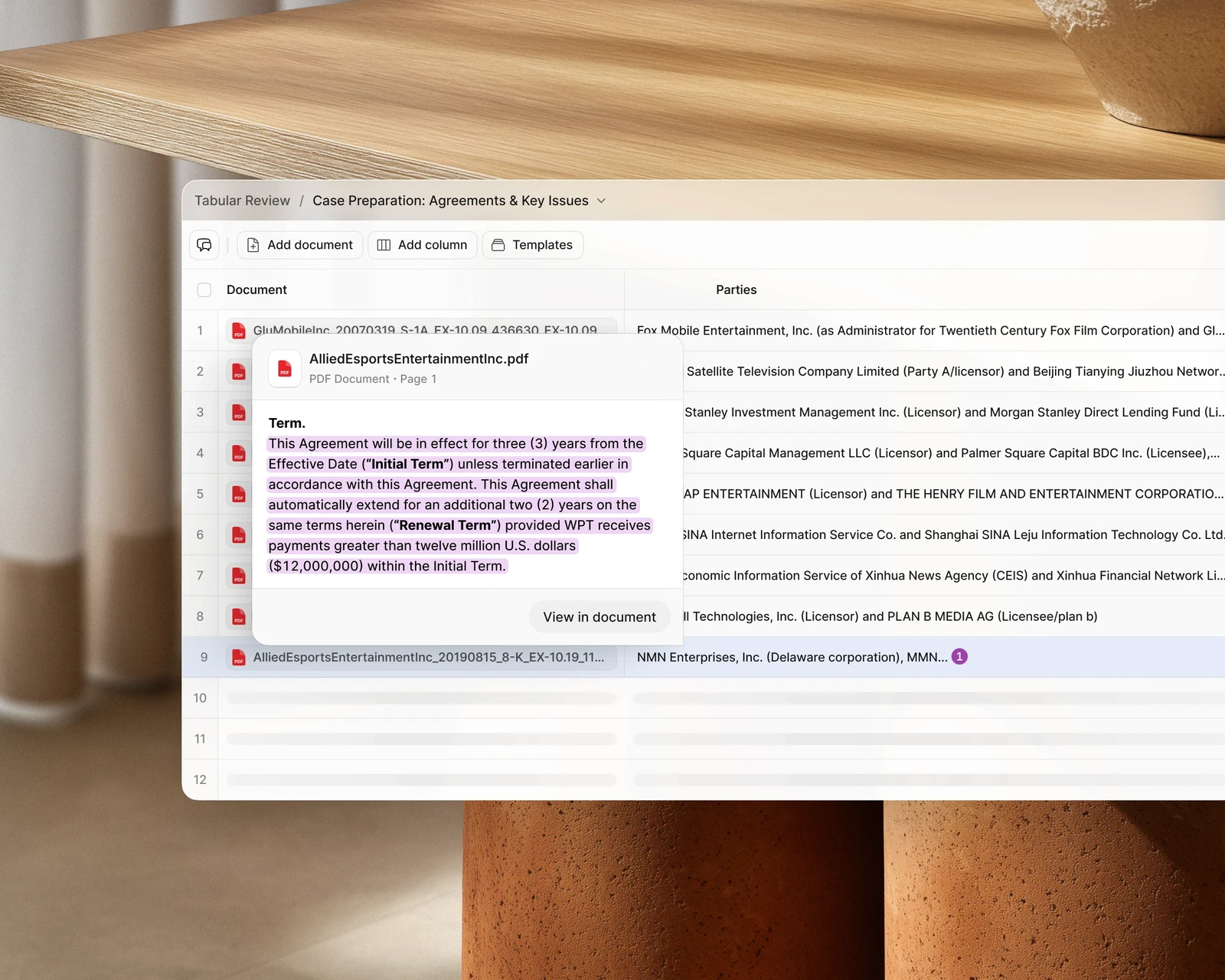
Tabular Review showing document rows, questions and source text
Actual product screen with illustrative documents and source-linked cells.
02 / HOW IT BECOMES REAL

Follow a matter.
From question to considered advice.

Follow an illustrative acquisition review. Each step shows where the software helps and where a lawyer’s expertise turns information into useful advice.

  1. 01

    Start with the decision the client needs.

    Define the scope and the questions, then bring in the relevant agreements. The work starts with a specific matter, not an open-ended prompt.

  2. 02

    Ask the same question across the documents.

    Compare the relevant terms in a table. Spot agreements that need closer attention and decide where to spend review time.

  3. 03

    Return to the source before relying on the answer.

    Check the extracted information against the underlying text. Record what has been reviewed and keep the reasoning visible to colleagues.

  4. 04

    Turn an issue into language someone can negotiate.

    Work on clauses directly in Word. The lawyer adjusts proposed language to the client’s priorities and the commercial context.

  5. 05

    Make the advice usable for the client.

    Share work and continue the conversation in Portal. The final result is a client who understands the options and can take the next step.

Follow the work, step by step

The matter is bigger than the prompt

A lawyer reviewing an acquisition needs to connect agreements, the client’s priorities, earlier decisions and the advice the client will act on. Legora’s product pages describe the parts of this work as review, research, drafting and collaboration. Its founding account begins with a junior associate discussing the time spent compiling information manually. After joining Y Combinator, the team spent several months inside Mannheimer Swartling, watching lawyers work and refining the product with them. The practical question was how software could carry useful context through a matter rather than merely answer one question.

That early customer work explains the company’s current bet. The aOS description connects matter context, tools, model routing, agents and permissions. Its October engineering account explains that model strengths vary by task, cost, latency, region and governance constraints. The system therefore breaks work into steps and chooses the appropriate model and context for each one. Signet reads this as a bet on orchestration: better models can improve an individual step, while the workflow determines whether the resulting work is useful to a legal team.

Legal work is moving from tools to systems, where AI doesn’t just assist, but helps deliver outcomes.

Max Junestrand · Co-founder and CEO · ARR announcement · 2026-04-02

Follow the evidence through the workflow

Consider an illustrative acquisition review. The matter lawyer chooses the agreements and questions that matter to the client. Tabular Review imports documents from a document management system, internal repository or virtual data room. It arranges documents in rows and review questions in columns. The lawyer can filter and compare answers, open a cell’s reasoning and return to the original source. Colleagues can mark work reviewed or lock cells, leaving the status visible. This gives the team a common review surface; the example describes a product workflow rather than a reported customer outcome.

Once the team identifies a clause to negotiate, the Word add-in proposes language against its playbook, rules and fallback positions. The lawyer inspects those edits and chooses what to apply. Agent can coordinate a longer task through planning, execution, review and delivery, producing editable files. Portal then lets the firm share selected work with the client, who can ask questions grounded in the shared material. These stages connect information, draft language and client communication. Each product page preserves controls for review, permissions or source inspection at the point where its work becomes consequential.

Make the workflow a working habit

MinterEllison’s account provides a useful test of this thesis. More than a thousand employees logged in on the first day, but its learning lead wanted to understand the significance and sophistication of their use. The firm gave Accelerator Program participants time away from billable work to build workflows with legal engineers and help their own practice groups adopt them. More than 150 use cases emerged. The reported change is a program for building capability inside the customer, with activity measures that should be read separately from any firmwide productivity claim.

For a Korea applicant, the connection is concrete. The three current roles divide commercial ownership, legal implementation and organizational change. Signet would prepare an example that follows one customer task from its initial business need through a tested workflow and adoption plan. A useful interview discussion would identify the source material, review standard, people involved and evidence that the team kept using the result. That connects directly to the postings’ emphasis on full-cycle sales, legal workflows and measurable rollout outcomes.

Understand the products and their customers

One matter, several work surfaces

Tabular Review turns a set of documents into a table that a legal team can inspect together. Documents occupy rows, questions occupy columns, and each cell links the answer to reasoning and source documents. Filters and formats help compare the material. Mark as Reviewed, Lock Cells and Review Mode let colleagues coordinate the checking work. The product page also describes reusable templates and an assistant for exploring the table. Its purpose is to organize attention around documents that need closer review, while the original source remains available for inspection.

Word Add-in brings drafting and redlining into the document lawyers already edit. A user can set the governing playbook, preferred language and fallback positions, then inspect the proposed changes. The page also describes filling templates, anonymizing material, improving writing and translation support. These are tools for preparing and reviewing text. Signet would ask a candidate to distinguish producing a plausible clause from checking whether it fits the client’s instructions and the surrounding contract, because the product’s value depends on that final legal fit.

Coordinate a task and share its result

Agent adds a longer sequence: plan the work, execute steps, review the result and deliver editable outputs. The surrounding system supplies context, tools and governance, while Skills make a team’s processes and standards reusable. The screen shows an illustrative drafting task moving through those stages. It is a product demonstration, so its progress indicator is a task state rather than an accuracy result. A customer-facing team needs to decide which steps are appropriate to delegate, what evidence should accompany the output and where a person approves the next action.

Portal is the client-facing continuation of the matter. A firm can publish selected files, reviews and workflows under its own brand. Clients query the shared material with citations, work with the firm in a shared workspace and use its workflows while the underlying prompts and firm knowledge stay protected. Hosts decide what is shared and who can perform sensitive actions. Guests participate without a guest licence. The relevant choice is therefore both commercial and operational: which pieces of the firm’s work are ready to expose to a client, with what access and review controls.

Read a customer case at its actual scale

Bird & Bird describes an 800-person, six-month pilot that informed the product before firmwide deployment. MinterEllison describes an Accelerator Program and more than 150 identified use cases. DKSH’s general counsel describes faster review, research and drafting while keeping judgment with lawyers. These are different kinds of evidence: pilot participation, capability-building activity and a qualitative account of legal work. Signet would carry those distinctions into a customer conversation. A program can demonstrate engagement and workable use cases while the team still needs task-specific evidence of the value created.

For the Legal Engineer role, a credible demonstration starts with a real legal task and ends with a customer who can repeat the workflow. The posting includes pilots, onboarding, rollouts, training, product feedback and reusable playbooks. Engagement work then connects those implementations to an organization’s change plan, while sales owns pipeline and revenue while working with Sales through the deal cycle. The product set explains why all three jobs exist together: a good comparison table or draft is part of the outcome, and the customer also needs permissions, standards and people who can make the process useful in practice.

03 / THE EVIDENCE

The story, in numbers.

DATED OBSERVATIONS

Law firms and in-house legal teams

teams
Law firms and in-house legal teams2025-05-21: 250; 2025-10-30: 400+; 2026-03-10: 800+; 2026-04-02: 1,000+; 2026-07-30: 1,500+; 2026-09-28: 2,100+2502025-05400+2025-10800+2026-031,000+2026-041,500+2026-072,100+2026-09

Dated company announcements; plus signs preserve reported lower bounds, with team counts distinct from individual users. These are dated disclosures, not a continuous growth record.

Figures, dates & basis +
Law firms and in-house legal teams
DateValueBasis
2025-05-21250Company-announced customer teams
2025-10-30400+Company-announced customer teams
2026-03-10800+Company-announced customer teams
2026-04-021,000+Company-announced customer teams
2026-07-301,500+Company-announced customer teams
2026-09-282,100+Company-announced customer teams

Legora

DATED OBSERVATIONS

Funding-round valuation

USD · B
Funding-round valuation2025-05-21: $0.675B; 2025-10-30: $1.8B; 2026-03-10: $5.55B; 2026-04-30: $5.6B$0.675B2025.05$1.8B2025.10$5.55B2026.03$5.6B2026.04

Valuations are from the dated announcements of completed funding rounds. The March Series D and its April extension are distinct financing events. These are dated disclosures, not a continuous growth record.

Figures, dates & basis +
Funding-round valuation
DateValueBasis
2025-05-21$0.675BCompleted funding round
2025-10-30$1.8BCompleted funding round
2026-03-10$5.55BCompleted funding round
2026-04-30$5.6BCompleted funding round

Legora

$100M ARR: a dated milestone

In April 2026, Legora reported over $100M in ARR within 18 months of general launch. ARR is not recognized annual revenue.

Series D round reaches $600M in equity

Legora announced a $50M extension, bringing its Series D to $600M in equity at a $5.6B post-money valuation. New investors included Atlassian and NVentures.

Seoul: an office and a local product

Legora announced a Seoul office, its fourth in Asia-Pacific, with a Korean interface and HWP support. It also described hiring across legal engineering, technical support and commercial work.

Read the growth story

Separate the recurring business from the financing

Law firms and in-house legal teams buy Legora for document review, research, drafting and collaboration. Customer accounts describe a path from a pilot to broader use, and Portal extends selected work to guests without a guest licence. On 2 April 2026, the company reported more than $100M of annual recurring revenue reached within eighteen months of general launch. The three Korea postings read on 8 October describe more than $200M of ARR. The latter is a current posting statement with a reading date, while the former is a dated announcement. Both describe recurring business rather than revenue recognized in a financial year.

Funding measures a different transaction. Legora announced an $80M Series B at a $675M valuation in May 2025, followed by a $150M Series C at $1.8B in October. Its March 2026 Series D announcement described $550M at a $5.55B valuation. On 30 April it added $50M, bringing that round to $600M and its post-money valuation to $5.6B, with Atlassian and NVentures joining. The $600M figure belongs to the extended Series D round. Signet would keep this sequence separate from customer spending and the ARR milestones when assessing how the company is growing.

I’m looking forward to helping the company make smart, disciplined decisions as it continues to grow.

David Eckstein · Chief Financial Officer · CFO appointment announcement · 2026-01-29

Track teams before assuming depth of use

Dated company announcements also show customer-team growth: 250 in May 2025, more than 400 in October, more than 800 in March 2026, more than 1,000 in April, more than 1,500 in July and more than 2,100 in September. These counts cover law firms and in-house legal teams, while user figures count individuals. The chart preserves the announcements’ lower bounds. A customer logo or team count indicates reach; MinterEllison’s account shows why meaningful integration also needs practice-specific workflows and people who can help colleagues use them.

The competitive context is already present in Korea. Harvey announced Bae, Kim & Lee’s firmwide deployment in June 2026, while a September press report described major Korean firms evaluating Legora. Legora’s own Seoul announcement emphasizes Korean interfaces, HWP support and local adoption work. Its October model account stresses that a legal system has to choose models within task and governance constraints. Signet reads the commercial contest as winning the customer’s working process: documents, permissions, legal standards and implementation support all enter the buying decision. Evaluation activity should retain its own status when discussing prospective customers.

Growth creates three tests

First, adoption has to produce useful work. MinterEllison’s learning lead distinguishes the sophistication of use from first-day logins. Second, the work remains consequential: the product uses citations, review controls and governance, and the engineering account discusses uneven model performance. Third, regional expansion increases the execution work. The September announcement described presence in eighteen cities and a goal to reach 700 EMEA staff over the next six to twelve months. That goal concerns future regional staffing, while the three Korea openings describe current responsibilities. Signet would examine each test using customer and hiring evidence.

For a candidate, these measures suggest concrete diligence. Ask how the team defines an adopted workflow, how it learns from review errors and how commercial promises connect to deployment capacity. The sales role owns GTM initiatives and works with Sales through the full cycle, the legal engineer returns customer feedback to the product, and the engagement role tracks rollout outcomes. Their connection is the practical business model: customers keep investing when the product becomes part of work they need to deliver. These are Signet’s questions derived from the postings and customer account, rather than promised employment outcomes.


04 / THE PEOPLE

Someone saw it first.

Max Junestrand, Legora co-founder and CEO
Co-founder & CEO

Max Junestrand

Early in Legora’s development, the team worked inside Mannheimer Swartling to learn how lawyers actually operate. In this conversation, Max Junestrand discusses the product choices behind a workspace that extends from document work to collaboration with clients.

The choice behind the company +

Legora’s founding account describes working inside Mannheimer Swartling for several months, observing lawyers and refining the product with them.

▶ Max Junestrand / Artificial Lawyer

“Legal work is moving from tools to systems, where AI doesn’t just assist, but helps deliver outcomes.”

Max Junestrand · ARR announcement · 2026-04-02
The decisions behind the company

Learn inside the customer’s office

Max Junestrand is Legora’s co-founder and CEO. The company’s account of its early development starts with a junior associate describing manual compilation work and continues through Y Combinator and several months inside Mannheimer Swartling. The team observed legal work and iterated with the people doing it. This explains the recurring place of legal engineers in the current business: customer knowledge shapes both the workflow and the product. Signet reads the founding decision as a way to make legal practice an input to product development, with the customer’s documents and routines setting the test.

The April ARR announcement frames the next step as moving from individual tools to systems that help deliver outcomes. That is consistent with Agent’s multi-step work and Portal’s connection to client delivery. It also gives the founder’s account a practical limit: a system has to earn trust across more of a matter, so source access, review states, editable documents and permissions become part of the product. For an applicant, the useful question is how the team learns when a customer’s intended workflow differs from the result the software actually produced.

Add product discipline and regional adoption

Bryan Tsao joined as Chief Product Officer in August 2026. The appointment describes his prior CPO role at Jasper and product-led growth and data work at Dropbox. It explicitly links the appointment to rigorous execution and the precision required for consequential legal work. David Eckstein joined as CFO in January 2026 after three years as Vanta’s CFO, with earlier finance roles at Menlo Security, OpenDNS and Box. His remit covers finance, planning and operational performance. These appointments place product execution and financial decision-making alongside the founding customer focus as the company expands.

Heather Paterson is the regional leader named in the Seoul announcement, where her title is VP APJ. The announcement connects Korean-language product work with people who help customers adopt it. The manual Korea profile observation supplies a legal-engineering function, while the current postings add commercial ownership and rollout responsibility. That evidence supports a regional connection and a set of functions. Signet treats the roles as distinct responsibilities and would discuss the actual collaboration arrangement with the hiring team, using the posting’s customer, product and engineering counterparts as a starting point.

The hardest part of AI in legal isn't the technology alone, it's adoption.

Heather Paterson · VP APJ, as titled in the Seoul announcement · Seoul office announcement · 2026-07-30

High standards include the way people work

The careers page names three values: Lean In, Fight for Excellence and Grow Together. It describes stepping forward, owning problems, setting ego aside and improving with colleagues and customers. These principles connect to the Legal Engineer posting’s feedback loop and the Engagement Manager’s work with senior stakeholders and several workstreams. The company’s hiring page describes an application, a people-team conversation, a hiring-manager interview, a case and presentation, and a final conversation with Max or the department head. It gives a typical duration of two to four weeks, which should be read as its stated process.

Signet would use the case presentation to show how you think with a customer. Sales candidates can walk through ownership of a complex deal. Legal candidates can bring a workflow with a testing and training plan. Consulting candidates can show the stakeholders, decisions and outcome measures in a change program. The careers page emphasizes an in-office culture and the Engagement Manager posting describes an in-person environment, alongside Seoul remote location metadata. Discuss that working arrangement specifically rather than assuming the location label settles the weekly routine.

05 / THE NEXT CHAPTER

A Seoul office is a beginning.
A new working habit is the win.

Win the account, make Korean legal workflows work, and help the firm use them repeatedly.

ASIA-PACIFIC & JAPAN LEADERSHIP

Heather Paterson

VP Asia-Pacific · regional scope

LinkedIn ↗
Legal engineering · profile observation
  • Legal Engineer
Commercial · hiring responsibilities
  • Enterprise Account Executive - South Korea
Rollout · hiring responsibilities
  • Engagement Manager - Korea

The manual South Korea LinkedIn view on 8 October 2026 shows one associated legal-engineering profile. Heather Paterson’s published title in the Seoul announcement is regional VP APJ; the hiring groups describe posted responsibilities. Profile observations and hiring functions do not establish headcount or reporting lines.

Why Korea? Why now?+

The Seoul announcement connects Korean law firms and cross-border in-house work with local language, HWP documents and adoption support. The Korea roles cover getting the customer, building working legal workflows and managing the change across the organization.

Seoul becomes the fourth Asia-Pacific office

The company announced Seoul after Sydney, Singapore and Tokyo, with Korean-language interfaces and HWP support.

Korean firms evaluate the product

A press report described major Korean firms considering or testing Legora. It describes evaluation activity rather than a completed rollout.

Understand the Korea opportunity

Korean documents need a local working process

Legora announced Seoul on 30 July 2026 as its fourth Asia-Pacific office. The announcement describes Korean-language interfaces, HWP support and expansion of Korean legal material, together with hiring for local adoption. It points to Korean firms and cross-border work by in-house teams as reasons to build the presence. Signet reads this as a workflow problem with a local shape: a legal team needs its own documents, language and standards connected to the product, along with people who can help introduce it into real matters. The office announcement is the beginning of that work.

A September press report described major Korean firms considering or testing Legora. That is evidence of evaluation activity, with the status preserved. In the same market, Harvey’s June announcement described Bae, Kim & Lee’s firmwide deployment. These sources make the buying decision concrete without turning a prospective customer into a completed sale. For a candidate, the useful preparation is to show how you would choose a first legal task, agree a review standard and demonstrate value to the people who decide whether the product belongs in their working process.

Three jobs connect a sale to a working habit

Enterprise Account Executive - South Korea asks for four to eight years in go-to-market, growth, sales or commercial work within B2B SaaS or a high-growth environment. The person owns pipeline and revenue and works with Sales across the full cycle of complex enterprise deals. Experience with law firms or in-house legal teams is a plus. Legal Engineer - South Korea instead asks for a legal background from a top-tier law firm or in-house team and curiosity about technology. It covers pilots, onboarding, rollout, demonstrations, training, product feedback and reusable playbooks. Each posting defines a different route into the customer’s work.

Engagement Manager - Korea asks for a management-consulting background, with experience at a leading consulting firm described as a strong plus. The person leads change programs, coordinates several workstreams, works with senior customer leaders and uses data to assess adoption and outcomes. B2B SaaS or legal-tech experience and work in regulated environments are nice to have. Signet reads the three roles together as sales ownership, legal implementation and organization-wide change. The requirements remain role-specific: legal experience belongs to the legal-engineering route, while consulting experience belongs to engagement.

Read the team evidence and working arrangement precisely

The manual South Korea LinkedIn view on 8 October showed one associated legal-engineering profile. This is a profile observation, not a count of employees. The Seoul announcement names Heather Paterson as VP APJ, a regional title that includes Korea. The organization view groups the observed function separately from responsibilities described in the current openings. It represents functions and evidence rather than reporting lines. Each of the three postings carries Seoul remote location metadata, while the Engagement Manager text and careers page describe an in-person or in-office environment. Candidates should clarify the weekly routine with the hiring team.

For interview preparation, Signet would bring one example grounded in your discipline and follow it through the customer’s process. A salesperson can show a complex deal with clear pipeline and revenue ownership. A legal practitioner can show a document workflow, the source checks and how colleagues would learn to use it. A consultant can show a multi-workstream rollout with senior stakeholders and outcome measures. The first-quarter reading is to choose a useful workflow, connect the commercial promise with implementation and make lessons reusable. This is an interpretation of the postings, not a promised assignment.

KOREA OPEN ROLES

3 open roles in Korea

Current Signet catalog · 2026-10-19

FOR YOU

Choose the role whose requirements fit your own experience.

Customer Success

Engagement Manager - Korea

Seoul (Remote)

Posting checked

The work
Lead rollout, change and measurable adoption with customer executives.
Who fits
Strong management-consulting background.
Keep in mind
B2B SaaS, legal tech and regulated-sector experience are nice to have.
GTM · Sales · BD

Enterprise Account Executive - South Korea

Seoul (Remote)

Posting checked

The work
Own pipeline and revenue; work with Sales across the full deal cycle.
Who fits
Four to eight years in GTM, growth, sales or commercial roles at B2B SaaS or a high-growth business.
Keep in mind
B2B SaaS or high-growth background; legal-sector experience is a plus.
Solutions Engineer

Legal Engineer - South Korea

Seoul (Remote)

Posting checked

The work
Turn legal tasks into pilots, training, playbooks and product feedback.
Who fits
Legal background with experience at a top-tier law firm or in-house legal team.
Keep in mind
Bridge lawyers and engineers while managing several customer relationships.
07 / NOW & NEXT

The next scene is taking shape.

Legal AI reaches the next generation of lawyers.

Three UK law schools have joined the Legal AI Scholars Program. Students in pro bono clinics can use the platform on live matters while learning how to question and supervise AI-assisted work.

Legal research, connected to another place lawyers work.

Legora announced a ChatGPT Enterprise plugin for shared customers. It connects legal questions to cited answers and sends lawyers back to Legora to inspect the underlying sources.

A Seoul office, and a product for Korean practice.

The company announced its fourth Asia-Pacific office. Korean-language and HWP support are accompanied by plans for local legal engineering, technical support and commercial hiring.

More context on what comes next

A regional office follows the customer work

The July 2026 Seoul announcement made Korea Legora’s fourth Asia-Pacific office, following Sydney, Singapore and Tokyo. It paired the office with Korean-language interfaces, HWP support and local hiring across legal engineering, technical support and commercial work. This connects the company’s system thesis to a particular market: the files, language and adoption process must fit the legal team doing the work. The three Korea openings read on 8 October make the commercial, implementation and organizational-change responsibilities visible. The announcement’s wider hiring description and the current board are evidence from different dates.

Salesforce selected Legora for its Legal and Corporate Affairs organization in September, covering North America, EMEA and Asia-Pacific. The announcement describes Legora as complementing Salesforce’s use of Agentforce and Slack. That is an example of coexistence within a customer’s technology stack, with a specific legal-work role. For a Korea applicant, it provides a useful commercial discussion: explain where the legal workflow adds value alongside tools the customer already uses, then show what material, controls and implementation steps it needs. The announced geographic scope should be kept as the customer’s regional coverage.

More users bring more local implementation

The Munich release was published on 28 September for an office opening on 29 September. It reported more than 13,000 legal professionals using the platform in Germany, compared with around 3,000 at the start of the year, and more than 200 law firms and legal departments across DACH. The same release reported more than 2,100 customer teams across over eighty markets and a presence in eighteen cities. Regional customer-team counts, individual users and office presence measure different things. Together they show geographic reach, while the release’s staffing target is a future plan rather than a completed organization.

Recent customer stories explain why implementation keeps returning to the center of the business. MinterEllison gave practice-group participants dedicated time to develop workflows and become internal advocates. DKSH described using the product for research, review and drafting across its legal function. Bird & Bird’s earlier pilot helped shape the product before firmwide deployment. The common thread is that adoption carries both product work and organizational work. Signet would watch how lessons from these programs feed into the reusable playbooks, training and feedback that the Korea postings explicitly ask people to build.

The system chooses the model, then earns trust

The 1 October engineering account brings the recent expansion back to product architecture. It describes models with different strengths, costs, latency, regional availability and governance requirements. A legal workflow can break a task into parts, choose models for those parts and supply the right tools and context. Agent, Tabular Review, Word and Portal are the work surfaces through which the customer sees that system. Signet reads the next test as making the system’s quality visible in the customer’s own tasks, with source access and approval controls that people can inspect while they work.

Over the next year, Signet would follow three connected signals: whether customer teams develop repeatable workflows, whether local implementation can sustain expanding regional reach, and whether model improvements translate into useful legal outputs under the customer’s controls. A candidate can turn those signals into questions for the hiring team: which matter comes first, who owns review and change, and what evidence shows that the customer continued using the workflow. Those questions connect the latest developments to the actual legal-engineering, engagement and sales jobs open today.

Their future. Your next chapter.

Find your part ↑

An independent profile by Signet. No affiliation or investment recommendation. Introductions happen only with your consent.
Research reviewed 2026-10-08

A LITTLE MORE CONTEXT

Understanding Legora.

What does Legora do?

Legora builds collaborative AI for legal teams to review documents, research sources and draft work while lawyers retain judgment and review.

What is the opportunity in Korea?

Win the account, make Korean legal workflows work, and help the firm use them repeatedly.

Are these confirmed job openings?

Employer postings were checked on 2026-10-08. Availability can change. Mock applications request a review from Signet.

How can I explore the company in more depth?

Follow the company from its vision through products, evidence and people to the Korea team and current roles. Use the table of contents to move within the page, and expand the sections for more context.

Back to the collection ↗