CJ Desai, CEO of MongoDB
MongoDB / THE WORLD THEY ARE BUILDING

Build the product, not a workaround.

Combining operational data with search and AI retrieval can reduce the number of disconnected systems an application team must coordinate. The value still depends on good data modeling, reliable migrations and a well-scoped implementation.

See it taking shape ↓
01 / THE PRODUCTS

The products behind the promise.

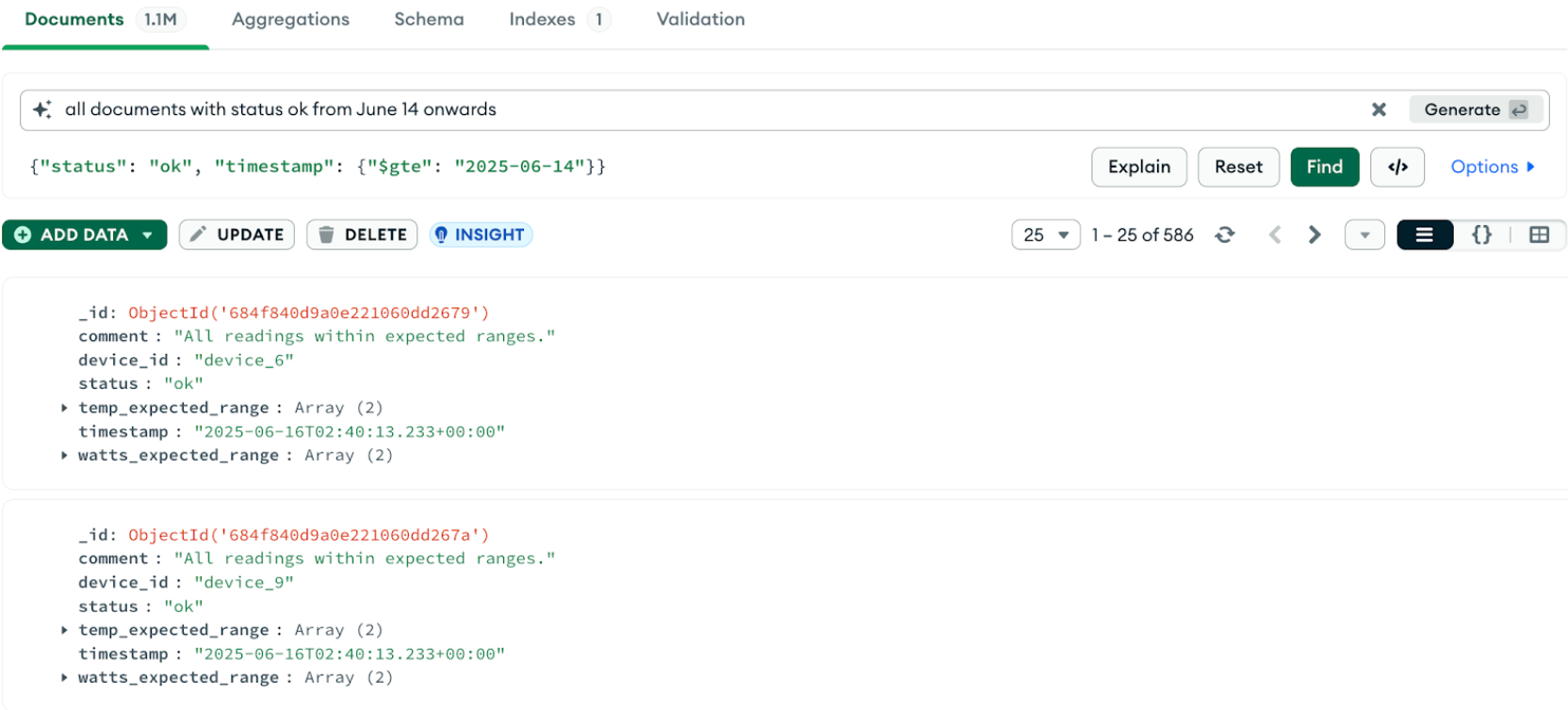
MongoDB Atlas Data Explorer querying example device readings
Official Atlas blog screenshot of Data Explorer querying enriched device readings. This is an example dataset from the article.
MongoDB Atlas

Build applications on a managed MongoDB database across supported cloud environments.

The team can focus more attention on applications instead of routine database administration.

Toyota Financial Services

Move data operations toward Atlas

The evidence is a changed architecture and operating burden; the 40% figure is the prior workload, not a claimed 40% time saving.

Atlas became a backbone for data fulfillment connecting lending and leasing systems to modern applications. The case also describes an event-logging platform processing millions of events weekly.

What changed? +

The published US case says the database team spent 40% of its time on infrastructure management, patching and support before Atlas.

MongoDB-published customer case for Toyota Financial Services in the US.

LG Uplus

An AI counsellor assistant for a 4,000 person contact centre, then a company-wide agreement

About 30% better resource efficiency and about 7% shorter average handling time per call, as the customer reported.

It built the service on Atlas Vector Search in about four months, keeping vector data and operational data in one system. In April 2026 it signed an MOU to extend MongoDB across its AI services and to modernize the underlying architecture.

What changed? +

The contact centre's 4,000 counsellors handle 3.5 million consultations a month. LG Uplus judged that the rigid schema of its relational database did not fit the counsellor advisor service it wanted to build.

Customer's own figures, presented at MongoDB.local Seoul in 2025 and 2026 and repeated in LG Uplus's April 2026 MOU announcement; the MOU states intent and is not a contract.

MongoDB Atlas Data Explorer with a natural language query box and a list of documents from an example collection.
Atlas Data Explorer as MongoDB shows it on its blog: a plain language request turned into a query over about 1.1M example documents. This is the data step of the workflow above.
02 / HOW IT BECOMES REAL

From an application change to a production-ready database

Illustrative application workflow based on Atlas and the professional-services role.

  1. 01

    Represent the application’s records as documents

    Developers decide which fields and relationships belong in each document. The design follows the application’s read and write needs rather than simply copying legacy tables.

  2. 02

    Choose a managed database environment

    Atlas provides database deployment and operational capabilities across supported clouds. Teams choose a configuration and prepare the application’s connection and security settings.

  3. 03

    Add search to the same application data

    Atlas Search indexes application documents for full-text search. The team can build discovery experiences without maintaining a separately synchronized search database for this use case.

  4. 04

    Agree on scope before handing over delivery

    An Engagement Manager turns customer needs into a project scope and statement of work. The agreed expectations then pass to the delivery team, reducing ambiguity about migration and adoption tasks.

Follow the work, step by step

The problem: seventeen kinds of database

MongoDB starts from a cost most engineering leaders recognize. Every application needs a database, and the company notes that a large organization can run tens of thousands of applications and the databases behind them. Choosing one is a strategic decision because it shapes how fast developers can work and how well the application performs. Over the years teams also added a separate system for search and now another for AI vectors, and every one of them has to be learned, synchronized, secured and paid for.

There’s no customer on this planet that wants to have 17 different databases.

Dev Ittycheria · Then President and CEO · Interview on reaching ten years as CEO · 2024-04-28

The company's answer has two parts. The first is the document model: each record is stored as one flexible document, close to the JSON that applications already pass around, so a team can add a field or a new kind of interaction without redesigning tables. The second is to put search, vector search and embeddings inside the same platform as the live data. In 2024 Ittycheria called standalone vector databases features masking as products, and in September 2026 his successor told investors that these capabilities are built in, not bolted on, so agents connect to one platform instead of many.

Why the bet looks stronger in 2026

Three changes made the bet more valuable. The first is the cloud. Atlas, the service in which MongoDB runs the database for the customer, launched in June 2016, was 2% of revenue at the 2017 IPO and 73% in the year ended 31 January 2026. MongoDB now earns most of its money operating the database, so it is paid when customers' applications grow.

The second is AI. Ittycheria argued in November 2025 that more software means more databases, and that a JSON database suits language models that read and write JSON. The company bought Voyage AI, a maker of embedding models, in February 2025 for $160.9M, and by March 2026 the number of customers using vector search had nearly doubled in a year.

Architecturally, we are well positioned for the AI era just by being a native JSON database, LLMs emit and consume JSON, MCP is built on JSON.

Dev Ittycheria · Then President and CEO · Investor call on his planned retirement, as reported · 2025-11-03

The third is migration. At its September 2026 Investor Day the company said AI tooling has changed the modernization process, so that Oracle, SQL and other relational workloads can move to MongoDB at record pace. It sizes that market at $10B, its own estimate, and sells it through two channels: directly to existing customers and through partners into new markets.

Following one application change through the platform

Take an illustrative case: a bank wants to add an AI assistant to an existing customer application. First the developers model the data, deciding which fields belong together in each document by how the application reads and writes, rather than copying the old tables one for one. Next platform and security engineers choose an Atlas deployment on the cloud the bank already uses and prepare access. Then the team indexes the same documents for full-text and vector search, so the assistant can find a customer's history by meaning without a second synchronized system.

If the application still lives on an old relational database, a migration comes first, and that is where people matter most. MongoDB and Cognition say their tools now automate much of the code work, but engineering teams keep the decisions that need human judgement: designing the target data model and sequencing the cutover. Before delivery starts, the customer and MongoDB agree a scope and its assumptions, so the project does not begin on a misunderstanding.

The pitch is simplification, and independent analysts accept part of it: fewer systems to stitch together means less code to maintain. They also note the cost. A unified platform can become lock-in, and native AI features help most when MongoDB is already the customer's main data store. Expect Korean buyers to raise both points.

Whichever Seoul seat you take, the daily work is to make this belief concrete for one Korean customer at a time: which application moves first, what it will cost, who will deliver it and how the result will be measured.


Understand the products and their customers

One database, sold two ways

MongoDB sells the same database through two doors. Atlas is the managed cloud service: MongoDB runs it on AWS, Google Cloud or Microsoft Azure and charges for consumption, and Atlas-related revenue was $1,807.9M in the year to 31 January 2026. Enterprise Advanced and other subscriptions, $578.1M that year, are for customers who run MongoDB themselves. In March 2026 the CEO said that in Europe and Asia he saw a preference in some industries to use MongoDB, potentially with Enterprise Advanced, and put only certain workloads in the cloud. That matters in Korea, where the named customers include a telecom operator, a card company and an insurer.

Search sits inside the same platform. Atlas Search indexes the documents an application already holds, vector search finds items by meaning using Voyage AI embeddings, and Native Reranking, in public preview, reorders results inside the query; the company says it can improve retrieval quality by up to 30%. The point for a buyer is one system to secure and pay for instead of three.

The newest layers: agents and modernization

On 29 September 2026 the company released MongoDB 9.0 as generally available, claiming up to 2x throughput, 35% faster reads and 30% faster updates against version 8.0 in its own benchmarks. It also put two things into public preview. Atlas Infinite is a deployment option for sudden spikes in demand. Atlas Agent Engine gives AI agents a place to run, a memory and governance, priced by consumption and drawn from a customer's existing Atlas commitment, so adopting it does not need a new contract.

For the Seoul roles the most important offer is AMP, the Application Modernization Platform. MongoDB describes it as tools, technique and talent: AI tools, a delivery method and expert engineers that modernize application logic and data architecture together rather than moving technical debt from one technology to another. The company says AMP projects run 2 to 3x faster on average. Since September 2026 it connects to Devin, Cognition's AI software engineer, and in early joint tests work that took five to six hours took just over an hour. Relational Migrator, an earlier tool for moving relational data, is still part of the kit, and the Seoul architect posting lists it among what a new hire learns.

Customers can move decades of legacy applications onto MongoDB in months instead of years, giving them a modern data foundation built to run AI applications and agents in production on live operational data.

Dev Ittycheria · Interim President and CEO · Press release on the Cognition partnership, Investor Day · 2026-09-29

Who has bought it, and what they measured

Toyota Financial Services in the United States built a data lake on MongoDB in 2017. Its database team was spending 40% of its time on infrastructure, patching and support, which led it to Atlas; Atlas now consolidates mainframe lending and leasing data into a real-time platform and runs an event log handling millions of events a week. The 40% describes the old workload, not a measured saving. Nationwide in the UK moved an overdraft database from SQL in about six months and its lead engineer estimates Relational Migrator saved half the effort.

Korean cases follow the same pattern. LG Uplus, whose 4,000 counsellors handle 3.5 million consultations a month, found its relational schema too rigid for an AI counsellor assistant, built it on Atlas Vector Search in about four months and reports about 30% better resource efficiency and about 7% shorter handling time. BC Card left PostgreSQL for Atlas to get hybrid search for an AI deals service, Meritz Fire runs fraud detection on Enterprise Advanced, and Syncly reports more than 10 times faster similarity search.

Almost every result here is the customer's own figure, shown on MongoDB's stage or on its case pages. The useful signal is the repeated shape of the problem: a relational schema that slowed an AI or search feature, solved by moving that application onto documents with search in the same system.

03 / THE EVIDENCE

The story, in numbers.

DATED OBSERVATIONS

Total annual revenue

USD · B

Company-disclosed total annual revenue in USD billions. Fiscal-year end dates are shown on each point. Historical comparatives follow the cited filing; revenue includes acquisition and currency effects and is not ARR.

Figures, dates & basis +
Total annual revenue
DateValueBasis
2021-01-31$0.59BTotal recognized revenue for the fiscal year ended 2021-01-31. Includes all reported revenue categories.
2022-01-31$0.874BTotal recognized revenue for the fiscal year ended 2022-01-31. Includes all reported revenue categories.
2023-01-31$1.284BTotal recognized revenue for the fiscal year ended 2023-01-31. Includes all reported revenue categories.
2024-01-31$1.683BTotal recognized revenue for the fiscal year ended 2024-01-31. Includes all reported revenue categories.
2025-01-31$2.006BTotal recognized revenue for the fiscal year ended 2025-01-31. Includes all reported revenue categories.
2026-01-31$2.464BCompleted fiscal year ended 2026-01-31; total recognized revenue from the earnings release, whose financial tables are unaudited. Not calendar-year 2026 guidance.

MongoDB · MongoDB / SEC

CJ Desai succession announced

MongoDB announced Desai would become CEO effective November 10, 2025. This appointment is historical.

FY2026 results disclosed

Annual revenue was $2.46B and Atlas annual revenue grew 29%.

Interim CEO returns

Ittycheria returned immediately following Desai’s departure, with a permanent CEO search underway.

Read the growth story

Who pays, and for what

Most of MongoDB's money is subscription revenue, and most of that is Atlas, billed by consumption, so revenue rises when customers' applications store more data and handle more traffic. Enterprise Advanced brings subscription revenue from customers who run the database themselves. Professional services were $77.8M, or 3%, in the year to 31 January 2026. The filing says those services typically do not involve implementation, are meant to make deployments faster and more successful, and are part of its retention and expansion strategy: customers who buy them have typically grown their usage faster.

The dated numbers, and what each one measures
MeasureValuePeriod or dateWhat it is
Total revenue$2.46B (+23%)Year ended 31 January 2026Recognized revenue, audited annual report
Quarterly revenue$771.8M (+30%)Quarter ended 31 July 2026Recognized revenue; subscription $747.1M, services $24.6M
Atlas share of revenue73%Year ended 31 January 2026Share of recognized revenue; 70% the year before
Total subscription ARR$2,886M (+25%)End of July 2026Annual recurring revenue; Atlas $2,281M, EA and other $605M; excludes services
Net ARR expansion rateAbout 121%31 January 2026What last year's customers pay now against a year earlier
Remaining performance obligations$1,519.2M (+91%)31 July 2026Contracted revenue not yet recognized
Customers70,60031 July 2026Free users excluded; 434 at $1M+ in ARR
Asia Pacific revenue$285.5M (+18.8%)Year ended 31 January 2026By customer address; 11.6% of the total by Signet's calculation

Read the table as separate measures. Revenue is earned over a period. ARR combines contractual commitments with annualized actual usage: the prior 90 days for Atlas direct-sales customers and the prior 30 days for self-serve customers, assuming unchanged usage or subscriptions and excluding professional services. Remaining performance obligations cover contracted revenue yet to be recognised. Net ARR expansion of about 121% means the prior-year customer cohort’s ARR grew by about 21%, including churn and contraction in the denominator; it is distinct from cash paid now.

Growth picked up again in 2026

Quarterly revenue was $628.3M in the three months to October 2025, up 19%, then $695.1M in the quarter to January 2026, up 27%, $688M in the quarter to April, up 25%, and $771.8M in the quarter to July 2026, up 30% and the fastest growth since fiscal 2024. Atlas grew about 29% for the fifth quarter in a row, and in the quarter to January 2026 Atlas passed a $2B run rate, meaning the latest quarter's Atlas revenue scaled to a year. Revenue guidance for the year to January 2027 rose from a range of $2.860B to $2.900B in March to a range of $2.99B to $3.03B in September.

Profit followed. The non-GAAP operating margin reached 24% in the July quarter, up from 15% a year earlier, free cash flow was $137.6M, and income from operations under GAAP was $28.4M against a loss of $65.3M a year before. The customer base also moved up market: 70,600 customers at 31 July 2026, with 2,999 paying $100K+ and 434 paying $1M+ in ARR. At Investor Day the company set targets for about three years: total revenue growth of 20%+ and Atlas growth in the mid 20s.

Where it stands, and what could go wrong

MongoDB competes with Oracle, IBM and Microsoft, with the database services of AWS, Google Cloud and Azure, and above all with PostgreSQL, which overtook it in developer popularity rankings. The company points to customers that left PostgreSQL because it could not scale, and in September 2026 described an AI lab that moved its chat memory system to Atlas in four weeks and reads 10x faster. Those are the company's own examples. Three risks stand out: a top team that has changed twice in eleven months, cloud providers and PostgreSQL chasing the same workloads, and an Asia Pacific region that is the smallest and grew slowest in the last fiscal year.

In an interview, keep the measures apart. Say Atlas grew about 29% when you mean Atlas, and 23% for the company's year. Say subscription ARR when you cite $2,886M, and remember it excludes services. If you are joining the services side, know that services are 3% of revenue by design: the line exists to make customers consume more, so judge your impact by the adoption it unlocks.

04 / THE PEOPLE

Someone saw it first.

Official photograph of Dev Ittycheria
Interim President and CEO

Dev Ittycheria

Ittycheria led MongoDB from 2014 to 2025 and remained on the board. The September 28, 2026 announcement confirms his return while the board searches for a permanent CEO.

The choice behind the company +

The board appointed him immediately after CJ Desai stepped down to join Meta. This is an interim continuity decision, not a new permanent appointment.

“There’s no customer on this planet that wants to have 17 different databases.”

Dev Ittycheria · Interview on reaching ten years as CEO · 2024-04-28
The decisions behind the company

A returning CEO and an open search

MongoDB was founded in 2007, and the person most associated with its shape is Dev Ittycheria, CEO from September 2014 to November 2025. He took the company public in 2017, when it had 4,300 customers, moved it to the cloud with Atlas, and in the company's words grew annual revenue from about $35M to more than $2.3B. He is also a partner and senior advisor at Sequoia Capital and lead independent director of Datadog.

When I joined the company, it wasn’t clear if people would trust us to be a truly mission-critical technology

Dev Ittycheria · Then President and CEO · Interview on reaching ten years as CEO · 2024-04-28

In November 2025 he stepped back from full-time work and CJ Desai, who came from Cloudflare and before that was president and chief operating officer of ServiceNow, became CEO on 10 November 2025. On 24 September 2026 Desai gave notice, and on 28 September he left for a senior role at Meta. The board brought Ittycheria back as interim CEO the same day, retained an executive search firm to find a permanent successor and reaffirmed its financial guidance.

I know the company, our people and our customers extremely well, and I have enormous confidence in the opportunity ahead.

Dev Ittycheria · Interim President and CEO · Press release on the CEO transition · 2026-09-28

The people above the Seoul seats

The go-to-market leadership was rebuilt in 2026. In March the president of field operations and the chief revenue officer left, and Erica Volini, who built the partner-led model at ServiceNow after senior roles at Deloitte, joined as chief customer officer reporting to the CEO. The leadership page says she is merging technical, partner and services teams into one engine, and on the March call the CEO placed professional services among the post-sale functions she owns. Ryan Mac Ban, formerly chief revenue officer at Confluent, now runs revenue. Mike Berry has been CFO since May 2025, and Jim Scharf, an early AWS employee who ran Amazon DynamoDB, is CTO.

In the region, Simon Eid is SVP for Asia Pacific. A careers post credited to him says business leaders run India, ASEAN and ANZ as their own businesses with every function reporting to them. In Korea the country manager since October 2025 is Jungwook Jang (장정욱). He has more than 20 years in the industry: he led database strategy for the Samsung Group account at Oracle Korea, was the first Korea country manager of Databricks, and headed AWS Korea and IBM Korea's GTS business.

We go to market differently in India than we do in Australia, and differently in Singapore than we do in South Korea.

Simon Eid · SVP, Asia Pacific · MongoDB careers blog post on APAC, credited to him on the careers page · 2023-09-28

How MongoDB says it works and hires

The careers page asks three things of everyone: deliver the right outcomes for customers, live the company's values, and engage with each other as leaders. It says the company discusses things thoroughly but puts commitment over consensus, and its job postings call the Leadership Commitment the compass for decisions. Flexible employees typically work from a MongoDB office one to two days a week. The chief product officer frames product choices the same way, as meeting developers on their own terms, wherever they are.

On the worry that headquarters decides everything: the company's own material describes regional business leaders and a country manager with senior local experience, and every Seoul role sits in an Asia Pacific team. The same material also shows a top team rebuilt within twelve months and a permanent CEO still to be chosen. In practice, the people who will shape a Seoul hire's first year are the country manager and the Asia Pacific leadership.

05 / THE NEXT CHAPTER

Seoul is staffing the three seats of a modernization deal

Read together, the roles cover how a Korean enterprise moves an application onto MongoDB: an architect designs the system and proves it, a partner specialist brings in the cloud and AI partners who influence the choice of database, and an engagement manager scopes and sells the services that lower the risk of delivery.

LOCAL & REGIONAL LEADERSHIP

Jungwook Jang (장정욱)

Korea Country Manager, appointed October 2025

Sales
  • Enterprise account executives
  • Regional sales directors
Engineering
  • Engineering profiles
Business development
  • Partner roles
Customer success and support
  • Customer success managers
Marketing
  • Field and revenue marketing

Team shape read from public LinkedIn profiles at human speed on 2026-10-07; the org chart above is the current reading. Counts are profiles found, not official headcount, and grouping does not establish reporting lines.

Why Korea? Why now?+

MongoDB came to Korea after developers had already adopted it. The Korean subsidiary was set up in 2018, counted about 140 customers in 2019, more than 450 at the end of 2021 and 540 by October 2022, and its country manager at the time said it was hard to find a customer that did not use MongoDB, with explosive growth in digital native accounts. The second phase is enterprise modernization. Since 2025 the company's Korean message has been that new AI workloads are the reason to replace the legacy operational database and make MongoDB the common data layer, which a MongoDB managing director put bluntly in Seoul: moving from Oracle to PostgreSQL is a sideways move, not modernization. The October 2025 choice of a country manager who led database strategy for the Samsung Group account at Oracle Korea and was the first Korea head of Databricks fits that shift, and the APAC head said then that the company had built a strong base in Korea and that it was the right time to accelerate. The 2026 agreements with LG Uplus and BC Card are the clearest public signs so far of that pitch landing with large Korean enterprises. Korea is also one market inside Asia Pacific, which was 11.6% of revenue in the last fiscal year, and the country named for new investment is Japan.

MongoDB Korea set up

Korean press dates the founding of the Korean subsidiary to 2018.

More than 450 Korean customers

The company told Korean press it had grown from about 140 Korean customers in 2019 to more than 450 at the end of 2021, up 50% in a year, and planned to target finance customers through Naver Cloud, which had signed an OEM contract the year before.

540 customers and a partner team

Four years after founding the Korean subsidiary counted 540 customers and said it would set up a dedicated partner organization.

Samsung Electronics and Yanolja on stage in Seoul

At MongoDB.local Seoul 2024 Samsung Electronics showed an internal big data analysis assistant built on MongoDB and Yanolja described folding its other NoSQL databases into MongoDB.

The Oracle replacement pitch

At MongoDB.local Seoul 2025 at COEX, LG Uplus, Meritz Fire and Syncly presented results and a MongoDB managing director argued that legacy modernization means leaving relational databases altogether.

New country manager

Jungwook Jang (장정욱) was appointed Korea country manager, with more than 20 years at Oracle Korea, Databricks, AWS Korea and IBM Korea.

Asia Pacific strategic partner program

MongoDB launched an invitation-only partner program for Asia Pacific and set a goal of four times as many strategic partners in the region by the end of the fiscal year.

LG Uplus MOU

LG Uplus agreed to extend MongoDB from its AI contact centre to its AI services across the company and to modernize the architecture underneath.

BC Card MOU

BC Card and MongoDB signed an agreement at BC Card's head office on AI infrastructure, natural language search and AI recommendations, with the Korea country manager present.

MongoDB.local Seoul 2026

Seoul was again on the company's event tour; the country manager argued that AI results depend on the architecture of live operational data, not on the choice of model.

Understand the Korea opportunity

Korea came early, through developers

By its own account, MongoDB opened in Korea into a market where developers already used it. The Korean subsidiary was set up in 2018 and the company counted about 140 Korean customers in 2019, more than 450 at the end of 2021 and 540 by October 2022. Its country manager at the time said that after opening the office he visited many customer sites and found it hard to find one that did not use MongoDB, with explosive growth in digital native accounts. In 2022 it also planned to reach finance customers through Naver Cloud, an OEM partner since 2021, and said it would set up a dedicated partner team.

After opening the Korea office I visited many customer sites. It was hard to find a customer that did not use MongoDB.

신재성 (Shin Jae-seong) · Then Korea Country Manager · Interview with Korean trade press; English rendering of the published Korean text · 2022-02-23

The newer pitch: replace the old database for AI

Since 2025 the Korean message has centred on enterprise modernization. The company argues that new AI workloads are the lever for replacing legacy operational databases, and that making MongoDB the common data layer is easier and cheaper than running AI beside the old systems. At the 2025 Seoul event a MongoDB managing director said that moving from Oracle to PostgreSQL is only a sideways move between technologies that are decades old. In October 2025 the company appointed Jungwook Jang (장정욱) as country manager, a leader who had run database strategy for the Samsung Group account at Oracle Korea, and the APAC head said the company had built a strong base in Korea and that now was the time to accelerate modernization.

Picking a high performing model alone does not produce the result you expect.

Jungwook Jang (장정욱) · Korea Country Manager · MongoDB.local Seoul 2026 press briefing, as quoted in Korean trade press; English rendering of the published Korean text · 2026-09-01

The pitch now has large Korean names behind it. LG Uplus signed an MOU in April 2026 to extend MongoDB from its AI contact centre to AI services across the company, and BC Card signed one in July 2026 at its head office with the country manager present. Meritz Fire runs fraud detection on Enterprise Advanced, Syncly runs vector search on Atlas, and Samsung Electronics and Yanolja presented their use at the 2024 Seoul event. MongoDB.local Seoul has run every year from 2024 to 2026.

Where Korea sits inside Asia Pacific

The filings report Asia Pacific as one line: $285.5M in the year to January 2026, 11.6% of revenue, growing 18.8% against 22.8% for the whole company, and $83.2M in the quarter to July 2026, growing 25.7% against 30.5%. The country the CFO named for go-to-market investment in May 2026 was Japan, and the Investor Day listed APJ, meaning Asia Pacific and Japan, among region-specific investments. The region is building partners: an invitation-only program launched in March 2026 aims for four times as many strategic partners by the end of January 2027. On 7 October 2026 the company's job board carried 119 Asia Pacific postings, 63 of them in Gurugram, India, and three in Seoul.

On the worry that Seoul is a satellite: the office has existed since 2018, it has a senior country manager appointed a year ago, two large enterprise agreements in 2026 and an annual event, and it is hiring across three functions at once. The caution is that Japan, not Korea, is the market the company has named for new investment, so the Korea team earns resources through results.

What the three open seats add up to

The three Seoul roles fit together. The Senior Solutions Architect, posted on 17 September 2026, works with sales executives on technical discovery, demos, proof of value and sizing, asks for ideally 12 or more years of customer-facing experience and lists Relational Migrator and AI retrieval architectures among what you learn. The Principal Partner Specialist, posted on 21 August 2026, builds pipeline through AWS, Google Cloud, Microsoft and Korean partners such as Megazone and Bespin, and needs fluent Korean and English. The Engagement Manager, posted on 29 April 2026, scopes and sells professional services and carries a services bookings quota; the company's own blog stresses that the role is services sales, not delivery.

In any of the three seats you would spend your first months inside live modernization deals with Korean enterprises: proving the design, bringing in the partner who will deliver, or pricing the services that lower the risk. Your measure is deals that move, not activity.

KOREA OPEN ROLES

3 open roles in Korea

Current Signet catalog · 2026-10-19

FOR YOU

Choose the role whose responsibilities match your own customer work.

Customer Success

Engagement Manager

Seoul

Posting checked

The work
Scope, negotiate and close professional-services opportunities.
Who fits
The ideal profile lists a bachelor’s degree in computer science, mathematics or engineering, or equivalent professional experience.
Keep in mind
Seoul hybrid role with a services bookings quota; travel for key engagements and team offsites.
GTM · Sales · BD

Principal Partner Specialist

Seoul

Posting checked

The work
Build Korea partner strategy and pipeline with cloud and AI partners.
Who fits
At least ten years of quota-carrying experience generating pipeline and selling through cloud partners and/or emerging AI-native partners that influence database selection, within a heavy sales matrix.
Keep in mind
Seoul hybrid; work with cloud and AI partners toward monthly, quarterly and annual bookings goals.
Solutions Engineer

Senior Solutions Architect

Seoul

Posting checked

The work
Run technical discovery, demos, proof of value and architecture design with sales.
Who fits
The ideal profile lists a minimum of three years of professional experience with modern scripting languages and/or popular programming languages.
Keep in mind
Seoul hybrid role; ability to travel up to 25% is listed in the ideal profile.
07 / NOW & NEXT

The next scene is taking shape.

Leadership succession announced

Desai was appointed effective November 10, 2025.

FY2026 revenue grows 23%

MongoDB disclosed $2.46B annual revenue and more than 65,200 customers.

Ittycheria returns as interim CEO

Desai stepped down to join Meta; the board began a permanent CEO search and reaffirmed previously issued guidance.

More context on what comes next

A second CEO change in under a year

On 28 September 2026 CJ Desai stepped down to lead a new enterprise AI initiative at Meta, about ten months after he became CEO. The board made Dev Ittycheria interim CEO the same day, began a search for a permanent successor and reaffirmed its guidance, and the shares fell more than 17% on the news. A few weeks earlier Desai had reported the fastest quarterly growth in several years, so the change came during a strong run, not a weak one.

Investor Day: agents, migration and targets

The next day the company held its Investor Day at the Nasdaq MarketSite in New York. It released MongoDB 9.0, previewed Atlas Infinite and Atlas Agent Engine, launched Devin for MongoDB Modernizations with Cognition, and raised its long-term targets to revenue growth of 20%+ and Atlas growth in the mid 20s for about three years. A first-person slide in the deck lists four aims: execute on product and go-to-market, find a successor, drive momentum and provide a seamless transition. Each launch ties back to the same thesis: more of the customer's data and AI work on one platform. The year also carried a warning. In December 2025 a high-severity flaw in the open source MongoDB Server, CVE-2025-14847 with a CVSS score of 8.7, was under active exploitation according to the US cybersecurity agency, after the company had issued a fix.

What to watch over the next year

  • Who the board names as permanent CEO, and whether the Investor Day plan, including Japan and the US federal business as named investments, survives the choice.
  • Whether Atlas Agent Engine and Atlas Infinite move from public preview to general availability and start to show up in Atlas consumption.
  • Whether Asia Pacific growth catches up with the company rate, and whether the partner program reaches four times as many strategic partners by January 2027.
  • Whether more Korean enterprises follow LG Uplus and BC Card from agreements into published results.

Their future. Your next chapter.

Find your part ↑

An independent profile by Signet. No affiliation or investment recommendation. Introductions happen only with your consent.
Research reviewed 2026-10-07

A LITTLE MORE CONTEXT

Understanding MongoDB.

What does MongoDB do?

An application’s records change as products add fields and new interactions. MongoDB stores document-shaped data and offers a managed Atlas platform, so developers can evolve an application while the platform handles more of its database operations.

What is the opportunity in Korea?

Read together, the roles cover how a Korean enterprise moves an application onto MongoDB: an architect designs the system and proves it, a partner specialist brings in the cloud and AI partners who influence the choice of database, and an engagement manager scopes and sells the services that lower the risk of delivery.

Are these confirmed job openings?

Employer postings were checked on 2026-10-08. Availability can change. Mock applications request a review from Signet.

How can I explore the company in more depth?

Follow the company from its vision through products, evidence and people to the Korea team and current roles. Use the table of contents to move within the page, and expand the sections for more context.

Back to the collection ↗