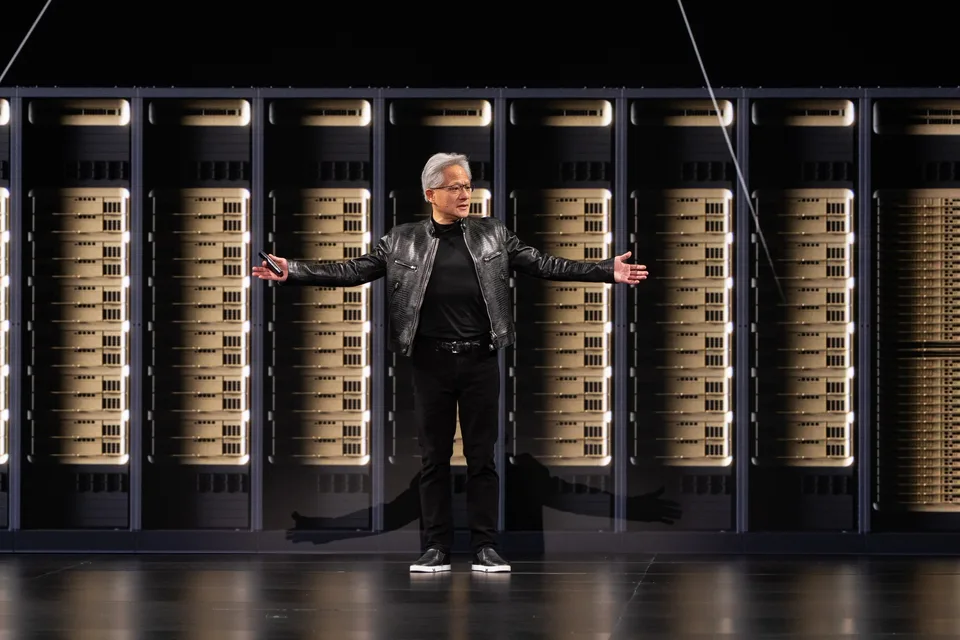
NVIDIA CEO Jensen Huang beside Vera Rubin systems
NVIDIA / THE WORLD THEY ARE BUILDING

Compute becomes a factory for intelligence.

The next constraint may be how effectively a cluster supplies useful tokens within power, cooling and latency limits. Whole-system architecture and operations therefore matter alongside chip performance.

See it taking shape ↓
01 / THE PRODUCTS

The products behind the promise.

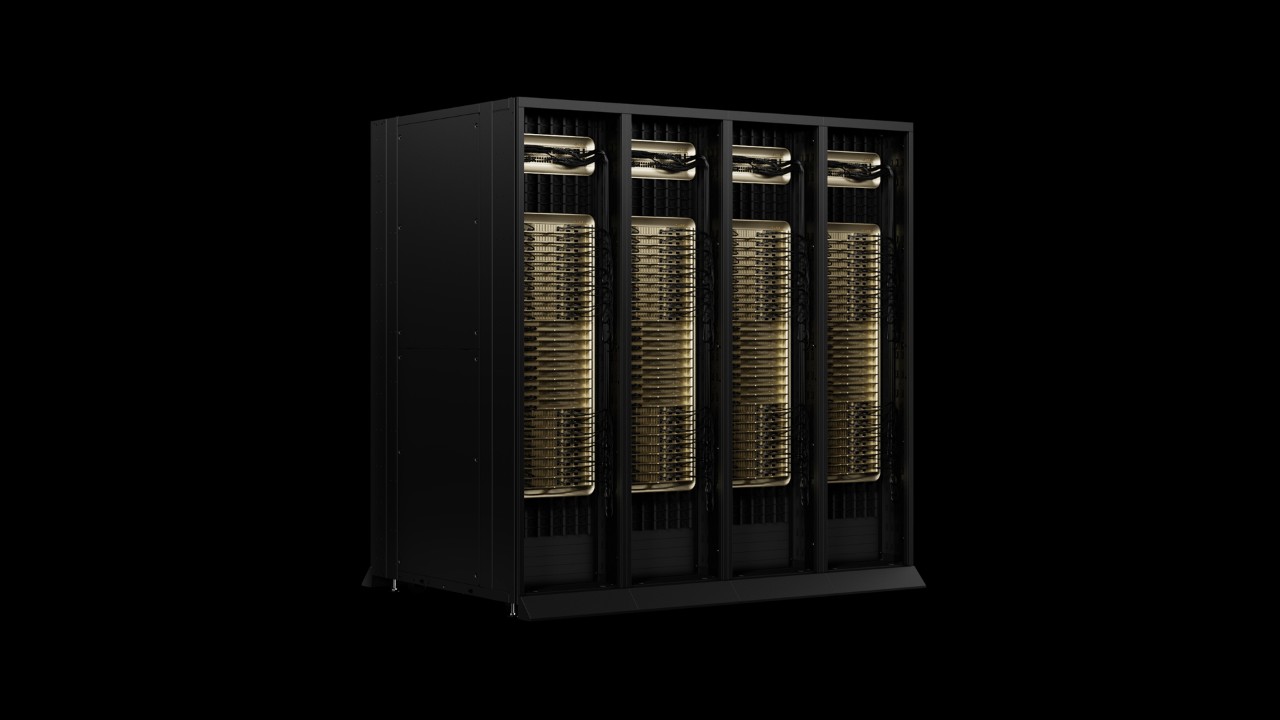
The DGX SuperPOD page shows a DGX GB300 system.
DGX SuperPOD

Deploy GPU systems with networking and a validated reference architecture.

Reduce architecture and integration work for large AI clusters.

Eli Lilly and Company

An AI factory reaches operation

1,016 Blackwell Ultra GPUs; assembled in four months, according to NVIDIA.

NVIDIA reports LillyPod went online with DGX SuperPOD, networking and AI software.

What changed? +

Lilly needed a company-operated environment for scientific AI workloads.

February 2026 vendor account verifies infrastructure deployment, not faster drug approval or proven patient outcomes.

NAVER

From Korean language models to a national AI factory

55 megawatts to start, 200 megawatts planned by 2028; NVIDIA plans to invest $1 billion in NAVER Corp., and Brookfield signed a nonbinding term sheet to fund up to $9 billion. NVIDIA's planned investment requires customary closing conditions and NAVER securing at least $9 billion in committed financing, separate from NVIDIA's contribution.

In June 2026 NAVER said it would expand sovereign AI infrastructure starting at 55 megawatts. In July NAVER, Brookfield and NVIDIA set a target of 200 megawatts, roughly 100,000 GPUs in the summit account, including planned Vera Rubin and Blackwell infrastructure, at the GAK Sejong data center by 2028.

What changed? +

NAVER CLOVA used DGX SuperPOD to build language models for the Korean and Japanese markets, according to a NAVER executive quoted on NVIDIA's product page.

An undated customer quotation on NVIDIA's product page and NVIDIA press releases of June and July 2026; capacities and investments are plans with target dates.

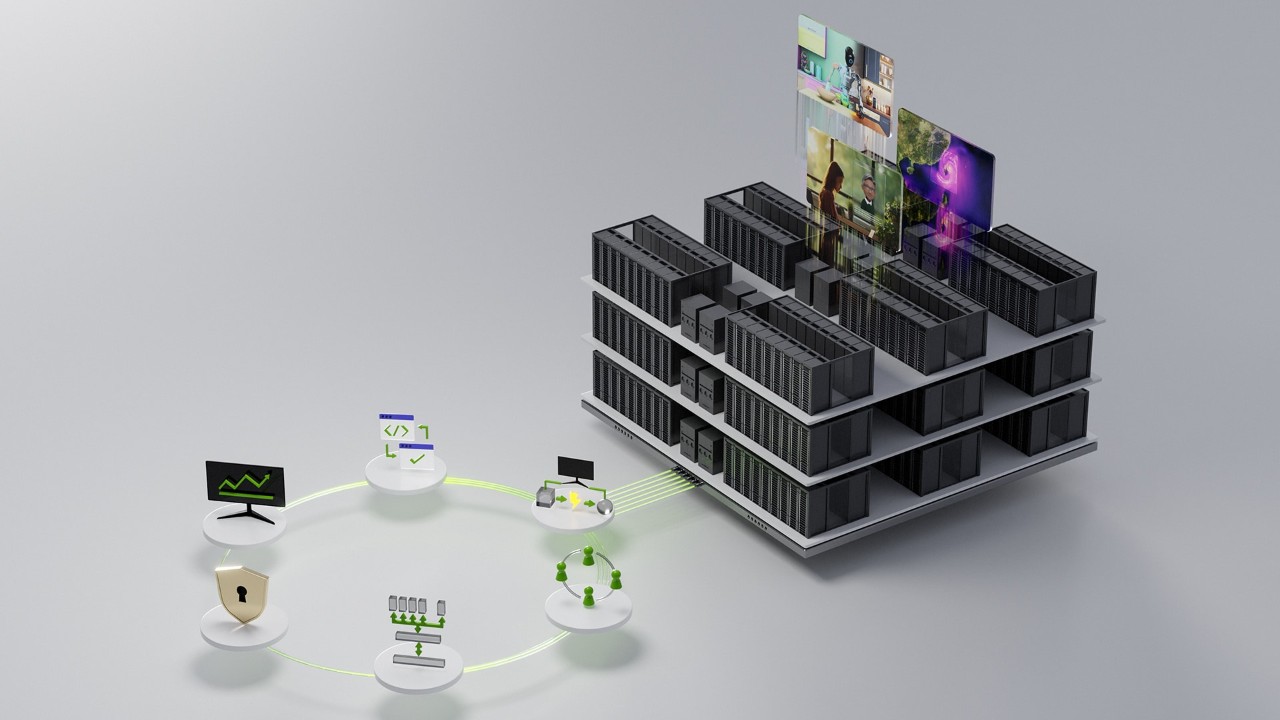
NVIDIA illustration of an AI factory: stacked rows of server racks connected to a ring of software icons, with images and video rising above the racks.
NVIDIA's own illustration of an AI factory, from its AI page: racks of computing, the software around them, and the output above.
02 / HOW IT BECOMES REAL

From model requirements to an operating AI cluster

Illustrative workflow: a Korean team has a training or inference workload and must build a dependable cluster around it.

  1. 01

    Translate workload into capacity

    Architects establish memory, throughput and latency requirements. They select a reference architecture suited to the workload and deployment model.

  2. 02

    Design the fabrics and facility

    Compute, storage and management networks have different jobs. Power distribution and cooling must support the intended systems.

  3. 03

    Provision a usable cluster

    Cluster management provisions nodes and software while Kubernetes operators support GPU workloads. Deployment teams validate the reference design on the actual installation.

  4. 04

    Keep training and inference productive

    Mission Control combines monitoring and automation for infrastructure operations. The architect supports developers after deployment so workload behavior informs changes.

Follow the work, step by step

A data center with one product

NVIDIA describes the problem on its own explainer page. An AI factory is computing infrastructure built for the whole AI life cycle, from taking in data to training and high-volume inference, and its primary product is intelligence, measured by token throughput. Where a general data center runs many kinds of work, an AI factory is tuned for AI, above all for inference performance and energy efficiency. The annual report states the bet in legal language: NVIDIA pioneered accelerated computing and now calls itself a data center scale AI infrastructure company.

And so every company will produce tokens. And that is the reason why I call them AI factories.

Jensen Huang · Founder and CEO, NVIDIA · Fourth quarter fiscal 2026 earnings call (third-party transcript) · 2026-02-25

Huang's reasoning runs from software to hardware. As AI moves into every piece of software, every company ends up producing tokens, so its computing becomes a factory with an output and a cost per unit. That changes what NVIDIA sells. Since the Blackwell generation it designs chips, networking, systems, software and algorithms together, a practice it calls extreme co-design, so that hundreds of thousands of GPUs work as a single giant computer. Signet's reading: the rival in this framing is any mix of parts that turns the same power into fewer tokens.

Why now: reasoning models and a power ceiling

Two changes made the bet pay now. The first is demand. When it launched Blackwell Ultra in March 2025, NVIDIA said reasoning and agentic AI, models that think through steps and act on their own, need orders of magnitude more computing. At GTC in March 2026 Huang said he believed computing demand had grown a million times over the last few years, and that he sees at least $1 trillion in revenue from 2025 through 2027, a forward statement. The second change is power: a data center can draw only so much electricity, so output per watt becomes the measure.

Every data center is power constrained. Customers make critical architectural decisions based on performance per watt given these constraints and the need to maximize AI factory revenue.

Colette Kress · Executive Vice President and CFO, NVIDIA · Fourth quarter fiscal 2026 earnings call, prepared remarks (third-party transcript) · 2026-02-25

NVIDIA's October 2026 argument to buyers adds the price. Each megawatt of AI factory costs roughly $60 million by the company's estimate, so operators commit capital only with a clear view of the return, and tokens per second per megawatt becomes the number that governs earning capacity. The same post notes that the A100, shipped in 2020, is still in commercial service six years later. A well-built factory keeps earning: that is the claim a Seoul architect carries to a Korean buyer.

From a customer's plan to a running cluster

Follow an illustrative Korean customer with a model to train and a service to run. First the requirement: the customer's machine learning and infrastructure teams set memory, throughput and latency needs, and an NVIDIA solutions architect matches them to a reference architecture, the tested blueprint for a DGX SuperPOD, a cloud partner or an enterprise build. Then the connections: compute, storage and management each get their own network, called a fabric, over InfiniBand or Ethernet, and the building must supply enough power and cooling. NVIDIA's DSX platform packages this as a playbook to design, build and operate AI factories, and DSX Air lets a company simulate the factory in software before building it.

Then the build and the handover. NVIDIA's own deployment teams install the cluster, a continuous bring-up team stabilizes it after the handover, and Mission Control schedules work, monitors the systems and recovers from faults. Judgement matters most at two points: choosing the design, because a wrong fabric or power plan is expensive to undo, and the weeks after go-live, when GPUs are healthy and a model still runs slowly because of networking, storage or scheduling. The AI Factory postings ask for hands-on support to developers at exactly that stage.

A Seoul hire represents a whole system, and the customer measures it in tokens per megawatt. The 19 open Korea roles sit at different points of this chain: solutions architects at the requirement and the handover, developer technology engineers at optimization, and automotive, semiconductor and robotics specialists inside a customer's own industry. Know where your seat sits before the interview.

Understand the products and their customers

Three layers sold as one

NVIDIA sells the AI factory in layers that a customer can buy together. The hardware layer is GPUs and CPUs built into rack-scale systems: the GB300 NVL72 rack connects 72 Blackwell Ultra GPUs and 36 Grace CPUs, which NVIDIA says delivers 1.5 times the AI performance of the GB200 NVL72, and each GPU can move 800 Gb/s of data into Spectrum-X Ethernet or Quantum-X800 InfiniBand networks. Above it sit Mission Control for operations, and CUDA with the libraries and models built on it.

DGX SuperPOD is the turnkey version. NVIDIA describes it as a full-stack data center platform, with computing, storage, networking, software and infrastructure management built to work together, that scales to tens of thousands of GPUs for training and inference of trillion-parameter models. With DGX GB300 systems it uses the GB300 NVL72 rack design. The buyer is an organization that wants an AI factory without designing one from parts: enterprises, research groups and cloud operators. Two Korean customers speak on the product page. KT's LLM development team lead says the team trained its models more effectively on it, and NAVER's CLOVA lead says it is helping build language models for the Korean and Japanese markets.

Mission Control keeps the factory running after it is built. The product page lists developer workload scheduling and orchestration, monitoring and autonomous recovery, from cluster deployment to integration with building management, as fully supported software. Version 2.3 supports the GB200 NVL72 and GB300 NVL72 systems. Its buyers are the platform teams who run AI infrastructure day to day. The Korea networking posting names it next to Base Command Manager and Run:ai as NVIDIA's cluster orchestration software, which shows how close the operations layer is to the work of the Seoul team.

The software layer is the oldest and, by Huang's account, the most valuable. NVIDIA's October 1, 2026 article counts more than 10 million developers building on CUDA-X libraries and models, and more than 1,000 CUDA-X libraries and models sit on top; at GTC 2026, the year CUDA turned 20, Huang called the CUDA-X libraries the company's crown jewels. The Korea postings name the pieces customers meet: Megatron-LM, NeMo and TensorRT-LLM for models, Omniverse and Isaac Sim for simulation and robots, NIM microservices and blueprints for packaged applications. Salesforce fine-tuned NVIDIA's open Nemotron model and runs it inside its own infrastructure.

One customer, from wet lab to dry lab

Eli Lilly shows the build and the intended scientific use. By NVIDIA's account, even productive drug discovery teams can analyze roughly 2,000 molecular ideas per target per year, because each experiment needs physical synthesis and testing. In February 2026 Lilly launched LillyPod, the first DGX SuperPOD with DGX B300 systems, built on 1,016 Blackwell Ultra GPUs with more than 9,000 petaflops of AI performance and assembled in four months. Mission Control manages it. Lilly's stated aim is a computational dry lab where scientists test billions of molecular hypotheses before committing to physical experiments.

Computation is at the heart of biology and it is at the heart of science

Thomas Fuchs · Senior Vice President and Chief AI Officer, Eli Lilly · LillyPod launch, as quoted in NVIDIA's blog · 2026-02-25

The company case documents a build: a named customer, a cluster size, a time to assemble and the software that runs it. The scientific payoff it describes is Lilly's goal, which will take years to judge. The Korean names follow the same pattern. KT and NAVER describe using the platform, and the large Korean projects of 2025 and 2026 are plans with target dates, so a candidate should speak of them as commitments in progress.

What the Seoul team actually sells

A Seoul solutions architect rarely sells a chip. The AI Factory postings ask the architect to keep up with three reference architectures, for DGX SuperPOD, NVIDIA Cloud Partners and enterprises, and to pick the one that fits a customer's training or inference cluster. In an interview, talk about the system: fabrics, storage, cooling and the operations software, and how each choice changes tokens per megawatt.

03 / THE EVIDENCE

The story, in numbers.

DATED OBSERVATIONS

Annual revenue

USD · B

Full fiscal years, including FY2026, which ended on January 25, 2026. NVIDIA reports fiscal years ending in January; these are company-wide revenue figures, not Data Center-only sales.

Figures, dates & basis +
Annual revenue
DateValueBasis
2021-01-31$16.675BFull fiscal year ended 2021-01-31; consolidated company revenue.
2022-01-30$26.914BFull fiscal year ended 2022-01-30; consolidated company revenue.
2023-01-29$26.974BFull fiscal year ended 2023-01-29; consolidated company revenue.
2024-01-28$60.922BFull fiscal year ended 2024-01-28; consolidated company revenue.
2025-01-26$130.497BFull fiscal year ended 2025-01-26; consolidated company revenue.
2026-01-25$215.938BFull fiscal year ended 2026-01-25; consolidated company revenue.

NVIDIA

Blackwell Ultra platform

NVIDIA announced rack-scale systems and inference software for reasoning workloads.

Korean AI infrastructure plans

Government and industrial partners announced plans involving over 260,000 NVIDIA GPUs.

Fiscal 2026 results

Revenue reached $215.938B with Data Center revenue of $193.7B.

Read the growth story

Who pays, and for what

NVIDIA earns money by selling accelerated computing: chips, complete systems, networking and software, mostly to the companies that build and rent out AI data centers. In fiscal 2026, the year that ended on 25 January 2026, total revenue was $215.9B, up 65%, and Data Center revenue was $193.7B of that total, up 68%. The top five cloud providers and hyperscalers account for a little over 50% of Data Center revenue, the CFO said in February 2026. Beyond them NVIDIA sells to AI cloud providers, enterprises, industrial companies and governments; its sovereign AI business, tied to national AI infrastructure, more than tripled to over $30B in fiscal 2026.

The dated numbers and what each one measures (fiscal years end in late January)
MeasureValuePeriodWhat it counts
Annual revenue$215.938BFY2026, year to 25 Jan 2026All revenue under GAAP; up 65%
Data Center revenue$193.7BFY2026Part of total revenue, not extra; up 68%
Net income$120.067BFY2026GAAP
Gross margin71.1%FY2026GAAP; 75.0% in FY2025
Sovereign AI revenueover $30BFY2026A business line NVIDIA defines; more than tripled
Quarterly revenue$68.1BQ4 FY2026, to 25 Jan 2026Up 73% on a year earlier
Quarterly revenue$96.2BQ2 FY2027, to 26 Jul 2026Up 106% on a year earlier
Data Center revenue$89.0BQ2 FY2027Up 117%; Hyperscale $48.710B and AI Clouds, Industrial and Enterprise $40.313B inside it
Revenue outlook$108.0B, plus or minus 2%Q3 FY2027Guidance, a forecast; assumes no Data Center compute revenue from China
Two largest direct customers22% and 14%FY2026Share of total revenue from two direct customers in the filing

The newest quarter shows the pace. In the quarter that ended on 26 July 2026 revenue was $96.2B, up 106% on a year earlier, and Data Center revenue was $89.0B. Inside Data Center, the hyperscale category was $48.710B and the category for AI clouds, industrial and enterprise buyers was $40.313B, up 138%; NVIDIA recast these categories during the year, so compare them only within the same filing. Gross margin, the share of revenue left after the cost of the products, was 71.1% for fiscal 2026 and 75.0% in the July quarter. For the quarter to October 2026 the company guided to $108.0B, plus or minus 2%, without assuming any Data Center compute revenue from China.

AI has reached its inflection point. It's doing useful work. Its tokens are productive and profitable. Now, compute is revenue.

Jensen Huang · Founder and CEO, NVIDIA · Second quarter fiscal 2027 results release · 2026-08-26

From $16.7B to $215.9B in five years

The growth chart is whole-year revenue: $16.675B in fiscal 2021, $26.914B in fiscal 2022, $26.974B in fiscal 2023, $60.922B in fiscal 2024, $130.497B in fiscal 2025 and $215.938B in fiscal 2026. Fiscal years end in late January, so fiscal 2026 is mostly calendar 2025. Geography needs care: NVIDIA reports revenue by where its direct customers are headquartered, which can differ from where chips are shipped or used. In fiscal 2026 the United States accounted for $149.617B, Taiwan $42.345B, China including Hong Kong $19.677B and all other countries together $4.299B. Signet's reading: the table shows who signs the purchase, so a project in Korea can sit under another country's line.

Where NVIDIA stands, and three risks

NVIDIA's annual report names AMD, Huawei and Intel among its competitors, along with large cloud companies such as Alphabet, Amazon and Microsoft whose internal teams design their own AI hardware. That last group matters most, because they are also NVIDIA's largest buyers; a financial data vendor's analysis points out that the buyers behind the concentration are the same ones building alternatives. The same filing lists Samsung among the makers of chips for cars and devices that compete with NVIDIA, so one Korean group can be supplier, customer and competitor at once. NVIDIA's defense is the system and the software. Huang says its token cost is the best in the world because of extreme co-design, and NVIDIA's October 1 article counts more than 10 million developers building on CUDA-X libraries and models.

Three risks follow. Concentration: two direct customers made up 22% and 14% of fiscal 2026 revenue. Financing: NVIDIA increasingly helps customers fund the buildout through commitments, guarantees and investments, and the cost of insuring its debt rose in July 2026. Geopolitics: US export licensing for H20 chips to China led to a $4.5 billion charge in early fiscal 2026, guidance now assumes no China data center compute revenue, and supply depends on partners in Taiwan and South Korea.

Two habits help in an interview. Name the period and the measure every time: fiscal 2026 ended in January 2026, Data Center revenue is part of total revenue, and guidance is a forecast. And keep plans apart from sales: the Korean GPU numbers are announced plans with target dates, while revenue counts what NVIDIA has sold.

04 / THE PEOPLE

Someone saw it first.

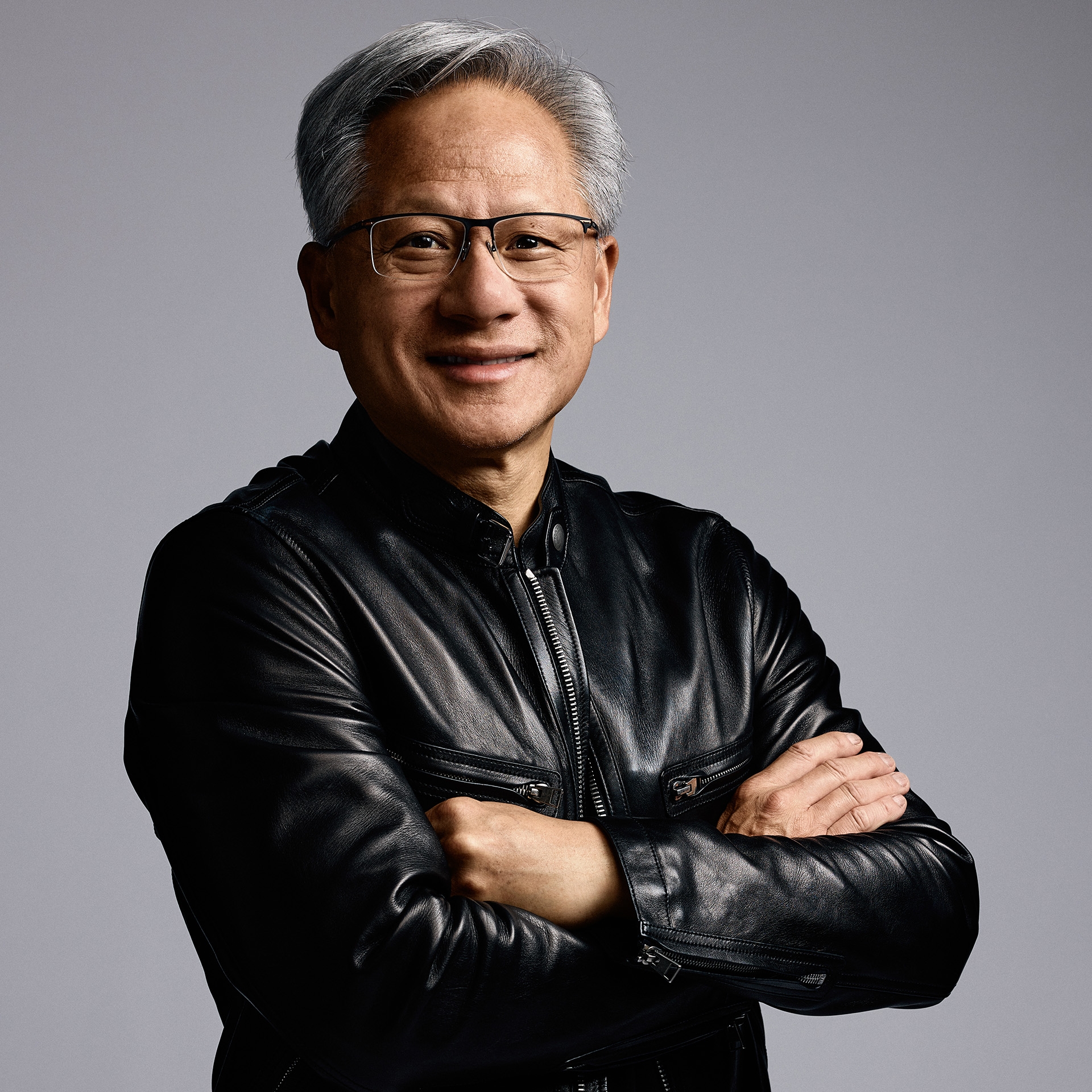
Photograph of Jensen Huang
Founder, President and CEO

Jensen Huang

Huang founded NVIDIA in 1993 after working at LSI Logic and AMD.

The choice behind the company +

NVIDIA’s 2025 platform announcement combines Blackwell Ultra, networking and inference software into an AI factory offer.

“And so every company will produce tokens. And that is the reason why I call them AI factories.”

Jensen Huang · Fourth quarter fiscal 2026 earnings call, answer to an analyst (third-party transcript) · 2026-02-25
The decisions behind the company

The founder who still runs it

Jensen Huang founded NVIDIA in 1993 and has been its president, chief executive and a board member since the start. Before that he worked at LSI Logic and AMD, and he holds electrical engineering degrees from Oregon State University and Stanford. The company's own biography credits its invention of the GPU in 1999 with growing PC gaming, redefining computer graphics and starting the era of modern AI. In Seoul in June 2026 he dated NVIDIA's founding dream to 33 years earlier.

With the internet, you can find anything. And now, with artificial intelligence as an infrastructure layer across the planet, we can know everything and do anything.

Jensen Huang · Founder and CEO, NVIDIA · On stage with Marc Benioff at Dreamforce, as quoted in NVIDIA's blog · 2026-09-15

Four decisions explain the company's present shape. First, from parts to systems: since Blackwell, NVIDIA designs the whole data center stack together. Second, a steady cadence: Blackwell Ultra was announced in March 2025, and by June 2026 Huang said Vera Rubin was in full production. Third, publishing the blueprint: reference architectures and the DSX platform let cloud partners, enterprises and countries build factories themselves, spreading NVIDIA's design without NVIDIA running every site. Fourth, money: in 2026 NVIDIA began helping to finance the buildout, working with six investment firms to mobilize over $500 billion of third-party capital, subject to definitive agreements, and planning direct investments such as $1 billion in NAVER.

When we think Vera Rubin, we think the entire system, vertically integrated, complete with software, extended end to end, optimized as one giant system

Jensen Huang · Founder and CEO, NVIDIA · GTC 2026 keynote, San Jose, as quoted in NVIDIA's live blog · 2026-03-16

The people who shape a Korea role

For a Korea hire, a handful of leaders matter. Colette Kress, executive vice president and chief financial officer, explains the business to investors and frames customer choices as performance per watt. Raymond Teh, senior vice president for Asia-Pacific, briefed Korean media on the 2025 GPU plan. In Korea, 정소영 opened the Korea AI Expert Day at GTC 2026 and gave a keynote in Busan in July 2026 on the industrial revolution that AI factories will set off; Korean press calls 정소영 the head of NVIDIA Korea, and NVIDIA Korea's blog uses the title Head of Korea Enterprise Business. 김태용, a vice president of Omniverse engineering, told the same GTC session that Korea is the best placed country to build physical AI.

How NVIDIA says it works and hires

The careers page states one rule: the project is the boss, even for the CEO. The annual report adds the shape of the workforce: about 42,000 employees in 38 countries at the end of fiscal 2026, 31,000 of them in research and development; more than 80 percent in technical roles and more than half with an advanced degree; over 40 percent of that year's new hires from employee referrals; and a turnover rate of 3.7 percent. Signet's reading: a company that hires through its own people and rarely loses them rewards a referral, and a candidate with a contact inside should use it.

Huang's public stance is fast and engineering-led. At Dreamforce in September 2026 he called safety job one and an engineering problem, and said a company should run as fast as it can but pause if a product is not going to be safe. On the August 2026 earnings call he said that for many tasks NVIDIA could say it had already achieved AGI, then called the milestone senseless; what matters, he said, is AI doing productive and useful work. In a television interview reported in September he called scaring people about AI irresponsible, and parts of the technology press have answered him critically. A candidate should expect a company that prizes shipping and treats risk as something to engineer.

On the worry that headquarters decides and Seoul executes: most Korea postings describe a bridge. The PR role aligns Korean work with global messaging, the Omniverse role turns customer needs into bugs and product improvements for global engineering teams, and the networking role starts after NVIDIA's deployment team hands a cluster over. Seoul shapes what headquarters hears about Korean customers, while product and architecture decisions sit with global teams.

05 / THE NEXT CHAPTER

Korean AI infrastructure, engineering and customer work

Architects translate customer requirements into NVIDIA designs and support use; engineering roles implement and optimize simulation, AI or DRIVE software; business roles connect Korean media, manufacturers and developers with global teams.

LOCAL & REGIONAL LEADERSHIP

정소영

Head of Korea Enterprise Business; press-described Korea head

Software and simulation engineering

Current system SW title sample and engineering/automotive requisitions.

Architecture and developer partnerships

Current architect/developer-relations titles and technical customer requirements.

Communication and community

Current NVIDIA community title plus PR/event sample and PR requisition.

Consumer accounts

Current consumer account manager requisition supports Korean manufacturers.

Automotive operations

Current title sample explicitly identifies an NVIDIA AVX operation coordinator.

October 8 Korean-filtered LinkedIn returned 192 associated profiles; selected current-NVIDIA title observations and current 19 job descriptions support the function view. These observations are separate from staff totals and reporting relationships.

Why Korea? Why now?+

The sources give three reasons, and Signet reads them together. Supply: NVIDIA's annual report says the business depends on partners especially in Taiwan and South Korea, Samsung Electronics and SK hynix supply the HBM memory its systems need, and Huang said NVIDIA could not have built today's AI supercomputers without HBM invented in Korea. Demand: at APEC in October 2025 the government and Korea's largest groups announced plans for over 260,000 NVIDIA GPUs, which NVIDIA's senior vice president for Asia-Pacific said would lift Korea from about 65,000 AI GPUs to more than 300,000, and in 2026 those plans gained megawatts and dates at NAVER, SK Telecom, LG and SK hynix. Industry: Huang argues that AI needs manufacturing and industrial capability, which Korea has, and calls robotics the next major sector there. Korea is therefore both a supplier and a buyer of the AI factory, and NVIDIA says the partnership is over 25 years old.

A national plan of over 260,000 GPUs

At the APEC summit in Gyeongju, NVIDIA, the Korean government, Samsung, SK, Hyundai Motor Group and NAVER announced plans for over 260,000 NVIDIA GPUs across sovereign clouds and AI factories, starting with 13,000 for the government's cloud partners.

Hyundai Motor and Kia expand autonomous driving work

NVIDIA announced an expanded collaboration with Hyundai Motor Company and Kia on next generation autonomous driving built on its Hyperion platform.

Korea AI Expert Day at GTC

About 300 Korean company staff and developers attended a Korea session in San Jose, where NVIDIA's solutions architect team presented semiconductor process optimization and agentic AI.

A Korea-only partner night in Taipei

During GTC Taipei, NVIDIA held a networking event only for Korean companies, which Korean press read as a sign of Korea's place in the AI supply chain.

Huang in Seoul, four Korean projects

SK Telecom announced a gigawatt-scale AI cloud with its first AI factory in 2027, NAVER a start at 55 megawatts, LG Group an AI factory, and SK hynix a multiyear memory partnership. Huang hosted roughly 200 Korean partners at a reception.

Plans grow at the AI Summit

NAVER, Brookfield and NVIDIA set a target of 200 megawatts by 2028, SK Group and NVIDIA announced plans for a partnership of more than $500 billion, and NVIDIA and KAIST announced a joint AI research lab in Seoul.

Developer meetup with OpenAI in Seoul

About 100 Korean developers attended a joint NVIDIA and OpenAI meetup at OpenAI's Seoul office, closed by NVIDIA's Korea solutions architect lead.

NVIDIA AI Day Seoul, planned

NVIDIA set a two day AI Day at COEX in Seoul for 9 and 10 November 2026 and expects about 2,000 attendees and 20 partners.

Understand the Korea opportunity

Korea sits on both sides of the factory

NVIDIA's case for Korea starts with supply. Its annual report says the business depends on consistent supply from overseas partners, especially in Taiwan and South Korea, and Samsung Electronics and SK hynix supply the high-bandwidth memory, HBM, that NVIDIA's AI systems depend on. At the AI Summit with President Lee Jae Myung in July 2026, Huang put the dependence plainly.

If not for the invention of HBM memory in Korea, NVIDIA wouldn't have been able to invent the supercomputers that power AI today.

Jensen Huang · Founder and CEO, NVIDIA · AI Summit, San Francisco, as quoted in NVIDIA's blog · 2026-07-24

The second reason is demand at national scale. At the APEC summit in Gyeongju in October 2025, NVIDIA and Korea announced plans for over 260,000 NVIDIA GPUs: over 50,000 for the National AI Computing Center and Korean clouds, starting with 13,000; over 50,000 each for Samsung Electronics and SK Group; 50,000 Blackwell GPUs for Hyundai Motor Group; and over 60,000 for NAVER Cloud. NVIDIA's senior vice president for Asia-Pacific said this would lift Korea from about 65,000 AI GPUs to more than 300,000. These are multi-year plans, not an installed base.

In 2026 the plans gained megawatts and dates. During Huang's Seoul visit in June, SK Telecom said it would build a gigawatt-scale AI cloud on NVIDIA's DSX platform with its first AI factory online in 2027, NAVER said it would start at 55 megawatts, and LG Group said it was building an AI factory. In July NAVER, Brookfield and NVIDIA set a target of 200 megawatts, roughly 100,000 GPUs, by 2028, with NVIDIA planning to invest $1 billion in NAVER; SK Group and NVIDIA announced plans for a partnership of more than $500 billion; and KAIST and NVIDIA announced a joint AI research lab in Seoul. NVIDIA's proposed investment requires closing conditions and NAVER to finalize at least $9 billion in separate committed financing; Brookfield's term sheet is nonbinding.

The third reason is industry. At APEC Huang told Korean leaders that AI needs manufacturing and industrial capability, the ingredients for Korea to fly, and in Seoul he called robotics the next major sector in Korea. Hyundai Motor Group and NVIDIA planned about $3 billion of investment in Korean physical AI, including an NVIDIA AI Technology Center, and KAIST is planning another one with NVIDIA. Korean companies even sit inside the factory: LG Energy Solution and LG Electronics are in NVIDIA's DSX Ready program for validated battery storage and cooling units.

The Korea team in the public record

NVIDIA's Korea organization is customer-facing and technical. 정소영, whom Korean press calls the head of NVIDIA Korea and whom NVIDIA Korea's blog titles Head of Korea Enterprise Business, opened the Korea AI Expert Day in San Jose in March 2026 with welcome remarks, where about 300 Korean company staff and developers heard NVIDIA's solutions architect team present semiconductor process optimization and agentic AI. 정구형, NVIDIA's Solutions Architect Lead in Korea, and a senior developer relations manager, spoke at a joint NVIDIA and OpenAI meetup in Seoul in August 2026 for about 100 developers.

Last year about 400 Korean applicants attended GTC. This year it is 800, double in a single year.

정소영 · Head of NVIDIA Korea (엔비디아코리아 대표) in Korean press; Head of Korea Enterprise Business on NVIDIA Korea's blog · Korean quotation from the March18 event reported March20; English translation · 2026-03-18Signet interpretation

What the 19 open roles are for

The employer's own board listed 19 open roles in Korea on October 8, 2026, and they read as a map of the plans above. Six are solutions architects: two for AI Factory, and one each for pre-training and post-training with Korea's frontier model makers, continuous bring-up networking, physical AI with Korean universities and enterprises, and semiconductor simulation with Korean chipmakers. Four engineers optimize and simulate. Six automotive roles build NVIDIA's driving software and help Korean partners adopt it. Three business roles cover public relations, GeForce laptop sales with Korean manufacturers, and developer relations for generative and sovereign AI.

On the worry that Korea is a satellite, the evidence points the other way. NVIDIA calls the partnership more than 25 years old, the Korean projects run to 2027 and 2028, Huang told Korean reporters NVIDIA will always consider investing in Korea, and the PR posting describes a period of growth and heightened public visibility. The Seoul seats cover customer engagement, local engineering and communication; product and architecture decisions sit with global teams.

Across the roles, a Korea hire turns a Korean customer's plan into something that runs: a cluster that trains, a chip simulation that finishes faster, a DRIVE release in a car, or a story the Korean press gets right. Experience floors run from 2 years to 12 years. Seven postings mention English, five as a requirement; the PR, consumer sales and Omniverse postings require Korean, and the automotive program manager posting lists it as a plus.

KOREA OPEN ROLES

19 open roles in Korea

Current Signet catalog · 2026-10-19

FOR YOU

Check your specific degree alternatives, experience floor, language strength and travel condition.

Engineering · AI

Deep Learning Applications Engineer

Korea, Seoul

Posting checked

The work
Build AI tools and agents for debugging, testing and deploying automotive software.
Who fits
BS/MS or higher in a related field or equivalent experience; 2+ years of professional software development.
Keep in mind
Hands-on SIL/HIL, LLM/VLM APIs and agent frameworks are required.
Engineering · AI

Developer Technology Engineer - AI

Korea, Seoul

Posting checked

The work
Optimize AI workloads with developers and NVIDIA architecture, research and software teams.
Who fits
MS/PhD in AI, computing or system optimization or equivalent experience, plus 3+ relevant years.
Keep in mind
Multimodal training or post-training depth and technical communication are required.
Engineering · AI

Developer Technology Engineer - Simulation

Korea, Seoul

Posting checked

The work
Optimize scientific simulation workloads with CUDA and collaborate on GPU technology.
Who fits
PhD in an HPC/simulation-related discipline or equivalent experience; 3+ years of relevant experience.
Keep in mind
Numerical methods, physics and performance work are central; Seoul full-time.
See all 19 roles
GTM · Sales · BD

Senior Account Manager, Consumer Sales

Korea, Seoul

Posting checked

The work
Grow GeForce notebook business with Korean manufacturers and OEM/ODM partners.
Who fits
Bachelor’s degree and 12+ years in OEM sales, account management or business development in PC, semiconductor or consumer electronics.
Keep in mind
Own quarterly and annual revenue targets, demand forecasts, inventory and joint OEM business plans.
Engineering · AI

Senior Automotive Software Program Manager

Korea, Seoul / Korea, Remote

Posting checked

The work
Run Korean automotive partner software programs from requirements to series production.
Who fits
BS/MS/PhD in a relevant field or equivalent experience; 6+ automotive software-development years.
Keep in mind
Willingness to attend regular partner-site meetings is required; automotive standards experience is preferred.
Engineering · AI

Senior Developer Relations Manager- GenAI

Korea, Seoul

Posting checked

The work
Grow technical GenAI partnerships and developer programs across enterprises, ISVs and government.
Who fits
BS/MS in a relevant field or equivalent experience; 12+ overall technology years including 5+ hands-on agentic/GenAI/LLM/VLM work.
Keep in mind
Technical architecture, code reviews and some travel are required; NVIDIA stack depth is preferred.
Engineering · AI

Senior Developer Relations Manager, Omniverse/Simulation

Korea, Seoul / Korea, Republic of

Posting checked

The work
Help Korean developers adopt Omniverse and Physical AI and connect their needs to product teams.
Who fits
BS/MS in engineering, physics or computer science, or equivalent experience.
Keep in mind
Based in Seoul, Korea.
Engineering · AI

Senior Omniverse Engineer, Physical Simulation, Digital Twins and Robotics

Korea, Seoul

Posting checked

The work
Build Omniverse physical simulations, digital twins and robotics integrations for customers.
Who fits
BS/MS/PhD in a related discipline or equivalent experience, and 7+ years of software or simulation work.
Keep in mind
Experience using AI coding agents and the ability to author reusable agent skills are required.
Engineering · AI

Senior Perception Engineer, Obstacle Foundation Models - Autonomous Vehicles

Korea, Seoul

Posting checked

The work
Build obstacle perception foundation models and validate them for autonomous vehicles.
Who fits
PhD/MS/BS in a relevant technical field or equivalent experience, with 5+ years of deep-learning perception experience.
Keep in mind
Own data, model performance and safety metrics; embedded perception experience is preferred.
Marketing · Content

Senior Public Relations Manager

Korea, Seoul

Posting checked

The work
Run Korean media relations, local communications and issues aligned with headquarters.
Who fits
Bachelor’s degree and at least 12 years in PR or corporate communications.
Keep in mind
MNC experience or a company with strong headquarters/branch reporting structure is strongly preferred.
Solutions Engineer

Senior Solutions Architect, Continuous Bring Up Networking

Korea, Seoul / Korea, Remote

Posting checked

The work
Stabilize and optimize AI/HPC networking after cluster deployment and handover.
Who fits
BS/MS/PhD in a relevant discipline or equivalent experience; at least 8 years in AI/HPC networking.
Keep in mind
Work with CBU DevOps and infrastructure architects; sometimes provide pre-sales support.
Engineering · AI

Senior System Software Engineer - Automotive

Korea, Seoul

Posting checked

The work
Develop and integrate automotive system software on NVIDIA platforms.
Who fits
Bachelor’s in a related discipline or equivalent experience; 5+ years of software development.
Keep in mind
Willingness to travel worldwide is required; MS/PhD, QNX safety and automotive integration are preferred.
Engineering · AI

Senior System Software Engineer, Drive AV Architect - Automotive

Korea, Seoul

Posting checked

The work
Define DRIVE AV embedded architectures and align Korean OEM requirements with NVIDIA.
Who fits
BS/MS or higher in a relevant field or equivalent experience, and 5+ years in automotive embedded software.
Keep in mind
Willingness to travel worldwide is required; safety and customer integration experience are preferred.
Engineering · AI

Simulation Engineer, Industrial Physics and Robotics

Korea, Seoul

Posting checked

The work
Build and validate industrial-physics and robotics simulation software.
Who fits
BSc or equivalent experience, or MSc/PhD in CS, engineering, robotics, mathematics, physics or a related field; 8+ years of experience.
Keep in mind
Production simulation experience, physical validation and interest in AI-assisted workflows are required.
Solutions Engineer

Solutions Architect - AI Factory

Korea, Seoul

Posting checked

The work
Design AI Factory architectures and support customers after cluster deployment.
Who fits
Bachelor’s degree or higher in Computer Science, Computer Engineering or a related field.
Keep in mind
Compute, storage and management fabrics are required; power/cooling and Kubeflow are preferred.
Solutions Engineer

Solutions Architect - AI Technology Center for Physical AI

Korea, Seoul

Posting checked

The work
Collaborate with Korean researchers on physical AI, robotics and digital twins.
Who fits
PhD in a relevant field or equivalent experience and 5+ hands-on years in digital twins/robotics.
Keep in mind
Evaluate Korean research proposals and guide experimental code toward large-scale research environments.
Solutions Engineer

Solutions Architect - Semiconductor Simulation

Korea, Seoul

Posting checked

The work
Accelerate Korean semiconductor design/manufacturing simulations with GPU and AI.
Who fits
6+ years in semiconductor design/manufacturing or an EDA ISV; MS/PhD in a relevant field or equivalent experience.
Keep in mind
AI physics models and experience with CUDA-X, PhysicsNeMo or Omniverse are preferred.
Solutions Engineer

Solutions Architect, AI Factory

Korea, Seoul

Posting checked

The work
Design AI Factory architectures and support customers after cluster deployment.
Who fits
Bachelor’s degree or higher in Computer Science, Computer Engineering or a related field.
Keep in mind
Compute, storage and management fabrics are required; power/cooling and Kubeflow are preferred.
Solutions Engineer

Solutions Architect, Pre-training and Post-training

Korea, Seoul

Posting checked

The work
Help Korean frontier model teams train, post-train, optimize and publish joint results.
Who fits
5+ hands-on years across pre-training, supervised fine-tuning, reinforcement-learning post-training, optimization and evaluation.
Keep in mind
Understanding how GPU, network and storage infrastructure affects model development is preferred.
07 / NOW & NEXT

The next scene is taking shape.

Blackwell Ultra platform

NVIDIA announced rack-scale systems and inference software for reasoning workloads.

Korean AI infrastructure plans

Government and industrial partners announced plans involving over 260,000 NVIDIA GPUs.

Fiscal 2026 results

Revenue reached $215.938B with Data Center revenue of $193.7B.

More context on what comes next

The buildout is still accelerating

Read against the thesis, the last quarter has three threads. The first is scale. In the quarter that ended in July 2026 revenue reached $96.2B, and Huang said compute is now revenue. By June he had said Vera Rubin was in full production, and NVIDIA guided the October quarter to $108.0B.

The AI infrastructure buildout is at full steam.

Jensen Huang · Founder and CEO, NVIDIA · Second quarter fiscal 2027 results release · 2026-08-26

NVIDIA now helps pay for the factories

The second thread is financing. NVIDIA said it would work with six investment firms to mobilize over $500 billion of third-party capital, subject to definitive agreements. Its July-quarter filing describes an August agreement to guarantee defined lease and power obligations, capped at $105 billion, for an OpenAI-affiliated tenant at SB Energy’s Ohio campus. It covers approximately 4.25 gigawatts across nine phases, with the first expected in fiscal 2029. Guarantees take effect as leases commence and payment is triggered by specified tenant defaults; NVIDIA also has an option for about 3.8 additional gigawatts. The earlier August reporting described an 8-gigawatt site. These are conditional credit support and expansion phases. Huang called chips an investable asset class, and a technology columnist noted that the external financing platforms rest on memorandums of understanding.

Korea moves from plans to dates

The third thread is Korea and the factory's physical layer. In October NVIDIA Korea announced DSX Ready, a program of validated power and cooling equipment that includes LG Energy Solution and LG Electronics, and confirmed NVIDIA AI Day Seoul at COEX for 9 and 10 November 2026, expecting about 2,000 attendees and 20 partners. On 28 September Huang received the Korea Society's Van Fleet Award in New York. Export risk stayed in the news: in early October the press reported the US arrest of a technology executive accused of smuggling servers worth more than $300 million, containing export-controlled NVIDIA chips, into China, and an NVIDIA spokesperson called the diversion insignificant.

  • The October quarter against the $108.0B guidance, and whether China stays out of the outlook.
  • Whether the Korean plans become running factories: SK Telecom's first AI factory in 2027 and NAVER's 200 megawatts by 2028.
  • How much of NVIDIA's growth rests on guarantees and investments in its own customers.

Their future. Your next chapter.

Find your part ↑

An independent profile by Signet. No affiliation or investment recommendation. Introductions happen only with your consent.
Research reviewed 2026-10-08

A LITTLE MORE CONTEXT

Understanding NVIDIA.

What does NVIDIA do?

NVIDIA combines GPUs, high-speed networking, systems and software into accelerated-computing platforms. An AI factory turns those components into a managed environment for training and inference, not just a room containing servers.

What is the opportunity in Korea?

Architects translate customer requirements into NVIDIA designs and support use; engineering roles implement and optimize simulation, AI or DRIVE software; business roles connect Korean media, manufacturers and developers with global teams.

Are these confirmed job openings?

Employer postings were checked on 2026-10-08. Availability can change. Mock applications request a review from Signet.

How can I explore the company in more depth?

Follow the company from its vision through products, evidence and people to the Korea team and current roles. Use the table of contents to move within the page, and expand the sections for more context.

Back to the collection ↗