Korea sits on both sides of the factory
NVIDIA's case for Korea starts with supply. Its annual report says the business depends on consistent supply from overseas partners, especially in Taiwan and South Korea, and Samsung Electronics and SK hynix supply the high-bandwidth memory, HBM, that NVIDIA's AI systems depend on. At the AI Summit with President Lee Jae Myung in July 2026, Huang put the dependence plainly.
If not for the invention of HBM memory in Korea, NVIDIA wouldn't have been able to invent the supercomputers that power AI today.
Jensen Huang · Founder and CEO, NVIDIA · AI Summit, San Francisco, as quoted in NVIDIA's blog · 2026-07-24
The second reason is demand at national scale. At the APEC summit in Gyeongju in October 2025, NVIDIA and Korea announced plans for over 260,000 NVIDIA GPUs: over 50,000 for the National AI Computing Center and Korean clouds, starting with 13,000; over 50,000 each for Samsung Electronics and SK Group; 50,000 Blackwell GPUs for Hyundai Motor Group; and over 60,000 for NAVER Cloud. NVIDIA's senior vice president for Asia-Pacific said this would lift Korea from about 65,000 AI GPUs to more than 300,000. These are multi-year plans, not an installed base.
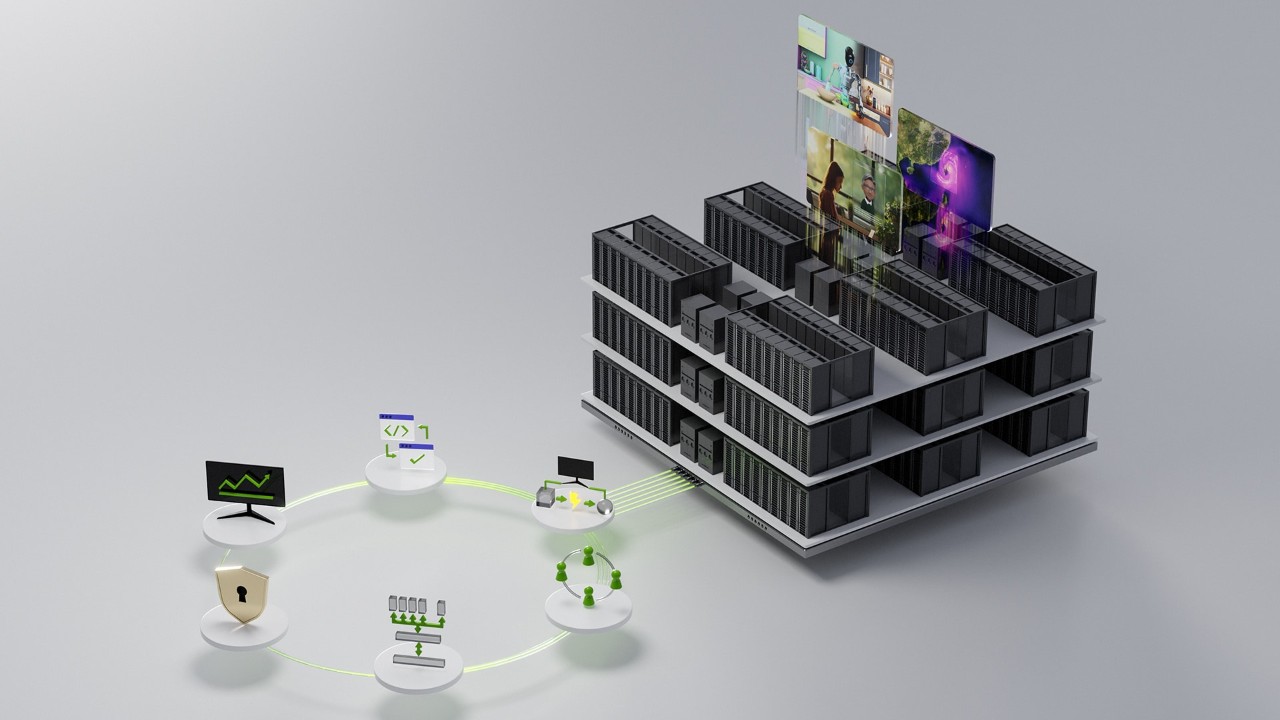
In 2026 the plans gained megawatts and dates. During Huang's Seoul visit in June, SK Telecom said it would build a gigawatt-scale AI cloud on NVIDIA's DSX platform with its first AI factory online in 2027, NAVER said it would start at 55 megawatts, and LG Group said it was building an AI factory. In July NAVER, Brookfield and NVIDIA set a target of 200 megawatts, roughly 100,000 GPUs, by 2028, with NVIDIA planning to invest $1 billion in NAVER; SK Group and NVIDIA announced plans for a partnership of more than $500 billion; and KAIST and NVIDIA announced a joint AI research lab in Seoul. NVIDIA's proposed investment requires closing conditions and NAVER to finalize at least $9 billion in separate committed financing; Brookfield's term sheet is nonbinding.
The third reason is industry. At APEC Huang told Korean leaders that AI needs manufacturing and industrial capability, the ingredients for Korea to fly, and in Seoul he called robotics the next major sector in Korea. Hyundai Motor Group and NVIDIA planned about $3 billion of investment in Korean physical AI, including an NVIDIA AI Technology Center, and KAIST is planning another one with NVIDIA. Korean companies even sit inside the factory: LG Energy Solution and LG Electronics are in NVIDIA's DSX Ready program for validated battery storage and cooling units.
The Korea team in the public record
NVIDIA's Korea organization is customer-facing and technical. 정소영, whom Korean press calls the head of NVIDIA Korea and whom NVIDIA Korea's blog titles Head of Korea Enterprise Business, opened the Korea AI Expert Day in San Jose in March 2026 with welcome remarks, where about 300 Korean company staff and developers heard NVIDIA's solutions architect team present semiconductor process optimization and agentic AI. 정구형, NVIDIA's Solutions Architect Lead in Korea, and a senior developer relations manager, spoke at a joint NVIDIA and OpenAI meetup in Seoul in August 2026 for about 100 developers.
Last year about 400 Korean applicants attended GTC. This year it is 800, double in a single year.
정소영 · Head of NVIDIA Korea (엔비디아코리아 대표) in Korean press; Head of Korea Enterprise Business on NVIDIA Korea's blog · Korean quotation from the March18 event reported March20; English translation · 2026-03-18Signet interpretation
What the 19 open roles are for
The employer's own board listed 19 open roles in Korea on October 8, 2026, and they read as a map of the plans above. Six are solutions architects: two for AI Factory, and one each for pre-training and post-training with Korea's frontier model makers, continuous bring-up networking, physical AI with Korean universities and enterprises, and semiconductor simulation with Korean chipmakers. Four engineers optimize and simulate. Six automotive roles build NVIDIA's driving software and help Korean partners adopt it. Three business roles cover public relations, GeForce laptop sales with Korean manufacturers, and developer relations for generative and sovereign AI.
On the worry that Korea is a satellite, the evidence points the other way. NVIDIA calls the partnership more than 25 years old, the Korean projects run to 2027 and 2028, Huang told Korean reporters NVIDIA will always consider investing in Korea, and the PR posting describes a period of growth and heightened public visibility. The Seoul seats cover customer engagement, local engineering and communication; product and architecture decisions sit with global teams.
Across the roles, a Korea hire turns a Korean customer's plan into something that runs: a cluster that trains, a chip simulation that finishes faster, a DRIVE release in a car, or a story the Korean press gets right. Experience floors run from 2 years to 12 years. Seven postings mention English, five as a requirement; the PR, consumer sales and Omniverse postings require Korean, and the automotive program manager posting lists it as a plus.