Three products that stack
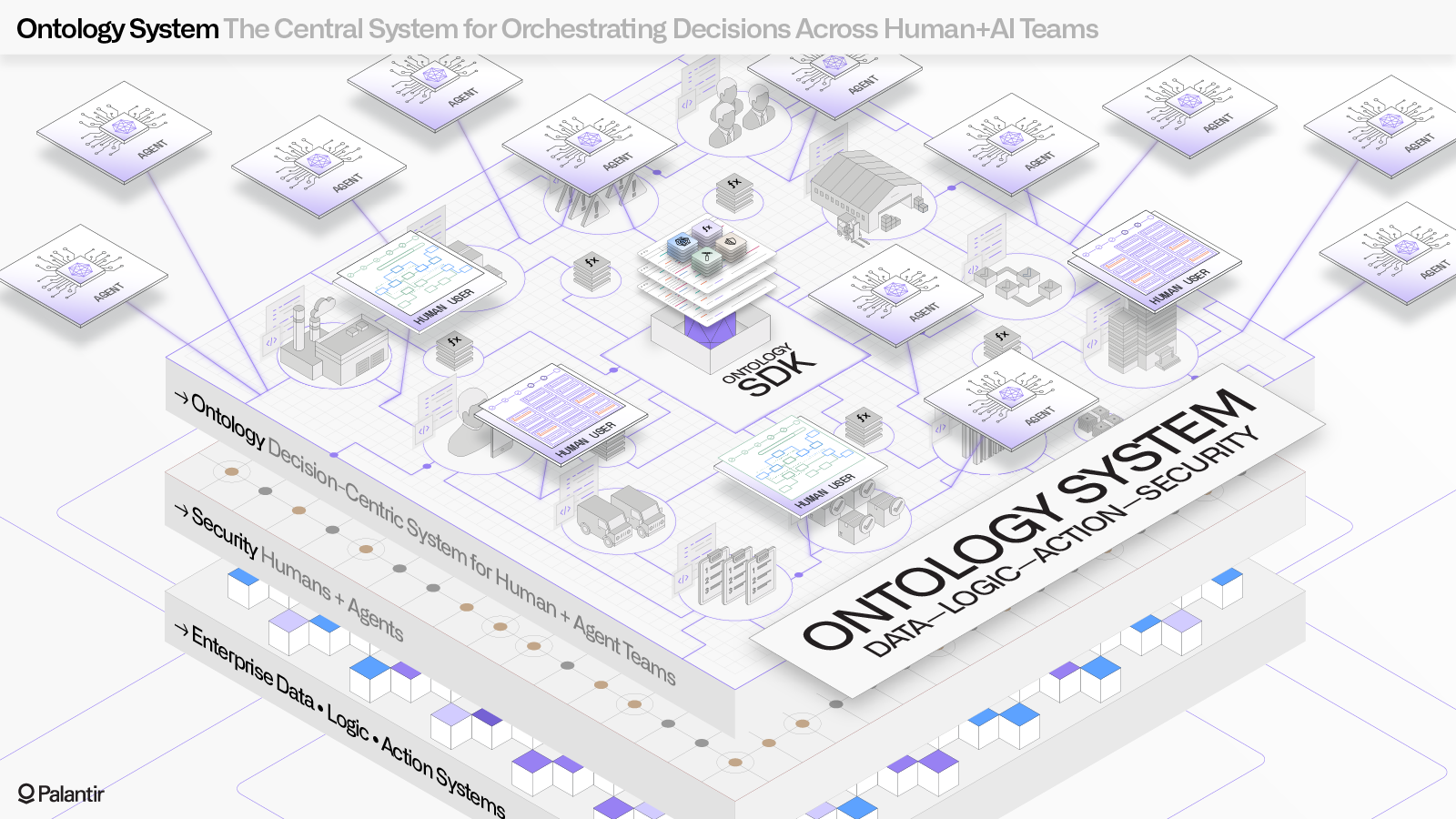
Palantir's architecture documentation describes three integrated platforms that stack. Foundry is the base, AIP attaches language models to it, and Apollo keeps the software delivered. The annual filing lists a fourth, Gotham, used across government functions, which this chapter leaves aside. The filing calls Foundry the "foundational data operations platform" and describes the Ontology as "the heart of our platforms."
Foundry integrates an organization's data, such as datasets, virtual tables and models, and maps it in the Ontology into objects, properties and links, which Palantir calls the semantics of the organization. Action types and functions define what people are allowed to change, which it calls the kinetics. Teams then build analyses and applications on top, and the Workshop screen in the documentation is one example, built on demonstration data. Buyers are operations leaders, data teams and application builders. Palantir says its first rival is the customer's own software team, and describes the other rivals by category.
AIP connects language models, tools and agents to the Ontology so a model can look up an organization's own data and propose actions within the controls that organization has set. Teams can test how the model behaves before it reaches users. Palantir sells it through bootcamps, where customers build use cases live with its engineers in one to five days. The screen shown is AIP Chatbot Studio from Palantir's documentation, with a demonstration chatbot built on Federal Reserve press conference transcripts. Palantir frames its rival here as the language labs behind the models, and its CEO has said customers "have declined to become vassal states of the language labs."
Apollo is the delivery side of the platform. Palantir's architecture documentation describes it as managing continuous delivery of software across different environments, so applications stay current where a customer's data and operations sit. The documentation screens show an API explorer and a documentation explorer for queries and types. Buyers are platform and software operations teams.
One customer, and the limits of what is reported
HD Hyundai is the best-documented customer in Korea. The work began in 2021 at HD Hyundai Oilbank, the year HD Hyundai also started its Future of Shipyard project, which aims by 2030 for a largely automated shipyard built around a digital twin. In 2022 two shipbuilding affiliates ran pilots on Palantir's platform, starting in January and May, joining the data they had already accumulated to look for ways to improve design and production. In September 2022 the group signed a Foundry contract covering its shipbuilding affiliates, valued at $20M over five years, which Palantir said brought the total value of its contracts with the group to $45M over five years. Korean trade press describes the software being used for schedule management on ship construction and for material management, financial planning and equipment operation.
Together with Palantir Technologies, (we are) drawing on the latest innovation in AI, digital twins, and so much more to transform our shipyards, unlocking a whole new level of productivity and safety
Chung Ki-sun · Executive Vice Chairman, HD Hyundai · Palantir's customer video, as reported in Korean English-language press · 2025-02-28
What was reported afterwards is a claim, not a measurement. The companies say HD Hyundai is manufacturing ships around 30% faster with Palantir software. A separate report gives a 2030 target of 30% higher productivity. In January 2026 the companies announced a group-wide expansion, which Palantir called its largest and longest partnership of its kind in Korea. Its value was reported as hundreds of millions of dollars over several years, but that figure came from an unnamed person and Palantir declined to comment on terms. The announcement also names areas where HD Hyundai Oilbank saw results. Distinguish the company's 30% performance claim, anonymous-source reporting of January contract value, and the $45M contract value announced in 2022.
A second named customer: Airbus
A further customer example is Airbus. Palantir and Airbus began collaboration on A350 manufacturing in 2015 and developed the Skywise aviation platform. Palantir says more than 50,000 people used Skywise in daily operations as of the February 2026 renewal. The initial collaboration date and the later platform adoption are separate milestones.
HD Hyundai announced group-wide expansion in January 2026, while LG CNS announced broader LG Group adoption plans in March. Announced expansion and live deployments are separate stages.