Sean Xiang Ren, official USC faculty portrait.
Sahara AI / THE WORLD THEY ARE BUILDING

Prepare domain data and connect agents with useful, accountable work.

An engineer needs to check a component against a design requirement while working inside a design tool.

See it taking shape ↓
01 / THE PRODUCTS

The products behind the promise.

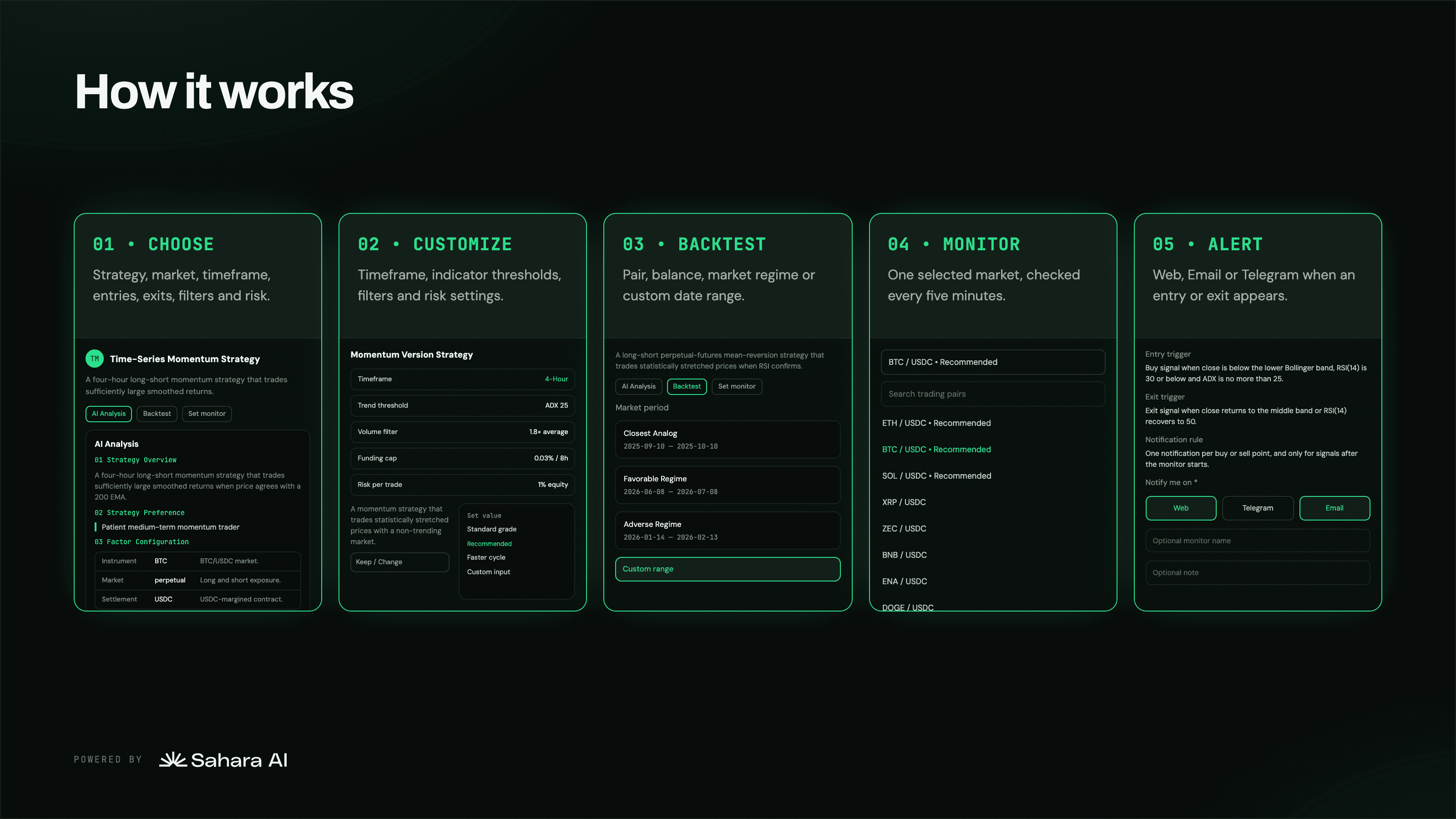
Official Sorin strategy workflow illustration with interface panels.
Sorin

Research, inspect strategy rules and monitor market conditions.

Bring relevant market context into a defined research workflow.

Motherson Group

Design knowledge inside the engineering workflow

Qualitative customer-reported workflow case.

Prepared multimodal knowledge supports grounded recommendations in the design tool.

What changed? +

Engineers search fragmented design documentation and standards.

Industrial agent case, distinct from the group’s sales or workforce.

Official Sorin strategy workflow illustration with interface panels.
02 / HOW IT BECOMES REAL

From a domain task to reviewed agent work

Illustrative scene: a Korean builder event leads to questions about an enterprise data pilot.

  1. 01

    Define a task

    Agree the user workflow and required evidence.

  2. 02

    Prepare knowledge

    Collect and review domain data through a pilot.

  3. 03

    Connect and evaluate

    Review the agent’s result inside the intended workflow.

Follow the work, step by step

Useful agents begin with usable domain knowledge

An engineer needs to check a component against a design requirement while working inside a design tool. Sahara AI connects the knowledge required for that decision with an agent embedded in the existing workflow. The Motherson case describes transforming written standards, process documents and 3D design content into a searchable knowledge base, then connecting a multimodal agent with the live design environment. Signet reads the proposition through that concrete task: prepare the information, retrieve relevant evidence and assist a decision where the person already works, with the source of the answer visible to the user.

That task joins two businesses described on the current site. Data services collect, label, enrich and validate information for AI development. Agentic solutions connect internal and external data with reasoning, recommendations and actions across integrated systems. Signet would start a customer discussion with the intended workflow rather than a generic request to add AI. Name the person doing the work, the decision that needs support, the information available and the action that may follow. The resulting scope gives both a commercial partner and a technical team a common definition of what a useful deployment must accomplish.

Data work follows requirements, pilots and quality review

The enterprise data service page lays out a sequence from requirements definition and pipeline design to a pilot, full execution and delivery. The customer specifies data type, quality thresholds and output format; the team decomposes the work into tasks and selects annotation and review layers. A pilot checks accuracy and turnaround before broader execution. Signet would explain this with an illustrative document classification project: agree labels and difficult edge cases, test the instructions on a small batch and revise them before activating a larger contributor group. The mechanism makes data quality part of the workflow design.

The public Data Services Platform gives individual contributors a related entry point. Its July 2025 launch describes selecting suitable tasks, submitting work, quality screening and approved contribution rewards. The documentation presents collection, refinement and labeling as concrete ways to contribute. Signet would keep contribution activity and employment distinct: completing a platform task is a product participation path, while a Seoul job opening has its own qualifications and responsibilities. For a community professional, the useful connection is helping a participant understand the task, its instructions and its acceptance conditions, then bringing recurring feedback to the teams responsible for the platform.

An agent needs evidence, permissions and a defined outcome

The March 2026 roadmap connects data work with protocols for provenance, usage policies and value distribution. It describes a future in which datasets, models, tools and agents can be composed with traceable contributions. Signet retains the release stage of each component: the roadmap places the Agentic AppChain mainnet in the fourth quarter and beyond, so the planned stage remains attached to that infrastructure. The product question is which evidence follows an action and which rights apply to the asset involved. Those questions help a customer understand the intended system before assessing a particular implementation.

The published examples cover different forms of evidence. MIT computer-use work uses interaction traces and corrections; Snap conversation research uses sustained dialogue and memory questions; the industrial design agent links recommendations with standards and geometry. Signet would explain the shared pattern as matching the data and evaluation to the task the agent must perform. A successful retrieval example, a conversation benchmark and a design recommendation each answer their own question. The company’s product direction becomes clearer when the reader can see the input, the action and the evidence appropriate to that specific workflow.

Understand the products and their customers

Sorin brings market research into one interface

Sorin is Sahara AI’s consumer-facing product for global digital markets. The April launch and current product page describe research, analysis and portfolio-related workflows, with further capabilities in the desktop application. Signet explains the software through a user reviewing market information and deciding what to investigate next. The product assembles relevant context and tools; an assessment of its usefulness should follow the data sources, freshness, explanation and the precise action available in the chosen module. The page’s broad market coverage is a product description, while actual account access depends on the applicable integration and user setup.

Quant Trading Strategy, announced August 27, gives a defined research workflow. The user chooses a starting framework, inspects entry and exit rules, customizes a version, tests that version against historical data and monitors live conditions. Version one provides research and alerts, with the user deciding whether to act; it does not execute orders. Signet preserves that boundary even though Sorin Desktop separately advertises autonomous execution. A software demonstration can show the saved strategy, test period and alert configuration. Historical testing describes behavior in a selected period and remains separate from a promise about future financial performance.

ClawApp makes local agent setup more accessible

ClawApp launched in February as a desktop interface for setting up and managing OpenClaw agents. The current site presents model providers, tools, skills, MCP servers and permissions in one workflow, with hosted models or local Ollama as choices. It also describes scheduled tasks using the same configured agent. Signet would explain the product through a recurring research summary: choose the model and required tools, define the permitted task and review a scheduled result. That demonstration gives a user a concrete way to understand configuration without treating a scheduling control as proof that every task will complete correctly.

The contribution and developer products serve different people around the same AI workflow. Data Services Platform supports approved data tasks. Developer Platform registers and manages assets, assigns licenses and supports agent development. Marketplace documentation describes discovery and licensing, with an August dataset monetization update adding submissions and payment features. The documentation retains some older coming-soon language, so Signet states the specific dated dataset feature rather than claiming every asset type has identical live monetization. A clear product explanation names the contributor, the developer and the buyer, then follows the asset and the rights relevant to their use.

External agents can use Sorin tools through MCP

Tools as a Service exposes Sorin market data and analysis tools to an agent the user already has. Its current documentation marks TaaS as live and says the user’s own agent handles reasoning and tool selection. Agent as a Service is the proposed route to call Sorin’s fuller agent over HTTP. The September announcement describes both in the expansion, while the current documents call AaaS coming soon and mark its production host as not serving yet. Signet presents TaaS as the documented live interface and AaaS as announced infrastructure with production delivery still pending.

Enterprise agents remain a separate route for domain-specific work. The company describes agents that use proprietary data and connect with the customer’s existing systems under its rules and permissions. The Motherson design example combines a prepared knowledge base with source-grounded recommendations inside the design tool. Signet would demonstrate that route through the work a customer wants to improve, the supporting information and the acceptance test for a proposed result. Together, the products span consumer research, local automation, contribution and enterprise deployment, with a different user and delivery stage for each part of the offering.

03 / THE EVIDENCE

The story, in numbers.

DATED OBSERVATIONS

Enterprise client coverage

clients
40+

Dated company-published client lower bound; one operating snapshot.

Figures, dates & basis +
Enterprise client coverage
DateValueBasis
2026-08-1440+August guide explicitly reports 40+ enterprise clients.

Sahara AI

Quant research and monitoring

The August 27 Quant Trading Strategy launch gives Sorin users ten starting frameworks and a connected path through inspecting rules, creating a strategy version, historical testing and monitoring. The initial version is a research and alert product, with order execution outside its stated scope. Signet would read the release through the saved version: the same conditions reviewed and tested become the conditions monitored. The product question is whether the user understands the rules and receives an appropriately scoped alert, while historical results remain attached to the chosen market and testing period.

Existing agent walkthrough

The September 4 walkthrough combines Claude, Robinhood and Sorin as an example of bringing financial context into an existing agent environment. Signet treats the article as an integration walkthrough with the permissions and service setup it describes. It is evidence of a proposed user workflow, not an instruction for the reader to connect an account or trade. For a product or community discussion, the useful explanation identifies which component provides data, which one reasons over it and which action is expected from the user, preserving the boundaries of the actual example.

Financial tools infrastructure

The September 10 page carries a September 9 announcement for TaaS and AaaS and connects eligible infrastructure access with recurring staking credits. Current documentation distinguishes live TaaS from upcoming AaaS and identifies production AaaS as not serving yet. Signet preserves the announcement and the current operating status together. The next meaningful evidence is a documented production interface and a real integration appropriate to that interface. The distinction also determines who owns reasoning in a partner workflow: TaaS supplies specialized tools to the partner’s agent, while the proposed AaaS route supplies Sorin’s own reasoning. A local proposal should state that responsibility explicitly. This also gives the Korea team a concrete communication task: describe the delivered tools accurately, explain the planned extension and keep any local partner proposal tied to the capability it can actually use today.

Read the growth story

Enterprise delivery provides the stated business foundation

The March roadmap and August company guide say the present revenue foundation is enterprise data services and proprietary agent deployments. The guide reports more than forty enterprise clients and describes revenue in an imprecise cumulative phrase, without a defined annual reporting period. Signet uses the client lower bound as a dated operating snapshot. For the commercial model, the important connection is between a customer’s data or agent workflow and a delivered service that customer funds. The company’s general business description supports that connection, while a financial comparison needs amounts and periods stated on a consistent basis.

The data service page describes per-data-point pricing and a pilot that helps establish cost and schedule before full execution. That gives an enterprise opportunity a concrete commercial shape: define a data requirement, test the work, agree delivery and provide the result in the requested format. Signet would ask which work is included and what the acceptance threshold is. A count of labeled records is meaningful when the customer understands their purpose and quality. The commercial account relationship therefore combines scope, delivery economics and repeat customer needs, with the exact agreement determining the purchased service.

Consumer credits and partner access add different routes

The company describes expansion through consumer products and partners embedding capabilities in their own products. ClawApp’s launch article explains usage-based credits and top-ups for model inference and execution. The Sorin staking announcement describes another access mechanism, where eligible token staking corresponds to recurring product credits under program conditions. Signet keeps product credits distinct from a cash return. The current ClawApp site still labels its staking-credit extension as coming soon, so that particular feature remains a planned extension. A useful account discussion names the product, the billing unit and the user’s expected task volume.

Tools as a Service takes the partner model into an existing agent workflow. A user can keep the reasoning system they already use and add specialized market tools. The September infrastructure announcement connects eligible service access with recurring credits, while the current TaaS documentation specifies the live interface. Signet would assess this through adoption and continued use: who connects the service, which task it improves and what measured usage requires ongoing compute. This is a commercial reading of the offered infrastructure, not a forecast that every integration will become a paying customer or deliver a particular level of revenue.

Funding, tokens and customer activity have different meanings

In August 2024, Sahara AI announced forty-three million dollars of funding backed by investors including Binance Labs, Pantera Capital and Polychain Capital. That dated financing announcement supports the company’s development history. The separate token documentation describes allocation and utility within the ecosystem. Signet would label each measure by what it records: financing supplied to the business, a token-related program or a customer activity count. The enterprise client chart uses the August 2026 lower bound of forty. The labels preserve the meaning of each item instead of presenting funding or a token’s trading value as recognized company sales.

The public offering exposes several operating pressures. Enterprise projects depend on accurate domain work and coordinated delivery. Consumer and agent services incur inference, data and infrastructure costs as usage grows. Financial-market applications also need reliable data, clear product boundaries and appropriate user control. Signet would examine those pressures through a proposed customer workflow: which specialists review the dataset, how usage is budgeted and which actions remain with the user. This makes the business discussion assessable through observed work and service conditions, while keeping a speculative profitability estimate out of a company introduction.

04 / THE PEOPLE

Someone saw it first.

Sean Xiang Ren, official USC faculty portrait.
Co-founder and CEO

Sean Ren

AI researcher Xiang Ren, USC associate professor and INK Lab leader.

The choice behind the company +

Connect domain data with grounded production agent workflows.

“The challenge was never just retrieval.”

Sean Ren · Motherson case · 2026-05-07
The decisions behind the company

Two founders combine AI research and ecosystem experience

The August 2024 funding announcement dates Sahara AI’s founding to April 2023 and identifies Sean Ren as CEO and Tyler Zhou as co-founder. It describes Ren’s AI research background and Zhou’s prior Binance Labs investment experience. The February 2026 Danal partnership identifies Zhou as co-founder and COO, while the May Motherson account identifies Ren as CEO and co-founder. Signet reads their roles through the work described: research and production data inform the technology direction, while partnerships and local execution help connect that technology with customers and participants in a broader ecosystem.

USC’s faculty profile identifies Xiang Ren as an associate professor and leader of the INK research lab, and the lab lists Sean as Xiang Ren. His documented research concerns generalizable language systems, evaluation, factual knowledge and reliability. This gives a grounded background for the company’s interest in domain data and verifiable agent behavior. Signet would connect a research theme with a concrete production example rather than treat a faculty title as a product performance guarantee. The public university portrait supplies a correctly identified human image for the leadership section, with its university source retained.

The ownership thesis reaches data, rights and value distribution

The company’s stated mission is to build infrastructure so people can contribute to and share in the value generated by AI. The early community announcement described a network of knowledge, compute and execution participants receiving recognition for their contributions. Developer and Marketplace documentation later gives that thesis a working surface through asset registration, licenses and co-ownership. Signet would examine how a contributor’s work becomes an asset another developer can use, which rights accompany the use and how an applicable payment is handled. The interpretation follows the published proposition while keeping implemented features and future protocol plans attached to their stages.

The Seoul postings publish six values, including speaking up to build better, integrity, ownership and resilience. Those are employer-stated expectations for collaboration. Signet would use them to prepare evidence-based interview examples: identify a problem, raise a concern with relevant context, agree who owns the next action and follow through on the result. A local partnership role may need to challenge an unclear integration plan; a community role may need to relay recurring participant confusion. The values become useful when the candidate can explain the actual choice and outcome in a situation, rather than repeat the value phrase alone.

A long-running agent needs accountable handoffs

The July infrastructure article argues that agent systems need to preserve intent, policy and attribution when work crosses models and tools. Signet uses that as the company’s stated infrastructure problem, without repeating the article’s speculative claims about other model releases. The practical question is what remains observable after an agent delegates a task: the requested action, the allowed scope, the tool used and the resulting evidence. Connecting those elements gives a team a way to discuss responsibility in a long-running workflow, beyond a successful answer in a single conversation turn.

The enterprise stories offer specific grounds for that discussion. An industrial recommendation traces to a standard; a computer-use correction records how an interaction failed; a conversation dataset preserves context over weeks. Signet reads the founder’s claim about production agentic AI through those different kinds of task evidence. Each example asks a team to coordinate domain specialists, data work and product delivery. A prospective colleague can therefore prepare a case about turning an unclear request into a reviewed workflow, explaining the data needed, the people involved and the test used to decide whether the resulting system serves its intended user.

05 / THE NEXT CHAPTER

Danal exploration and two Seoul roles

The Account Manager posting names global partnership and ecosystem teams as close collaborators. Community Manager names global marketing and developer relations. The organization view therefore shows these published functions and local partners or participants without assigning a country head or employee count. Signet’s illustrative scenario is a Korean builder event that produces interest in an enterprise data pilot. The community colleague understands the participant’s question, the business colleague evaluates the opportunity and technical specialists help define the pilot. That scenario is a preparation suggestion grounded in the two postings, not an extra contractual requirement added to either job.

Local partners and participants
Global partnerships and ecosystem
Marketing and developer relations

Functions from current postings, with no local staffing estimate.

Why Korea? Why now?+

The announcement also describes a possible link between Sorin and consumer environments such as the Paycoin app through Danal’s subsidiary PayProtocol. The two companies say they will explore that direction; the introduction therefore retains it as a potential integration. Signet would prepare a local partner conversation around the user task and operating boundary: what information the user needs, where it appears in the partner product and how the parties evaluate its usefulness. A proposed market-intelligence experience and payment infrastructure each require their own implementation and evidence, even when discussed inside the same memorandum.

Danal MOU announcement

Explore applied AI for stablecoin infrastructure and possible consumer integrations.

Understand the Korea opportunity

The Danal relationship starts with a documented MOU

Sahara AI and Danal Fintech announced a strategic memorandum concerning stablecoin and AI-based financial infrastructure in February 2026. Sahara’s page is dated February 9 and carries a February 10 body date; Danal’s own news record dates the announcement February 10. The stated work includes transaction analysis, settlement and reconciliation automation, risk controls and cross-border support. Signet reads this as a documented collaboration to explore and evaluate use cases. The wording keeps the agreement at its announced stage, with later evidence needed to establish a deployed product, a transaction volume or recognized commercial revenue from the partnership.

The announcement also describes a possible link between Sorin and consumer environments such as the Paycoin app through Danal’s subsidiary PayProtocol. The two companies say they will explore that direction; the introduction therefore retains it as a potential integration. Signet would prepare a local partner conversation around the user task and operating boundary: what information the user needs, where it appears in the partner product and how the parties evaluate its usefulness. A proposed market-intelligence experience and payment infrastructure each require their own implementation and evidence, even when discussed inside the same memorandum.

Two Seoul roles connect business growth and participation

The current official Ashby board lists three global openings, including two full-time remote roles assigned to Seoul. Account Manager sits in BD and Partnerships, despite a title that might otherwise suggest only customer maintenance. The description asks for at least five years in business development, partnerships or venture building, a Korean AI and blockchain network, negotiation experience, fluent Korean and proficient English. It covers enterprise adoption, partnerships with companies and institutions, local startup collaboration and investment opportunities. Signet preserves the employer’s actual scope so a candidate prepares for regional business building as well as relationship management.

Community Manager is the second Seoul role, in Marketing. Its stated qualifications include at least three years in community management, developer relations or event operations, experience running events, social channel skills and fluent Korean with proficient English. The work combines online channels, meetups, hackathons, ambassadors, local content and growth tracking. Naver Blog appears alongside Discord and Telegram in the channel list. Signet would prepare a candidate to explain how a program moves from awareness to participation and retention, showing the audience, event or channel choice and the evidence used to improve the next iteration.

Local execution needs global and regional counterparts

The Account Manager posting names global partnership and ecosystem teams as close collaborators. Community Manager names global marketing and developer relations. The organization view therefore shows these published functions and local partners or participants without assigning a country head or employee count. Signet’s illustrative scenario is a Korean builder event that produces interest in an enterprise data pilot. The community colleague understands the participant’s question, the business colleague evaluates the opportunity and technical specialists help define the pilot. That scenario is a preparation suggestion grounded in the two postings, not an extra contractual requirement added to either job.

For either role, the product release stage is part of accurate local communication. A data contribution task, the live TaaS interface, a research-only strategy monitor and a proposed payment integration provide different forms of participation. Signet would ask a candidate to explain one using Korean that names the user, the action and the evidence clearly, then coordinate the same understanding with global colleagues in English. A local launch or program becomes easier to review when its intended audience and delivered feature are explicit. This connects the language requirements in the postings with the work the company is actually describing.


KOREA OPEN ROLES

2 open roles in Korea

Current Signet catalog · 2026-10-19

FOR YOU

Prepare a local partnership or program case with an observed outcome.

GTM · Sales · BD

Account Manager

Seoul

Posting checked

The work
Build Korean partnerships and enterprise adoption.
Who fits
Brings five-plus years building commercial relationships, strategic alliances, or new ventures.
Keep in mind
Full time remote; fluent Korean, proficient English.
Marketing · Content

Community Manager

Seoul

Posting checked

The work
Run localized channels, events and contributor programs.
Who fits
Has at least three years in community, developer relations, or event operations.
Keep in mind
Full time remote; fluent Korean, proficient English.
07 / NOW & NEXT

The next scene is taking shape.

Quant research and monitoring

The August 27 Quant Trading Strategy launch gives Sorin users ten starting frameworks and a connected path through inspecting rules, creating a strategy version, historical testing and monitoring. The initial version is a research and alert product, with order execution outside its stated scope. Signet would read the release through the saved version: the same conditions reviewed and tested become the conditions monitored. The product question is whether the user understands the rules and receives an appropriately scoped alert, while historical results remain attached to the chosen market and testing period.

Existing agent walkthrough

The September 4 walkthrough combines Claude, Robinhood and Sorin as an example of bringing financial context into an existing agent environment. Signet treats the article as an integration walkthrough with the permissions and service setup it describes. It is evidence of a proposed user workflow, not an instruction for the reader to connect an account or trade. For a product or community discussion, the useful explanation identifies which component provides data, which one reasons over it and which action is expected from the user, preserving the boundaries of the actual example.

Financial tools infrastructure

The September 10 page carries a September 9 announcement for TaaS and AaaS and connects eligible infrastructure access with recurring staking credits. Current documentation distinguishes live TaaS from upcoming AaaS and identifies production AaaS as not serving yet. Signet preserves the announcement and the current operating status together. The next meaningful evidence is a documented production interface and a real integration appropriate to that interface. The distinction also determines who owns reasoning in a partner workflow: TaaS supplies specialized tools to the partner’s agent, while the proposed AaaS route supplies Sorin’s own reasoning. A local proposal should state that responsibility explicitly. This also gives the Korea team a concrete communication task: describe the delivered tools accurately, explain the planned extension and keep any local partner proposal tied to the capability it can actually use today.

More context on what comes next

August strategy tools join rules, tests and alerts

The August 27 Quant Trading Strategy launch gives Sorin users ten starting frameworks and a connected path through inspecting rules, creating a strategy version, historical testing and monitoring. The initial version is a research and alert product, with order execution outside its stated scope. Signet would read the release through the saved version: the same conditions reviewed and tested become the conditions monitored. The product question is whether the user understands the rules and receives an appropriately scoped alert, while historical results remain attached to the chosen market and testing period.

September example connects existing agent environments

The September 4 walkthrough combines Claude, Robinhood and Sorin as an example of bringing financial context into an existing agent environment. Signet treats the article as an integration walkthrough with the permissions and service setup it describes. It is evidence of a proposed user workflow, not an instruction for the reader to connect an account or trade. For a product or community discussion, the useful explanation identifies which component provides data, which one reasons over it and which action is expected from the user, preserving the boundaries of the actual example.

September infrastructure announcement has distinct delivery stages

The September 10 page carries a September 9 announcement for TaaS and AaaS and connects eligible infrastructure access with recurring staking credits. Current documentation distinguishes live TaaS from upcoming AaaS and identifies production AaaS as not serving yet. Signet preserves the announcement and the current operating status together. The next meaningful evidence is a documented production interface and a real integration appropriate to that interface. The distinction also determines who owns reasoning in a partner workflow: TaaS supplies specialized tools to the partner’s agent, while the proposed AaaS route supplies Sorin’s own reasoning. A local proposal should state that responsibility explicitly. This also gives the Korea team a concrete communication task: describe the delivered tools accurately, explain the planned extension and keep any local partner proposal tied to the capability it can actually use today.

Their future. Your next chapter.

Find your part ↑

An independent profile by Signet. No affiliation or investment recommendation. Introductions happen only with your consent.
Research reviewed 2026-10-10

A LITTLE MORE CONTEXT

Understanding Sahara AI.

What does Sahara AI do?

An engineer needs to check a component against a design requirement while working inside a design tool. Sahara AI connects the knowledge required for that decision with an agent embedded in the existing workflow. The Motherson case describes transforming written standards, process documents and 3D design content into a searchable knowledge base, then connecting a multimodal agent with the live design environment. Signet reads the proposition through that concrete task: prepare the information, retrieve relevant evidence and assist a decision where the person already works, with the source of the answer visible to the user.

What is the opportunity in Korea?

The Account Manager posting names global partnership and ecosystem teams as close collaborators. Community Manager names global marketing and developer relations. The organization view therefore shows these published functions and local partners or participants without assigning a country head or employee count. Signet’s illustrative scenario is a Korean builder event that produces interest in an enterprise data pilot. The community colleague understands the participant’s question, the business colleague evaluates the opportunity and technical specialists help define the pilot. That scenario is a preparation suggestion grounded in the two postings, not an extra contractual requirement added to either job.

Are these confirmed job openings?

Employer postings were checked on 2026-10-10. Availability can change. Mock applications request a review from Signet.

How can I explore the company in more depth?

Follow the company from its vision through products, evidence and people to the Korea team and current roles. Use the table of contents to move within the page, and expand the sections for more context.

Back to the collection ↗