Adam Singolda, official CEO portrait.
Taboola / THE WORLD THEY ARE BUILDING

Connect open-web attention with measurable advertiser outcomes.

Taboola connects performance advertisers with audiences on publishers, apps and other digital properties.

See it taking shape ↓
01 / THE PRODUCTS

The products behind the promise.

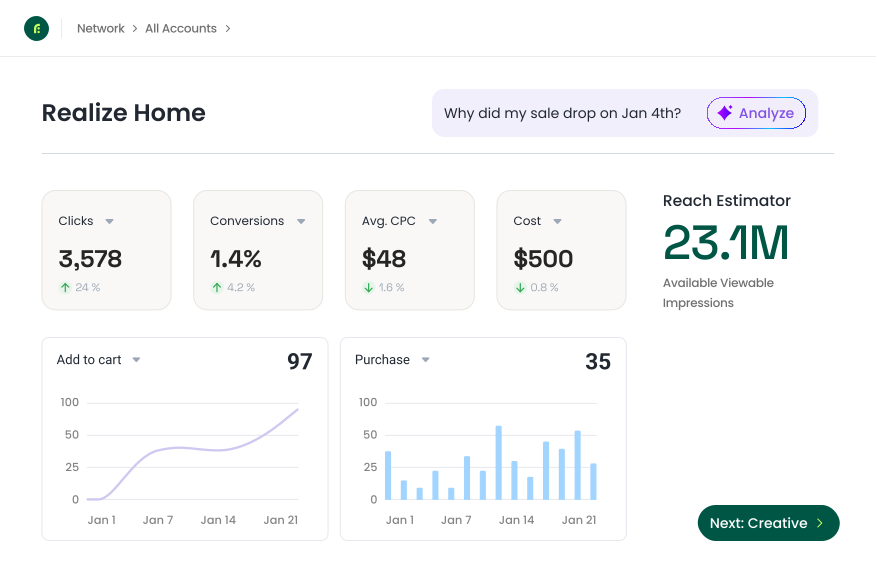
Official Realize dashboard illustration with example account figures.
Realize

Manage campaigns beyond search and social.

Connect media access with measured advertiser goals.

Wikitree

Publisher-site discovery

A dated selection agreement, without an invented performance result.

The July agreement adds questions and answers grounded in its journalism.

What changed? +

Readers explored the publisher’s news and archive through existing routes.

Wikitree DeeperDive agreement announced July1,2026.

Official Realize dashboard illustration with example account figures.
02 / HOW IT BECOMES REAL

Goal, delivery and optimization

Illustrative scene: a Korean advertiser launches and evaluates a publisher campaign.

  1. 01

    Define

    Set an objective, destination and conversion tracking.

  2. 02

    Deliver

    Match advertisements with suitable publisher supply.

  3. 03

    Optimize

    Use reports and customer context to choose changes.

Follow the work, step by step

Connect advertisers with readers of independent media

Taboola connects performance advertisers with audiences on publishers, apps and other digital properties. A business brings a measurable campaign goal, such as qualified visits, enquiries or purchases; the publisher brings a place where people already read and explore content. Realize is the advertiser platform used to set up and manage this relationship. The reader encounters an advertisement in the publisher environment and may visit the advertiser’s own site. Signet’s useful starting scene is a marketer deciding how to grow beyond an existing search and social budget. That decision needs an appropriate audience, creative, a destination and a way to observe what happened after a click. The platform is therefore more than the familiar recommendation unit at the bottom of a news article. It combines access to media properties with tools for choosing, measuring and improving performance campaigns.

Observe a campaign from the goal to its result

In an illustrative workflow, a marketer selects an objective, supplies a landing page and creative, and establishes tracking for the desired action. Delivery then connects advertisements with available publisher placements, while bidding and budget choices influence the opportunities pursued. The Performance AI page describes learning from engagement and post-click signals and adjusting delivery as campaigns run. Campaign Controls supplies reporting by publisher, device and creative, along with guidance through Abby. These are distinct operational steps: an account can receive traffic without achieving the intended business action, and a conversion metric is only useful when its definition and capture are understood. Signet would ask the operator to follow one example from campaign setup to a reported conversion, explain the source of the measurement and show which decision they changed afterward. A clear account of that loop helps a buyer assess whether an additional channel fits its existing marketing process.

The publisher side gains a conversational route

DeeperDive adds an answer experience inside a publisher’s website using that publisher’s journalism. A reader can ask a question, receive a summary and follow links into related articles rather than leaving the publisher’s own environment. The product page illustrates the question, answer and discovery steps; the launch materials connect this with publisher engagement and monetization. The AI answer-advertising offering extends the monetization infrastructure to conversational experiences. Signet keeps the two journeys connected but distinct: Realize serves an advertiser’s campaign objective, whereas DeeperDive gives readers another way to explore a publisher’s content. Their common commercial question is whether relevant attention can become valuable activity within an environment the publisher controls. For an actual implementation, the editorial source, the answer’s supporting links, placement suitability and measurement should be examined together. Claimed engagement benefits need their own period and denominator, rather than being assumed from the appearance of an AI interface. Publisher-level reports also let the account team examine where delivery occurred, rather than assessing a campaign only through one aggregate result.


Understand the products and their customers

Realize combines campaign tools and media access

Realize was introduced in February 2025 as Taboola’s expansion beyond native advertising into performance formats outside search and social. Its current product pages describe native, display and video experiences, advertiser objectives and publisher supply. The structured product in this dossier is Realize, not an unrelated stock image of marketing work. Its official dashboard illustration shows account health, clicks, conversions, spend and an analysis prompt with example figures. Those figures illustrate the interface and are not a named client’s measured outcome. Signet would connect the dashboard with a campaign’s settings, destination and tracking before interpreting a trend. The practical product question is how the advertiser learns which placement and creative contributed to its chosen action and how that evidence changes the next campaign decision. Format availability and a larger media network create options, but the buyer still needs a campaign that is suited to its own conversion objective.

Identity, automation and operator decisions work together

Realize ID connects identifiers and observed activity with predicted purchase intent. The documentation says it is enabled automatically for campaigns and describes optional customer-data connections; it also distinguishes identity signals from contextual targeting when complete identity is unavailable. Performance AI separately handles campaign learning, bidding and delivery, while Campaign Controls exposes reports and recommendations. The Realize+ page describes more autonomous decisions against an advertiser’s stated goals and still presents a beta-access request. Q2 remarks described an early group of advertisers using that system. Signet therefore preserves beta status rather than treating the current promotional page as proof of universal availability. A useful product demonstration would state which capability is enabled in the relevant account, which settings remain under the operator’s control and which measurement drives the optimization. It would also separate a simulated forecast, a suggested change and an observed campaign outcome, since they answer different business questions.

DeeperDive uses the publisher’s own content

DeeperDive is the second structured product, with an official answer-screen mockup showing a reader question, a publisher-generated answer and a follow-up prompt. Its product description says responses are grounded in the publisher’s reporting and links help readers explore related content. Wikitree selected it in July 2026 to offer another way to engage with Korean news content; NBC News expanded its broader Taboola relationship in August to programmatic display. These are different agreements and should not be presented as the same product rollout. The DeeperDive expansion and answer-advertising materials show why Taboola connects content discovery with monetization. Signet would review the boundary between an editorial answer and a commercial placement, the source articles returned and the reader’s next step. The outcome to assess is a useful, traceable discovery journey within the publisher’s site. A question box alone does not establish editorial quality, incremental revenue or a guaranteed change in user retention. Its creative tools include formats and assisted headline or asset preparation tied to the advertiser’s destination.

03 / THE EVIDENCE

The story, in numbers.

DATED OBSERVATIONS

Annual reported revenue

USD · million

Annual revenue; separate from GAAP gross profit and non-GAAP ex-TAC.

Figures, dates & basis +
Annual reported revenue
DateValueBasis
2022-12-31$1401.2MReported annual revenue.
2023-12-31$1439.7MReported annual revenue.
2024-12-31$1766.2MReported annual revenue.
2025-12-31$1912.04MReported annual revenue.

Taboola

Dianomi acquisition offer

On September 18, 2026 Taboola announced an offer to acquire Dianomi, whose published advertiser and publisher relationships concentrate on finance, business and lifestyle. The release describes expected completion before the end of 2026 subject to conditions and Dianomi shareholder approval. Signet therefore records an acquisition offer rather than a completed merger. The strategic connection is a more specialized supply route for performance campaigns, which still requires a completed transaction and working integration to become an operating result. A reader should keep the named Dianomi relationships in their original scope rather than automatically reassigning them as Taboola’s existing contracts.

Realize ID launch

The September 22 Realize ID announcement describes connecting fragmented signals from content consumption, advertisements and buying activity. Current help documentation places the feature within campaigns and explains optional data connections. Its intent model is relevant to reaching a prospect while that person is actively comparing options, but a model’s predicted intent is different from an observed purchase. The launch’s efficiency claim has its own internal measurement scope and is not a promised return for every advertiser. Signet would examine the available signals, measurement definition and the operator’s control alongside the launch, then ask whether the feature improves an appropriate campaign objective in the specific account.

DeeperDive recognition

The September 30 AdExchanger announcement reports publisher-growth and monetization recognition for DeeperDive and says the product reaches more than eleven million monthly active users. This is a company-disclosed product-reach observation, distinct from the broader network’s daily active-user figure and from annual revenue. The July Wikitree agreement is a concrete Korean example in that product’s adoption story. Signet would follow the next product update through source-grounded answers, publisher control and reported engagement with clear denominators. Recognition, an adoption agreement and financial performance are three kinds of evidence that should be read together without being converted into one universal success metric.

Read the growth story

Advertising revenue includes a cost of media supply

Taboola sells performance advertising through relationships with advertisers and digital properties. The annual filing explains its revenue recognition and the cost associated with traffic acquisition; publisher economics therefore belong beside advertiser demand. This differs from treating an advertiser’s total campaign budget as software subscription revenue. Signet would explain the commercial loop with an advertiser paying for delivery and a publisher receiving the economics of the relevant agreement. Contract structure, delivery and traffic-acquisition costs influence what the company retains. The financial statements make it possible to distinguish reported revenue, GAAP gross profit and the company’s non-GAAP ex-TAC measure. Those figures should retain their original definitions when comparing periods. A commercial discussion can then focus on acquiring suitable advertiser demand, maintaining publisher relationships and producing repeatable campaign value, rather than describing every dollar passing through the system as high-margin recurring software income.

Use comparable annual revenue observations

The company reported annual revenue of $1,401.2 million in 2022 and $1,439.7 million in 2023 in the full-year 2023 release. Its 2024 results reported $1,766.2 million, and the full-year 2025 statements report $1,912.040 million at the more precise thousand-dollar level. The chart uses annual revenue observations for those years. It does not mix them with a current stock-market value, a forward outlook or advertiser spending. The 2025 release separately reports $569.510 million of GAAP gross profit and $713.511 million of non-GAAP ex-TAC gross profit; those are different measures rather than alternative revenue totals. The table’s traffic-acquisition cost helps explain the difference between the business’s gross flow and the amount retained before other expenses. Signet keeps the financial evidence in a labeled series so that a reader can inspect the period and metric without needing to infer what a rounded headline represents.

New products and partnerships need separate evidence

Q2 2026 results reported $476.8 million in quarterly revenue, $139.5 million of GAAP gross profit and $192.4 million of ex-TAC gross profit. They provide a more recent operating snapshot but cannot simply replace or be multiplied into an annual result. The prepared remarks discuss new product work, including Realize+ beta activity, as context for the business. The August NBC News announcement expands a publisher relationship into programmatic display; the September Dianomi announcement is an offer subject to conditions and shareholder approval. Neither announcement establishes a booked incremental revenue number for Taboola. Competition with other performance channels, partner concentration and changing privacy or media conditions are relevant risks in the filing. Signet’s comparison would ask whether a new channel produces suitable incremental activity, what supply economics apply and whether the relationship remains useful when advertiser priorities change. This treats product potential and recognized financial results as connected evidence with different limits. The NBC expansion also illustrates that a publisher can add another delivery format within an existing relationship rather than constitute a wholly new customer.

04 / THE PEOPLE

Someone saw it first.

Adam Singolda, official CEO portrait.
Founder and CEO

Adam Singolda

The official history dates Taboola’s founding to 2007 and describes Adam Singolda’s interest in software that could surface relevant material when a viewer did not know what to watch. Initial publisher and advertiser partnerships followed in 2012. Current investor announcements continue to identify him as founder and CEO. The dated February 2025 Realize launch explains a later strategic change: the business would serve performance advertisers across more formats rather than rely only on its native-advertising legacy. Signet reads this as a change in the product’s commercial reach, not a change in the founding year. A reader can connect the original discovery idea with the present network by asking whose intent is understood, where that person encounters a recommendation and how the advertiser or publisher benefits from the next action. This supplies a concrete frame for examining the leadership’s product choices without inventing a personal motivation beyond the published history.

The choice behind the company +

The first leadership principle in Signet’s reading is to connect attention with a defined outcome. Realize’s performance focus, reporting tools and campaign documentation support that interpretation. A candidate can demonstrate it by describing a goal, the measured action and the decision taken when evidence changed, rather than by repeating an isolated click-through rate. The second principle is to keep publishers central to content discovery. Singolda’s Wikitree statement describes a new user habit built around follow-up questions and continued exploration, while the DeeperDive materials place the answer experience on the publisher’s own site. These are editorial interpretations of public statements, not an internal company-values list. They point toward concrete work questions: how does a campaign improve useful activity, how are source articles surfaced, and who owns the experience when automation changes it? Bringing an example with explicit scope lets a reader assess those questions against actual product work and the responsibilities in a current job.

“We were aiming for a step-change,”

Eldad Maniv · Company interview · 2026-07-22
The decisions behind the company

Adam Singolda’s discovery idea becomes a media network

The official history dates Taboola’s founding to 2007 and describes Adam Singolda’s interest in software that could surface relevant material when a viewer did not know what to watch. Initial publisher and advertiser partnerships followed in 2012. Current investor announcements continue to identify him as founder and CEO. The dated February 2025 Realize launch explains a later strategic change: the business would serve performance advertisers across more formats rather than rely only on its native-advertising legacy. Signet reads this as a change in the product’s commercial reach, not a change in the founding year. A reader can connect the original discovery idea with the present network by asking whose intent is understood, where that person encounters a recommendation and how the advertiser or publisher benefits from the next action. This supplies a concrete frame for examining the leadership’s product choices without inventing a personal motivation beyond the published history.

Eldad Maniv connects internal workflows across teams

A July 22, 2026 company interview identifies Eldad Maniv as president and COO and describes work to make AI part of internal operations. It discusses ownership in 2024, secure infrastructure in 2025 and a central team within the Office of the COO in 2026. Its account of future shared processes is a direction for 2027, not an already completed organizational change. The careers and social-responsibility pages separately describe people, contribution and an inclusive working environment. Signet would use these materials to prepare questions about how a team records decisions, shares context and hands work to the next function. Published leadership descriptions are evidence of stated practices; an interview with the relevant team is still needed to understand how those practices operate in a particular role. In the Seoul account-management job, for example, sales, customer service and AdOps are named collaborators, providing a more specific view of the handoff than a general culture statement.

Respect the publisher’s environment and the campaign goal

The first leadership principle in Signet’s reading is to connect attention with a defined outcome. Realize’s performance focus, reporting tools and campaign documentation support that interpretation. A candidate can demonstrate it by describing a goal, the measured action and the decision taken when evidence changed, rather than by repeating an isolated click-through rate. The second principle is to keep publishers central to content discovery. Singolda’s Wikitree statement describes a new user habit built around follow-up questions and continued exploration, while the DeeperDive materials place the answer experience on the publisher’s own site. These are editorial interpretations of public statements, not an internal company-values list. They point toward concrete work questions: how does a campaign improve useful activity, how are source articles surfaced, and who owns the experience when automation changes it? Bringing an example with explicit scope lets a reader assess those questions against actual product work and the responsibilities in a current job.

05 / THE NEXT CHAPTER

Publishers, campaigns and Seoul commercial work

Seoul sales and account management are hybrid with three office days; marketing has a hybrid tag.

Sales
Account management and AdOps
Korea/Japan marketing

Published functions, not an inferred team-size chart.

Why Korea? Why now?+

The current Greenhouse board returned three Seoul jobs when checked on October 10. Advertising Sales Manager Korea asks for at least three years of relevant advertiser-sales experience, Korean-media relationships and Korean communication with the ability to communicate in English. Its work includes a pipeline, forecasting, negotiation and new-client closure. Advertising Account Manager asks for at least five years of customer-facing account management or sales and responsibility for at least ten accounts. It names launch support, conversion tracking, budget pacing, creative tests, retention and account growth. Both descriptions explicitly state a hybrid policy of three office days a week. Senior Marketing Manager is a full-time role covering Korea and Japan, with no direct reports; the Japanese coordinator supports local execution. It asks for eight years in B2B marketing and at least one year in a senior or lead role. Japanese is a strong plus rather than a mandatory language requirement.

Wikitree selects DeeperDive

A dated Korean publisher agreement.

Understand the Korea opportunity

Korean publishers and advertisers use different sides

The current Seoul employer overview names The Chosun, The JoongAng and Maekyung Media Group among publisher relationships, and Samsung, LG, Hyundai Motor Group and Kakao Pay among advertiser examples. These are the employer’s published descriptions; they do not by themselves date a specific deployment or establish a result for every named business. A more precise dated product event is Wikitree’s July 1, 2026 selection of DeeperDive. Its announcement connects the publisher’s news archive with reader questions and further exploration. Signet would distinguish the supply-side publisher relationship from the advertiser’s campaign goal when explaining Korean market activity. A Korean publisher needs an experience that fits its content and readers; an advertiser needs the ability to reach relevant prospects and observe their next action. Both sides require local context, but they are different buyers and operating responsibilities. The company’s current Seoul roles show how commercial teams work with the advertiser side.

Three current Seoul jobs have distinct scopes

The current Greenhouse board returned three Seoul jobs when checked on October 10. Advertising Sales Manager Korea asks for at least three years of relevant advertiser-sales experience, Korean-media relationships and Korean communication with the ability to communicate in English. Its work includes a pipeline, forecasting, negotiation and new-client closure. Advertising Account Manager asks for at least five years of customer-facing account management or sales and responsibility for at least ten accounts. It names launch support, conversion tracking, budget pacing, creative tests, retention and account growth. Both descriptions explicitly state a hybrid policy of three office days a week. Senior Marketing Manager is a full-time role covering Korea and Japan, with no direct reports; the Japanese coordinator supports local execution. It asks for eight years in B2B marketing and at least one year in a senior or lead role. Japanese is a strong plus rather than a mandatory language requirement.

Prepare evidence for the role’s own decisions

Signet’s preparation suggestion for sales is to bring one Korean-market opportunity from discovery to a clear commercial next step, showing how audience suitability and campaign goals informed the proposal. For account management, use a case that links a launch or tracking issue with campaign evidence, a customer discussion and the subsequent optimization decision. For marketing, describe a plan across two markets with explicit local execution, budget choices and the handoff to sales; the job names campaign analysis, events, localization and global marketing partners. The marketing description has a hybrid tag but does not specify the three-day rule stated in the other two jobs. These suggestions come from the current employer descriptions and are not a promised interview sequence or reporting chart. The org view groups published functions rather than deriving team size from three openings. Applicants should use each official posting and retain the role-specific work arrangement and language wording when assessing fit.

KOREA OPEN ROLES

3 open roles in Korea

Current Signet catalog · 2026-10-19

FOR YOU

Match a scoped example to each role’s own requirements.

GTM · Sales · BD

Advertising Account Manager

Seoul, South Korea

Posting checked

The work
Campaign launch, optimization, retention and account growth.
Who fits
5+ years customer-facing experience and at least ten accounts.
Keep in mind
Hybrid; three office days stated.
GTM · Sales · BD

Advertising Sales Manager - Korea

Seoul, South Korea

Posting checked

The work
Pipeline, proposals and new advertiser contracts.
Who fits
3+ years of relevant sales; Korean and English communication.
Keep in mind
Hybrid; three office days stated.
Marketing · Content

Senior Marketing Manager

Seoul, South Korea

Posting checked

The work
Own Korea and Japan marketing plans and local execution.
Who fits
8+ years B2B marketing; Korean and English; Japanese a plus.
Keep in mind
Full-time, hybrid tag, no direct reports.
07 / NOW & NEXT

The next scene is taking shape.

Dianomi acquisition offer

On September 18, 2026 Taboola announced an offer to acquire Dianomi, whose published advertiser and publisher relationships concentrate on finance, business and lifestyle. The release describes expected completion before the end of 2026 subject to conditions and Dianomi shareholder approval. Signet therefore records an acquisition offer rather than a completed merger. The strategic connection is a more specialized supply route for performance campaigns, which still requires a completed transaction and working integration to become an operating result. A reader should keep the named Dianomi relationships in their original scope rather than automatically reassigning them as Taboola’s existing contracts.

Realize ID launch

The September 22 Realize ID announcement describes connecting fragmented signals from content consumption, advertisements and buying activity. Current help documentation places the feature within campaigns and explains optional data connections. Its intent model is relevant to reaching a prospect while that person is actively comparing options, but a model’s predicted intent is different from an observed purchase. The launch’s efficiency claim has its own internal measurement scope and is not a promised return for every advertiser. Signet would examine the available signals, measurement definition and the operator’s control alongside the launch, then ask whether the feature improves an appropriate campaign objective in the specific account.

DeeperDive recognition

The September 30 AdExchanger announcement reports publisher-growth and monetization recognition for DeeperDive and says the product reaches more than eleven million monthly active users. This is a company-disclosed product-reach observation, distinct from the broader network’s daily active-user figure and from annual revenue. The July Wikitree agreement is a concrete Korean example in that product’s adoption story. Signet would follow the next product update through source-grounded answers, publisher control and reported engagement with clear denominators. Recognition, an adoption agreement and financial performance are three kinds of evidence that should be read together without being converted into one universal success metric.

More context on what comes next

A finance-focused network is proposed

On September 18, 2026 Taboola announced an offer to acquire Dianomi, whose published advertiser and publisher relationships concentrate on finance, business and lifestyle. The release describes expected completion before the end of 2026 subject to conditions and Dianomi shareholder approval. Signet therefore records an acquisition offer rather than a completed merger. The strategic connection is a more specialized supply route for performance campaigns, which still requires a completed transaction and working integration to become an operating result. A reader should keep the named Dianomi relationships in their original scope rather than automatically reassigning them as Taboola’s existing contracts.

Realize ID adds an intent-mapping offering

The September 22 Realize ID announcement describes connecting fragmented signals from content consumption, advertisements and buying activity. Current help documentation places the feature within campaigns and explains optional data connections. Its intent model is relevant to reaching a prospect while that person is actively comparing options, but a model’s predicted intent is different from an observed purchase. The launch’s efficiency claim has its own internal measurement scope and is not a promised return for every advertiser. Signet would examine the available signals, measurement definition and the operator’s control alongside the launch, then ask whether the feature improves an appropriate campaign objective in the specific account.

DeeperDive recognition follows Korean adoption

The September 30 AdExchanger announcement reports publisher-growth and monetization recognition for DeeperDive and says the product reaches more than eleven million monthly active users. This is a company-disclosed product-reach observation, distinct from the broader network’s daily active-user figure and from annual revenue. The July Wikitree agreement is a concrete Korean example in that product’s adoption story. Signet would follow the next product update through source-grounded answers, publisher control and reported engagement with clear denominators. Recognition, an adoption agreement and financial performance are three kinds of evidence that should be read together without being converted into one universal success metric.

Their future. Your next chapter.

Find your part ↑

An independent profile by Signet. No affiliation or investment recommendation. Introductions happen only with your consent.
Research reviewed 2026-10-10

A LITTLE MORE CONTEXT

Understanding Taboola.

What does Taboola do?

Taboola connects performance advertisers with audiences on publishers, apps and other digital properties. A business brings a measurable campaign goal, such as qualified visits, enquiries or purchases; the publisher brings a place where people already read and explore content. Realize is the advertiser platform used to set up and manage this relationship. The reader encounters an advertisement in the publisher environment and may visit the advertiser’s own site. Signet’s useful starting scene is a marketer deciding how to grow beyond an existing search and social budget. That decision needs an appropriate audience, creative, a destination and a way to observe what happened after a click. The platform is therefore more than the familiar recommendation unit at the bottom of a news article. It combines access to media properties with tools for choosing, measuring and improving performance campaigns.

What is the opportunity in Korea?

Seoul sales and account management are hybrid with three office days; marketing has a hybrid tag.

Are these confirmed job openings?

Employer postings were checked on 2026-10-10. Availability can change. Mock applications request a review from Signet.

How can I explore the company in more depth?

Follow the company from its vision through products, evidence and people to the Korea team and current roles. Use the table of contents to move within the page, and expand the sections for more context.

Back to the collection ↗