Photograph of Jae Lee.
TwelveLabs / THE WORLD THEY ARE BUILDING

Video becomes something you can ask.

As archives become retrievable, teams can reuse material and build workflows across many files. The next question is whether the system preserves timing and context well enough for actual edits and decisions.

See it taking shape ↓
01 / THE PRODUCTS

The products behind the promise.

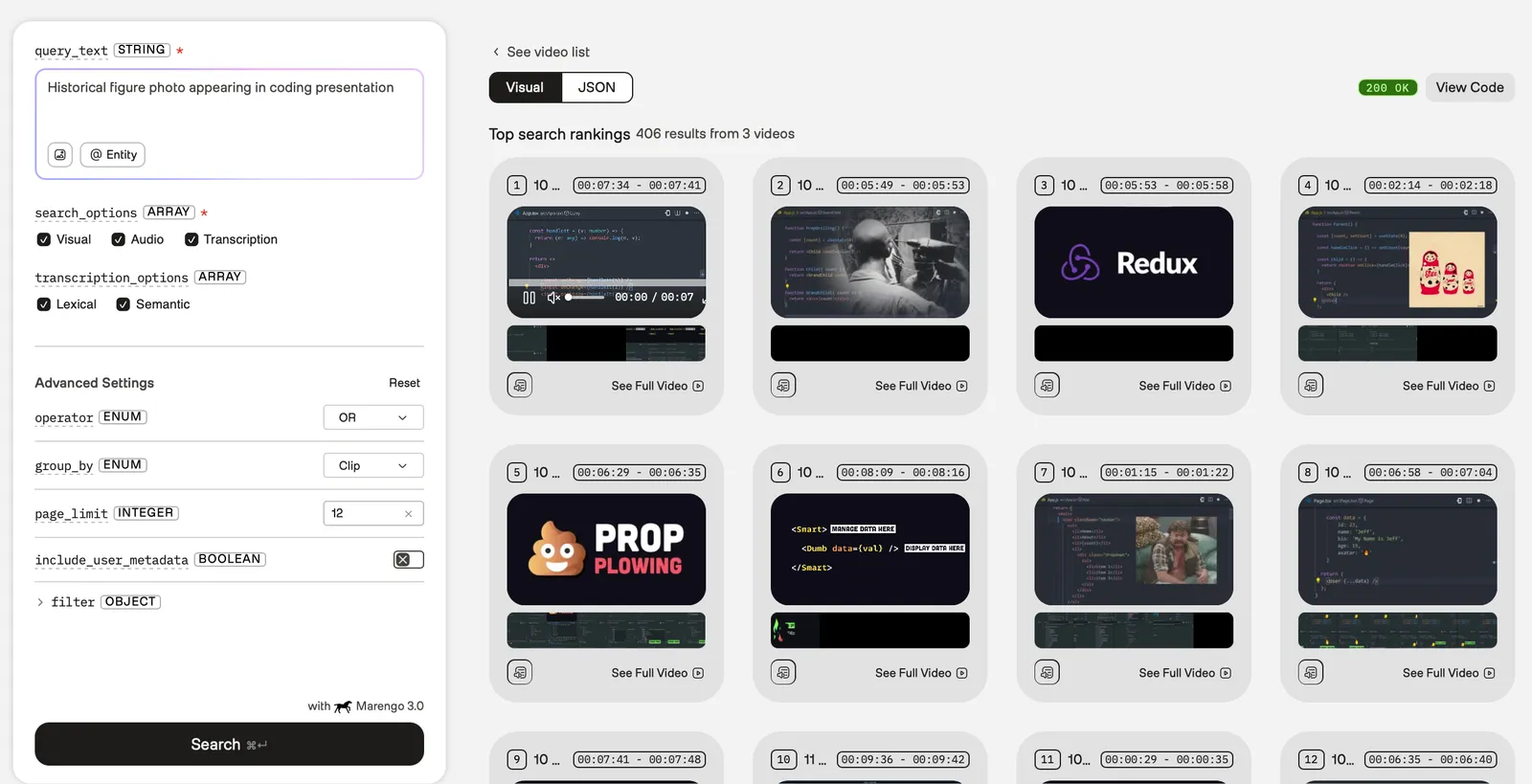
Marengo-powered Playground: natural-language video search results.
Marengo

Index and retrieve video by meaning.

Expose moments that old metadata cannot describe.

Mimir / Fonn Group

Keep AI search inside the media system

Mimir integrates natural-language and image-based retrieval inside its media asset interface.

Mimir integrated TwelveLabs so users can search by meaning and discover scenes inside its interface.

What changed? +

Finding archive footage relied on adequate tags or someone’s memory of its contents.

Mimir is an integration partner and product user; this is not evidence naming every downstream broadcaster.

GS SHOP

Shopping clips read as buying signals

Ordering customers up 57.5 percent, conversion rate up 29.4 percent, unique clicks up 21.7 percent, average watch time from 6.3 to 8.0 seconds.

GS SHOP connected TwelveLabs video understanding through Amazon Bedrock, read 30 second clips as intent signals for recommendations and found a scene described in detailed Korean in seconds.

What changed? +

Finding a scene in a one hour broadcast tape took one to two hours, and an in-house model was ruled out over the cost of data labeling, GPU infrastructure and specialist staff.

TwelveLabs case study page, undated, from 2026; results are the company's write-up of the customer's numbers, and Korean press described the gain with other measures.

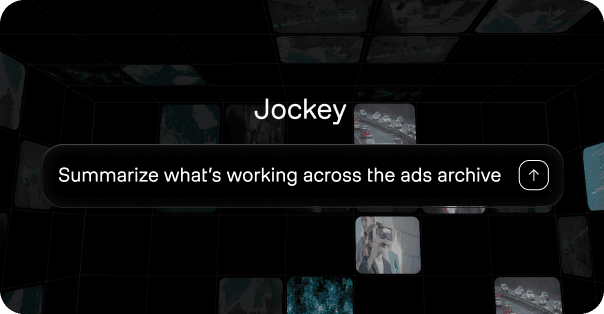
Jockey interface: the question "Summarize what's working across the ads archive" typed over a wall of video tiles.
The bet in one screen, from the TwelveLabs homepage: a plain question asked of a whole video archive through Jockey, the company's video agent.
02 / HOW IT BECOMES REAL

From an archive query to usable timestamped footage

This illustrative editor journey follows Mimir’s verified integration and TwelveLabs’ model roles. It treats models as part of a media workflow rather than a finished broadcast.

  1. 01

    Create a semantic layer for footage

    Marengo converts audiovisual content into embeddings. The archive can be searched by what appears and happens rather than only a manually entered tag.

  2. 02

    Describe the scene the story needs

    An editor searches in ordinary language inside Mimir. Relevant moments surface from content and meaning even where tagging is incomplete.

  3. 03

    Turn the sequence into metadata

    Pegasus provides video-language analysis and structured temporal segments. An application can request fields useful for archive, editing or review.

  4. 04

    Bring chosen moments back into production

    Mimir keeps content in the existing media workflow. Human editors decide what to use, while the intelligence layer reduces the search burden.

Follow the work, step by step

Video is the record nobody can search

TwelveLabs starts from a problem familiar to anyone who has hunted for one clip in a drive full of footage. Keyword search reaches titles, tags and descriptions, but not what happens inside the video. The CEO, Jae Lee, told TechCrunch in December 2024 that most organisations will not assign people to sift through their video archives. So footage piles up, and finding a moment depends on someone remembering where it is. The company's own estimate of how much of the world's data is video varies by speaker and month, from over 80 percent in June 2026 to upwards of 90 percent in July 2026, so read it as a claim about direction.

The world does not happen in text. It happens in motion.

Jae Lee · Co-founder and CEO · Founder letter on the company blog, Series B announcement · 2026-07-01

The belief that sets TwelveLabs apart is about where understanding comes from. In the July 2026 letter Lee calls language how humans compress reality after the fact, useful but lossy, and says most AI systems are trained on that compression while TwelveLabs chose to build on the signal. The release the same day puts it in one line: "Not language models watching video, but models born in video." In 2024 he described the difference as focus: for TwelveLabs, video is "not an add-on" to a general model.

Why the bet looks different in 2026

Three things changed between the start, about five years ago, and today. Attention: in November 2025 co-founder Soyoung Lee said she saw a lot of innovation in large language models and in video generation such as Sora, but not in video understanding, and the CTO, 이승준, had called the moment an inflection like text AI before ChatGPT. Money: $50M in June 2024, $30M from strategic investors in December 2024 and a $100M Series B in July 2026. Distribution: the models are sold through Amazon Bedrock, and a June 2026 interview with its head of strategic partnerships noted that customers often already keep the data they want analysed on AWS.

What winning looks like is stated plainly. The founder letter sets the goal "to make every second of video addressable, searchable, and usable by agents". In December 2025 Lee said he wants TwelveLabs to index a large part of the world's video within four to five years. Note the word agents: the job postings expect software, not only people, to become the main reader of video, and the company builds for that reader.

One archive, four steps

Follow an illustrative newsroom editor, based on the company's integration with Mimir, a media asset management system. First the archive is indexed: Marengo, the embedding model, turns sight, sound and speech into numbers that capture meaning. Then the editor asks in ordinary language inside Mimir, and time-coded moments come back even where tags were thin. CBS News and Stations runs this pattern at scale; a CBS executive said at IBC2026 that about 800,000 hours were already digitised and that 4,000 hours were ingested in one week, a record.

Next, Pegasus, the video-language model, cuts whole videos into segments on a schema the customer defines and fills structured fields, so results flow into archive, editing or compliance systems. Last, the chosen moments go back into production, and a person decides what airs. In the CBS project, Soyoung Lee said TwelveLabs creates the metadata and is "not actually an application or an interface that end users are able to access". At RAISE Summit she described the judgment of good content as a human task.

The evidence that these models beat general ones is the company's own: Pegasus 1.5 against Gemini 3.1 Pro on tests TwelveLabs designed, Marengo 3.5 against Google and Amazon embedding models. The homepage's "+13.1%" over Gemini equals the gap between two scores, 0.4555 and 0.3243, a difference in points rather than a 13.1 percent gain. In an interview, ask how customers measure quality.

Each step maps to open Korea roles: Marengo indexes, Pegasus structures, and the platform roles keep the chain running for enterprise customers. The bet pays only if those steps hold up on hours of video, not clips.


Understand the products and their customers

Three products, priced by the hour

TwelveLabs sells understanding of video in parts. Marengo, the embedding model, makes footage searchable. Since Marengo 3.5 in August 2026 it places video, audio, images, text and documents in one shared space and meters each kind of input separately. Search with Marengo 3.5 is available through Jockey. The separate Developer Search pricing lists $2.50 to index an hour of video once, $0.09 per hour per month for embeddings infrastructure and $4 per 1,000 searches. In September 2026 Marengo became the first video model in Amazon Bedrock's managed knowledge base, so an AWS customer can switch on video search inside a service it already uses.

Pegasus, the video-language model, reads a video and writes about it. Version 1.5 in April 2026 changed its job: instead of answering one question about a clip, it cuts an entire video of up to two hours into segments on a schema the customer defines and returns structured fields for each, and a URL is enough to start. Version 1.6 on 6 October 2026 added first-person footage from body cameras and robots and reads images with the same prompts. The list price is $1.75 per hour of input video plus output tokens. For Segment, billed input duration is the selected video window, or the whole video if no range is set, multiplied by the number of segment definitions in the request. Analyze bills the window alone.

Jockey sits on top. It is an agent that splits a question, retrieves with Marengo, segments with Pegasus and reasons across thousands of videos, keeping a memory of the customer's archive, then returns timestamped cuts. Because it runs on models the company owns, each release improves it without customers re-integrating. In June 2026 the company introduced Rodeo, its first application for editors and creators, in a pilot phase; a partnerships executive said it "came at the request of customers".

Who has bought it, and what was measured

The clearest named case is Korean. GS SHOP, a home shopping company selling through TV, data broadcasting and mobile live commerce, connected TwelveLabs through Amazon Bedrock and read 30 second clips as signals for recommendations. The company's case page reports 57.5 percent more ordering customers, a 29.4 percent higher conversion rate and 21.7 percent more unique clicks, and says finding a scene in a broadcast tape went from one to two hours to seconds. GS SHOP had weighed building its own model and dropped the idea over labeling, GPU and staff costs. These are TwelveLabs' figures for its customer, and a Korean newspaper later described the gain with other measures.

Abroad, Maple Leaf Sports & Entertainment in Toronto is the sports case the company repeats: video search and retrieval that took 16 hours takes 9 minutes. UNICEF Korea Committee shows another route to market. A Korean integrator, Letsur, built its archive system on TwelveLabs APIs, indexing about 200 hours and 2TB of video from an 8TB store, and the case page reports 95 percent less time to find content. SBS has a published plan to search special effects scenes with Marengo 2.7 and summarise clips with Pegasus 1.2. Sejong City uses the models to help CCTV operators find incidents across thousands of feeds, with face and biometric recognition removed.

Why partners carry the product

Look at how customers arrive. GS SHOP came through Amazon Bedrock, UNICEF Korea through Letsur, CBS News through Mimir. TwelveLabs sells a layer that other systems call, so clouds, integrators and media software carry much of the selling. That shapes the engineering work too: the models must perform inside someone else's system, at someone else's scale and price.

This chapter maps onto the open Korea roles. The Pegasus research scientist and machine learning engineer work on Segment and its serving; the Marengo staff research engineer owns the embedding model and its production API; the infrastructure engineers build the multi-tenant setup that enterprise customers run on across AWS, GCP, Azure and on-premises.

03 / THE EVIDENCE

The story, in numbers.

DATED OBSERVATIONS

Developers using the platform

developers
Developers using the platform2023-10-24: 17,000 developers; 2024-12-12: 30,000+ developers17,000 developersOct 202330,000+ developersDec 2024

Developers using the TwelveLabs platform, from individuals experimenting to enterprises, as the CEO gave the figure to TechCrunch at each date. It counts developer accounts, not paying customers. These are dated disclosures, not a continuous growth record.

Figures, dates & basis +
Developers using the platform
DateValueBasis
2023-10-2417,000 developersCEO's figure in an email interview with TechCrunch: 17,000 developers since the private beta opened in early May 2023.
2024-12-1230,000+ developersCEO's figure in an interview with TechCrunch: more than 30,000 developers, from individuals to large enterprises.

TechCrunch

Series A

Raised $50M for team and model development.

Infrastructure partnerships

Strategic funding connected video models to major enterprise data ecosystems.

Series B

Raised $100M as the company expanded toward an agentic video system.

Read the growth story

Paid by the hour, the query and the contract

TwelveLabs earns money when customers run video through its models. Developers pay as they go: by the hour of video indexed, by the month to keep it searchable, per thousand searches and per token for analysis, after a free tier of up to 10 hours of indexing; free indexes expire after 90 days. Enterprises sign committed-use contracts at custom prices and can ask for private or self-managed deployment. Much of this reaches customers through partners: Amazon Bedrock and AWS Marketplace, Databricks and Snowflake through their vector databases, and media systems such as Mimir.

The money figures with dates are the funding rounds: $10M from Nvidia, Intel and Samsung Next in October 2023, bringing the total to $27M; a $50M Series A in June 2024; $30M from strategic investors in December 2024, for a total of $107.1M; and the $100M Series B on 1 July 2026, which SiliconANGLE put at more than $207M raised in all. Funding is capital to spend, not revenue. On revenue, the CEO has described shape and speed: in July 2026 he said a large part comes from US and European business customers and that developer-driven revenue grows 80 to 120 percent a year.

The dated numbers and what each one measures
WhenNumberWhat it measuresBasis
Oct 202317,000Developers on the platform since the private beta in May 2023CEO, to TechCrunch
Oct 2023$10M; $27MStrategic round; total raised to datePress-reported
Jun 2024$50MSeries A funding, co-led by NEA and NVenturesCompany-disclosed
Dec 2024$30M; $107.1MStrategic funding; total raised to dateCompany-disclosed; press-reported
Dec 202430,000+; 73Developers using the platform; full-time employees, company-wideCEO, to TechCrunch
Dec 2025More than halfShare of customers in media and entertainmentCEO, Korean press interview
Jul 2026$100M; more than $207MSeries B funding; total raised to dateCompany-disclosed; press-reported
Jul 202680 to 120% a yearGrowth of developer-driven revenueCEO, Korean press interview
Jul 202680%; 60%+R&D share of the Korea office; Korea headcount growth since March 2025Korea head, Korean press interview

What has grown, and where

Developers on the platform went from 17,000 in October 2023 to more than 30,000 in December 2024, both by the CEO's count, when the company had 73 full-time employees. In November 2025 Soyoung Lee described the base as thousands of developers and hundreds of enterprise customers. In December 2025 the CEO said most revenue and customers were in North America and that media and entertainment made up more than half. The newest market shows its scale in one customer: a US robot-learning data company asked for at least 7.3 million hours of video analysis a year, and TwelveLabs says it tokenized hundreds of thousands of hours for it within 24 hours. In Seoul, the Korea head said she weighs the slope of growth over today's revenue size, with a goal of growing threefold over last year.

Who it competes with, and three risks

TwelveLabs competes with much larger companies on two fronts. General-purpose multimodal models from Google and OpenAI can already watch video; Lee's answer in 2024 was that they "aren't optimized for video". Cloud providers also sell video tools and embedding models, Amazon among them, which is also TwelveLabs' investor, preferred cloud and a main sales route. The company's own tests put Pegasus 1.5 ahead of Gemini 3.1 Pro and Marengo 3.5 ahead of Gemini Embedding 2 and Amazon Nova. Signet reads three risks from this: larger labs closing a gap measured by the company itself, one cloud partner that is also a competitor, and most revenue in North America and more than half of customers in media and entertainment while robotics and Korean manufacturing are only starting.

In an interview, keep three kinds of number apart: capital raised (the $100M Series B), growth rates (80 to 120 percent a year for developer revenue) and usage (developers, hours of video). Each measures something different from annual revenue. If asked how the business is doing, the safe sentence is the CEO's own: developer revenue growing 80 to 120 percent a year, with a large part of revenue from US and European business customers.

04 / THE PEOPLE

Someone saw it first.

Photograph of Jae Lee.
Co-founder & CEO

Jae Lee

Lee holds a UC Berkeley degree in Electrical Engineering and Computer Science and leads a company with a significant Seoul presence.

The choice behind the company +

The funding releases explain a video-first multimodal approach and distribution through enterprise infrastructure partners.

“The world does not happen in text. It happens in motion.”

Jae Lee · Founder letter on the company blog, Series B announcement · 2026-07-01
The decisions behind the company

Five engineers who ended up in media

Jae Lee is the co-founder and CEO. TechCrunch describes him as a data scientist by training to whom basic search never made sense for video, since keywords reach titles and tags but not the content of a clip. He recruited peers to build something better: Aiden Lee, SJ Kim, Dave Chung and Soyoung Lee. A Korean newspaper describes the five founders as Korean, with the company headquartered in San Francisco and its core research and development in Korea. The name comes from the size of the first team, twelve people. Soyoung Lee, co-founder and head of go-to-market, explains the turn: "we have five co-founders but we come from a tech background and not a media background", and by the second year they found themselves working a lot with media companies.

Models commoditize. The intelligence layer that composes them does not.

Jae Lee · Co-founder and CEO · Series B press release · 2026-07-01

Four decisions explain the company's shape. Video only: Lee told TechCrunch in 2024 that video deserves the company's "sole focus". Own the models: TwelveLabs trains Marengo and Pegasus itself and builds its agent on them, and the line above says where Lee expects value to sit, in the layer that composes models. Go through the biggest cloud: the company says it was "born on AWS", named AWS its preferred cloud in 2026 with a multiyear commitment that includes optimising its video inference on AWS Trainium chips, and launches new models there first. And build research in Seoul: in December 2024 it hired Yoon Kim, a former SK Telecom CTO, as President and Chief Strategy Officer, splitting his time between San Francisco and Seoul.

The leaders a Seoul hire will meet

For the open Korea roles, the leaders who matter sit close to the work. SJ Kim, a co-founder, leads Pegasus engineering. His test for a model is one question, whether it is actually used, and he says the Korean machine learning team owns the full cycle from data design to training, serving and release. Kian Kim leads Pegasus research and co-wrote the Pegasus 1.5 technical post; he says his team's research priorities all come from product impact. The CTO, 이승준, fronted the 2025 Seoul hiring push for senior ML engineers. 이혜민 (Hyemin Lee) joined in March 2025 as Korea head for the Korea and Asia-Pacific market.

Our Korea MLE team is fully glocalized. One team owns the whole cycle, from data design to training, serving and general availability.

SJ Kim · Co-founder and Pegasus engineering lead · Company Korean blog interview; English rendering of the published Korean text · 2026-03-20

How the company says it works and hires

The careers page lists three values: unwavering conviction, pioneering spirit and unbreakable discipline, on a foundation of acting with care. The job postings add a method. Foundation models, search and the agent sit in one organisation that, like a Formula 1 team, optimises "for the global system, not local parts", and teams share work in progress weekly. In Seoul, engineering and research work in pods, small teams built around one goal, and SJ Kim says decisions happen inside the team, without waiting across time zones. Members of the Pegasus 1.5 team called the release schedule tight; one researcher remembers going home at 7 a.m. on a Saturday after a training run failed on Friday.

On the fear that Seoul only executes, the sources split. The Korea head describes the model directly: important decisions and product and business direction are set together at the global level, and the Korea team executes fast. The Pegasus leads describe more room: one Seoul team owns a model from data to release, and the research lead wants everyone on his team to work like a CEO and to say so when a decision does not help the company. Both can hold: direction is global, model ownership sits in Seoul.

05 / THE NEXT CHAPTER

Build production video ML from Seoul

The Seoul roles build Pegasus and Marengo, serve and evaluate them in production, operate enterprise infrastructure and meter internal AI-model use.

LOCAL & REGIONAL LEADERSHIP

이혜민 (Hyemin Lee)

Korea head, Korea and Asia-Pacific market

Model research and engineering
  • ML Research Engineer
  • Staff Backend Engineer
  • ML Data Engineer
  • Builder of Pegasus

Roles observed in Korea-filtered public profiles.

Go-to-market and customer engineering
  • GTM Lead APAC
  • Staff Solutions Architect
  • Product Partnerships
  • Marketing

Some headlines describe APAC responsibilities from Korea.

People and recruiting
  • Head of People & Culture APAC
  • Recruiting

People-team and recruitment functions observed in public profiles.

Published market leadership and observed profile functions are set out in the Korea chapter.

Why Korea? Why now?+

TwelveLabs is headquartered in San Francisco, but a Korean newspaper's interview with the CEO describes its five founders as Korean and its core research and development as done in Korea. The sources give three reasons for that base, in order of weight. Talent comes first. The company hired a former SK Telecom CTO, Yoon Kim, as President in December 2024, and the CEO said Kim "will also give us a unique talent advantage in South Korea"; it ran a Seoul hiring push for senior ML engineers in February 2025; and by July 2026 the Korea office was 80 percent R&D and had grown at least 60 percent in headcount since March 2025. Capital and partners come second. Korea Investment Partners, SK Telecom and NAVER Ventures are all investors, NAVER Ventures co-led the Series B, and the CEO says TwelveLabs works with NAVER as one team on the national AI foundation model project. The market comes third and is the newest: GS SHOP, SBS, UNICEF Korea Committee and Sejong City are named customers, and in October 2026 the CEO pointed Korean demand at safety and process work in car, chip and shipbuilding plants. The Korea head adds her own reason: large language models already have dominant US players, but video understanding has none yet, so Korea has a second chance.

A Korean investor from the start

Korea Investment Partners is named among the existing investors in the $50M Series A.

SK Telecom invests and a President splits time with Seoul

SK Telecom joins the $30M strategic round, and former SK Telecom CTO Yoon Kim becomes President and Chief Strategy Officer, dividing his time between San Francisco and Seoul.

K-AI Alliance

TwelveLabs joins SK Telecom's K-AI Alliance, then 25 companies. SK Telecom says it invested $3M in 2024 and works with TwelveLabs on video understanding for its personal AI agent.

A Seoul hiring push

A two week drive seeks senior data and ML infrastructure engineers, ML research engineers and research scientists with 5+ years of experience.

A Korea head joins

이혜민 (Hyemin Lee) joins to lead the Korea and Asia-Pacific market.

Into Amazon Bedrock

Korean press reports TwelveLabs as the first Korean company, and the first video understanding model, listed on Amazon Bedrock.

Pegasus 1.5, built in Seoul

The company publishes how its Seoul team, organised in pods, built Pegasus 1.5 on a tight schedule.

NAVER Ventures co-leads the Series B

NAVER Ventures, whose first ever investment was TwelveLabs, co-leads the $100M round with NEA, and the company commits to keep investing in Seoul.

Seoul is 80 percent R&D

The Korea head says 80 percent of the Korea office works in R&D and headcount has grown at least 60 percent since she joined.

A Korean market plan

The CEO names Korea's target market: safety and process improvement on manufacturing floors in cars, chips and shipbuilding.

Understand the Korea opportunity

A research base first, a market second

TwelveLabs is headquartered in San Francisco, but a Korean newspaper's interview with the CEO describes its five founders as Korean and its core research and development as done in Korea. The clearest reason in the sources is talent. When the company hired Yoon Kim, a former SK Telecom CTO, as President in December 2024, Lee said Kim "will also give us a unique talent advantage in South Korea". A Seoul hiring push for senior ML engineers followed in February 2025. By July 2026 the Korea head said 80 percent of the Korea office worked in R&D and headcount had grown at least 60 percent since March 2025. The company lists two Korean sites, an office in Yongsan-gu, Seoul, and one in Pangyo.

US big tech already took the lead in the LLM race, but video understanding has no dominant player yet, so I think Korea can create another opportunity.

이혜민 (Hyemin Lee) · Korea head, Korea and Asia-Pacific market · Interview with Yonhap News; English rendering of the published Korean text · 2026-07-31

Korean capital and partners came early and stayed. Korea Investment Partners was already an investor at the 2024 Series A. SK Telecom invested $3M in 2024, joined the December 2024 strategic round, brought TwelveLabs into its K-AI Alliance in January 2025 and works with it on video understanding for its personal AI agent. NAVER Ventures made TwelveLabs its first ever investment and co-led the 2026 Series B, and the CEO says the company works with NAVER as one team on Korea's national AI foundation model project.

Customers, and the team that runs Korea

Korean customers span commerce, broadcasting, the non-profit sector and public safety: GS SHOP, SBS, UNICEF Korea Committee through the integrator Letsur, and Sejong City. In October 2026 the CEO named the next Korean market: safety and process improvement on manufacturing floors in cars, chips and shipbuilding. The Korea head, 이혜민 (Hyemin Lee), joined in March 2025 and leads the Korea and Asia-Pacific market. She describes the split plainly: important decisions and product and business direction are set at the global level, and the Korea team executes fast. She also wants the Seoul office seen as a place to do global-level AI work, not only a revenue outpost.

Every one of the seven open Korea roles on the employer's board on 8 October 2026 is in engineering or research. Three build models: Senior ML Research Scientist, Pegasus; Senior Machine Learning Engineer, Pegasus; and Staff ML Research Engineer, Multimodal Structure & Marengo. Four build the ground they run on: Senior Platform Engineer, Staff Infrastructure Engineer, Senior Infrastructure Engineer and Token Engineer, the last of which meters and controls how the company's own researchers and engineers use AI models. Read together, the postings say the Seoul hires are for making models and keeping them running for enterprise customers.

What the Korea hiring asks of you

The roles share three demands. Ownership: the platform posting wants incidents chased across layers to the root cause, and the research roles want people who set direction on loosely defined problems. Production: model work is judged on what ships, which matches SJ Kim's test of whether a model is actually used. And English across time zones: the platform and infrastructure postings prefer English communication, and the Pegasus research lead names the time zone as the hardest part, since a simple question to San Francisco can take 13 hours to answer and one conversation can run past a day.

Honestly, it may not suit someone who only wants to do basic research.

Kian Kim · Pegasus research lead · Company Korean blog interview; English rendering of the published Korean text · 2026-03-27

On the fear that the Korea office is a satellite: Seoul is 80 percent R&D, it built Pegasus 1.5, it grew at least 60 percent in headcount between March 2025 and July 2026, and the Series B release commits to continued investment there. The risk to weigh is different: direction is set globally, most revenue comes from North America, and a simple question to San Francisco can take 13 hours to answer.

If you join, the work is building or running video models in production. Pick the group that matches your record, Pegasus, Marengo or the platform beneath them, and prepare one system you owned end to end.

KOREA OPEN ROLES

7 open roles in Korea

Current Signet catalog · 2026-10-19

FOR YOU

Choose among seven model and platform roles by work you have shipped.

Engineering · AI

Senior Backend Engineer, Forge

Seoul, South Korea

Posting checked

The work
Build APIs, identity, organizations and billing for the Forge developer platform.
Who fits
5+ years in backend engineering and leadership of technical decisions/projects in fast-changing environments.
Keep in mind
Seoul-based hybrid work. Must be eligible for overseas travel; all hires have a three-month probation at 100% salary.
Engineering · AI

Senior Frontend Engineer, Forge

Seoul, South Korea

Posting checked

The work
Build video-AI and agent experiences for Playground and Jockey App.
Who fits
5+ years in frontend development, leading production web-app design, launch and operation.
Keep in mind
Seoul-based hybrid work. Must be eligible for overseas travel; all hires have a three-month probation at 100% salary.
Engineering · AI

Senior Infrastructure Engineer

Seoul, South Korea (Hybrid)

Posting checked

The work
Build and operate reliable cloud infrastructure.
Who fits
Cloud infrastructure build and operations in AWS, GCP, Azure or similar.
Keep in mind
Multitenant infrastructure, compliance-audit experience and 7+ years are preferred.
See all 7 roles
Engineering · AI

Senior Machine Learning Engineer, Pegasus

Seoul, South Korea (Hybrid)

Posting checked

The work
Build and operate production Pegasus ML systems.
Who fits
Software-engineering and ML foundations and experience shipping production ML systems.
Keep in mind
Inference optimization experience, including batching, caching or quantization, is preferred.
Engineering · AI

Senior Platform Engineer

Seoul, South Korea (Hybrid)

Posting checked

The work
Build developer platforms and resolve production root causes.
Who fits
Production cloud systems and Linux, networking, containers and Kubernetes.
Keep in mind
Own investigation through rollout and root-cause improvements; 7+ years is preferred.
Engineering · AI

Staff Infrastructure Engineer

Seoul, South Korea (Hybrid)

Posting checked

The work
Design and run multi-tenant enterprise infrastructure.
Who fits
Cloud infrastructure build and operations in AWS, GCP, Azure or similar.
Keep in mind
Multitenant infrastructure, compliance-audit experience and 12+ years are preferred.
Engineering · AI

Staff ML Research Engineer, Multimodal Structure & Marengo

Seoul, South Korea (Hybrid)

Posting checked

The work
Own Marengo models, training, structure and production APIs.
Who fits
At least seven industry years in computer vision, video understanding or multimodal learning.
Keep in mind
Evidence pairs publications with shipped products.
07 / NOW & NEXT

The next scene is taking shape.

Video-first research funded

$50M Series A supported model and team development.

Enterprise data ecosystem investment

$30M strategic financing included major data and infrastructure companies.

Agentic video architecture

The Series B release described perception, knowledge and reasoning together.

More context on what comes next

Recent capital, model and market signals

Recent announcements add three threads to the company's thesis. The first is capital and the cloud. The $100M Series B on 1 July 2026 came with a deeper AWS partnership, a promise that new models launch first on AWS, and new offices in New York and London. On 10 September Marengo became the first video model in Amazon Bedrock's managed knowledge base.

The second is the pace of models. Marengo 3.5 arrived on 31 August 2026 with per-input pricing and the former four-hour cap removed for asynchronous video and audio ingestion; other file, upload, rate and task-processing limits still apply; Pegasus 1.6 followed on 6 October with first-person video and image reading. The third is a new market. On 30 September a post co-written by Yoon Kim, whom the company named President in 2024, said the first test of video intelligence for physical AI is robotics, where public datasets show 70 to 155 annotator hours of hand labeling per hour of first-person footage. Two days later the CEO described a US robot-learning data customer asking for at least 7.3 million hours a year, and a Korean plan aimed at factory safety.

How the threads tie back to the bet

Each thread tests the same bet from a different side. Robot footage is the purest case of video as data that machines, not editors, must read, and Pegasus 1.6 is the Pegasus team's first answer to it. The AWS route tests Lee's claim that the composing layer, not the model, is what lasts, since Amazon also builds models.

What to watch over the next year

  • Whether robotics data and Korean manufacturing turn into named, paying customers beyond the first US data company.
  • Whether outside tests back the company's own benchmark lead over Gemini and Amazon Nova.
  • Whether the Seoul team keeps the pace of Marengo 3.5 and Pegasus 1.6, five weeks apart, while it fills the seven open Korea roles.

Signet's reading: for a Seoul candidate, Pegasus 1.6 is the most direct signal. The model the Pegasus roles work on now reads first-person robot footage, so data, evaluation and serving for that kind of video are a likely part of the next quarter.

Their future. Your next chapter.

Find your part ↑

An independent profile by Signet. No affiliation or investment recommendation. Introductions happen only with your consent.
Research reviewed 2026-10-10

A LITTLE MORE CONTEXT

Understanding TwelveLabs.

What does TwelveLabs do?

A newsroom may own years of footage but still depend on someone remembering the right clip. TwelveLabs builds models that make sight, sound and motion searchable and turn video into structured information.

What is the opportunity in Korea?

The Seoul roles build Pegasus and Marengo, serve and evaluate them in production, operate enterprise infrastructure and meter internal AI-model use.

Are these confirmed job openings?

Employer postings were checked on 2026-10-10. Availability can change. Mock applications request a review from Signet.

How can I explore the company in more depth?

Follow the company from its vision through products, evidence and people to the Korea team and current roles. Use the table of contents to move within the page, and expand the sections for more context.

Back to the collection ↗